How Bed and Breakfasts Can Make Money From a Small Retail Corner
Your guests are already relaxed and in a buying mindset. Here is how a small retail corner turns that attention into income with scan-to-pay checkout, live stock tracking, and automatic split payouts, and no inventory to buy.
Your guests are already in a buying mindset. They're relaxed, away from home, surrounded by a property they find charming. A small retail corner converts that attention into bed and breakfast retail income without asking you to become a shopkeeper.
The friction most B&B owners picture is real but fixable. Stock costs, payment terminals, staff time at checkout, these concerns stop the idea before it starts. Here's the truth: none of them apply when the setup is built correctly. A Retail Widget combines a printable scan-to-pay QR checkout with live stock tracking and automatic split payouts. It removes every one of those barriers.
You carry no inventory and buy no stock. Makers supply their products on a placement basis. Guests scan a QR code to buy. Settlement happens automatically between you and the maker. No till, no manual transfer, no new hire.
This guide covers where to position your retail corner, which products work, how to find local makers, how scan-to-pay checkout works in practice, and how to track income without adding a shop system. You can also start with the broader picture of earning from unused shelf space to understand the full model before you build it.
Why Bed and Breakfasts Are Ideal Retail Hosts
The case for B&Bs as retail hosts is stronger than it looks. It comes down to five structural advantages that most hospitality formats simply don't share.
Captive audience. Guests stay at least one night, often two or three. They walk the same corridors, sit in the same breakfast room, linger in common areas at a pace retail windows can't manufacture. Physical retailers spend significant money to create dwell time. You already have it built in.
Trust advantage. Guests who choose a B&B over a chain hotel are seeking character, locality, and curation. They trust the host. When you place a local honey or a hand-thrown mug on a shelf, guests interpret that as a recommendation. That implied endorsement converts differently from an anonymous product on a supermarket shelf.
Low retail competition. Your guests aren't comparing your retail corner to a nearby boutique. They're often in a village, a coastal town, or a countryside property where local products are genuinely hard to find. Scarcity is a sales condition.
Existing infrastructure. You already have electricity, Wi-Fi, surfaces, and foot traffic moving through a defined route each morning. A retail corner needs a shelf, a card holder for the Retail Widget QR code, and a guest with a phone. Infrastructure cost is minimal.
No stock risk. This point changes the economics entirely. Because makers supply products on placement terms, you hold no purchase liability. If a jar of preserve sits for two weeks unsold, you return it or the maker collects it. Your cash is never tied to it.
The same model runs in other hospitality formats. See how cafes apply the same model and hotels monetising lobby space for evidence that the mechanics transfer across settings.
Choosing the Right Spot in Your Property
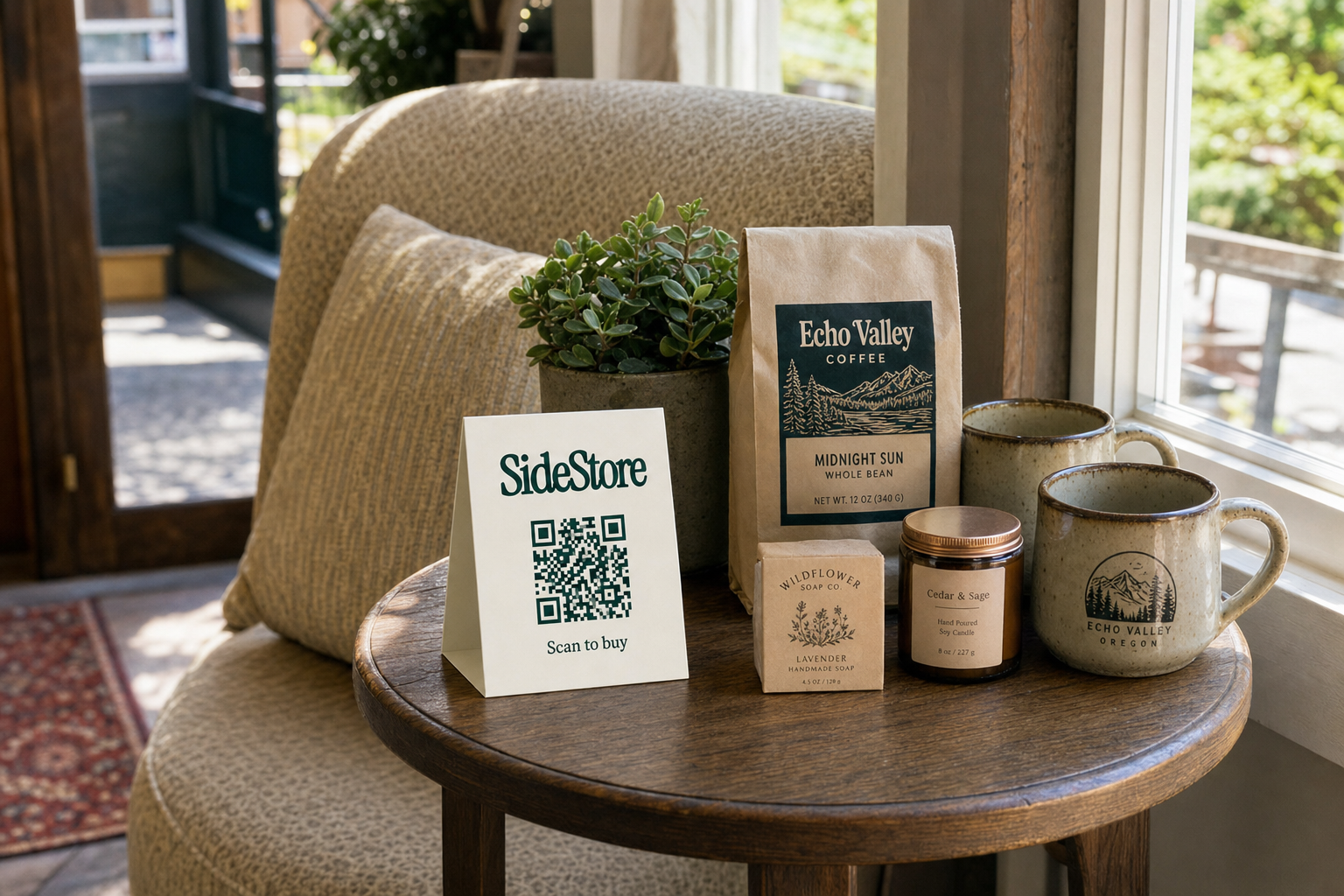
Location inside the property matters more than shelf size. A beautiful display in the wrong place earns nothing. Placement in a natural traffic pinch point earns steadily.
Map where guests slow down. Three locations merit serious consideration.
The breakfast room. Guests spend 20 to 45 minutes here each morning. A shelf or small table along one wall, within eyeline from seated positions, captures that dwell time. Keep the display within 1.5 metres of the nearest guest table so products are close enough to read without standing.
The check-in desk or entrance hall. This is a transition moment. Guests have just arrived, they're curious about their surroundings, they haven't yet settled into room mode. A tidy display on a console table or windowsill, roughly 30 to 40 centimetres deep and no more than 60 centimetres wide, fits without crowding a working space.
The corridor outside guest rooms. Less obvious, but effective in properties where guests pass the same point repeatedly. A wall-mounted shelf at eye height, approximately 150 centimetres from floor level, works well. Keep it to four or five products maximum so it reads as curated rather than cluttered.
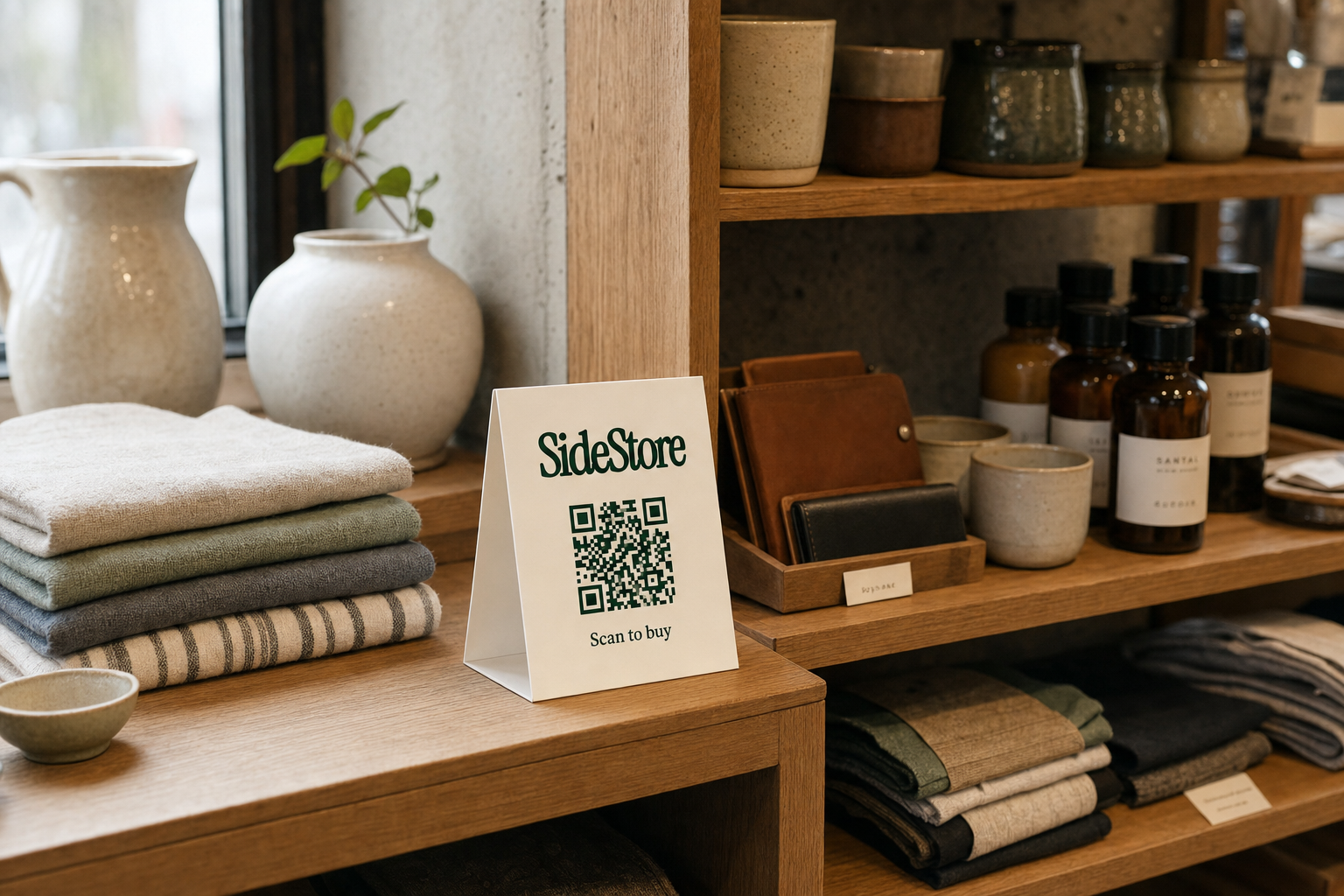
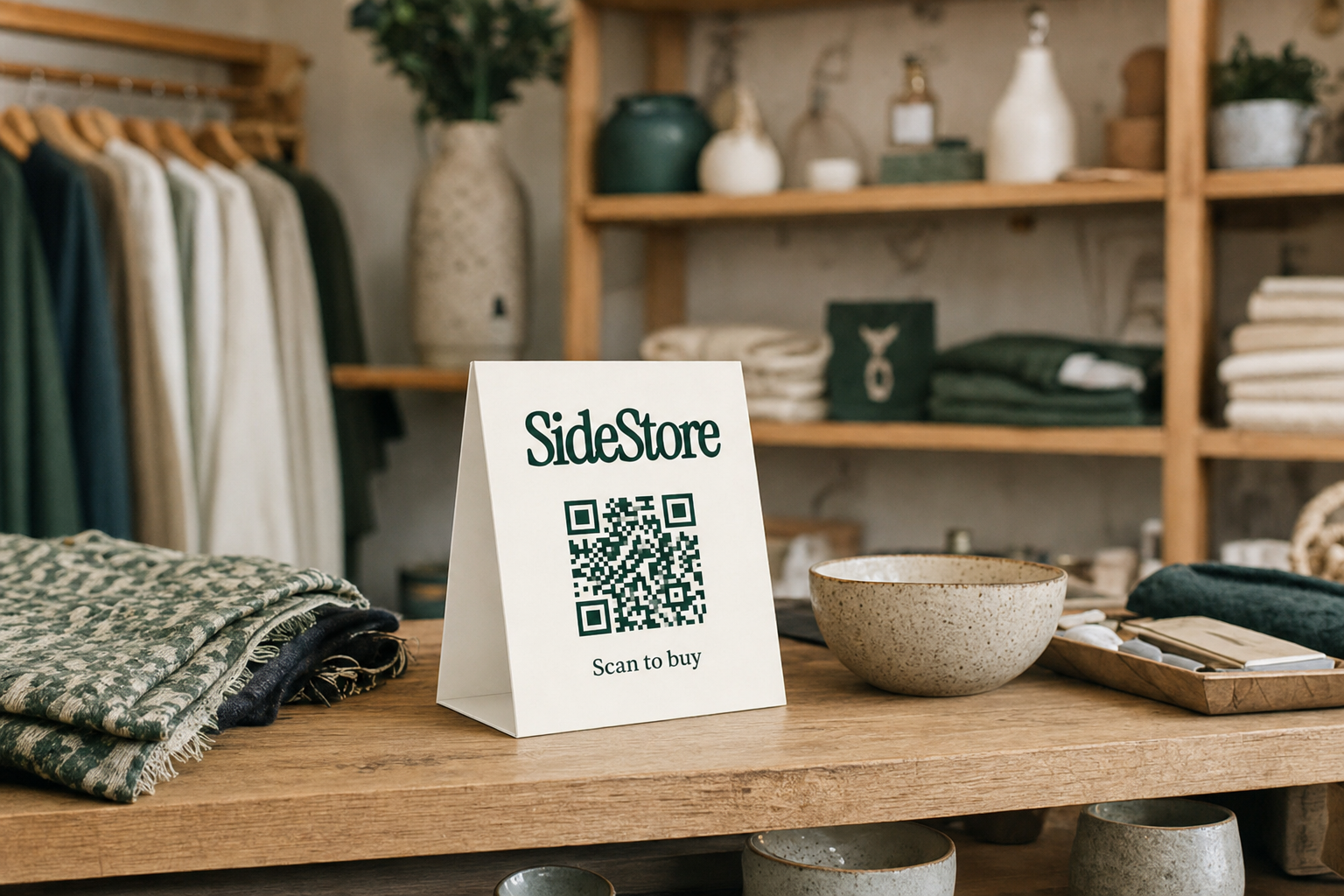
In every location, the Retail Widget QR code card should stand at the front of the display, unobstructed. Guests need to see it without searching. A small acrylic card holder or a branded card tent both work. The code should be large enough to scan from 30 centimetres away without leaning.
Good sight lines matter. If a guest has to step around furniture to reach the display, you lose the sale. Clear a direct path.
Which Products Sell Well in a B&B Setting
Product selection is the difference between a display that earns and one that collects dust. The principle is straightforward: choose things that feel native to the property and useful to someone travelling.
Start with 8 to 15 SKUs. Fewer than eight and the display looks thin; more than fifteen and it becomes difficult to scan quickly. Guests in a B&B setting make impulse decisions, not considered ones. A tight, curated range closes faster than a broad one.
The strongest categories tend to be consumables and small carry items. Local jams, honey, infused oils, and handmade chocolates sell consistently because they're edible souvenirs guests can't find at home. Handmade soaps and small candles work because they fit in a suitcase and smell of the place. Greeting cards and small art prints by local artists sell to guests who want a lightweight memento.
Avoid anything fragile without protective packaging, anything over roughly 40 CHF unless the product is clearly explained, and anything that requires demonstration or a size decision. Clothing with sizing is difficult. Skincare with ingredient lists needing reading is slow. Keep the buying decision simple enough to complete in under 90 seconds.
For sourcing ideas beyond your immediate contacts, see how boutiques source local products without buying inventory. The same sourcing channels apply: local markets, maker directories, regional craft fairs.
Price pointing matters. Products in the 8 to 30 CHF range tend to convert well in hospitality settings. Below that, guests may not notice. Above it, the purchase requires more justification than an impulse moment provides.
How to Find Local Makers to Fill Your Shelf
Finding makers is easier than most B&B owners expect. The channels already exist; you're simply entering them with a specific offer.
Start local and visible. Weekend farmers' markets, regional craft fairs, and independent food festivals are full of makers who sell direct because they have no other retail channel. Approach them after the market closes, when they're packing up and willing to talk. Your pitch: their product in a curated B&B setting, sold to guests actively looking for local things, with no fees to join and no risk to the maker.
Local food and craft directories, regional tourist board listings, and Instagram accounts tagged to your town or county are equally productive. A direct message to a maker with ten followers costs nothing and often lands well because larger retail opportunities aren't yet reaching them.
When you approach a maker, frame the conversation from their perspective. They get placement in a high-trust hospitality setting. Their products reach an audience that's already left home to discover the area. They receive their share of every sale automatically through split settlement. They don't need to invoice you, chase payment, or visit the property to collect a cheque.
The split settlement mechanism is the key point to name clearly. SideStore handles the payout automatically. A typical arrangement gives the maker 70 to 80 percent of the sale price, with the remainder going to you as the host. Neither party touches a spreadsheet or initiates a bank transfer.
That arrangement is the foundation of the full shelf-space monetisation model. Present it plainly and most makers will say yes quickly.
Setting Up Scan-to-Pay Checkout With a Retail Widget
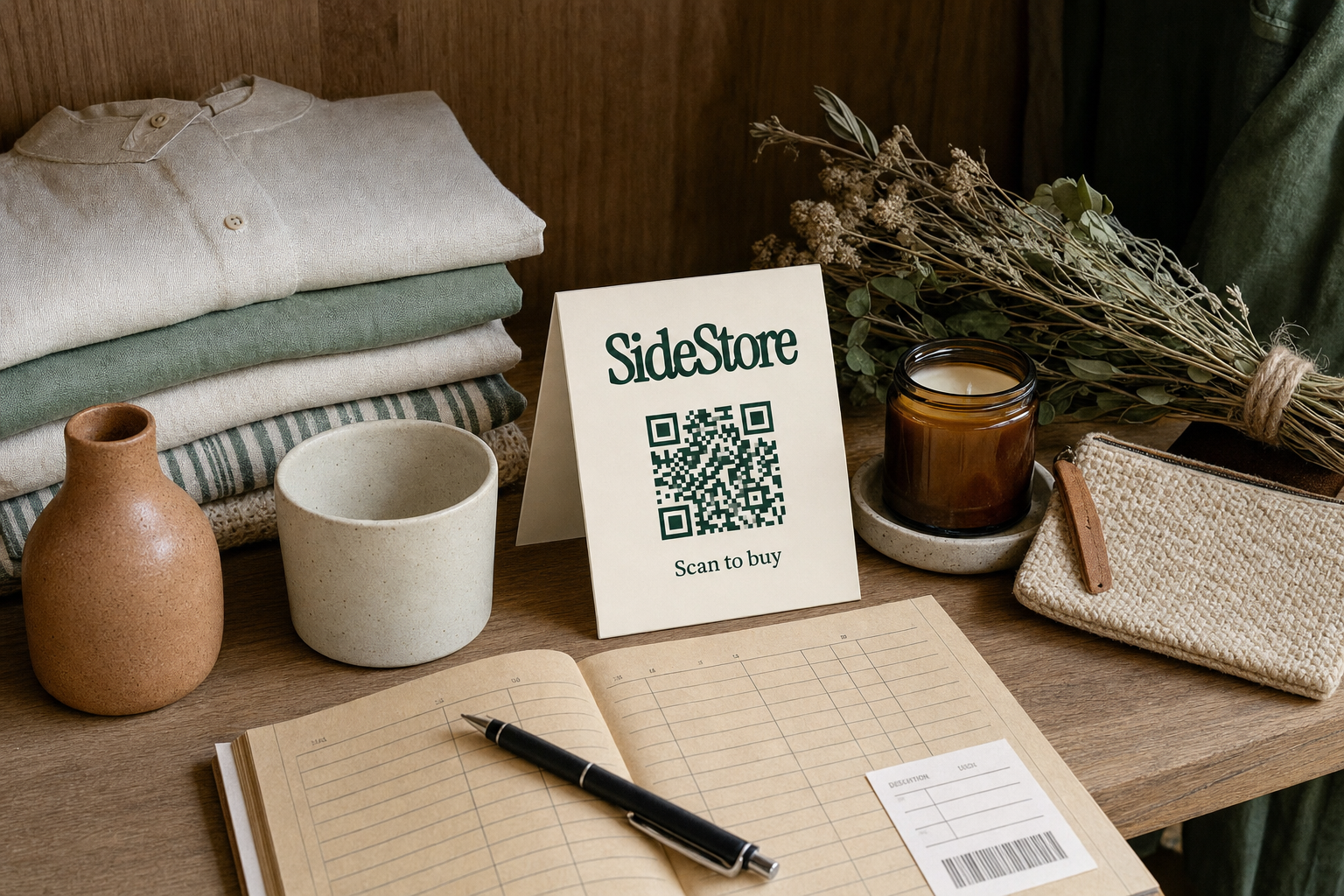
A Retail Widget is a deployable commerce unit: a printable QR checkout card paired with live stock tracking, placement attribution, and automatic split payouts, all managed from one dashboard. Print it, place it next to the product, and the widget handles the rest.
The guest checkout flow is short.
- Guest picks up or examines the product.
- Guest scans the QR code on the Retail Widget card using their phone camera.
- A product page loads with the item name, price, and a buy button.
- Guest completes payment using Apple Pay, Google Pay, or a card.
- Stock count updates automatically and both host and maker receive their share of the sale.
No app download required. No staff member needs to be present.
The theft concern comes up in almost every conversation about unmanned retail. Address it honestly: low-price items in a trusted, identity-linked guest environment carry very low theft rates. B&B guests have checked in with a name and payment details on file. The social contract of being a guest in someone's home is a stronger deterrent than most people assume. Many hospitality operators using this setup report no meaningful shrinkage after the first few weeks.
On the back end, the Retail Widget records each scan, each completed purchase, and each payout. Stock levels adjust in real time. When a product reaches zero, the widget signals that to your dashboard.
What you don't need: a card terminal, a till, a point-of-sale system, a staff member stationed at the display, or a manual process to transfer the maker's share. The entire checkout and settlement layer runs without your involvement after the initial setup.
Tracking Your Income and Stock Without a Shop System
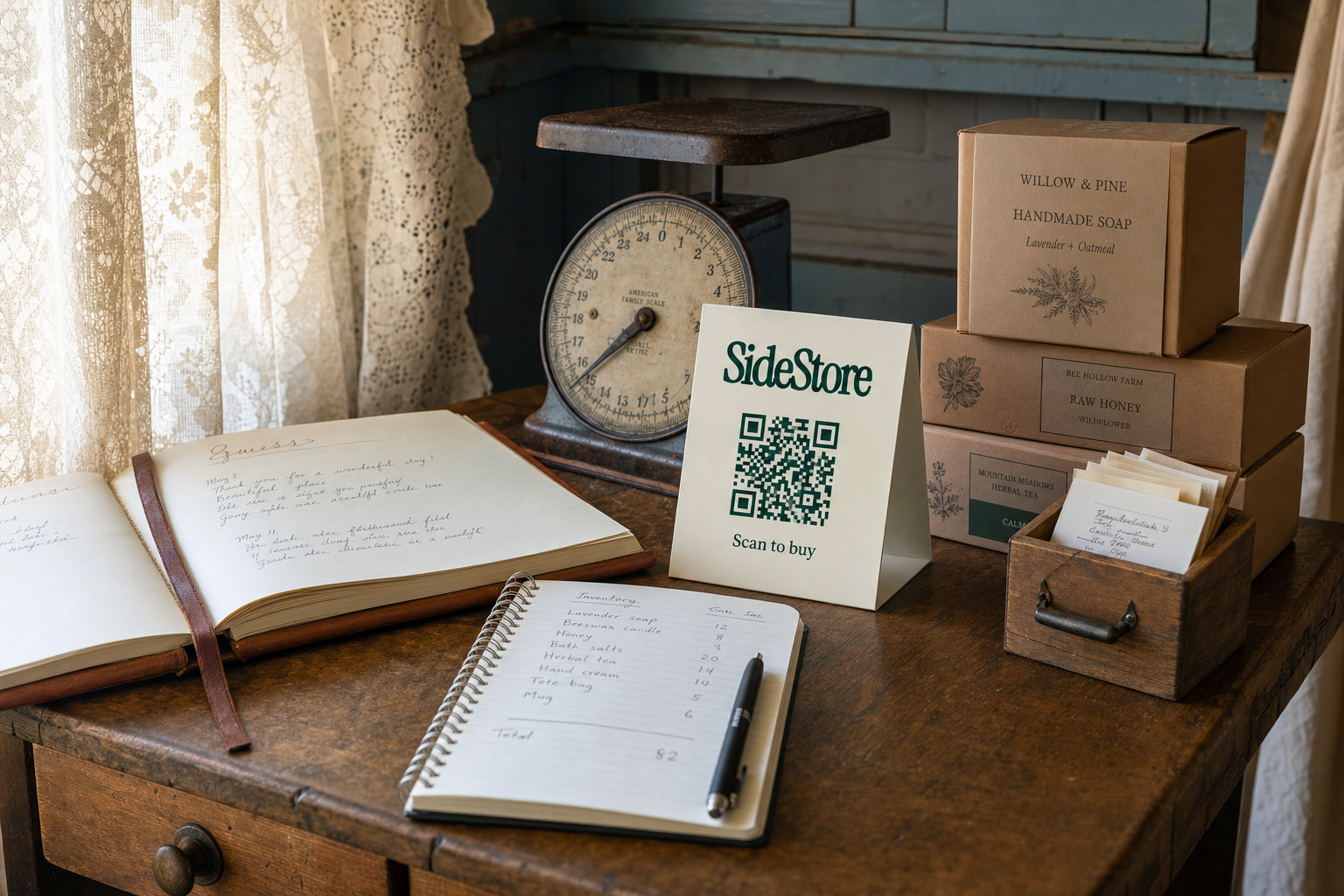
Traditional consignment arrangements require manual stock counts, handwritten logs, and regular reconciliation meetings. None of that applies here.
Placement attribution means that each Retail Widget is tagged to a specific location in your property. If you run two displays, one in the breakfast room and one in the entrance hall, the dashboard shows you which location is generating which sales. You don't need to guess or cross-reference receipts.
Live stock tracking updates each time a sale completes. You can check current levels from your phone at any point, which means restocking conversations with makers happen based on actual data, not a walk around the property. When a maker asks how their product is moving, you send them the number from the dashboard rather than estimating.
Payout visibility is equally direct. You can see your host earnings per placement, per product, and per time period. There's no mystery about what you've earned or when it arrives.
This contrasts sharply with the traditional consignment model, where income is opaque until the end of a billing cycle and disputes about stock levels are common. The operational difference is significant.
For context on how properties managing more than one placement point keep this organised, see how high-traffic retailers manage multiple placements. The same dashboard logic scales from one shelf to many.
Growing Your Retail Corner Over Time
Start with one location and one shelf. This isn't a hedge, it's the correct operating principle. A single display with eight to ten well-chosen products gives you clean data on what sells, what sits, and which spot on your property generates the most engagement.
After four to six weeks, the data tells you what to do next. If the breakfast room display sells consistently but the corridor shelf doesn't, you add a second breakfast room display rather than trying to rescue the corridor. Expand based on what's working, not on what feels ambitious.
If you operate more than one property, the same dashboard covers all locations. Each Retail Widget is attributed to its placement, so your income breakdown stays clear even across multiple sites. A second B&B, a holiday cottage, a rented room in a separate building, each becomes a placement node in the same network.
Seasonal rotation is worth building into your calendar from the start. Guests arriving in winter want different things than summer visitors. Swapping four or five SKUs at the start of each season keeps the display feeling fresh and gives you a reason to reconnect with makers about new products.
The long-term opportunity described in the full B&B retail corner guide is a distributed retail network built from placements you already have capacity for. You don't need new premises. You need a consistent approach to filling and managing the shelves you put in place today.
A Retail Corner Is a Revenue Line, Not a Project
The model is simple. You have space guests already move through. Local makers have products and no retail channel. A Retail Widget connects them: scan-to-pay checkout, automatic split settlement, and a dashboard that shows you exactly what is selling and what you've earned.
Entry costs are low. You carry no stock. You hire no one. You install a shelf and a QR card.
The practical steps are covered above, but the starting point is straightforward: register on SideStore, contact two or three local makers, and go live with your first display within a week.
If you want to see how other hospitality settings run the same model, read how cafes run the same model or boutiques adding local products without stock risk.
Set up your first Retail Widget and start earning from the space you already have.