How Hotels Can Turn Lobby and Reception Space Into Retail Revenue
Your lobby is full of dwell time you are not monetizing. Here is how a curated shelf of local maker products, activated by a Retail Widget, earns commission on every sale with no stock to buy and no staff time required.
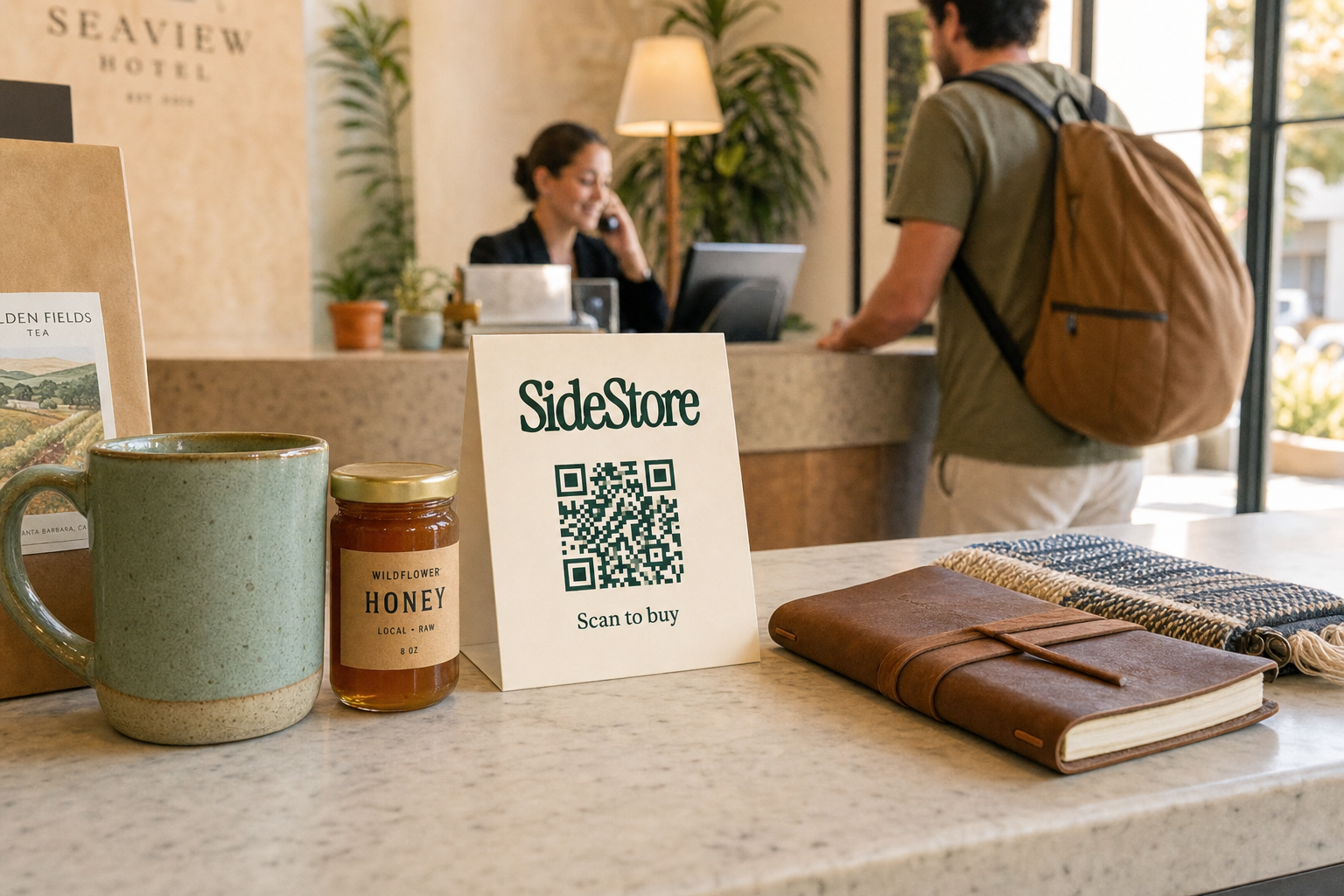
Your hotel lobby sees dozens, sometimes hundreds, of guests every day. They check in, they wait, they browse. That dwell time is commercial attention, and most hotels leave it completely unmonetized.
The traditional gift shop model requires buying stock, managing inventory, hiring staff, and absorbing unsold product. For most properties, that overhead kills the margin before it starts. You know the math: a shelf full of merchandise gathering dust while your front desk handles returns and inventory counts.
There is a different model. By placing a curated shelf of local maker products in your lobby, activated by a Retail Widget, you earn a commission on every sale with no stock to buy, no staff time required, and no financial exposure to unsold goods. The maker handles the product. The Retail Widget handles checkout and payouts. You provide the space.
This guide walks through why hotel lobbies are natural retail environments, which products perform well, how scan-to-pay checkout removes operational burden, and how to go live with your first placement. If you are already curious about the broader opportunity, monetizing unused shelf space is a useful place to start.
Why Your Lobby Is Already a Retail Space, Just Not Earning
Walk through your lobby and look at it with commercial eyes.
Guests queue at reception. They sit in lounge chairs waiting for a room to be ready. They return in the evening with a few minutes to kill before dinner. That is not wasted time, that is dwell time, and dwell time is the raw material of retail.
Hotel guests also arrive in a particular mindset. They are away from their usual routines. They are receptive to novelty. Many are actively looking for something local to take home: a memento, a gift, a small treat that says "I was here." That purchasing intent is already in the room. The question is whether your lobby is set up to meet it.
The old model was a gift shop: a dedicated room or staffed counter, branded merchandise bought at wholesale, managed by a team member whose time costs money regardless of whether a single item sells. You know how this ends. Margins thin quickly. Unsold stock at season's end becomes a write-off. Your team dreads the inventory count.
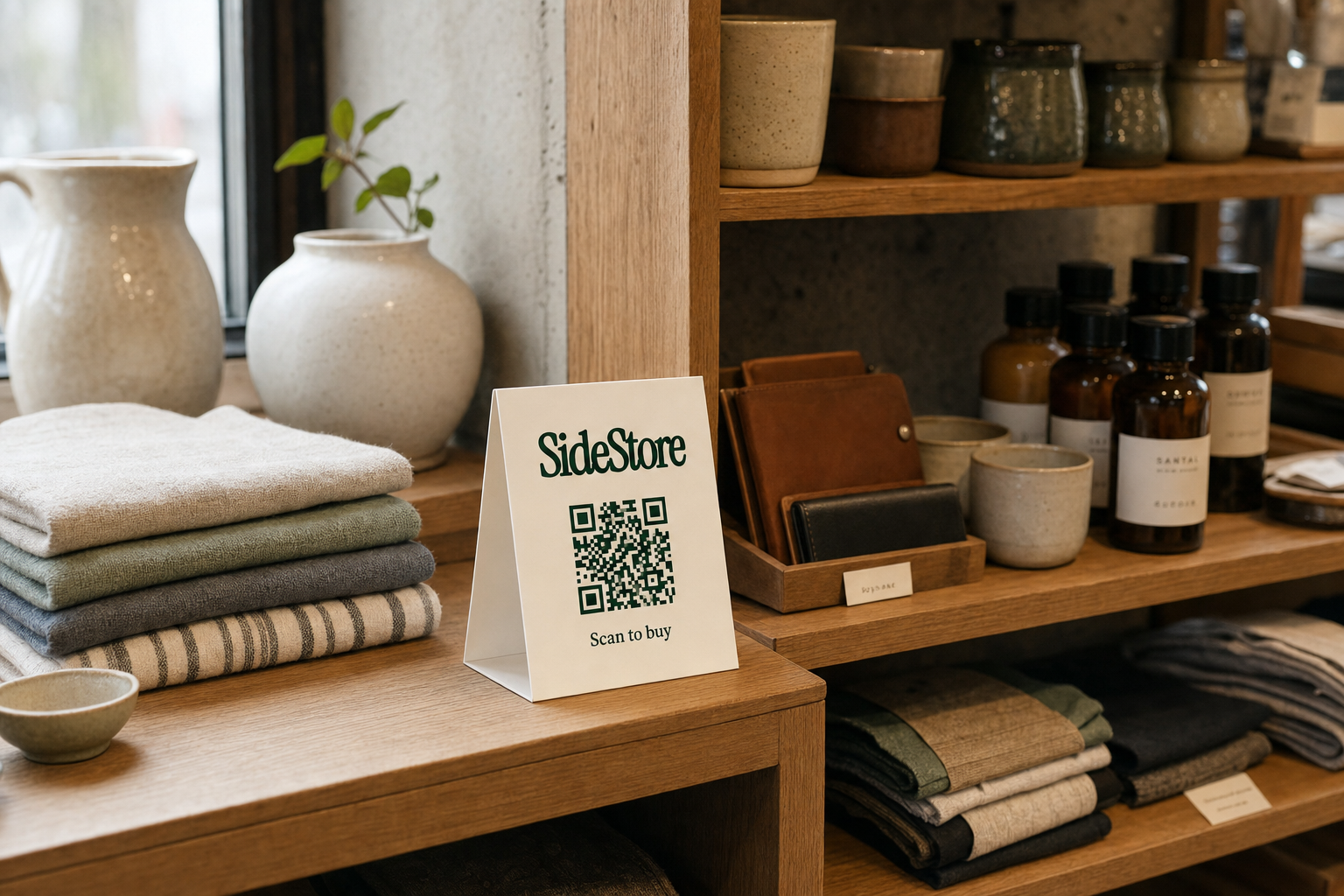
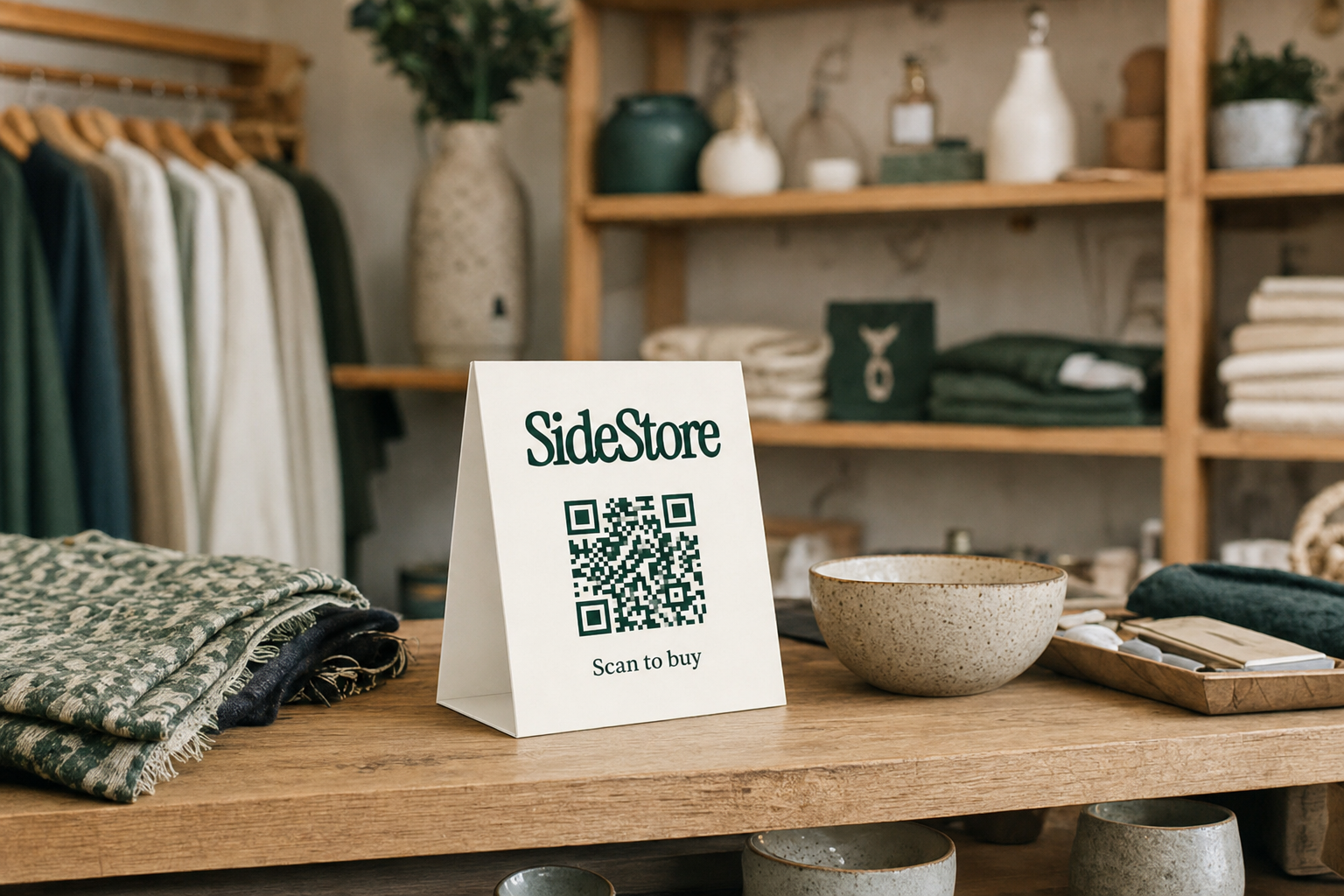
The Retail Widget model works differently. A local maker brings their products to your shelf. A printed QR code on a small display card is the entire checkout mechanism. Guests browse, scan, pay, and take their item. The sale settles automatically. Your commission arrives in your account without a staff member touching the transaction.
Critically, placement attribution means every sale is logged against your specific hotel location. You see exactly which shelf, in which property, is generating revenue. That is not how a gift shop works. Gift shops produce a register total. Retail Widgets produce a data trail, showing you which placements earn and which need refreshing. If you are curious how cafes apply the same model to a counter or shelf, how cafes apply the same model to counter space shows the parallel in a different setting.
Which Products Sell Well in Hotel Lobby Retail
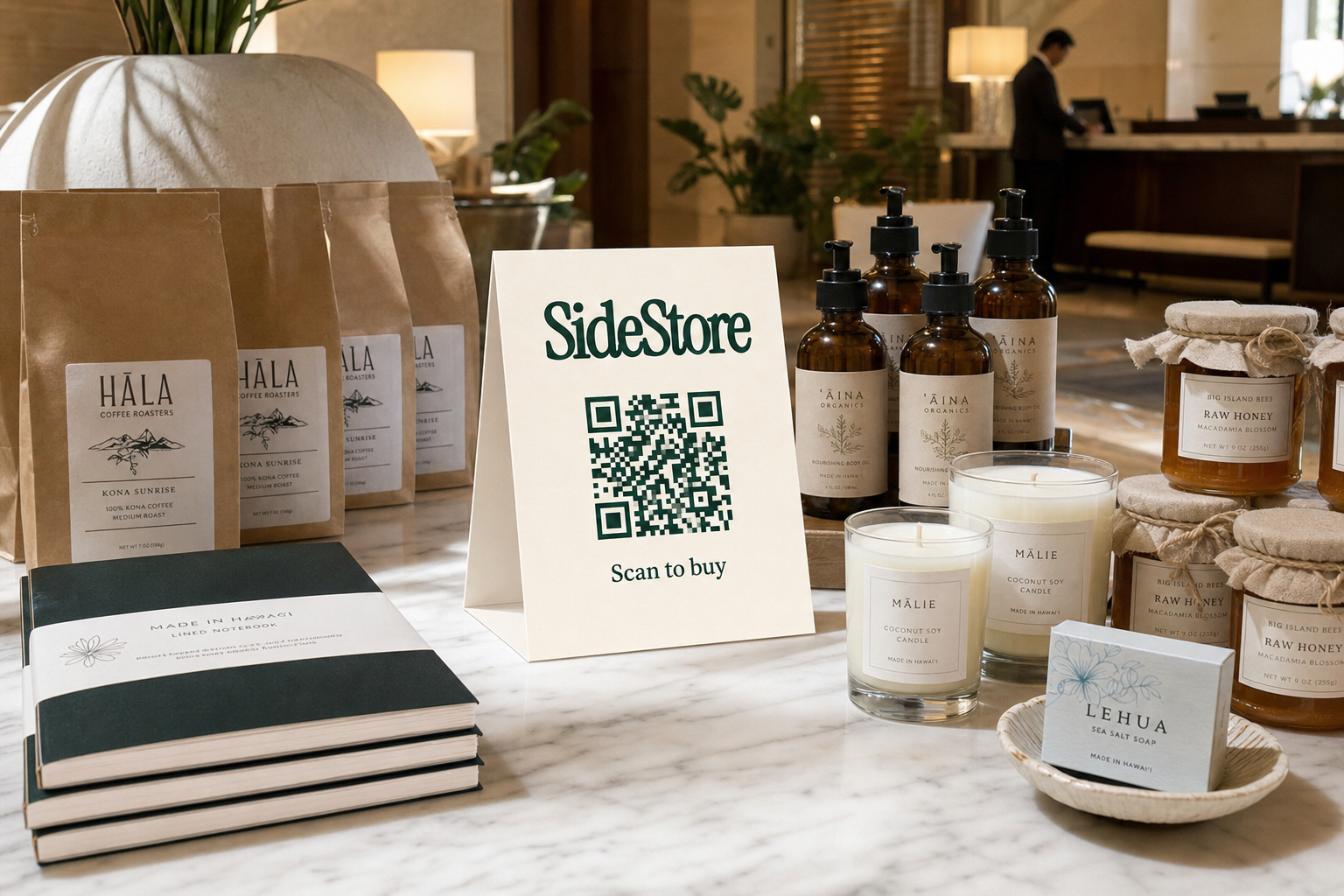
Guest psychology shapes what sells. A traveler standing in a hotel lobby is not in a grocery mindset. They are curious, slightly indulgent, and often motivated by the idea of bringing something local back home. That context gives you a clear filter for product selection.
The strongest performers tend to be small, giftable, and locally made. Artisan candles, handmade soaps, small-batch preserves, locally blended teas, ceramic coasters, illustrated prints of the surrounding area, or handcrafted jewelry at an accessible price. The local origin story matters, guests want something they could not have bought at an airport shop.
On price, aim for roughly CHF 15 to CHF 80. Below CHF 15, the item can feel throwaway and the commission yield is low. Above CHF 80, the purchase becomes deliberate and guests often want time to think, which lobby retail rarely provides. For a hotel in a tourist-heavy area, a CHF 35 to CHF 55 tier often sees the highest scan-to-purchase conversion.
Size is a practical constraint that operators underestimate. Every item on your shelf needs to fit in a guest's luggage. Anything larger than a 25 cm cube becomes a friction point. Fragile items without solid packaging become your front desk's problem. Makers who have thought about travel-ready packaging are immediately more suitable partners.
The local angle is not optional, it is the product's primary selling point. A generic scented candle from an anonymous supplier gives a guest no reason to buy. A candle made by a maker two streets away, with a label that names the neighborhood, gives them a story to tell when they arrive home. How boutique shops curate local products without buying inventory covers the curation logic in detail.
What not to stock: avoid perishables without clear expiry handling, anything requiring size selection (clothing with sizing ambiguity), or products with regulatory complexity (some food items, alcohol). These categories create service questions your front desk team should never have to answer.
How Retail Widgets Handle Checkout Without Your Staff
This is the operational core of the model, and it is worth understanding precisely.
A Retail Widget is a deployable checkout unit for a single product or product line. In a hotel lobby, it looks like a small printed card or label attached to a shelf display. It contains a QR code linked to that specific product, from that specific maker, at that specific location. A guest picks up the item, scans the code with their phone camera, lands on a checkout page, and pays. No app download. No staff interaction. No card reader to manage.
The scan event triggers a chain of automatic actions. Payment processes and logs against your hotel's placement. Stock count decrements by one. If the maker has set a low-stock threshold, they get notified to replenish. Your commission calculates and queues for settlement. This entire sequence completes before the guest has walked back to the lift.
Stock tracking runs continuously in the background. You do not need to check the shelf at the end of each day. The dashboard shows live inventory levels for every product placed in your space. When a maker needs to top up, they do so on their own schedule. Your team's involvement is zero.
Split payout settlement means neither party has to invoice the other. When a sale completes, the split between the maker's revenue and your commission calculates automatically and pays out on the agreed schedule. There is no end-of-month reconciliation spreadsheet. No chasing payments. The mechanics are the same whether you have one shelf or ten.
Compare that to traditional hotel retail operations. A gift shop requires a point-of-sale system, staff to operate it, stock management, supplier relationships, purchase orders, returns handling, and shrinkage management. The Retail Widget model eliminates every one of those operational layers. Your role is to provide a shelf, maintain its presentation, and receive your commission. For properties that want to see how this scales to higher foot traffic, how high-traffic retailers use the same approach at scale is directly relevant.
Setting Up a Hotel Lobby Retail Placement: Step by Step
The process from empty shelf to live placement takes less than a week for most properties.
Start by identifying the right location within your lobby. This is not about finding spare space, it is about finding high-dwell, high-visibility space. The area near the reception desk, a lounge seating cluster, or the corridor between the lift and the front door all work well. You need natural foot traffic and a moment of pause. A corner that guests walk past at speed without stopping is not the right spot, even if it is architecturally prominent.
Curate your initial maker partners before you set up anything physical. Reach out to two or three local makers whose products fit the price range and size criteria. Approach them with a clear offer: their product gets displayed in your lobby, you handle the physical space, the Retail Widget setup handles checkout and payouts. Most makers producing at a local artisan level are actively looking for placement opportunities. You do not need a buying team or a procurement process. How bed and breakfasts set up a small retail corner with the same process shows how small properties handle this outreach simply.
Set up the physical display to match your lobby's aesthetic, not to shout "shop." A small wooden shelf, a piece of reclaimed furniture, or a dedicated surface near existing decor works better than a wire rack that reads as retail. The goal is an extension of your lobby's design, not an interruption of it. Less merchandise, displayed cleanly, outperforms a crowded shelf every time. Think of it like seasoning a dish: restraint is the skill.
Activate the Retail Widget for each product. The maker registers their product on SideStore, generates the Retail Widget for your location, and produces the printed QR display card. You attach it to the shelf display at the point of sale. This is your checkout mechanism. Test the scan yourself before the shelf goes live, make sure the checkout page loads correctly and the product information is accurate.
Monitor the first two weeks actively. Check the dashboard for scan data and sales. If a product is being scanned but not purchased, the price or the product page may need adjustment. Flag this to the maker. If a product is selling but not being restocked quickly enough, set a lower replenishment threshold. Two weeks of live data tells you more about what works in your specific lobby than any amount of prior planning.
How the Revenue Model Works for Hotels
Hotel lobby retail typically operates on one of two commission structures. The right choice depends on your volume expectations and your relationship with the maker.
The first is a straight percentage commission on each sale. The maker sets the retail price. You agree on a commission split, commonly between 20 and 35 percent for a hotel lobby placement, reflecting the premium location and foot traffic you provide. Every time a guest scans and buys, that percentage of the sale value settles to your account automatically.
The second is a flat shelf fee, where the maker pays a fixed monthly amount for the display space regardless of sales volume. This suits makers who want cost predictability and hotels that prefer guaranteed income over variable commission. In practice, a percentage model is more common because it aligns both parties' interests: you both benefit when the product sells well.
To make this concrete: imagine a shelf with four products, each priced at an average of CHF 40. In a month with 150 guests passing through your lobby daily, if 1 percent of daily guests make a purchase, that is roughly 45 sales per month. At CHF 40 per sale and a 25 percent commission, your monthly revenue from that single shelf is CHF 450. That is a conservative estimate, tourist-heavy properties in peak season often see higher conversion, but it reflects a realistic baseline, not a best-case projection.
The structural protection here is zero inventory risk. You have not bought anything. If a product sells slowly, your only cost is the shelf space itself, space you already had. The maker absorbs any slow-moving stock. The full guide to making money from unused shelf space covers the financial mechanics in more depth.
Lobby Retail as a Guest Experience Asset, Not Just a Revenue Line
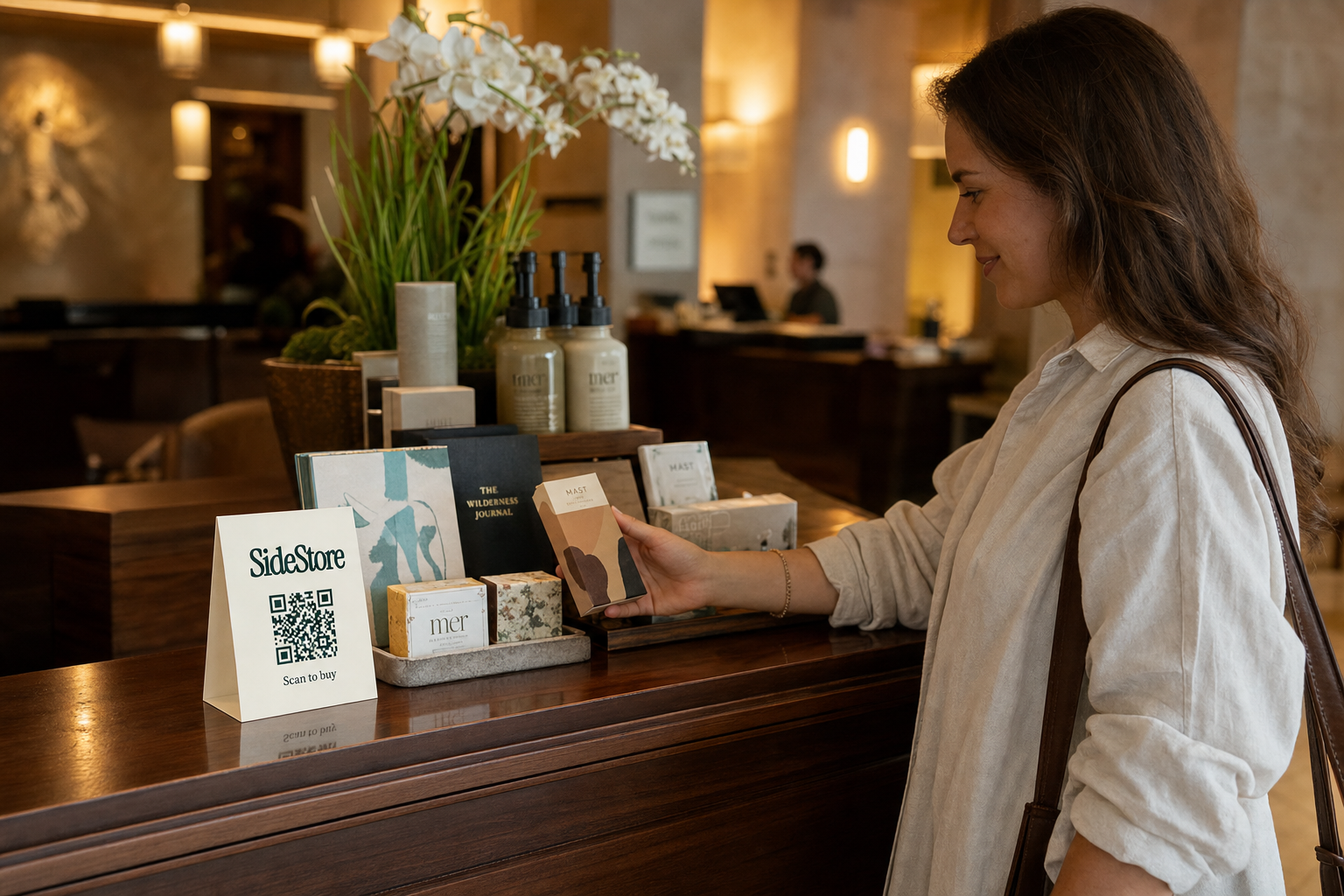
Most hotel operators who think about lobby retail for the first time frame it as a revenue question. The sharper framing is a hospitality question: what does this shelf say about your property?
A well-curated shelf of local maker products communicates that your hotel is connected to its location. It signals taste and editorial judgment, that someone at this property has thought about what the surrounding area produces and has brought the best of it inside. That is a hospitality statement, not a commercial one. Guests notice this kind of attention. It registers.
The aesthetic concern is legitimate. A poorly assembled retail corner, mismatched products, cluttered display, generic merchandise, does damage your lobby's impression. The solution is not to avoid retail. It is to curate tightly. Three well-chosen products displayed with intention look better than fifteen products competing for attention. How boutiques use local curation to strengthen their retail identity shows how this logic plays out in a retail-first context, and it transfers directly to hospitality.
Guests who discover something unexpected and genuinely local in a hotel lobby tend to mention it. In reviews, in conversation, sometimes in photographs. That is not a marketing campaign, it is a natural byproduct of doing something worth noticing. Keep expectations calibrated: a single shelf will not transform your review profile. But it becomes a small, consistent signal that your property pays attention to where it is. That signal accumulates over time.
Scaling From One Shelf to a Distributed Hotel Retail Network
One lobby shelf is a placement. Multiple shelves across multiple properties is a retail network, and that shift is a systems question, not a staffing one.
Consider a hotel group running five properties. Each property activates two shelves: one near reception, one in a lounge or breakfast area. That is ten active placements, each running its own Retail Widgets, its own stock tracking, and its own commission settlement. The dashboard aggregates all ten. You see total revenue, placement-level performance, and which maker products are moving across the network at a glance.
The practical implication is that scaling does not require a proportional increase in operational effort. Adding a third shelf to a property or bringing a new property into the network follows the same setup steps as the first shelf. The makers who perform well at one location are natural candidates for expansion to others.
Placement attribution becomes especially valuable at this scale. You can compare the lobby shelf at a city-centre property against the lounge shelf at a resort, identify which product categories travel across both contexts, and make informed decisions about which makers to deepen relationships with.
How high-traffic retailers manage multiple placement points at scale and how cafes scale shelf placements across multiple locations both illustrate how the same dashboard logic applies across very different venue types. The infrastructure is the same. Only the physical setting changes.
Go Live With Your First Lobby Placement
Your lobby already has the foot traffic. It already has guests who want something local. The only thing missing is an activated shelf.
Pick one location inside your property. Identify one or two local makers whose products fit. Set up your first Retail Widget placement this week. There is no stock to buy, no system to install, and no staff training required. How bed and breakfasts get started with a small retail corner shows how small properties move from zero to live quickly. The full guide to monetizing unused shelf space covers the broader model.
Start with one shelf. The data will tell you what to do next.