How to Sell Photography Prints in Hotels: Turning Guest Rooms into a Gallery
Learn how to sell photography prints in hotels on consignment: pitch templates, split percentages, agreement essentials, and how the Retail Widget manages every placement.
How to Sell Photography Prints in Hotels
Selling photography prints in hotels is the practice of placing your work on consignment inside a hotel property so that guests can purchase directly from the room or lobby, with the hotel earning a share of each sale and you receiving the remainder automatically.
You can do this without upfront stock costs to the hotel and without opening a store of your own. The model is straightforward: you supply the prints, you set the retail price, you agree a consignment split with the property manager, and you handle installation. When a guest buys, the payout is split between you and the hotel.
It sits alongside selling art prints in local shops on consignment as one of the most accessible offline distribution channels for independent photographers. Unlike wholesale, where you discount deeply and hand over stock with no guarantee of payment, consignment versus wholesale makes the risk asymmetry plain: on consignment, you only get paid when something sells, but you never lose stock you were never paid for.
Start with one property. Prove the placement works. Then scale.
Why Hotels Are an Unusually Good Fit for Photography Print Sales
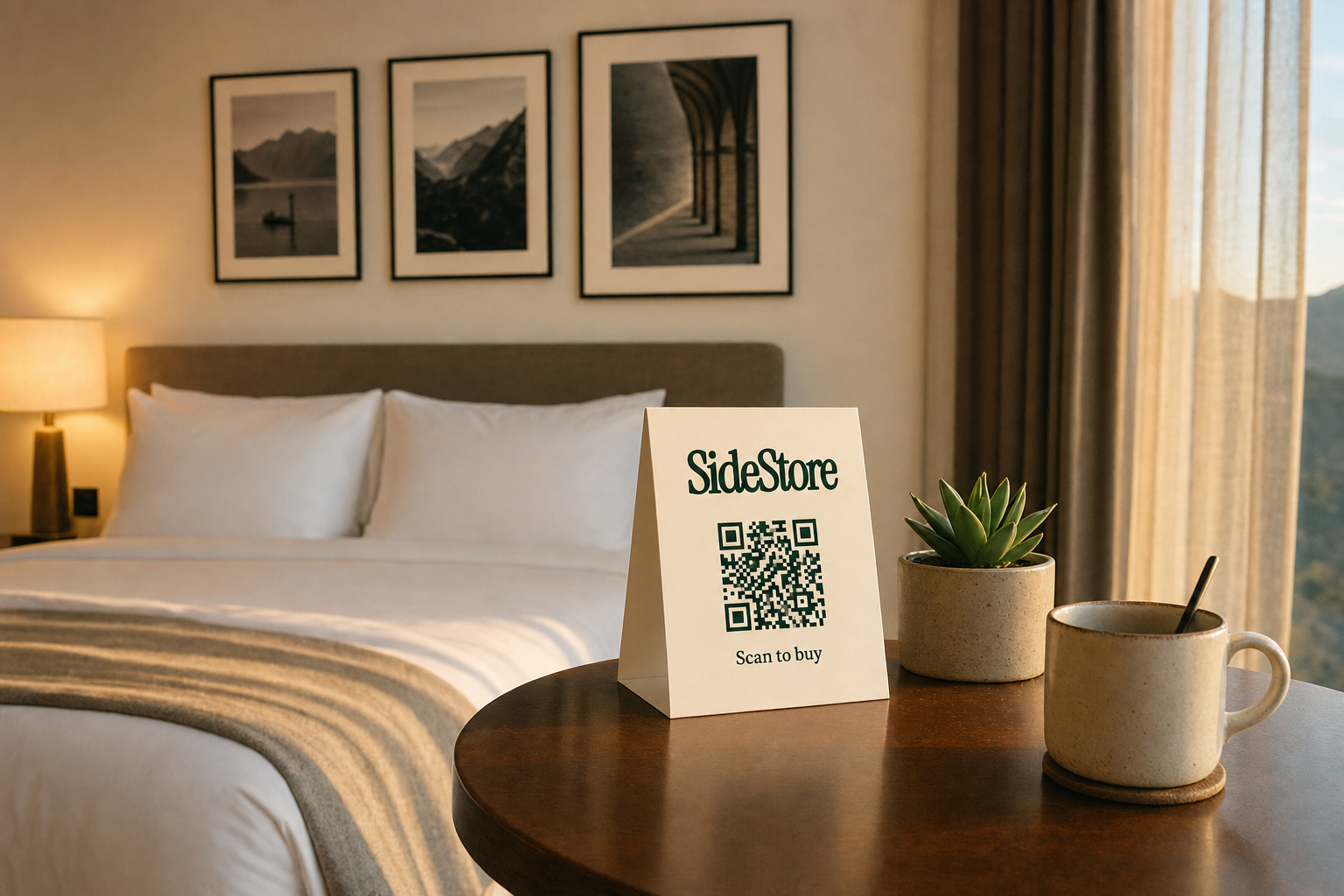
Hotels offer something most retail venues cannot: a captive audience with time, emotional openness, and a credit card already on file with the property.
Think about what a guest is doing in a hotel room. They are not rushing through a shop. They are pausing. They are sitting with a view, eating room service, winding down after a conference day. Dwell time in a hotel room is measured in hours, not minutes. A print hanging above the desk or beside the bed gets looked at repeatedly across a stay. That kind of repeated, unhurried exposure is genuinely rare in retail.
There are three other structural advantages worth naming.
The emotional context is favourable. Guests are often in a celebratory or aspirational mindset: anniversary trips, business travel with an expense account, holidays. That state of mind is more receptive to an impulse purchase of something beautiful than a Tuesday afternoon in a high street boutique.
The purchase is a souvenir with aesthetic value. A print of a local landscape, a city's architecture, or an abstract image connected to the region gives guests a tangible memory of the stay. Hotels understand this instinctively, which is why the pitch to a property manager lands more naturally than you might expect.
The venue earns passively. The hotel does not need to train staff, manage stock, or run a shop. The consignment model means they simply host your work and receive their share when a sale happens. That low-effort payoff is the core of the pitch. Compare this to pop-up retail as an alternative sales channel, which demands your physical presence, or selling prints in cafes, where footfall is high but dwell time is shorter and the purchase context is more transactional.
None of this means every hotel will say yes. But the fit is genuinely good, and the objections are manageable.
How to Approach and Pitch a Hotel Property Manager
The right person to contact is usually the general manager at a boutique or independent property, or the food and beverage or guest experience manager at a larger hotel. Reaching the right decision-maker before you pitch saves significant time.
Some hotels will decline outright. That is not a failure of your work; it is a fit problem. Boutique and design-led independents are your best starting point. Large chain properties have procurement layers that make ad hoc consignment arrangements difficult, though not impossible if you have a warm introduction.
Here is how to structure the approach.
Research the property first. Look at the hotel's aesthetic, its existing room décor, and its brand positioning. A hotel marketing itself on local character is a far easier pitch than a business-travel chain with uniform rooms.
Contact with a one-paragraph email, not a portfolio dump. State who you are, name two or three specific prints you think suit their rooms, and make the no-risk proposition clear in the first sentence: no upfront cost to them, no stock to buy, a percentage of each sale as passive income.
Offer a short meeting or a physical sample visit. Property managers respond better to prints they can hold than to JPEGs in an email. If you can bring a framed sample, do it.
Present the consignment mechanics plainly. Explain how guests buy (scan-to-pay via the Retail Widget's QR function, or a card at the front desk), how stock is tracked, and how payouts work. Remove every operational concern before it becomes an objection.
Propose a trial placement. Offer three to five prints in one room type or the lobby for sixty to ninety days. A limited trial lowers the commitment threshold significantly.
Follow up once. If you hear nothing after seven days, send a brief follow-up. If there is still no response, move to the next property. Persistence beyond that becomes pressure.
For more on the mechanics of selling through someone else's retail space and structuring the initial conversation, and on pitching boutiques and independent retailers with a consignment frame, both articles cover the common objections you will face and how to answer them honestly.
What a Consignment Agreement for Artists Must Cover in a Hotel Setting
A consignment agreement for artists placing work in a hotel must cover six things: ownership, pricing control, split terms, liability, the return process, and the duration of the arrangement.
Without a written agreement, every one of those six things defaults to a verbal understanding, which is unenforceable and genuinely risky when prints go missing or are damaged during a room renovation. Get it in writing, even if the agreement is a single clear page.
Here is what each clause needs to address.
1. Ownership. State explicitly that the prints remain your property until a guest purchases them. This protects you if the hotel closes, changes management, or is sold.
2. Retail price. You set the retail price. The agreement should confirm the hotel cannot discount your work without your written consent.
3. Consignment split. State the percentage clearly: what the hotel receives per sale and what you receive. Both figures should appear as percentages and as a worked example using a round number so there is no ambiguity. Illustrative example: if the retail price is £200 and the split is 70/30, the agreement states you receive £140 and the hotel receives £60 per sale.
4. Liability for loss or damage. Define whether the hotel is liable for prints damaged during cleaning, maintenance, or guest misuse. Many hotels will resist full liability; a realistic clause covers negligence but not fair wear and tear.
5. Return and removal. Specify how unsold prints are returned to you, the notice period required on either side to end the arrangement, and who bears the cost of collection.
6. Duration and renewal. State the initial term (sixty or ninety days is common for a trial) and what happens at the end: auto-renewal, renegotiation, or return of stock.
For high-value placements, have a solicitor or lawyer review the agreement before you sign. The cost of a short professional review is small relative to the value of twenty framed prints hanging in a hotel corridor. For context on how this differs from a wholesale arrangement, see how consignment differs from wholesale agreements.
Consignment Percentage: What Split to Offer a Hotel and Why
The consignment split you offer a hotel will typically land somewhere between 60/40 and 80/20 in your favour, with the exact figure depending on the hotel's contribution to the sale: foot traffic, display quality, staff involvement, and brand association.
These ranges are illustrative, not research-backed benchmarks. Every negotiation is different. Use them as a starting point, not a fixed rule.
| Venue Type | Hotel's contribution | Typical maker share | Typical host share | Notes |
|---|---|---|---|---|
| Boutique hotel, prime lobby display | High footfall, curated aesthetic, staff can recommend | 60, 65% | 35, 40% | Hotel's brand association adds real value |
| Boutique hotel, in-room display only | Passive display, no staff involvement | 70, 75% | 25, 30% | Lower host contribution justifies higher maker share |
| Independent B&B or guesthouse | Very small footfall, personal recommendation possible | 75, 80% | 20, 25% | Volume is low; split reflects that |
| Design hotel, curated art programme | Active curation, marketing of artist | 55, 65% | 35, 45% | Hotel is doing significant selling work |
The split is a negotiation, not a formula. If a hotel has strong design credentials and an active Instagram presence featuring its rooms, their brand contribution to your print's perceived value is real. Price that in. If they are simply providing a wall and doing nothing else, a 75/25 split in your favour is reasonable to propose.
One practical note: make sure the split applies to the retail price after any payment processing fees, not before. This should be explicit in the consignment agreement.
Consignment inventory software that handles split payouts can automate the settlement so neither party has to manually calculate and transfer after each sale.
Placing, Displaying, and Tracking Your Prints Inside a Hotel
Placing your prints in a hotel requires three physical visits at minimum: installation, at least one restock or check-in, and eventual removal or renewal. There is no fully automatic version of this. The logistics are real.
Here is how to structure each step.
Installation. Arrive with prints pre-framed, pre-labelled, and ready to hang. Bring your own hanging hardware unless the hotel confirms they will provide it. Agree the exact location of each print in advance so the installation visit is efficient.
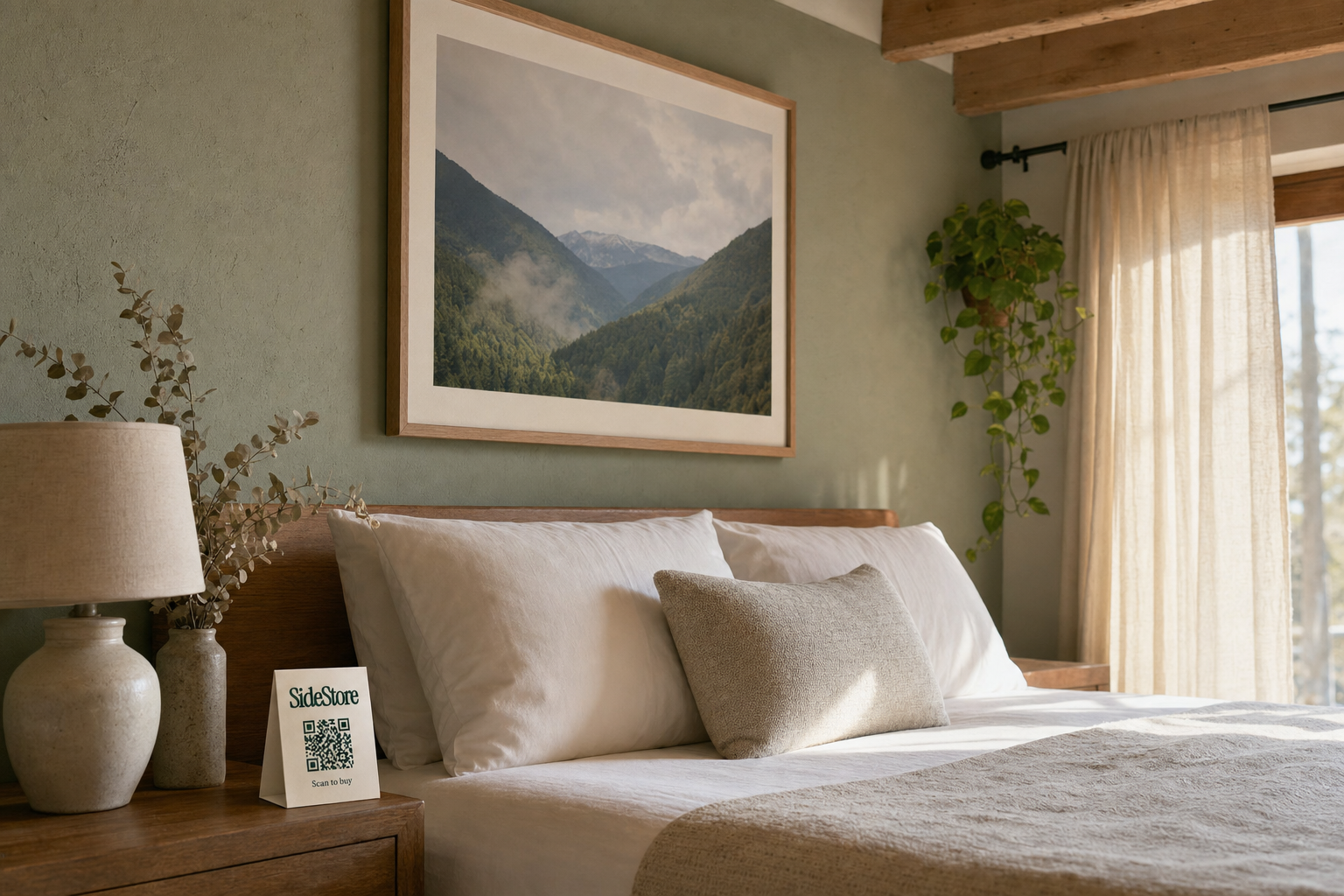
Labelling and checkout. Each print needs a label that includes the title, your name, the retail price, and a way to purchase. Through the Retail Widget, you can print a QR code card that guests scan to buy directly. A guest scans, pays via their phone, and the sale is recorded. The QR checkout is one function of the Retail Widget, which also handles live stock tracking, placement attribution, and automatic split settlement. It is not a separate standalone tool.
Stock tracking. The Retail Widget logs each sale in real time and updates your inventory count. You can see, from a single dashboard, which prints have sold across every placement. When a print sells, you receive an alert and can plan your next restock visit accordingly.
Restocking. Budget for a check-in visit every four to six weeks, or sooner if sales are strong. Bring a replacement print for anything that has sold. Check the condition of remaining prints while you are there.
For more on managing the logistics of print placements end to end, see consignment inventory software for tracking placements and placement logistics for print makers in retail.
How to Price Photography Prints for Hotel Consignment
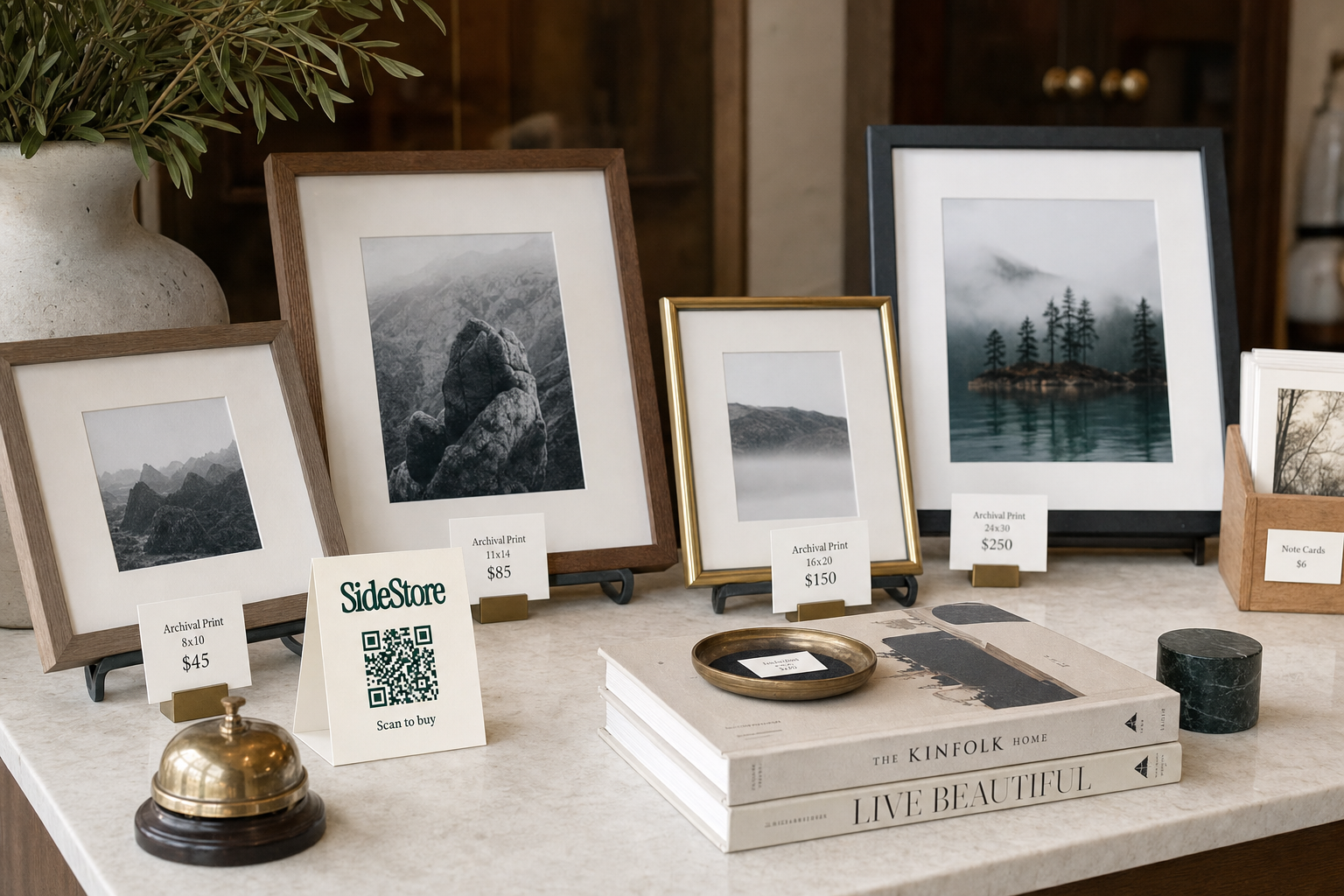
Price your hotel prints to cover your production cost, your time, the consignment split, and a margin that makes the placement worthwhile at realistic sales volumes.
The most common mistake is pricing prints at what you think a guest will pay, without working backwards from what you actually need to earn per sale. Start with your floor.
Here is an illustrative worked example. Suppose a large format print costs you £40 to produce (printing, framing, packaging, delivery to the property). You want to earn at least £80 per sale after the consignment split. If the hotel takes 30%, you need your 70% share to equal £80, which means a retail price of approximately £115. Round up to £120 or £125 for a clean price point. That is your floor; pricing above it is a judgement call about the market.
Several factors justify pricing higher than your floor. Hotel guests in a design property with a premium nightly rate are accustomed to premium price points. A print with a direct connection to the location, the view from the hotel's own windows, a local landmark photographed at an unusual time, carries a story premium. Limited editions with a numbered certificate add perceived scarcity.
One honest caveat: there is no single correct price for a photography print in a hotel. The range observed across the market is genuinely wide. Test a price point during a trial placement and adjust at renewal. For more on pricing strategy in hospitality venues, see pricing prints for consignment in hospitality venues.
Scaling: Running Photography Prints Across Multiple Hotel Properties
Once a single hotel placement is working, the process of adding more properties is largely a repeat of what you have already done. The complexity is logistical, not conceptual.
Each new property requires its own installation visit, its own consignment agreement, and its own restock schedule. There is no way around the physical labour of maintaining multiple placements; scaling without opening a store of your own still means showing up with prints, a drill, and a schedule. The advantage is that your sales infrastructure, your pricing, your agreement template, your Retail Widget dashboard, transfers wholesale to the next placement.
The Retail Widget's placement attribution feature is particularly useful here. Each placement has its own identifier, so you can see at a glance which hotel is selling, which room type performs best, and which prints move fastest in which context. That data lets you make deliberate decisions: which properties to prioritise for restocking, which prints to retire, and where to pitch next.
For practical guidance on building a distributed retail network without your own store, the principles apply directly to a multi-hotel print operation.
Frequently Asked Questions
These questions reflect the genuine gaps that photographers and makers run into when placing prints in hotels for the first time. The answers below are honest about what varies and what is fixed.
Do I need a consignment agreement to sell prints in a hotel?
Yes. A written consignment agreement for artists protects your ownership of the prints, fixes the retail price and split terms, and defines what happens to unsold work. A verbal arrangement is unenforceable. Even a single clear page, signed by both parties, is far better than nothing.
What percentage do hotels take on consignment art?
There is no fixed industry standard. As a rough and illustrative guide, hotels typically take somewhere between 25% and 40% of the retail price, with the exact figure depending on their contribution to the sale. A hotel with strong design credentials and active guest engagement justifies a higher share than one offering only a wall. Negotiate based on contribution, not convention. See the split table in the section above for illustrative ranges by venue type.
How does a guest buy art from a hotel room?
Through the Retail Widget, a guest scans a QR code card displayed alongside the print, pays on their phone, and the sale is recorded instantly. The QR checkout is one function of the Retail Widget, which also handles stock tracking and automatic split payouts. Some hotels prefer to handle purchases at the front desk; both approaches work, though the QR route requires no staff involvement.
What happens to unsold prints in a hotel?
Your consignment agreement should specify this clearly. At the end of the agreed term, you collect unsold prints, typically within a notice period of seven to fourteen days. The hotel should not sell, reposition, or dispose of your work without your consent. Make the return process explicit in the agreement before installation.
Can I sell other products to hotels on consignment?
Yes. Ceramics, candles, small textile pieces, locally made goods, and similar products are all placed in hotels on consignment by independent makers. The consignment mechanics are the same. For more on selling local products through someone else's retail space and the difference between consignment vs wholesale for independent makers, both articles cover the broader product landscape.
Start Small, Place Deliberately, and Let the Placement Earn
The way to sell photography prints in hotels is to start with one property that fits your work, agree a clear consignment arrangement in writing, install your prints properly, and let the placement run for sixty to ninety days before you evaluate.
Do not over-extend into multiple properties before you have proven the model works for you. One placement done well teaches you more than five done carelessly.
When you are ready to grow, your consignment placement in local shops and managing consignment inventory across placements will transfer directly. Start with the first placement.