Pop-Up Retail: What It Is, What It Costs, and Smarter Alternatives for Independent Makers
Pop-up retail costs more than the stall fee. Discover the full cost breakdown, honest pros and cons, and how consignment commerce gives makers offline presence without the overhead.
What Is Pop-Up Retail and Should You Try It?
Pop-up retail is a short-term physical selling format where a brand or maker rents temporary space, ranging from a market stall to an empty shopfront, to sell directly to customers for days, weeks, or a defined season.
For independent makers, pop-up retail is genuinely appealing: you get face-to-face customer feedback, immediate sales, and the kind of brand storytelling a product page can never replicate. But the cost picture is more complicated than the stall fee suggests. Venue hire, insurance, equipment, staffing, and the problem of unsold stock all add up fast. Before you commit, you need to see the full number, not just the headline rate.
This guide covers what pop-up retail actually is, what every format costs in practice, and where it makes sense for an independent maker. It also explains how how consignment works for independent makers gives you ongoing offline shelf presence at a fraction of the cost and risk, so you can decide which model, or which combination, fits where you are right now.
What Pop-Up Retail Actually Is (and What It Is Not)
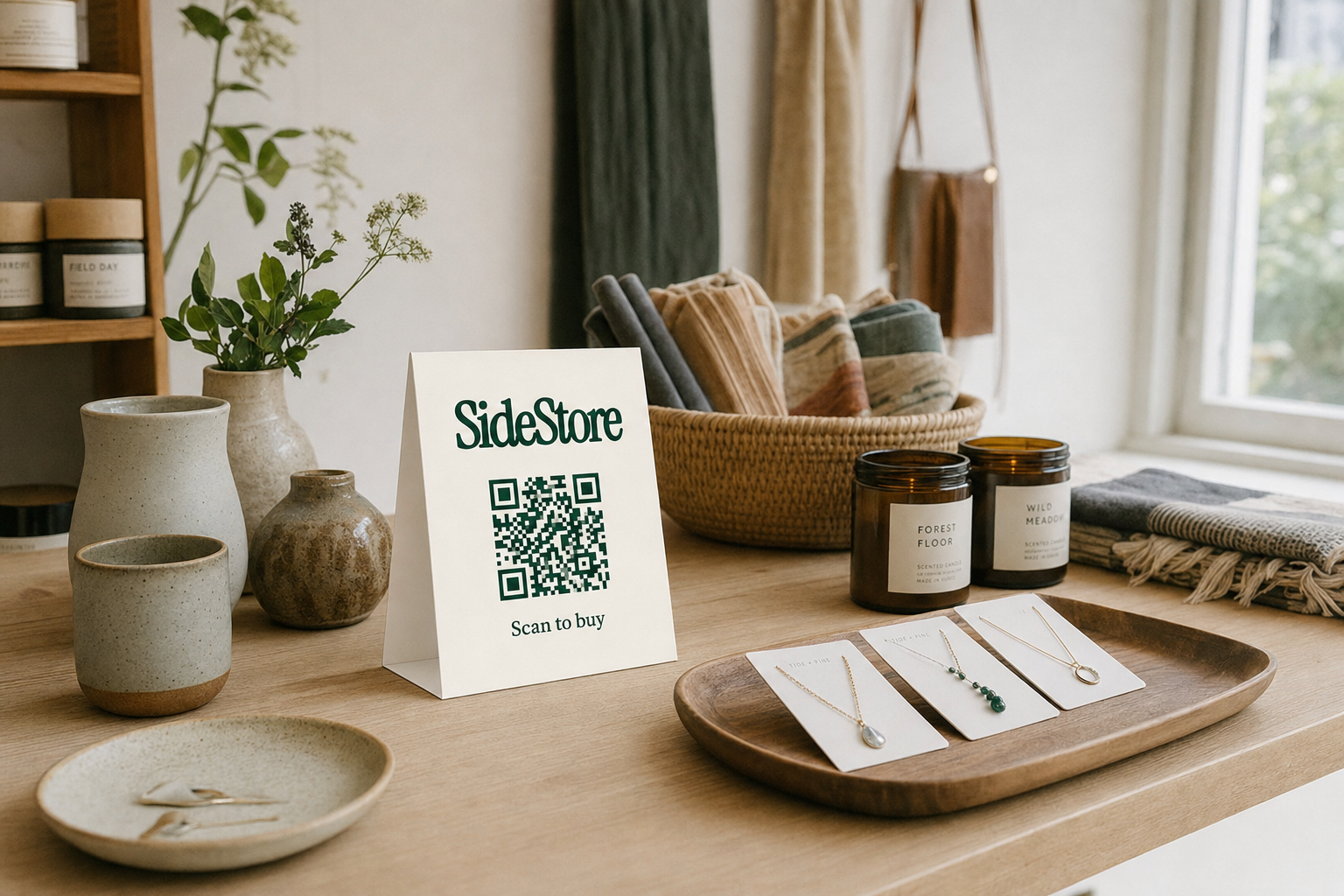
Pop-up retail is temporary, intentional physical selling in a borrowed or rented space. It is not a permanent shop with a short lease, not an online-to-offline redirect, and not simply attending a market as a vendor. What defines it is the combination of impermanence and commercial intent.
Three main formats exist for makers:
1. Market stall or fair booth. You rent a pitch at a curated market, craft fair, or seasonal event. The space is yours for the duration of the event only. Setup and breakdown happen the same day or weekend. Pitch fees can range from quite affordable for a community market to several hundred per day for a premium curated fair, though costs vary widely by location, event tier, and whether electricity or furniture is included. This is the lowest barrier entry point for pop-up retail.
2. Shared pop-up space. A vacant shopfront or gallery is subdivided between multiple makers who split costs. You get a physical shelf or zone within the shared environment for days or weeks. This format offers a more professional presentation than a market stall and can feel closer to a real retail environment, but coordination with co-makers adds complexity and any shared costs require clear written agreements.
3. Solo branded pop-up. You rent an entire vacant unit, a hotel lobby nook, or a dedicated event space and run it entirely yourself. Maximum creative control, maximum cost. This format suits a product line with sufficient volume to justify the overhead and a maker who has already validated demand elsewhere.
What pop-up retail is not, and this matters, is a substitute for distribution. A pop-up sells to whoever walks past on those specific days. It does not leave a product on a shelf after you pack up. How consignment placements differ from running your own space is the key distinction to understand before committing budget to either model.
What a Pop-Up Really Costs: The Full Breakdown
The total cost of a pop-up retail run is almost always higher than the venue fee alone. Most makers who've done one will tell you the stall hire was the smallest line item by the time they added everything else. Here is what to budget for across all seven cost categories.
1. Venue or pitch hire. The headline cost. Market pitches can range from nominal fees for small local events to significant daily rates for premium urban fairs. Short-term vacant shopfront rentals vary enormously by city, location grade, and duration. Verify locally and ask whether the quote includes furniture, fixtures, or utilities.
2. Insurance. Many venues require public liability insurance as a condition of entry. If you do not already carry a policy, short-term event insurance is available but adds to your fixed cost. Check the venue's specific minimum coverage requirement before booking.
3. Equipment and display hire. Trestle tables, rails, shelving, lighting, and signage are rarely included in a basic pitch fee. Hiring these items per event adds up. Owning your own equipment solves the recurring hire cost but creates a storage and transport problem between events.
4. Staffing. A solo maker working a full market day is doing no production, no admin, and no fulfilment during those hours. If you hire help for multi-day pop-ups, labour costs are real and often underestimated. Even casual staffing at minimum wage across a weekend can rival the venue hire itself.
5. Transport and logistics. Getting product, display equipment, and yourself to and from the venue costs time and money. For makers without a vehicle, van hire is a recurring expense. Factor mileage, parking, and loading time honestly.
6. Unsold stock handling. Product that does not sell has to go somewhere. Dealing with unsold stock after a pop-up run is a genuine post-event challenge. Transporting it back, storing it, and discounting it to clear are all costs that rarely appear in a pre-event budget. Managing excess boutique inventory requires a plan before you pack the van, not after.
7. Opportunity cost. This is the hardest line item to name but the most important. The hours spent setting up, trading, and packing down are hours not spent making. For a maker whose production capacity is already constrained, this trade-off is real and should sit in any honest cost analysis.
Pop-Up Retail: Pros, Cons, and What Each One Costs You
Pop-up retail is worth pursuing under specific conditions. It is a strong format for product validation, for building brand recognition in a target neighbourhood, and for generating the kind of customer conversation that sharpens your offer. It is a poor fit as a permanent distribution strategy, especially when the cost-per-sale is high and the shelf presence disappears the moment you pack up.
| Factor | Pop-Up Retail | What It Costs You | Verdict for Makers |
|---|---|---|---|
| Upfront cash | Venue, insurance, display, transport all due before you make a single sale | High fixed cost regardless of sales performance | Risky for makers with limited working capital |
| Flexibility | Dates and locations are fixed once booked | Missed events mean sunk cost with no recovery | Low flexibility once committed |
| Brand storytelling | Face-to-face selling, live product demos, real-time feedback | Requires your physical presence and time | Strong advantage for launch or validation |
| Customer data | Direct conversations, email sign-ups, social follows | Only from people who walk past that day | Valuable but narrow |
| Shelf presence | Exists only during the pop-up window | Zero presence after pack-down | Not a distribution strategy |
| Staffing burden | Solo or small team required on-site | Hours of non-production time | High opportunity cost for a maker |
| Unsold stock | Must be transported back and stored or discounted | Real logistical and financial cost | Often underestimated pre-event |
| Scalability | Each new location requires a new event or booking | Linear effort, no leverage | Does not scale without proportional resource |
Pop-up retail earns its place as a validation and storytelling tool. It rarely earns its place as a primary distribution channel once you price in every cost, especially for makers whose time is already the constraint.
How to Find Pop-Up Retail Space (and What to Look For)
Makers find pop-up retail space through five main channels, and the right one depends on your format, budget, and how much lead time you have. No single platform dominates; the best option often depends on your city and your product category.
Five channels for finding pop-up retail space:
Local market organisers. Search for curated markets, craft fairs, and design markets in your area. Most publish application windows and pitch fees on their own websites. Apply early as popular events often fill months in advance.
Vacant shopfront platforms. In some cities, platforms exist that list empty retail units for short-term hire by the day or week. Search for "pop up retail space for rent" with your city name. Verify the listing includes an actual rental agreement, not just a casual arrangement.
Co-working and creative hubs. Many shared creative spaces hold regular maker markets or allocate retail zones to resident makers. If you are already part of a maker community, this is often the lowest-cost route.
Direct outreach to venue owners. Hotels, cafes, and boutiques with underused floor space are sometimes open to a maker taking a corner for a week. How to approach merchants about consignment placement uses the same relationship skill, except consignment leaves the product there after you leave.
Social media and maker communities. Local Facebook groups, Instagram, and maker forums regularly surface short-notice space opportunities, especially when a previous tenant cancels. Responsive makers who are ready to move quickly often find the best deals here.
Before you commit, verify:
- Foot traffic at the specific time of day and day of week you will be trading, not the venue's claimed average
- Whether the pitch fee includes electricity, furniture, and WiFi
- The exact load-in and load-out window
- Insurance requirements in writing
- Whether you have the right to display your own signage
Building distribution without a fixed retail commitment is possible once you understand that the goal is shelf presence, not the pop-up event itself.
Pop-Up Retail Ideas That Actually Work for Independent Makers
The best pop-up retail ideas for makers with limited budgets are the ones that minimize fixed cost while maximizing the specific benefit you are after, whether that's product feedback, brand visibility, or direct sales. Here are five formats worth considering.
1. Shared maker market pitch. Split a larger pitch with one or two complementary makers to halve the hire fee. Works when your product categories are adjacent but not competing. The success condition is a clear written agreement on cost-sharing, setup, and breakdown responsibilities before the event.
2. Hosted pop-up in a cafe or boutique. Approach a cafe or boutique with an existing customer base and propose a one-day or one-week in-store pop-up. The host benefits from the activation energy; you benefit from their foot traffic. How hosting products boosts a cafe's margin and additional revenue streams in a coffee shop are reasons a well-framed pitch often lands with cafe owners. The success condition is choosing a venue whose existing clientele genuinely matches your product.
3. Seasonal or event-tied pop-up. Align your pop-up with an existing event, a local design week, a food festival, or a holiday market, to borrow its foot traffic rather than generate your own. The cost driver here is the event pitch fee, which is often higher for premium events. The success condition is that the event's audience is your audience.
4. Test-and-convert pop-up with a consignment follow-up. Use a one-day pop-up to validate demand, then immediately approach the host venue about leaving products on consignment through SideStore's Retail Widget after the event ends. The Retail Widget handles scan-to-pay checkout, live stock tracking, and automatic split settlement, so the host carries no inventory risk and you maintain shelf presence between visits. The success condition is running the pop-up and the consignment conversation as a single strategy, not two separate activities.
5. Digital-to-physical launch event. If you already have an online following, use a one-off pop-up as a physical meet-and-buy moment. Market it to your existing audience rather than relying on walk-in traffic. The cost driver is the event space; the success condition is a list large enough to fill the room.
The Smarter Alternative: Consignment Placement Without the Pop-Up Overhead
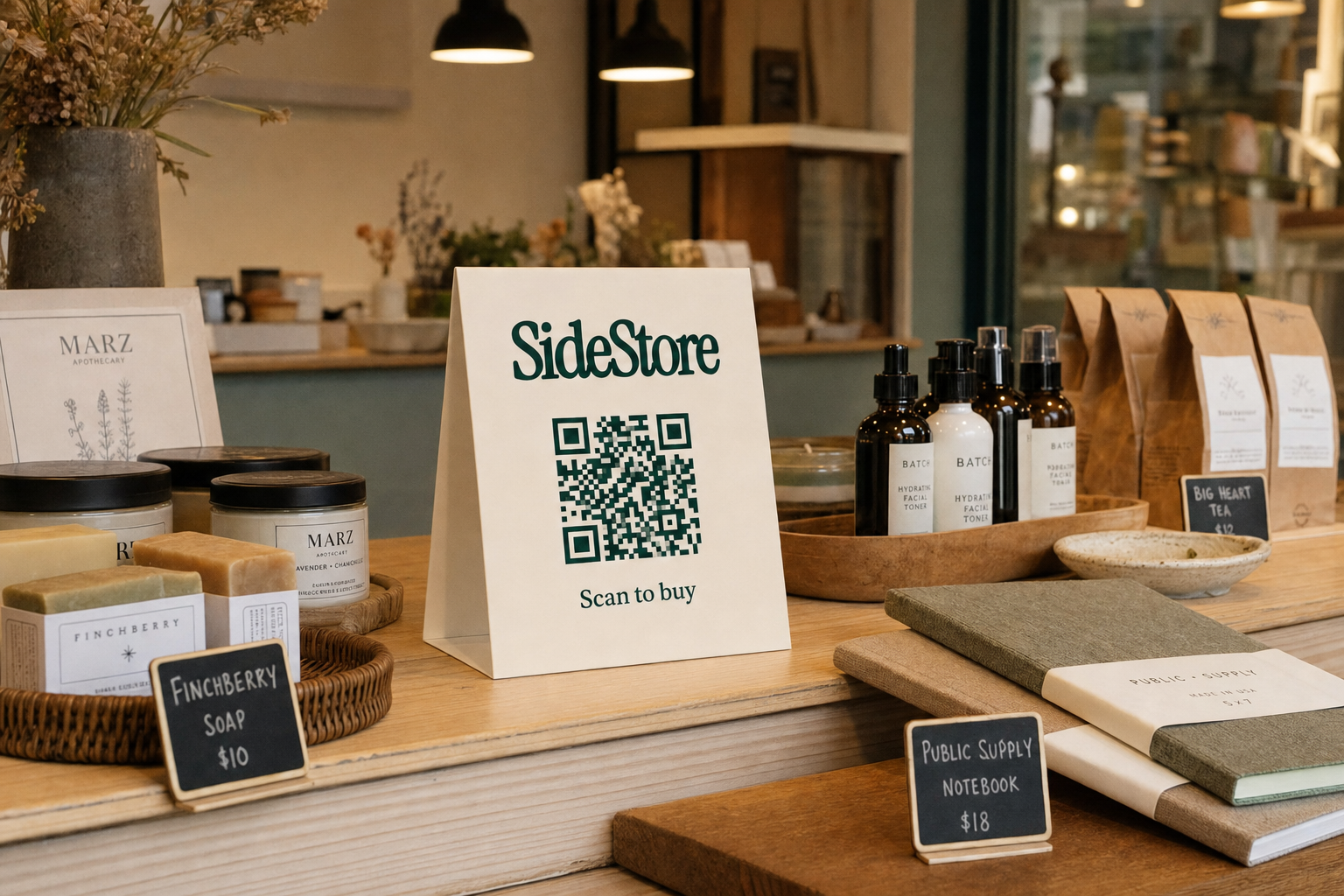
The smarter alternative to pop-up retail, for makers who want ongoing offline distribution rather than a one-time event, is consignment placement: putting your products on a shelf in an existing merchant space and getting paid when they sell, with no upfront cost to the host and no fixed overhead for you.
Pop-ups are genuinely useful. They let you test a product in front of real people, collect feedback that sharpens your offer, and build brand story in a way that a product page cannot. That is a legitimate and valuable function. The problem is when makers treat pop-ups as a distribution strategy rather than a validation tool, because a pop-up disappears the moment you pack down.
Consignment placement solves the distribution problem pop-ups cannot. When you place your products in a merchant space on consignment through SideStore, your shelf presence is continuous. The host, whether a cafe, boutique, hotel, or any retailer with available shelf space, carries no inventory risk. They do not buy your products upfront. They earn a split on every sale, and the Retail Widget handles the mechanics automatically.
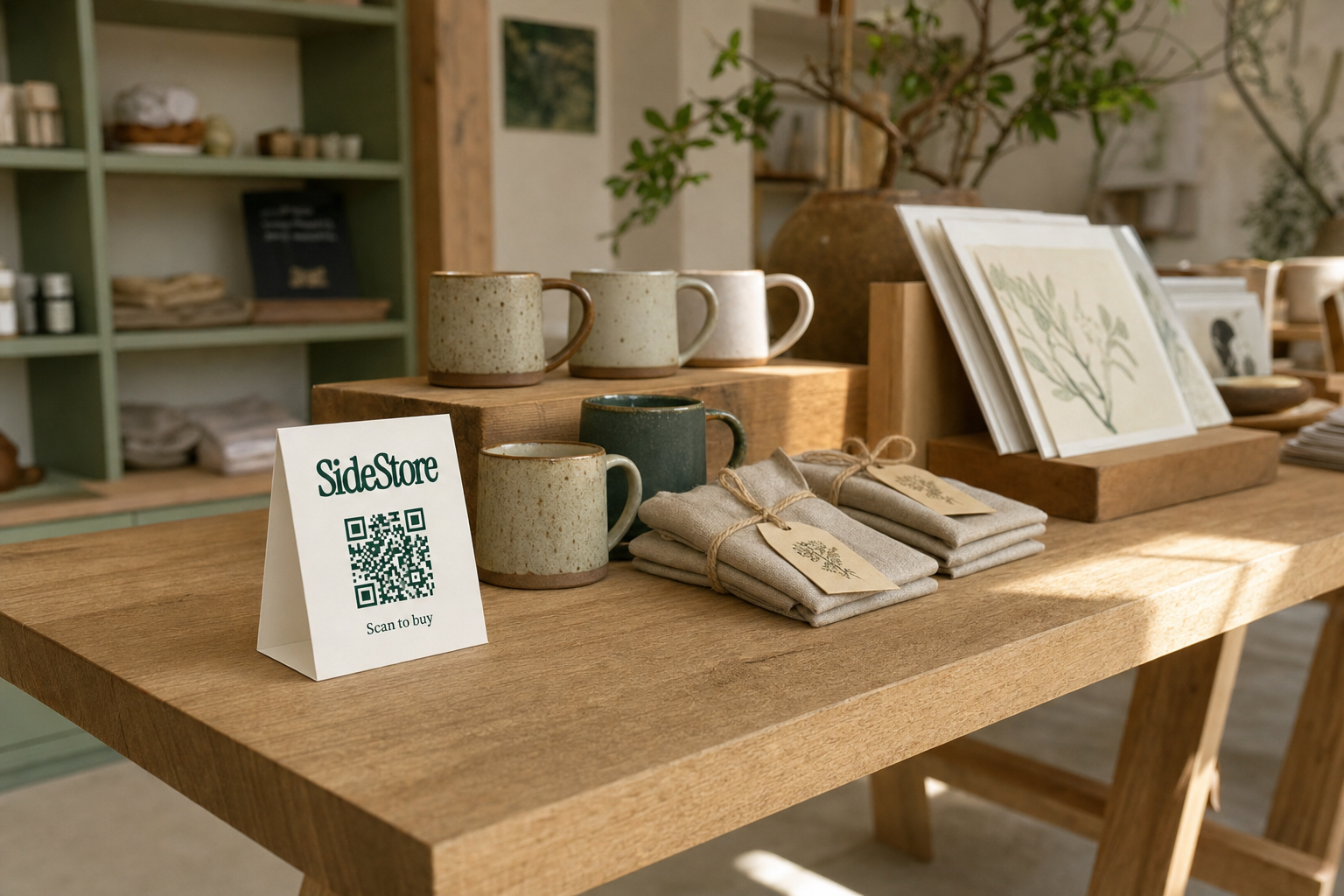
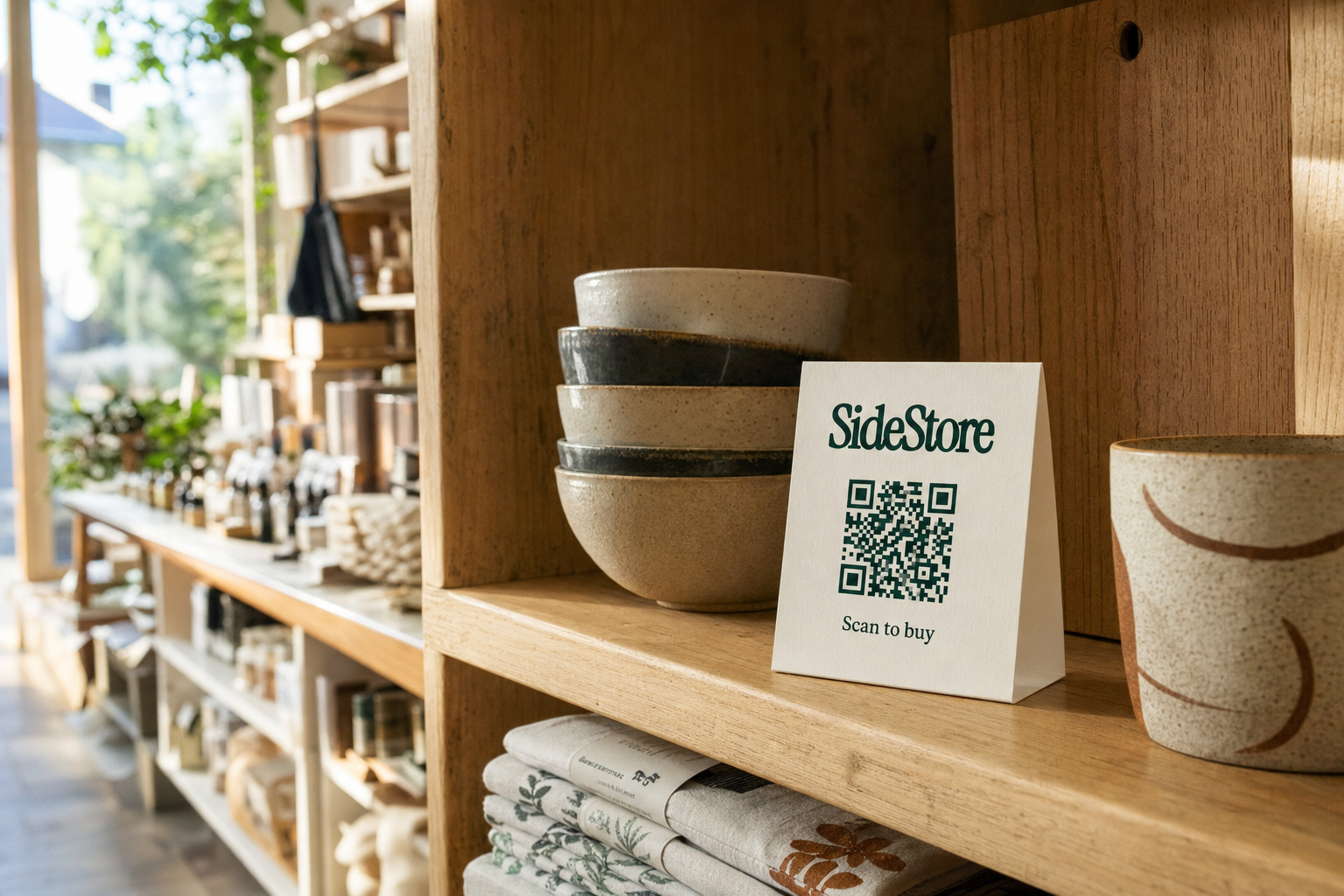
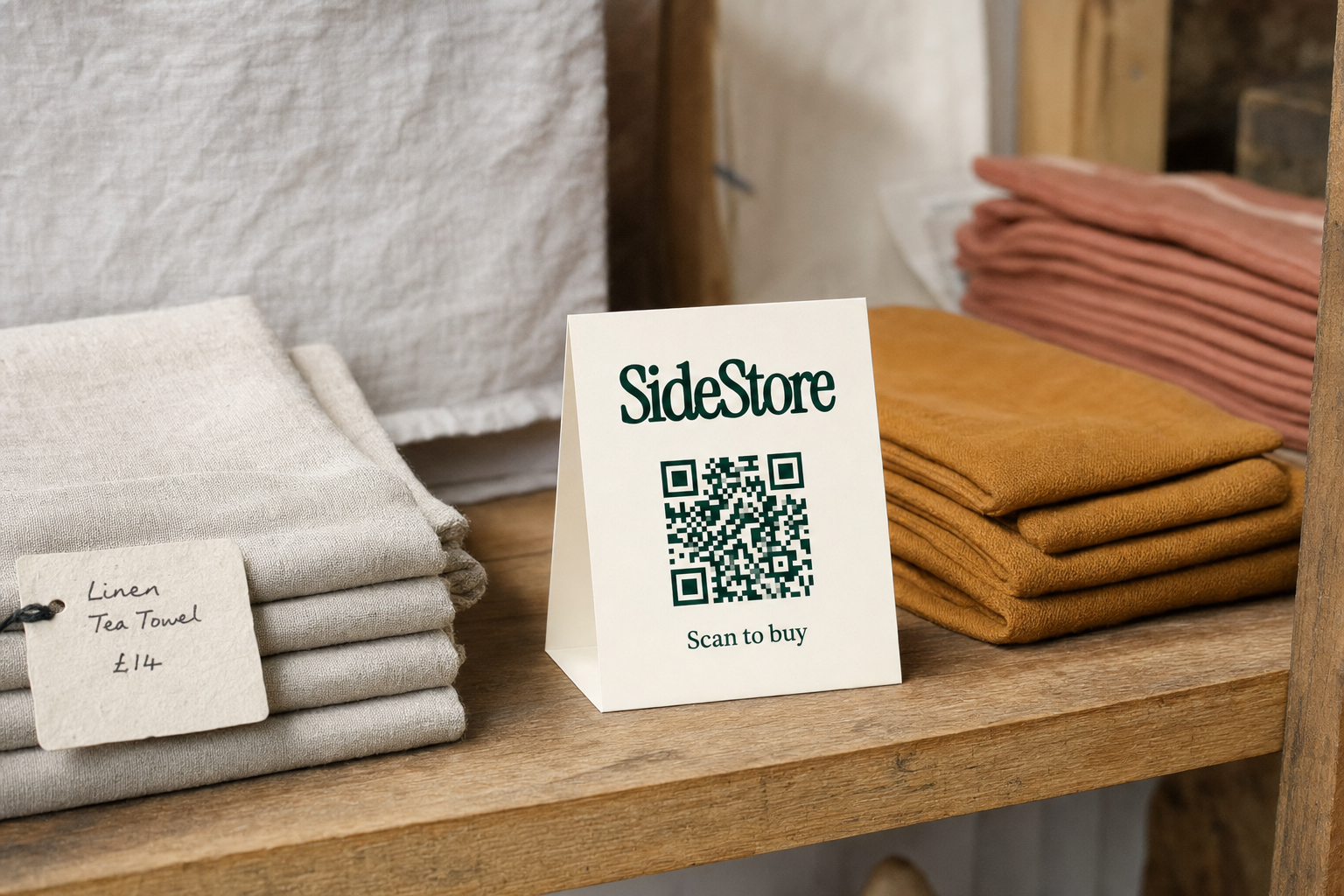
Here is what the Retail Widget actually does. It handles checkout through a printable scan-to-pay QR, so a customer can scan and buy without the host needing to be involved in the transaction. It tracks live stock levels, so you know when to replenish without having to visit every location. It attributes sales by placement, so you can see which venues perform and which do not. And it handles split payouts automatically, so the host receives their agreed share and you receive yours, with no manual reconciliation.
A maker can print the SideStore QR card and attach it directly to their own product, or a merchant can display a single card covering all products in their SideStore placement. The QR checkout is one function of the Retail Widget, not the whole product. The Retail Widget is the interface for running the entire consignment placement from placement setup through to settlement.
How consignment commerce works in practice is worth reading before you budget another pop-up. And building offline distribution without a fixed store gives you the structural picture of what a distributed consignment network actually looks like.
Pop-Up Retail vs Consignment Placement: Side-by-Side Comparison
How do pop-up retail and consignment placement compare when you put them directly against each other? The honest answer is that they serve different functions, and the right question is not which is better, but which one solves the problem you actually have right now.
| Factor | Pop-Up Retail | Consignment Placement | Advantage | Notes |
|---|---|---|---|---|
| Upfront cost | High (venue, insurance, equipment, staffing) | Low to none (host carries no inventory risk) | Consignment | Pop-up costs are fixed before a single sale |
| Ongoing shelf presence | Ends when event ends | Continuous while products are in place | Consignment | Pop-ups require repeated bookings to maintain presence |
| Customer feedback | Direct and immediate | Indirect via sales data | Pop-up | Face-to-face validation is a genuine pop-up advantage |
| Brand storytelling | Strong; maker is present | Dependent on product presentation | Pop-up | A maker's physical presence cannot be replicated |
| Stock risk | Unsold stock returns to maker at maker's cost | Host holds no stock; maker restocks on their schedule | Consignment | Post-event stock handling is an underestimated pop-up cost |
| Checkout handling | Maker or hired staff manage transactions | Retail Widget scan-to-pay handles checkout automatically | Consignment | Reduces labour requirement to near zero |
| Sales tracking | Manual counting or POS if you bring one | Live stock tracking via Retail Widget | Consignment | Real-time visibility without physical presence |
| Settlement | Maker keeps all revenue; all costs paid upfront | Automatic split payout to maker and host | Consignment | No manual reconciliation; settlement is built in |
| Scalability | Each location requires a new event booking | Add placements via dashboard; no new events needed | Consignment | Consignment scales without proportional effort |
| Minimum viable commitment | One day to one weekend | Ongoing, adjustable by placement | Consignment | Lower friction to start and to exit |
Consignment placement wins on cost, continuity, and scalability. Pop-up retail wins on immediacy and storytelling. A strong maker strategy uses both: pop-ups to validate and build brand, consignment to turn that presence into ongoing distribution. A deeper guide to selling on consignment explains how to structure the placement from first approach to live settlement.
From One-Off Pop-Up to a Distributed Consignment Network
Moving from a single pop-up event to a distribution model that works without you being physically present every day is a three-phase process. It is not complicated, but it requires intentionality at each step.
Phase 1: Validate. Run a pop-up, a market stall, or a hosted in-store event in a venue whose customer base matches your product. Your goal here is not volume of sales. It is confirmation that a stranger will hand over money for your product at your chosen price, without your intervention. That confirmation is the output of Phase 1. Until you have it, do not scale anything.
Phase 2: Convert. After a successful validation event, approach the host venue directly about a consignment placement. You have just proved demand in their space. That is a compelling conversation. Set up the Retail Widget, print the scan-to-pay QR card, agree on the split, and deploy. The output of Phase 2 is your first live consignment placement: a product on a shelf that sells without you standing next to it.
Phase 3: Replicate. Use your SideStore dashboard to manage that first placement and identify which products move, at what rate, and in what volumes. Then approach the next venue. Why cafes are strong hosts for consignment placements and the margin profile of a typical cafe host explain why high-footfall hospitality venues are often the most receptive hosts. The output of Phase 3 is a distributed consignment network: multiple placements, tracked centrally, settled automatically.
Each phase has a defined output. Move to the next only when you have it.
Frequently Asked Questions About Pop-Up Retail
These are the questions makers most commonly have about pop-up retail, drawn from the practical trade-offs covered in this guide. Cost figures are indicative ranges, not benchmarks, because local market conditions vary significantly.
What is a pop-up retail store?
A pop-up retail store is a temporary physical selling space, ranging from a single market stall to a fully branded vacant unit, used for days, weeks, or a defined season. It gives makers direct customer contact and brand presence without a permanent lease. Unlike a consignment placement, it exists only for the duration of the event and requires the maker's physical presence to operate.
How much does it cost to rent a pop-up retail space?
The cost of pop-up retail space varies widely depending on format, location, and duration. A community market pitch might cost relatively little per day; a curated urban fair or premium vacant shopfront can run to several hundred per day or more. The headline hire fee is rarely the full cost: insurance, equipment, staffing, and transport add substantially to the total. Verify all-in costs with the venue before committing, and budget for unsold stock handling as a real line item.
What are the best pop-up retail ideas for small makers?
The most practical pop-up formats for makers with limited budgets are shared market pitches (to split the hire cost), hosted in-store pop-ups in cafes or boutiques with aligned audiences, and seasonal event pitches where foot traffic is already guaranteed. For makers who want ongoing shelf presence rather than a one-off event, pairing a pop-up with a consignment follow-up through SideStore is a stronger strategy than treating either in isolation. How community-focused venues use consignment to diversify income shows how even non-commercial hosts can participate in a consignment placement model.
Is consignment better than a pop-up for independent makers?
Consignment and pop-up retail solve different problems. Pop-up retail is better for product validation, direct customer feedback, and brand storytelling. Consignment placement is better for ongoing offline distribution, scalability, and reducing fixed cost per sale. For most independent makers, the answer is not one or the other: use a pop-up to validate demand, then convert the host venue into a live consignment placement through SideStore's Retail Widget to maintain shelf presence without the ongoing overhead.
What to Do Next
If you have read this far, you know what pop-up retail actually costs, when it makes sense, and what it cannot do for you long-term. The next step is practical. If you have not yet validated your product in front of real customers, plan a focused pop-up or market event and treat it as a test, not a sales channel.
Once that validation is done, the move is to convert that physical presence into an ongoing consignment placement through SideStore. Set up the Retail Widget, deploy to one venue, and manage it from your dashboard. Then replicate. How to set up your first consignment placement is where to go next.
Build a consignment network without opening a store of your own.