The average independent café nets between 2.5% and 6.5%, which means roughly $15,000 to $50,000 in annual profit. That range is deliberately wide: location, format, labour costs, and whether you run additional revenue streams push the number in sharply different directions. Espresso-based drinks carry gross margins of 60% to 70%, but rent, wages, and overheads consume most of that before you see actual take-home. Most coffee shop owners find their real leverage in understanding the gap between those two numbers.
For a closer look at how margins break down by shop format, see coffee shop profit margin. If you want a practical framework for running a profitable operation, how to profit from a coffee shop covers the operational levers in detail.
Gross Profit vs Net Profit: The Number That Actually Matters
Gross profit is what you keep after paying for coffee, milk, and cups. Net profit is what's left after rent, staff, utilities, and every other operating cost. For a coffee shop, these two figures rarely tell the same story, and treating them as interchangeable is one of the most common planning mistakes.
Here's a real example. A café pulling $400,000 in annual revenue with a 65% gross margin generates $260,000 in gross profit. That sounds strong on paper. Subtract $120,000 in wages, $60,000 in rent, $20,000 in utilities and insurance, and $10,000 in miscellaneous costs, and your net profit lands at $50,000. That's a 12.5% net margin, which is actually solid for an independent café. Many shops land closer to 3% to 6%, meaning that same $400,000 revenue might yield only $12,000 to $24,000.
The practical takeaway: when you see a coffee shop profit figure, always ask which profit they mean. Gross margin is useful for pricing decisions and controlling COGS. Net margin is the real measure of whether your business is healthy.
For a broader view of how these margins compare across different ownership models and shop types, coffee shop profit margins provides additional context.
Where the Money Goes: A Typical Coffee Shop Cost Breakdown
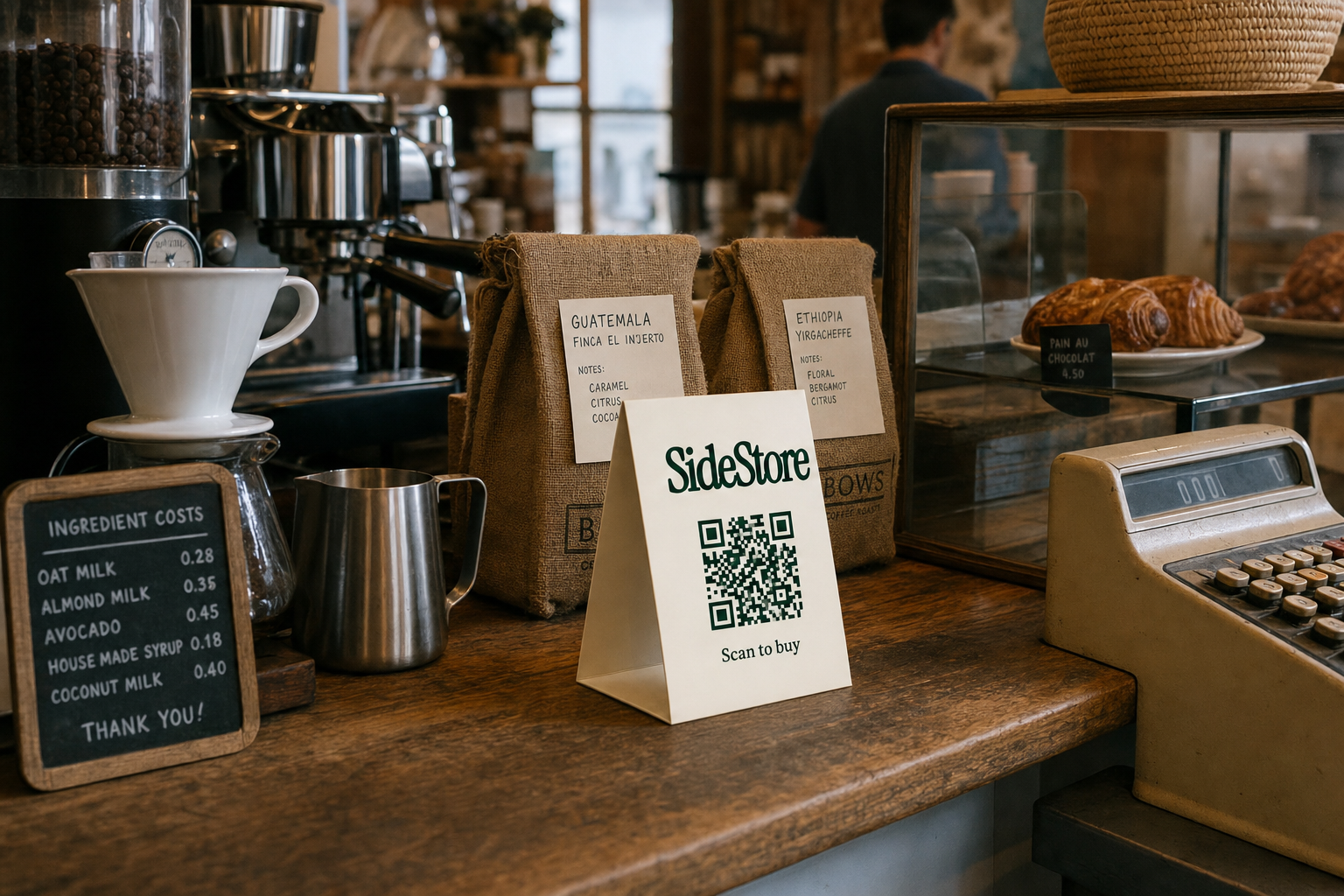
Most of your revenue disappears into three categories before profit is counted: product costs, labour, and occupancy. Industry data suggests these three typically consume between 55% and 75% of revenue in an independent café, leaving a thin margin for everything else.
Here's how costs typically distribute across a $300,000 annual revenue café:
Cost of Goods Sold (COGS): Coffee beans, milk, syrups, food items, and packaging typically represent 28% to 35% of revenue. Specialty cafés sourcing high-grade single-origin beans often sit at the higher end. Using commodity-grade blends can push this lower, though often at the cost of differentiation.
Labour: Wages, payroll taxes, and benefits typically account for 30% to 38% of revenue. This is frequently your largest single cost line. A café with strong manager cover and extended hours can see labour climb above 40%, especially in markets with higher minimum wages.
Rent and Occupancy: Including rates, service charges, and common area fees, rent typically sits between 8% and 15% of revenue. Location premium matters enormously. A high-footfall urban location may justify a 15% rent-to-revenue ratio; that same rent paid by a neighbourhood café doing half the volume quickly becomes unviable.
Other Operating Costs: Utilities, insurance, marketing, equipment maintenance, and merchant fees typically add another 5% to 10%.
What remains is your net profit. For a café doing $300,000 in revenue with costs at the conservative end of these ranges, that might be $30,000 to $45,000. At the expensive end, you might be looking at $9,000 or less.
For more on managing the product side of this equation, see the guide to running a coffee retail shop.
Average Coffee Shop Profit by Size and Type
Profit varies significantly by shop format. A drive-through kiosk and a multi-room specialty café have almost nothing in common on the cost structure side, even if they're pulling shots from the same grinder. The table below uses representative benchmarks to show typical ranges across common formats. These are illustrative figures designed for planning purposes, not guarantees.
| Shop Type | Typical Annual Revenue | Net Margin Range | Typical Annual Net Profit |
|---|---|---|---|
| Espresso kiosk / drive-through | $150,000 to $250,000 | 10% to 18% | $15,000 to $45,000 |
| Small independent café (under 10 seats) | $180,000 to $320,000 | 4% to 10% | $7,000 to $32,000 |
| Medium independent café (10 to 40 seats) | $300,000 to $600,000 | 3% to 8% | $9,000 to $48,000 |
| Large independent or flagship café | $600,000 to $1.2M | 2.5% to 6% | $15,000 to $72,000 |
| Café with retail or food production component | $350,000 to $800,000 | 5% to 12% | $17,500 to $96,000 |
A few patterns worth noting. Kiosks consistently outperform sit-down cafés on net margin because they carry no dine-in labour, minimal rent footprint, and a focused menu. Larger cafés generate more absolute profit in dollar terms but often see margins compress as headcount and rent scale. Cafés that add a retail component, bagged coffee, merchandise, or curated local products, can add 2 to 5 percentage points to net margin when managed well.
For a practical view of how to structure operations for profit from a coffee shop, the levers differ meaningfully by format.
Six Factors That Move Coffee Shop Profit Up or Down
Six variables account for most of the spread between a café at 2% net margin and one at 12%. Understanding which factors you can control matters more than chasing every metric equally.
1. Location and rent-to-revenue ratio. Moving from a 15% rent-to-revenue ratio to 10% through better volume or renegotiated terms adds 4 to 5 percentage points directly to net margin. Rent is largely fixed; your only leverage is volume and lease terms.
2. Average transaction value. Upselling from a flat white to a pastry, or from a single drink to a bag of beans, lifts revenue per customer without adding to occupancy or labour cost. Lifting average spend by $1.50 per transaction across 200 daily customers adds roughly $109,000 to annual revenue.
3. Labour scheduling and efficiency. Over-staffing quiet periods is one of the most common margin killers. Careful scheduling against actual traffic patterns typically produces meaningful savings without affecting service quality.
4. Menu complexity. Every additional menu item adds training burden, COGS variability, and waste risk. Simpler menus tend to have lower food waste and faster service times, both of which protect margin.
5. Beverage mix. Espresso-based drinks typically carry the highest margins. A shift in sales mix toward lower-margin food or packaged goods can erode overall gross margin even when revenue holds steady.
6. Additional revenue streams with low or no incremental cost. Hosting events, selling retail products, or partnering with local makers through how cafes can make money from unused shelf space can add revenue without proportionally raising costs. See also the broader overview of make money from unused shelf space for a practical breakdown of how this works in practice.
Adding Revenue Without Adding Costs: Retail on Consignment
The highest-leverage revenue move available to most cafés rarely appears in coffee industry guidance: consignment retail. On consignment, a local maker places their products in your café and gets paid only when those products sell. You earn a percentage of each sale without buying any stock, carrying any inventory risk, or managing replenishment yourself.
This matters for your bottom line because it converts idle shelf space into a revenue-generating asset at near-zero marginal cost. There's no purchase order, no stock write-off, and no storage overhead. The only input required is the physical space, which you already have.
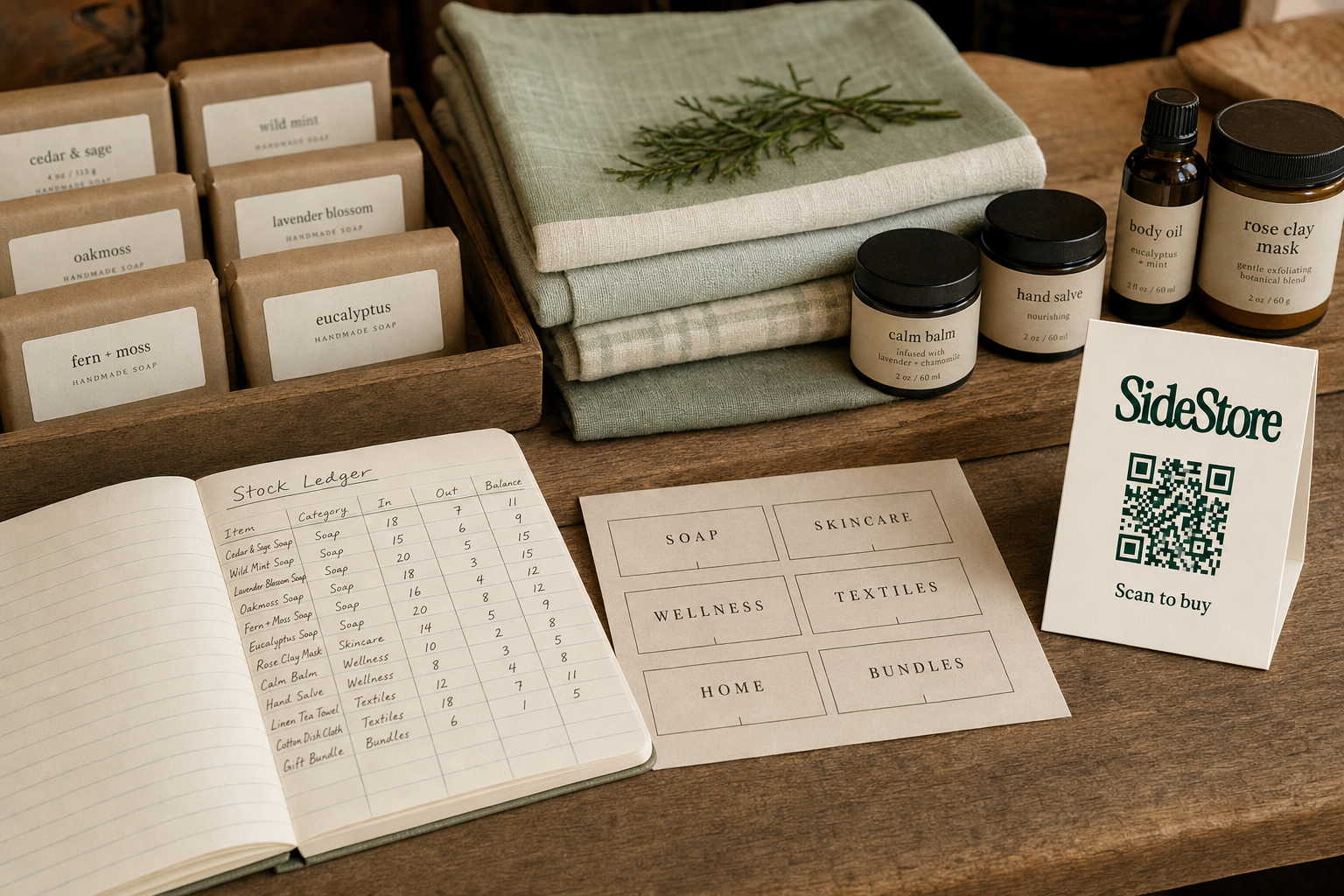
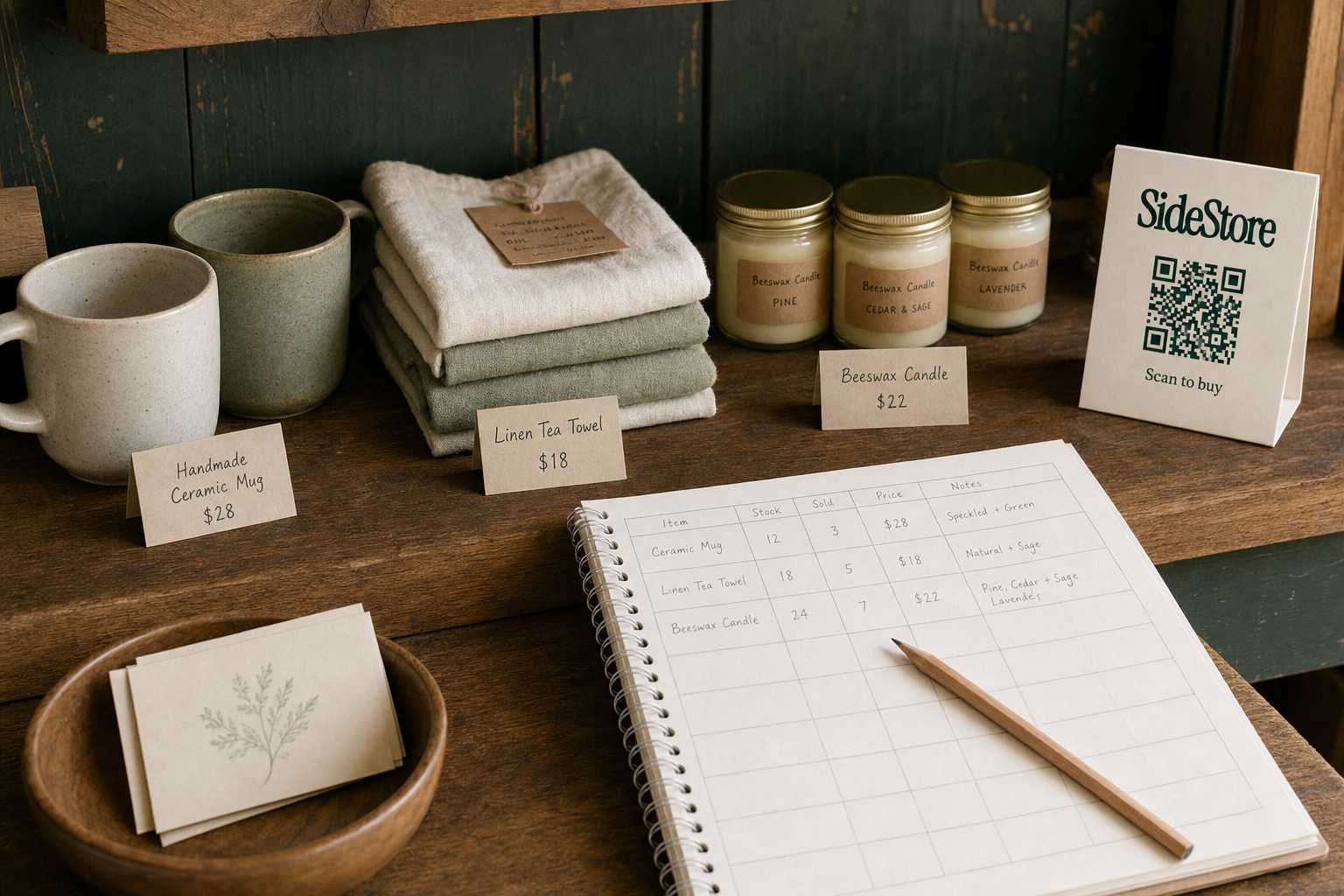
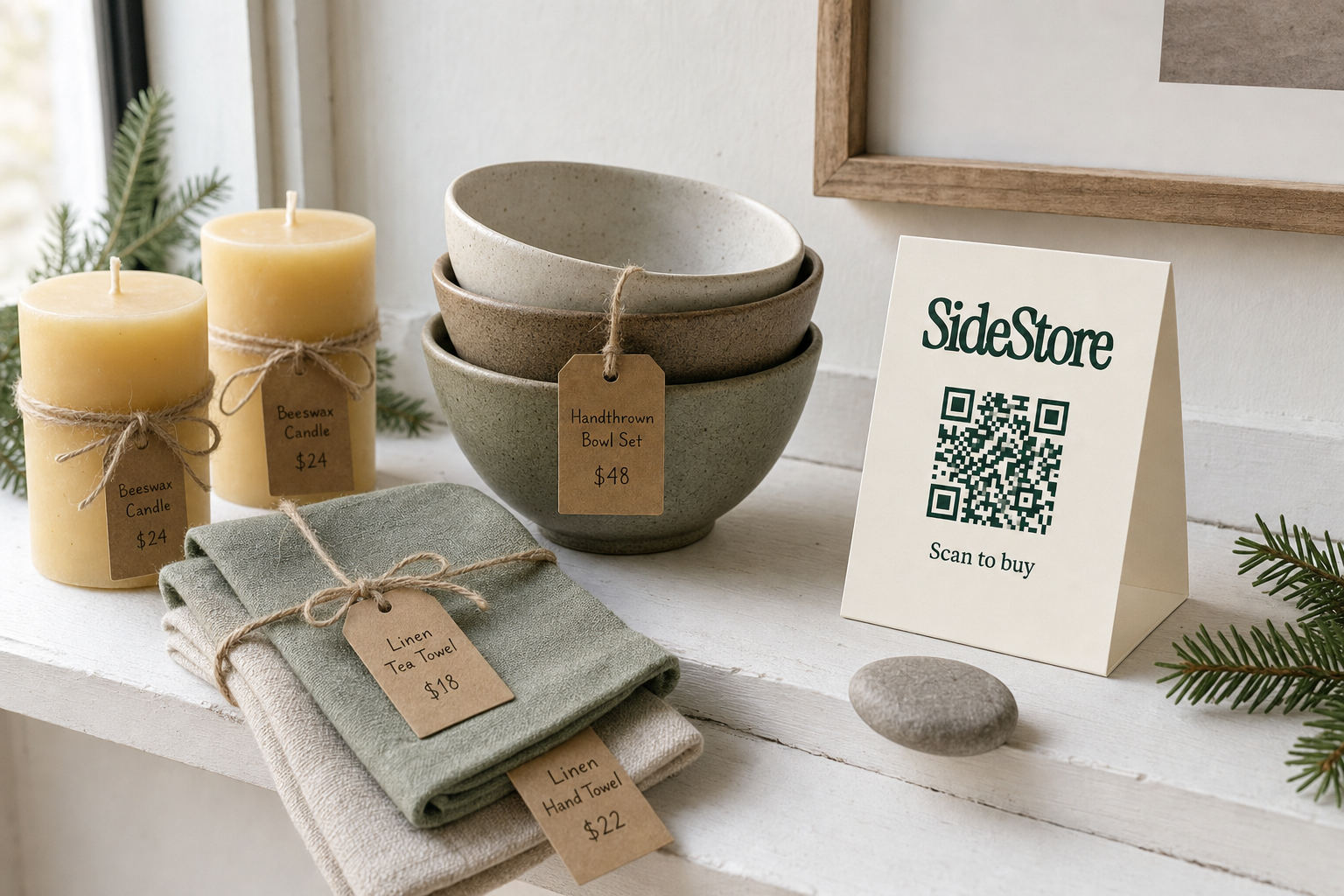
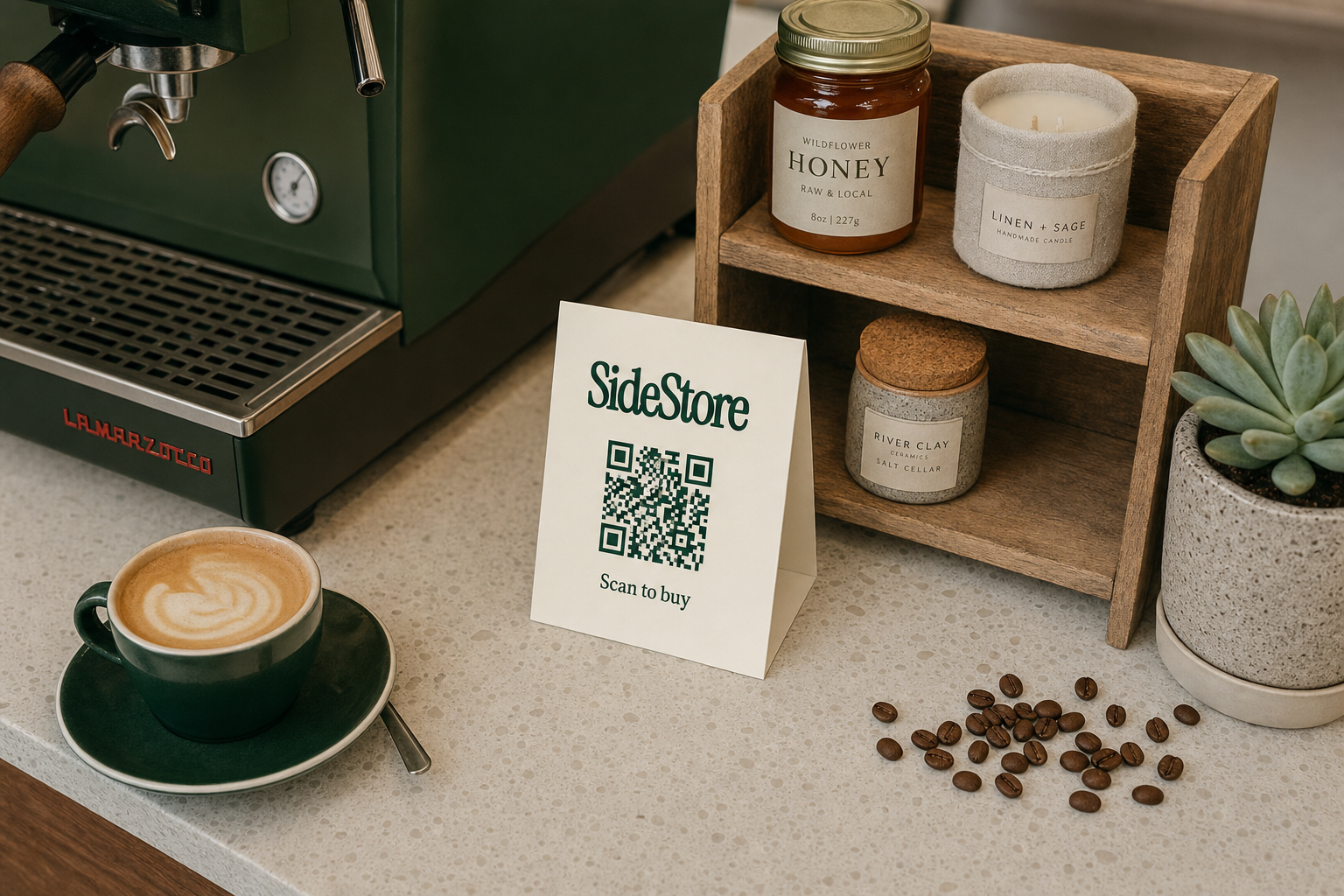
SideStore's Retail Widget is the interface that handles this end to end. It manages the consignment placement itself, including live stock tracking, placement attribution, and automatic split payouts between you and the maker when a product sells. One function of the Retail Widget is a printable scan-to-pay QR card: a merchant can display a single SideStore card for all consignment products in their placement, letting customers browse and purchase without requiring staff involvement at the point of sale.
The revenue impact depends on product selection, foot traffic, and shelf placement. A café doing 200 customer visits per day with three to five well-chosen local products on a visible shelf might generate an additional $400 to $1,200 per month in consignment income at zero inventory cost. That translates directly to net profit, because there's no COGS on your side.
For the full picture on how this works in practice, see cafes making money from unused shelf space, how the SideStore QR card works, and what consignment means for a coffee shop.
Practical Steps to Improve Your Coffee Shop's Profit Margin
Improving your profit margin comes down to a small set of high-impact actions applied consistently. The steps below are ordered by typical ease of implementation, not by impact size.
1. Audit your rent-to-revenue ratio first. Calculate rent as a percentage of your last 12 months of revenue. If it sits above 12%, that's your most urgent constraint. If your revenue is $300,000 and rent is $42,000, you're at 14%. Closing that gap requires either lifting revenue or renegotiating terms at the next lease review.
2. Review labour against traffic data. Pull your hourly transaction data for the last 90 days and map it against your scheduled hours. Most cafés find one or two staffed periods per week where labour cost significantly outpaces sales volume. Trimming two overstaffed hours per week can recover $3,000 to $8,000 annually at typical wage rates.
3. Simplify and re-price your menu. Identify your five highest-margin items and ensure they're visually prominent. Review whether any items are priced below their contribution margin threshold. A $0.30 price increase on your two best-selling drinks adds meaningful revenue with no change to COGS.
4. Add consignment retail without buying inventory. Placing local products on consignment through a platform like SideStore requires no purchase order and carries no stock risk. For more on the model, see adding local products without buying inventory and the practical guide to monetising unused shelf space.
5. Track net margin monthly, not annually. Waiting until year-end to calculate net profit means you operate 12 months without feedback. A monthly P&L, even a simple one, lets you catch cost creep before it compounds.
Frequently Asked Questions
How much profit does a coffee shop make per day? Based on typical annual net profit ranges of $15,000 to $50,000 for an independent café, daily net profit works out to roughly $40 to $135 per day. High-performing cafés with strong retail or additional revenue streams can exceed this; cafés in their first two years often sit below it.
Is owning a coffee shop profitable? It can be, but margins are thin and the failure rate for new cafés is high in the first three years. Profitability is achievable, particularly for operators who control rent carefully, maintain a simple menu, and diversify revenue beyond espresso drinks. Most owners report that profitability requires two to three years of operation to stabilise.
What is a good profit margin for a coffee shop? A net margin above 6% is generally considered healthy for an independent café. Anything above 10% is strong and usually indicates either a low-cost format (kiosk or drive-through) or meaningful additional revenue streams. For a detailed breakdown, see coffee shop profit margins in depth.
How long does it take a coffee shop to become profitable? Most independent cafés reach operational profitability (covering all running costs) within 12 to 18 months, assuming reasonable location and volume. Recovering initial setup costs and reaching genuine net profitability typically takes two to four years. Shops with unusually high fit-out or franchise costs may take longer.
How can a coffee shop increase profit without raising prices? The most effective approaches are reducing food waste, tightening labour scheduling, and adding zero-inventory revenue streams. Consignment retail is one of the most accessible options for an established café: it generates income from existing shelf space without raising prices or adding operational complexity. For alternative revenue structures, see non-profit coffee shop models for context on how different ownership approaches affect the profit calculation.
The Bottom Line on Coffee Shop Profit
The average independent café nets between 2.5% and 6.5%, or roughly $15,000 to $50,000 annually. Those numbers are achievable, but not automatic.
The two highest-leverage actions are controlling your rent-to-revenue ratio and adding revenue streams that carry no proportional cost increase. Consignment retail, managed through a platform like SideStore, is the clearest example: you earn a split of every sale from products a maker places in your space, with no inventory purchase and no stock risk.
If you operate a café with shelf space, the next step is straightforward: model what a consignment placement would earn you using the SideStore Retail Widget. For makers reading this who want to understand the supply side of this model, see how local makers can sell without opening a store and the guide to selling to consignment. And for merchants weighing all available options, alternatives for makers looking for retail without fixed costs shows the full picture of how consignment commerce fits into the broader retail landscape.