Coffee shop profit margin typically sits between 2.5% and 6.5% net after all expenses. Your gross margin on drinks alone looks much better, usually 65, 75%, but rent, labour, and waste pull that number down sharply once you account for everything. If your cafe is hitting 10% net, you're running a tight operation. If you're below 3%, you have margin leaks worth finding.
Understanding where your revenue actually goes is the first step to controlling it. The sections below break down costs by category, compare different cafe formats, and show how adding consignment retail to your floor plan can shift the margin maths without inventory risk or extra headcount.
Gross Margin vs Net Margin: What Each Number Tells You
Gross margin and net margin measure two different things. Confusing them leads to bad decisions.
Gross margin shows what you keep after the direct cost of making the product: coffee, milk, cups, consumables. Net margin shows what you actually keep after every expense in the building.
For a coffee shop, the gap between the two is wide. A flat white might cost you £0.65 to make and sell for £4.00, giving you a gross margin above 80% on that cup. But by the time you pay rent, wages, utilities, insurance, card fees, and waste, the net margin on that same cup collapses.
Here's an illustrative example (all figures indicative):
- Monthly revenue: £25,000
- Cost of goods sold (coffee, milk, food): £6,250 (25% of revenue)
- Gross profit: £18,750 (gross margin: 75%)
- Labour: £9,500
- Rent: £4,000
- Utilities, insurance, card fees, other: £2,500
- Net profit: £2,750
- Net margin: 11%, this is at the high end; many cafes land closer to 4, 7%
The practical implication is straightforward: a high gross margin flatters the numbers. Watch net margin. That's the figure that tells you whether the business is actually working.
Coffee Shop Cost Breakdown: Where Every Revenue Pound Goes
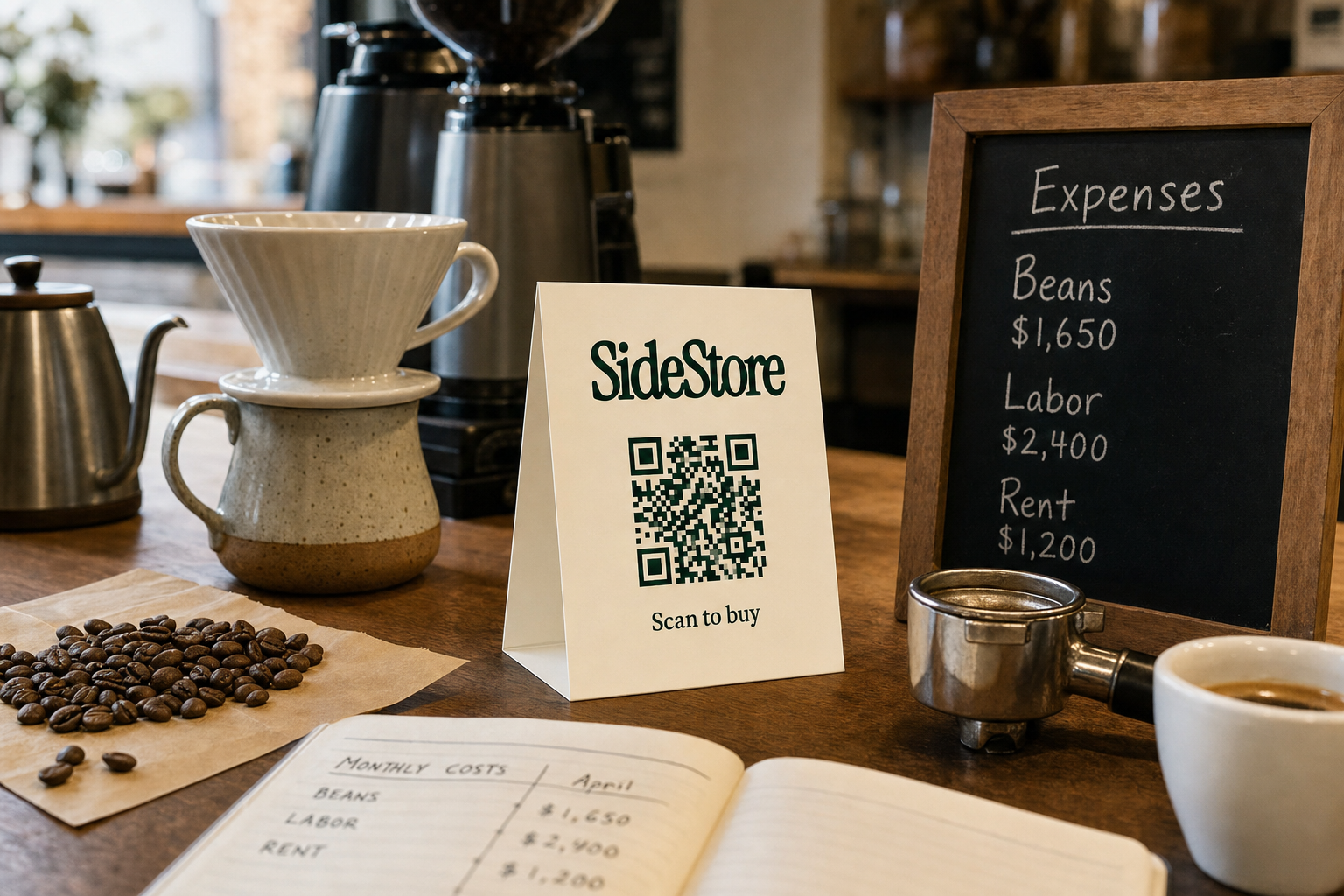
Most of a coffee shop's revenue disappears before it becomes profit. Four cost categories typically account for 85, 95% of what comes in: goods, labour, occupancy, and overheads. The table below reflects industry benchmarks for independent cafes; your numbers will vary by location, lease, and service model.
| Cost Category | Typical % of Revenue | Notes |
|---|---|---|
| Cost of goods sold (coffee, milk, food) | 25, 35% | Lower for drink-only menus; food pulls this up fast |
| Labour (including National Insurance / social charges) | 30, 40% | The single biggest controllable cost for most cafes |
| Rent and occupancy | 10, 15% | High-footfall locations push this toward 20% |
| Utilities (power, water, waste) | 3, 6% | Espresso machines are heavy energy users |
| Card processing and platform fees | 1, 3% | Rises if delivery platforms take a cut |
| Marketing and sundry overheads | 2, 5% | Often underestimated by new operators |
| Net profit | 2, 12% | Wide range; depends on format, lease, and discipline |
Two lines surprise most new operators: labour, which rarely stays below 30% even in well-run shops, and card fees, which compound quietly across thousands of transactions. If your occupancy cost climbs above 15%, margin recovery becomes very difficult without significant volume.
Idle shelf space is a cost that does not appear in this table but belongs here. A display counter or a spare wall unit that earns nothing is square footage your rent is already paying for. Converting that dead space into a revenue line, through consignment retail, for example, turns a fixed cost into variable income.
Margin Benchmarks by Coffee Shop Format
Format affects coffee shop profit margin significantly. A kiosk with low rent and two staff operates on a completely different cost structure than a full-service cafe with table service and a kitchen. The benchmarks below are illustrative ranges based on observed patterns, not guaranteed outcomes.
| Format | Est. Net Margin Range | Key Margin Driver | Main Risk |
|---|---|---|---|
| Kiosk / market stall | 8, 15% | Low occupancy cost | Volume dependency, weather |
| Drive-through | 6, 12% | High throughput, low dwell time | Site lease cost, equipment capex |
| Counter-service cafe (no kitchen) | 4, 9% | Controlled COGS, lower labour | Competition, limited ticket size |
| Full-service cafe with food | 2, 7% | Higher ticket size | Food waste, kitchen labour |
| Specialty roaster-cafe hybrid | 5, 12% | Retail coffee bean sales lift margin | Requires roasting expertise |
Kiosk and drive-through formats benefit from low occupancy cost and fast throughput: you move volume without the rent burden of a high-street unit. Full-service operations with food menus push ticket size up, but kitchen labour and waste eat into the gain.
The roaster-cafe hybrid is worth noting because it demonstrates a principle that applies to any format: adding a retail product line with a different cost structure changes the margin maths. Bagged coffee carries a higher gross margin than a brewed cup once labour is factored in. The same logic applies to sharing retail space with local makers.
Six Levers That Improve a Coffee Shop's Net Margin
The most effective ways to improve your profit margin are not the dramatic ones. They're systematic: raise revenue per square foot, cut waste, reduce low-margin complexity, and add revenue streams that carry low fixed cost. These six levers work across formats.
1. Raise average transaction value, not just footfall
A higher ticket size from the same number of customers costs nothing in rent or extra labour. Upselling a pastry, a bag of beans, or a gift item at the point of sale is the lowest-cost revenue increase available to you.
2. Cut your menu to your highest-margin lines
Every item on a menu costs money to hold in stock, train staff on, and plate. A shorter menu with well-engineered pricing typically delivers better margin than a long one with aspirational dishes dragging down your COGS and complicating your kitchen.
3. Renegotiate your lease or reconfigure your floor plan
Rent is often treated as fixed, but a lease break clause, a sublease arrangement, or a reconfiguration that improves covers-per-square-foot can move margin meaningfully. Even shaving one percentage point off occupancy cost matters at low net margins.
4. Time labour precisely
Labour is your largest controllable cost. Scheduling staff to match actual footfall patterns, rather than running comfortable buffers, is uncomfortable but effective. A 2-hour overstaffed morning shift five days a week is a significant annual cost.
5. Add a zero-inventory retail revenue stream via consignment
This lever deserves plain explanation. Under a consignment arrangement, local makers place their products in your cafe, you display them, and you earn a percentage of each sale automatically when a customer buys. You don't buy the stock, you carry no inventory risk, and you don't manage fulfilment. The SideStore Retail Widget handles checkout (including a scan-to-pay QR that customers use in-person), live stock tracking, and automatic split payouts to you and the maker. Your margin from this revenue line has no associated COGS on your books.
6. Measure margin per seat and per square foot, not just overall
A cafe that knows its revenue per square foot can make rational decisions about layout. If your seating area generates £X and your display counter generates nothing, you have a floor plan problem with a margin fix.
How Retail Products on Consignment Add a Margin Layer Without Inventory Risk
A coffee shop can add a retail revenue stream without buying inventory. Consignment is the mechanism that makes it work: a maker brings their products to your cafe, you place them on display, and you receive a share of each sale. No purchase order, no upfront payment, no stock sitting on your books.
The margin logic is straightforward. If a ceramics maker places ten mugs in your cafe at a retail price of CHF 45 each and you receive 30% of each sale, that's CHF 13.50 per unit in revenue with zero cost of goods on your side. Sell five mugs in a month and you've added CHF 67.50 in net revenue from shelf space that was previously earning nothing.
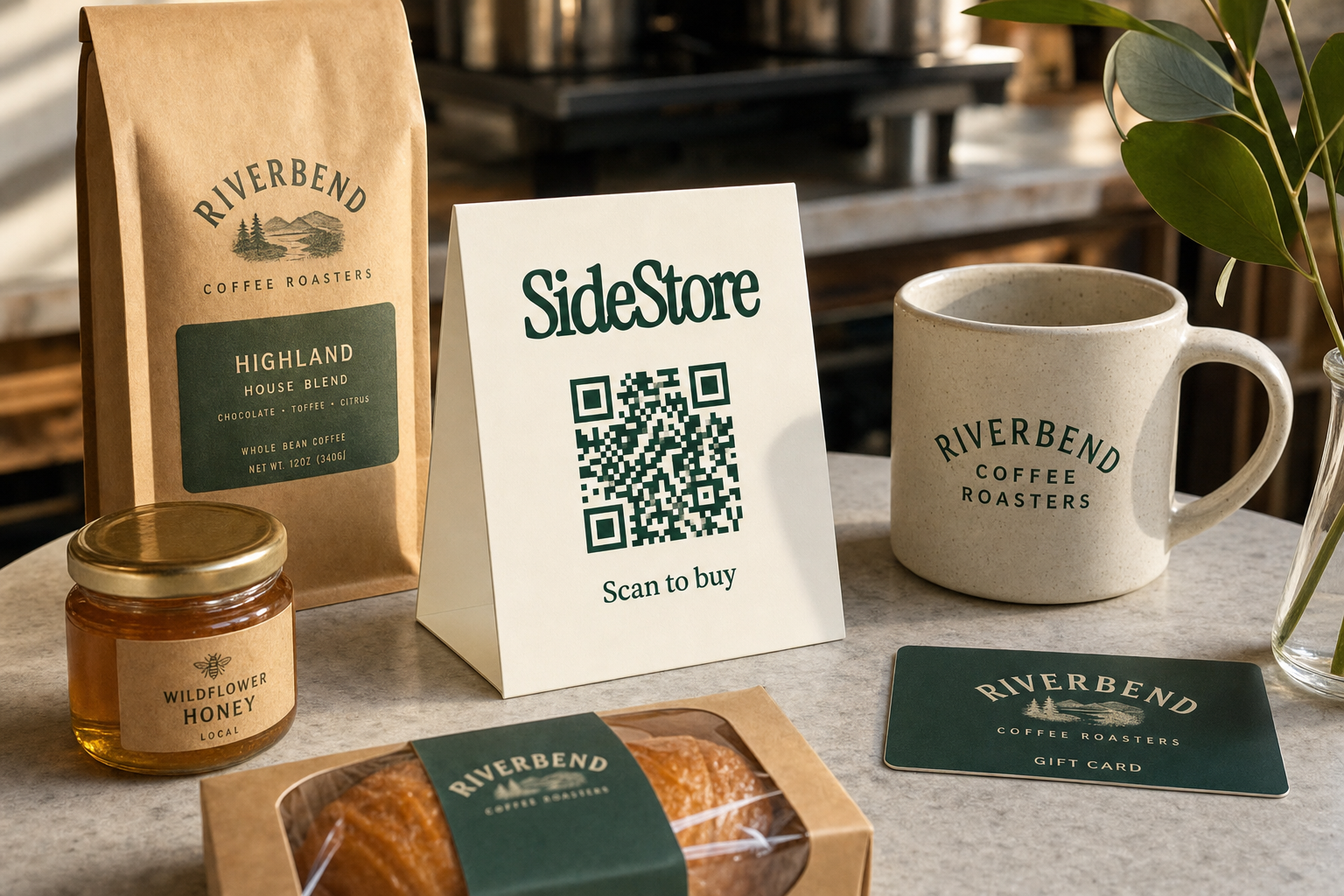
SideStore's Retail Widget is the interface that manages this end to end. It lets a maker or merchant place and manage a product on consignment: the Widget handles checkout through a scan-to-pay QR (one function of the system, not the whole thing), tracks live stock levels, attributes each sale to the correct placement, and runs automatic split payouts so neither party has to chase a spreadsheet.
The margin implication for the cafe is significant: this revenue stream carries no COGS, no inventory risk, and no additional labour beyond the initial display setup. Any play that monetises idle shelf space converts a fixed cost (rent for space you were already paying for) into variable income.
Coffee Shop Revenue Streams: A Margin Comparison
Different revenue streams carry very different margin profiles. The table below compares the main sources of cafe income on gross margin percentage, labour demand, and inventory risk. All figures are indicative benchmarks; your actual numbers will depend on product mix, pricing, and staffing model.
| Revenue Stream | Gross Margin % | Labour Required | Inventory Risk |
|---|---|---|---|
| Espresso drinks | 70, 80% | High (barista time per unit) | Low (short perishable window) |
| Food / kitchen items | 50, 70% | Very high (prep, cooking, plating) | Medium, High (waste exposure) |
| Packaged retail (beans, merchandise) | 55, 70% | Low (shelf display only) | Medium (you own the stock) |
| Consignment retail (third-party makers) | 20, 40% of retail price, no COGS | Very low (display setup only) | None (maker owns the stock) |
| Events / private hire | 60, 80% | Variable | Low |
Consignment retail stands out: the gross margin percentage is lower than a brewed espresso, but you carry no cost of goods and almost no labour. It's the revenue stream with zero inventory risk.
Frequently Asked Questions: Coffee Shop Profit Margin
The most common questions about coffee shop profit margin circle around one core concern: is the business actually viable, and what does a good result look like?
Is a coffee shop profitable?
Yes, but profitability depends heavily on rent, staffing discipline, and volume. Many independent cafes operate on net margins of 3, 7%, which is viable but leaves little room for unexpected cost increases. Shops with lower occupancy costs or additional revenue streams such as consignment retail tend to perform more reliably.
What is a good profit margin for a coffee shop?
A net margin of 6, 10% is considered strong for an independent cafe. Margins above 10% are possible, particularly for kiosks or drive-throughs with low occupancy costs. Margins below 3% usually signal a structural problem with rent, labour, or pricing.
Why do coffee shops fail?
Undercapitalisation and rent miscalculation are the two most common causes. Many operators underestimate how long it takes to build footfall and how much rent consumes at low volumes. Poor menu pricing and labour overstaffing in early months compound the problem quickly.
How can a coffee shop increase its profit margin?
The highest-leverage moves are: reduce labour hours per transaction through scheduling discipline, raise average transaction value through upselling and menu engineering, and add revenue streams with no COGS. Consignment retail is one option that works particularly well because it converts idle shelf space into income without adding complexity.
Do coffee shops make money from retail products?
Yes, and it's an underused margin lever. Packaged coffee beans, branded merchandise, and curated local products all carry gross margins comparable to drinks, often with lower labour per sale. Consignment retail removes inventory risk entirely while still contributing to net revenue.
The Margin Maths in Plain Terms
Coffee shop profit margin is determined by a handful of numbers: rent as a share of revenue, labour as a share of revenue, and what's left after both. Get those two ratios under control and the margin becomes manageable. Let either drift, and a 75% gross margin on your espresso programme won't save the month.
The most underused tool in a cafe's margin toolkit is the space you already have. A shelf, a counter corner, or a display unit that earns nothing is rent you're already paying. Adding a consignment retail placement converts that fixed cost into a variable income line with no stock risk and no extra headcount.
Build a consignment network without opening a store of your own.