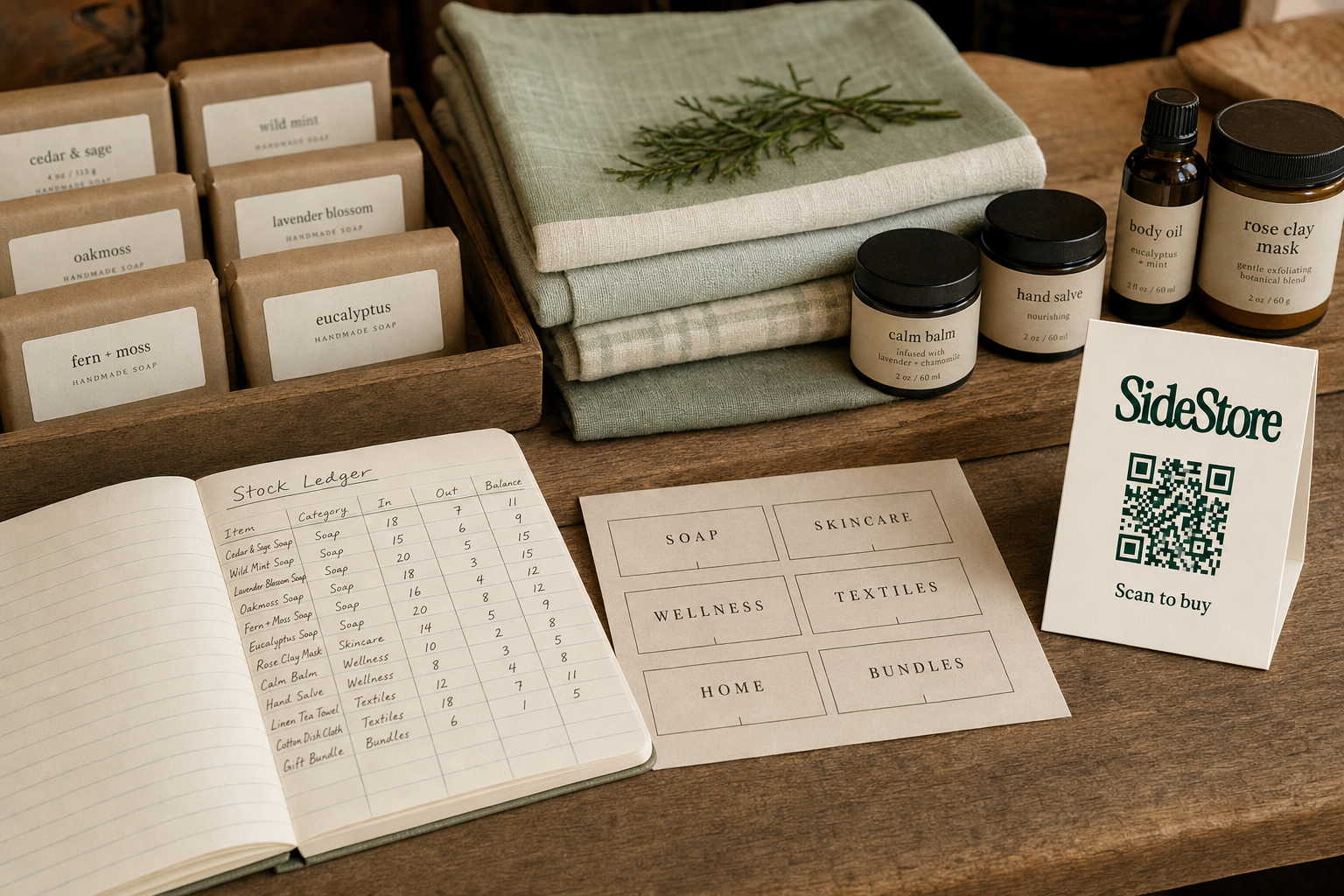
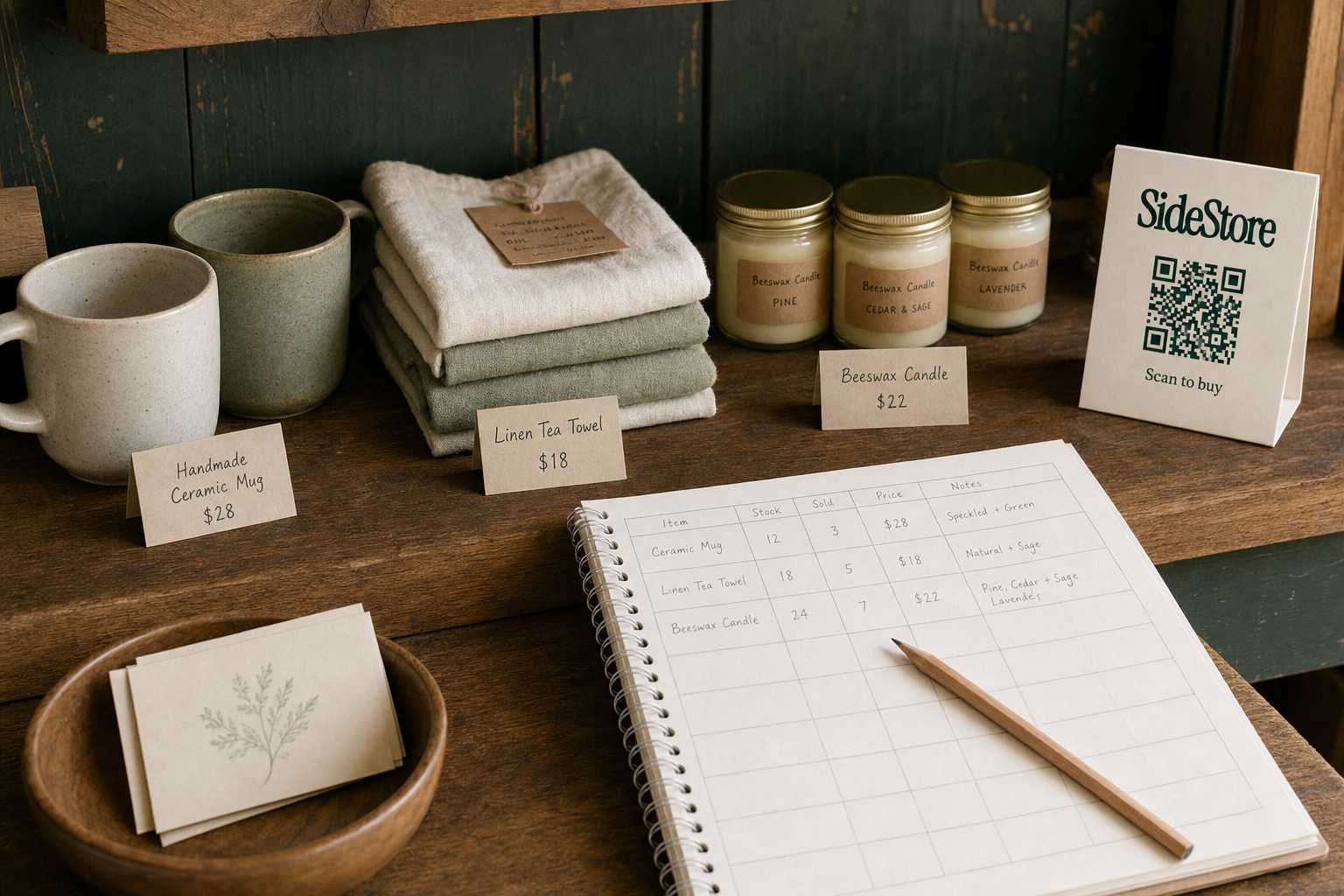
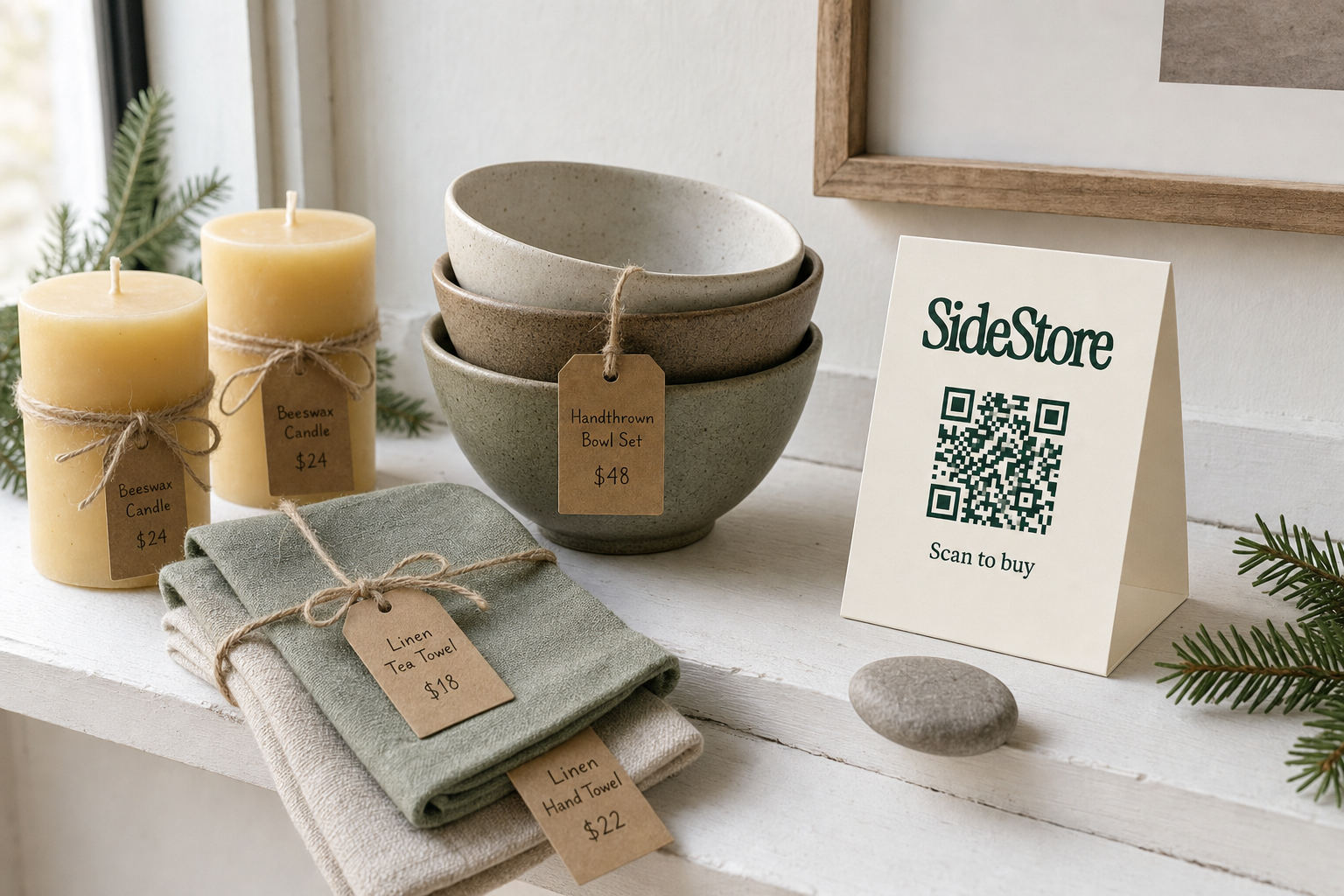
Selling to consignment means placing your products in a merchant's space, a cafe, boutique, hotel, or retailer, and getting paid only when those products sell. No upfront cost to the host. No inventory risk on either side. If you make physical products and want offline distribution without the fixed costs of opening a store, consignment is the most accessible model available. You keep ownership of your stock until the moment of sale. The merchant earns a percentage for providing the shelf space. No lease, no bulk order, no minimum purchase. If you're ready to sell products without opening a retail store, consignment is where most independent makers start. And if you're ready to go deeper on the practical side, sell handmade products in physical stores on consignment covers the full steps.
How Consignment Works: The Core Mechanics
In a consignment arrangement, you place your products with a merchant. The merchant displays them. When a customer buys one, the sale revenue splits between you and the host according to a pre-agreed percentage. Neither party pays for stock upfront. That single principle drives everything else.
Here is the sequence:
- Placement. You bring your products to a merchant space and leave them there on display. This is called a placement, your products are physically in the venue but still legally yours.
- Sale. A customer buys one of your products, either in person or via a scan-to-pay checkout attached to the product.
- Split. The sale revenue divides between you (the maker) and the merchant (the host) according to the agreed percentage. The split is set before the placement begins.
- Settlement. You receive your share of the revenue on a schedule you both agree to, weekly, monthly, or per-sale.
Traditional consignment friction lives in steps three and four. Tracking what sold, calculating the split, and chasing payment. Most makers manage this with a spreadsheet and a follow-up email. This works until you have products in four or five venues simultaneously. If you want to earn from unused shelf space without the administrative overhead, the Retail Widget handles settlement automatically. It tracks each sale per placement and pays out each party without manual invoicing.
Consignment Splits and Pricing: What to Expect
How much you earn per sale depends on two variables: the retail price you set and the split percentage you agree with the merchant. Start by expecting the maker's share to fall between 50% and 70% of the retail price, with the host taking the remainder.
That range shifts by venue type, product category, and how much display effort the merchant puts in. A boutique that actively merchandises your work alongside their own curated selection will reasonably expect a higher share than a cafe that gives you a shelf and moves on.
A worked example. You make ceramic mugs and price them at CHF 40 each. You agree a 60/40 split: 60% to you, 40% to the host.
- Your share per mug sold: CHF 24
- Host's share per mug sold: CHF 16
At that split, you need to sell 10 mugs to earn CHF 240 from a single placement. Have the same product in five venues simultaneously, and 10 units across those five locations yields CHF 240 per week, achievable for a maker producing modest volumes.
The pricing trap: set a retail price that feels comfortable, then calculate the split, then discover your earnings per unit barely cover materials. Work backwards instead. Set the retail price first based on what you need to earn, then negotiate the split. If the merchant's minimum percentage makes the margin untenable, the placement is not worth taking.
Consignment vs. Wholesale vs. Market Stalls: A Side-by-Side
How does consignment compare to other ways of getting your products in front of customers? Three models dominate for independent makers: consignment, wholesale, and weekend market stalls. Each has a different risk profile and earnings structure.
| Model | Upfront cost to maker | Inventory risk to host | Maker earns | Best for |
|---|---|---|---|---|
| Consignment | None | None, host never buys stock | % of retail price per sale (typically 50, 70%) | Makers who want ongoing placements with no upfront cash required |
| Wholesale | Production cost only | Host buys stock and carries the risk | Fixed wholesale price (commonly 40, 60% of retail) | Makers with consistent volume and production capacity |
| Market stalls | Stall fee + transport + time | Maker carries all unsold stock home | 100% of retail price, minus all overheads | Makers who want direct customer contact and full margin |
Each fails differently. Wholesale fails when a retailer over-orders and then discounts your work to clear it, damaging your brand. Market stalls fail when footfall is low, because you've already paid the fee and given up your Saturday. Consignment fails when a merchant is disorganised, stock goes missing, settlement is delayed, and you spend more time chasing payment than making products.
The solution is structure. A clear agreement upfront and a system that tracks sales and settles automatically. For makers exploring alternatives to weekend markets for independent makers, consignment with a well-organised merchant is often the most sustainable ongoing channel.
How to Approach a Merchant About Consignment
Getting a merchant to say yes comes down to making it easy for them to say yes. Merchants are not refusing your products. They're managing risk, time, and shelf space. Address those three concerns directly and the conversation becomes straightforward.
Most merchants evaluate four things when a maker approaches them:
1. Product-space fit. Does your product make sense in their venue? Handmade candles in a boutique hotel lobby: clear fit. The same candles in a sports equipment shop: poor fit. Spend time in the space as a customer before you approach. Look at what they already stock. If your product sits naturally alongside it, that's your opening line.
2. Risk and effort. The merchant needs to know they take on zero financial risk and minimal operational effort. Say this plainly: "You don't buy the stock. You don't handle ordering or returns. You display the product and earn a share of every sale." How boutique shops evaluate local product placements shows what the host is really weighing.
3. Logistics. How will stock be replenished? How will sold items be tracked? Who handles the paperwork? Merchants say no when these questions hang in the air. Come with a proposal, not a request. Tell them how you'll manage restocking, what the check-in looks like, and how settlement will happen.
4. Terms clarity. Merchants who have had bad consignment experiences before got burned by vague agreements. Bring a simple written summary of the split, the review period, and the exit terms. It signals you're professional and that the arrangement is low-risk. How cafes think about consignment shelf space shows the host perspective, more practical than most makers expect.
What a Consignment Agreement Should Cover
Before you leave your products with any merchant, something needs to be in writing. A handshake works until it doesn't. A written consignment agreement protects both parties and removes the ambiguity that causes most disputes.
Six clauses belong in every agreement:
Product description and quantity. List exactly which products are being placed, how many units, and at what retail price. Include SKUs or descriptions precise enough to avoid confusion at settlement.
Split percentage. State the maker's percentage and the host's percentage explicitly. "60/40 in favour of the maker" is clear. "We'll sort it out at the end of the month" is not.
Settlement schedule. Specify when and how the maker gets paid, weekly, monthly, per-sale. Note the payment method. Ambiguity here causes most consignment disputes.
Stock tracking and reporting. Who records what sells? How are discrepancies resolved? If you're using the Retail Widget, this is automatic. If not, agree on a manual process before the products go in.
Liability for loss or damage. If a product is broken, stolen, or goes missing, who bears the cost? This varies by merchant and by product value. Clarify it before placement.
Review period and exit terms. How long is the initial placement? What's the notice period if either party wants to end the arrangement? Can the maker retrieve unsold stock, and how much notice is required?
A brief disclaimer: this article is practical guidance, not legal advice. For high-value placements or complex arrangements, consult a legal professional in your jurisdiction.
Modern Consignment: How the Retail Widget Handles the Hard Parts
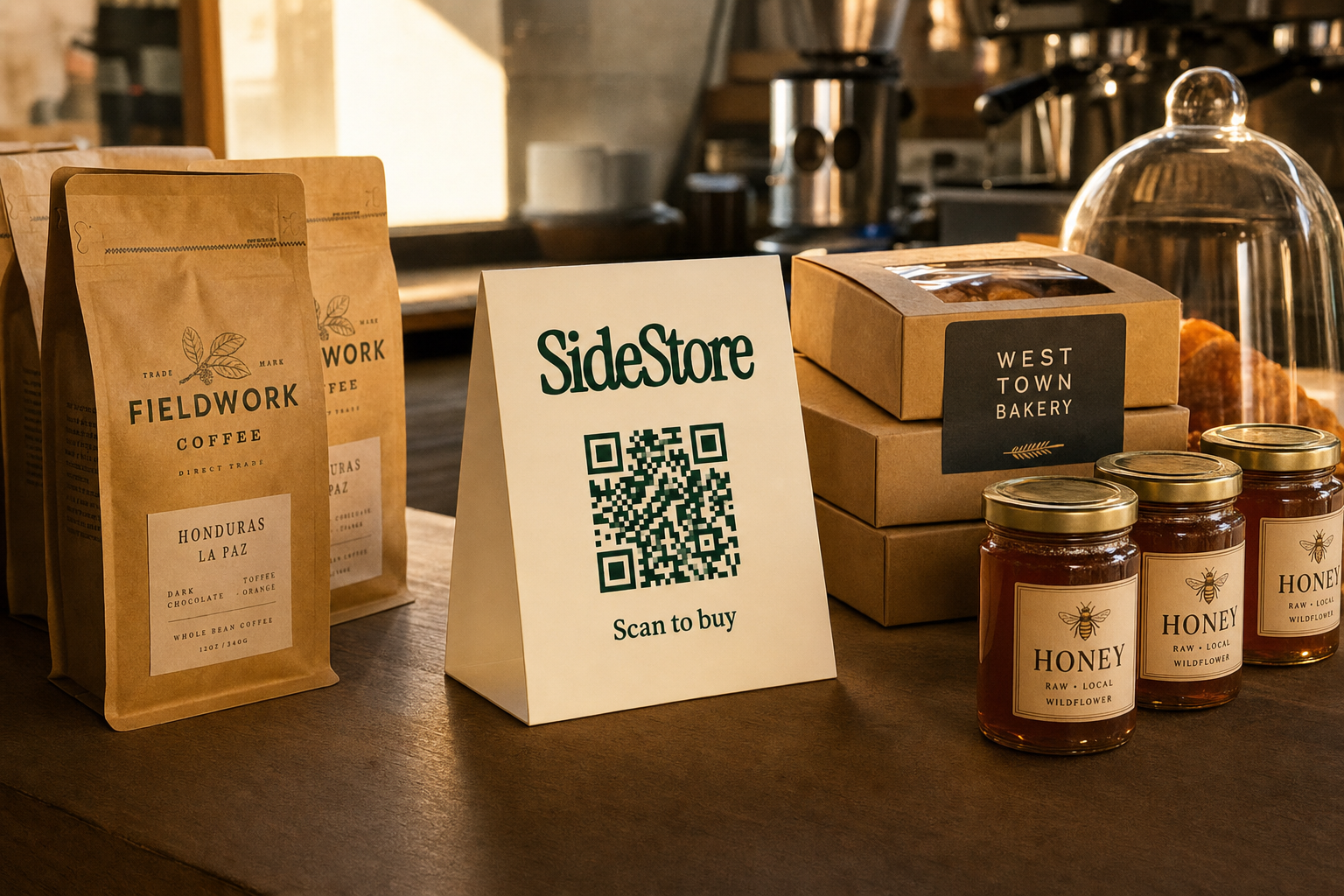
Traditional consignment and modern consignment look different in practice. The model is the same, place products, earn on sale, split the revenue, but the friction in the traditional version accumulates.
Three pain points make traditional consignment hard to scale:
Manual stock tracking. You rely on the merchant to record each sale accurately. Across two or three venues, small errors compound. You discover a discrepancy only at settlement, when it's difficult to trace.
Manual invoicing and settlement. At the end of each period, you calculate what sold, what each party is owed, and send an invoice. The merchant pays when they get around to it. Cash flow becomes unpredictable.
No placement attribution. When you have products in multiple venues, you often don't know which location is performing and which isn't. You're restocking everywhere or pulling stock from the wrong place.
The Retail Widget addresses each of these directly. Live stock tracking records every sale in real time, per placement. Automatic split settlement calculates and distributes each party's share without manual invoicing. Placement attribution shows you exactly which venue is selling, so you deploy stock where it works.
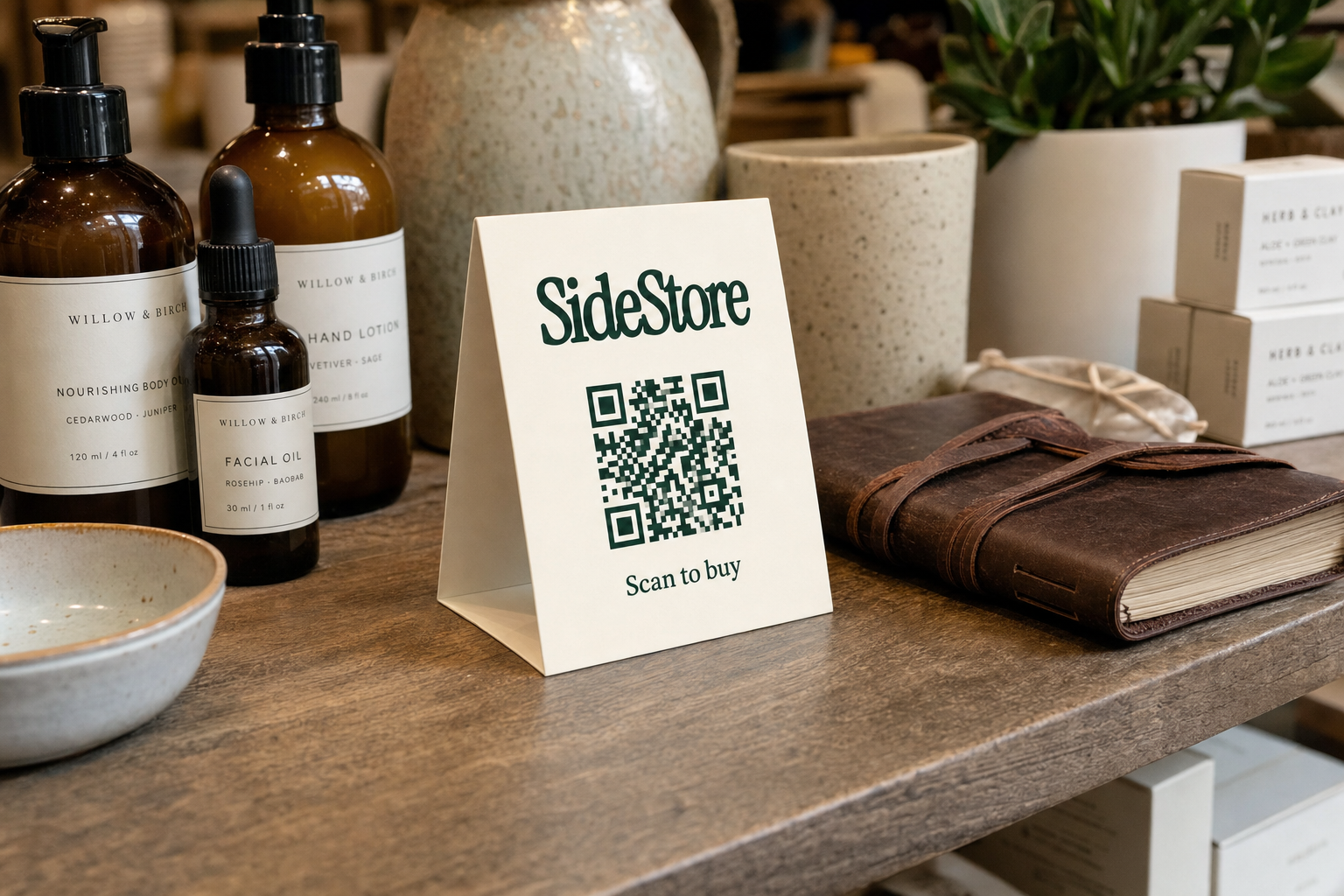
The scan-to-pay QR checkout, one function within the Retail Widget, lets a customer scan, pay, and complete a purchase without the merchant's involvement in the transaction. See how the SideStore QR card and scan-to-pay checkout work for a plain-language explanation. For makers managing several placements or for high-traffic retailers thinking about consignment placements, this removes the operational overhead that makes traditional consignment impractical at scale.
Which Merchant Spaces Are Worth Approaching?
Not every venue with a spare shelf is a useful placement. The right merchant space matches your product, has relevant customer traffic, and has a host open to consignment as a model.
Five venue types work consistently well for independent makers:
Cafes with unused shelf space. High daily footfall, relaxed browsing behaviour, and customers already in a spending mindset. Cafes with unused shelf space are among the most approachable first placements for new makers.
Boutiques. Curated retail environments where customers expect to discover independent brands. Product-fit matters more here, but conversion is strong when it's right.
Hotels and lobby retail. Guests have time, they're exploratory, and they're often looking for locally made gifts. Hotels and lobby retail space sustains premium pricing better than most venues.
Bed and breakfasts. Intimate settings where the host's personal recommendation carries real weight. Bed and breakfasts with a small retail corner suit makers whose story is part of the product.
High-foot-traffic retailers. Bookshops, garden centres, farm shops, venues where customers browse and where your product category fits the existing selection.
Your First Consignment Placement: A Practical Checklist
Before your first placement goes live, you need eight things in order. The first placement takes more effort than subsequent ones, you're building the template. Every placement after gets faster.
- Set your retail price. Work backwards from your target margin. Factor in the split before you agree to anything.
- Identify two or three target venues. Choose venues where your product fits the existing offer and the customer profile makes sense.
- Prepare a product sample. Bring a physical example of what you're placing. Merchants say yes to things they can hold.
- Draft a one-page placement proposal. Cover the split you're proposing, your restocking plan, and your settlement preference. Keep it to one page.
- Prepare a consignment agreement. Use the six clauses above as your checklist. Have it ready to share after the initial conversation.
- Set up your stock tracking. Whether you use the Retail Widget or a spreadsheet, have the system ready before the products go in, not after.
- Label your products clearly. Price, product name, and your maker name or brand. If you're using a scan-to-pay QR card, attach it or arrange for the merchant to display it alongside the placement.
- Agree a first review date. Set a specific date to check in, review what's sold, and discuss whether the placement is working for both parties.
Do not skip the review date. It's the moment that turns a one-off placement into an ongoing relationship.
Start With One Shelf, Build From There
Selling to consignment is a practical, low-risk way to get your products into real-world spaces without fixed costs or bulk orders. Find one merchant whose space fits your product, negotiate a clear split, put a written agreement in place, and get your first placement live. Everything else, multiple venues, automated settlement, placement attribution, comes after that first placement proves the model works for you.
How to sell handmade products in physical stores on consignment covers the next steps.
Build a consignment network without opening a store of your own.