title: Selling Consignment description: Learn how selling consignment works, how splits are calculated, and how to place your products in cafes, boutiques, and hotels without upfront costs or inventory risk. date: 2026-07-29 category: Makers tags: [consignment, selling consignment, makers, placements, Retail Widget, split payouts] primaryKeyword: selling consignment
Consignment is simple in concept: you place your products with a merchant, they display them, a customer buys one, and you both get paid. No upfront cost to the host. No inventory purchase. No fixed retail lease for you. You keep ownership of your stock until the moment of sale.
For makers, this solves the actual problem most of you face: how do you reach customers in physical retail without signing a lease, without paying for booth rental at every weekend market, without selling to a wholesale buyer at half your markup? Consignment gives you offline distribution on your terms. You place products, the merchant displays them, the split happens at the point of sale.
This guide covers everything you need to know: how the model works, how splits are calculated, how to find and pitch venues, what belongs in a written agreement, and how to manage stock and payments across multiple placements. If you are new to consignment, start with what selling on consignment means before continuing.
How Selling Consignment Works
In consignment, you place your products with a merchant. The merchant displays them. A customer buys one. The sale proceeds are split between you and the host according to a percentage you agreed on in advance. You are not selling to the merchant. You are selling through them.
The transaction loop is straightforward. You supply a quantity of products to a venue. Those products sit on the merchant's shelf, in their cabinet, or on their counter. A customer selects a product and pays. The payment splits: you receive your agreed share, the merchant receives theirs. At the end of a cycle, whether weekly or monthly, unsold stock is either replenished, swapped, or returned to you.
The trade-offs are clear. The merchant takes on no inventory risk and no upfront cost, which is why they agree to host. You retain ownership of unsold stock, which means you carry the cost of goods throughout the placement. If a product sits for three months and never sells, that dead stock is your loss. Your cash flow depends entirely on sales velocity.
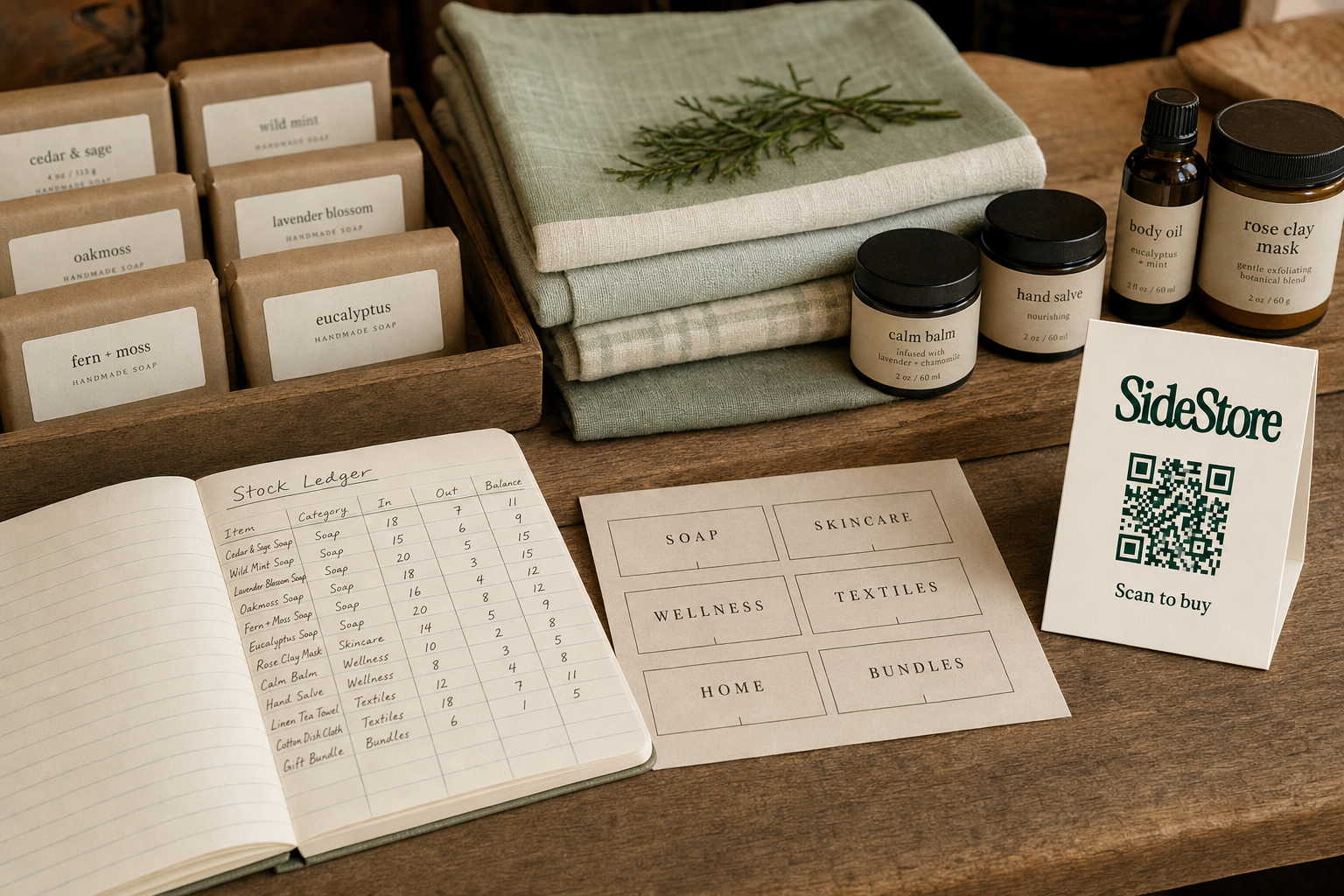
Traditional consignment has always involved friction: handwritten stock sheets, manual payment reconciliation, spreadsheets that don't sync, and the persistent problem of not knowing what is actually on the shelf at any given moment. Digital tools now eliminate that paperwork, though the model itself has not changed.
If you want to sell products without opening a retail store, consignment is the most direct route. You access the merchant's existing customer base. You skip their overhead entirely.
Understanding the Consignment Split
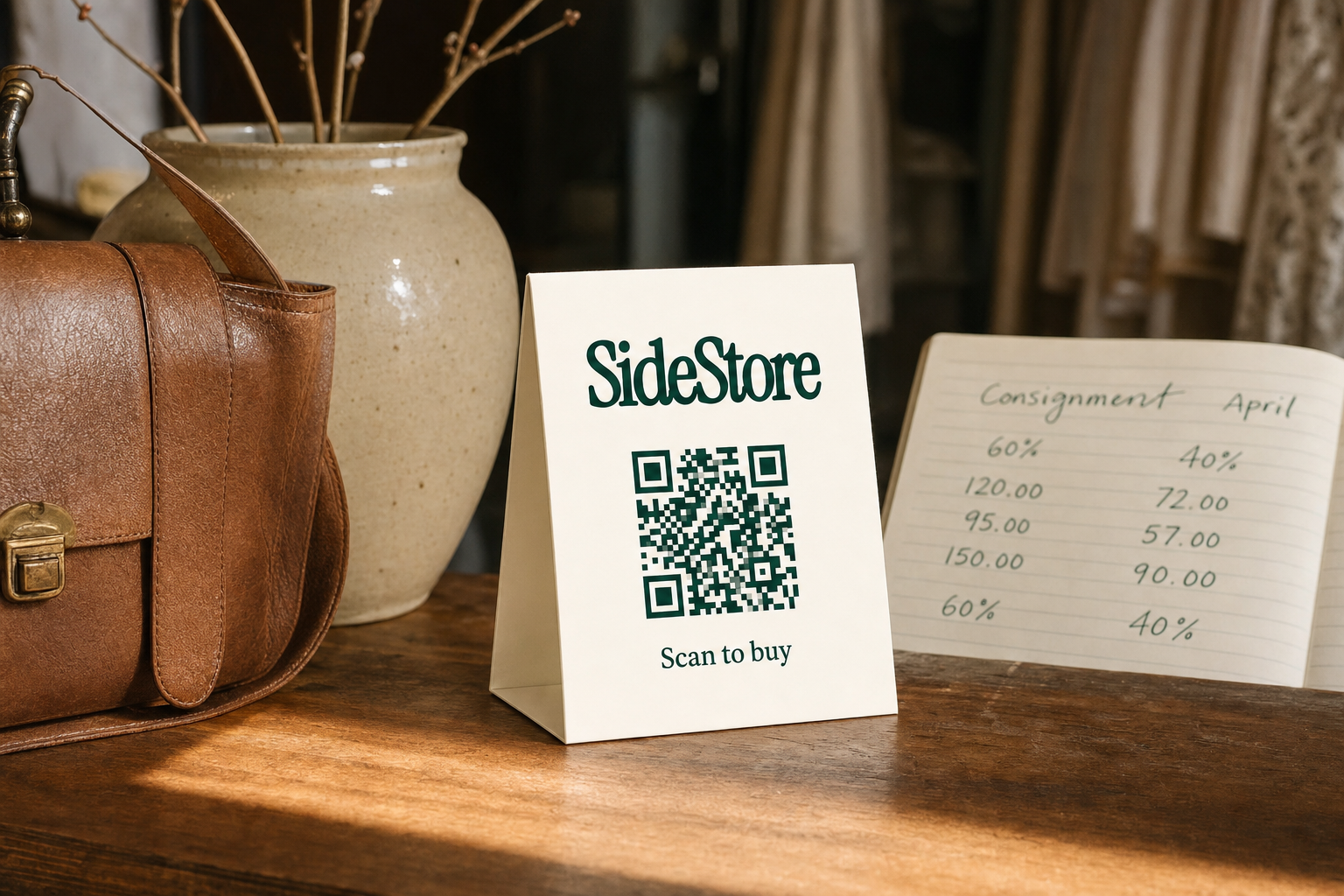
The consignment split determines what percentage of each sale goes to you and what percentage goes to the merchant. Typical arrangements run between 60/40 and 70/30 in your favour, though every negotiation is different and no universal standard exists.
What shifts the split in your direction:
- Product price point. Higher-ticket items often command better maker splits because the merchant's absolute earnings are larger even at a lower percentage.
- Category and turnover rate. Fast-moving products are more attractive to hosts, which gives you leverage.
- Venue prominence. A high-footfall boutique hotel lobby can justify a higher host cut than a quiet side-street cafe.
- Exclusivity. If you agree not to place the same product with a competing venue nearby, some merchants will offer a better split in return.
- Your track record. A maker with evidence of strong sell-through at a previous placement negotiates from a stronger position than one who is pitching cold.
Worked example: Your ceramic mug retails for CHF 40. You agree on a 65/35 split. The merchant earns CHF 14 per unit sold. You earn CHF 26. If you place 20 mugs and 15 sell in a month, your earnings from that placement are CHF 390. The merchant earns CHF 210 for hosting the display.
When you scale to three or four venues, manually reconciling those splits becomes its own job. SideStore's Retail Widget handles automatic split settlement at the point of sale, so you do not chase each merchant for payment individually.
For more on negotiating terms, read selling to consignment shops.
Pros and Cons of Selling Consignment: A Summary
Consignment is well-suited to makers who want physical distribution without fixed retail costs, but it is not the right model for every product or every stage of a business. Here is how it stacks up:
| Dimension | For Makers | For Merchants |
|---|---|---|
| Upfront cost | None (you supply stock, not cash) | None (no inventory purchase) |
| Inventory risk | You carry unsold stock | Zero |
| Cash flow timing | Paid after sale, not upfront | Earn at point of sale |
| Admin effort | Moderate to high without tools; low with Retail Widget | Low |
| Distribution reach | Access existing foot traffic in multiple venues | Earn from idle shelf space |
| Stage fit | Best for early-stage makers testing demand | Best for venues with free display space |
The biggest advantage of consignment for makers is speed of access. You can place products in a working retail environment this week, with a real customer base, without a lease or a wholesale negotiation. For merchants, the advantage is equally clean: revenue from shelf space that was already sitting empty.
The biggest risk for makers is cash flow lag. You carry the cost of production before any sale is confirmed. If your unit economics are tight and your product does not move quickly, consignment can quietly drain working capital. Consignment tends to fail on unit economics when the product price is low, the merchant split is high, and sell-through is slow. Know your numbers before you place.
For context on other distribution options, see alternatives to weekend markets for artists and small brands.
How to Find and Pitch the Right Venues
The best venues for consignment are spaces where your target customer already spends time and where the host has display capacity they are not fully using. Cafes, boutique hotels, bed and breakfasts, and independent boutiques consistently work well.
Four steps to pitch a venue:
- Research fit before contact. Walk in. Look at the space, the clientele, and whether similar products already sell there. A ceramic mug belongs in a specialty coffee shop, not a fast-food counter. Alignment matters more than foot traffic alone.
- Lead with the host benefit. Your pitch is not "will you sell my products?" It is "I'd like to place some products here on consignment, no cost to you, no stock to buy, and you earn a cut of every sale." That framing removes the perceived risk immediately.
- Bring a concrete proposal. Name the products, the retail price, the split you are proposing, and the trial period. A four-week trial with six units is far easier to say yes to than an open-ended arrangement.
- Follow up once. If you get no reply within a week, follow up with one short message. If there is still no interest, move on. Rejection is not a signal that consignment does not work; it is a signal that this venue is not the right fit right now.
Three criteria for evaluating a venue:
- Customer alignment: does the venue attract people likely to buy your product?
- Display quality: is there a dedicated, visible space, or will your products be buried?
- Host reliability: does the venue have stable opening hours and an owner or manager you can communicate with?
A multi-venue strategy is more resilient than dependence on a single placement. Aim for three to five venues across different location types.
Read more about how cafes can earn from unused shelf space, how hotels can turn lobby space into retail revenue, and how boutique shops add local products without buying inventory.
What to Put in a Consignment Agreement
A consignment agreement needs to define ownership, payment terms, and what happens to unsold stock before you leave a single product at a venue. A handshake is not sufficient.
Five non-negotiable clauses:
- Ownership statement. Products remain your property until sold. This matters if the merchant disputes a payment or if their business faces creditor action.
- Split percentage and payment schedule. State the exact percentage, the payment frequency, and the payment method. Vague terms produce delayed payments.
- Stock count and replenishment process. Agree on how stock is counted at placement, how discrepancies are handled, and how restocking is requested.
- Product care and liability. Who is responsible if a product is damaged, stolen, or lost on the merchant's premises? Define this in writing.
- Termination and return clause. Either party should be able to end the arrangement with reasonable notice (two weeks is common) and unsold stock must be returned in the condition it was placed.
The overlooked clause: venue closure. What happens if the merchant closes suddenly, temporarily, or permanently? Name a procedure for stock retrieval and confirm that outstanding sales must be settled before closure.
SideStore's Retail Widget provides placement attribution and live stock tracking, which gives both parties a shared, accurate record of what is on the shelf at any time. That data becomes your source of truth if a dispute arises.
Get the terms right before placement. For more detail on what to negotiate when selling to a consignment shop, see that guide. Always seek legal advice specific to your jurisdiction; consignment law varies, and no article replaces a qualified professional.
Managing Stock and Getting Paid Across Multiple Placements
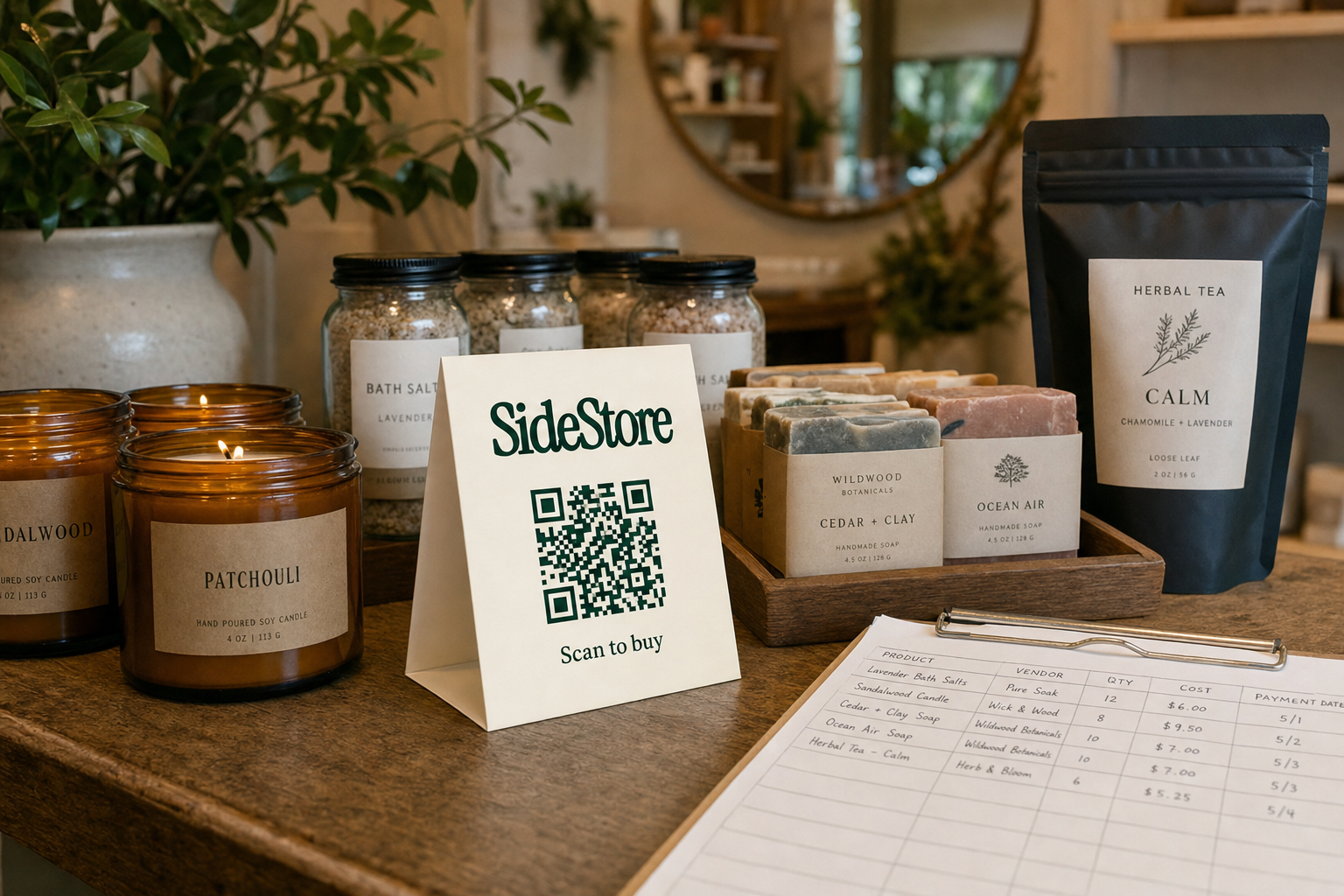
Tracking stock and getting paid across multiple venues is the operational challenge that stops most makers from scaling beyond one or two placements. The core problems are the same every time: stock discrepancies you cannot verify remotely, payment chasing that takes more time than the sale was worth, and no per-venue performance data to guide decisions.
SideStore's Retail Widget addresses each one.
Stock discrepancies are resolved through live stock tracking. The Retail Widget records every sale at the point of transaction, so your stock count updates in real time across every active placement. You do not need to call each merchant to find out what is left.
Payment chasing is removed by automatic split payouts. When a sale occurs, the split is calculated and settled automatically. You do not invoice the merchant. You do not follow up. The payment happens as a function of the transaction.
Per-venue performance data is captured through placement attribution. The Retail Widget records which venue generated each sale, so you can see which placements are performing and which are not. That data is the most useful asset you have when deciding whether to restock a venue, renegotiate terms, or replace a low-performing placement with a better one.
The scan-to-pay mechanism is part of how this works in practice. You can attach a SideStore QR card to your product, or a merchant can display a single card for all products in the placement. A customer scans, pays, and the transaction is recorded. The QR checkout is one function of the Retail Widget, not the whole product.
Read more about how the SideStore QR card works and how B&Bs run a small retail corner on consignment.
Use data from your first placement to make your second and third placements smarter. Which products sold fastest? Which price point performed? Which customer context generated the most scans? Answer those questions from placement one and you go into placement two with evidence, not guesswork.
Frequently Asked Questions About Selling Consignment
Most makers misunderstand consignment in one of two ways: they assume the split is fixed by some industry standard, or they assume ownership transfers when they drop off stock. Neither is true.
What is a typical consignment percentage for handmade products?
Splits for handmade products commonly fall between 60/40 and 70/30 in your favour, but there is no industry-wide standard. The split you achieve depends on your product category, the venue's foot traffic, your sell-through history, and how you structure the negotiation. Read the full guide to what selling on consignment means for more context on how splits are structured.
Who owns the products while they are on consignment?
You do. The maker retains ownership of every unit until the moment of sale. This is the defining feature of consignment. The merchant displays and sells on your behalf; they do not buy stock from you.
What happens to unsold consignment stock?
Unsold stock is returned to the maker at the end of the agreed placement period, or when either party terminates the arrangement. Your consignment agreement should specify the return procedure, the condition expectations, and the timeline.
Can I sell the same product in multiple venues at once?
Yes. Selling the same product across multiple venues simultaneously is one of the main advantages of consignment over wholesale. The practical requirement is the ability to track stock and sales per venue, which is where tools like SideStore's Retail Widget become essential. If you want to understand how to start selling without holding inventory across channels, that guide covers the broader model.
Start Placing: Your First Consignment Step
The most useful next step is also the most specific one: identify one venue this week and propose a short trial. One venue. A defined number of units. A four-week window. That is enough to generate real data on sell-through, customer fit, and the operational reality of your first placement.
Consignment gives you offline distribution without fixed costs, and each placement you add builds a network you run from one dashboard.
When you are ready to go deeper, read a deeper guide to selling through consignment or explore other distribution alternatives for makers.