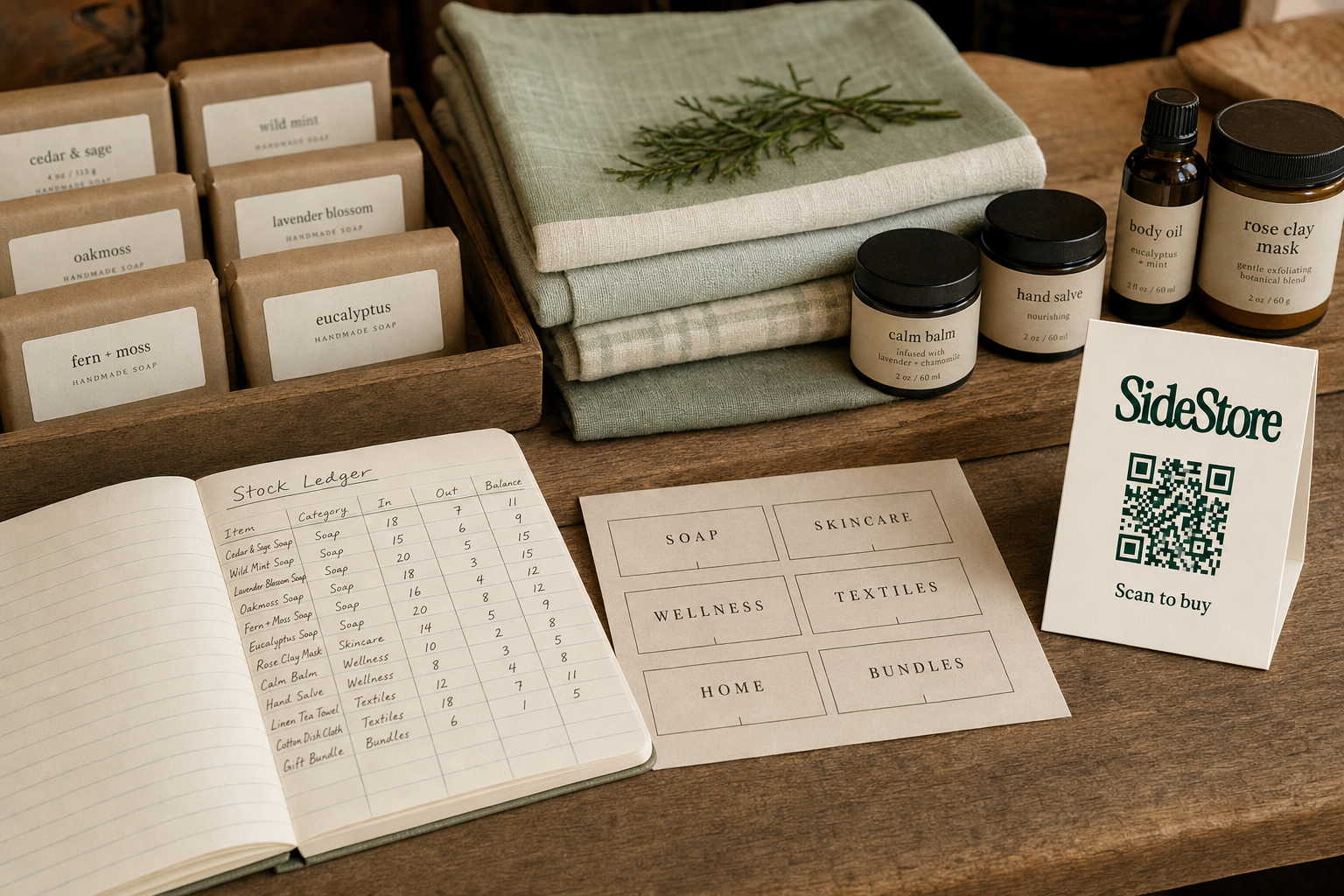
Consignment means you place products in a merchant's space and get paid only when they sell. No upfront cost to the host. No inventory risk on either side. You keep ownership of your stock until the moment it sells. The merchant earns a percentage of each sale for hosting your products.
That is the model in one sentence. If you want terminology broken down further, the selling on consignment article covers every nuance. If you are looking at the broader picture of physical distribution without a lease, the guide on how to sell products without opening a retail store maps out your full landscape.
This guide walks you through how consignment actually works, what splits to expect, how it compares to wholesale and weekend markets, where to find the right merchant spaces, and how to manage multiple placements without losing track.
How Selling Through Consignment Works
Consignment follows a clear sequence: you supply the products, a merchant hosts them, a customer buys, and the proceeds split according to a percentage you both agree on beforehand. The part that used to make this painful, tracking stock across venues, chasing payments, reconciling spreadsheets, the Retail Widget handles for you.
Here is what the process actually looks like.
1. Model the placement. Before you place a single unit, you use the Retail Widget to set your product price, define the consignment split, and specify how many units you are placing. The Widget shows you the exact maker payout and host cut in real numbers before anything goes live.
2. Agree terms with the merchant. You bring your modelled placement to a merchant who has free shelf or counter space. Because the Widget has already done the maths, the conversation is concrete: "Here is the product, here is the price, here is your cut per sale."
3. Place the product and activate the QR. Your products go on the merchant's shelf. You can print the SideStore QR code card and attach it directly to your own product, or the merchant can display a single SideStore card for all the products in the placement. Either way, the scan-to-pay QR is one function of the Retail Widget, not the entire product. To see exactly how the card works in practice, read how the SideStore QR card works.
4. Customer scans and buys. A customer picks up your product, scans the QR, pays on their phone. No cashier involved. Stock updates live in the Retail Widget dashboard the moment the transaction clears.
5. Split payout settles automatically. The Retail Widget calculates the split and routes your share and the host's share without either of you having to chase an invoice or reconcile a spreadsheet at month end.
6. Restock or redistribute. Live stock tracking tells you when a venue is running low. You restock that placement or move units from a slower venue to somewhere with better throughput. For the full mechanics of placing products with a merchant, the selling to consignment article goes deeper.
Understanding the Consignment Split
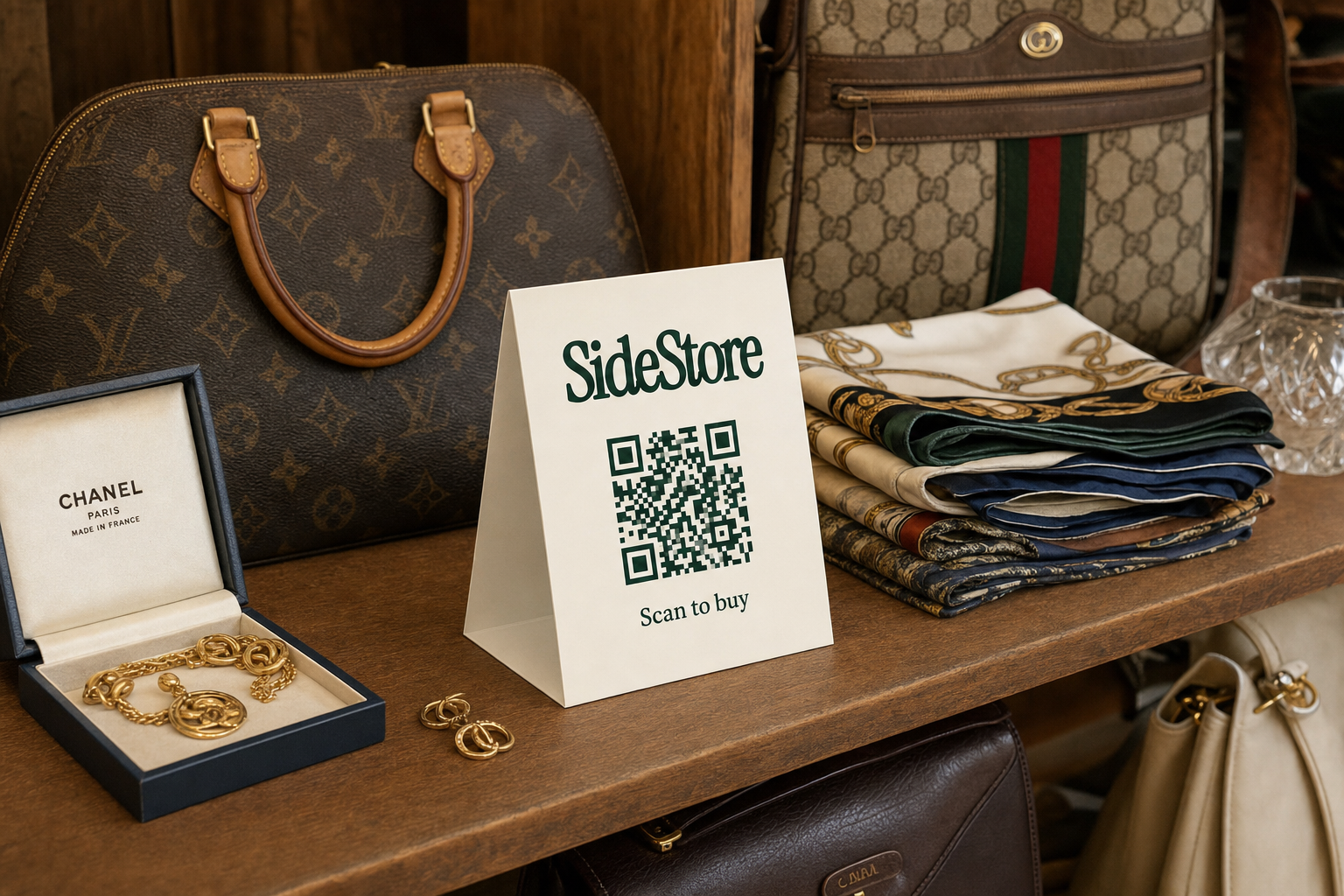
The consignment split is the percentage of each sale that goes to you versus the percentage that goes to the host merchant. Typical splits run 60 to 80 percent to the maker and 20 to 40 percent to the host, though the exact figure depends on product category, venue type, and how much display effort the merchant provides.
You set the split. That matters. The Retail Widget does not impose a fixed rate. You define the percentage when you model your placement, and you see immediately what your per-unit payout will be at that price. If the numbers do not work for your cost structure, you adjust the price or the split before anything goes live. Control stays with you.
When a sale happens, the Retail Widget settles the split automatically. Your share goes to you. The host's share goes to them. There is no invoice to raise, no payment to chase, and no end-of-month reconciliation call. Both parties can see their running balance in the dashboard.
A few things worth knowing before you set your split:
Price for the split from the start. Many makers price for direct sales and then discover consignment eats their margin. Build the host percentage into your retail price before you agree to anything. The guide on how to sell handmade products in physical stores on consignment covers margin planning in detail.
Higher host cut can mean better placement. A merchant who earns 35 percent per unit has more incentive to display your product prominently than one earning 20 percent. This is a trade-off worth modelling, not avoiding.
Venue type shapes expectations. A boutique with high footfall and a curated aesthetic often expects a larger percentage than a cafe adding a small retail corner. Knowing what a typical boutique inventory arrangement looks like helps you negotiate from an informed position.
Consignment vs. Wholesale vs. Weekend Markets: A Plain Comparison
The three most common distribution options for independent makers are consignment, wholesale, and weekend markets. Each has a different risk profile, margin structure, and operational demand.
| Distribution channel | Upfront cost | Stock risk | Margin kept by maker | Admin burden | Scalability |
|---|---|---|---|---|---|
| Consignment (SideStore) | None | None, you own stock until it sells | High (typically 60, 80%) | Low, Retail Widget handles checkout, stock tracking, and split payouts | High, one dashboard for unlimited placements |
| Wholesale | None to maker; retailer buys stock upfront | Retailer bears stock risk after purchase | Low (typically 40, 60% of retail, often less) | Moderate, invoicing, minimum order negotiations, returns | Moderate, dependent on retailer relationships |
| Weekend market | Stall fee paid upfront | You bear all unsold stock | High, you keep full sale price minus fees | High, every event requires your physical presence, setup, teardown | Low, bounded by how many events you can attend |
The trade-offs are real on all sides.
Wholesale offers the simplest transaction once a retailer is on board: you ship, they pay. But the margin hit is steep, and getting stocked requires meeting minimum order thresholds that not every maker can meet early on.
Weekend markets let you keep more of the sale price, but your income is capped by your physical presence. You cannot be in three cities on the same Saturday. Costs accumulate across stall fees, travel, and time away from making.
Consignment sits in the middle: no upfront payment, no inventory risk, and a margin that stays healthy if you price correctly. The historic downside, tracking multiple venues and chasing split payments, disappears when the Retail Widget handles it. For a broader view of your options, the article on alternatives to weekend markets for artists and small brands is worth reading alongside this one, as is the overview of selling without holding inventory.
Finding Merchant Spaces for Your Consignment Placement
The best merchant spaces for consignment are venues with consistent footfall, a customer base that aligns with your product, and physical space that is currently idle. Cafes, boutiques, hotels, and bed and breakfasts all fit that description, and each has its own reason for saying yes.
Cafes already have customers waiting, browsing, and lingering. A shelf near the counter or a display by the window turns idle space into passive revenue. Cafes earn from a product they never had to buy, and the customer discovers something new while waiting for their order. Read how cafes think about unused shelf space to understand the host perspective.
Boutiques look for products that complement their existing range without requiring a wholesale buy. Consignment lets a boutique test a new maker's line at zero inventory cost. See boutiques adding local products without buying inventory for the full picture.
Hotels have lobby and reception areas with captive guests who have both time and spending intent. A well-placed consignment display in a hotel lobby reaches guests at exactly the moment they want a local keepsake. The article on how hotels use lobby space for retail shows how those venues think about it.
Bed and breakfasts are intimate spaces where guests are already primed to appreciate handmade and local products. A small retail corner fits naturally. More on this in the guide for bed and breakfasts with a retail corner.
When you approach any of these venues, a one-sentence pitch works well: "I make [product], I place it on your shelf on consignment, you earn a percentage of each sale, and the Retail Widget handles checkout and payouts so there is no admin on your side." That last part answers the merchant's most common objection: "It sounds like extra work." It is not.
Managing Multiple Placements Without Losing Track
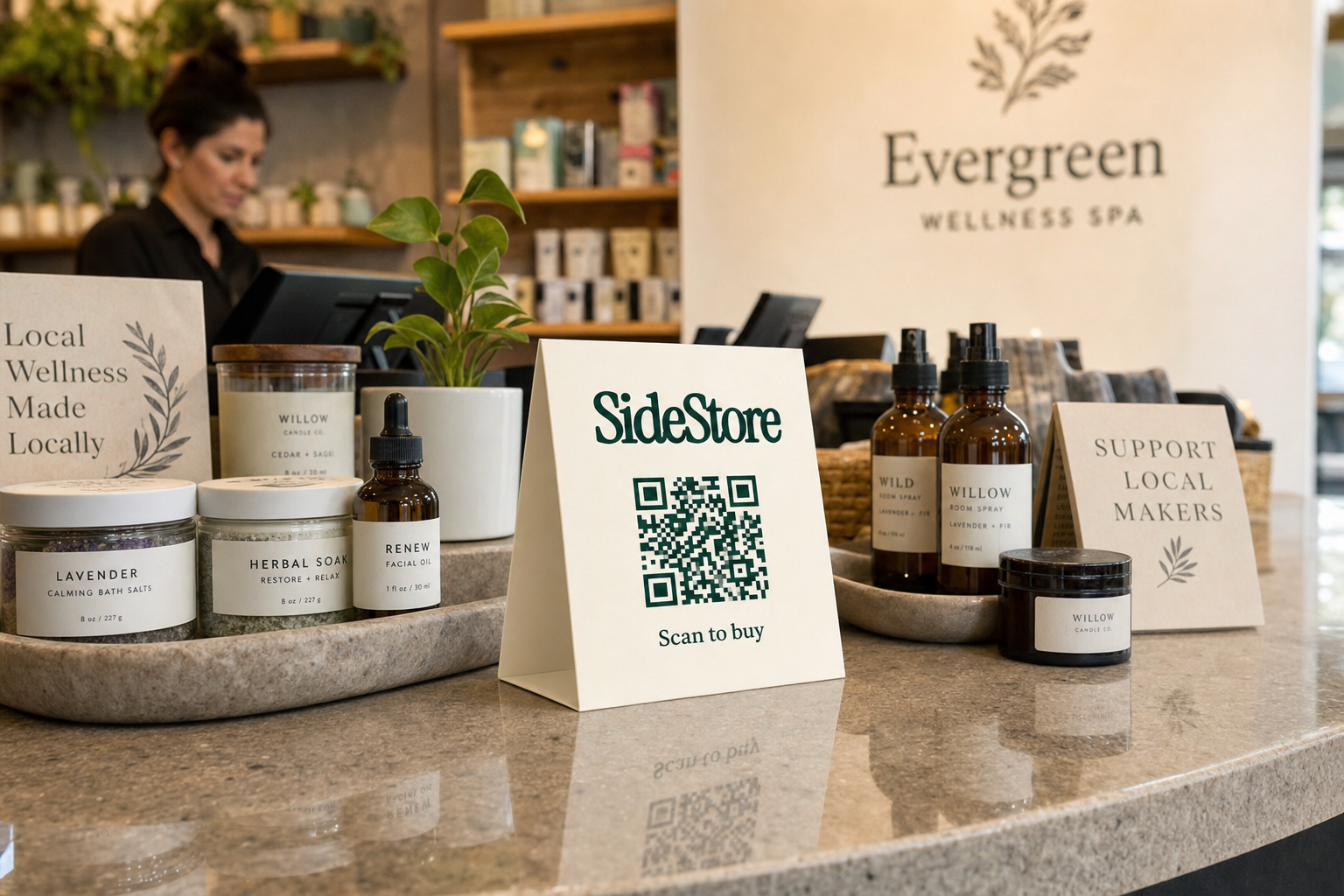
The moment you have products in more than one venue, traditional consignment becomes a spreadsheet problem. You are tracking which venue holds how many units, which ones sold, who owes you what, and whether any venue has run dry. Phone calls get missed. Payments get delayed. You lose visibility into which location is actually performing.
The Retail Widget solves this at the infrastructure level. Every placement lives in one dashboard. Stock levels update live across all venues the moment a sale completes. Split payouts settle automatically, so there is no reconciliation call at month end.
This is what a distributed consignment network looks like in practice: your products in a cafe, a boutique, a hotel lobby, and a B&B, all managed from a single interface, without you spending your time chasing each venue.
Placement attribution is the feature that turns this from management into strategy. The dashboard tells you which venue drove which sale. You can see that your ceramic mugs sell consistently at the hotel and slowly at the cafe, and act on that signal: restock the hotel, reduce units at the cafe, or try a different product there. Without attribution, you are guessing. With it, you are deciding.
For more on building physical distribution across multiple locations, the article on how to sell in multiple locations without opening a retail store goes further. If some placements develop slow-moving stock, the guide on managing slow-moving stock covers your options.
Practical Tips for Selling Through Consignment
Success in consignment comes down to a handful of disciplined habits.
Price for the split before you agree to anything. Take your cost of goods, add your desired margin, and then build the host percentage on top. If the final retail price feels too high for the venue's customer base, your product may not be a fit for that space. That is useful information.
Start with one or two placements. Placing in five venues at once before you understand the model creates operational noise. Start small, learn how stock moves, test your QR card presentation, and expand once you have a working playbook.
Keep your placement lean. Three to six units per venue is usually enough to test whether a location works. Overstocking ties up inventory and crowds a shelf. A lean display is also easier for the merchant to maintain.
Use attribution data to make decisions. The Retail Widget tells you which venue drives sales. Act on that data: double down on high performers, rotate product in slow ones, and do not let units sit in a venue that has not converted in weeks.
Put your terms in writing. Agree the split, the restock process, and what happens to unsold product before you place anything. A short written agreement protects both parties and removes ambiguity from the relationship.
Let the Retail Widget handle the admin. Checkout, stock tracking, and split payouts are automated. Your job is making good product and building merchant relationships, not reconciling spreadsheets.
One more thing worth saying plainly: in-venue presentation matters. Your QR card must do the selling in your absence. A clear product name, a short description, and a price visible at a glance give a browsing customer everything they need to scan and buy. Venues like non-profit coffee shops and coffee shops used as retail venues show how even minimal display setups can convert consistently when the product presentation is clear.
Consignment is a relationship. Treat it like one.
Start Your First Consignment Placement
Starting your first consignment placement means picking one venue, modelling your split in the Retail Widget, having a direct conversation with the merchant, and going live. That is the whole process. You do not need a lease, a minimum order, or a dedicated sales team.
The case for consignment is straightforward: no upfront cost, no inventory risk, and a margin you control. The Retail Widget removes the admin that made traditional consignment impractical at scale.
Start with one merchant. Learn from that placement. Then add another. The guide on how to sell handmade products in physical stores on consignment gives you the practical detail for each step.
Build a consignment network without opening a store of your own.