How Shared Retail Networks Support Local Economies (and Why Makers Should Care)
title: How Shared Retail Networks Support Local Economies (and Why Makers Should Care) description: Discover how shared retail networks keep money local, reduce risk for independent makers, and turn idle merchant shelf space into passive income, with no inventory cost. date: 2026-09-26 category: Makers tags: ["shared retail", "distributed retail network", "consignment", "independent makers", "local economy", "Retail Widget"] primaryKeyword: how shared retail networks support local economies
A shared retail network is a system where multiple independent makers distribute their products through a common set of merchant spaces, sharing the physical infrastructure of retail without each maker owning a store of their own.
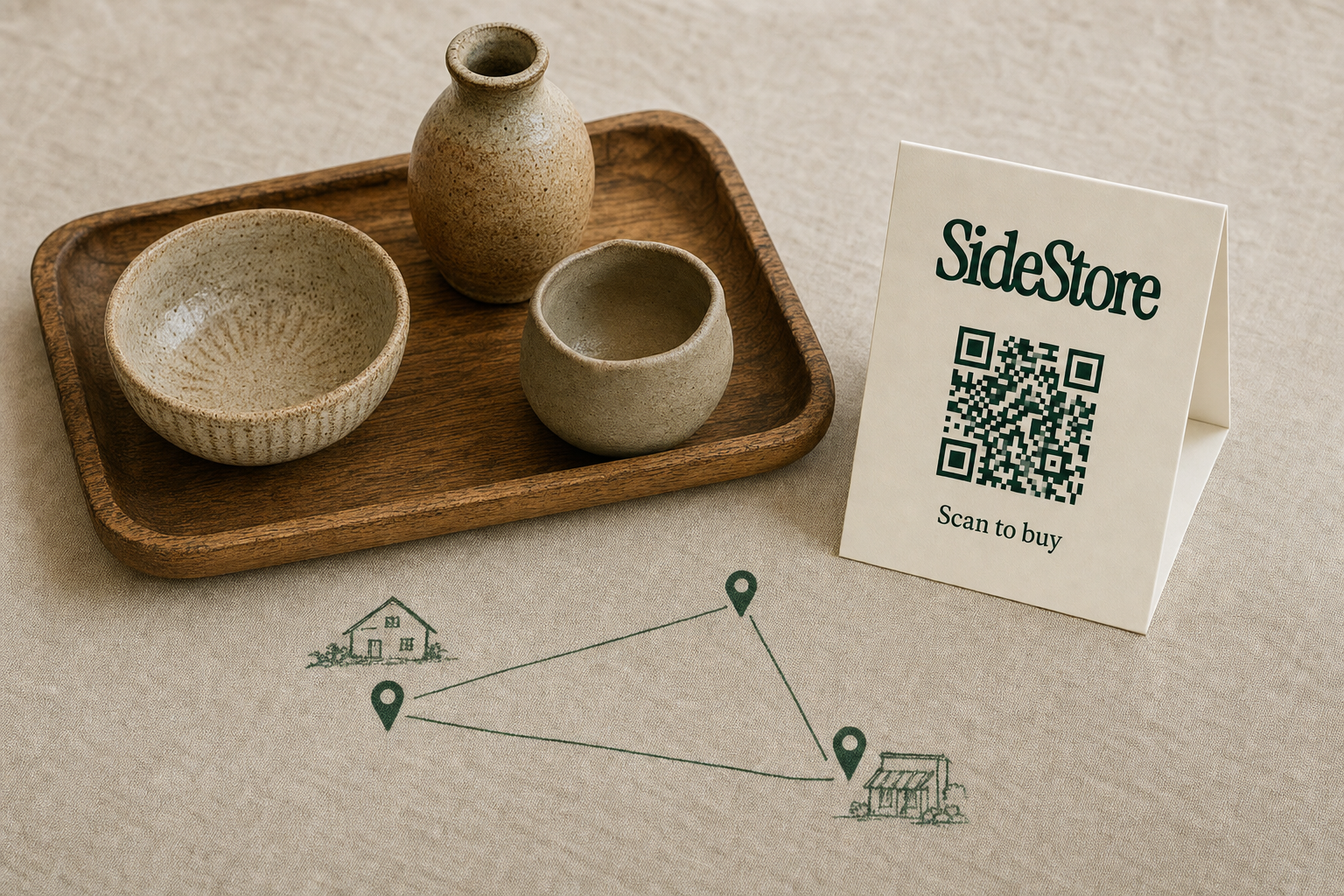
Here is the economic core: money circulates between local makers, local merchants, and local customers rather than leaving the community entirely. When an independent ceramicist places their work in a neighbourhood cafe, both businesses benefit. The ceramicist gets distribution without a lease. The cafe earns from shelf space it already has. The customer buys something made nearby. That three-way loop is the engine of a local retail economy, and shared infrastructure is what makes it repeatable at scale.
Shared retail models have existed for decades in the form of collective stores, market stalls, and consignment arrangements. What has changed is the tooling. Platforms like SideStore now give independent makers and merchants the infrastructure to run those arrangements across multiple locations simultaneously, without spreadsheets, manual settlements, or constant in-person coordination. For a deeper look at how shared retail models have evolved, the collective store model is a useful reference point.
What Is a Distributed Retail Network?
A distributed retail network is a structure in which a maker's products appear in multiple physical locations, each managed under a shared set of rules, financial terms, and tracking systems, without the maker owning or leasing any of those spaces.
The simplest version is a single maker with placements in three or four merchant spaces: a bookshop, a hotel lobby, a cafe. Scale that up and you have dozens of placements across a city or region, all running on the same consignment terms, the same stock-tracking system, and the same payout logic. The defining feature is that the infrastructure is shared rather than duplicated. The maker does not set up a separate arrangement with each host from scratch; they use the same model, deployed repeatedly.
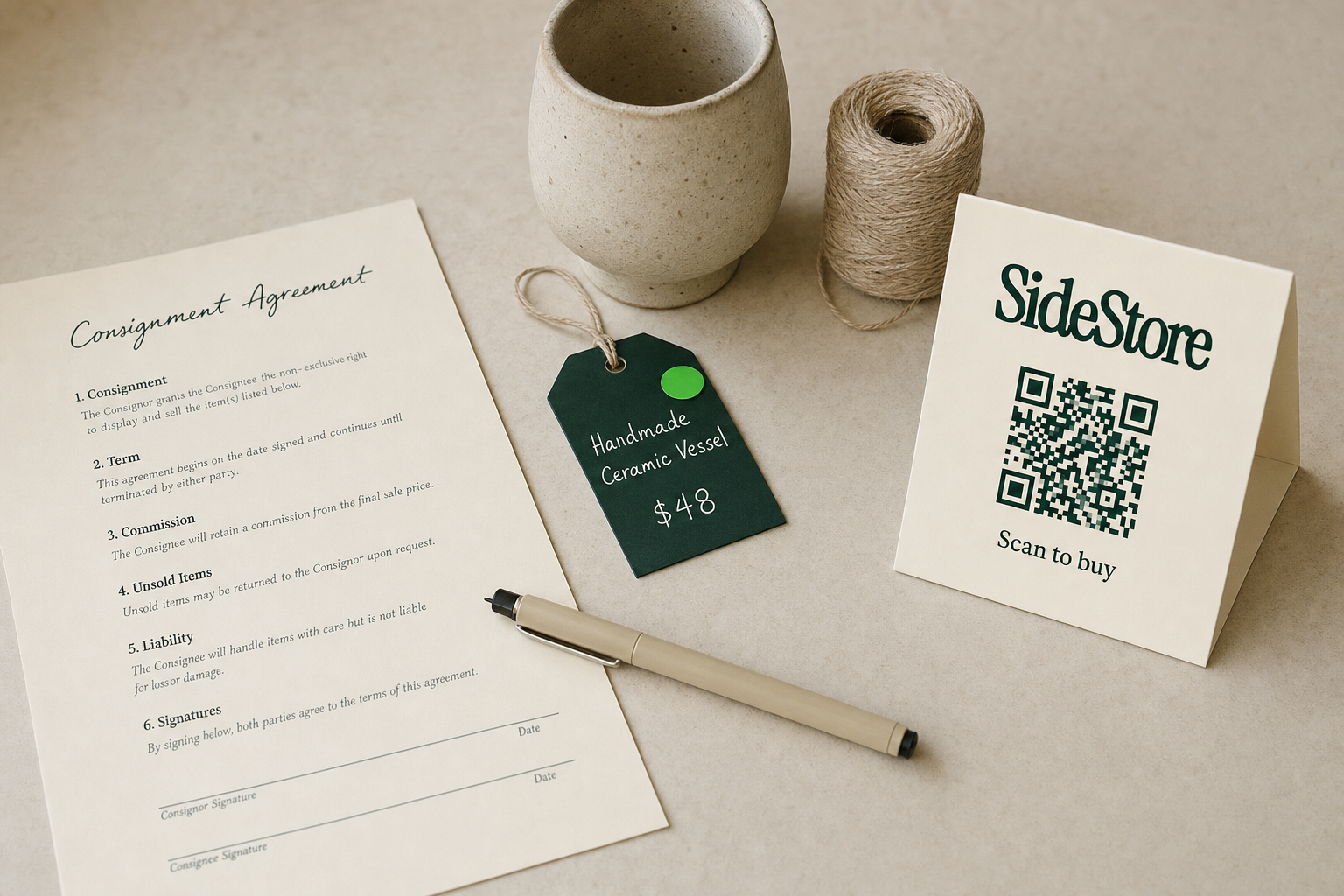
Consignment is the financial model that makes this work. The merchant hosts the product at no upfront cost and takes a percentage when it sells. The maker ships stock and gets paid on sales, not on placement. Neither party risks capital on inventory the other controls. That alignment of interests is what makes the arrangement stable enough to scale.
The infrastructure layer that makes multiple placements manageable is the Retail Widget. Rather than selling through someone else's store on improvised terms, a maker uses the Retail Widget to model the consignment split, activate a placement, track live stock levels across locations, and receive automatic split payouts when a sale completes. What was once a paper-based, trust-heavy arrangement becomes something closer to software: repeatable, auditable, and scalable. If you are evaluating tooling for this, consignment inventory software is worth understanding before you commit to a model.
The Economic Case: Why Shared Retail Keeps Money Local
Shared retail supports local economies because it redirects spending toward locally made goods and locally operated venues rather than national chains or online platforms that route revenue elsewhere.
The mechanism is the local multiplier effect. Economic research on local multiplier effects consistently suggests that money spent at independent businesses recirculates within a community at a higher rate than money spent at national retailers. When a maker earns a sale through a local cafe, both the maker and the cafe reinvest some of that revenue locally: on materials, on staffing, on other local suppliers. A sale through a national e-commerce platform, by contrast, sends most of the margin to a distant warehouse and a corporate settlement system.
Three actors benefit in a well-functioning shared retail network.
First, makers gain revenue without the fixed costs of their own premises. Second, merchants generate income from space that would otherwise sit idle. Third, communities retain a wider variety of independent businesses than the economics of solo retail would otherwise support. A cafe that earns meaningfully from hosted maker products is more likely to stay open than one relying solely on coffee margins.
The structural problem shared retail solves is the minimum viable scale problem. Physical retail has traditionally required a maker to commit to a lease, fit-out, and staffing before knowing whether local demand exists. That barrier eliminates most independent makers before they start. Shared retail flips the sequence: the maker tests demand across several real locations at low cost, and scales into the locations that perform. Merchants operating venues with foot traffic but underutilised display space, such as those analysed in the context of how coffee shops generate revenue from their floor space, are natural partners in this model. They already have the customer flow; they simply need a low-friction way to monetise the edges of it.
Shared Retail Models Compared
The right shared retail model depends on who bears the risk, what the upfront costs are, and how the maker gets paid. The table below gives a direct comparison.
| Model | Who bears inventory risk | Upfront cost to maker | Upfront cost to host | How maker gets paid | Scalability |
|---|---|---|---|---|---|
| Consignment (SideStore) | Maker | None | None | Automatic split payout on each sale | High, same model deploys to any number of venues |
| Collective store | Maker | Low, Medium (membership or fee) | Shared among members | Sales minus collective fees, periodic settlement | Medium, limited to one or a few shared spaces |
| Pop-up retail | Maker | Medium, High (space rental, fit-out) | None (landlord earns rent) | Gross sales minus all costs | Low, temporary, location-specific |
| Wholesale to retailer | Retailer | Low (production cost only) | Medium, High (inventory purchase) | Upfront on delivery, regardless of sell-through | Medium, but retailer bears risk, so uptake is harder |
| Online marketplace | Platform | Low (listing fees) | N/A | Periodic platform payout minus fees | High, but no physical presence |
The key trade-off is risk versus reach. Consignment through SideStore carries no upfront cost to either party and scales to as many venues as a maker can supply, but the maker carries the inventory until it sells. Wholesale shifts that inventory risk to the retailer, which sounds appealing until you realise most independent retailers are reluctant to buy stock from an unknown maker. Pop-up retail gives a maker full control of the experience but concentrates risk in a single short window. The collective store sits in the middle: low cost, limited scale. For most independent makers starting to build physical distribution, consignment is the lowest-friction entry point precisely because neither party has to bet capital before knowing whether the placement works.
How Makers Benefit from Shared Retail Infrastructure
Joining a shared retail network gives a maker physical distribution, live inventory visibility, automatic settlement, and the ability to test markets without a fixed-cost commitment.
Getting your products into physical retail as an independent maker is genuinely hard. Retailers want proven sellers. Leases require capital you probably do not have. Markets are seasonal. The result is that many talented independent designers stay online-only not because they prefer it but because the alternatives seem inaccessible. Shared retail infrastructure changes that calculus in four concrete ways.
Physical distribution without premises. You place your products in existing merchant spaces on consignment. You do not sign a lease, hire staff, or fit out a shopfront. Your products sit in a cafe, a boutique, or a hotel lobby and reach customers who would never find you online.
Live stock tracking across locations. Many makers find that the hardest part of multi-venue consignment is knowing what is where. The Retail Widget tracks stock levels at each placement in real time, so you can replenish before a shelf runs empty rather than discovering a stockout on your next in-person visit.
Automatic split payouts. Settlement is handled by the platform. When a sale happens, the agreed split between you and the host merchant is calculated and paid automatically. Independent artisans typically report that manual settlement is where consignment arrangements break down; removing it from the equation removes most of the friction.
Low-cost market testing. Place in three different venues, see which performs, double down on what works. This is how you learn how to approach a local shop about stocking your products with evidence rather than hope. Whether you are placing handmade products in boutiques or selling art prints in cafes, the shared infrastructure means each placement runs on the same terms and generates comparable data.
How Merchants Benefit from Hosting Maker Products
Hosting maker products on consignment earns a merchant passive income from shelf space they already have, with no inventory to buy and no stock risk if products do not sell.
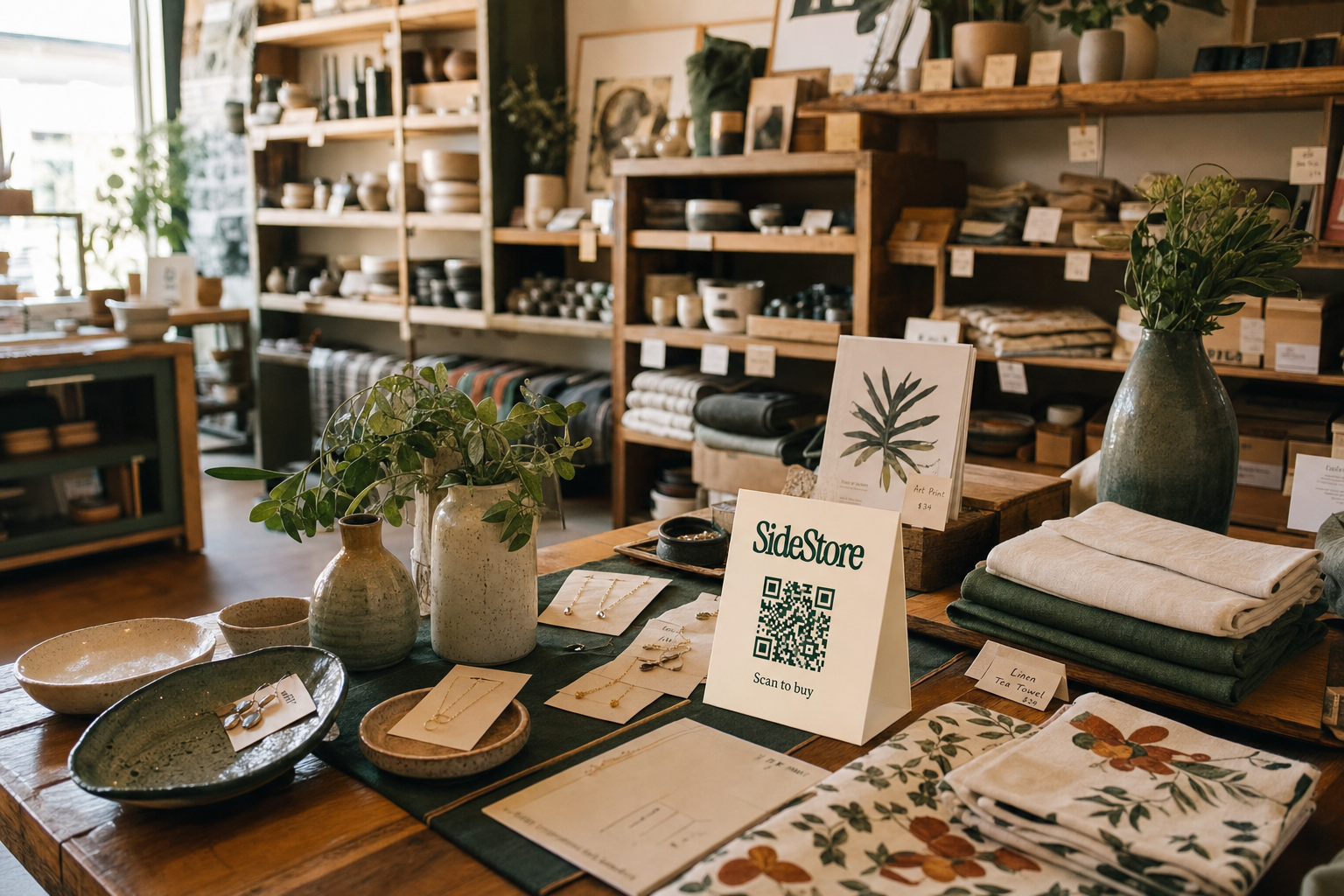
That is the mechanics of it. If you operate a cafe, a boutique, or a hotel, you almost certainly have display surfaces that are either empty or working harder than they need to. A consignment placement fills that space with curated, locally made products. When a customer buys one, a percentage of the sale goes to you automatically.
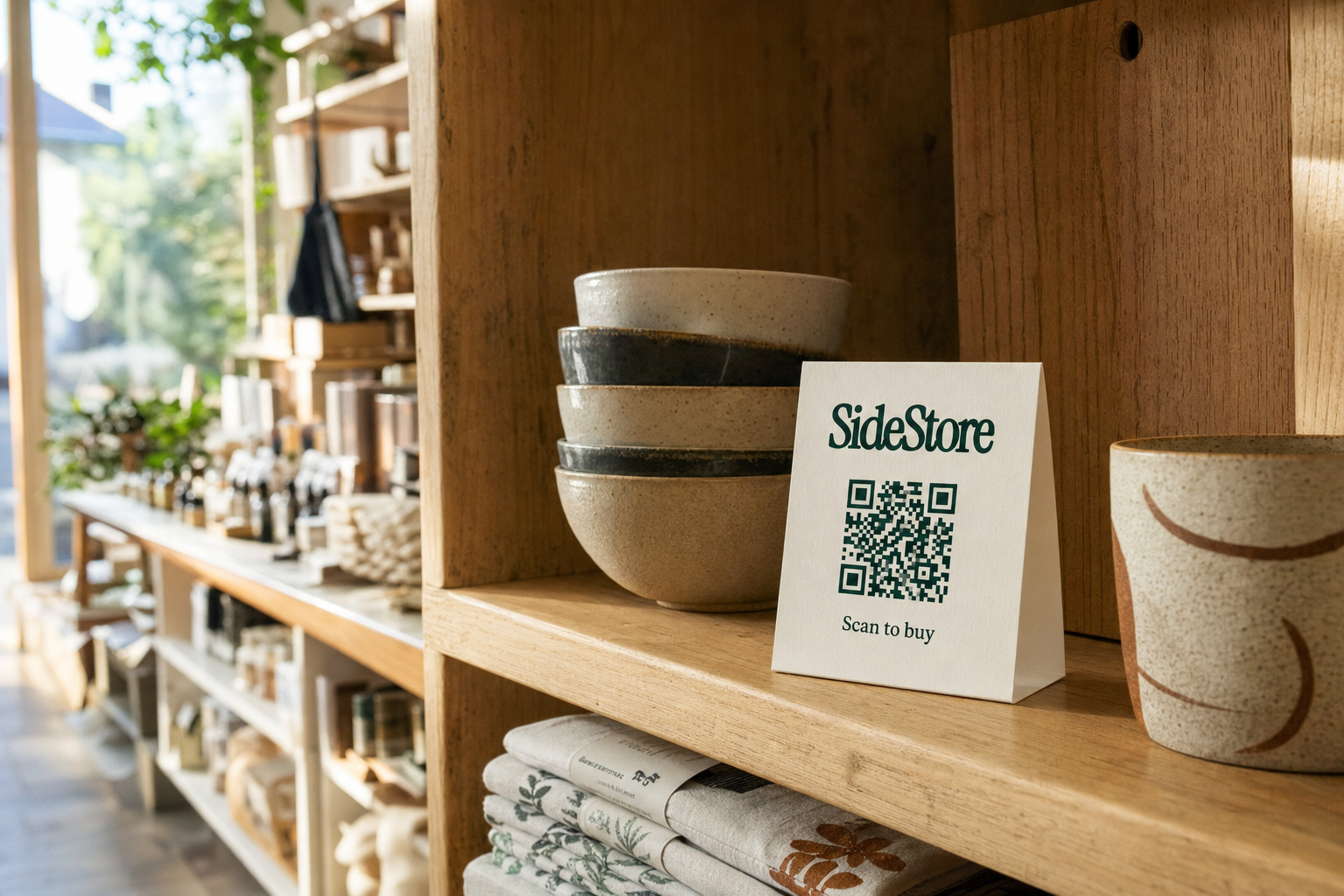
The operational overhead is minimal. You display a SideStore QR card for the placement. Customers scan it to purchase. The Retail Widget handles the checkout, tracks live stock levels for that placement, attributes the sale to your location, and splits the payout between you and the maker without any manual calculation on your part. You are not running a shop-within-a-shop; you are hosting a managed placement that operates largely on its own.
The financial logic is straightforward. You earn a percentage of sales from products you did not buy, did not risk, and do not need to manage beyond keeping the display tidy and restocking when the Retail Widget flags that inventory is low. If a product does not sell, your cost is the shelf space it occupied, which was idle anyway.
For venues that already attract foot traffic, the opportunity compounds. A hotel hosting locally made products earns from guests who want to take something home. A boutique hosting a complementary maker's range attracts customers who might not have come in otherwise. For context on how this plays out in practice, see placing local products in hotels and hosting art prints in local shops.
Can Independent Makers Actually Share Retail Infrastructure?

Yes. A solo maker can access and use shared retail infrastructure today through SideStore, without co-owning anything, without joining a collective, and without any technical setup beyond registering a placement in the Retail Widget.
It is worth separating two things that often get conflated. Shared infrastructure does not mean collective co-ownership. You do not need to co-operate a shared store or split governance with other makers. The infrastructure, the checkout system, the stock tracking, the split settlement logic, is provided as a service. You use it for your placements the same way you use a payment terminal: it belongs to the platform, you benefit from it, and you pay nothing upfront.
The cost objection is worth addressing directly. Many independent makers assume that professional retail tooling carries a subscription cost that does not make sense until you have significant volume. SideStore's consignment model means the platform earns when you earn; there is no fee you pay for placements that are not yet selling. That structure is precisely designed for makers who are still building their distribution.
The access objection is also surmountable. Getting a merchant to say yes is the real work, and it is covered in detail in the context of managing consignment inventory across multiple venues and approaching hosts with a clear, low-risk proposition. The infrastructure removes every excuse a merchant might have about complexity: the Retail Widget handles checkout, attribution, stock tracking, and payouts. Your job is to show up with good products and a placement that makes sense for the host's space.
Open Infrastructure for Independent Commerce: What It Looks Like in Practice
Joining a shared retail network through SideStore follows a short, repeatable sequence: a maker sets up their products and consignment terms in the Retail Widget, places them into a merchant space, and the infrastructure handles everything from there.
Here is what that looks like for each party.
For the maker:
- Register your products in SideStore and set your consignment split (the percentage you keep on each sale).
- Identify merchant spaces with relevant foot traffic. Start with approaching a local shop about a consignment placement using the consignment model as your pitch: no cost to them, no inventory risk.
- Activate the placement in the Retail Widget. This generates the placement's QR card, a printable card you or the merchant can display.
- Ship or deliver your stock to the merchant.
- Monitor live inventory and sales from your dashboard. Replenish when stock is low.
- Receive automatic split payouts as sales occur.
For the merchant:
- Agree to host a maker's placement on the consignment terms they propose.
- Display the SideStore QR card in your space, either on individual products or as a single card for the whole placement.
- The Retail Widget handles customer checkout when they scan, tracks inventory automatically, and calculates split payouts without any action from you.
- Receive your split of each sale automatically.
That is the full loop. For a broader view of what selling through someone else's store involves before you start, it is worth reading through the mechanics of a consignment placement in detail.
The Network Effect of Local Retail Done Right
If you are a maker, the next step is to place your first product in a merchant space and let the data tell you where to scale. If you are a merchant, the next step is to identify the shelf space you are not currently earning from and host your first placement.
How shared retail networks support local economies is not a theoretical argument. It is a practical outcome of many small, low-risk placements adding up: makers earning from physical distribution they could not afford alone, merchants generating passive income from space they already have, and communities retaining the independent businesses that keep local economies distinct. Start with one placement. Build the network from there. For a practical starting point, placing products in local shops covers the ground-level mechanics of getting that first placement live.