How to Sell Art Prints in Local Shops: A Maker's Guide to Consignment Placement
Selling art prints in local shops means placing your work in someone else's retail space, a café, boutique, or hotel, on consignment. You earn a share of each sale. No rent. No upfront cost. No inventory risk to the host.
That is the model. You produce the prints. A shop displays them. A customer buys. You both get paid.
No storefront of your own. No long-term lease. No minimum order the shop has to commit to. If you are looking for real-world distribution without the overhead of opening a retail operation, consignment is the most direct route available to independent makers. You keep control of your work. You retain ownership until the moment of sale. You can place prints in multiple shops at once and build reach without scaling fixed costs.
This guide walks you through every stage: finding shops that fit your work, pitching with confidence, writing an agreement that protects you, pricing the split so both sides win, and tracking stock so you get paid without chasing anyone. If you are weighing other formats, selling through someone else's store on consignment and pop-up retail alternatives for independent makers are worth reading alongside this one.
What Consignment Actually Means for Artists and Print Makers
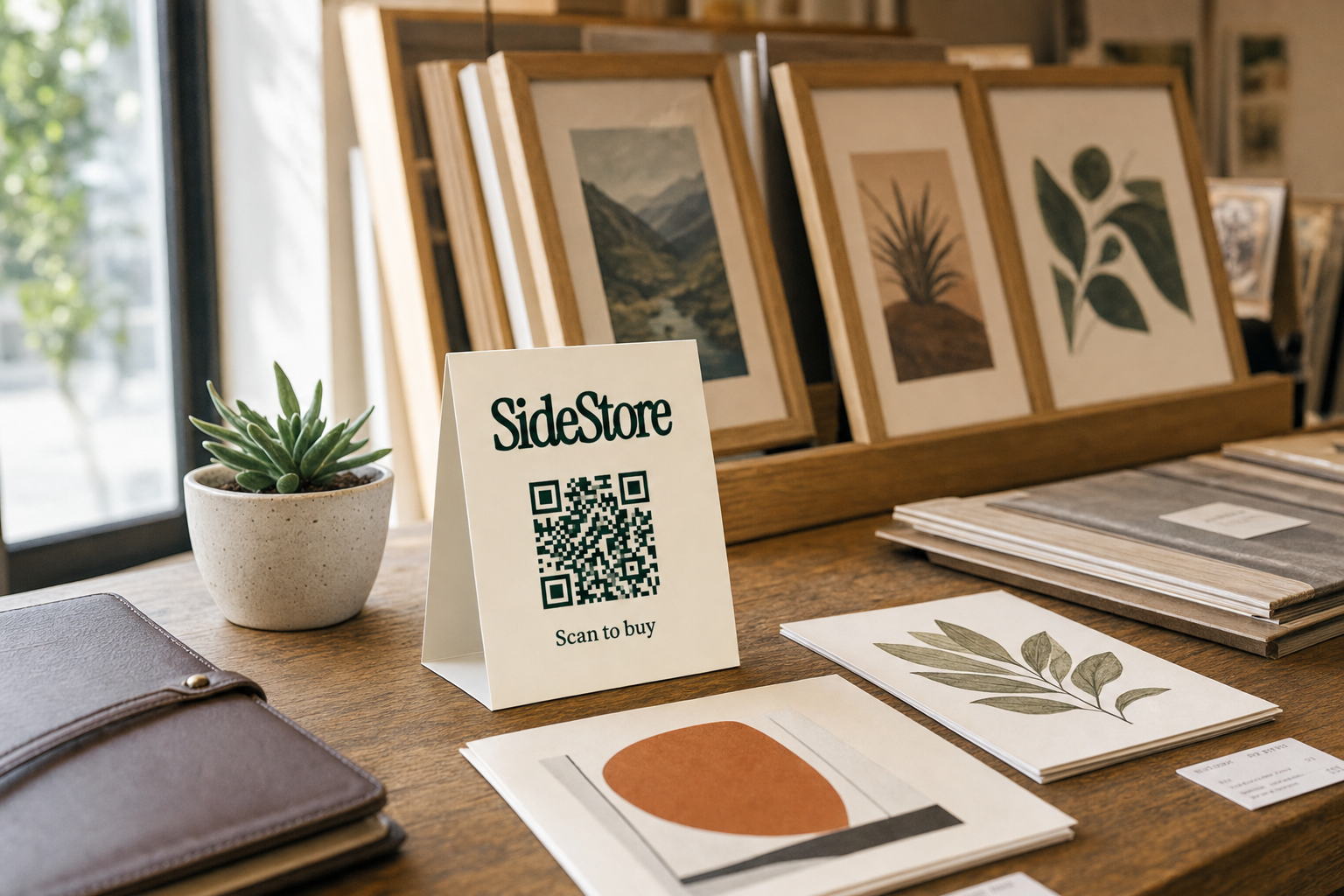
Consignment is straightforward: you place your products in a shop and get paid only when they sell. The shop takes no inventory risk and pays nothing upfront. You retain ownership of every print until a customer buys it.
For print makers, this distinction matters. Wholesale means you sell a batch of prints to a retailer at a discount and they own the stock from that moment on. Consignment keeps your work yours until the point of sale. The shop earns a commission on each sale. You receive the remainder. Neither party is out of pocket before a transaction happens.
The commission split, the percentage the shop keeps versus what you receive, is negotiated, not fixed by industry standard. Ranges vary by shop type, location, and how much traffic the venue draws. Check what similar shops in your local market are offering. Use that as your baseline. Accepting a lower share for a high-footfall location can make commercial sense. Accepting the same low share in a quiet side-street shop rarely does.
One important detail: consignment does not transfer liability if the shop closes or loses your work. That is precisely why a written agreement matters, more on that below.
The practical upside for makers is that consignment removes the biggest barrier to offline distribution: upfront cost. You do not need to buy a retail licence, hire staff, or sign a lease. You need prints, a shop willing to host them, and an agreement that spells out the terms clearly. Once you have more than one or two placements running, tracking them gets complicated fast with spreadsheets, which is why many makers turn to consignment inventory software to stay organized.
How to Find Local Shops That Will Actually Say Yes
The shops most likely to host your prints are already selling complementary products to customers who value handmade or locally produced work. Independent cafés with a design-conscious interior. Gift boutiques. Bookshops. Lifestyle hotels.
Start with the places you already visit. Walk in as a customer. Look for signals: Are there any handmade or local products on display? Is there a small gifts section near the counter? Does the aesthetic match your print style? A shop that already hosts one or two local makers has already decided the model works. That conversation is easier than convincing a sceptical owner from scratch.
Beyond your regular haunts, look at local makers' markets and craft fairs. Not to sell there yourself, but to see which shops sponsor them, advertise in their programmes, or have nearby stalls. Those shops are signalling active interest in the independent maker community.
Cafés are a particularly good starting point. They have natural footfall, customers who linger, and wall space they often struggle to fill with meaningful content. Understanding how coffee shops think about additional revenue helps you frame your pitch in terms a café owner hears. Boutiques present differently, they are more curated by nature, so reading up on how boutiques manage their inventory gives you useful context before you walk through the door.
Be honest about the numbers: not every shop you approach will say yes. Some have a waiting list of local makers already. Some lack the wall space. Some owners are simply not interested right now. That is not a rejection of your work. Keep moving. A handful of well-matched placements is worth far more than a long list of shops where your prints feel out of place.
How to Pitch a Shop Owner: What to Say and What to Bring
When you walk into a shop to pitch a consignment placement, your job is to answer the owner's unspoken question, what is in this for me?, before they have to ask it.
Open with something like: "I'm a local print maker and I'm looking for a spot to place a small collection on consignment. You'd earn a commission on every sale, there's nothing to buy upfront, and I handle the restocking." That sentence names the benefit, removes the risk, and explains your role in ten seconds. It is honest. It respects their time.
What to bring:
- Three to five sample prints in the size and finish you plan to place. Owners need to see the physical quality, not a photo on a phone.
- A one-page placement proposal that lists the suggested retail price, your proposed commission split, the number of prints you would place to start, and how you handle restocking and returns.
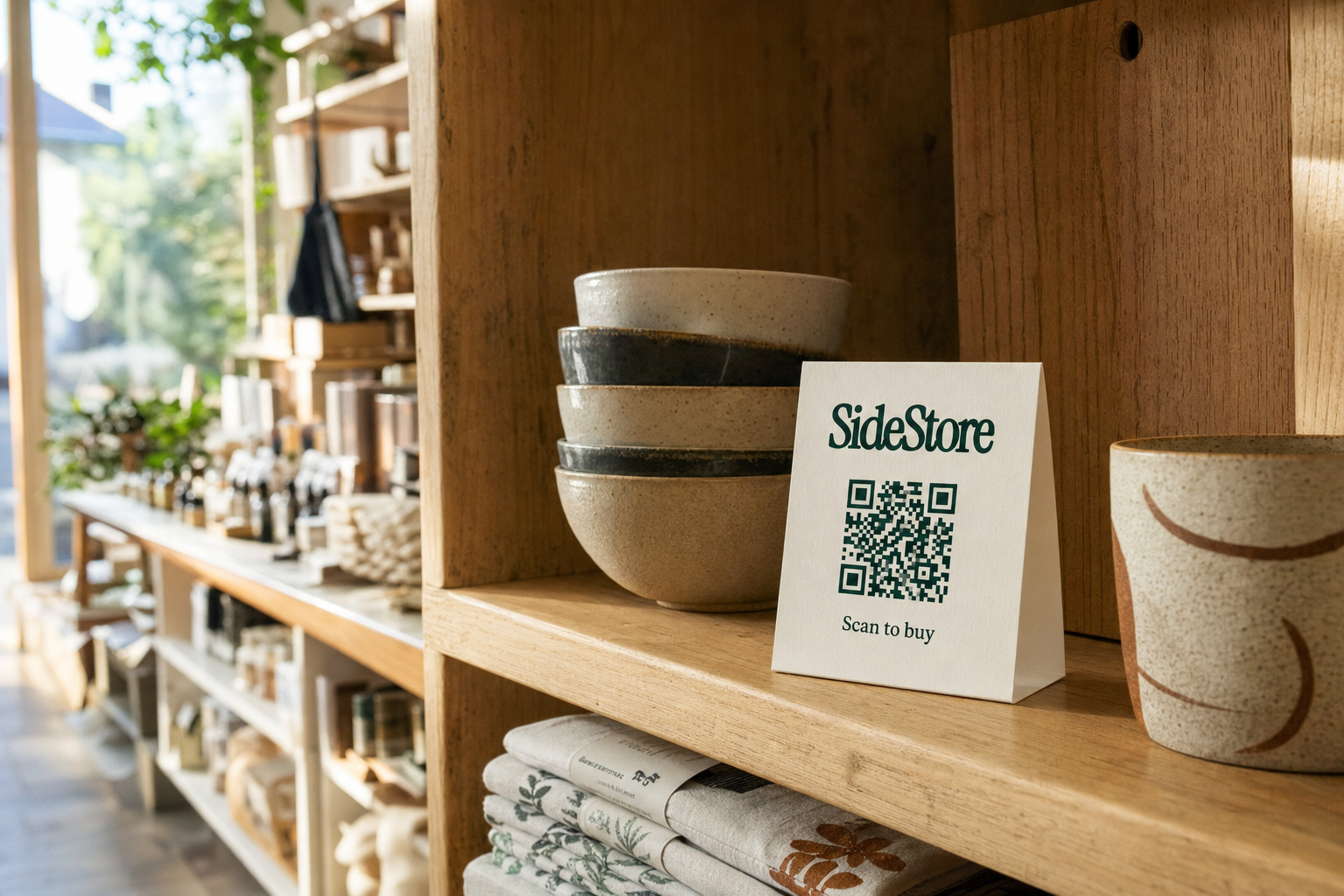
- A QR code or simple demo of how checkout and stock tracking will work, if you are using a digital tool like SideStore's Retail Widget.
Keep the initial placement small. Offer five to ten prints to start. A smaller commitment is easier for an owner to agree to, and it gives you a real-world test before you invest in a larger run.
Do not claim you can guarantee sales or foot traffic. No maker can promise that, and shop owners know it. What you can promise is that the financial risk to them is zero and that you will make the administrative side easy to manage. Read approaching retail partners as a maker before you go in, understanding the merchant's perspective makes your pitch sharper.
What Your Consignment Agreement Must Cover
A consignment agreement for artists is a written contract that defines who owns the work, what the commission split is, how and when you get paid, and what happens if prints are damaged, lost, or the arrangement ends. Disputes most commonly arise when one of these clauses is missing or vague.
You do not need a lawyer to write a workable consignment contract for artists, but you do need a document both parties sign before a single print goes on the wall. Here are the six clauses that matter:
1. Inventory list. A description of every print placed: title, edition, size, quantity, and agreed retail price. This list becomes the reference point for every future stock check.
2. Commission split. The percentage the shop retains and the percentage you receive on each sale, stated clearly. Specify whether VAT or sales tax is calculated before or after the split.
3. Payment schedule. How often you get paid (weekly, monthly, per sale) and by what method. "When convenient" is not a payment schedule.
4. Stock check process. How often you or the shop counts and reports the remaining inventory, and who initiates that process.
5. Damage and loss. What happens if a print is damaged in the shop, stolen, or goes missing. Does the shop compensate you at retail price, at your production cost, or not at all? Write it down.
6. Termination clause. How either party ends the arrangement, notice period, who collects unsold stock, and the timeline for final payment.
Tracking consignment stock digitally removes a lot of friction around clauses three and four. And keeping an accurate inventory list for consignment placements gives you a practical format for clause one that both you and the shop owner can follow without confusion.
How to Price Your Prints and Structure the Commission Split
Pricing your prints for consignment means building backwards from what you need to earn per sale. Account for the shop's commission, your production cost, and a margin that makes the placement commercially worth your time.
Here is the arithmetic. Say your print costs £12 to produce (paper, ink, packaging, your time at a minimum). You agree a commission split where the shop keeps 35% of the retail price. Price the print at £35: the shop earns £12.25 and you receive £22.75, leaving you £10.75 after production cost. Price the same print at £25: your net after commission and production cost drops to £4.25. At that margin, a slow month in a quiet shop produces almost nothing.
Price for the split, not for what feels politely modest. Many makers underprice because they worry about putting off customers. But a print priced at £35 in a design-led café signals value. A print priced at £18 in the same space signals the opposite.
What commission percentage should you offer? There is no single correct answer. It varies by shop type, location, and the traffic that venue brings. The right question is: at this split, does the placement earn enough to justify your time managing it? If not, either the price or the split needs to move.
Understanding how merchants think about margin on additional products helps you appreciate why a shop owner cares about the percentage too. Approach the split as a negotiation, not a fixed concession you make to get the placement.
From Pitch to First Payout: The Consignment Placement Phases
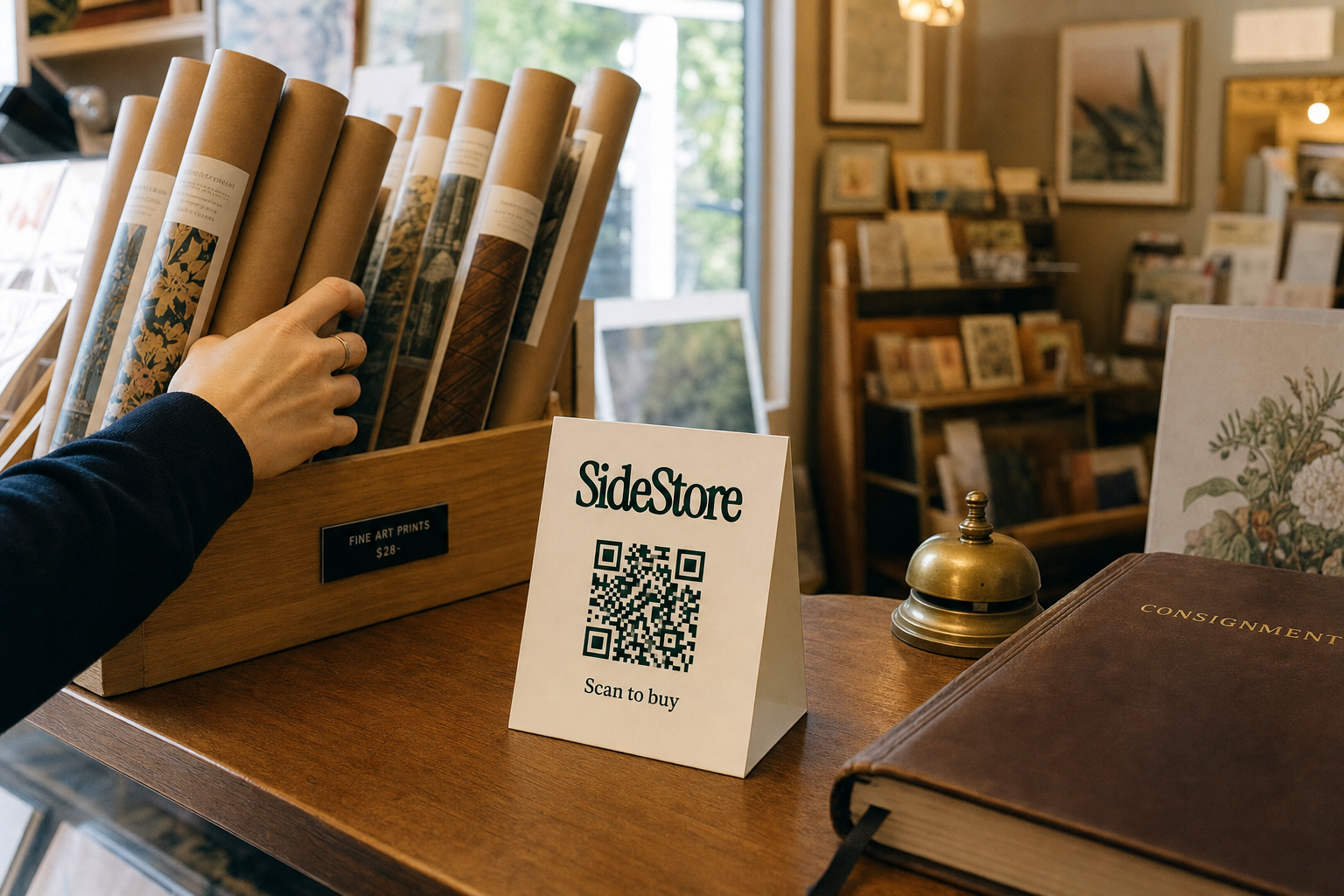
A consignment placement has five distinct phases. Each one has a clear owner and a signal that tells you whether to proceed or adjust.
| Phase | Action | Who Owns It | Timeline | Success Metric |
|---|---|---|---|---|
| 1. Approach | Identify target shops, make contact, present sample prints | Maker | 1, 2 weeks | Shop owner agrees to a follow-up conversation |
| 2. Agreement | Negotiate terms, sign consignment contract, confirm inventory list | Both parties | 3, 7 days | Signed agreement with all six clauses complete |
| 3. Go Live | Deliver prints, set up display, activate scan-to-pay QR if using SideStore | Maker (with shop's cooperation) | 1 day | Prints on shelf, checkout method confirmed, stock count recorded |
| 4. Active Placement | Regular stock checks, restock as needed, monitor sales data | Both parties | Ongoing (monthly review minimum) | Sales occurring; stock level matches records |
| 5. Payout | Payment transferred per the agreed schedule | Maker initiates, shop pays | Per contract (e.g., monthly) | Payment received within the agreed window |
When a placement under-performs, weeks pass with no sales, do not wait for the contract end date to act. Visit the shop, look at where your prints are positioned, check whether they are visible from the entrance, and ask the owner if customers have shown interest. Sometimes one repositioning changes everything. If the location genuinely is not converting after a fair period, collect your prints, end the arrangement cleanly per the termination clause, and redirect that stock to a better-matched space.
Good looks like: consistent sales, stock counts that match your records, and payment arriving on the agreed date.
Tracking Your Stock and Getting Paid Without Chasing Anyone
The hardest part of selling prints on consignment is not the pitch or the agreement. It is knowing, at any moment, exactly how many prints are on each shelf and whether the money owed to you has actually moved.
Paper-based tracking, a spreadsheet emailed to the shop owner once a month, breaks down as soon as you have more than one or two placements. Owners forget to update it. Numbers drift. Disputes arise about what sold and when.
A more reliable approach uses digital consignment inventory software that gives both you and the shop a live view of stock levels and sales. SideStore's Retail Widget is built for exactly this: it handles checkout, live stock tracking, placement attribution, and automatic split payouts across every location you place in. The split is calculated at the point of sale, not at the end of the month when someone has to do the arithmetic.
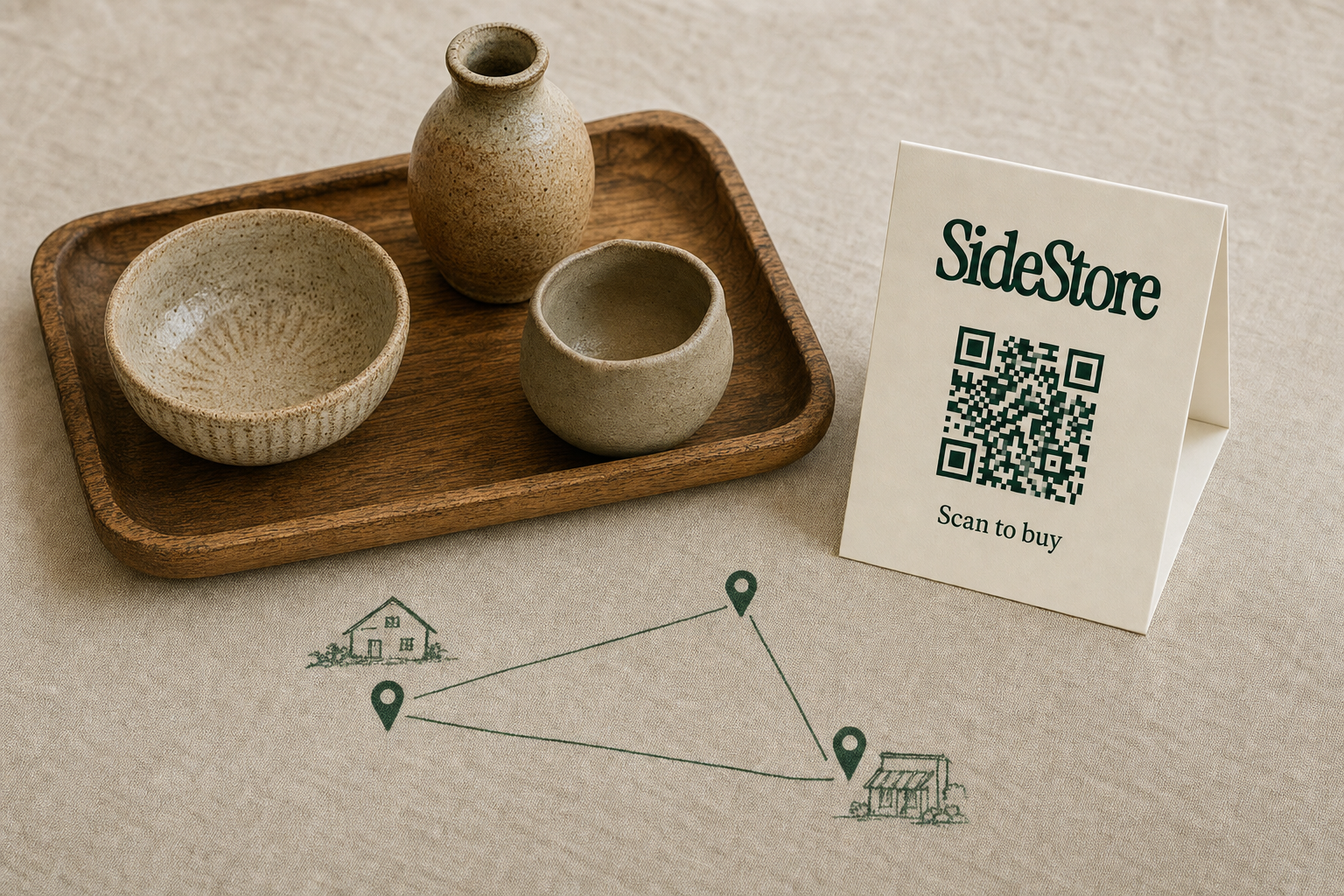
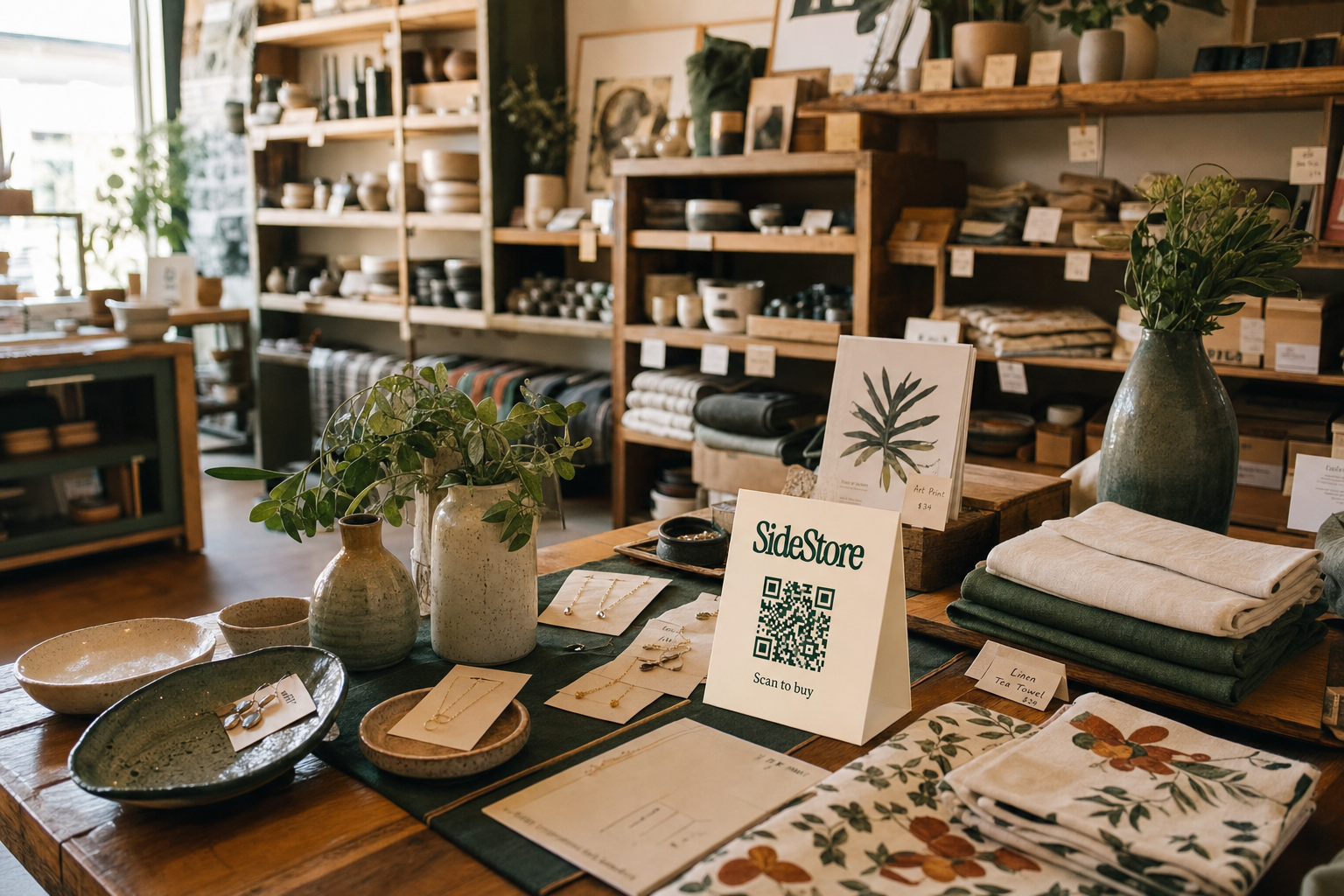
One practical mechanic worth understanding precisely: a maker can print the SideStore QR code card and attach it directly to each product, or a merchant can display a single SideStore card covering all the products in their placement. Either way, when a customer scans the QR code and completes checkout, the Retail Widget records the sale, updates the stock count, and queues the split payout automatically. The QR checkout is one function of the Retail Widget, the Widget also manages the broader placement: agreements, inventory, attribution, and payouts across your whole consignment network.
For makers managing inventory across multiple boutique placements, having one dashboard that aggregates all locations makes the difference between a manageable operation and a chaotic one.
Displaying Your Prints: How Presentation Drives Sales
How your prints are displayed in a shop has a direct effect on whether customers notice them, stop, and buy. In most cases, display is something you control more than you might expect.
Three concrete rules for display that earn their place:
1. Eye level is the only level that matters. Prints hung above a customer's line of sight or propped on a low shelf get passed over. Request wall space between shoulder and eye height, or a counter placement within natural reach. If the shop cannot offer that, it may not be the right placement.
2. Group your prints, do not scatter them. A cluster of three to five prints reads as a collection and signals intention. Individual prints placed in separate corners of a shop lose visual weight and make a customer walk past. Grouping also makes your QR card or price tag easier to find.
3. Keep the immediate area clean. Your prints sitting next to a stack of paper bags or a cluttered counter lose impact immediately. At each restock visit, take two minutes to tidy the display area around your work. That small act signals to the shop owner that you are a reliable placement partner, not a maker who drops prints and disappears.
Going Beyond One Shop: Building a Consignment Network
A consignment network is what you have when your prints are placed in multiple shops simultaneously. Each one generates sales independently while you manage the whole operation from a single point.
Getting there takes months, not days. The first placement teaches you what works: which print sizes sell, which display setups perform, how often you need to restock, and what a healthy sales pace looks like for your work. The second placement is faster because you have done it once. By the third and fourth, you have a repeatable system.
The shift from one placement to a distributed consignment network is partly logistical and partly a mindset change. You stop thinking of each shop as a one-off arrangement and start thinking of your placements as a portfolio, something to deploy, manage, and scale. SideStore is built for that shift. The Retail Widget lets you run every placement from one dashboard: live stock across all locations, split payouts handled automatically, and placement attribution so you know which shops are actually selling.
Building retail partnerships as a maker gives you a framework for approaching each new shop efficiently. And understanding boutique inventory management from the merchant's side helps you remain a low-effort partner, which is exactly what keeps doors open when you want to expand.
Start with One Placement, Build from There
The next step is simpler than the whole guide might suggest: identify one shop that fits your work, walk in with sample prints and a one-page proposal, and start a conversation. That is it. One placement, well-managed, teaches you more than any amount of planning.
Once that first placement is live and running cleanly, stock tracking working, payment arriving on schedule, prints selling at a pace that justifies the split, you have proof of concept. Then you add a second location, and the model starts to compound.
SideStore's Retail Widget exists to make that compounding manageable: one dashboard for all your placements, automated split payouts, and live inventory so you are never guessing what is on a shelf.
If consignment is not the only format you want to explore, other distribution options for independent makers are worth your time. And if you want to understand why cafés in particular are often receptive to hosting prints, why coffee shops are often open to consignment explains the margin logic from their side.
Start with one placement. Build from there.
Build a consignment network without opening a store of your own.