What Is a Distributed Retail Network? How Makers Can Sell in Multiple Stores Without Managing Each One
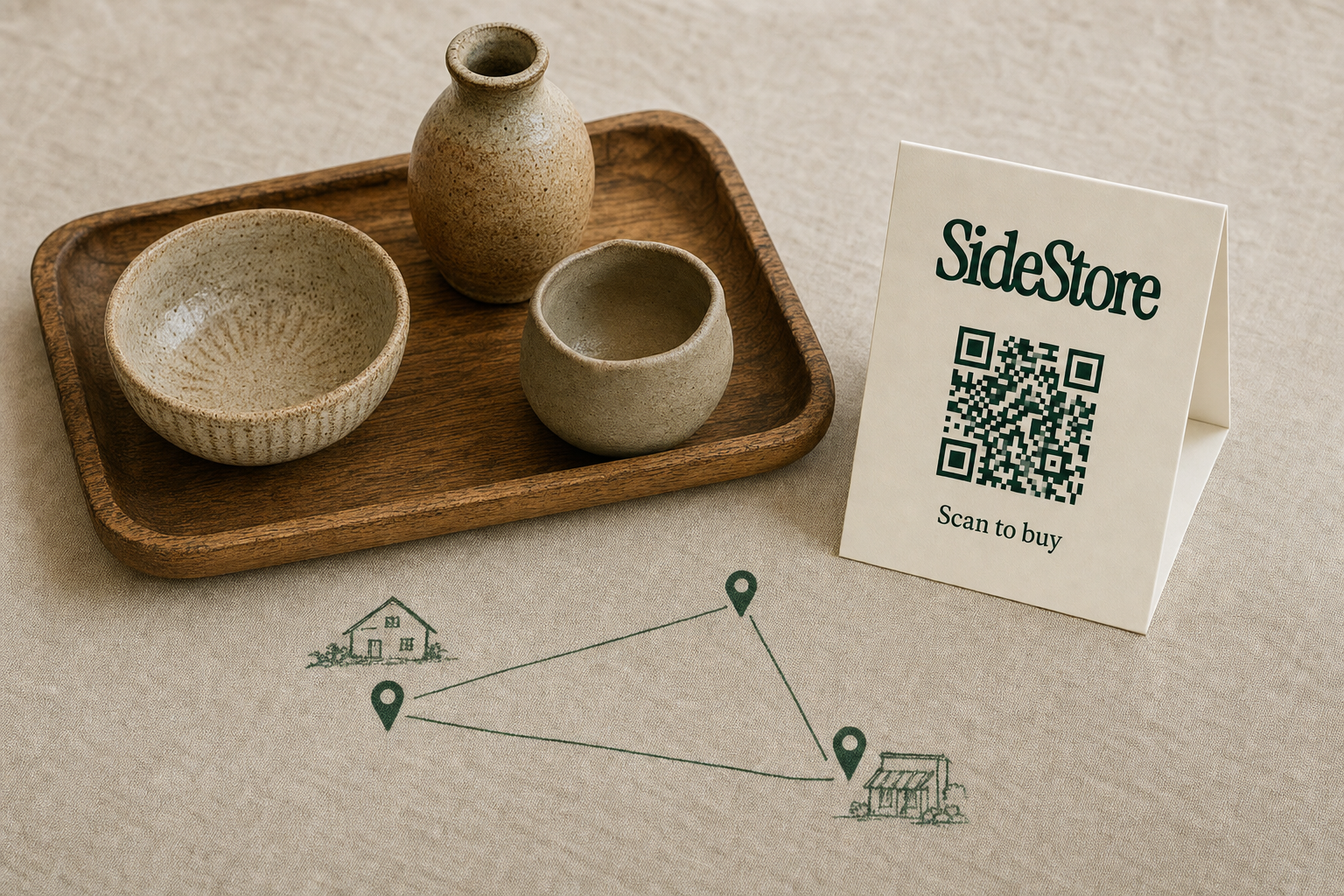
A distributed retail network is a collection of independent physical locations, cafes, boutiques, hotels, retailers, where a maker's products are sold simultaneously, without the maker owning or operating any of those spaces.
For independent makers, this changes everything. Instead of pouring capital into a single storefront, you sell through someone else's store and let each venue act as a node in a network you manage centrally. Stock sits in multiple places. Sales happen across all of them. You track, restock, and settle from one dashboard, not by visiting each location individually.
This is the structural answer to one of the hardest problems in independent retail: how do you achieve broad physical distribution without fixed costs, without wholesale minimums, and without an operations team? A distributed model is the answer. Consignment is the mechanism that makes it accessible. If you've been exploring physical alternatives to selling only online, this is the offline distribution model worth understanding first.
What Makes a Retail Network 'Distributed', and Why It Matters for Makers
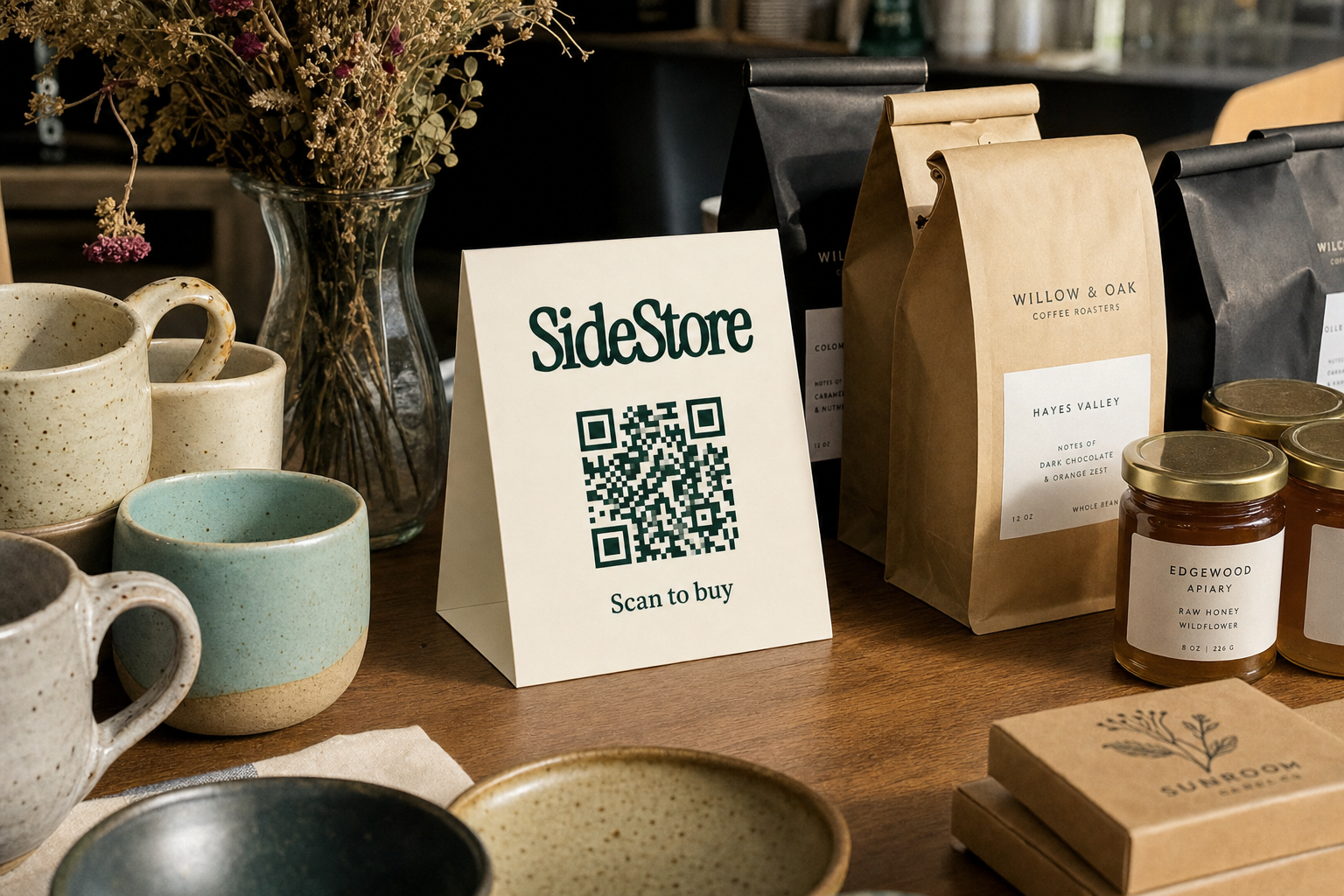
A retail network becomes 'distributed' when sales responsibility and physical presence are spread across multiple independent locations, rather than concentrated in one place you own or control directly.
Centralised retail means one location, one lease, one set of overheads. A pop-up adds temporary presence but remains centralised for its duration, one venue, one event window. You can read more about pop-up retail as a temporary centralised alternative if you're comparing the two models. Distributed retail is structurally different: it spreads your products across many venues simultaneously, and each venue functions independently while you manage the whole from outside.
That distinction matters because the failure mode changes. With a single store, a quiet week affects everything. With a distributed network, a slow month at one cafe is absorbed by sales in a boutique across town. Risk spreads across nodes instead of concentrating in one place.
Now consider the difference between consignment and wholesale in this context. Wholesale means you sell products to a retailer upfront, they own the stock, bear the risk, and set the price. You get paid immediately but lose control of placement and pricing. Consignment means you place products in a venue and get paid only when they sell. The host bears no inventory risk. You retain pricing control and can pull or rotate stock as needed.
For a ceramicist placing work in eight cafes across the city, consignment is the only model that makes a distributed network viable without requiring thousands of dollars of upfront wholesale orders from each host. The hosts say yes more easily. You scale faster. And the operational mechanics, checkout, stock tracking, payout, are what determine whether that network stays manageable or collapses under its own complexity.
How Consignment Makes Distributed Selling Possible Without a Store
Consignment is the lowest-friction entry point into distributed retail because neither party carries the risk that normally blocks the arrangement.
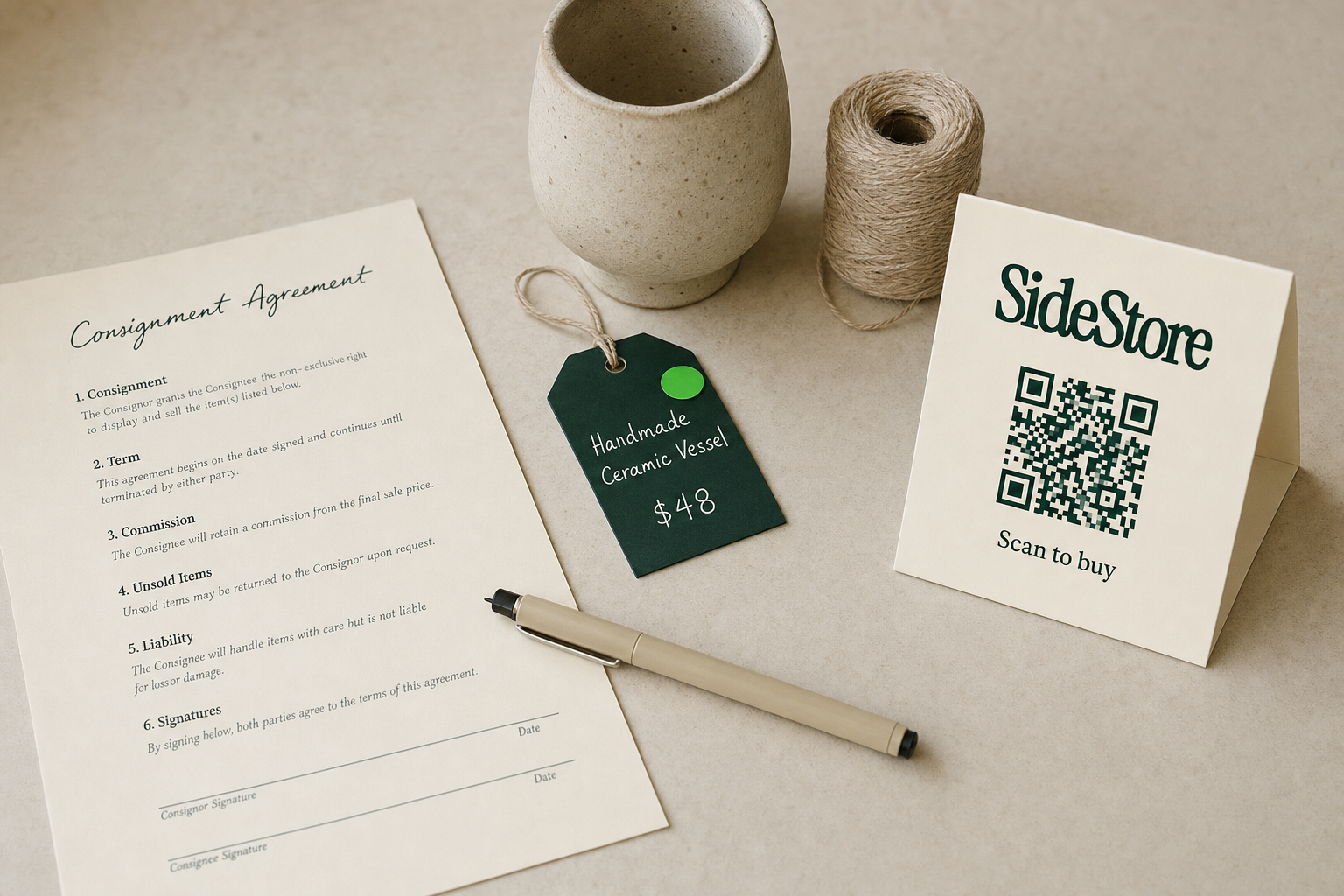
Here is how the mechanics work precisely. You, as the maker, place products in a host venue, a cafe, a boutique, a hotel lobby. The host displays them. When a customer buys, the sale price is split between you and the host according to an agreed split. The host earns revenue from space they already had. You earn distribution without a lease. No upfront cost changes hands. No stock purchase is required from the host.
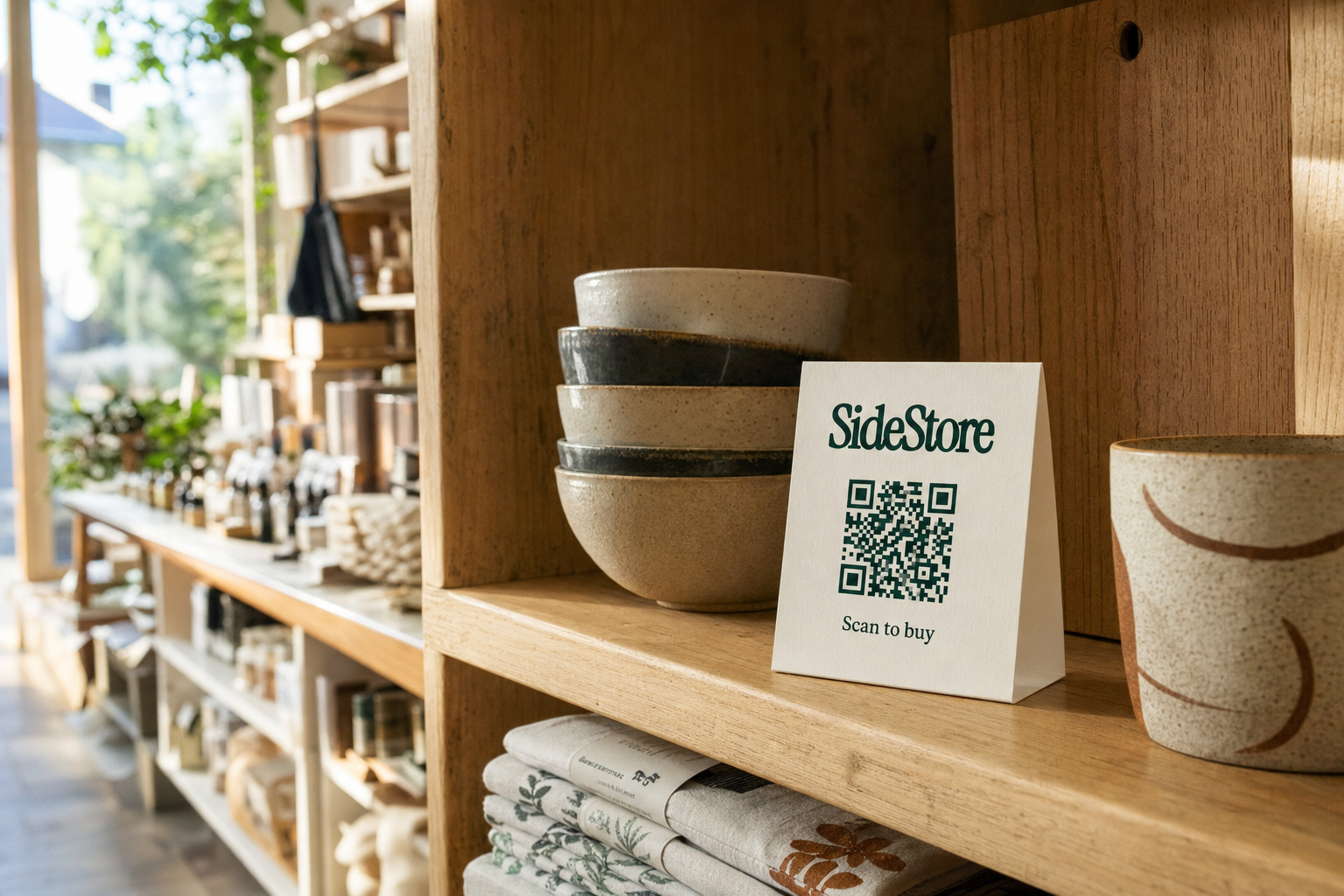
What makes this manageable across multiple locations is the infrastructure behind each placement. SideStore's consignment inventory software approach is embodied in the Retail Widget: a full consignment-management interface that handles checkout, live stock tracking, placement attribution, and automatic split payouts. The QR card, a printable code a customer scans to buy, is one checkout function within the Retail Widget, not the whole product. A maker can attach the QR card to each individual item, or a merchant can display a single card covering all the products in that placement.
This matters operationally. When stock runs out at one location but not others, the Retail Widget reflects that in real time. You know which node needs restocking without calling anyone. Payouts settle automatically rather than requiring you to invoice each host separately. Placement attribution shows which venues drive sales, so you can make evidence-based decisions about where to place more stock and where to pull it.
If you're starting with a specific product category, understanding how to place art prints in cafes on consignment gives you a concrete model to follow before scaling to additional venue types.
How to Build a Distributed Consignment Network: A Step-by-Step Path
Building a distributed consignment network follows a sequence. Start small, prove the model at one node, then replicate with evidence.
Step 1: Define your product's placement profile
Before approaching any venue, identify what type of space suits your product, and why. A hand-poured candle fits a boutique hotel corridor. Ceramic mugs fit a specialty cafe. This isn't guesswork; it's about matching your product's price point, visual weight, and customer context to the foot traffic and mood of the space. Be specific before you approach anyone.
Step 2: Approach your first venues deliberately
Read the guide on how to approach a local shop about stocking your products before your first conversation. Lead with the host benefit: no upfront cost, no inventory risk, automatic split payouts. For boutiques specifically, pitching handmade jewellery to boutiques shows how to frame the conversation around the host's margin, not just your product's merit.
Step 3: Set up each placement through the Retail Widget
Once a host agrees, configure the placement in SideStore: set your pricing, agree the split, upload your product details, and generate the QR card. The Retail Widget activates that node, checkout, stock tracking, and payout split are live from day one. No paper invoices, no manual stock counts.
Step 4: Monitor placement performance and restock proactively
Watch which venues are selling and which are not. The Retail Widget's live stock tracking shows you when a location is running low, before it hits zero. Restock proactively at your strongest nodes. Don't wait for a host to call you.
Step 5: Replace underperforming nodes and add new ones
If a venue consistently moves no stock after a fair window, pull the placement and approach a new venue. This is where a distributed consignment network differs from a static distribution deal. In wholesale, removing a retailer is costly and fraught. In a consignment network, rotating a node is a logistical step, not a contract renegotiation. You stay in control.
That final step, the ability to replace and expand nodes without penalty, is what makes this model genuinely scalable for an independent maker. Hotels, for example, offer an interesting node type: selling local products to hotels explains the specific dynamics of that venue category.
Distributed Consignment Network vs Traditional Retail Options: A Direct Comparison
The question isn't whether distributed consignment is good, it's whether it's the right fit compared to the alternatives you're weighing.
| Option | Upfront Cost | Inventory Risk | Location Control | Admin per Location | Scalability |
|---|---|---|---|---|---|
| Own store | High (lease, fit-out) | High (you own all stock) | Full | High | Low (one location) |
| Wholesale to retailers | Low-medium (bulk production) | Medium (retailer holds stock, but you produce upfront) | Low (retailer controls pricing and display) | Low once set up | Medium (requires larger volumes) |
| Pop-up rental | Medium (space hire, setup) | High (unsold stock is your problem) | Full during event | High (each pop-up is a new operation) | Low (time-limited) |
| Distributed consignment network (SideStore) | Low (no lease, no upfront stock purchase by host) | Low (you place stock, host takes none) | High (you set price, pull stock, rotate nodes) | Low (Retail Widget handles checkout, tracking, payouts) | High (add nodes without new contracts or capital) |
The table makes the structural advantage clear: distributed consignment optimises for low upfront cost, retained control, and scalability simultaneously. Wholesale gives you lower ongoing admin once established, but at the cost of pricing control and the need for larger production runs. A pop-up gives you full control but no permanence and high per-event effort.
For consignment inventory software for scaling beyond five locations, the tooling becomes the differentiator, which is why the Retail Widget's automatic split payouts matter more at ten nodes than at two.
Distributed consignment is not the right choice if your product requires extensive in-person explanation to sell, if your unit economics only work at high wholesale volumes, or if your production capacity can't reliably restock multiple venues. Understand what pop-up retail space actually costs if you're considering that as your primary channel instead.
Open Infrastructure vs Platform-Controlled Marketplaces: What Independent Makers Should Know

Not all selling infrastructure is equal. The distinction between open infrastructure for independent commerce and platform-controlled marketplaces is structural, and it affects your margins, your data, and your autonomy.
A platform-controlled marketplace, think of the major online craft and product platforms, sets the rules, owns the customer relationship, controls discoverability, and takes a fee you cannot negotiate. Your products exist at the platform's discretion. If the algorithm changes, your visibility changes with it. Many makers eventually look for alternatives to Etsy for independent makers for exactly this reason.
A community-owned marketplace operates differently in theory: participants share governance, fees, and sometimes infrastructure. In practice, genuinely community-owned models are rare and operationally complex to sustain. They offer more autonomy than a platform-controlled marketplace but carry coordination costs.
SideStore sits in a third category: maker-managed infrastructure. You initiate each placement, you set the price, you agree the split with your host, and you manage stock rotation. SideStore provides the Retail Widget as the operational layer, checkout, tracking, attribution, payouts, but the commercial relationships are yours. No platform controls your discoverability. No algorithm determines which cafe sees your products.
This is a meaningful distinction. Whether you're selling art prints in local shops on consignment or placing ceramics in boutique hotels, the host relationship belongs to you, not to a marketplace intermediary.
The honest trade-off: maker-managed infrastructure means you do the sourcing and relationship work. A platform-controlled marketplace hands you an audience, at a cost. Know which problem you're actually trying to solve before choosing.
Which Venue Types Work Best as Nodes in a Maker's Retail Network
The best nodes in a distributed consignment network share one trait: consistent, relevant foot traffic from customers who have both the intent and the spending capacity to buy your product category.
Cafes
Why they work: high repeat visit frequency means regular exposure to your products, even from customers who don't buy on the first pass. A single well-placed shelf near the counter gets seen daily. Read more on selling art prints in cafes for a product-specific view of how this plays out. Poor fit: a cafe with very high throughput but no browsing culture, fast coffee queues don't generate the dwell time needed for considered purchases.
Boutiques
Why they work: curated product environments signal quality, and customers arrive in purchase mode. Your product sits alongside complementary items that prime the same buying intent. Poor fit: a boutique with an extremely narrow existing aesthetic where your product creates visual friction rather than coherence.
Hotels
Why they work: captive audience with discretionary spending, often looking for locally made products as gifts or mementos. The lobby or room placement extends your exposure beyond store hours. More on how to sell local products to hotels. Poor fit: budget or transit hotels where guests aren't in a browsing or gifting mindset.
High-foot-traffic retailers
Why they work: volume. More people passing means more scans, more discovery, more sales at lower individual dwell time. Poor fit: if your product needs explanation to convert, a complex skincare formulation, for example, high volume alone doesn't close the sale.
Understanding how cafes think about shelf revenue and margins helps you pitch any of these venues with financial fluency, not just enthusiasm.
Frequently Asked Questions
Can independent makers share retail infrastructure without owning a store?
Yes. Through consignment, you place products in host venues, cafes, boutiques, hotels, and the Retail Widget handles checkout, stock tracking, and split payouts centrally. You manage the network without owning any of the physical spaces. Read a full guide to selling through someone else's store for the full mechanics.
What is the difference between a distributed retail network and a wholesale deal?
In wholesale, you sell stock to a retailer upfront; they own it and set the terms. In a distributed consignment network, you retain ownership of the stock until it sells, control the price, and can rotate or pull products from any node. The host earns a split on each sale rather than buying inventory.
How many locations do I need to call it a distributed network?
There's no formal threshold, but the structural benefits, risk diversification, performance comparison across nodes, rolling restocks, become meaningful at three or more active placements. Two is a start. Twelve is a network.
Do I need a separate QR code for each venue?
No. A merchant can display a single SideStore QR card for all products in that placement, or a maker can attach individual QR cards to each product. The QR checkout is one function within the Retail Widget; the system tracks which placement each sale comes from regardless of how the QR is displayed.
What happens if a venue stops wanting to host my products?
You withdraw the placement, collect your remaining stock, and reallocate to a new or existing node. Because consignment involves no upfront stock purchase by the host, there's no commercial dispute to resolve. The Retail Widget updates your live inventory accordingly.
Start with One Placement, Build from There
A distributed retail network is built one placement at a time. The first venue proves your product sells in a physical space. The second teaches you what good performance looks like. By the third, you have a replicable model.
Your concrete next step: identify one venue whose customers match your product, then approach it using what you know about pitching your first boutique placement. Set up the Retail Widget. Go live. Observe.
Build a consignment network without opening a store of your own.