What Is a Collective Store? How Shared Retail Models Work for Independent Makers
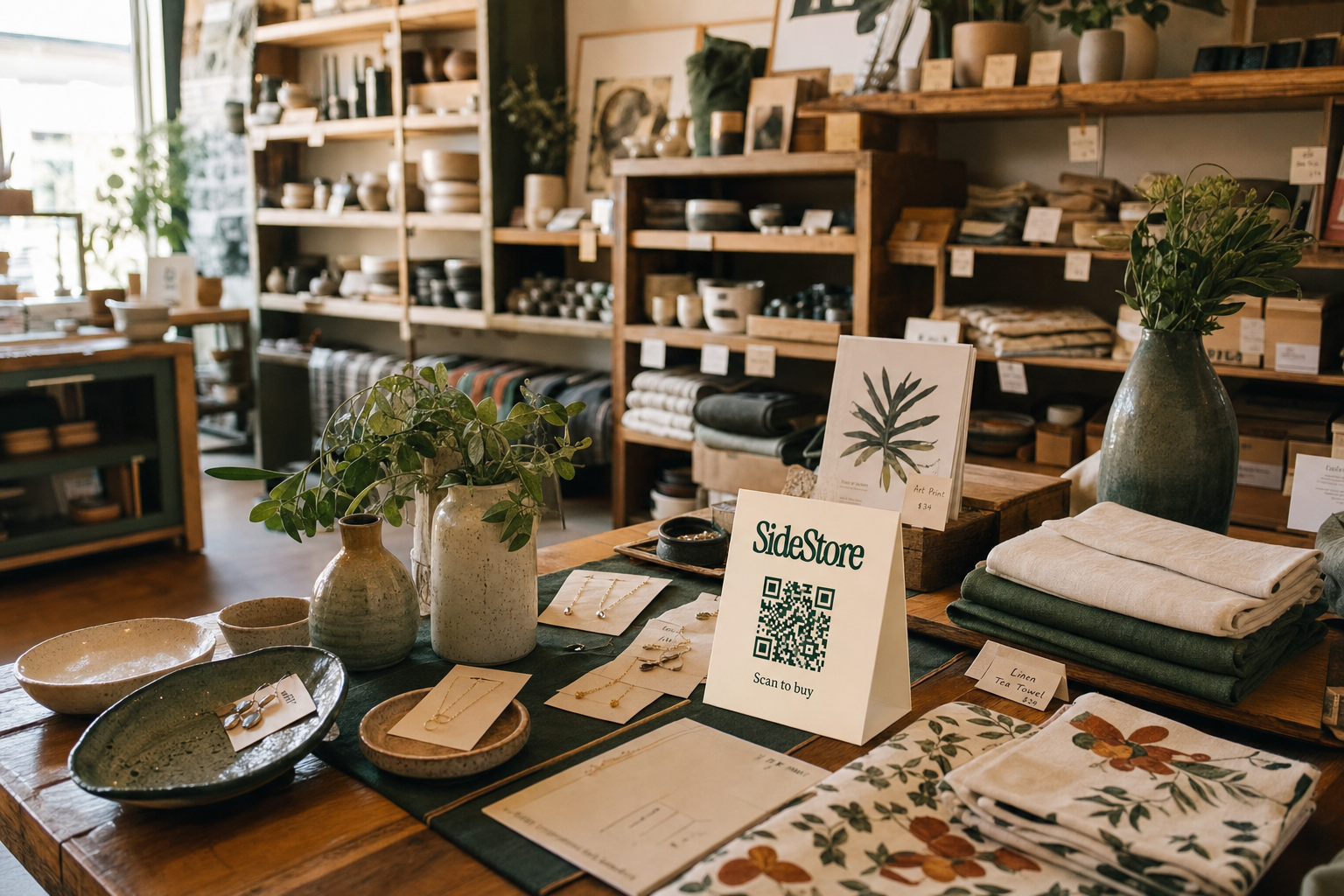
A collective store is a shared retail space where multiple independent makers or artisans sell their products under one roof, splitting lease costs, staffing duties, and operational responsibilities between them. If you're wondering what a collective store is and whether it suits your situation, the short answer is this: it's a lower-cost entry into physical retail, but it carries real operational obligations that solo or digital selling does not.
Collective stores give makers a physical presence without bearing the full weight of a commercial lease alone. You contribute to rent, roster your time at the till, and receive payouts based on your individual sales. The trade-off is governance: decisions about hours, layout, and membership require consensus, which takes time and energy.
Before committing to any shared retail model, it's worth mapping all the physical and digital alternatives for independent makers available to you. Collective stores are one option among several, and the right choice depends on how much risk you can absorb, how many hours per month you can commit, and how many locations you want to reach.
How a Collective Store Actually Works
A collective store works by pooling resources: makers share one leased retail space, divide operating costs proportionally, and take turns staffing the shop floor, with sales tracked per maker and payouts distributed periodically, usually monthly. That's the structure in its simplest form.
In practice, each maker pays a fixed fee or proportional share of rent and utilities each month. Some collectives also take a small commission on sales, typically in addition to the membership fee, to cover shared costs like point-of-sale systems, packaging, and display fixtures.
Space allocation is usually handled by floor plan agreement. Each maker gets a defined area, shelf, or display unit. Sales attribution depends on how the collective manages its point-of-sale setup. Older collectives use honor systems or manual logs; better-run ones use consignment inventory software that ties each transaction to a specific maker and product.
Roster commitments are where many makers underestimate the obligation. Expect to staff the shop for somewhere between 8 and 16 hours per month, depending on the collective's rules and how many members share the load. Fewer members means more hours per person. If you miss your shift, most collectives require you to find cover or pay a penalty.
Payouts come at the end of the period, after shared costs are deducted. The net amount reflects your gross sales minus your share of communal expenses. Transparency varies considerably between collectives: some share detailed itemised statements, others provide only a final figure.
If the idea of selling through someone else's store appeals to you but the staffing obligation does not, there are structures that separate selling from manning a till, which the sections below cover.
The Main Types of Collective and Shared Retail Models
Shared retail takes several distinct forms: the traditional collective store, the consignment placement, the pop-up concession, the platform cooperative, and the distributed consignment network. Each sits at a different point on the spectrum of cost, commitment, and control.
Traditional collective store. Multiple makers co-sign or jointly rent a physical space. Costs and duties are shared. This is what most people picture when they ask what a collective store is. It works well when the group is cohesive and the location has reliable foot traffic, but it requires active governance and regular physical presence.
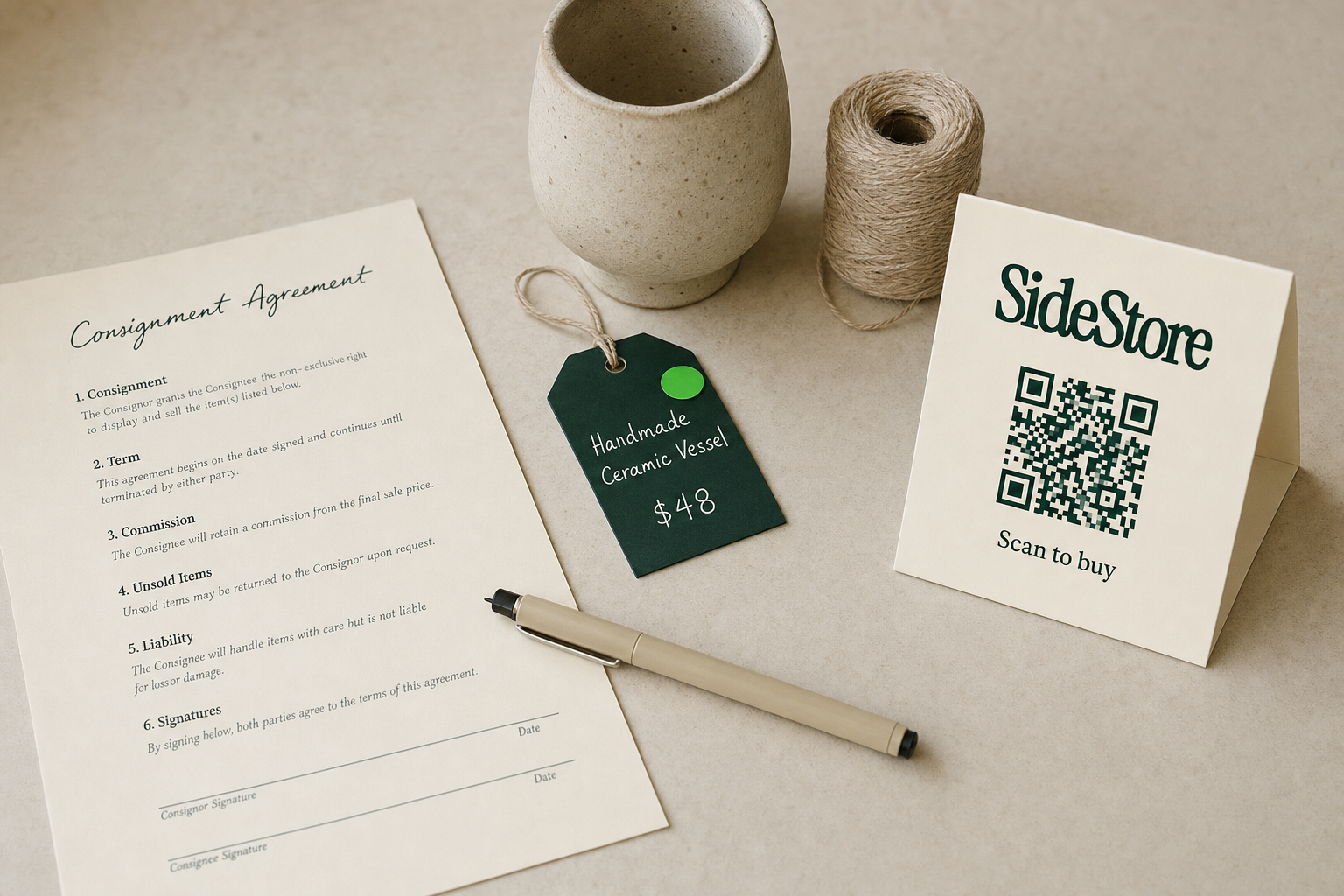
Consignment placement. A maker places products in an existing merchant space (a boutique, cafe, or hotel) and gets paid only when those products sell. The host holds no inventory risk and pays nothing upfront. The maker risks nothing in rent. Attribution and payouts are handled by the placement agreement or by purpose-built tools. Approaching a local shop about stocking your products is often the first step into consignment, and the barrier to entry is lower than joining a collective.
Pop-up concession. A maker rents a temporary space, a market stall, a short-term shop-in-shop, or a pop-up retail space for a defined period, days to weeks rather than months. The cost is contained and the commitment is finite, but the sales window is narrow and there's no compounding foot traffic from repeat visitors.
Platform cooperative. An online or hybrid marketplace owned collectively by its maker-members, who govern it democratically and share platform revenue. This model transfers platform ownership to the sellers rather than to a VC-backed company, but it introduces governance overhead and requires sustained member participation to function.
Distributed consignment network. Rather than placing products in one shared space, a maker places them across many merchant spaces simultaneously. Each placement is independent. Stock tracking, scan-to-pay checkout, and split payouts run through a single interface like the SideStore Retail Widget. The maker reaches multiple locations without co-signing a single lease or rostering a single shift.
The right model is not always the most obvious one. A maker who sells high-margin, low-volume work may find a single well-chosen consignment placement in a quality boutique outperforms a collective store membership that costs more in rent and time. Start with your margin, not with the model's name.
Collective and Shared Retail Models: Side-by-Side Comparison
The right model depends on two things: how much financial risk you can absorb and how many hours per month you can give to operations. This table maps the five main models against those two variables, plus payout mechanics and best-fit scenarios.
| Model | Who holds lease/risk | Maker's upfront cost | Ongoing time duty | Payout mechanism | Best for |
|---|---|---|---|---|---|
| Traditional collective store | Makers jointly | Proportional rent share + deposit | 8-16 hrs/month rostering | Periodic split after shared costs deducted | Makers with local community, consistent output |
| Consignment placement | Host merchant | None (products only) | Occasional restocking visits | Per-sale split, manual or via software | Makers testing new markets or locations |
| Pop-up concession | Maker (short term) | Stall/space rental fee | Full presence during pop-up | All sales direct to maker | Makers with seasonal or event-driven products |
| Platform cooperative | Collective member entity | Membership buy-in varies | Governance participation | Revenue share after platform costs | Makers wanting ownership stake in their sales channel |
| Distributed consignment network | Host merchants (per location) | None | Dashboard management only | Automatic split payouts per placement | Makers scaling across multiple locations without a lease |
If you are just starting out and want to test physical retail with minimal risk, consignment placements and distributed consignment networks sit at the low-cost, low-obligation end of this spectrum. Managing those placements becomes significantly easier when you use purpose-built consignment inventory software rather than spreadsheets.
What Is a Platform Cooperative for Makers?
A platform cooperative is a marketplace or selling platform that is collectively owned and democratically governed by its members, usually the makers or sellers who use it, rather than by outside investors or a private company. Where a traditional marketplace extracts fees and makes unilateral decisions about algorithms and terms, a platform cooperative distributes both the revenue and the decision-making among its members.
In practice, joining a platform cooperative typically means buying a membership stake, paying an ongoing fee, or contributing labour, and in return receiving a vote in how the platform is run. Revenue surplus is often distributed back to members rather than to shareholders.
The appeal is structural: you're not subject to a platform changing its fee structure overnight or deprioritising your listings in an algorithm update. You and your fellow members set the rules.
The challenge is equally structural. Governance takes time. Reaching consensus on pricing, membership criteria, platform features, and conflict resolution requires sustained participation from members who also need to run their own businesses. Cooperatives that lose member engagement tend to stagnate.
There is also the question of network effects. Platform cooperatives often operate at smaller scale than commercial alternatives, which can mean less organic traffic and fewer built-in buyers. You may need to drive your own audience to the platform, which reduces one of the main reasons to list on a marketplace in the first place.
If you're weighing a platform cooperative against other selling channels, it helps to map the full range of alternatives to Etsy for independent makers before committing to any single model. Cooperative ownership is valuable when the platform itself is where your buyers shop; less so when you have to do all your own marketing anyway.
What Is a Distributed Retail Network and How Does It Differ from a Collective Store?
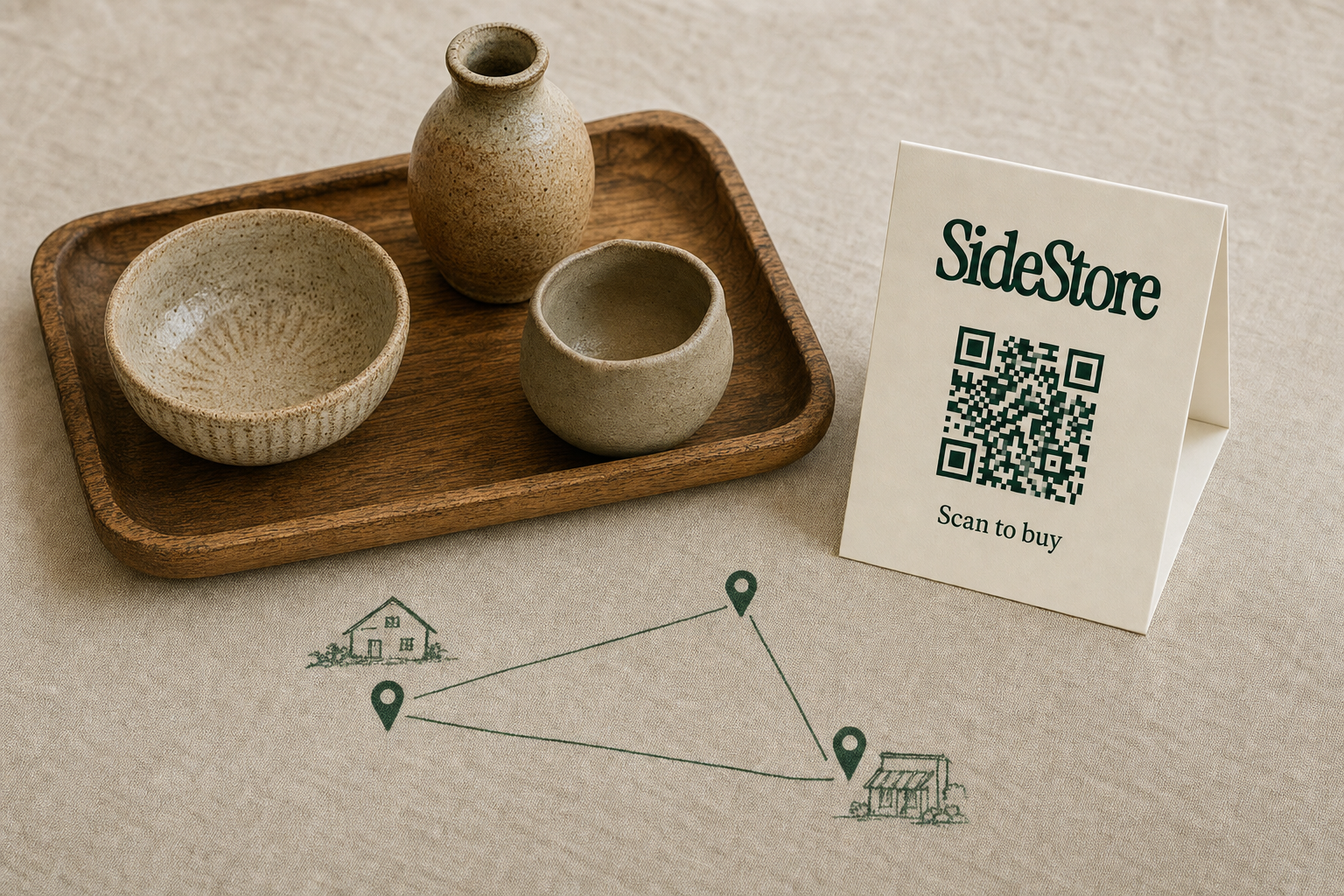
A distributed retail network inverts the collective store model: instead of many makers sharing one location, one maker places products across many locations simultaneously. The maker doesn't co-sign a lease or staff a till. Each placement is independent and runs on its own.
In a collective store, physical presence is mandatory and governance is shared. In a distributed retail network, the maker manages everything from a single dashboard. Each host merchant, whether a cafe, boutique, or hotel, earns a split of each sale in exchange for hosting the products in their space. No upfront cost, no inventory risk for the host, and no rent for the maker.
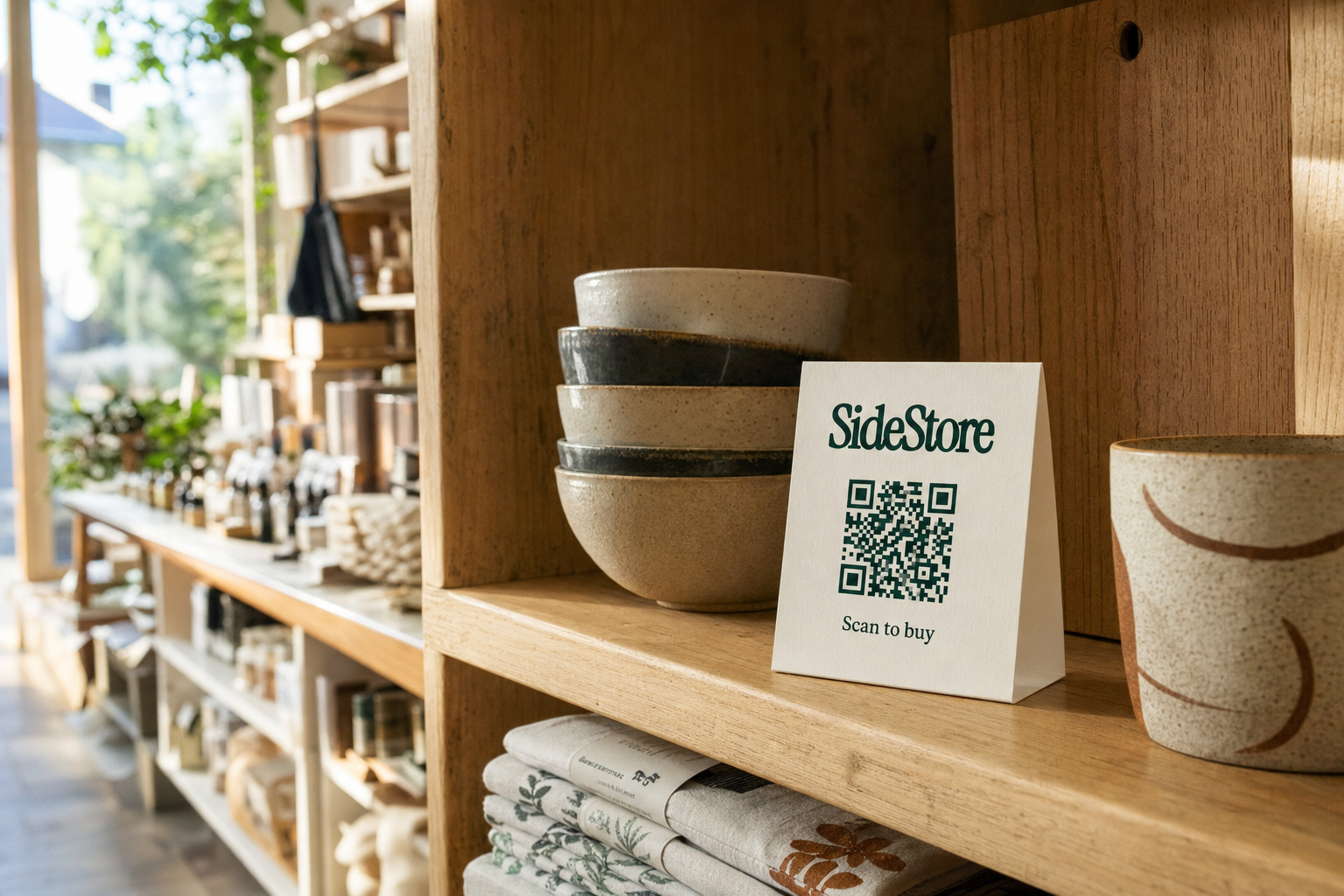
SideStore's Retail Widget is the tool that makes this mechanics concrete. When a maker places products in a merchant space through SideStore, the Retail Widget handles the full placement: scan-to-pay checkout via a printable QR card, live stock tracking per location, placement attribution so you know exactly which merchant is moving which products, and automatic split payouts settled directly to both maker and host at point of sale.
The practical difference from a collective store is significant. You can have placements in a ceramics boutique, a hotel lobby, and a neighbourhood cafe simultaneously, and manage all three from one place, without attending a single governance meeting or covering anyone's shift.
For makers who want to explore this model across different venue types, the approach to placing art prints in local shops on consignment, selling local products to hotels, and selling through cafes each has its own nuances. The underlying mechanism is the same; the pitch and product fit differ by venue.
Honest Trade-Offs: What Collective Stores Get Right and Where They Fall Short
Collective stores genuinely work for some makers: the built-in community lowers the cost of physical retail and the shared space creates a curated shopping experience that individual consignment placements can't replicate. But the roster obligation and governance overhead are real costs that don't show up in the membership fee.
What collective stores get right. A well-run collective creates a destination. Shoppers visit because the curation and the story attract them, not just because they need a product. That pull is harder to manufacture through a consignment placement in a host merchant who sells other things primarily. Collective stores also give makers direct customer feedback: you staff the till, you hear what people say, and you learn quickly what sells and what doesn't.
The community itself has value. Makers in a collective share contacts, share equipment, collaborate on events, and refer customers to each other. That informal network can accelerate your understanding of the market.
Where collective stores fall short. The roster is non-negotiable in most collectives. If your production schedule is irregular or you have other commitments, covering 8 to 16 hours of till duty per month becomes a genuine constraint. Missing shifts damages relationships and often incurs penalties.
Governance disagreements are more common than new members expect. Decisions about store hours, display allocation, new membership, and cost splits require consensus from people who have competing interests. Progress can be slow.
And a collective store is one location. If you make handmade jewellery and want boutique distribution, a single collective store caps your reach at one postcode. A distributed consignment approach reaches more venues without the governance overhead, though it sacrifices the destination quality of a well-curated collective.
How to Choose the Right Shared Retail Model for Your Situation
The right model becomes clear once you answer three questions: How many hours per month can you commit to operations? How much upfront financial risk can you absorb? And do you want depth in one location or reach across many? Answer those three questions first, then match them to a model.
If you can commit 8+ hours per month and want a local community. A traditional collective store is worth exploring. It gives you a physical home and peer support, but expect governance overhead.
If you have limited time but want to test physical retail. A consignment placement requires no rostering. You place products, restock occasionally, and collect your split. Start with how to approach a local shop about stocking your products to understand the conversation.
If you want scale across multiple venues without a lease. A distributed consignment network via a tool like SideStore's Retail Widget lets you manage many placements from one dashboard. No lease, no roster, automatic split payouts.
If you want a short window to test demand. A pop-up concession gives you a finite, contained risk. Useful before committing to a longer model.
If you care about platform ownership. A platform cooperative suits makers who want a democratic stake in their selling channel and can afford the governance time.
One additional factor worth understanding: the margins and expectations of your host venues vary significantly by type. Knowing how cafes think about margins and supplementary revenue helps you pitch consignment terms that actually work for both sides.
Frequently Asked Questions
These are the questions makers most commonly ask after reading about collective stores. Each answer is written to stand on its own.
What is the difference between a collective store and a cooperative?
A collective store is a shared physical retail space where makers split costs and duties. A cooperative is a legal ownership structure where members collectively own and govern an entity, which could be a store, a platform, or any business. A collective store can be run as a cooperative, but many are informal arrangements without formal cooperative governance or legal structure.
Do I need to be present in a collective store to sell my products?
In most collective stores, yes. Roster duties, typically 8 to 16 hours per month, are a standard membership condition. Some larger or more established collectives hire part-time staff to reduce maker presence requirements, but this is the exception. If physical presence is a constraint, consignment placements or a distributed consignment network via consignment inventory software may suit you better.
How do collective stores handle unsold stock?
Policies vary. Most give makers responsibility for removing unsold stock at the end of a membership period. Some collectives run periodic clearance events or markdowns to move slow inventory, with the markdown decision made collectively. If products don't sell, you retrieve them and rethink either the product or the placement.
What is a community-owned marketplace versus a traditional marketplace?
A community-owned marketplace (often a platform cooperative) is owned and governed by its seller-members, who share revenue and vote on platform decisions. A traditional marketplace is owned by a private company that sets terms, takes fees, and makes decisions unilaterally. Community ownership offers more stability and alignment; traditional marketplaces offer larger audiences and more established infrastructure.
The Practical Next Step
Before committing to any model, test one consignment placement first. It costs nothing upfront, carries no lease obligation, and tells you more about your products' physical retail performance than any amount of planning. If it works, you can scale it or layer in a collective store alongside. Learn more about how to sell through someone else's store to start that process.
Build a consignment network without opening a store of your own.