How to Sell Art Prints in Cafes: Turn Wall Space into a Passive Income Stream
Selling art prints in cafes works on consignment. You place framed or unframed prints on a cafe's walls. The cafe earns a percentage when a print sells. Neither of you pays upfront, neither carries inventory risk. The mechanics are straightforward: identify cafes whose aesthetic matches your work, pitch the owner with a clear proposal, sign a written agreement, set up signage with a scan-to-pay QR checkout, and manage stock from your studio.
That is the full picture in one paragraph. The rest of this guide fills in the detail: what to say in the pitch, how to structure the split, what your consignment agreement must include, and how to scale from one cafe to a distributed network of placements without losing your mind to spreadsheets and follow-up emails. If you are also considering retail spaces beyond cafes, the guides on selling art prints in local shops and selling through someone else's store are worth reading alongside this one.
Why Cafes Are One of the Best Venues for Selling Prints
Cafes work for art prints because of dwell time. A customer who stays for a coffee and a laptop session gives your work far more attention than a shopper passing through a retail aisle. That extended presence converts browsing into genuine consideration.
The physical setup is already there. Cafes hang artwork to create atmosphere. By offering your prints on consignment, you give the owner a way to make that wall space generate revenue rather than simply look good. Under the SideStore consignment model, the cafe earns a split every time a print sells. They take on zero stock risk. The Retail Widget handles checkout, live inventory tracking, and automatic split payouts. There is no upfront purchase, no invoicing, no cash-in-envelope arrangement. The mechanics run themselves.
For the owner, the logic is simple: the wall was already there, and now it pays. For you, every cafe placement is a sales channel that operates while you are making the next piece. The prints work. You do not have to be present.
Cafes also attract repeat customers. A regular who walks past your print three times a week and finally scans the QR code to buy it is a realistic conversion, not an optimistic fantasy. Understanding how cafe owners think about their own margins helps before you pitch. The articles on cafe profit margins and what a coffee shop actually earns give you that grounding.
How to Pitch a Cafe: What to Say and What to Bring
The most effective cafe pitch takes less than five minutes and leads with the owner's benefit, not your portfolio. A cafe owner is not an art buyer. They are a business operator. Frame the conversation around idle wall space generating a revenue split with zero effort and no stock risk on their part, and you will get a fair hearing.
Before you walk in, do this:
Research the cafe's aesthetic online and in person. Your ceramics or abstract prints need to sit naturally in the space. A specialty coffee bar with exposed concrete walls and a muted palette is a different pitch than a neighbourhood bakery covered in floral wallpaper. Choose venues where your work fits without explanation.
What to bring to the meeting:
- Two or three sample prints, framed or mounted, so the owner can see exactly what the wall will look like
- A one-page summary of the consignment terms you are proposing: split, review period, collection process
- A printed QR card from your SideStore Retail Widget, so you can demonstrate the scan-to-pay checkout in thirty seconds
- A short list of the prints you would place, with retail prices marked clearly
How to frame the pitch:
Open with the owner's outcome: "I'd like to hang a small collection of prints on consignment. You earn a percentage of each sale, carry no stock, and I handle restocking and removal." That sentence does most of the work. Avoid leading with your creative background unless they ask.
The split to propose:
A 70/30 split in the maker's favour, you keep 70, the cafe earns 30, is a common starting point for cafe consignment. Some venues in higher-footfall locations may expect 60/40. Start at 70/30 and let the owner negotiate. The split matters less than getting the placement confirmed and the prints on the wall.
The follow-up:
If the owner is interested but not ready to commit, leave a sample print on approval for one week. It closes more placements than any amount of follow-up email. For context on pitching retail spaces more broadly, the guide on pitching boutiques and retail spaces covers the same principles for a slightly different audience.
The Consignment Agreement: What to Include and Why It Matters
A consignment agreement for artists is a written contract that specifies how products are placed, priced, sold, and settled between a maker and a venue. You need one for every cafe placement, regardless of how friendly the relationship feels. Handshake deals collapse when a print is damaged, a cafe closes, or an owner changes.
A solid consignment contract for artists should include these six clauses, in this order:
Product description and valuation. List every print by title, edition number, dimensions, and agreed retail price. This record prevents pricing disputes later and matters enormously if a piece is lost or damaged.
Revenue split and payment terms. State the agreed percentage split and how often settlement happens: monthly is the standard. If you use SideStore, the Retail Widget handles automatic split settlement per sale, so you can reference the platform rather than specifying a manual bank-transfer process.
Stock tracking and reporting. Define how you will both know what has sold. With the Retail Widget running live stock tracking, this clause is simple: the platform is the record. Without technology, you need to specify a manual stocktake interval.
Display and placement conditions. Specify where in the cafe the prints will hang, who is responsible for installation, and what happens if the cafe wants to move them.
Damage and liability. State clearly who bears the cost if a print is damaged while in the cafe's care. Typically the cafe accepts liability for damage caused by their staff or environment.
Term, termination, and collection. Set a review period (three or six months is reasonable) and specify how much notice either party needs to end the arrangement and how quickly you will collect unsold work.
For a broader look at how these agreements fit into retail partnerships, the guide on consignment agreements for retail partnerships covers the full context. Keep the language plain. A one-page agreement that both parties actually read is more useful than a five-page document that gets filed and forgotten.
Pricing Your Prints and Structuring the Revenue Split
Pricing prints for cafe consignment means building the venue's split into the retail price from the start, not subtracting it afterward. This is the mistake most makers make: they decide what they want to earn, set that as the price, and then discover they have given away their margin.
Work the arithmetic in the right direction. Here is an illustrative example:
- You want to receive £140 for a signed, limited-edition A2 print (materials, labour, and a margin for your time)
- The cafe takes a 30% split
- Retail price must therefore be: £140 ÷ 0.70 = £200
- The cafe earns £60 per sale; you receive £140
Set the retail price at £200 from the outset. Do not price it at £140 and then offer a split; you will walk away with £98.
Limited vs. open edition pricing. Limited editions justify a higher retail price because scarcity is part of the value. A numbered edition of 25 prints can price at a premium over an open-edition print of the same image. Be consistent: if you sell open editions online at a lower price, a cafe customer who checks will notice the discrepancy.
Framed vs. unframed. Framed prints sell more easily in cafes because they are ready to hang and look finished on the wall. They also justify a higher retail price. The trade-off is the upfront cost of frames and the added logistical work of transporting them. Unframed prints in a portfolio sleeve work if the price point is lower and you include a note that framing is available to order.
Price clearly. An unmarked print is a print that does not sell.
Setting Up Your Display: Labels, Signage, and the QR Checkout
A well-set-up cafe display does three things: it catches the eye, it tells the customer the print is for sale, and it makes buying effortless. Most maker displays fail on the third point. The print is beautiful, there is a small handwritten price label, and there is no clear way to buy. The customer finishes their coffee and leaves without acting.
Physical setup:
- Hang prints at eye level where possible, ideally in a sightline from seating areas rather than behind the counter
- Use a clean printed label for each piece: title, edition information, dimensions, and price
- Include a short sentence about you and your practice, printed neatly and laminated if the cafe environment is humid
Signage:
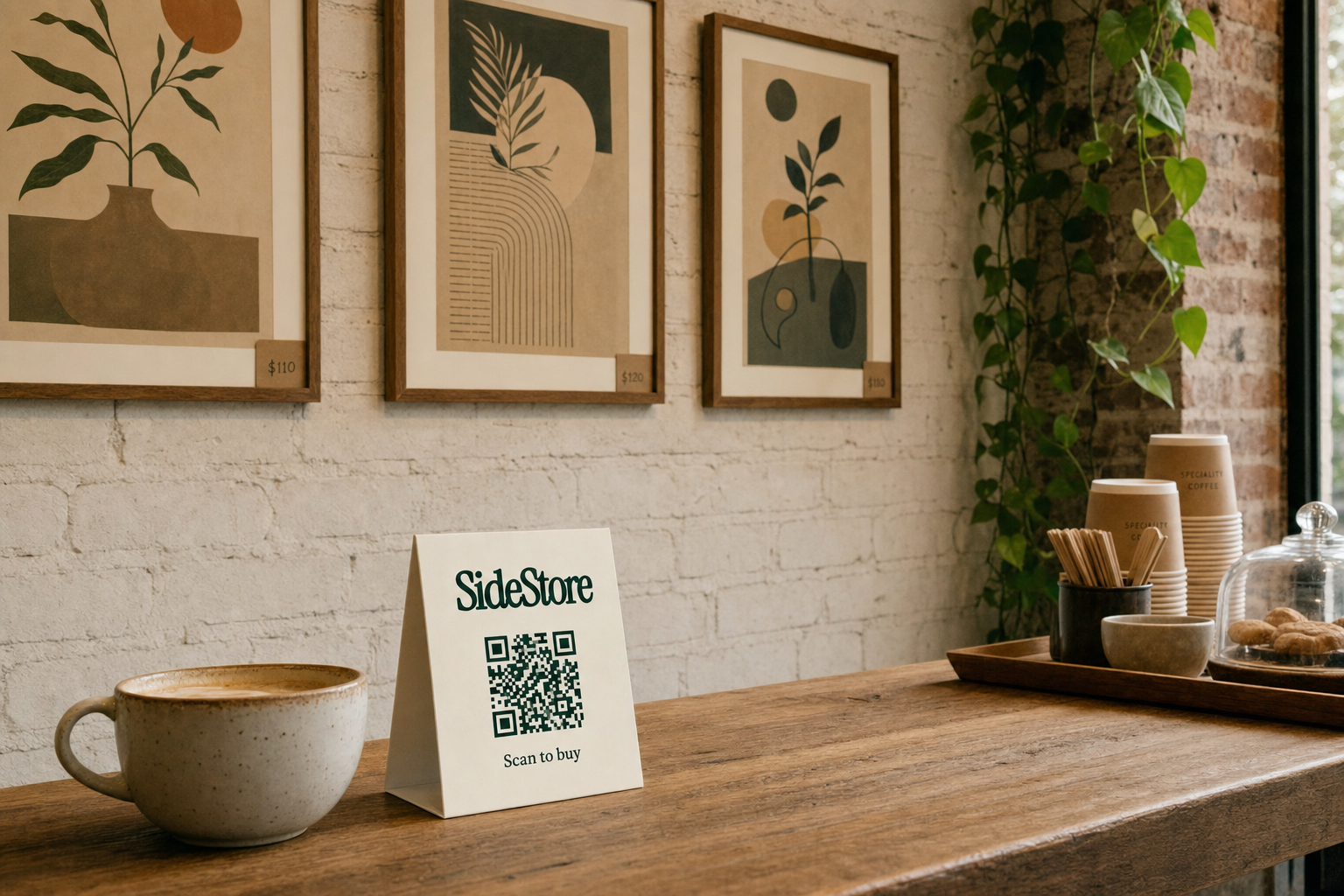
A small A5 card near the display explaining that prints are available to purchase, with a prompt to scan the QR code, does significantly more work than price labels alone. Keep the language direct: "These prints are for sale. Scan to buy."
The QR checkout via the Retail Widget:
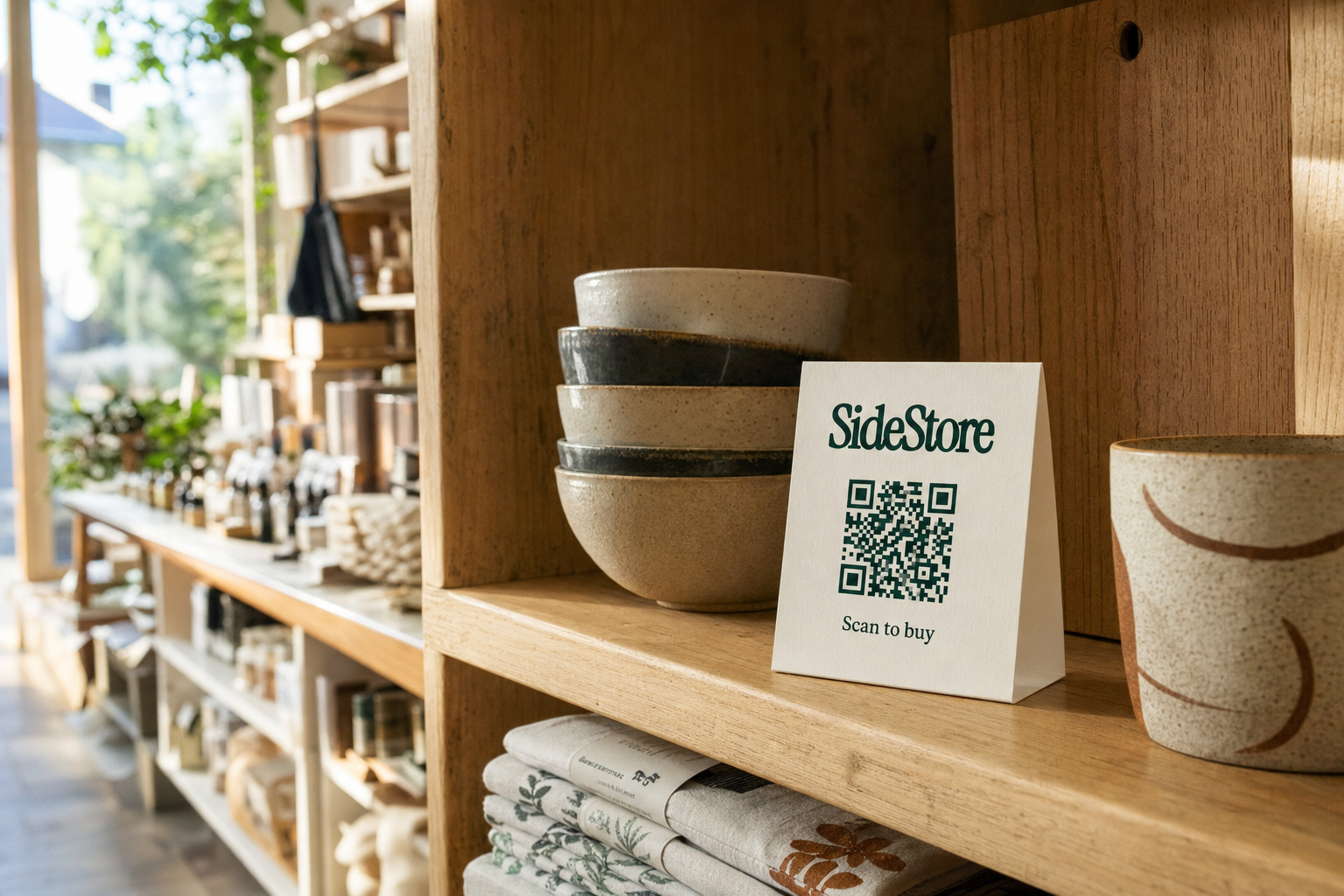
The SideStore Retail Widget is the consignment-management interface that runs the placement end to end. It handles checkout via a printable scan-to-pay QR card, live stock tracking, placement attribution, and automatic split payouts. The QR checkout is one function of the Widget, not the whole product. A customer scans the code on their phone, selects the print, and pays. The sale is recorded, stock is decremented, and the split settlement is calculated automatically.
You can print one QR card that covers all the prints in a placement, or attach individual QR cards to each piece. Either way, the mechanics are handled without you being present. For a deeper look at managing inventory across placements, the guide on consignment inventory software is the logical next read.
Cafe Consignment vs. Other Distribution Options for Print Makers
Cafe consignment is one of several routes to market for print makers, and it is worth comparing them honestly before committing your inventory.
| Distribution channel | Upfront cost | Inventory risk | Footfall / reach | Admin burden | Split or fee |
|---|---|---|---|---|---|
| Cafe consignment (SideStore) | Low | None | Medium (local, loyal) | Low (Retail Widget handles tracking and settlement) | 30% to cafe, variable |
| Boutique consignment | Low | None | Medium | Low to medium | 30, 50% to boutique, variable |
| Pop-up stall | Medium (pitch fees, equipment) | You hold all stock | High (event-dependent) | High (manual sales, cash handling) | None, but high cost |
| Online-only (e.g. Etsy) | Low | You hold all stock | High (global) | Medium (shipping, listings, reviews) | Platform fee, no split |
| Own shop / studio | High | Full | Low (dependent on location) | Very high | None |
Cafe consignment through SideStore sits in a useful middle ground: low cost to enter, no stock risk for the venue, and the administrative load handled by the Retail Widget. Pop-up stalls offer higher short-term footfall but require physical presence and carry significantly more operational effort. Online platforms reach a broader audience but compete in a crowded marketplace and require you to manage fulfilment individually. For makers who want offline presence without the commitment of a physical premises, the comparison makes a strong case for starting with consignment. If you want to explore the pop-up route alongside, the pop-up retail guide covers the trade-offs in detail, and the selling prints in local shops guide extends the consignment approach beyond cafes.
Scaling Beyond One Cafe: Managing a Distributed Consignment Network
The real leverage in selling prints on consignment appears when you move from one cafe to five, or ten. That is where the model shifts from a modest side income to a meaningful distribution network. It is also where manual management breaks.
With a single cafe, a handwritten stock list and a monthly cash settlement is manageable, if inefficient. Add three more venues and the problems multiply: you no longer know in real time what has sold where, which venue owes you money, or which placement needs restocking. Chasing four cafe owners for separate monthly payments is not a passive income stream; it is unpaid administration.
SideStore addresses this directly. Each cafe becomes a separate placement in the dashboard, with its own live stock count, its own sales record, and automatic split settlement that runs without you sending a single invoice. When a print sells at placement three, the split is calculated and recorded immediately. You see it from wherever you are working.
This is what selling prints on consignment looks like at scale: your prints are in ten cafes across the city, each placement is live, and your dashboard shows you the consolidated picture without a spreadsheet in sight. You manage restocking decisions based on real stock data, not on memory or a phone call to a cafe owner.
The practical ceiling on a manually managed consignment network is roughly two or three venues. With the right inventory tools, that ceiling rises substantially. The guide on consignment inventory software for tracking placements explains the options in detail.
Selling Ceramics and 3D Objects in Cafes: What Changes
Knowing how to sell ceramics through coffee shops follows the same consignment model as prints, with three practical differences worth handling upfront.
The consignment agreement, the revenue split, the Retail Widget checkout, and the payment mechanics are identical. What changes is the physical reality of the objects. Ceramics sit on surfaces rather than hanging on walls, so placement attribution matters differently: a shelf near the register is a better location than a shelf behind a condiment station. You will want to specify the exact display location in your agreement.
Fragility introduces a liability clause that flat prints do not require to the same degree. State clearly in your consignment contract who bears the cost of breakage. Reasonable terms: the cafe is liable for damage caused by their staff or operations; accidental customer damage is shared or covered by a small damage deposit you build into the pricing.
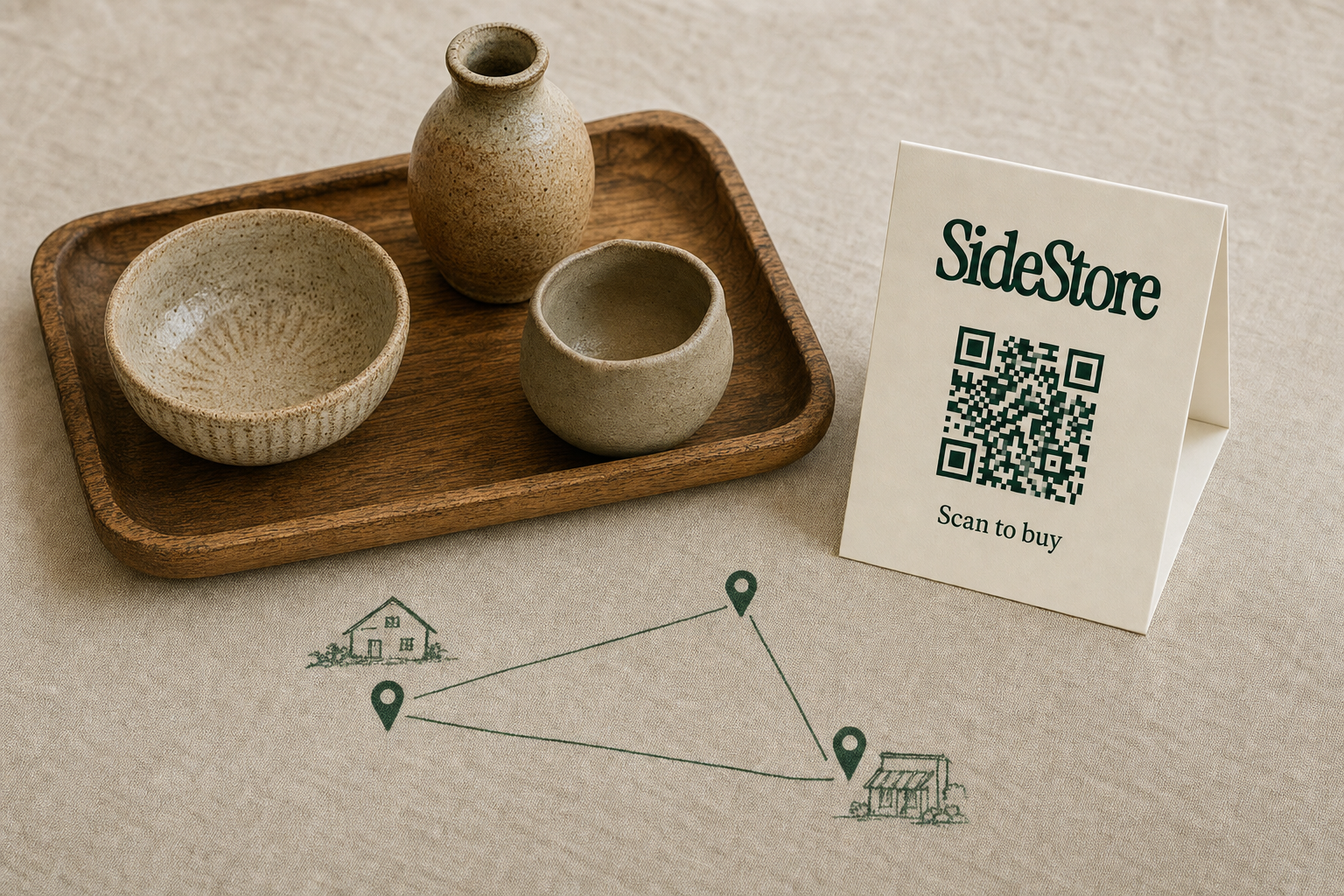
Ceramic pieces also photograph better with minimal context. A handwritten card with the maker's name and a QR code resting beside a cup or a bowl is an effective in-situ display that sells the piece without over-explaining it.
Frequently Asked Questions
Do I need a formal contract to sell prints in a cafe?
Yes. A written consignment agreement for artists protects both parties if a print is damaged, a cafe closes, or a payment dispute arises. Keep it simple: one page covering the product list, split, payment schedule, liability, and collection terms. A friendly arrangement without paperwork will eventually encounter a situation the friendship cannot resolve.
What is a typical consignment split for cafes?
A 70/30 split, where you keep 70% and the cafe earns 30%, is a reasonable starting point. Higher-footfall venues may negotiate toward 60/40. The split matters less than the retail price you set: build the cafe's percentage into the price before you agree anything, so your target revenue is protected regardless of what you settle on.
How do I know when a print sells if I am not in the cafe?
With SideStore's Retail Widget, you do not need to be present. The Retail Widget tracks live stock across all your placements and records each sale automatically. You can see what sold, at which venue, and when, from your dashboard. Without that, you are relying on the cafe owner to report sales and send payment, which is where manual consignment arrangements most commonly break down.
Can I sell prints in multiple cafes at once?
Yes, and it is the natural next step once your first placement is running. Each cafe is a separate placement in SideStore, with its own stock level, sales record, and automatic split settlement. Managing five placements through the dashboard takes roughly the same effort as managing one. For makers who want to understand how consignment works across different retail formats, the guide on how consignment works for handmade products in retail is a useful companion read.
Next Steps: Place Your First Print
Getting started with selling art prints in cafes is a five-step process you can complete this week.
- Select three cafes whose aesthetic matches your work and whose owner you can approach directly. Walk in during a quiet mid-morning slot, not a Saturday rush.
- Prepare your pitch pack: two sample prints, a one-page consignment proposal with your proposed split and terms, and a printed SideStore QR card to demonstrate the checkout.
- Set up your Retail Widget before the pitch so you can show the owner a live, working checkout. A working demo closes more placements than a verbal description.
- Sign a written agreement for every placement that proceeds. Use the six-clause checklist from this guide as your template.
- Photograph every placement once the prints are hung. You will need these images for future pitches to other venues, and they are useful marketing material in their own right.
After your first placement is live, revisit it after thirty days. Check the stock, confirm the display is in good condition, and use that conversation to raise the possibility of a second location. Scaling from one cafe to several is the point where passive income becomes a genuine distribution strategy. The guides on selling art prints in local shops and boutique inventory systems for multi-venue makers will help you manage the next stage.
The goal is straightforward: build a consignment network without opening a store of your own.