What Is a Fair Consignment Percentage? Industry Standards Explained
Wondering what a fair consignment percentage looks like? Learn typical splits by venue, the break-even formula, and how to negotiate with confidence.
What Is a Consignment Percentage?
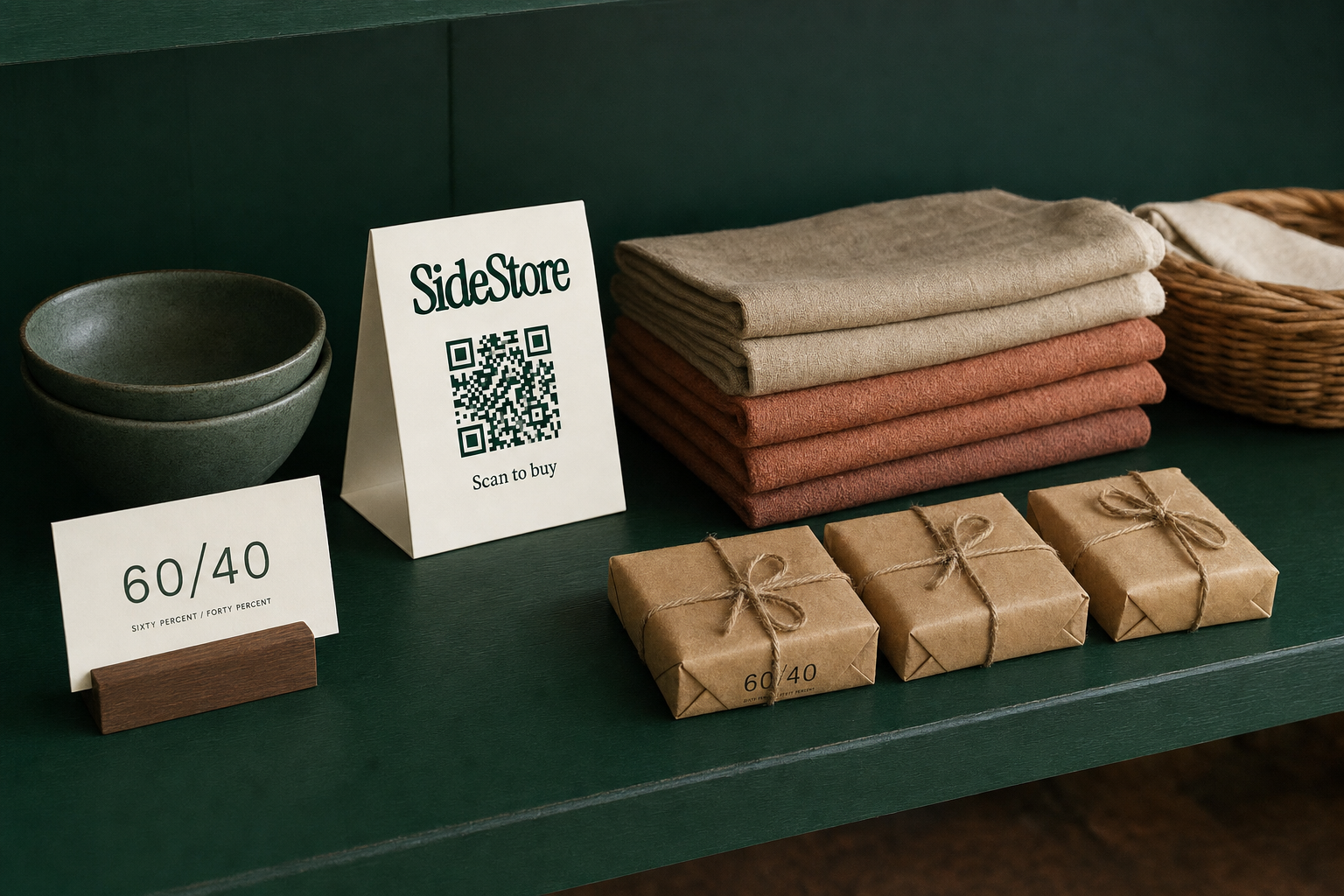
A consignment percentage is the share of a product's retail sale price paid to the maker versus the share retained by the merchant host. Most consignment arrangements split somewhere between 50/50 and 70/30 in the maker's favour, with the average consignment percentage sitting around 60% to the maker and 40% to the host across most product categories.
The exact split depends on venue type, product category, sales volume, and whether the merchant provides active selling support or simply shelf space. A gallery handling fragile, high-touch artwork will typically retain a larger share than a cafe displaying candles on a counter. Neither arrangement is wrong, what matters is whether the numbers work for both sides before anything is signed.
If you're weighing consignment against other models, you may also want to read about consignment vs. pop-up retail before committing to either path.
How a Consignment Split Works
A consignment split works by dividing a product's retail sale price between the maker and the host merchant at the moment of sale, with no upfront payment required from either side. The maker provides the stock; the merchant provides the space and the footfall; and both get paid only when a customer buys.
The mechanic is straightforward. Say you price a handmade ceramic mug at £40 retail and agree a 60/40 split. At the point of sale, £24 goes to you as the maker and £16 goes to the merchant. No invoice, no chasing payment, the split is settled automatically at checkout.
That alignment is precisely what makes percentage splits preferable to flat placement fees. A flat monthly fee of £20 benefits the merchant whether your product sells twelve units or none. A percentage split means the merchant earns more when your product performs well, which gives them a genuine reason to position it visibly and recommend it to customers. Both parties are betting on the same outcome: the sale.
For the merchant, the host percentage needs to cover the opportunity cost of that shelf space, what else could sit there, and what would it earn? For you as a maker, the split has to leave enough margin above your cost of goods to justify the channel at all. That calculation comes in a later section, but keep it in mind: percentage splits align incentives beautifully, but only if your retail price is set correctly before the conversation starts.
Platforms built for consignment, like SideStore's Retail Widget, handle this split automatically at checkout, including live stock tracking and placement attribution, so neither party has to manage the maths manually. If you're thinking about boutique inventory management, understanding the split mechanic is the right place to start.
Industry-Standard Consignment Percentages by Category
The typical consignment percentage varies by product category, and the range across the industry runs from roughly 50/50 to 70/30 in the maker's favour. These are widely reported norms drawn from common practice, not audited statistics, and your own split should be benchmarked against them before you agree to anything.
Here is what you can reasonably expect by category:
Handmade crafts and gifts (60, 70% maker): Low-margin, high-volume products like candles, soap, and printed goods tend to attract maker-friendly splits because margins are thin. A merchant taking 40% on a £12 candle earns £4.80 per unit, workable only if turnover is brisk.
Jewellery and accessories (50, 60% maker): Higher retail prices mean the host's absolute return per sale is larger even at a lower percentage. A £120 necklace at a 50/50 split puts £60 in the merchant's pocket, which is meaningful. Expect more negotiation in this category.
Art and prints (40, 60% maker): Galleries traditionally retain 40, 50% because they invest heavily in curation, presentation, and client relationships. Independent venue placements, a hotel lobby, a boutique, typically sit closer to 60% for the maker.
Clothing and apparel (50, 60% maker): Boutique hosts often negotiate harder here because garments require fitting space, handling, and sometimes returns management. Expect to land around 55/45 in practice.
Food and drink products (60, 70% maker): Shelf-stable food products in cafes and delis typically favour the maker, partly because the host already earns on consumables and treats retail product as a secondary revenue line. The host's 30, 40% is essentially pure margin on space they already have.
Books and stationery (55, 65% maker): Mid-range splits are standard. Bookshops and stationery boutiques often handle returns, which justifies a slightly larger host share.
Getting your retail price right before agreeing to any split is essential. See pricing inventory for a boutique and managing your boutique inventory list for the underlying mechanics.
Consignment Split Benchmarks at a Glance
If you want a single reference to anchor your negotiations, the table below consolidates typical split ranges by venue and product type. These figures reflect common practice across the consignment industry. Use them as a starting benchmark, not a ceiling or a floor, your specific terms will shift based on the factors covered in the next section.
For hosts managing multiple consignment placements, tools like boutique hub inventory tools can help you track performance across each product line without losing sight of which splits are actually delivering.
| Venue / Category | Typical Maker Share | Typical Host Share | Notes |
|---|---|---|---|
| Boutique, gifts and crafts | 60, 70% | 30, 40% | Low margin products; maker needs room to cover COGS |
| Boutique, clothing and apparel | 50, 60% | 40, 50% | Handling and returns often justify a higher host share |
| Boutique, jewellery | 50, 60% | 40, 50% | Higher unit prices make the host's absolute return viable |
| Cafe or coffee shop, shelf goods | 60, 70% | 30, 40% | Host treats retail as secondary income on existing space |
| Hotel, lifestyle and gift | 60, 65% | 35, 40% | Low active-selling effort; split reflects passive placement |
| Gallery, original art | 40, 50% | 50, 60% | Galleries invest heavily in curation and client relationships |
| Deli or farm shop, food products | 60, 70% | 30, 40% | Shelf-stable goods; host margin supplements core food trade |
What Factors Shift the Consignment Percentage?
Five main factors move the typical consignment percentage up or down: your product's cost of goods, the host's foot traffic and active selling role, the exclusivity of the placement, the volume you can supply, and whether the merchant carries any stock risk.
Before any of those come into play, you need one number: your break-even split. The formula is simple.
Break-even maker share (%) = (COGS ÷ Retail Price) × 100
If your cost of goods sold (COGS) is £14 and your retail price is £40, your break-even maker share is 35%. Any split that gives you more than 35% covers your costs. Anything below it means you're losing money on every sale. In practice, you need margin above break-even to cover your own time, restocking logistics, and packaging, so a realistic minimum maker share in this example is closer to 50, 55%.
Now the five factors:
1. Foot traffic and sell-through rate. A high-footfall venue that moves product quickly is worth accepting a slightly lower maker share. A quiet location that shifts two units a month is not, unless the split is generous enough to compensate for the slow pace.
2. Active selling versus passive display. If a merchant's staff actively recommend your product, describe it, and field questions, that warrants a larger host share. If your product sits on a shelf with a QR card and sells itself, the host's contribution is space alone, and the split should reflect that.
3. Exclusivity. If the merchant is asking to be your sole stockist in a neighbourhood or city, that limits your placement options and deserves compensation, either a better maker split or a minimum sales guarantee.
4. Supply volume. If you can reliably supply high volumes, you have leverage. A merchant who wants consistent stock has reason to offer favourable terms. Thin supply capability weakens your position.
5. Overheads the host carries. A merchant who handles packaging, gift-wrapping, or returns management is doing work that has a cost, and that cost reasonably sits in the host share.
See how a cafe earns from its floor space and live boutique inventory tracking for how hosts think about what that shelf space is actually worth to them.
How to Negotiate a Consignment Percentage
Negotiating a consignment percentage is straightforward when you walk in knowing three numbers: your break-even maker share, your target maker share, and your walk-away minimum. Anchor the conversation to category norms, not to what feels comfortable to say out loud.
Here is a clear sequence:
Step 1: Calculate your walk-away number first. Using the break-even formula above, establish the minimum maker share that covers your COGS plus a workable margin. If you need 55% to make the channel viable, that is your floor, you do not go below it regardless of how appealing the venue looks.
Step 2: Research category norms and open with them. Lead with the industry benchmark, not your personal preference. "Handmade gift products in boutique settings typically run 60, 65% maker" is a factual anchor. It positions your request as reasonable, not arbitrary.
Step 3: Offer something in exchange for a better split. If the merchant pushes for a larger host share, consider what you can offer instead: faster restocking turnaround, a wider product range, exclusive access to a new line, or a short-term trial at their preferred split with a review clause after 90 days. A trial with a defined review point is often easier for a merchant to agree to than a permanent term.
Step 4: Clarify what the host share covers. Before you sign, confirm whether the host's percentage includes any active selling, display maintenance, or returns handling, or whether it is purely a space fee. That distinction affects whether their share is fair value.
Step 5: Put the split in writing, with a review date. Verbal agreements drift. A simple written agreement, including the split percentage, the review date, and who is responsible for restocking, protects both parties.
If you want context on what profit margins a cafe host works with, that will help you understand why some merchants push hard for a larger share and where their ceiling actually is.
Consignment Percentage vs. Wholesale Margin: Which Model Fits?
The right question is not which model is better, it is which model fits your cash flow, your risk tolerance, and the type of merchant you are selling through. Consignment and wholesale serve different situations, and neither is universally superior.
With wholesale, you sell stock to a retailer upfront at a trade price, typically 40, 60% below retail. You get paid immediately, no waiting for sell-through, but you absorb the full cost of goods and take the margin hit on every unit. If the retailer over-orders and then returns stock, you carry that risk too.
With consignment, you retain ownership of the stock until it sells. Your retail margin is higher because you are not discounting to a trade buyer. But cash comes later, and you may have product sitting in a venue for weeks without selling.
Wholesale suits makers with strong cash reserves, reliable production capacity, and retail buyers who order in volume. It suits merchants who want to own their stock and set their own prices.
Consignment suits makers who cannot afford to sell at trade price without breaking even, who want to test new venues without committing stock upfront, or who are building distribution gradually across multiple locations. It suits merchants who want product on their shelves without the purchase commitment.
One honest note: consignment requires more ongoing management, restocking, tracking, settlement reconciliation. If you place products in ten venues and manage it manually, the administrative load is real. Platforms like SideStore's Retail Widget automate split payouts and live stock tracking, which changes that equation, but the underlying model still demands more active management than wholesale.
For a fuller picture of how much profit a retail host makes per sale, that context helps you understand what a merchant needs from either arrangement.
What Makes a Split Fair for the Merchant?
A split is fair for a merchant when the host share covers the opportunity cost of the shelf space and generates a return that justifies the minimal effort consignment requires. The key calculation is shelf ROI: how much does that placement earn per square metre, per month, compared to alternatives?
Here is a simple example. Suppose a small shelf section holds ten units of a £30 product. At a 35% host share, each sale returns £10.50 to the merchant. If that section turns over ten units a month, the merchant earns £105 from space that might otherwise sit empty or hold a product they had to buy upfront.
Compare that to stocking a wholesale product in the same space. The merchant buys in at £15 per unit, sells at £30, earns £15 per unit, but only after committing £150 upfront and carrying the risk of unsold stock. At moderate sell-through rates, the consignment shelf often matches or beats the wholesale shelf in net return, with zero stock risk.
That is the merchant's case for consignment: not maximum margin per unit, but reliable return on idle space with no capital outlay. The split is fair when the host share, multiplied by realistic sell-through volume, exceeds what that space would realistically earn otherwise.
Merchants thinking about diversifying a cafe's revenue streams will find that consignment placements are one of the lower-effort ways to add a non-food revenue line to an existing floor plan.
Frequently Asked Questions
What percentage do consignment shops take?
Most consignment shops retain between 30% and 50% of the retail sale price, with the maker receiving the remaining 50, 70%. The exact percentage depends on the product category, the venue type, and what services the merchant provides. Galleries tend to retain more (40, 50%) because of their curation and client-relationship investment; cafes and boutiques hosting shelf goods typically retain 30, 40%.
What is a good consignment percentage for a maker?
A good consignment percentage for a maker is one that covers your cost of goods, your restocking effort, and leaves a workable margin above break-even. In practice, 60, 70% is a reasonable target for most handmade or craft products. Calculate your break-even maker share first (COGS divided by retail price), then negotiate upward from there. Anything below your break-even share is not a good deal, regardless of how attractive the venue appears.
Is 50/50 consignment fair?
A 50/50 split can be fair, but only if your retail price is high enough that 50% covers your COGS and leaves sufficient margin. For lower-priced products with thin margins, 50/50 often leaves the maker with little or nothing after costs. For higher-value products, jewellery, art, apparel, 50/50 is common and workable. The fairness of any split depends entirely on the numbers, not on the ratio in the abstract. Run the break-even formula before agreeing.
Can I negotiate a consignment percentage?
Yes, consignment percentages are almost always negotiable, particularly for new placements. Anchor your opening position to category norms, know your walk-away minimum before the conversation starts, and offer something concrete in return for a better split: faster restocking, a broader product range, or an agreed review date after a trial period. For guidance on inventory management for boutique hosts, understanding what matters to the merchant helps you negotiate more effectively.
How does consignment differ from wholesale in terms of percentage?
In wholesale, a retailer typically buys stock at 40, 60% below the retail price, so the maker receives their margin immediately but at a discount. In consignment, the maker retains ownership of the stock until it sells and receives a larger share of the retail price, typically 50, 70%, but only after the sale occurs. Consignment gives the maker a higher per-unit return; wholesale gives the maker immediate cash and no sell-through risk. Which model is better depends on your cash flow position and production capacity.
The Right Consignment Percentage Starts with Your Numbers
The right consignment percentage is the one that covers your costs, rewards the merchant fairly for their space, and leaves both parties with a reason to keep the arrangement going. Start with your break-even maker share, benchmark it against category norms, and negotiate from there. Before you place a single product, run the maths. If you're still weighing your options, read about alternatives to consignment for independent makers to see how the models compare.