Consignment Contract for Artists: What to Include and What to Watch Out For
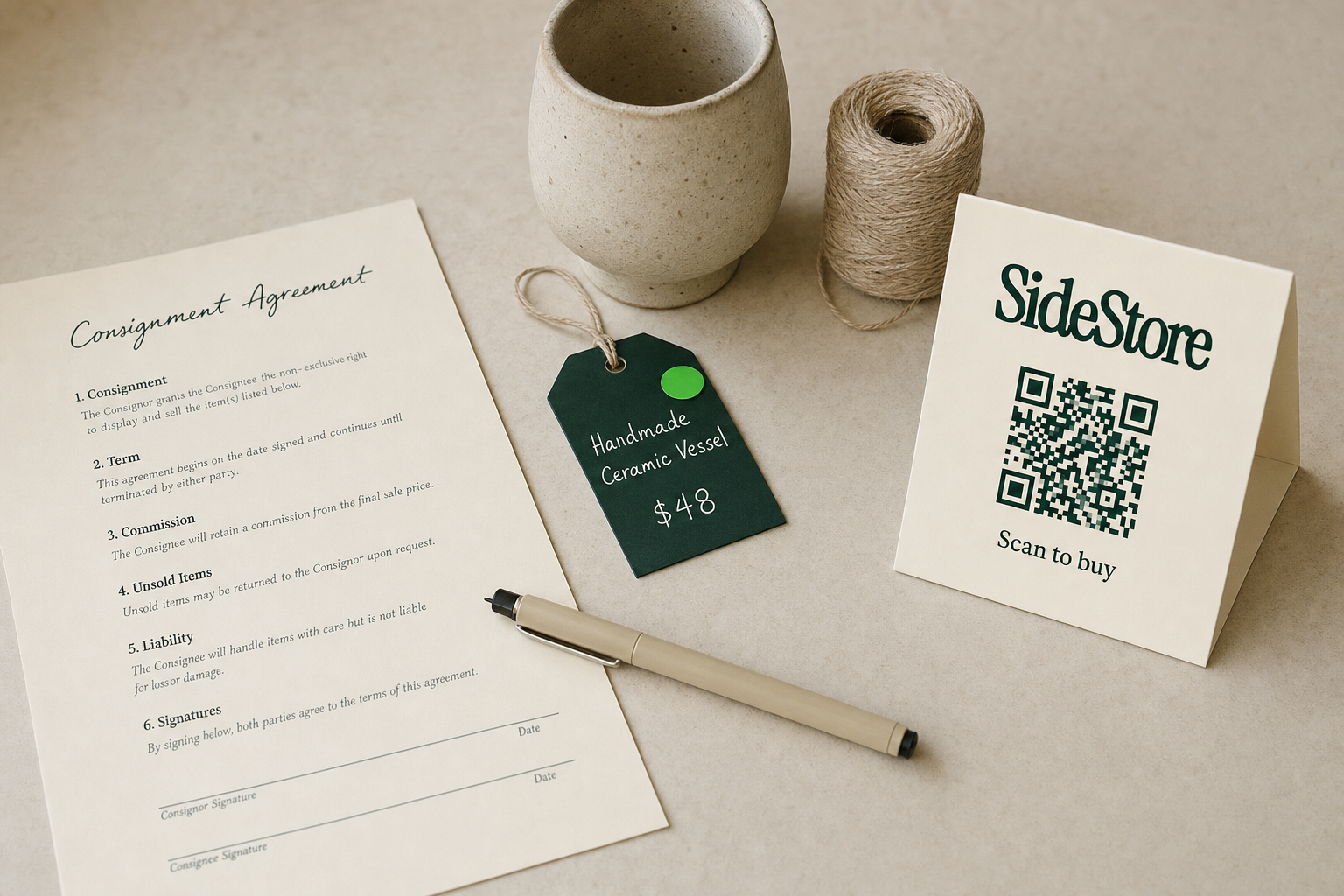
A consignment contract for artists is a written agreement between you and a merchant that spells out exactly how your work gets displayed, sold, and paid for in their space, and what happens if nothing sells.
You hand over your work. They display and sell it. You get paid when a sale happens. No upfront cost to them. No inventory risk on their side. That is the deal. But without something in writing, every detail lives only in someone's memory, and memories diverge fast.
A solid consignment agreement covers the commission split, the payment schedule, who carries liability for damaged or stolen work, how long the arrangement lasts, and how either party can end it. Get these terms in writing before a single piece leaves your studio. A handshake agreement may not be unenforceable in every jurisdiction, but it is very difficult to prove in a dispute.
If you are still weighing your options, read our overview of consignment vs wholesale before you commit to either model.
How Selling on Consignment Works (and Why the Contract Is Everything)
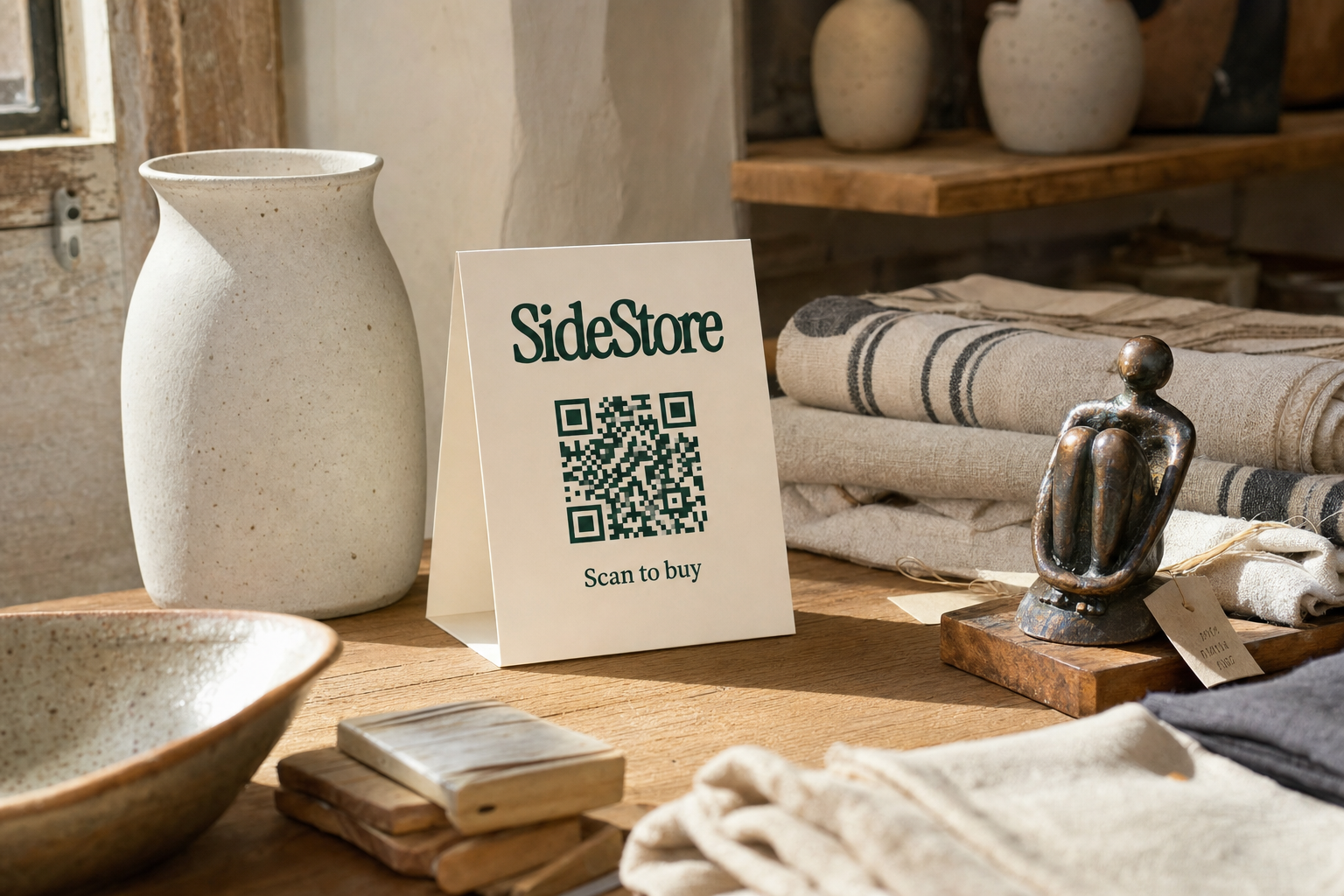
You place your products in a merchant's space. They sell those products on your behalf. You receive a percentage of each sale after it happens. You retain ownership of the stock until the moment it sells. The merchant never buys your work from you outright.
That ownership detail matters more than anything else. Because you still own the stock, you bear the loss if it is damaged, stolen, or destroyed, unless the contract explicitly assigns that risk to the merchant. Equally, if the merchant marks your work down to clear space, you may receive far less than your asking price, unless the contract prohibits price changes without your consent.
The payment schedule is where many first-time consignment arrangements quietly fall apart. Monthly settlement is common. Quarterly settlement exists. Some informal arrangements pay "when they remember." If the contract does not name a specific payment date and method, you have no recourse when settlement is late.
Every clause you negotiate protects a real, concrete interest. The commission rate determines your margin. The liability clause determines your exposure. The retrieval clause determines whether you can get unsold work back in one piece. The average consignment percentage you accept depends heavily on what other terms you negotiate alongside it: a higher commission rate may be worth accepting if the liability, pricing, and payment terms strongly favour you.
Before you place work anywhere, read our guide to selling through someone else's store so you understand what you are agreeing to mechanically before the contract conversation even begins.
The Nine Essential Clauses Every Consignment Contract Must Include
A consignment agreement for artists must cover nine categories of term. Miss one and you create a gap that a dispute will fall straight through.
1. Description and inventory of work
List every piece by title, medium, dimensions, and agreed retail price. Without this list, disputes over which items were placed and at what value become impossible to resolve. Attach a signed inventory sheet as an exhibit to the contract itself.
2. Consignment percentage split
State the exact percentage each party receives from each sale. "We'll sort something fair" is not a clause. If the split is 60/40 in your favour, write 60/40. If the merchant takes 35%, write 35%. (See the section below on standard splits by venue type.) The failure case here: a merchant verbally agrees to 60/40, then invoices you at 50/50 three months later.
3. Retail pricing and discounts
Specify who controls the retail price and whether discounts require your written consent. Without this clause, a merchant can put your work in a clearance sale at half price and pay you half of that reduced amount. You need explicit language that your floor price cannot be breached without your approval.
4. Payment schedule and method
Name a specific date (for example, the 15th of each calendar month), the payment method (bank transfer, cheque, platform settlement), and what documentation accompanies payment, such as a sales report showing which pieces sold. The failure case: a merchant pays "whenever," which in practice means after a phone call, after a reminder, or not at all.
5. Liability for damage, theft, and loss
State clearly who bears the financial risk if a piece is damaged in the shop, stolen, or destroyed. Many standard contracts place this risk on you as the maker. If the merchant carries business insurance that covers consignment stock, ask for that confirmed in writing. If they do not, price the risk into your floor price or require them to obtain cover. See our guide to selling art prints in local shops for more on protecting lower-margin work placed widely.
6. Duration and renewal
Set a fixed term: three months, six months, one year. State whether the agreement auto-renews or requires a new signature. An open-ended agreement with no end date gives a merchant no incentive to actively sell your work. The failure case: work sits on a shelf for two years, neither party having formally ended the agreement, and you cannot legally retrieve it without triggering a dispute.
7. Retrieval of unsold work
Give yourself the right to collect unsold pieces at the end of the term or on reasonable notice (typically 14 to 30 days). Specify the condition in which work must be returned and who covers any retrieval costs. A merchant with no retrieval clause has no contractual obligation to return your work promptly or at all.
8. Exclusivity
If the merchant wants exclusive placement in their area, that exclusivity must be named, geographically bounded, and compensated. Without this clause, a merchant may assume exclusivity that was never granted, creating conflict when you place work nearby. Makers selling handmade jewellery in boutiques, for example, often place in multiple venues simultaneously. Read more in our guide to selling handmade jewellery in boutiques.
9. What happens if the merchant closes or becomes insolvent
This is the clause most templates omit. If the merchant closes, your stock does not automatically come back to you: it may be treated as a business asset by a liquidator unless the contract clearly identifies it as your property on consignment. A well-drafted clause states that the work remains your property at all times, is not available to creditors, and must be returned to you immediately on cessation of trading.
Consignment Percentage Splits: What Is Standard and How to Negotiate
The consignment percentage split that most merchants and artists land on falls somewhere between 50/50 and 70/30 in favour of the artist. The exact figure depends on the venue type, the volume of foot traffic, and how much display effort the merchant provides.
Most traditional consignment shops take 30 to 50 percent. Galleries lean toward 40 to 50 percent. Cafes and hotels, which provide incidental rather than dedicated selling effort, more often accept 20 to 30 percent, because the placement is passive and the display effort is minimal.
These are general industry norms, not guarantees. Every split is negotiable, and you should negotiate based on the value the merchant provides, not simply on what they first propose.
A few negotiating principles worth knowing:
- Higher foot traffic justifies a higher commission. A merchant who sends hundreds of customers past your work each day is providing real selling power.
- Display effort matters. If the merchant actively recommends your work to customers, that is worth more than a shelf in a corner.
- Exclusivity costs. If they want you not to place elsewhere locally, that concession should come with either a higher artist percentage or a minimum sales guarantee.
- Volume offsets percentage. Placing twenty prints at 35 percent may return more than placing two at 60 percent.
See our full breakdown of what percentage do consignment shops take across different venue types, and read our practical guide on how to approach a local shop about stocking your products before you sit down to negotiate.
Consignment Terms by Venue Type: A Quick Reference
Consignment terms vary meaningfully by venue type. A gallery operates differently from a cafe, and a hotel gift shop runs on different norms than a boutique. The table below gives you a working reference. Treat the ranges as honest estimates based on common industry practice: your specific situation will vary.
| Venue Type | Typical Split (Artist / Venue) | Payment Schedule | Liability Norm | Display Effort Required |
|---|---|---|---|---|
| Art Gallery | 50/50 to 60/40 | Monthly or per-sale | Often on artist unless gallery insured | High: curated, hung, lit by gallery |
| Boutique / Gift Shop | 60/40 to 70/30 | Monthly | Varies: check contract | Moderate: shelf placement, some signage |
| Cafe | 70/30 to 80/20 | Monthly or quarterly | Usually on artist | Low: passive display, QR or card checkout |
| Hotel / B&B | 65/35 to 75/25 | Monthly | Usually on artist | Low to moderate: display in common areas |
| Pop-up / Market Stall | Negotiated case by case | Per event | Usually on artist | Variable: depends on format |
For venue-specific guidance, see our articles on selling art prints in cafes and selling local products to hotels.
Red Flags: Contract Terms That Should Give You Pause
Several contract clauses are common enough to appear standard but carry real risk for artists. Spotting them before you sign is far cheaper than discovering them in a dispute.
1. No written inventory attached
If the contract references "artwork as discussed" without a signed inventory list, you have no documentary proof of what you placed, when, or at what value. When a piece goes missing, you cannot make a claim you can prove.
2. Unlimited right to discount
A clause that gives the merchant sole discretion to discount your work at any time, without a floor price or your consent, means your retail price is not really yours. This is particularly damaging for pieces where price signals quality.
3. No payment date specified
"Payment will be made periodically" is not a payment term. Without a named date, you have no basis to chase overdue settlement and no clear point at which the merchant is formally in breach.
4. Liability entirely on the artist, with no insurance requirement
Some liability on the artist is normal in consignment. But a contract that places full liability on you with no requirement that the merchant hold any insurance, or even take reasonable care, leaves you entirely exposed to events outside your control.
5. Auto-renewal with no retrieval window
A contract that auto-renews indefinitely and gives you only a short window to opt out, say five days before renewal, makes it operationally easy to stay locked in far longer than intended. Look for at least 30 days' notice to retrieve or exit.
6. Exclusivity with no defined geography or term
"You agree not to place work with other retailers" without a geographic boundary or expiry date is an open-ended restriction on your business. Exclusivity should always be bounded in place, time, and scope.
If an agreement raises several of these flags at once, know that you have options. You can place your work in other venues or explore flexible formats like a pop-up retail space where you retain more control over the terms.
How Digital Consignment Tools Make Contract Terms Work in Practice
A written contract sets the terms. A digital consignment tool makes those terms stick in day-to-day practice.
This is the gap most artists do not think about: you can have a perfectly written contract and still end up chasing payment, disputing stock counts, or arguing about which location sold which piece. The contract does not enforce itself.
SideStore's Retail Widget operates as the practical enforcement layer for the terms you have already agreed. When a maker places products on consignment through SideStore, the Retail Widget handles live stock tracking, so both parties always see the current inventory count without relying on the merchant's manual records. Scan-to-pay checkout via a printable QR card records each transaction at the point of sale. Automatic split payouts settle each sale directly and immediately, at the percentage agreed, without the maker having to invoice or chase.
This does not replace the contract. It means the payment schedule clause, the inventory clause, and the commission split clause are enforced by the system rather than by memory or goodwill.
If you are thinking about the software side of managing multiple placements, our overview of consignment inventory software covers what to look for and how these tools fit alongside a written agreement.
Frequently Asked Questions
Do I need a lawyer to write a consignment contract?
You do not necessarily need a lawyer for a straightforward consignment agreement for artists, particularly for lower-value placements. Many arts organisations publish template contracts you can adapt. However, if you are placing high-value work, negotiating exclusivity, or dealing with a commercially sophisticated venue, a brief review by an arts law practitioner in your jurisdiction is worth the cost. Contract law varies by country and sometimes by region.
What happens to my work if the shop closes or goes bankrupt?
This depends on how your contract is written and on local insolvency law. If the contract clearly states that your work is your property on consignment and is not available to creditors, you have a stronger position. Without that language, a liquidator may treat your stock as a business asset. In most jurisdictions, consignment stock can be separated from the merchant's assets, but only if ownership is clearly documented. Take legal advice in your jurisdiction if you are placing high-value pieces with a merchant whose financial position is uncertain.
Can I place the same piece in more than one shop?
Yes, unless your contract includes an exclusivity clause. A single original piece can only be in one location at a time, but editions, prints, and multiples can be placed across many venues simultaneously. Check every contract you sign for exclusivity language before placing the same work or edition elsewhere. If no exclusivity is specified in writing, none exists.
How do I end a consignment agreement if it is not working out?
Most well-drafted contracts include a notice period, typically 14 to 30 days written notice, after which you have the right to retrieve unsold work. If your contract specifies this, follow the process exactly and keep records of your notice. If your contract has no termination clause, you are in less certain territory: approach the merchant in writing, request your work back, and document everything. You may also find it useful to read our guide to creating a line sheet for wholesale as you think about whether wholesale might suit certain venues better than consignment. For higher-value items, our guide to selling furniture on consignment covers retrieval logistics for bulkier work.
Before Your Work Leaves Your Studio
A consignment contract for artists is the single document that turns a handshake into an enforceable arrangement. Every piece of work you place without one carries risk you are not being paid to take.
Get the nine clauses in writing before anything leaves your studio: inventory, split, pricing control, payment date, liability, duration, retrieval, exclusivity, and what happens if the merchant closes. Negotiate the average consignment percentage alongside those terms, not in isolation.
Once your contracts are solid, selling through someone else's store becomes a repeatable, scalable model: place work in one venue, learn the process, then build a distributed consignment network across as many merchant spaces as your production can support.