Where Can I Sell Besides Etsy? 10 Physical and Digital Alternatives for Independent Makers
Selling beyond Etsy means building a distribution network across multiple channels, physical venues, alternative marketplaces, and your own digital storefront, so your income doesn't depend on a single platform's fees or algorithm changes.
The practical answer: consignment placements in local venues, weekend markets, pop-up retail, boutique wholesale, Amazon Handmade, Faire, Not On The High Street, your own website, and social commerce. Ten real options exist. The strongest strategy combines at least one physical and one digital channel.
Etsy's limitations are real and worth naming plainly. The platform charges 6.5% on the sale price plus shipping, a $0.20 listing fee per item, and payment processing on top. Your visibility depends on an algorithm you don't control. And you're competing with millions of other sellers in the same search results. None of that makes Etsy worthless, but it does make diversification sensible.
This article assesses all 10 alternatives honestly: fees, effort, and who each suits best. It also covers selling through someone else's store as a structured channel, not just a vague suggestion to "approach boutiques." A physical-plus-digital mix tends to outperform any single platform. Here's how to build one.
Why Makers Look Beyond Etsy (And Why It Makes Sense)
Etsy works until it doesn't. The platform gives you an audience, but it also takes a significant cut and holds the relationship with your customer. Once you understand the fee stack and the algorithm risk, looking elsewhere becomes a straightforward business decision.
Take a concrete example. On a $40 product, Etsy's 6.5% transaction fee costs $2.60. Add the $0.20 listing fee and payment processing (typically around 3% plus a fixed amount depending on your country), and you're giving up roughly $4 to $5 per sale before you've accounted for materials, packaging, or postage. Scale that across a month of sales and the margin erosion is substantial.
Beyond fees, there's the algorithm dependency. Etsy's search ranking changes without warning. Sellers who built their business on strong organic Etsy placement have seen traffic collapse after updates, with no recourse and no customer list to fall back on. If Etsy is your only channel, that risk sits entirely with you.
Then there's saturation. Search for almost any handmade product category and you'll find tens of thousands of listings. Standing out requires either paid advertising spend or years of review accumulation, neither of which favors a maker just starting out.
The more durable alternative isn't abandoning Etsy; it's treating it as one channel among several. Understanding the difference between consignment vs wholesale as physical channel models is a useful starting point, because the economics and risk profiles differ sharply. Once you see the full range of options, single-platform dependency starts to look like the riskier choice.
5 Physical Alternatives to Etsy (No Store Required)
You don't need your own shop to sell in person. The five physical channels below are all accessible to independent makers without a lease, a shopfit, or a large upfront investment. Each has a different fee structure, effort level, and risk profile.
1. Consignment placements in local venues
Consignment means a host venue, a cafe, boutique, hotel, or any retailer with free shelf space, displays your products and you get paid when they sell. The host takes a percentage of the sale price (typically 25% to 40%, though this varies by venue and product type). You retain ownership of the stock until it sells, and you don't pay rent or a listing fee upfront.
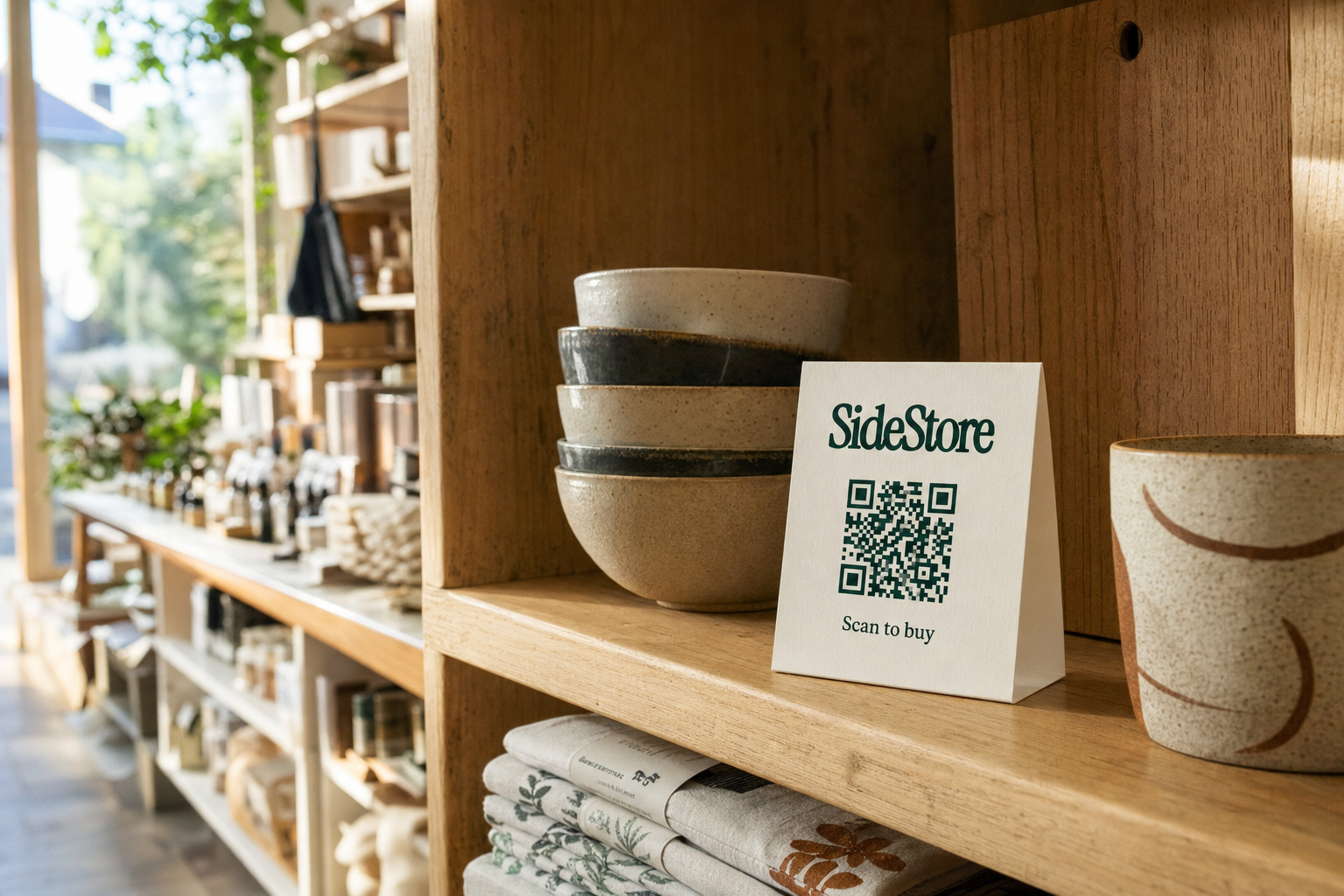
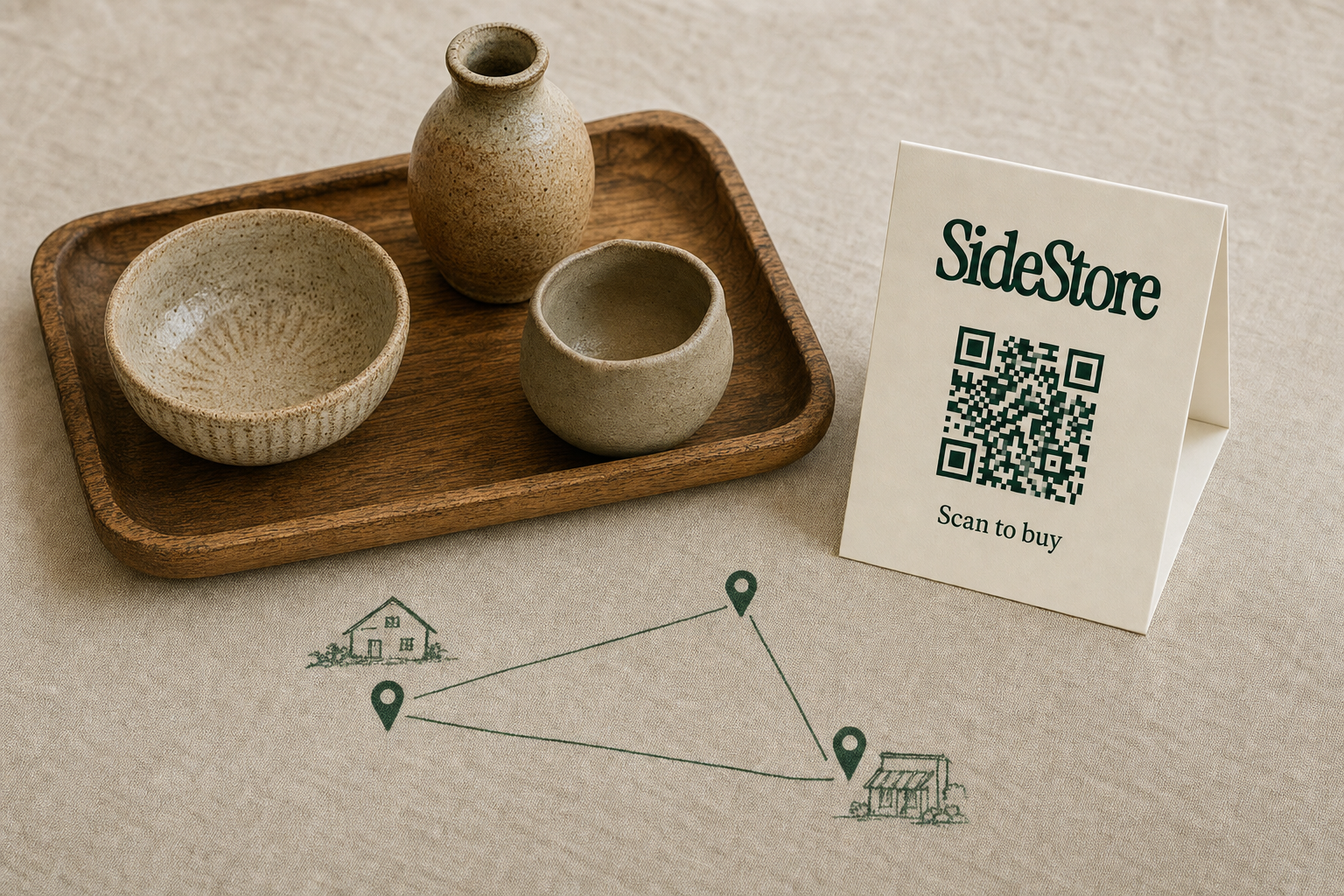
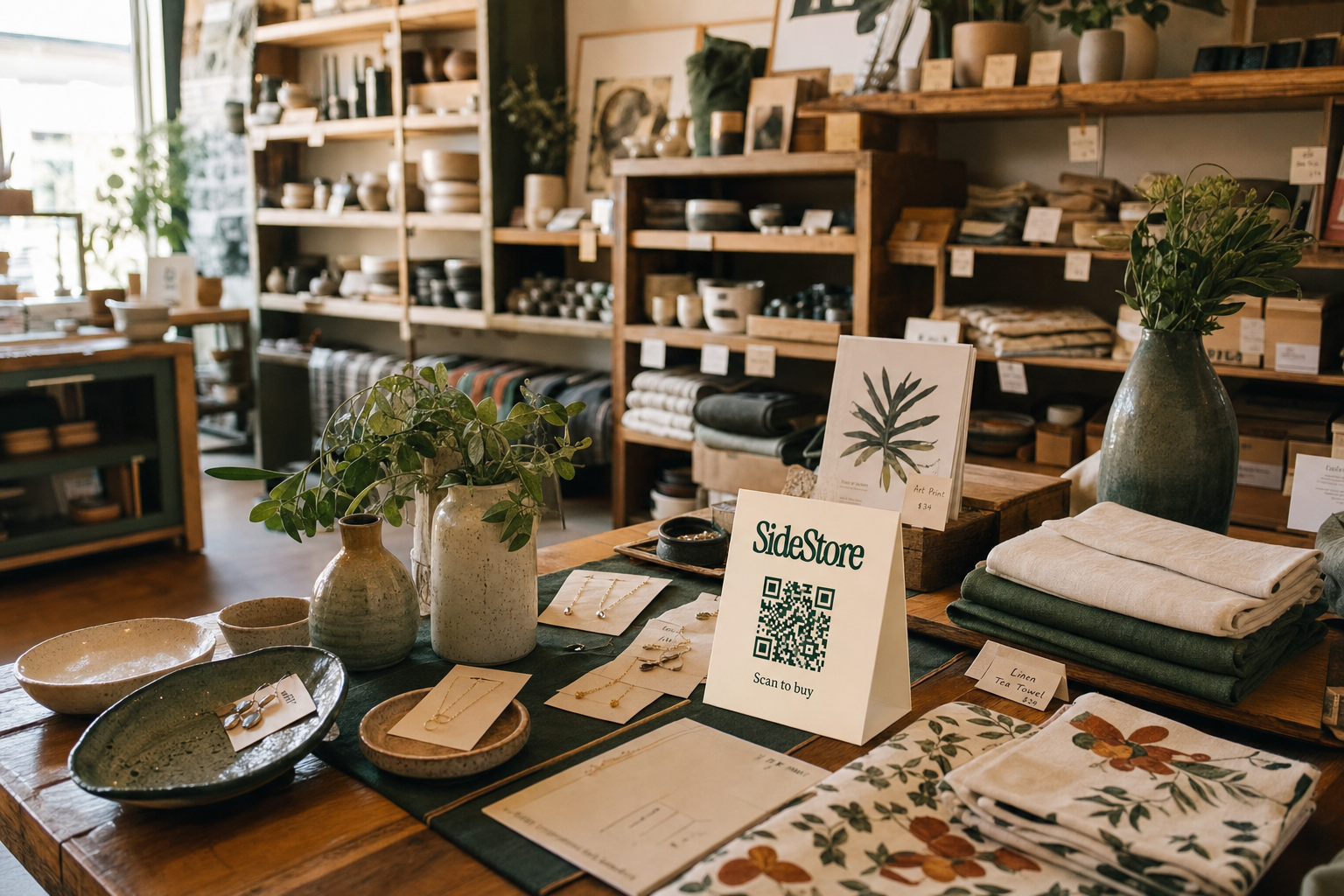
SideStore's Retail Widget is the interface that places and manages a product on consignment. It handles live stock tracking, placement attribution, and automatic split payouts to you and the host venue. One function of the Widget is a printable scan-to-pay QR card that a merchant can display for all SideStore products in their space, or that you can attach directly to your product, so the checkout works without staff involvement. The trade-off: you are responsible for approaching venues, delivering initial stock, and restocking when levels drop. The mechanics don't run themselves.
Consignment suits makers with products that photograph well, have a clear retail price point, and don't require explanation to sell. For more on this model, the guide to sell art prints in local shops on consignment covers the approach in detail, and placing prints in cafes gives venue-specific guidance.
2. Weekend markets and craft fairs
Markets give you direct access to customers, real-time feedback on what sells, and a chance to build local recognition quickly. Stand fees vary widely, a community market might charge $30 to $80 per day, while curated design markets in larger cities can run $200 or more for a weekend pitch.
The effort is significant. You need display materials, stock, a payment terminal, and your own time for setup, trading, and pack-down. Repeat attendance at the same market builds a returning customer base, but a single weekend rarely covers the effort cost unless your average transaction value is reasonably high. Markets suit makers who enjoy direct customer interaction and have products that benefit from being handled or tried in person.
3. Pop-up retail spaces
Pop-ups let you take a temporary standalone space, a retail unit, a shared space in a larger venue, or a curated pop-up event, for a defined period. Costs range considerably depending on location, duration, and format. Short-run shared pop-ups in smaller cities can be affordable; prime-location solo pop-ups in major retail areas carry meaningful rent. The full breakdown of pop-up retail space costs and trade-offs is worth reading before committing.
The honest trade-off: a pop-up gives you controlled brand presentation and no permanent overhead, but it requires setup investment and ends. Unless you use it to build a customer list or test a location for a future permanent placement, the return may not justify the cost. The pop-up retail guide for independent makers covers how to make the format work strategically rather than just as a one-off event.
4. Boutique wholesale
You sell a batch of products to a boutique at a wholesale price (typically 40% to 60% of retail), and the boutique takes the margin risk. You get paid upfront, which is the main advantage. The trade-off is that wholesale minimums can require producing a larger run than you've tested, and if the boutique doesn't sell through, they may not reorder.
This suits makers who can produce consistently at volume and who have a product with a proven sell-through rate. If you make jewelry, selling handmade jewelry in boutiques gives a practical framework for the approach and conversation.
5. Trunk shows and in-store events
A trunk show is a maker-hosted event within an existing retail space, a boutique or gallery invites you in for a day or a weekend to sell directly to their customers. You bring your full collection, the host promotes to their audience, and you split revenue or pay a flat fee for the space. It's lower commitment than a full pop-up and benefits from the host's existing foot traffic. The trade-off: availability depends on the host's schedule and interest, and it doesn't create a permanent channel.
5 Digital and Online Alternatives to Etsy
Digital platforms give you reach without physical logistics, but each trades convenience for some combination of fees, effort, or reduced control. Here are five worth evaluating honestly.
Online alternatives to Etsy fall into three categories: larger marketplaces (more traffic, more competition), curated platforms (better brand fit, harder to get on), and owned channels (full control, no built-in audience). The right choice depends on your product type, your margin, and how much time you can put into platform management. For context on tracking sales across channels, managing consignment inventory across channels is relevant once you're running more than one.
6. Amazon Handmade
Amazon Handmade places your products in front of Amazon's enormous buyer base. The platform charges a referral fee of around 15% of the sale price, with no separate listing fee for approved Handmade sellers. The application process requires demonstrating that your products are genuinely handmade, and approval is not guaranteed.
Traffic potential is high, but so is competition, and your product sits within Amazon's design environment, not your own branded storefront. Suits makers with products that have a clear search term, a competitive price point, and the capacity to handle volume if a listing gains traction.
7. Faire
Faire is a wholesale marketplace connecting independent makers with independent retailers. Retailers browse and order through the platform; Faire handles invoicing and payment terms. The platform charges makers a commission of approximately 15% on new retailer connections and around 9% on repeat orders, though these figures may vary and are worth confirming directly.
The honest trade-off: Faire opens doors to boutiques you might not have reached otherwise, but you're selling at wholesale price minus commission, which compresses margins. It suits makers who want retail distribution without doing the door-knocking themselves and who can produce at small-batch wholesale volumes.
8. Not On The High Street (UK)
Not On The High Street is a curated UK marketplace focused on gifts, homeware, and personalised products. Acceptance is selective, and the platform charges an annual membership fee plus a commission on sales (percentages vary; check current terms directly). The curation means less competition than Etsy and a buyer who expects to pay a fair price for something distinctive.
The trade-off is geographic: the platform's audience is almost entirely UK-based, and if you're outside the UK, shipping cost and time will be a friction point. Suits UK-based makers or those willing to absorb international postage to reach a gift-focused buyer.
9. Your own website
Owning your storefront means keeping more margin, owning your customer data, and building a brand asset rather than a platform presence. Shopify, Squarespace Commerce, and WooCommerce are all credible options at different price and technical complexity points. Platform fees are relatively low (Shopify's entry plan carries a monthly fee plus payment processing; exact figures change, so check current pricing directly).
The trade-off is traffic. A self-hosted store starts with zero visitors. You'll need SEO, email marketing, or social content to drive people to it. This suits makers who are willing to invest in audience-building over time and who want long-term independence from any marketplace's rules.
10. Social commerce (Instagram Shop, TikTok Shop)
Instagram and TikTok both allow product tagging and in-app purchasing. Setup is relatively low-friction if you already have a social presence. Commission structures vary by platform and region. The honest reality: social commerce rewards content creation at a level many makers can't sustain alongside making. It suits makers whose process is visually compelling on video and who genuinely enjoy creating content, not those looking for a passive channel.
All 10 Alternatives at a Glance: Fees, Effort, and Who Each Suits
| Channel | Type | Platform Fee | Effort to Start | Presence Required? | Best For |
|---|---|---|---|---|---|
| Consignment (SideStore) | Physical | ~25, 40% rev share (varies by venue) | Medium | No (after setup) | Makers wanting passive physical distribution |
| Weekend markets | Physical | $30, $200+ per day (varies widely) | High | Yes | Makers who sell well face-to-face |
| Pop-up retail | Physical | Varies by space and duration | High | Yes | Testing locations or launching a collection |
| Boutique wholesale | Physical | None (you sell at wholesale price) | Medium | No | Makers with consistent production capacity |
| Trunk shows / in-store events | Physical | Flat fee or rev share | Medium | Yes | Makers with a strong story to tell in person |
| Amazon Handmade | Digital | ~15% referral fee | Medium | No | Products with clear search terms and volume potential |
| Faire | Digital | ~9, 15% commission | Medium | No | Makers seeking wholesale retail connections |
| Not On The High Street | Digital | Annual fee + commission | Low (if accepted) | No | UK-based makers with gift or personalised products |
| Own website | Digital | Monthly platform fee + payment processing | High initially | No | Makers investing in long-term brand independence |
| Social commerce | Digital | Varies by platform | High (ongoing) | No | Makers with strong visual content output |
Two observations worth making: the channels with the lowest platform fees (your own website, boutique wholesale) tend to require the highest effort. The channels with lowest effort to maintain (consignment, established marketplaces) involve giving up a percentage of each sale. There's no free lunch, but the trade-offs are legible once you see them laid out.
How to Build Your Channel Mix: Start With One Physical and One Digital
The question isn't which single channel replaces Etsy, it's which combination gives you stability, reach, and manageable workload. A minimum viable distribution strategy is one physical channel and one digital channel running simultaneously. Here's a three-step process for choosing them.
Step 1: Assess your product type.
Products that benefit from being seen, touched, or discovered by accident (art prints, ceramics, jewelry, candles, textiles) tend to perform in physical placements. Products with a specific search term and a gift occasion behind them (personalised items, niche hobby accessories) tend to perform on digital marketplaces. Many products suit both; that's the point. The guide to how to sell through someone else's store covers product-to-channel fit in practical terms.
Step 2: Assess your available time honestly.
A weekend market requires your full day. A pop-up requires days of preparation and presence. A Shopify store requires ongoing SEO and content work. Consignment placements, once set up, require restocking visits but not constant attention. Be realistic about what you can maintain without burning out. Spreading across four channels at once is a reliable way to do all of them badly.
Step 3: Assess your production volume.
Wholesale requires batch production. Markets require carrying stock. Consignment ties up inventory in venues. Digital marketplaces can work with made-to-order. Match your channel to what your production process can actually support.
The minimum viable combination for most makers: one consignment placement (low effort to maintain, builds local presence) plus one owned or marketplace digital channel (Etsy, your own site, or a curated marketplace). This gives you physical discovery and digital reach without overextending. Use consignment inventory software to manage multiple placements once you have more than one or two active venues.
Don't add a third channel until the first two are generating consistent returns. Premature expansion fragments your attention and dilutes quality in every channel.
Consignment Placements: The Physical Channel Most Makers Overlook
Consignment is the physical channel with the most favorable risk profile for independent makers, yet it's consistently underused because the mechanics aren't widely understood. Here's how it actually works.
In a consignment arrangement, you place your products in a host venue at no upfront cost to the host. The host earns a percentage of each sale; you receive the remainder. Stock stays yours until it sells. No wholesale minimum, no invoice to chase, no inventory risk for the merchant, which is precisely why venues that would never commit to a wholesale order are often willing to try consignment.
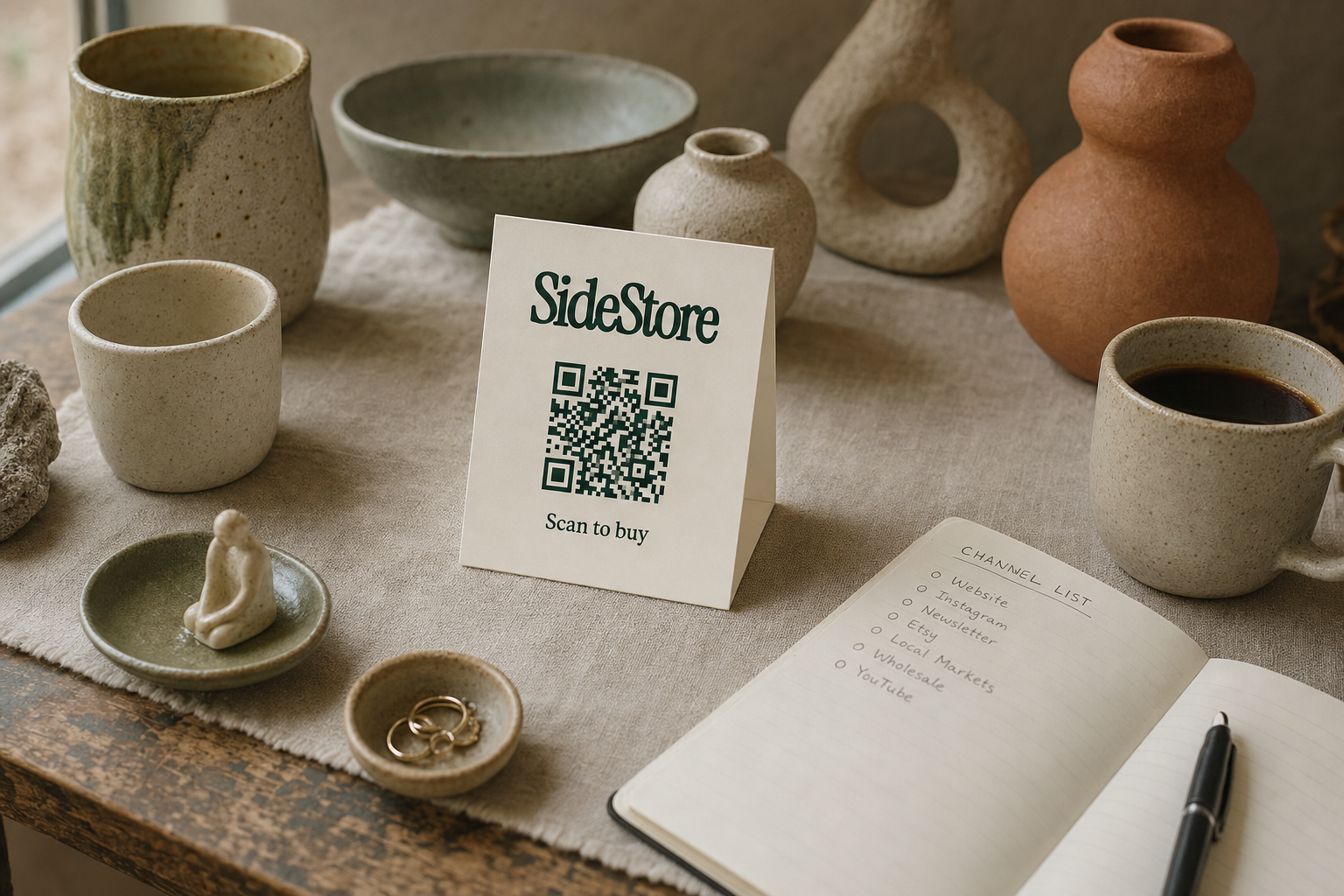
SideStore's Retail Widget is the interface that runs this from end to end. It manages the placement itself, tracks live stock levels, attributes sales to the correct venue, and handles automatic split payouts so neither you nor the host has to reconcile manually. The scan-to-pay QR checkout is one function of the Retail Widget, a printable card a merchant can display for their SideStore placement, or that you can attach directly to a product, not the whole product.
Realistic venue types to approach: independent cafes, design-led hotels, lifestyle boutiques, gallery gift shops, co-working spaces with reception areas, and independent bookshops with a gift section. These venues already have foot traffic; they just need curated products to sell alongside their core offer. Cafes, in particular, are more receptive than many makers expect, the guide to how to place art prints in cafes on consignment explains why, and why cafes welcome additional revenue streams gives the host's perspective. For product-specific guidance, how to sell art prints in local shops is directly applicable.
Your responsibilities in this model are real: approaching venues with a clear pitch, delivering the initial stock, and restocking when levels fall. The Retail Widget handles the transactional mechanics. The relationship-building is yours to do.
Frequently Asked Questions
Is it worth selling on Etsy and somewhere else at the same time?
Yes, and most experienced makers do exactly this. Etsy provides a ready-made audience and search traffic you would otherwise have to build; a second channel reduces your dependence on Etsy's algorithm and fee structure. Running both in parallel gives you a fallback if one channel underperforms. The key is not to treat Etsy as your only channel while you wait to see if the alternative gains traction.
What is the cheapest alternative to Etsy?
Consignment is one of the lowest-cost entry points: you pay no platform fee upfront and give up a percentage only when a product sells. A basic own-website setup (a simple Squarespace or Shopify store) carries a monthly fee but no per-transaction commission beyond payment processing. Weekend markets have an upfront stand fee but no ongoing cost. The cheapest option depends on your definition, lowest cash outlay, lowest per-sale cost, or lowest total annual cost.
How do I get my products into a physical shop without a wholesale minimum?
Consignment. A host venue takes your products on the basis that they earn a percentage of sales, so there's no minimum order for them to commit to. You approach the venue, deliver stock, and get paid when it sells. This is the core mechanic SideStore is built around. You can also explore consignment inventory software to manage multiple placements cleanly from one dashboard.
Are weekend markets worth it as an alternative to Etsy?
Markets are worth it if your product sells well face-to-face, your average transaction value is high enough to cover the stand fee and your time, and you can attend consistently enough to build a returning local audience. A single market appearance is unlikely to be transformative. As a standalone replacement for Etsy, markets are limited by your own presence and geography. As a complement to digital sales, they can be genuinely valuable. Read whether pop-up retail is right for you for a comparable framework applied to pop-ups.
Can I sell on multiple platforms at once?
Yes. Most makers run two to four channels simultaneously. The practical limit is your capacity to manage stock, fulfill orders, and maintain quality across all of them. Start with two, stabilize them, and add a third only when the first two are running smoothly.
Where to Sell Besides Etsy: Your Next Step
The core argument is straightforward: relying on a single platform is a business risk, and the alternatives are more accessible than most makers realize. A physical channel and a digital channel together give you reach, resilience, and options that no single marketplace can provide.
If you've been asking where you can sell besides Etsy, the honest answer is: almost anywhere your products are a reasonable fit. The constraint is usually not access, it's deciding which two channels to start with and giving them enough time to work.
Here's a concrete action for this week: identify three local venues that match your product's aesthetic and price point, a cafe, a boutique, a hotel lobby, a gallery gift shop. Walk in or send a short email. Ask whether they host consignment products. That conversation costs you nothing and opens the door to a physical distribution channel that requires no storefront of your own.
For a practical framework on that conversation, a maker's guide to retail partnerships covers the pitch and the structure. If jewelry is your medium, pitching boutiques and getting paid goes further into the specifics.
Build a consignment network without opening a store of your own. It's not a shortcut, it's a structure, and SideStore is built to run it.