Consignment vs Wholesale: Which Model Is Right for Independent Makers?
The Real Choice
Consignment and wholesale are two fundamentally different ways to get your products into physical retail. In consignment, you place products in a shop and get paid only when they sell. In wholesale, you sell your stock outright to a retailer at a discount, take payment upfront, and walk away. Neither is universally better. The right choice depends on your production scale, your cash flow situation, and where you actually are in your distribution journey right now.
If you are testing a new market or building retail partnerships without large upfront costs, consignment is your move. If you have proven demand, reliable production capacity, and margins that can survive a steep discount, wholesale becomes viable. Most makers who scale eventually use both, at different times and with different retail partners.
This guide shows exactly how each model works, what the numbers look like in practice, and how to decide which to use and when.
How Consignment Works
Consignment is simple in principle: you supply products to a venue, the venue displays them, and you only get paid when someone buys one. The shop takes a percentage of the sale price as their fee. You stay the owner of the goods until a customer walks them out the door.
The typical host take is 30 to 50 percent of the retail sale price, though this varies by product type, venue, and your negotiating position. A coffee shop hosting handmade ceramics might take 30 percent; a curated gallery might take 50 percent. You set the retail price, you keep the rest. See our guide to average consignment percentage for what to expect by category.
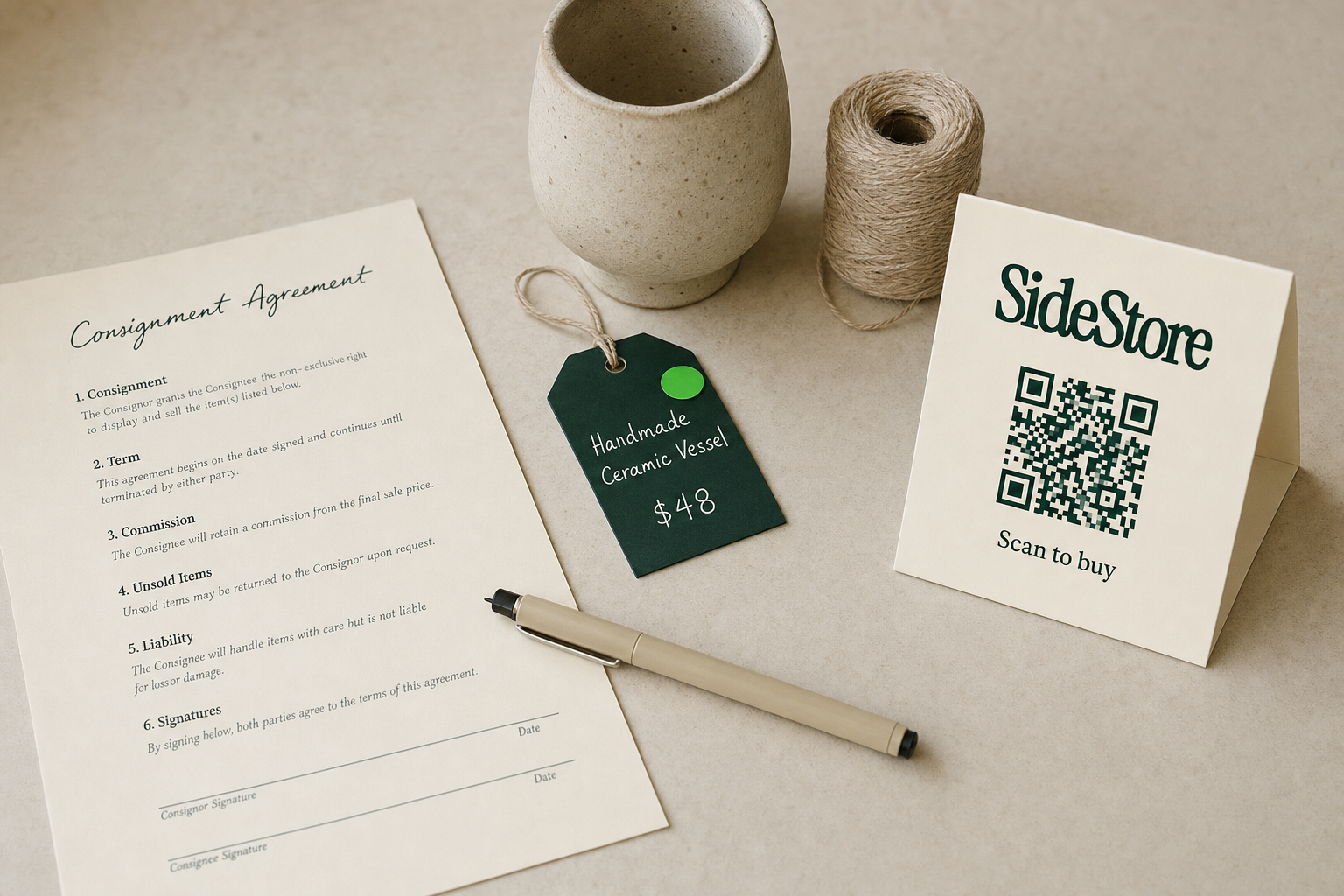
Here is how it works in practice. You deliver stock to the venue with a consignment agreement that documents what items you placed, the split, and what happens to unsold stock after a set period. The retailer handles display and customer service. You carry the risk of damage, theft, or inventory that sits there month after month generating zero income.
For makers just starting out or exploring a new geographic market, this is a lower-stakes way to test whether a venue's customers actually want what you make. You are not gambling cash upfront on a bulk order and hoping the retailer moves it. You are placing products and watching real customer behaviour. The price you pay is carrying inventory risk and waiting weeks or months to see income from a single placement.
The operationally heavy part arrives once you have products in more than a handful of venues. Tracking what stock is where, reconciling sales reports from different retailers, and chasing down payouts becomes genuinely time-consuming. This friction is exactly what tools like SideStore are designed to reduce. If you are placing art prints in local shops on consignment, having a clear system from the start saves hours of administrative work later.
How Wholesale Works
Wholesale is transactional. You sell your products outright to a retailer at a discount, typically 40 to 60 percent below the recommended retail price. The retailer pays you upfront, owns the stock from that moment on, and resells it at full retail price. Your involvement ends once payment clears.
The standard wholesale pricing model is keystone pricing: the retailer pays you roughly half the retail price. Here is what that looks like with actual numbers:
- Retail price: £60
- Your cost of goods (materials, labour, packaging): £15
- Wholesale price (50% of retail): £30
- Your maker margin: £30 minus £15 = £15 per unit, or 50% gross margin
That £15 needs to cover your labour, studio overhead, and any order fulfilment costs. If your cost of goods runs higher relative to your retail price, keystone wholesale may not leave you with enough to sustain the business. Many makers find wholesale only makes sense when their production costs are below 25 to 30 percent of retail price, though this varies by what you make and how your business is structured.
Wholesale typically requires a wholesale line sheet before a retailer will even consider placing an order. A line sheet shows your product range, wholesale prices, minimum order quantities, lead times, and payment terms. Creating one forces you to document your pricing and production capacity in a way that is genuinely useful for your business regardless.
The main advantage of wholesale is immediacy. You get paid before you know whether a single unit has sold through. The main risk is that you have manufactured stock you cannot take back if the retailer over-orders or if your product does not move. Understanding how retail buyers actually think, including how to pitch handmade products to boutiques, prepares you for what those conversations actually require.
Consignment vs Wholesale: Head to Head
The clearest way to choose is to compare them directly. They differ on almost every dimension that matters.
| Dimension | Consignment | Wholesale |
|---|---|---|
| Upfront payment to you | None until items sell | Yes, on delivery or agreed terms |
| Who owns the stock | You do | The retailer does |
| Who bears inventory risk | You do | The retailer does |
| Your revenue per unit | Higher percentage of retail (50, 70% typical) | Lower fixed price (40, 55% of retail) |
| When you get paid | After the item sells (delayed) | Immediately when order is fulfilled |
| Minimum order size | Usually none | Yes; varies by retailer |
| Unsold stock | You reclaim it or write it off | The retailer's responsibility |
| Relationship with retailer | Ongoing; requires monitoring | Transactional after order ships |
| Paperwork required | Consignment agreement, stock logs | Purchase order, line sheet, invoice |
| Best for makers at this stage | Early-stage, market testing | Proven demand, production capacity |
| Your administrative work | High (you track all placements) | Low after handover |
A few things to note. The revenue percentages shown are typical ranges, not hard rules. Both models vary significantly by what you make and what you negotiate. The "inventory risk" row is the one most makers underestimate: in consignment, you can lose stock to theft, damage, or if the retailer runs into financial trouble, you may struggle to recover it without a solid agreement in place.
And be honest with yourself about wholesale margins. Immediate cash can make thin margins feel acceptable when they are not. Run your numbers before you commit to anything.
Consignment: The Real Advantages and Real Drawbacks
Consignment is the more accessible entry point to physical retail, but that accessibility comes with trade-offs you should understand before you place your first item.
Where consignment genuinely works for you:
- You test a new market without committing to production runs you are not confident will sell.
- You own your products, which means you control the retail price and can reclaim unsold stock if things do not work out.
- There is no minimum order, so you can start small and scale up as the venue proves itself.
- You often keep a larger share of the sale price than you would on wholesale.
Where consignment creates real friction:
- Cash flow is unpredictable. A retailer with thin foot traffic may hold your stock for months without generating a sale, and you will not know unless you are actively tracking it.
- Theft and damage happen. Your products are in someone else's space, and unless your agreement is explicit about liability, you absorb the loss.
- Chasing payments from multiple venues is administratively burdensome without a system. Most makers seriously underestimate how much time this takes across even five or six placements.
- If a retailer closes or hits financial trouble, recovering your stock or its value can be slow and difficult.
Good consignment inventory software addresses this directly. It gives you live visibility into stock levels and sales across all your placements instead of waiting for sporadic retailer emails and reports.
The honest take: consignment rewards makers who manage it actively. It is not a set-and-forget model. The venues that perform well are worth scaling. The ones that do not should prompt a real conversation or a withdrawal. Treat each placement as an ongoing relationship, not a one-time drop.
Wholesale: The Real Advantages and Real Drawbacks
Wholesale is often sold as the graduation from consignment, but it brings its own risks and constraints worth examining carefully before you commit.
Where wholesale genuinely favours you:
- Payment is immediate. Once the retailer accepts your order and you fulfill it, you have cash in hand without waiting to see whether the product actually sells through.
- The operational burden drops sharply after handover. The retailer manages display, inventory, and customer service. You focus on production.
- A confirmed wholesale order validates your product in a meaningful way. A buyer committing real money signals something important about your work.
Where wholesale creates real problems:
Go back to that £60 retail, £15 cost of goods, £30 wholesale price. Your £15 margin sounds reasonable until you account for production time, packaging, delivery, and sales administration. The actual return on your time may be much tighter. If a retailer pushes for 60 percent off retail (below keystone pricing), that margin compresses further and faster.
Retailers expect minimum order quantities (MOQs), and those vary widely. A boutique new to wholesale might ask for 6 to 12 units. Larger retailers might expect 24 or more. If you cannot produce consistently at those volumes, wholesale commitments become a serious production stress.
Returns and allowances can also complicate things. While the retailer owns the stock, many wholesale agreements include terms around damaged goods or slow-season markdowns, some of which push cost back toward you.
Creating a wholesale line sheet before you approach buyers is not optional. It disciplines your pricing and protects you when negotiations get real.
Which Model Is Right for You? A Stage-by-Stage Framework
The answer to "should I use wholesale or consignment" is not universal. It is stage-dependent. Where you are as a maker right now matters more than an abstract preference for one model.
Stage 1: Early-stage, untested product or market
You have not yet proven that your target customer will buy your product at your target retail price. Consignment is the right move. Place a small quantity in a venue that reaches your customer, and you learn without the risk of a large production run you cannot sell. The cost is your time and attention. The benefit is real market data with minimal financial exposure. Start with how to sell through someone else's store to understand what the relationship actually requires.
Stage 2: Proven demand, limited production capacity
You have evidence that your product sells. Consignment is still appropriate here, but you need to be actively managing placement performance. Pull from underperforming venues, concentrate stock where sell-through is strong. At this stage, start building a wholesale line sheet so that when buyers approach you, you are ready. Do not rush into wholesale commitments you cannot reliably fulfill.
Stage 3: Consistent production, multiple proven venues
This is where wholesale becomes viable. You have sell-through data, solid unit economics, and the production capacity to fulfill purchase orders reliably. Many makers run consignment and wholesale in parallel at this stage: consignment for new or experimental venues, wholesale for established retail partners who have already demonstrated demand. Consider pop-up retail as an alternative distribution channel to complement both.
A practical note on timing: give a placement 8 to 12 weeks minimum in a well-matched venue before you draw conclusions about sell-through. That is a floor, not a guarantee.
Managing Consignment at Scale
Consignment in one shop is manageable. Consignment in five, ten, or twenty shops is an entirely different operational challenge. Once you scale, the logistics become the constraint on your growth.
The problems are predictable. Each venue reports sales on a different schedule. Stock counts drift out of sync when retailers do not update you promptly. Payouts arrive at different times and in different amounts, making reconciliation slow and frustrating. Without a centralised system, you end up managing spreadsheets for each location and chasing emails that should be automatic.
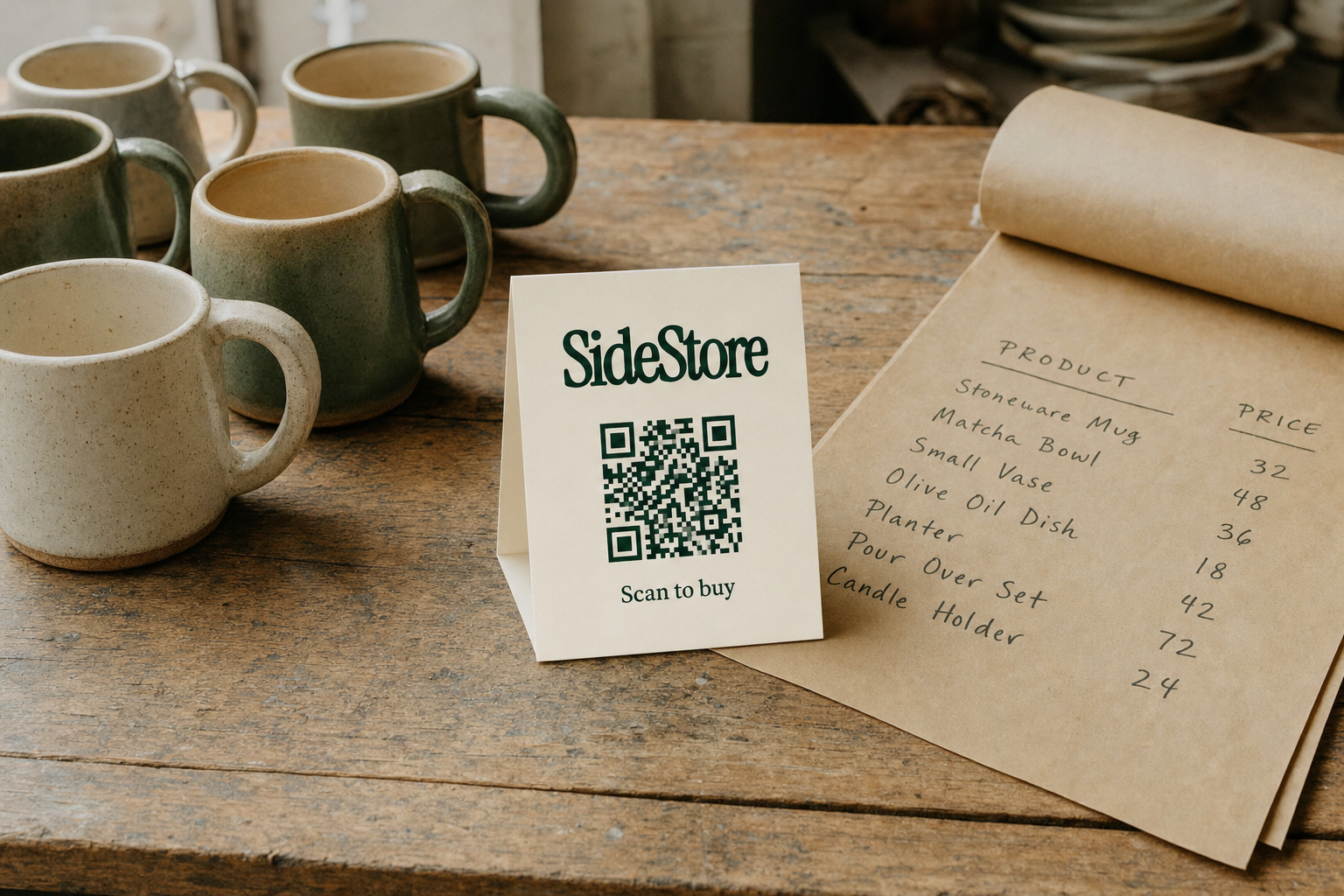
SideStore's Retail Widget is built precisely for this operational layer. It is the interface for placing and managing products on consignment. It handles live stock tracking, placement attribution, and automatic split payouts across every venue in your network. When a customer scans the QR code and buys, the transaction is recorded instantly, inventory is updated, and the split between you and the host is settled automatically. You see the full picture from one dashboard, not from a stack of retailer emails.
If you are approaching venues to host your products, understanding why merchants say yes to consignment placements helps you make a compelling case. A guide like how cafes earn from idle shelf space gives you the language to frame the proposition from the retailer's perspective.
If you are evaluating software options more broadly, consignment inventory software covers the category in depth.
Scaling your distribution means treating your placements as a system, not as a series of individual relationships. This is what separates makers who expand their retail footprint from those who plateau at a handful of venues.
Frequently Asked Questions
Should I use wholesale or consignment?
Use consignment when you are testing a new market, product, or type of retail venue. Use wholesale when you have proven demand, reliable production capacity, and margins that survive the price reduction. Many makers run both in parallel: consignment for new placements, wholesale for proven retail partners. The decision is stage-dependent, not permanent.
What is a fair consignment percentage?
A fair average consignment percentage sits between 30 and 50 percent going to the host, with you keeping the remainder. The exact split depends on your product category, the type of venue, and what the retailer actually contributes to the sale (display space, marketing, foot traffic). Galleries and specialist retailers often take toward 50 percent; lower-overhead venues typically take 25 to 35 percent. Always negotiate based on what the venue actively contributes.
Can I run consignment and wholesale at the same time?
Yes, and many established makers do. A common approach: use consignment with newer or smaller venues where you want to test fit before committing stock, and wholesale with larger or proven retail partners who have already shown strong sell-through. Running both requires pricing discipline. Your wholesale price should never undercut the retail price you set for consignment placements in the same market, or you create confusion that hurts both you and your retailers.
What do I need before approaching a retailer for wholesale?
You need a wholesale line sheet document. You need clear unit economics showing your cost of goods and wholesale price. You need a minimum order quantity you can reliably produce and a realistic lead time. Retailers also want to see your product in person or in strong photography, your brand story in brief, and evidence that the product has sold somewhere before. Approaching wholesale buyers without this preparation is common and almost always unsuccessful.
Know Your Numbers. Place Deliberately. Scale What Works.
Consignment vs wholesale is not a choice between a good option and a bad one. It is a choice between two different tools with different applications, and the right tool depends on where you actually are in building your distribution network.
Consignment gives you access to physical retail without upfront cost and without opening a store of your own. The trade-off is your time managing placements and delayed cash flow. Wholesale gives you immediate payment and lower ongoing effort, but demands proven margins and production consistency you may not yet have.
Start with consignment if you are building distribution for the first time. Manage it actively. Pull from venues that do not perform. When sell-through data gives you confidence in a venue or a market, that is the moment wholesale becomes worth considering.
Next step: read how to sell through someone else's store to understand the relationship mechanics. Then use the margin framework in this article to run your actual numbers for both models before you approach any retailer. If you are ready to pursue boutique placement specifically, selling handmade products in boutiques covers the pitch and the terms in detail.
Build a consignment network without opening a store of your own.