What Is a Shelf Offering? How Makers Can Structure Their Consignment Range for Retail Buyers
What Is a Shelf Offering?
A shelf offering is your structured proposal to place a curated product range in a merchant's physical space, on consignment. It specifies which products, at what retail price, under what split terms, with what replenishment commitment, and what on-shelf marketing materials you'll provide.
If you've arrived here from a financial search, note the name collision: in securities law, a "shelf offering" refers to an SEC-registered offering where a company files securities for delayed public sale, governed by rules around S-1 and S-3 registrations. That is a different conversation entirely. This article is for independent makers and artisans who want to place physical products in cafes, boutiques, and hotels without upfront cost to their host.
For makers, your shelf offering is the product of how consignment works: you place goods, the merchant hosts them at no inventory risk, and you both get paid when something sells. If you want the full picture of selling through someone else's store, start there, then come back to build your range properly.
What Does Shelf Space Actually Mean for an Independent Maker?
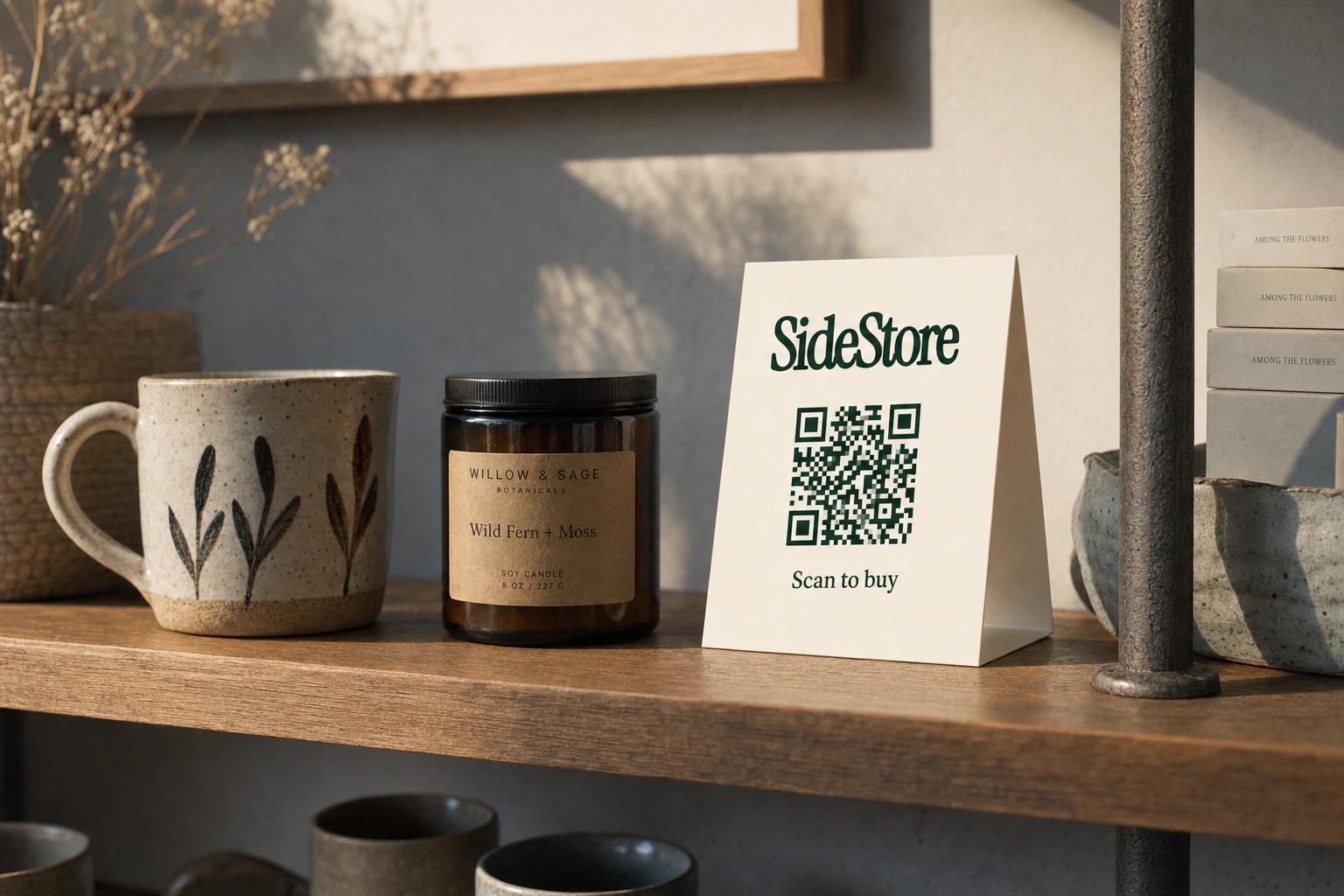
Shelf space in physical retail is the specific area a merchant allocates to your products inside their venue. For you as a maker, it means your goods are physically present where customers browse, pick up, and buy, without you owning or staffing that location.
The economics shift dramatically depending on how you access that space. Under wholesale, you sell stock to the merchant upfront at a reduced price, lose ownership, and lose control of pricing. Under paid placement, you pay a flat fee to occupy the shelf regardless of whether anything sells. Under consignment, you keep ownership of the stock, set your own retail price, and only get paid when a sale happens. The merchant earns a split of each sale in return for the space and foot traffic they provide.
Shared retail networks have made consignment shelf space more accessible for independent makers, and understanding whether a venue qualifies matters. For example, whether a coffee shop counts as a retail host is a practical question makers ask often, and the answer is yes, provided the space and foot traffic suit your product category.
What Goes Into a Shelf Offering: The Five Components
A strong shelf offering gives a merchant everything they need to say yes in one conversation. It covers your product selection, pricing logic, the split, your replenishment commitment, and your on-shelf presentation. Miss any one of these and expect hesitation or a delayed decision.
Here are the five components, what a merchant needs to see in each, and how the Retail Widget handles the operational side:
1. Product selection (your SKU range) Choose two to five products that form a coherent, visually related range. A merchant needs to see that your selection makes sense together and suits their customer. Avoid bringing your entire catalogue. The Retail Widget lets you model each SKU individually, so you can present exactly what you plan to place, with stock counts attached.
2. Retail pricing Every product needs a clear retail price, set by you, that leaves a viable split for the host while keeping the product attractive to their customers. Think through your cost of goods, your margin floor, and what the host's customer base will comfortably pay. The Retail Widget records your retail price per SKU and calculates the split automatically, so there is no manual arithmetic for either party. For detailed pricing guidance, see how to price your inventory.
3. Split terms State the consignment split plainly: maker keeps X%, host earns Y%. Many makers find a 60/40 or 70/30 split (maker/host) is a reasonable starting point, though the right number depends on your margins and the host's foot traffic. The Retail Widget encodes the agreed split and handles automatic settlement at the point of sale, removing any ambiguity about who gets what.
4. Replenishment plan A merchant's main concern after saying yes is whether you will disappear and leave an empty shelf. Commit to a specific replenishment cadence (weekly, fortnightly) and be realistic. The Retail Widget tracks live stock levels, so both you and the merchant can see when restocking is needed without a phone call. For a full view of consignment stock terms and conditions, review those before you agree anything in writing.
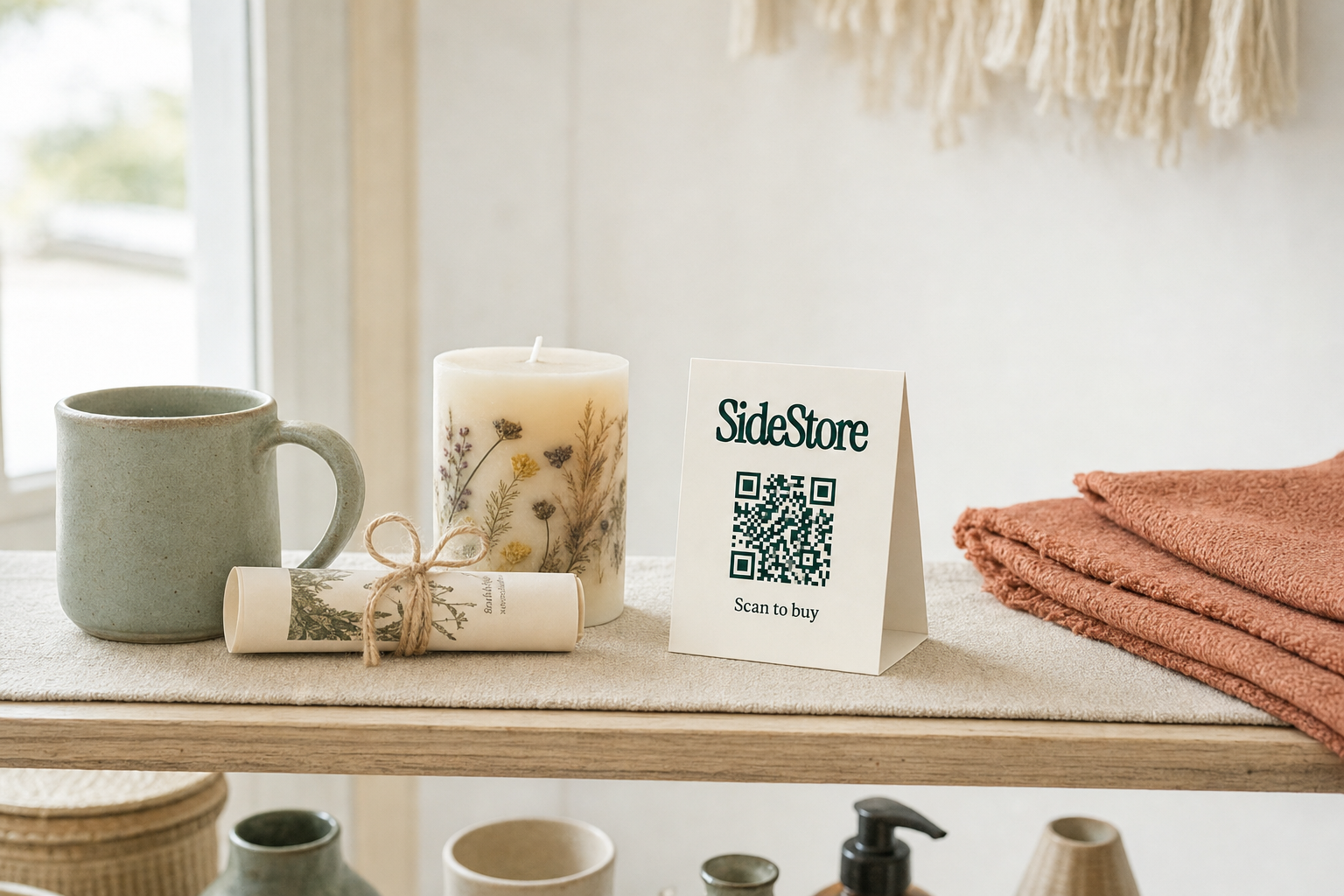
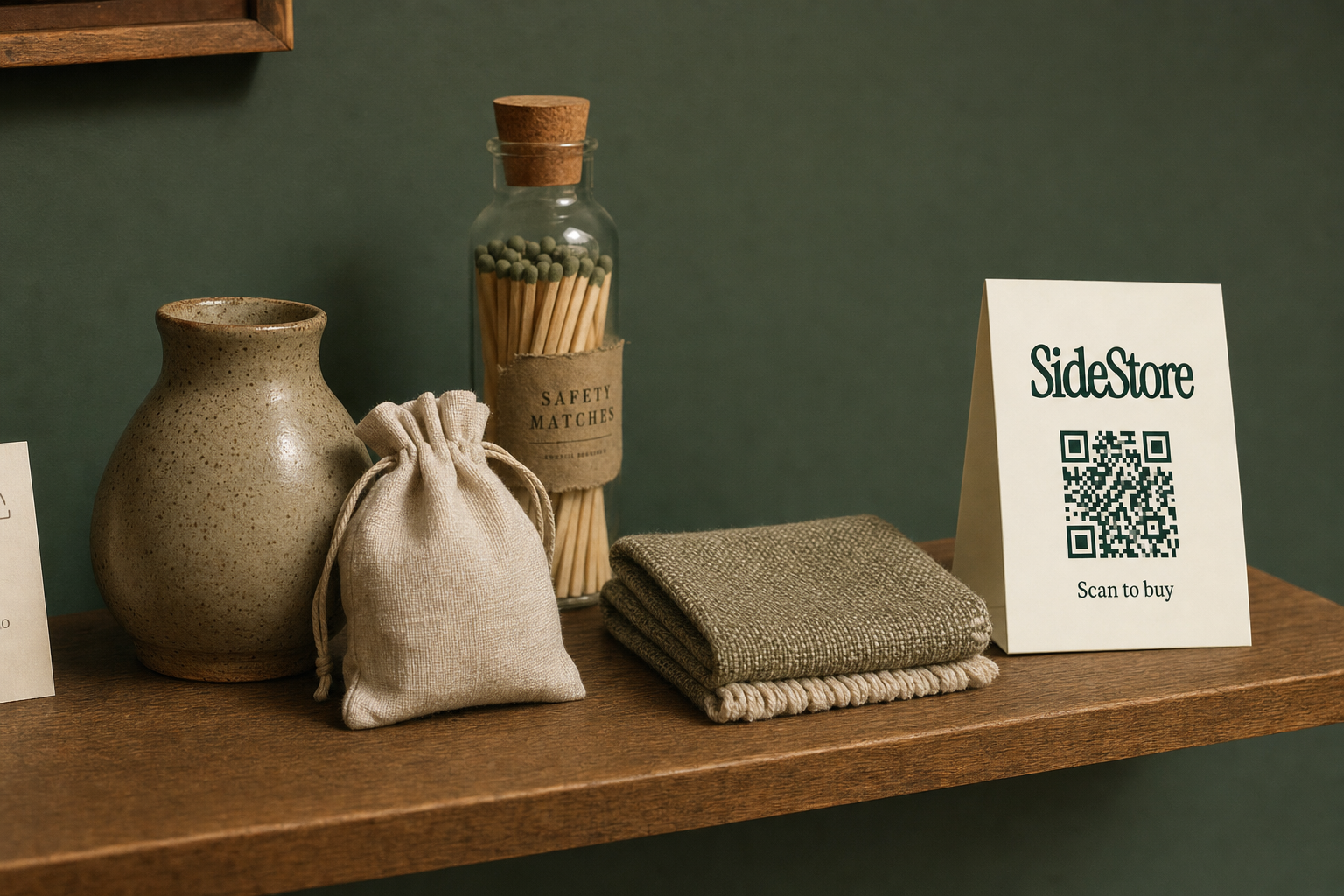
5. On-shelf marketing materials Your packaging, a product description card, and a scan-to-pay QR card are the only sales tools you have in an unmanned space. Plan them before the first placement goes live.
Shelf Offering Structures at a Glance: Consignment vs Wholesale vs Paid Placement
The right structure for your shelf offering determines how much financial risk you carry and how much control you keep. Consignment, wholesale, and paid placement are three distinct models with very different mechanics.
| Model | Upfront cost to maker | Stock risk | Price control | Settlement | Host effort |
|---|---|---|---|---|---|
| Consignment | None | Maker retains unsold stock | Full (maker sets price) | Automatic split at point of sale | Low (no buying decision) |
| Wholesale | None (maker is paid upfront by host) | Host owns stock after purchase | Lost (host reprices freely) | Lump sum to maker at order | High (host must commit cash) |
| Paid placement | Flat fee to host, paid upfront | Maker carries all risk | Full | None from host; maker keeps all sales revenue | None |
For consignment, the arrangement favours makers who want distribution without cash outlay, and it favours merchants who want revenue from idle shelf space without buying stock. Neither party is disadvantaged structurally, though your earnings depend entirely on sell-through, so a well-matched venue matters more than it does in wholesale.
For more on host-side inventory management, see boutique inventory system and purchasing inventory for a boutique.
On-Shelf Marketing: What You Control Without a Shop Assistant
When your products sit in a merchant's space without you present, packaging and printed materials do the selling. That's what "shelf space" means in practice: a silent, unsupervised sales environment where your on-shelf marketing either works or it doesn't.
Three tools are within your control:
Packaging and labelling. Your packaging is your first sales touchpoint. It needs to communicate what the product is, who made it, and why it is worth picking up, without any explanation from you or the host's staff. Clear, clean labelling with a retail price printed or tagged on the item removes friction at the point of decision.
Product story card. A small printed card placed next to your products that tells the story of the maker and the product in two to four sentences. Merchants rarely have time to explain your provenance to customers, so this card carries that job.
Scan-to-pay QR card. You can print the SideStore QR code card and attach it directly to your own product, or a merchant can display a single SideStore card for all the products in their SideStore placement. Either approach works. The QR checkout is one function of the Retail Widget, which is the broader interface that manages your entire placement: stock tracking, split settlement, and placement attribution. It is not a standalone payment device.
For category-specific placement ideas, see selling art prints in cafes and placing retail products in a salon.
How to Approach a Merchant with Your Shelf Offering
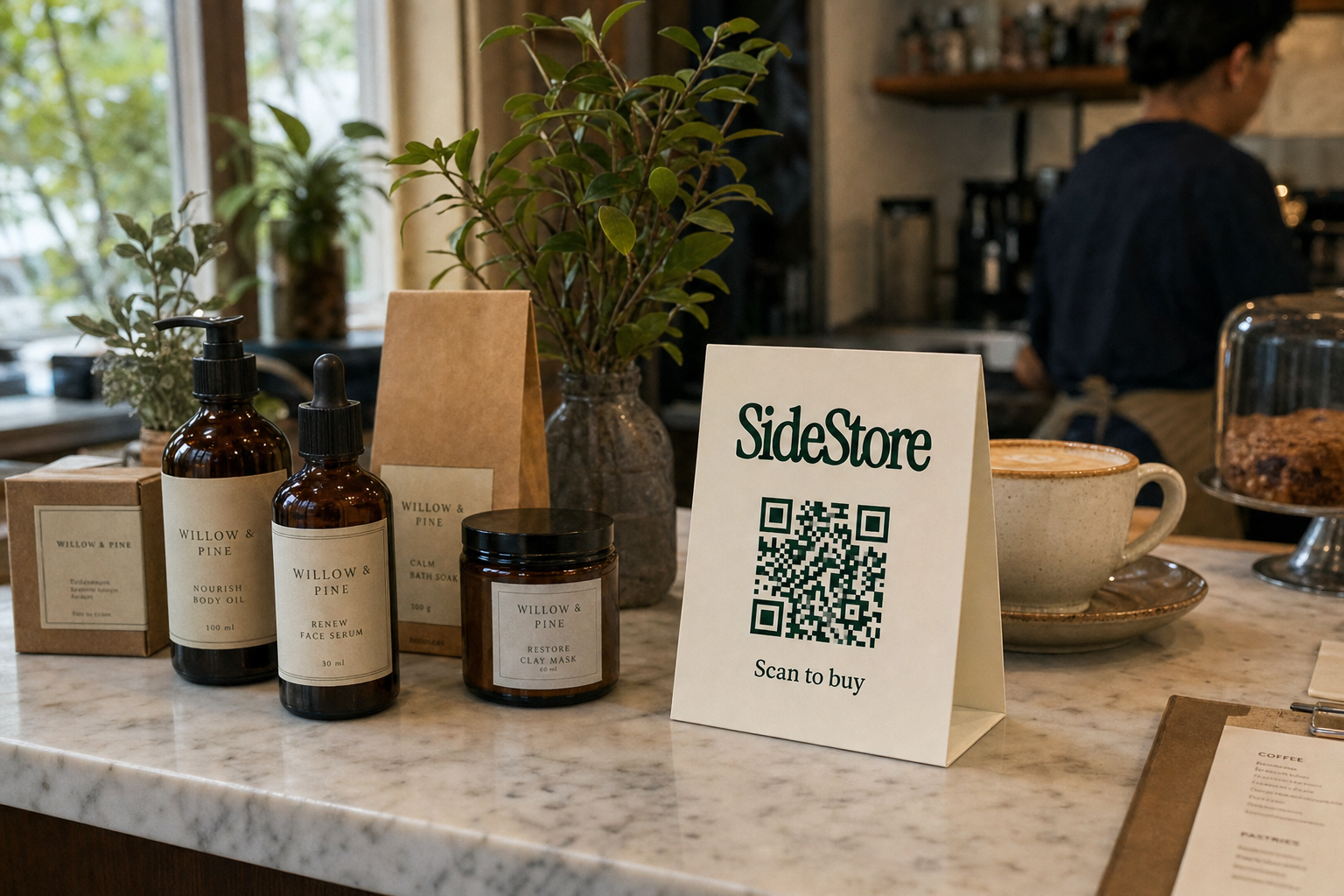
Approaching a merchant with a clear, complete shelf offering dramatically shortens the decision conversation. Walk in prepared, and the merchant's main job is to say yes or no, not to figure out how the arrangement would work.
Follow four steps:
Step 1: Build your shelf prospectus. A shelf prospectus is a one-page summary of your shelf offering: your product range, retail prices, proposed split, replenishment commitment, and on-shelf materials. It answers every operational question before the merchant asks it. Think of it as a consignment brief, not a sales pitch. Keep it to one page. Plain language, no jargon.
Step 2: Match your range to the venue. Before you walk in, spend ten minutes in the space as a customer. Assess the existing product categories, the typical customer, and where your products would sit. A range that fits the existing aesthetic and customer type is far easier to say yes to.
Step 3: Present the split as a default, not a negotiation. Many makers arrive without a defined split and end up in an uncomfortable back-and-forth. Set your split before the meeting and present it plainly. The Retail Widget handles automatic settlement at the agreed percentage, so once it is set, neither party needs to track it manually.
Step 4: Confirm replenishment logistics. The most common reason a first placement fails is that the maker disappears after drop-off. Agree a replenishment schedule at the meeting and show the merchant that live stock tracking through the Retail Widget means they can flag low stock without chasing you.
For a full walkthrough of the conversation itself, see how to approach a local shop about stocking your products. For a different format, how pop-up placements compare is worth reading alongside this.
Shelf-Stable Range Editing: Which Products to Include and When to Cut
A shelf-stable range is a product selection that holds its appeal and sells consistently across time, without constant swapping, repackaging, or discounting. Start with no more than three to five SKUs per placement. A tighter range is easier for the merchant to display well and easier for you to manage.
When you have placement attribution data from the Retail Widget, you can see exactly which SKUs are turning over and which are sitting. That data, not intuition, should drive your range decisions.
Cut a SKU when it has had no sales across two full replenishment cycles in a given placement. Keeping a slow mover on the shelf costs you nothing financially under consignment, but it crowds out space a faster product could occupy. It also signals to the merchant that the range is underperforming.
Add a new SKU only when an existing one is selling consistently. Expand from strength.
For the operational side, tracking boutique inventory live gives you the tools, and organising your product range covers the broader structure.
Shelf Offering: Frequently Asked Questions
These questions came directly from real searches. Some use financial-market terminology; where that is the case, the answer explains the securities-law meaning and redirects to the physical retail context.
What does a shelf prospectus mean? In physical retail, a shelf prospectus is a maker's one-page consignment brief: product range, retail prices, split terms, replenishment plan, and on-shelf materials. In securities law, a prospectus is a formal legal document filed with a regulator for a registered offering. The retail use is informal and practical; the securities use is a defined legal instrument.
What is the meaning of shelf offering? A shelf offering is a maker's structured proposal to place a curated range of products in a merchant space on consignment. It defines which products, at what price, under what split terms, and with what replenishment plan. Separately, in securities markets, a shelf offering refers to a registered offering where securities are pre-approved for delayed public sale.
How do shelf offerings and at-the-market offerings differ? These are two distinct securities mechanisms and are often confused. A shelf offering pre-registers securities for future sale at unspecified times. An at-the-market (ATM) offering sells those securities gradually into the existing market at prevailing prices. If you are asking about physical retail, neither term applies: your shelf offering is a consignment proposal, not a capital markets mechanism.
What constitutes an offering for stocks? In financial markets, a stock offering is a sale of equity securities to investors, either via an IPO, a follow-on offering, or a shelf registration. This is unrelated to the retail meaning of shelf offering. If you landed here from a finance search, your question falls under securities law, not consignment commerce.
What is a mixed shelf offering? In securities law, a mixed shelf offering allows a company to register multiple types of securities (equity, debt, or both) under a single shelf registration statement for future issuance. This is a capital markets term with no equivalent in physical retail consignment.
What is a debt shelf offering? A debt shelf offering is a shelf-registered issuance of bonds or other debt instruments, governed by SEC rules under the Securities Act. It is a finance and capital markets term, not a physical retail concept.
How do shelf offerings and follow-on offerings compare? A follow-on offering sells new shares to the public after an IPO, typically to raise additional capital. A shelf offering pre-registers securities for sale at a later, unspecified time. The key difference is timing and structure. Neither term describes physical retail placement; they belong to securities regulation.
Which regulatory act covers shelf offerings? Shelf offerings in the securities sense are governed by the Securities Act of 1933 in the United States, with SEC rules (including Rule 415) specifying how delayed offerings are registered and executed. Physical retail consignment has no equivalent regulatory framework; it is governed by commercial contract law.
How do S-1 and S-3 filings differ? An S-1 is the full registration statement filed by a company for an initial public offering. An S-3 is a shorter-form registration available to companies that already meet SEC reporting requirements, used for shelf registrations. S-3 filers can register securities in advance and issue them over time. Neither applies to retail consignment.
What is an S-3 shelf registration? An S-3 shelf registration is an SEC filing that allows eligible public companies to register securities for delayed issuance, drawing them down over time as market conditions suit. It is a securities-law mechanism. For makers, adding a physical channel to your online selling and pop-up retail space as an alternative are more relevant starting points.
Build Your Shelf Offering Before You Knock on the Door
A complete shelf offering, covering your SKU range, retail pricing, split terms, replenishment plan, and on-shelf materials, is what separates a maker who gets a placement from one who gets a polite maybe.
Consignment is structurally fair to both sides: no upfront cost for the merchant, no stock loss for you, automatic split settlement through the Retail Widget at every sale. The preparation is on you. Build the offering before the conversation, not during it.
Understand how consignment placement works, and if you want to know what a host earns from carrying your products, what a cafe host earns from a placement makes the merchant's side of the equation concrete.
Build a consignment network without opening a store of your own.