What Is a Pop-Up Store? How They Work and Why Consignment Is a Smarter Alternative
What Is a Pop-Up Store?
A pop-up store is a temporary physical retail space that operates for a defined period, anywhere from a single day to several months, before closing or relocating. It's not an online shop, a social media storefront, or a promotional display fixture inside an existing retailer. Pop-ups are standalone physical locations, often in vacant storefronts, market stalls, event venues, or shared retail environments.
The defining feature is temporary. That built-in end date separates pop-up retail from a conventional store lease and from selling through someone else's store on consignment.
Two clarifications matter upfront. First, pop-ups are physical. They require a location, staff, fixtures, and foot traffic. Second, they're not the branded display stands or in-store fixtures you see inside a supermarket. Those are permanent point-of-sale installations. A pop-up store is its own temporary retail environment, operated independently for a set term.
What Distinguishes a Pop-Up Store from Other Retail Formats?
A pop-up store differs from other retail formats primarily in its defined, short-term duration and the operator's full control over the retail environment. You rent a space, control the layout, manage the transaction, and close when the term ends. No ongoing lease commitment follows.
The confusion usually comes down to three adjacent formats:
- Temporary resale or thrift stalls. These sell second-hand goods from multiple sources. A pop-up store typically sells a specific brand's own products, new and curated.
- Online pop-up shops. A term sometimes used for time-limited e-commerce sales. These are digital, not physical. A physical pop-up store requires a real-world location.
- In-store promotional fixtures. Branded display units inside an existing retailer (a wine display in a supermarket, for instance) are permanent installations managed by a third party. They're not pop-up stores.
Consumer brands and major retailers use pop-up formats for product launches, seasonal campaigns, and market testing. A streetwear label might open a temporary space for 72 hours to coincide with a drop. A cosmetics brand might run a two-week shop-in-shop during the holidays. These are high-budget, high-coordination exercises. For independent makers, the mechanics are identical, but the budget is usually much thinner.
The pop-up retail design choices and the display solutions for temporary retail you select will shape how professional and compelling your space feels to passing customers.
What Does a Typical Pop-Up Shop Look Like? Layout, Fixtures, and Display
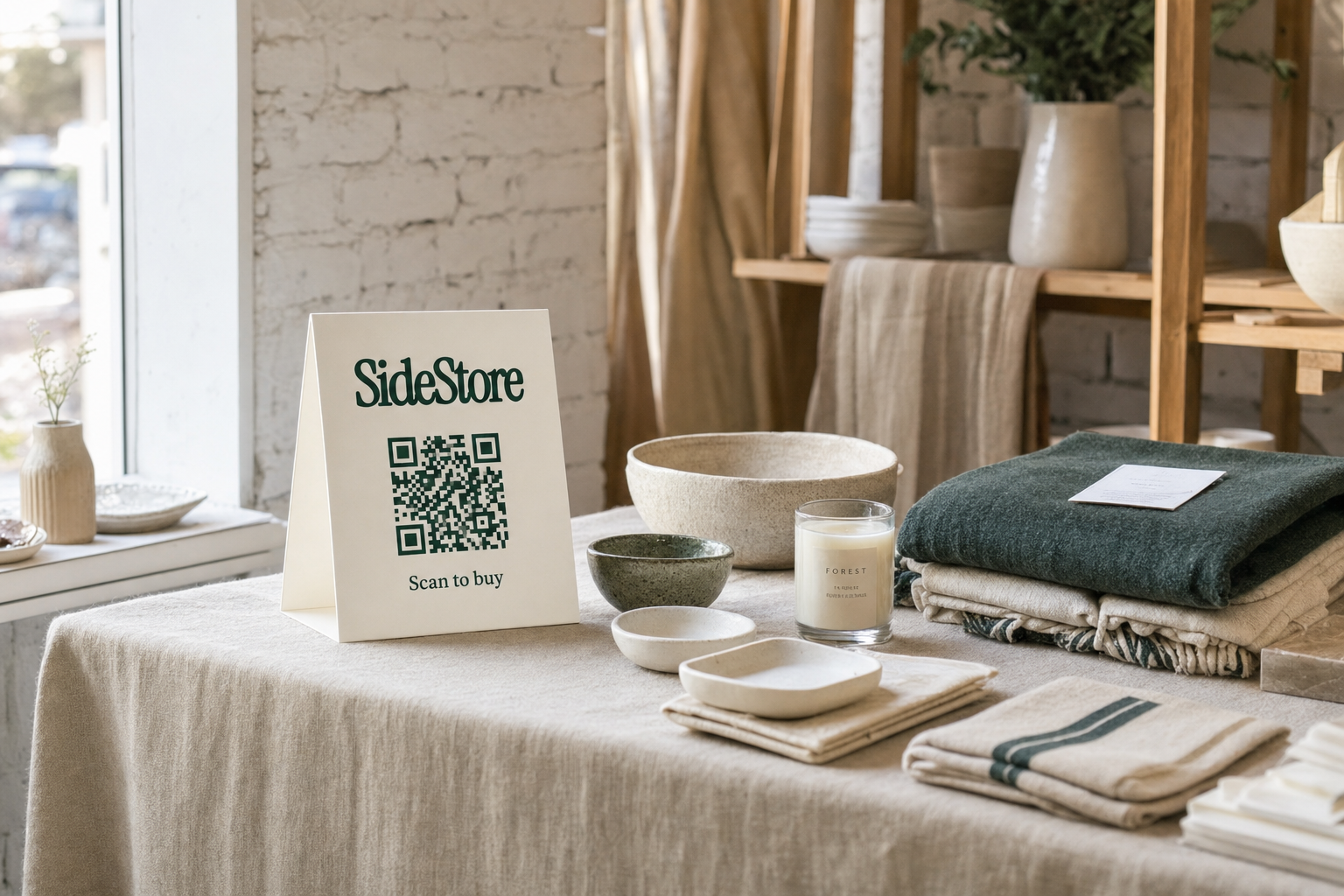
A typical pop-up is a stripped-back, modular retail environment built from portable fixtures that assemble quickly and break down cleanly when the term ends. The aesthetic varies by brand, but the underlying infrastructure is consistent: folding tables, garment rail stands, pegboards, cube shelving, and branded signage.
What fixtures are needed to set up a pop-up store?
The core kit covers display surface (folding or trestle tables), product hanging (clothing rails or rail stands), vertical merchandising (pegboards, grid panels, or slatwall), and point-of-sale (a card reader and a small counter or podium). Lighting, branded backdrops, and packaging complete the setup. Most operators rent or source fixtures second-hand to control cost.
What is pop-up staging and how does it differ?
Pop-up staging refers to the deliberate styling of the space to tell a brand story, not just display products. Where basic fixture setup arranges goods for access, staging arranges them for desire. A staged pop-up uses props, colour palettes, risers, and hero product moments to create an environment customers photograph and remember. Staging is what separates a well-attended pop-up from a flea market stall.
What display solutions work best for temporary retail spaces?
Modular, lightweight, and tool-free systems perform best. Grid panels and pegboards are particularly versatile because they accommodate hooks, shelves, and signage without screws or fixings. See the full breakdown in pop-up retail display ideas and the layout principles in how to design a pop-up retail space.
Can a pop-up venue serve dual purposes, such as retail and content creation?
Yes, and this is increasingly common. Brands design the space specifically to function as a photo or video backdrop during off-peak hours. Products are arranged for camera angles as much as for browsing. The visual content generated during the pop-up then feeds weeks of social media output, extending the commercial life of a short-term activation well beyond closing day.
Are Pop-Up Shops Profitable? Costs, Rental Models, and What the Numbers Look Like
Pop-up shops can be profitable. The margin depends on rental cost, product price point, and foot traffic, none of which you fully control before opening. Operators report strong results where the location matches the product and the run is short enough to limit overhead. The failure mode is nearly always an underperforming location locked in at a fixed weekly or monthly rate.
Five cost components to account for:
- Space rental, the dominant cost, typically charged daily, weekly, or monthly
- Fixtures and display, folding tables, rails, pegboards, lighting (often reusable across events)
- Staffing, covering open hours requires either your own time or paid help
- Licensing and insurance, required in most jurisdictions, with costs that vary by location and duration
- Marketing and foot traffic generation, the space itself delivers nothing; you bring the audience
Can pop-up shops operate on an hourly rental basis?
Some shared retail venues and event spaces offer hourly rates, particularly for market-style pop-ups or product launches tied to a specific event. Hourly pricing is more common in high-demand urban locations where operators want flexibility. Weekly and monthly rates remain the standard structure for standalone temporary storefronts.
What are the main drawbacks of operating a pop-up store?
The core disadvantage is fixed cost against variable revenue. You pay rent whether or not customers arrive. Add setup logistics, staffing, compliance, and the operational weight of running a retail environment from scratch, and the true cost often exceeds early projections. Foot traffic is never guaranteed. Operators also report underestimating the time burden of sourcing, negotiating, and managing the space itself.
The financial viability concern is legitimate. Pop-up retail suits high-margin products, brands with an existing audience to mobilise, or operators who have done the location research in advance. For makers without that existing audience or brand recognition, the risk-to-reward ratio is harder to justify. You can find practical guidance on locating and renting space in the guides to how to find and rent temporary retail space and pop-up retail agency options.
Is Business Registration Required to Run a Pop-Up Shop?
Yes, in most jurisdictions, business registration is required to run a pop-up shop. Selling goods commercially, even for a single weekend, typically constitutes trading activity and brings with it legal obligations around business registration, tax collection, and liability. The specific requirements vary by country, state, or local authority, so treat any information here as a starting framework rather than legal advice.
Key compliance items to address before you open:
- Business registration or sole trader status with the relevant authority
- Sales tax or VAT registration, if your turnover or the jurisdiction requires it
- Temporary trader or market permit from the local authority or venue
- Public liability insurance, which most venues now require as a condition of rental
- Food handling certification, if you sell any consumable products
Legal uncertainty is one of the most commonly cited barriers among first-time pop-up operators, and that uncertainty is reasonable. The compliance layer is real, and it varies enough between locations to make confident generalisation impossible. If you operate across multiple markets or events, the overhead compounds.
By contrast, placing products in a merchant's space on consignment carries a much lighter compliance burden for the maker. The merchant already holds the relevant licences and insurance for their venue. You can review how consignment arrangements are typically formalised in a consignment agreement for artists and understand the standard consignment stock terms and conditions before approaching any merchant.
Pop-Up Store vs Consignment: A Side-by-Side Comparison
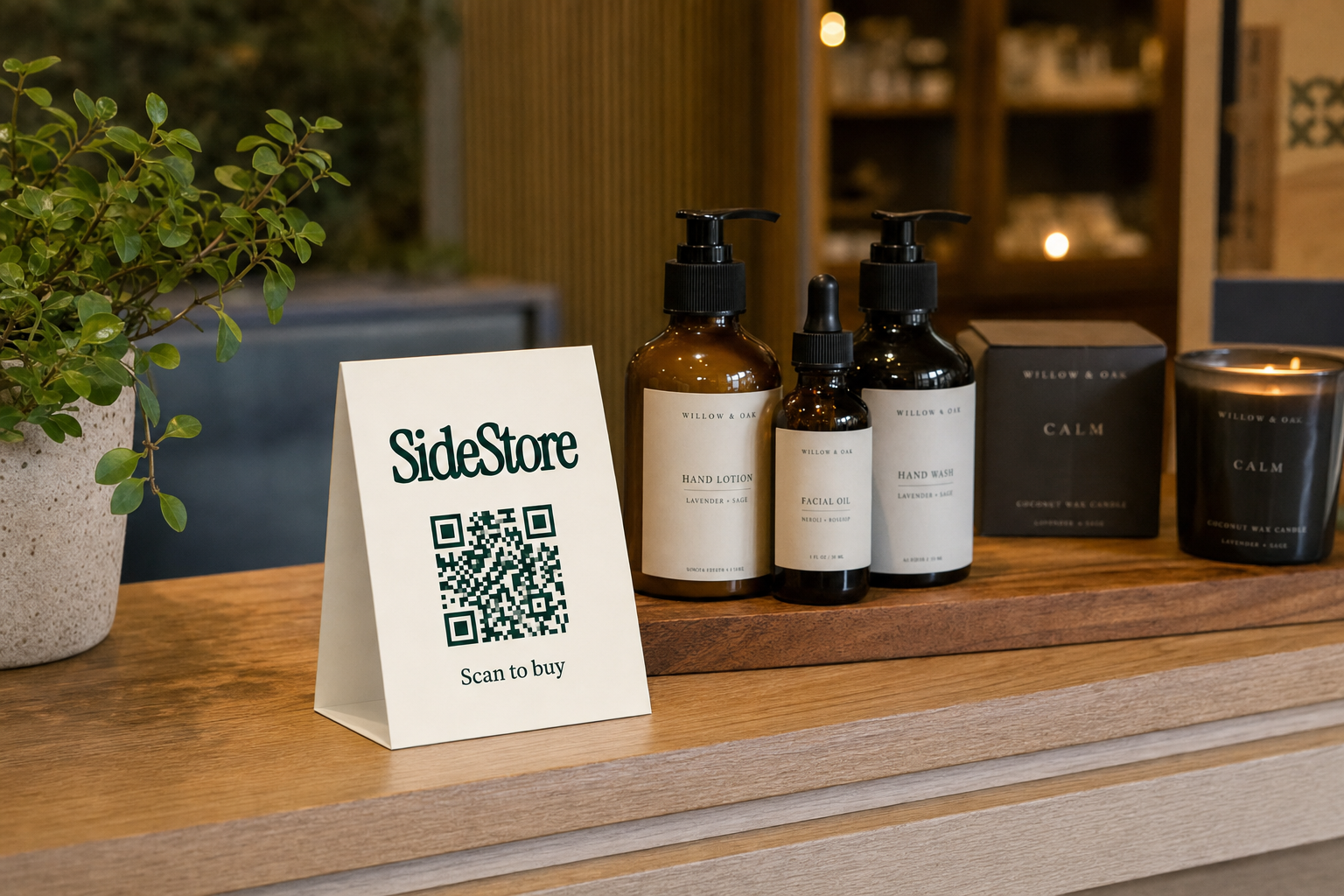
Pop-up retail and consignment placement both put your physical products in front of real-world customers. The difference is in who bears the cost, the risk, and the operational weight. Here's the direct comparison across the dimensions that matter most to a maker deciding between the two routes.
| Dimension | Pop-Up Store | Consignment Placement |
|---|---|---|
| Upfront cost | Fixed regardless of sales (rent, fixtures, insurance) | Zero fixed cost, maker pays nothing until a sale occurs |
| Inventory risk | Maker bears full risk of unsold stock | Merchant holds stock; maker is paid only on sale |
| Setup effort | High, source venue, negotiate lease, build out space, staff it | Low, approach a merchant, agree terms, deliver stock |
| Legal overhead | Business registration, permits, insurance, tax compliance for each location | Maker's existing registration; merchant holds venue licences |
| Scalability | Each new location is a separate project with its own cost and negotiation | Add placements in new merchant spaces without a lease for each |
| Ongoing management | Active, staffing, restocking, cash management, close-down | Passive, live stock tracking and split settlement via the Retail Widget |
Three rows worth expanding:
Upfront cost. A pop-up's rent is a committed expense from day one. If foot traffic is lower than expected, that cost doesn't adjust. Consignment placement has no fixed cost: the maker and the merchant each receive their agreed share only when a customer buys.
Scalability. Running a second or third pop-up multiplies the operational load. Adding a second or third consignment placement through SideStore adds a location to a single dashboard without a new lease negotiation, new fixtures, or new staffing.
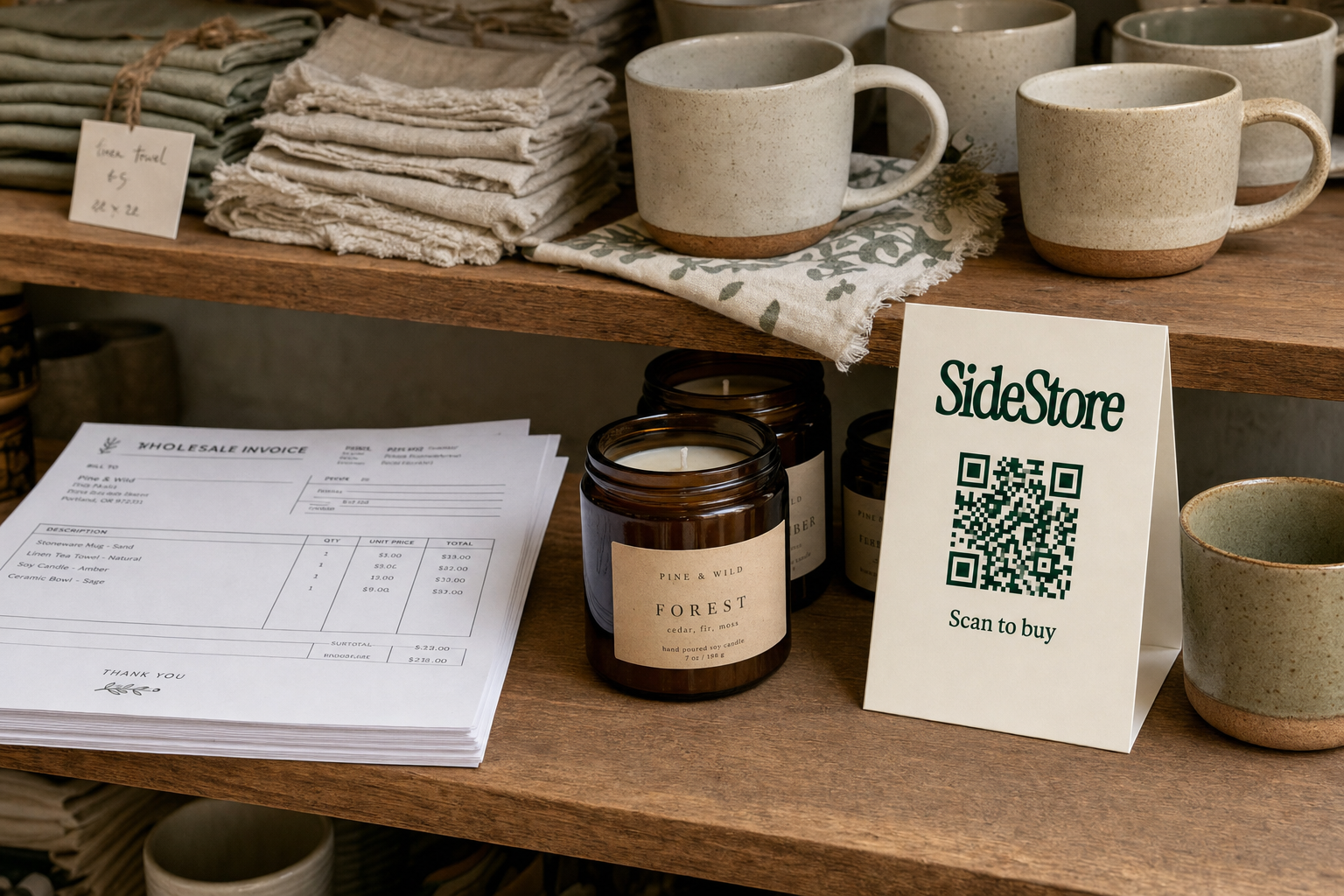
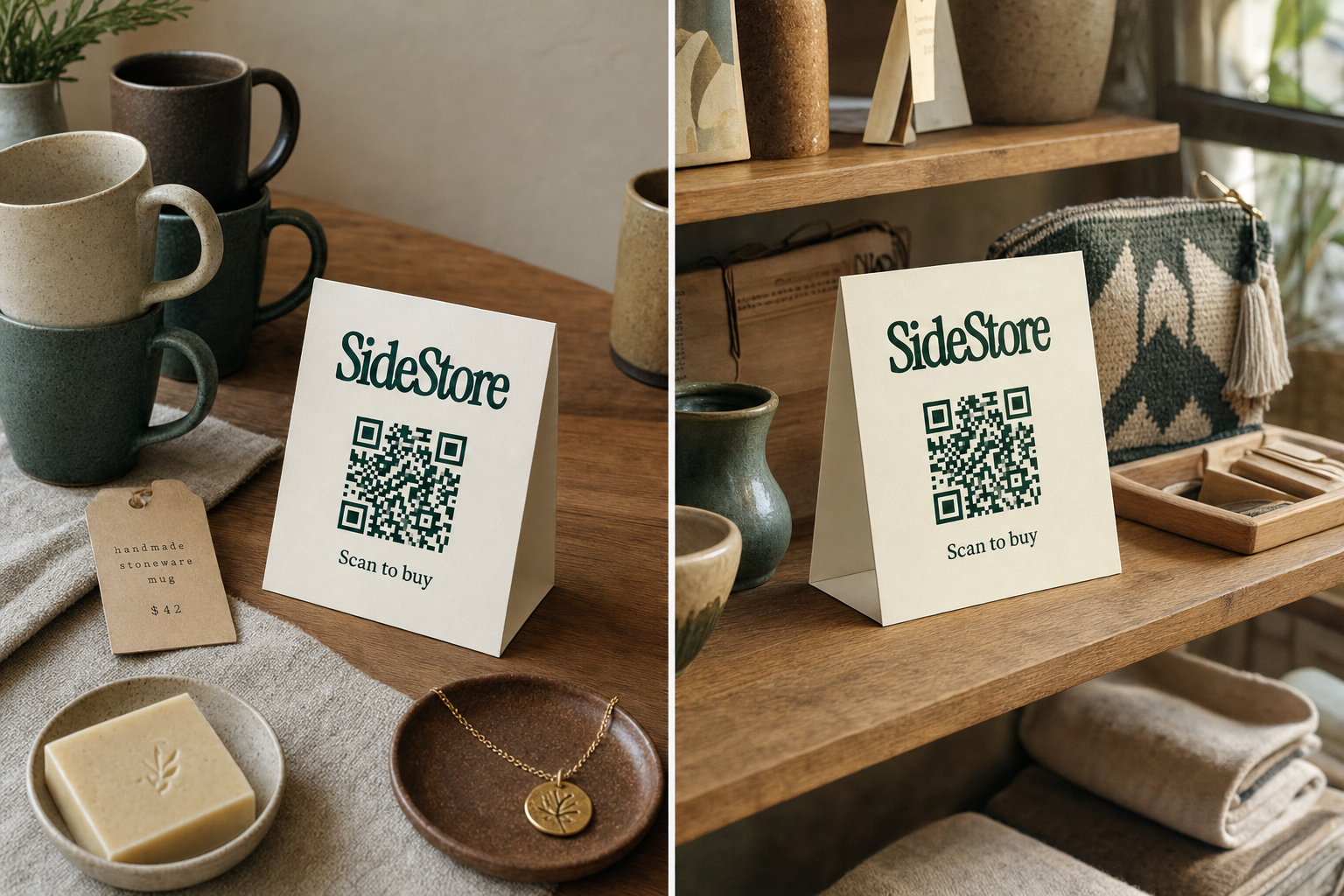
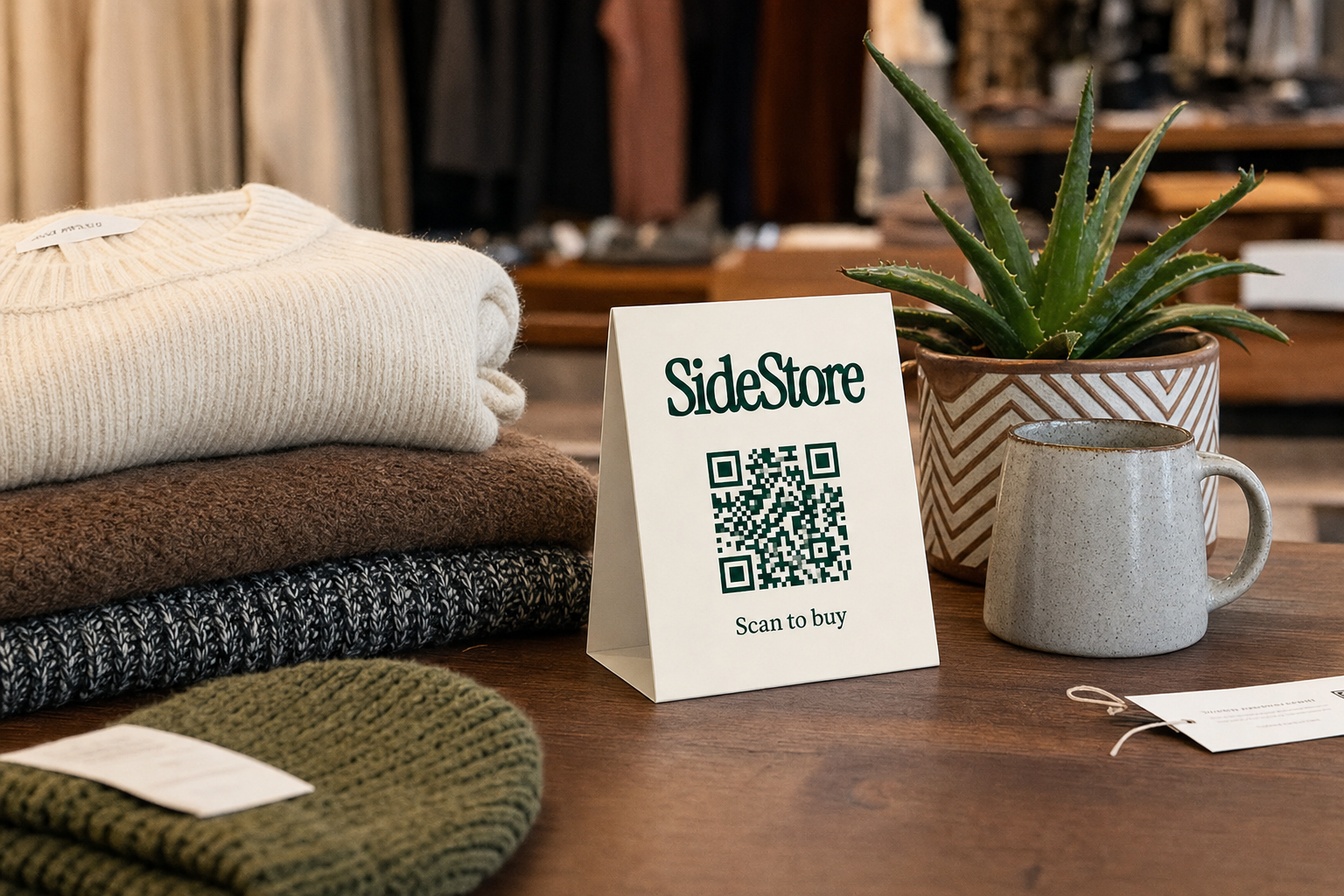
Ongoing management. The Retail Widget is SideStore's interface for placing and managing a product on consignment. It handles checkout (including a scan-to-pay QR code on the physical product or a single display card for the placement), live stock tracking, placement attribution, and automatic split payouts to the maker and the merchant. The QR checkout is one function of the Retail Widget, not the whole product.
For further reading on the trade-offs, see selling through someone else's store on consignment, the analysis of shared retail networks, and pop-up retail ideas if you're still considering the pop-up route.
How Consignment Placement Works as a Pop-Up Alternative
Consignment placement works like this: you place your products in a merchant's existing space, they display them, and both of you receive your agreed share automatically when a product sells. No lease. No build-out. No staffing cost for you.
If accessing good distribution channels feels out of reach, that's fair and common. Most independent makers don't have the budget for a lease or the audience to fill a pop-up. Consignment placement through SideStore offers a realistic path to physical retail presence without those prerequisites.
The steps are straightforward:
- Approach a merchant whose space and customer base suit your product.
- Agree on the consignment split and practical terms.
- Deliver your products and set up the Retail Widget for that placement.
- The Retail Widget manages checkout (via a printable QR on the product or the placement), tracks live stock levels, and issues automatic split payouts when sales occur.
- Add more placements in more merchant spaces from the same dashboard.
On the question of how to find space: consignment sidesteps most of the friction in the how to approach a local shop about stocking your products conversation. You're not asking a merchant to commit capital or risk. You're offering them margin from their idle shelf space, which is a fundamentally different conversation than negotiating a temporary lease.
Practical starting points include cafes, salons, and independent boutiques. You can see what products that sell well on a café counter look like, how selling retail products in a salon works in practice, or the specifics of selling art prints in cafés on consignment.
Frequently Asked Questions About Pop-Up Stores
The ten questions below cover what makers and operators most consistently need to know before committing to a pop-up format. Each answer stands alone as a quoted reference.
What distinguishes a pop-up event from other retail formats?
A pop-up store is a temporary, standalone physical retail space with a defined end date. It differs from a conventional store (no lease commitment), a market stall (full brand control over environment), an online shop (physical location required), and a promotional in-store fixture (independently operated, not embedded in another retailer's layout).
What are the main drawbacks of operating a pop-up store?
Rent is a fixed cost whether or not customers arrive. Staffing, compliance, and logistics add overhead that many operators underestimate. Foot traffic is unpredictable. Operators report that the total time and financial burden routinely exceeds early projections, particularly for makers without an existing audience to mobilise.
Is business registration required to run a pop-up shop?
In most jurisdictions, yes. Selling goods commercially, even for one day, typically requires business registration, a temporary trader permit, and in many cases VAT or sales tax registration. Requirements vary significantly by location. Consult your local authority or a qualified adviser before trading. See how to rent temporary retail space for venue-specific permit notes.
What does a typical pop-up shop layout or appearance involve?
A standard pop-up uses portable, modular fixtures: folding tables, garment rail stands, pegboards or grid panels, and a small point-of-sale counter. Staging, the deliberate styling of the space to tell a brand story, elevates the setup from a basic display to a curated retail experience that customers engage with and photograph.
Can pop-up shops operate on an hourly rental basis?
Some shared retail venues and event spaces offer hourly rates, particularly for product launches tied to a specific event. Hourly pricing is more common in high-demand urban locations. Weekly and monthly fixed-rate agreements remain the more standard structure for standalone pop-up storefronts.
What display solutions work best for temporary retail spaces?
Modular, lightweight, and tool-free systems perform best. Grid panels and pegboards accommodate hooks, shelves, and signage without fixings, making setup and breakdown fast. Garment rails, cube shelving, and branded backdrops round out most setups. The priority is portability without sacrificing the appearance of a considered retail environment.
What is pop-up staging and how does it differ?
Pop-up staging is the deliberate styling of the retail space to create a brand environment, not just a product display. Basic fixture setup arranges goods for access; staging arranges them for desire, using props, lighting, colour palettes, and hero product moments that prompt customers to photograph the space and engage with the brand beyond the transaction.
How do you find or rent temporary retail space?
Options include short-term lease platforms, dedicated pop-up space agencies, direct approaches to landlords with vacant units, and market or event organisers. The practical process involves venue scouting, permit research, and lease negotiation. Consignment placement bypasses this entirely: you approach an existing merchant, agree terms, and your products go live in their space without a lease. See the full guide at how to rent temporary retail space.
What fixtures are needed to set up a pop-up store?
Core fixtures include folding or trestle tables, clothing rail stands, pegboards or grid panels, cube shelving, and a point-of-sale surface. Card readers and printed signage complete the functional setup. Most experienced operators source reusable fixtures to spread the cost across multiple activations.
Can a pop-up venue serve dual purposes like retail and content creation?
Yes. Operators increasingly design pop-up spaces to function as photography or video backdrops during off-peak hours, generating social media content that extends the campaign well beyond the physical run. Is a coffee shop considered retail explores how dual-purpose venues already combine hospitality and retail presence in a single space.
Should You Run a Pop-Up Store, or Is There a Smarter Route?
Pop-up retail works when you have an existing audience to mobilise, a high-margin product, and the operational capacity to manage a temporary space from scratch. If any of those three conditions is missing, the fixed costs and logistics will likely absorb the margin before it reaches you.
Consignment placement is the concrete alternative: your products go live in an existing merchant's space, with no lease, no build-out, and automatic split payouts via the Retail Widget. Start with the full pop-up retail guide to weigh the formats side by side, or explore how a café host earns from idle shelf space in the average profit for a coffee shop host breakdown.