Cross-Selling for Makers: How to Place Complementary Products Across Multiple Retail Locations
Cross-selling means placing related products together on a shelf so a customer who picks up one naturally considers the other. For independent makers, it's how you increase average sale value without hunting for new customers.
If you make candles, your cross-selling opportunity might be a ceramic holder placed right beside them. If you design prints, it might be a greeting card in the same rack. The pairing does the selling for you, on the shelf, while you're elsewhere.
This matters especially when you're selling through someone else's store rather than running your own. You can't talk to every customer, so the shelf arrangement and product grouping must do the persuasion. Cross-selling is the structural answer to that problem. The sections below cover what it means, how to find your best pairings, and how to scale those pairings across multiple retail locations using consignment.
What Does Cross-Selling Mean?
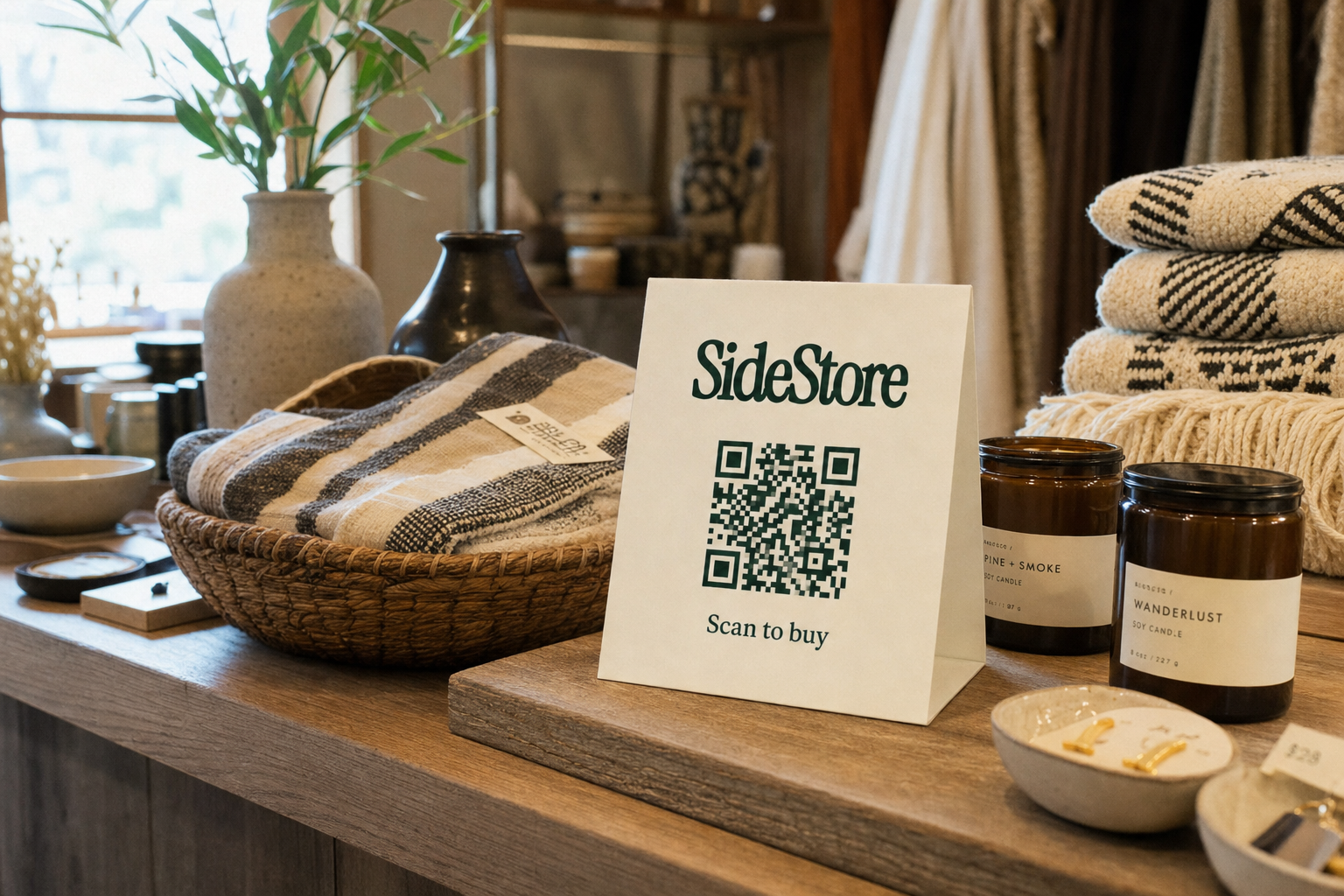
Cross-selling means presenting a customer with a product that complements what they're already considering. In physical retail, it's straightforwardly structural. A customer browses a boutique shelf, picks up a hand-poured soy candle, and notices a hand-thrown ceramic holder beside it. They buy both. No promotion, no discount, just thoughtful placement.
This article focuses specifically on physical retail cross-selling for independent makers. If you're looking for banking or insurance examples of cross-selling, those contexts fall outside this scope. Cross-selling in banking typically means offering a savings account to a current-account holder; in insurance, it means home cover to someone with car cover. Neither pattern translates directly to placing handmade goods in a boutique or cafe.
For makers, the most useful cross-selling examples are grounded in physical placement. A maker selling art prints in cafes might also place matching postcards at the counter. A maker placing handmade jewelry in boutiques might introduce a complementary polishing cloth or branded pouch in the same display. The goal is to serve the customer who already wants what you make, and to make buying more of it effortless.
The key distinction from general product bundling is intent. Cross-selling is active. You deliberately curate a pairing that makes sense to the customer standing in front of the shelf.
Cross-Selling vs Upselling: What Is the Difference?
Cross-selling and upselling are related but distinct tactics. Cross-selling introduces a complementary product alongside what the customer is already interested in. Upselling encourages the customer to choose a higher-value version of the same product. Many makers treat these as identical, which leads to muddled shelf setups and confused messaging. They're not the same.
Here's a direct comparison:
| Tactic | What it does | Physical retail example | Maker benefit |
|---|---|---|---|
| Cross-selling | Adds a complementary product to the purchase | Candle + ceramic holder displayed together | Higher basket value from one customer visit |
| Upselling | Moves the customer toward a higher-value version of the same item | Small print offered alongside a larger framed version at a premium price | Better margin per unit without stocking extras |
The clearest way to separate them: cross-selling broadens the basket, upselling deepens it.
For physical retail, cross-selling is usually the more accessible tactic for independent makers. You don't need to offer a "premium tier" of your product to cross-sell. You need a second, related product that makes sense beside the first. That's a lower barrier if you already make a range of items.
Upselling requires a clear value ladder in your product line. For pricing your products for boutique placement, understanding both tactics lets you structure your shelf presence more deliberately. You can cross-sell across categories and upsell within them.
The practical rule: want a customer to buy more items, cross-sell. Want them to spend more on one item, upsell.
Examples of Cross-Selling in Practice for Independent Makers
Cross-selling in physical retail for makers looks like deliberate product pairing at the shelf level. It's not a digital pop-up or a bank calling you about a loan. This article deals exclusively with physical retail examples; banking and insurance applications belong to a different domain entirely.
Here are four concrete examples relevant to independent makers:
1. Candles and ceramic holders. A maker selling hand-poured candles places a small run of ceramic holders from their own range on the same shelf. The customer buying the candle sees an obvious companion. No staff interaction needed.
2. Art prints and greeting cards. A maker placing art prints in a cafe also places a rack of matching greeting cards at the counter. The customer who admires the print on the wall can take a smaller version home immediately.
3. Skincare and linen pouches. A maker selling handmade soap places a small linen travel bag beside it. The pouch is a natural carrying case. The pairing suggests a gift set without requiring one.
4. Jewelry and polishing cloths. A jeweler with coffee shop retail placements adds a branded polishing cloth beside each piece. The cloth is low-cost to produce, extends the product's life, and justifies a small addition to the total purchase.
Each pairing works because the connection is obvious to the customer. No explanation needed. The shelf does the work.
How to Identify Cross-Selling Opportunities for Your Products
Cross-selling opportunities sit in the overlap between what you already make and what your customers are already buying or thinking about. Many makers report that the best pairings become obvious only after watching customers browse a physical display for a few weeks. Before you have that observation, a structured three-step method gives you a faster start.
Step 1: List your products by use occasion. Group everything you make according to when and how a customer uses it. Candles group with home fragrance occasions. Prints group with gifting occasions. Jewelry groups with personal styling occasions. Once you see the occasion clusters, the complementary pairings within each cluster become clear.
Step 2: Identify what a customer needs alongside your product. Ask yourself: what does someone need to use this product well, to store it, to gift it, or to maintain it? That adjacent need is your cross-selling slot. You may already make the product that fills it. If you don't, it signals a potential product to develop.
Step 3: Test the pairing in one placement before scaling. When approaching a local shop about stocking your products, propose a specific pairing. Place both products together and track whether the combined sales rate differs from each product placed alone. Use that result to decide whether to expand the pairing to more locations.
This method keeps you grounded in customer behaviour rather than assumption. Selling on consignment makes this testing process low-risk: you place the products, track what sells, and adjust without having committed to bulk inventory.
Cross-Selling Strategies That Work in Physical Retail Locations
Four strategies consistently produce results when cross-selling in physical retail, particularly for makers working across multiple merchant spaces. Each is actionable from your first placement.
Strategy 1: The Proximity Pairing
Place complementary products within arm's reach of each other on the shelf, never separated by unrelated items. Physical proximity is the simplest cross-selling signal. A customer who picks up product A and then immediately sees product B, touching distance away, is far more likely to consider both. Agree with your host merchant on a fixed section of the shelf where your products sit together, rather than being scattered across the display.
Strategy 2: The Suggested Use Card
Print a small card that sits with your products and describes how they work together. "Burn this candle in the holder below" or "Carry your jewelry in the pouch beside it." A suggested use card removes the need for sales staff to explain the pairing. It's especially useful in placing products in a salon space or any host location where staff have their own primary business to run.
Strategy 3: The Bundle Price Point
Display a combined price alongside the individual prices. "Both for CHF 32" gives the customer a clear prompt to consider both items as a single decision. This works without discounting if the bundle feels like a natural set. Coordinate with your merchant on how to display this cleanly, and ensure your boutique inventory management reflects paired stock levels so you don't sell out of one item without the other.
Strategy 4: The Scan-to-Pay Pairing via the Retail Widget
The Retail Widget is SideStore's consignment management interface. It handles checkout, live stock tracking, placement attribution, and automatic split payouts between you and the merchant. One function of the Retail Widget is a printable scan-to-pay QR card that a merchant can display for all the products in a placement. Configure your cross-selling pairs as a grouped placement within the Retail Widget so both products are visible to the customer at the point of checkout. Review your consignment stock terms and conditions to confirm the split settlement applies correctly to each product in the pairing.
How to Scale Cross-Selling Across Multiple Retail Locations
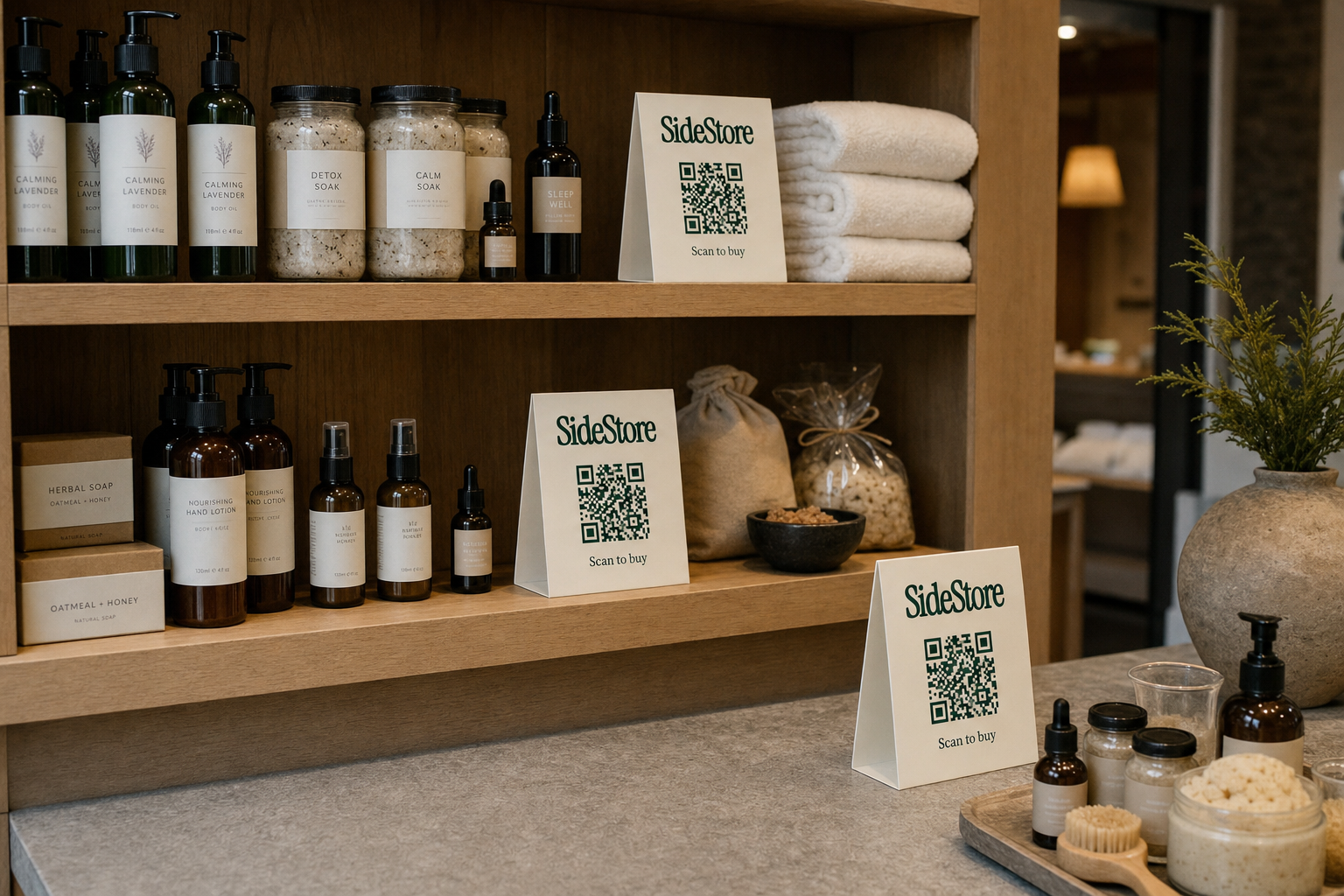
Scaling cross-selling across locations means replicating a proven pairing in multiple merchant spaces, then using live stock tracking and placement attribution to monitor which locations perform best. Many makers start with one strong pairing in one host venue; the data from that placement becomes the brief for the next.
Here's a concrete three-step scaling process:
Step 1: Confirm the pairing works in a single location. Run your cross-selling pair in one merchant space for four to six weeks. Use the placement attribution data from your Retail Widget to compare sell-through on paired products versus your previous single-product placement. A meaningful lift in basket size or sell-through rate confirms the pairing is worth scaling.
Step 2: Replicate the shelf logic across new placements. When you approach a second or third merchant, bring a brief that describes the pairing, the shelf arrangement, and the suggested use card. Build a distributed consignment network by placing the same proven pair in host venues with comparable customer profiles. A cafe audience and a boutique audience may respond differently to the same pairing; track both.
Step 3: Use live stock tracking to manage replenishment across locations. Live stock tracking in the Retail Widget tells you when either product in a pair is running low at a specific location. If the candle holder is out of stock, the candle cross-sell stops working. Set up replenishment alerts so both products in a pairing are restocked together. You can review live inventory tracking principles and organise your placement inventory by location to avoid the common problem of a half-paired shelf.
Cross-Selling on Consignment: How the Retail Widget Supports Multi-Product Placements
The Retail Widget is the interface that lets you place and manage products on consignment across multiple merchant spaces. It supports cross-selling directly because it's built to handle multi-product placements, not just single items.
When you set up a cross-selling pair using the Retail Widget, each product in the placement gets its own stock tracking, its own placement attribution, and its own contribution to the automatic split settlement. The host merchant earns their agreed share from each sale. You receive your share. The split payouts happen without manual reconciliation.
The scan-to-pay QR checkout is one function of the Retail Widget. A merchant can display a single QR card for all products in a placement, or you can attach individual cards to each product. Either way, a customer can scan and purchase without staff involvement, which matters in host venues where the merchant is focused on their core business.
This model gives you an alternative to pop-up retail with far less operational overhead. You place a proven product pair on consignment, the Retail Widget handles the mechanics of checkout and settlement, and you track performance from your dashboard. When placing handmade products in boutiques, that visibility across multiple placements lets you adjust pairings based on real sell-through data, not guesswork.
Frequently Asked Questions About Cross-Selling
What does cross-selling mean? Cross-selling is the practice of presenting a customer with a product that complements what they're already purchasing or considering. In physical retail, it typically means placing related products together on a shelf so the customer sees and considers both. The goal is to increase the total value of a single customer's visit without requiring a separate sales conversation.
How does cross-selling differ from upselling? Cross-selling adds a different, complementary product to the purchase. Upselling encourages the customer to choose a higher-value version of the same product. They're related but distinct tactics. Treating them as identical leads to shelf setups that try to do two things at once and end up doing neither well.
What are examples of cross-selling in practice? For makers in physical retail: a candle placed beside a ceramic holder, an art print beside a matching greeting card, handmade soap beside a linen travel pouch, or jewelry beside a branded polishing cloth. The pairing should be obvious to the customer without explanation.
How is cross-selling used in banking? In banking, cross-selling typically means offering an additional product such as a savings account or credit card to an existing account holder. This is relevant to financial services but out of scope for this article, which addresses physical retail for independent makers.
How is cross-selling used in insurance? In insurance, cross-selling means offering a customer a second type of cover alongside what they already hold, for example home insurance to someone with car insurance. This is a different context and out of scope here.
What strategies work for cross-selling in physical retail? The four that consistently work for makers: shelf proximity pairing, a suggested use card, a bundle price point, and grouped placement via the Retail Widget. Each removes friction between a customer seeing two products and buying both. For purchasing inventory for a boutique or managing buying inventory for an online boutique, understanding which pairings work informs your restocking decisions.
What tools or platforms enable cross-selling for makers? SideStore's Retail Widget is the most relevant tool for makers placing products on consignment. It's the interface that manages consignment placements end to end: checkout, live stock tracking, placement attribution, and automatic split payouts. The scan-to-pay QR checkout is one function of the Retail Widget, not the whole product. It lets a customer purchase a cross-selling pair at a merchant location without staff involvement.
What are the steps in the selling process for makers using cross-selling? The core steps: identify a complementary pairing from your existing range, test it in one merchant location on consignment, track sell-through using placement attribution, and replicate the proven pairing in additional locations. Each step is observable and adjustable.
How do you identify cross-selling opportunities? Start by grouping your products by use occasion. Then ask what a customer needs alongside each product to use it well, store it, or gift it. That adjacent need is your cross-selling slot. Test your first pairing in one placement before committing to it across your full network.
What is another term for cross-selling? Cross-selling is sometimes called "complementary selling" or "add-on selling" in retail contexts. The spelling "cross selling" (without a hyphen) and "cross-selling" (with a hyphen) refer to the same practice. Both are correct; the hyphenated form appears more commonly in formal retail writing.
Start With One Pairing, in One Merchant Space
The place to start is a single complementary pairing placed in one merchant space on consignment. Pick the two products from your range that share the most obvious use occasion, propose them as a grouped placement to a local host, and track the result over four to six weeks.
From there, you have real data. If the pairing sells well, you have the brief for your next placement. If one product moves faster than the other, you know which is the lead item and which is the companion. That knowledge shapes every subsequent decision in your distributed consignment network.
You don't need a store of your own to run a cross-selling strategy. You need a proven pairing, a willing merchant, and a Retail Widget that tracks each placement and settles each sale automatically.
For context on what a host location can realistically earn from carrying your products, see what a coffee shop can realistically earn from a consignment placement and real margins in coffee shop retail. Understanding the host's economics makes you a more effective partner when you propose the placement.