Faire vs Consignment: Which Is the Better First Step for Independent Makers?
Faire wholesale vs consignment: a plain comparison of fees, inventory risk, and cash flow to help independent makers choose the right first step into physical retail.
Faire is a wholesale marketplace that connects independent brands with retail buyers, requiring makers to sell and ship inventory upfront before getting paid. If you are deciding between Faire wholesale and consignment, the right answer depends almost entirely on your stage: how much sell-through data you have, how much working capital you can commit, and how much inventory risk you can absorb.
Getting into physical retail without an established brand is genuinely hard. Retail buyers want proof a product sells. Faire gives you reach, but it asks for inventory commitment first. Consignment inverts that logic: you place products into a space, and you get paid when they sell, with no upfront cost to the host and no bulk order to fulfil on day one.
This article covers how both models work, what each costs in fees and risk, and how to read the signals that tell you which to pursue first. If you want the foundational comparison, the full consignment vs wholesale breakdown covers the structural differences in depth. For makers who have never placed a product in a physical space before, selling through someone else's store is a useful starting point.
What Is Faire Wholesale and How Does It Operate?
Faire is a legitimate, online-only wholesale marketplace, not a general retail directory or a drop-ship platform. Retailers browse and place orders with independent brands; makers fulfil those orders from their own stock and get paid after a short net-payment period, minus Faire's commission.
How Faire operates in practice: You apply as a brand, build a product catalogue, set a wholesale price (typically around half your retail price), and list minimum order quantities. Retailers discover your brand, place orders, and Faire handles payment processing and dispute management. Faire reportedly takes a commission on sales, though the exact rate is subject to change and varies by account type, so check their current terms directly before listing.
On geographic availability: Faire operates across multiple markets including the US, Canada, UK, and much of Europe. It does not operate differently by country in terms of its core mechanics; catalogue visibility and shipping logistics will vary, but the platform model is the same.
On legitimacy: Faire is a well-established, venture-backed platform used by tens of thousands of independent brands globally. It is not a scam. The more practical question is whether its model suits your stage.
On first-order discounts: Faire does offer new retail buyers incentives on their first order, typically a credit or free-shipping arrangement. The specifics change, so verify on the platform.
On customer support: Faire provides support through an online Help Centre and ticketing system, not a public phone number.
How to list: Apply via Faire's website, build your brand profile, set wholesale pricing and minimums, and submit for review. It helps to have professional product photography and a clear line sheet for wholesale ready before you apply.
The structural tension is this: once a retailer places a Faire order, you pack and ship real inventory. If the product sits and the retailer returns unsold stock, you absorb it. That is the inventory risk the wholesale vs consignment comparison resolves.
What Is Consignment and How Is It Different?
Consignment means you place your products in a merchant space, and you get paid when those products sell. No upfront payment from the host, no bulk order to fulfil, and no inventory risk for the merchant. If the product does not sell, it comes back to you, unsold but not written off as a loss on someone else's terms.
Consignment can feel informal to makers who have not structured it properly. Without clear terms, tracking, and an agreed split, it is easy for stock to go unaccounted for. That concern is real, and it is worth taking seriously before you sign any agreement. Resources on what percentage consignment shops take, what a fair consignment percentage looks like, and consignment stock terms and conditions will help you go in informed.
With the right infrastructure, though, consignment is a professional, fully trackable distribution model. SideStore's Retail Widget is built exactly for this. It is the interface that places and manages a product on consignment across multiple merchant spaces: it handles checkout (including a scan-to-pay QR that customers use in-store), live stock tracking, placement attribution, and automatic split payouts between maker and host. The QR checkout is one function of a broader consignment-management system, not the whole product.
The key difference from Faire wholesale: you are not selling to a buyer who now owns the inventory. Your stock remains yours until a customer buys it. The host earns a split of each sale for providing the shelf space. The maker gets the remainder, automatically.
That structure makes consignment genuinely accessible to makers at any volume, without needing wholesale minimums, an established buyer relationship, or working capital to fulfil a purchase order.
Faire Wholesale vs Consignment: Side-by-Side
The clearest way to choose between these two models is to compare them on the dimensions that actually affect a maker's cash flow and risk. Here is how they stack up.
| Dimension | Faire Wholesale | Consignment (SideStore) |
|---|---|---|
| Inventory risk | Maker ships stock upfront; risk of return | Maker places stock; unsold stock returned, no retailer owns it |
| Cash flow timing | Paid after net-payment period (varies) | Paid on each sale, automatically |
| Who controls the shelf | Retailer, once they receive stock | Maker retains ownership throughout |
| Barrier to entry | Application, wholesale pricing, minimum quantities | Agreement with a merchant, product placed in space |
| Distribution reach | Large network of retail buyers on one platform | As many spaces as you place in; grows incrementally |
| Fees and commission | Platform commission (approximate; varies by account) | Split with host (varies by agreement, typically 25-40%) |
| Returns and unsold stock | Retailer may return; maker absorbs returned inventory | Stock returns to maker; no write-off, no retailer dispute |
| Best suited for | Makers with sell-through data, volume capacity, working capital | Makers validating a product, early-stage, low working capital |
The table shows that Faire and consignment are not competing for the same maker. They suit different stages. Fare wholesale rewards scale; consignment enables entry. For the full structural breakdown, the full consignment vs wholesale breakdown goes deeper on the mechanics.
When Faire Wholesale Makes Sense for a Maker
Faire wholesale makes most sense once you already have evidence your product sells and the production capacity to fulfil orders at volume. If you meet those conditions, Faire gives you access to a large, qualified network of retail buyers without the cost of a sales rep.
The specific profile Faire suits: you have sold at markets, through your own online store, or through a handful of local retailers, and you have repeat sell-through data to show. Your unit economics work at wholesale pricing (roughly half retail, after Faire's commission and your cost of goods). You have working capital to pack and ship inventory before payment clears. And you have the production capacity to restock when orders come in.
The common mistake is applying to Faire without understanding that it is a wholesale marketplace with real inventory risk. It is not a consignment platform, and it is not a drop-ship arrangement. When a retailer places an order, you ship real stock. If it does not sell through, you may get it back. That is the trade-off, and it is a reasonable one when your margin and volume support it.
A clean line sheet for wholesale buyers and a clear sense of how to approach a local shop about stocking your products first will help you arrive at Faire with proof points, not just a product.
When Consignment Is the Better First Step
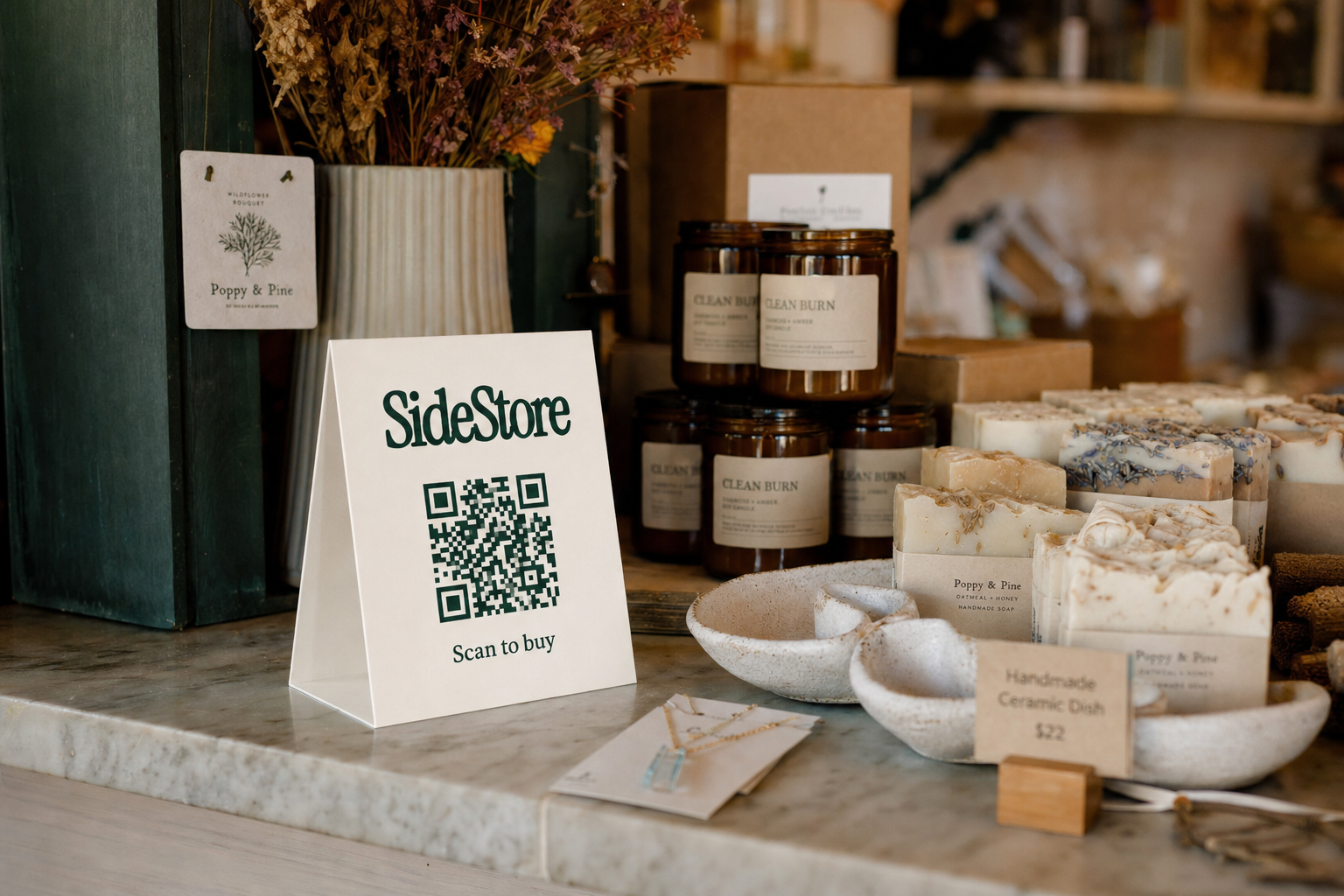
Consignment is the better first step when you are early-stage, have not yet proved sell-through in a physical space, and cannot absorb the inventory risk that Faire wholesale requires. If physical retail has felt closed to you because you do not have buyer relationships or bulk-order capacity, consignment opens the door without those prerequisites.
The specific maker profile consignment suits: you are making in small batches, you are testing whether a product connects with in-person shoppers, and you want distribution without fixed premises costs or wholesale minimums. You might be placing art prints, handmade jewellery, ceramics, clothing, body care, or any physical product that benefits from being discovered in a curated space.
SideStore's Retail Widget handles the operational complexity. You agree a split with a merchant, the host displays your product, and the Widget manages checkout (including the scan-to-pay QR for in-store purchases), live stock levels, placement attribution, and automatic split payouts. You do not need to chase payments or manually track what sold where. Many makers report building their first real retail presence through consignment placements in cafes, boutiques, and salons before they had a single wholesale buyer.
The validation loop matters: consignment generates sell-through data. That data is exactly what a Faire wholesale application, or any wholesale buyer conversation, benefits from. Consignment is not a lesser model; it is frequently the smarter starting point.
Practical starting points: placing art prints in cafes, selling handmade jewelry in boutiques, placing products in a salon, and understanding how shared retail networks work.
How to Decide: A Stage-by-Stage Framework
Choose based on where you are right now. Neither model is permanently better; they serve different stages of the same distribution journey, and a maker can run both simultaneously once the right conditions are met.
Stage 1: Validation (consignment first)
- Trigger conditions: no sell-through data in physical retail, small-batch production, limited working capital
- Action: place products on consignment in two to five merchant spaces using SideStore's Retail Widget
- Target: establish a sell-through rate over eight to twelve weeks
Stage 2: Proof of concept (consignment + direct wholesale)
- Trigger conditions: consistent sell-through above roughly 60-70% per placement cycle, reorder requests from hosts, production capacity above minimum viable quantities
- Action: approach local retailers directly about wholesale terms; begin preparing a line sheet and Faire brand profile
- Consider: pop-up stores as an alternative placement to build broader data before committing to wholesale
Stage 3: Scale (Faire wholesale + consignment in parallel)
- Trigger conditions: working capital available to fulfil purchase orders, documented sell-through, margin viable at wholesale pricing
- Action: list on Faire; keep consignment placements running in spaces where the audience is high-quality but order volume is low
- Note: selling clothing on consignment and selling furniture on consignment show how makers in specific categories maintain consignment alongside wholesale long-term
Consignment and wholesale are not an either/or decision at scale. Many makers run placements in independent merchant spaces on consignment while simultaneously selling to larger retailers via Faire.
Frequently Asked Questions
These are the questions makers and buyers ask most often about Faire wholesale and consignment, answered plainly.
What is Faire wholesale and how does it operate? Faire is an online wholesale marketplace where independent brands list products at wholesale prices and retail buyers place orders. Makers fulfil orders from their own stock, Faire processes payment, and the maker receives payment after a net-payment period minus Faire's commission. It operates the same way across all supported markets; geography affects shipping logistics, not the platform model.
What is Faire's customer support phone number? Faire does not list a public customer support phone number. Support is handled through their online Help Centre and a ticket or chat system. If you need assistance, start at Faire's Help Centre on their website.
Does Faire offer a discount on first orders? Faire has historically offered new retail buyers a credit or free-shipping incentive on their first order placed on the platform. The exact offer changes over time, so check Faire's current promotions directly before making assumptions about the discount structure.
Where are the largest wholesale markets located? Faire is an online-only platform; it does not have a physical location. Physical wholesale markets (trade shows, gift marts, apparel markets) are a separate category and operate in cities like Las Vegas, Atlanta, New York, and London. These are not the same as Faire, which runs entirely through its website.
How do sellers list products on Faire? Apply as a brand through Faire's website, build your product catalogue with wholesale pricing and minimum order quantities, add professional photography, and submit for review. Having a clear line sheet for wholesale buyers prepared before you apply will strengthen your application.
Is it better to sell wholesale or retail? It depends on your margin, volume, and stage. Wholesale gives you distribution reach and larger order sizes, but at a lower unit price and with inventory risk. Retail (direct or consignment) gives you full margin per unit and no inventory transferred to a buyer. Many independent makers find that consignment generates better per-unit returns than wholesale at early volumes, while wholesale becomes more efficient at scale. See what percentage consignment shops take by category and consignment contracts for artists for more detail on the consignment side of that trade-off.
The Practical First Step
If you are early-stage, start with consignment. Place your products in two or three merchant spaces, run the numbers, and let sell-through data tell you whether and when to move toward wholesale. That evidence makes every conversation with a retail buyer, including a Faire application, more credible.
Once you are ready to approach a local shop about stocking your products or to explore whether a coffee shop counts as a retail host, SideStore's Retail Widget handles the consignment mechanics from placement to payout. Start there.