Social Selling for Makers: How to Use Online Audiences to Drive In-Store Consignment Sales
Social selling is using social media to build relationships, create demand, and point buyers toward a purchase, without relying on paid ads or opening your own storefront. For independent makers, it is one of the most practical ways to generate consistent sales across multiple consignment placements without the overhead of running retail space yourself.
If you make physical products and want people to buy them, social selling is your distribution engine. You build an audience around your craft, warm that audience with authentic content, and then point them to a place where your product already sits on a shelf waiting. That place can be a boutique, a cafe, a hotel lobby, anywhere you have a live consignment placement.
Here is the key distinction: social selling is not about selling directly through Instagram checkout or a Shopify link. It is about selling on consignment through someone else's space and using your online presence to drive demand there. That is selling through someone else's store, and social selling is what makes that model scale.
What Does Social Selling Mean (and What It Is Not)
Social selling is the use of social media channels to find, connect with, and nurture potential buyers over time, turning followers into customers through trust rather than interruption. It is relationship-driven, content-led, and measured in purchase intent, not clicks or impressions.
Most makers confuse social selling with social media marketing, or worse, with paid social advertising. These are different things entirely.
- Social media marketing broadcasts. You publish content to build brand awareness, grow followers, and stay top-of-mind. One-to-many.
- Social media advertising buys reach. You pay for impressions or clicks from people who have not chosen to follow you.
- Social selling is relational. You engage directly with individuals, respond to comments and messages, share process and story content that signals expertise, and guide interested buyers toward a purchase decision.
A ceramicist who replies to every comment about their glazing technique, shares behind-the-scenes kiln videos, and then mentions that their mugs are stocked at a neighbourhood cafe is doing social selling. A ceramicist who runs a boosted post to 10,000 cold accounts is running social advertising. Both have their place. They are not the same.
What about the Social Selling Index? LinkedIn has a proprietary score called the Social Selling Index (SSI), calculated out of 100, that measures how effectively you build your brand, find the right people, engage with insights, and build relationships on that platform. It is visible in your LinkedIn Sales Navigator or profile dashboard. The SSI is LinkedIn-specific. It does not exist on Instagram, TikTok, or Pinterest, and it is designed primarily for B2B sales professionals, not independent makers selling physical goods. If LinkedIn is part of your channel mix, understanding it is useful. But it is not a universal measure of social selling performance.
For makers building shared retail networks and local demand, the relevant signal is simpler: are people asking where they can buy your product?
What a Social Selling Strategy Looks Like for an Independent Maker
A social selling strategy for a maker has three phases: build an audience worth activating, activate that audience toward a placement, and close the loop so the cycle repeats. Each phase is distinct and requires different content and actions.
Phase 1: Build
Before you can direct anyone anywhere, you need an audience that trusts you. Post content that demonstrates your craft, your values, and your process consistently enough that people form a real picture of who you are and what you make. Follower count does not matter. A tightly engaged audience of 400 people who genuinely follow your work is more useful than 8,000 passive accounts.
Focus on:
- Process content (how you make things, materials you use, decisions you make)
- Behind-the-scenes moments (packaging, studio, preparation)
- Stories that explain the why behind the product
Engagement is the metric that matters. Replies, saves, shares, and direct messages all signal an audience warming toward a purchase.
Phase 2: Activate
Once you have a live consignment placement, your social content shifts to activation. Tell your audience where they can find your work in the real world, specifically, which shop, cafe, or boutique carries it and what they will find there.
Timing is critical. The SideStore Retail Widget includes live stock tracking, so you know exactly how many units are available at each placement at any moment. Use that data to create urgency-led content: "Five of these left at [stockist name], no restock until next month." That is honest, specific, and actionable. It is also the kind of post that drives someone from passive interest to walking through a door.
Before this phase, you need placements confirmed. Reading up on approaching a local shop about stocking your products and understanding consignment stock terms and conditions will save you time and awkward conversations.
Phase 3: Close the Loop
After a sale happens at a placement, bring it back to your social channels. Thank the stockist publicly. Share photos of your product in situ. Ask buyers to tag the location. This creates a visible, recurring signal that your work moves, which builds credibility with both your audience and any future stockists you approach.
The three phases are not a one-time campaign. They are an ongoing cycle: new placement, new activation content, new social proof.
Which Social Selling Platforms Work Best for Makers Selling Physical Products
For makers selling physical goods through consignment, platform choice comes down to where your buyers spend time and what content format shows your work honestly. Visual platforms consistently outperform text-heavy ones for handmade and artisan products.
| Platform | Best for | Content format | Audience intent | Consignment activation tactic |
|---|---|---|---|---|
| Visual makers: ceramics, jewellery, textiles, prints | Photo, Reels, Stories | Discovery and aspiration | Story posts with stockist location tag and product name | |
| TikTok | Process-led makers; reaching younger buyers | Short video, behind-the-scenes | Entertainment, then purchase | "Where to find it" video naming the physical stockist |
| Home goods, art prints, lifestyle products | Static images, boards | Active purchase research | Pin linked to stockist page or SideStore placement | |
| Local community reach; older demographic | Posts, groups, Marketplace | Local buying intent | Community group post announcing local stockist | |
| B2B makers; wholesale or corporate gift angle | Articles, posts | Professional and B2B | Stockist announcement framed as a trade partnership |
A note on LinkedIn's SSI: LinkedIn's Social Selling Index is calculated from four pillars, establishing your professional brand, finding the right people, engaging with insights, and building relationships. It is scored out of 100 and visible in your LinkedIn profile or Sales Navigator. It applies only to LinkedIn. If your buyers are consumers rather than business purchasers, LinkedIn is unlikely to be your primary channel.
For makers focused on high-footfall retail contexts, cafes, boutiques, lifestyle shops, Instagram and TikTok typically generate the most direct consignment traffic. If you sell art prints in cafes or handmade jewellery in boutiques, those two platforms should anchor your strategy.
How to Use Social Selling to Drive Foot Traffic to a Consignment Placement
Social selling drives physical sales when your online content gives people a clear, low-friction reason to visit a specific location. The mechanism is straightforward: your content creates demand, your placement fulfils it, and the Retail Widget handles everything in between.
Small followings are not a barrier. A local audience of 300 genuinely interested people can generate meaningful foot traffic to a nearby stockist. Relevance and specificity matter far more than scale.
Here is the five-step workflow:
1. Confirm and announce your placement. Once a merchant agrees to carry your products on consignment, post about it immediately. Name the location, describe the products available, and give people a reason to go. Tag the merchant's account.
2. Create content that shows the product in context. Visit the placement and photograph your products in the actual space. People respond to seeing a ceramic mug on a cafe counter far more than seeing it on a white background. Share that content across your channels and tag the location.
3. Use live stock data to post urgency content. The SideStore Retail Widget tracks live stock at each placement. When inventory drops, use that information. Post: "Only a few [product] left at [location] this week." This is honest scarcity, not manufactured pressure.
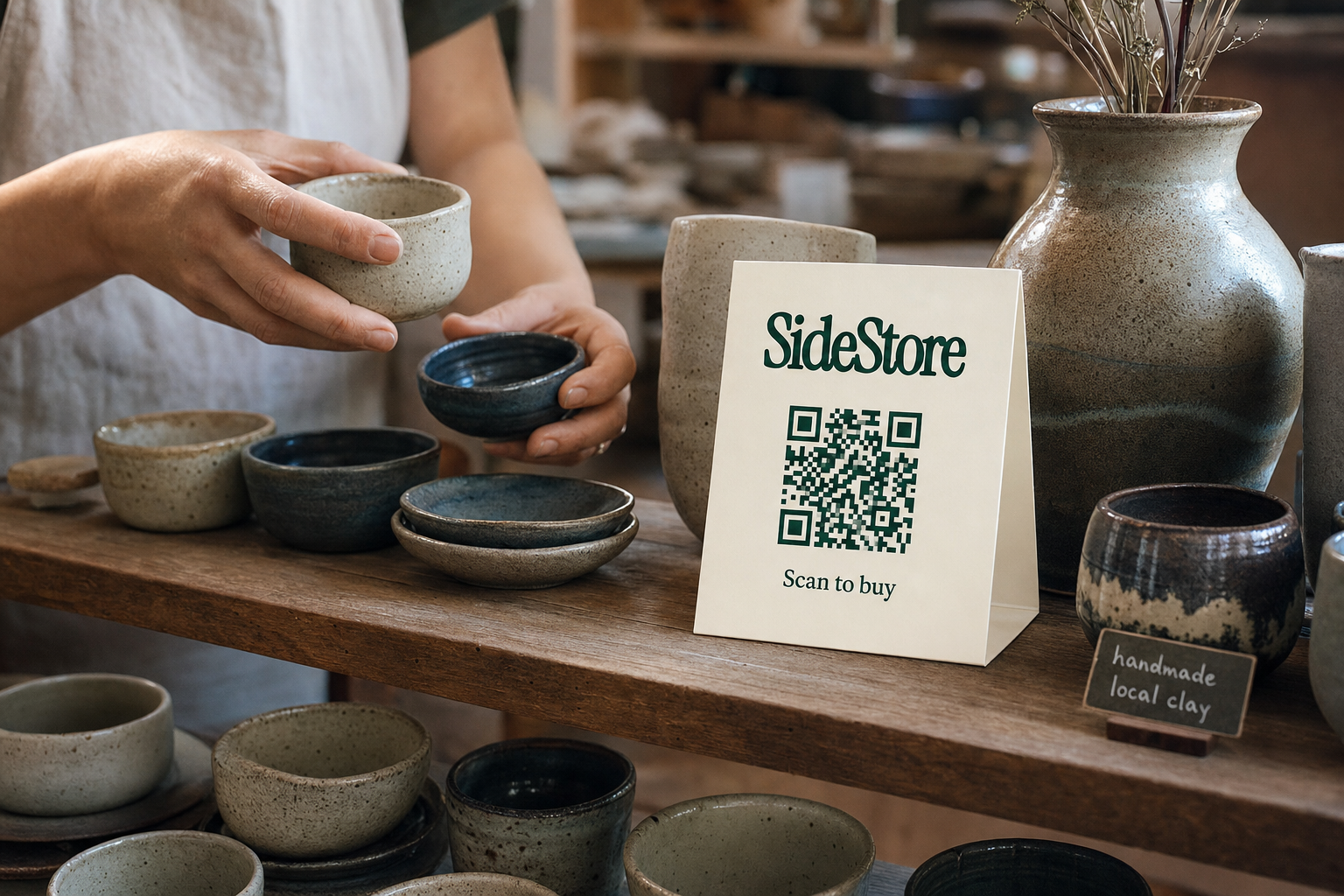
4. Make the path to purchase obvious. Include the physical address of the stockist in your bio, pinned post, or story highlight. People need to know exactly where to go before they commit to the trip. The Retail Widget also supports a scan-to-pay QR at the placement itself, so buyers who arrive can complete the purchase instantly without needing staff assistance.
5. Close the loop publicly. When stock sells through, post about it. Thank the stockist. Share any buyer responses you receive. These signals tell your wider audience that your work is genuinely in demand, and they build the case for your next placement approach.
For your first placement, setting up your first consignment arrangement and understanding what selling through someone else's store actually involves will give you a practical foundation. If you are weighing whether a consignment placement is better than a pop-up, it is worth reviewing alternatives to a pop-up store before committing time and money to either.
How to Sell Products Without a Store Using Social Selling and Consignment
Selling products without a store means combining an online audience with physical consignment placements so your products sit in real-world spaces you do not own or rent. Social selling is the demand engine; consignment is the fulfilment model.
Here is the honest comparison with other routes:
Etsy and Shopify give you an online storefront, which is excellent for reaching buyers anywhere in the world. The trade-off is visibility: you are one listing among millions, and driving traffic to your own store requires sustained SEO effort or paid advertising. Neither platform puts your product in front of someone walking past a shelf.
Market stalls offer direct in-person sales and genuine buyer feedback. The trade-off is time and energy: you are present at every sale, and each market day is an event to prepare for and attend.
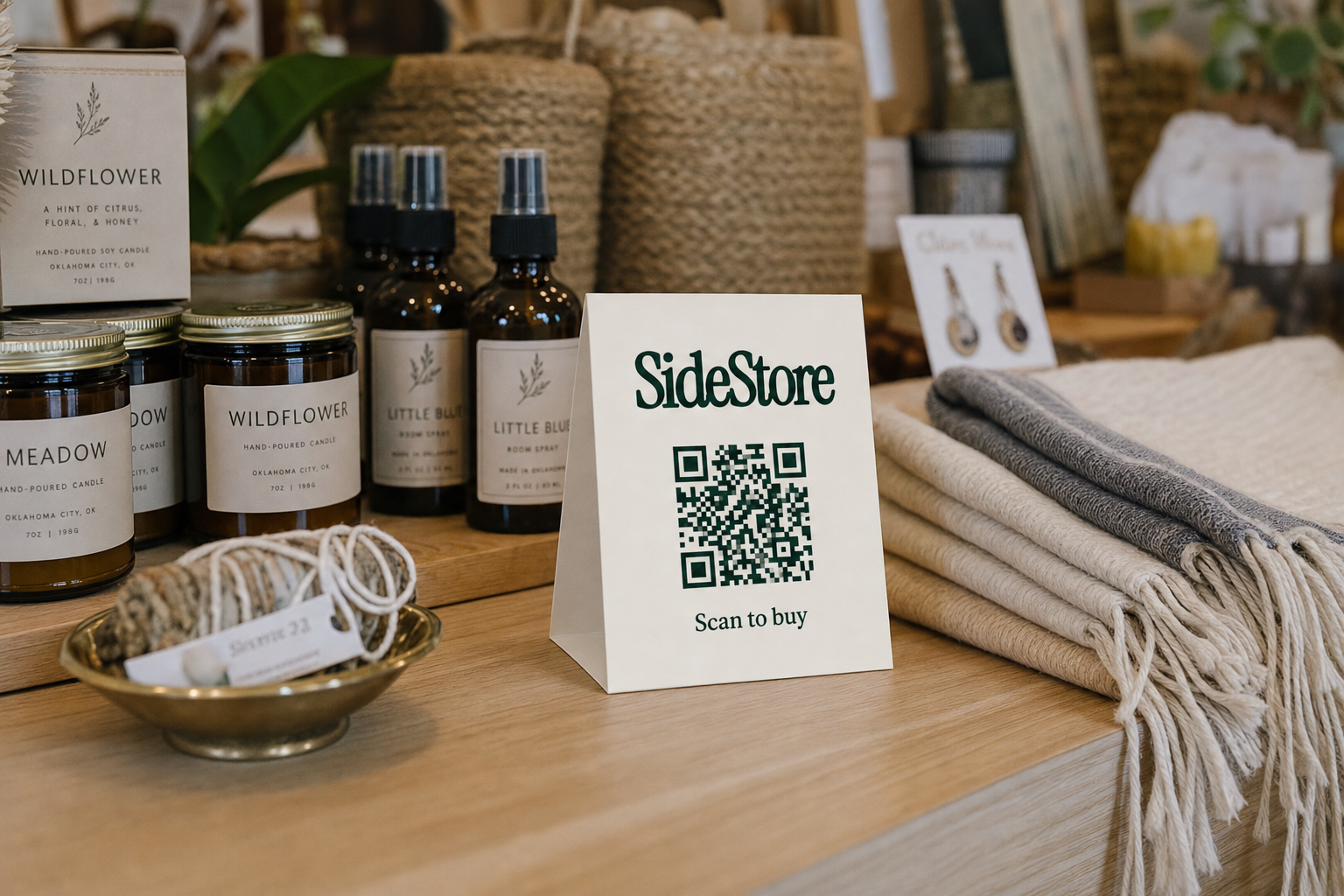
Consignment through SideStore sits in a different position. Your products are physically present in a merchant's space, a boutique, a cafe, a salon, seven days a week, without you being there. The Retail Widget handles checkout, stock tracking, and split payouts automatically. Your job is to keep your social audience informed about where to find your work.
All three routes can run simultaneously. Many makers use Etsy for international orders, market stalls for local community presence, and consignment placements for consistent daily exposure in high-foot-traffic venues. Useful reading before choosing your mix: managing boutique inventory across multiple channels, placing products in salons and beauty spaces, and understanding pop-up retail space costs and alternatives.
Social Selling: Frequently Asked Questions
The questions makers most commonly ask about social selling cluster around definitions, platform mechanics, and whether it actually works for physical products.
What does social selling mean? Social selling is using social media to build relationships with potential buyers and direct them toward a purchase through trust, content, and engagement rather than paid advertising. It is distinct from social media marketing (which focuses on reach and awareness) and from social advertising (which is paid). The goal is to turn followers into customers by being consistently useful and visible over time.
How do you sell something on social media? Post content that demonstrates the value and appeal of your product, engage directly with people who respond, and give them a clear path to buy. For makers with consignment placements, that path is a physical location: name the stockist, share the address, and use the Retail Widget's scan-to-pay QR so buyers can complete the purchase when they arrive.
What is the social selling index and how is it calculated? The Social Selling Index (SSI) is a LinkedIn-specific score, calculated out of 100, that measures four things: how well you build your professional brand, how effectively you find the right people, how often you engage with relevant insights, and how consistently you build relationships. It is not a universal metric and does not exist on Instagram, TikTok, or any platform other than LinkedIn.
How do you check your social selling index score on LinkedIn? Navigate to your LinkedIn profile and visit the Sales Navigator SSI page (linkedin.com/sales/ssi). You do not need a paid Sales Navigator subscription to view your SSI, though the full feature set requires one. The score updates daily.
What social selling platforms exist beyond LinkedIn? Instagram, TikTok, Pinterest, and Facebook all support social selling for makers of physical products. For consumer-facing goods with visual appeal, Instagram and TikTok consistently generate the strongest results. Pinterest works particularly well for products with longer purchase consideration cycles. See the platform comparison table above for maker-specific tactics on each.
What does a social selling strategy involve? Three phases: building a trusting audience through consistent process and story content; activating that audience toward a specific purchase location (in a maker's case, a consignment placement); and closing the loop by sharing social proof after sales occur. The cycle repeats with each new placement.
What is the rule of 7 in B2B? The rule of 7 is a marketing principle holding that a buyer typically needs to encounter a message or brand at least seven times before taking action. In social selling terms, it reinforces the value of consistent, repeated content rather than a single announcement post. Seven is a heuristic, not a proven threshold, but the underlying idea, that trust builds through repetition, is well supported by general sales practice.
What is the 5 5 5 rule for social media? The 5 5 5 rule is a community-building guideline: engage with 5 new accounts, interact with 5 existing connections, and leave 5 substantive comments each day. It keeps your presence active and relational without requiring heavy content production. For makers, it is a useful starting rhythm, particularly in the audience-building phase before placements are live. If you are wondering whether a venue like a coffee shop counts as a valid consignment placement, whether a coffee shop counts as a retail placement answers that directly.
Start Where You Are: Turn Your Following into Foot Traffic
The next step is simpler than it looks. Pick one channel, post about your craft consistently, and secure one consignment placement to point people toward. That is the entire model in its minimal form. Social selling generates the demand; consignment handles the fulfilment; the Retail Widget manages stock, checkout, and split payouts automatically.
You do not need a large following. You need a relevant one and a product that is physically reachable by the people who follow you. Once one placement is live and your audience knows about it, the model is repeatable. Each new stockist you add becomes another destination your content can activate.
Before you scale, it is worth organising your product inventory for multiple placements and pricing your products for consignment correctly. Both decisions are easier to get right early than to correct later.
Build a consignment network without opening a store of your own.