What Percentage Do Consignment Shops Take? a Category-by-Category Breakdown
A consignment percentage is the share of each sale that a shop keeps as commission, with the remainder paid to the maker once the item sells. Most consignment shops take between 30% and 50% of retail price, leaving makers with a payout of 50% to 70%. The exact figure depends on category, location, and the shop's cost structure. Clothing and accessories commonly land near 40/60 (shop/maker). Art and handmade goods often run 30/70 to 50/50. Furniture and vintage pieces can tip to 50/50 or beyond, reflecting floor space and handling demands.
No single percentage is universally correct. What matters is whether the split makes sense for your unit economics and the foot traffic the venue delivers. The sections below break that down category by category, so you can walk into any negotiation with real numbers and clear eyes.
How Consignment Percentage Splits Actually Work
In consignment, the maker sets the retail price, the shop sells the item and retains a pre-agreed percentage, and the maker receives the remainder. Nothing changes hands financially until a sale occurs. The shop carries no inventory cost and takes no purchase risk; you retain ownership of unsold stock.
A concrete example makes this tangible. Say you price a ceramic mug at $80 and agree to a 40/60 split (shop keeps 40%, you keep 60%). When the mug sells, the shop retains $32 and you receive $48. If the split were 50/50 instead, you would receive $40. That $8 difference per unit compounds quickly across a full placement of twenty or thirty pieces.
Consignment is structurally different from wholesale. In wholesale, the retailer buys stock outright at a discounted price, takes ownership, and sells at whatever margin they choose. You get paid immediately but lose control of retail price and accept a lower per-unit return. In consignment, you set the price, retain ownership of unsold goods, and get paid only on actual sales. The risk profile reverses: lower upfront certainty for you, but zero capital outlay for the shop.
Understanding that distinction matters before you negotiate. A shop asking for 50% consignment commission might still yield a better net return than a wholesale order at 45% of retail, because you control the retail price. Run the numbers for your own cost base before comparing the two models. The consignment vs wholesale breakdown lets you compare them side by side, and you'll want to review what a solid consignment contract should cover before you commit to any placement.
Consignment Percentage by Category: Typical Ranges at a Glance
The percentage a consignment shop takes varies significantly by product category. Here are the commonly reported ranges across most categories, based on what makers and shop operators typically negotiate in practice.
| Category | Typical Shop Commission | Typical Maker Payout | Notes |
|---|---|---|---|
| Clothing & Fashion | 35, 50% | 50, 65% | Higher in curated boutiques; lower in resale-heavy shops |
| Art & Prints | 30, 50% | 50, 70% | Galleries often sit at 50%; cafes and shops lean 30, 40% |
| Handmade / Artisan Goods | 30, 45% | 55, 70% | Lower commission common in maker markets and collectives |
| Jewellery | 40, 50% | 50, 60% | Small items with high handling frequency push rates up |
| Furniture & Vintage | 40, 60% | 40, 60% | Floor space and handling costs justify higher shop cuts |
| Books & Media | 30, 40% | 60, 70% | Low margin items; shops often take less to make economics work |
| Homewares & Gifts | 35, 50% | 50, 65% | Broad range; gift shops trend toward 40, 50% commission |
| Children's Items | 30, 50% | 50, 70% | Resale children's shops vary widely; safety compliance adds complexity |
Fashion and clothing tend to cluster around 40/60 in independent boutiques, though shops with a strong curatorial identity or high-foot-traffic location sometimes push toward 50%. The driver is turnover: fashion moves quickly, but unsold seasonal stock can sit for months. If you're navigating those terms, the guide to selling clothing on consignment walks through what to expect and where to push back.
Art, prints, and handmade goods see the widest variation. Established galleries commonly take 50%, a long-standing industry norm tied to curation, framing, and clientele development. Cafes, hotel lobbies, and independent boutiques operating on a lighter model often accept 30% to 40%, which is why placement in high-footfall non-gallery spaces can yield a better net return for emerging artists. Selling art prints in local shops explores where those placements work best.
Furniture and vintage carry the highest shop commissions for a straightforward reason: a large piece occupies significant floor space for an unpredictable period, requires handling on intake and sale, and may need staging or cleaning. A 50/50 split is common; some shops charge 55% or more for oversized pieces. If you are placing furniture on consignment, floor space cost is the variable to negotiate around. Selling furniture on consignment covers those specifics in depth.
What Actually Determines the Percentage a Shop Will Offer
Five variables move the consignment split more than any other factor. Understanding them lets you walk into a negotiation with a clear view of the shop's actual costs and where flexibility genuinely exists.
1. Overhead and rent. A shop paying high commercial rent in a city centre needs its commission to cover more fixed cost per square metre. All else equal, expect higher rates from high-street locations and lower rates from community markets, shared spaces, or lower-rent venues.
2. Turnover speed. Items that sell within days create less operational burden than pieces that sit for months. Shops generally reward fast-moving categories with lower commission expectations, because their per-item carrying cost is low. Slow-moving, space-heavy items attract higher rates.
3. Handling effort. Jewellery requires display cases, individual tagging, and attentive staff time. Clothing requires steaming, hanging, and size sorting. Items that arrive ready to display and sell themselves with minimal staff involvement are strong candidates for a lower rate negotiation.
4. Exclusivity. If a shop is your only local stockist, or requests category exclusivity, that is leverage you can trade. Offer exclusivity in exchange for a more favourable split or a guaranteed minimum display period.
5. Maker track record. A maker with documented sales history, even from other venues, is a lower-risk proposition for a new host. Bring data: units sold, average price point, sell-through rate. That evidence shifts the conversation from speculation to evidence-based negotiation.
One common misconception is that 50/50 is the "standard" and anything else is unusual. It is not. Fifty-fifty is one common outcome, not a floor or ceiling. Many shops work at 30/70; some charge 60/40 for categories with high overhead. The split is always negotiable.
High-footfall venues like hotels and cafes can deliver better net outcomes at equivalent or even lower commission rates, simply because foot traffic does the work. Placing products in hotels, selling art prints in cafes, or knowing how to approach a local shop with the right pitch are all worth investigating alongside the percentage itself.
Model Your Own Margin Before You Agree to a Split
Before you accept any consignment percentage, calculate your break-even commission rate: the maximum shop cut at which a sale still leaves you in profit. Agreeing to a split without that figure is accepting risk you have not measured.
Here is a four-step model to apply to any product before any negotiation.
Step 1: Calculate your cost of goods (COGS). Add up all direct costs to produce one unit: materials, labour (at a rate you would actually accept), packaging, and any per-unit shipping cost to deliver to the venue. Say your ceramic bowl costs $22 to produce all-in.
Step 2: Set your target retail price. Price the item at what it should sell for in the venue, not what you need to cover costs alone. Say you set retail at $75.
Step 3: Calculate your gross margin at different split scenarios. At a 40/60 split, you receive $45 on a $75 sale. Subtract your $22 COGS and you net $23 per unit before any other expenses. At a 50/50 split, you receive $37.50, netting $15.50. At 60/40 (you keep 40%), you receive $30, netting $8.
Step 4: Identify your break-even commission rate. Work backwards: if your COGS is $22 and your retail price is $75, the minimum you can accept is $22, meaning the shop can take at most $53, or roughly 70%, a number no mainstream shop would ask for. Your real floor is where the net margin drops below what makes the placement worth your time. Most makers set a target net of at least 25% to 35% of retail before considering a placement viable.
The no-upfront-cost advantage of consignment is real and worth factoring in. You are not tying capital to stock the shop holds. But unsold stock returned after months has a cost too, time, transport, and opportunity. Model sell-through assumptions honestly.
If you are also considering wholesale, comparing consignment margin to wholesale pricing and a direct consignment vs wholesale margin comparison give you the full picture.
Which Products Are Poor Candidates for Consignment
Not every product suits consignment, and placing the wrong items can cost you more in time and unsold stock than the channel ever returns. Recognising poor candidates before you commit saves both parties frustration.
1. Perishable or time-sensitive goods. Food, candles with short burn-dates, and seasonal items that expire or become unsaleable rapidly are high-risk on consignment. If the item does not sell before it becomes unfit for sale, you absorb the loss entirely.
2. Very low-price-point items. A product retailing at $5 or $8 leaves so little margin after commission that the per-unit return rarely justifies the handling, delivery, and reconciliation effort. Consignment economics work better with higher ticket items where the commission percentage leaves a meaningful dollar amount for you.
3. Fragile or high-maintenance display items. Items that break easily in a retail environment, or that require specialised display equipment the shop does not have, create operational friction that damages your relationship with the host and can result in stock losses you cannot recover.
4. Products requiring specialist knowledge to sell. If a staff member needs substantial training to explain or demonstrate your product, most consignment hosts will not invest that time. The item will sit passively and underperform regardless of the split agreed.
5. Highly customised or bespoke items. One-of-a-kind commissions and made-to-order pieces generally do not belong in a consignment setting where the customer expects to take the item home immediately. Bespoke work suits direct sales channels better.
Consignment works best for well-priced, self-explanatory, durable products with broad appeal at the venue's customer demographic. How to sell through someone else's store covers your full range of channel options if consignment alone does not fit your mix.
How Consignment Management Tools Affect Your Net Payout
Manual consignment creates friction that directly affects what you actually receive. Delayed reconciliation, no visibility into current stock levels, and manual payment runs are all costs that rarely appear in the headline split percentage but erode your real return.
In a traditional arrangement, a shop may tally sales at the end of the month, send a handwritten or spreadsheet-based report, and settle payment weeks after a sale occurs. You have no way to know in real time whether stock has sold, run low, or been misplaced. That information gap makes it hard to replenish efficiently or to know when a placement has gone stale.
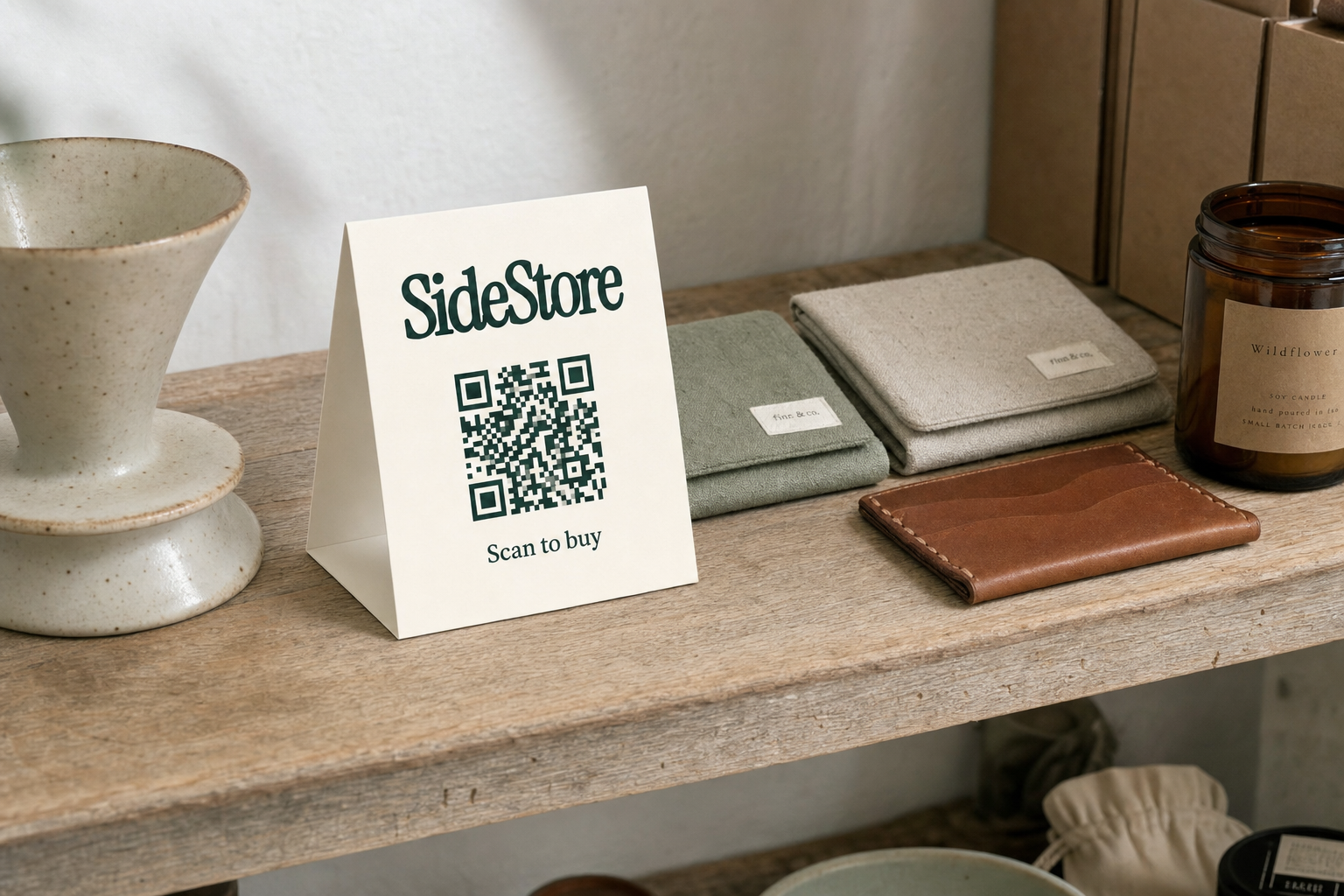
Digital consignment management tools change this in practical ways. The SideStore Retail Widget handles the operational layer of a placement end to end: live stock tracking so you know current inventory at each location, placement attribution so you can see which venue is performing, scan-to-pay checkout via a printable QR code card that you can attach to individual products or a merchant can display for the full placement, and automatic split payouts that settle each party's share without manual reconciliation.
The QR checkout is one function of the Retail Widget. The Retail Widget itself is the interface for placing and managing a consignment product from agreement through to settled payout. What that means in practice is that the split you negotiate stays clean: there is no delay, no disputed calculation, and no reconciliation burden eating into either party's time.
For a broader look at tools that support this model, consignment inventory software and shared retail models for independent makers are worth exploring alongside this article.
Frequently Asked Questions
What percentage do consignment shops typically take from sales?
Most consignment shops take between 30% and 50% of the retail sale price, leaving the maker with 50% to 70%. The exact figure varies by category, location, and the shop's overhead. Furniture and vintage pieces tend toward the higher end; art prints placed in cafes or non-gallery spaces often sit at the lower end. Commission rates are always negotiable and should be benchmarked against your unit economics before you agree.
What is considered a reasonable consignment percentage?
A reasonable consignment percentage is one where you retain enough margin to cover production costs and earn a return worth the placement effort. For most product categories, a shop commission of 30% to 40% is considered maker-friendly; 50% is common and accepted in many sectors; above 50% warrants scrutiny unless the venue offers exceptional foot traffic or curation value. How shared retail networks support local economies covers what fair terms look like across different formats and is worth reading alongside this one.
Which consignment stores offer the highest payout rates?
Makers commonly report the best payout rates from cafes, hotel lobbies, community markets, and maker collectives, where overheads are shared and the host's primary income comes from their core business rather than retail commission. Traditional resale consignment shops and established art galleries tend to take higher percentages. The venue type often matters more than the specific shop name.
Is consigning items better than selling them outright?
It depends on your capital position and pricing control. Consignment requires no upfront purchase from the shop, lets you set the retail price, and keeps ownership of unsold stock with you. Selling outright (wholesale) gives you immediate payment but typically at 40% to 55% of retail, and you lose control of the final price. If your margins are tight and cash flow matters, consignment's no-upfront-cost structure is a genuine advantage. If you want certainty and speed, wholesale suits better. Alternatives to renting pop-up retail space covers other distribution formats if neither model fits your situation.
What types of items should not be consigned?
Items that are perishable, very low in retail price, fragile without specialist display, highly bespoke, or require significant staff explanation to sell are generally poor consignment candidates. The strongest consignment products are durable, self-explanatory, well-priced, and appealing to the host venue's existing customer base.
What to Do Next
Now that you know the typical ranges and the variables that shift them, three concrete next actions move you forward. First, calculate your break-even commission rate for each product before approaching any venue. Second, benchmark the split you are offered against the category ranges in this article, what is a fair consignment percentage provides additional context. Third, if you are weighing consignment against wholesale, run both scenarios through the consignment vs wholesale comparison. Once your split is agreed, SideStore handles the operational layer: stock tracking, checkout, and automatic split payouts from a single placement dashboard.