Consignment Percentage Calculator: How to Work Out Your Split Before You Sign
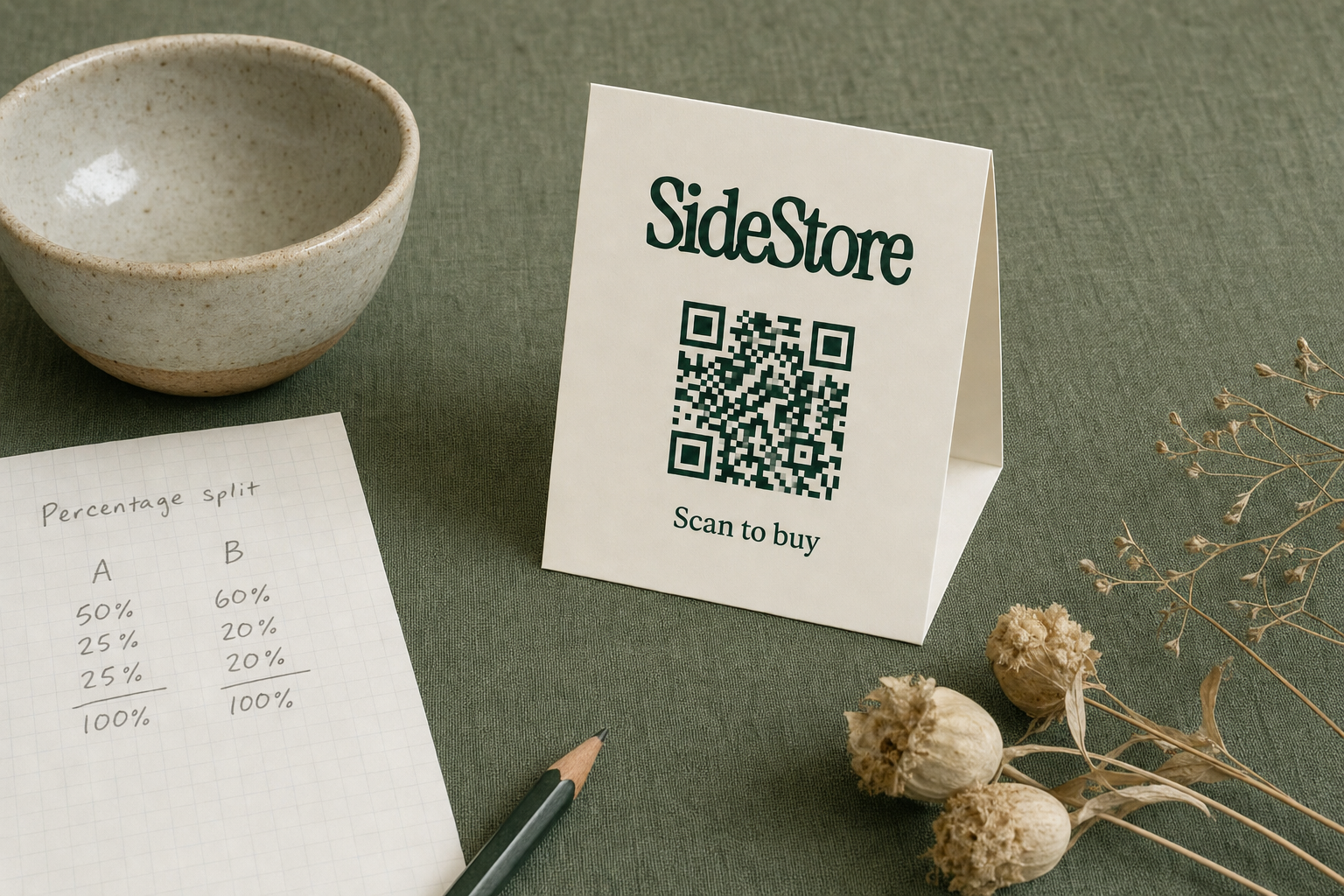
A consignment percentage is the share of a product's retail sale price that goes to you as the maker, with the remainder kept by the host merchant as their fee for providing shelf space and selling the product. Before you place a single item in any shop, you need to know your number, and you need to run it against your costs.
Most consignment disputes start the same way: a maker agrees a split verbally, never checks the maths, and discovers at payout that the percentage doesn't cover production costs. A consignment percentage calculator doesn't have to be software. It can be a formula you run on your phone before you sign anything.
The standard maker share sits between 50% and 70% depending on product category, though ranges vary by industry and individual negotiation. What counts as a fair consignment percentage and consignment vs wholesale are related questions worth understanding before you commit to either model.
This article gives you the exact formulas, a category-by-category comparison table, and a three-factor fairness test you can apply to any proposed split.
What Does a Consignment Percentage Actually Mean?
A consignment percentage tells you how the proceeds of a sale are divided between you as the maker and the merchant who sold it. It is not a commission charged on top of a price. It is a division of the price itself.
That distinction matters more than it sounds. A commission percentage is typically added onto a base amount: a 20% sales commission on a £100 deal means the salesperson earns £20 on top of their base. A consignment percentage works differently. You set a retail price, that price is what the buyer pays, and the consignment split determines who gets which portion of it. Nothing is added. Everything is divided.
Take a £40 product. On a 60/40 split (60% to you, 40% to the host), you receive £24 and the host keeps £16. On a 50/50 split, both parties receive £20. Neither number is "wrong", the question is which one still makes sense after you subtract your cost of goods.
Many makers conflate these two calculations and end up pricing incorrectly. If you treat your consignment percentage like a commission and try to build it on top of a wholesale price, your retail price will almost certainly be too high for the placement to work, or too low for you to profit.
For a detailed breakdown of what percentage consignment shops take by type of retailer, and for a template that locks the agreed split in writing, see the consignment agreement for artists guide.
How to Calculate Your Consignment Percentage Split
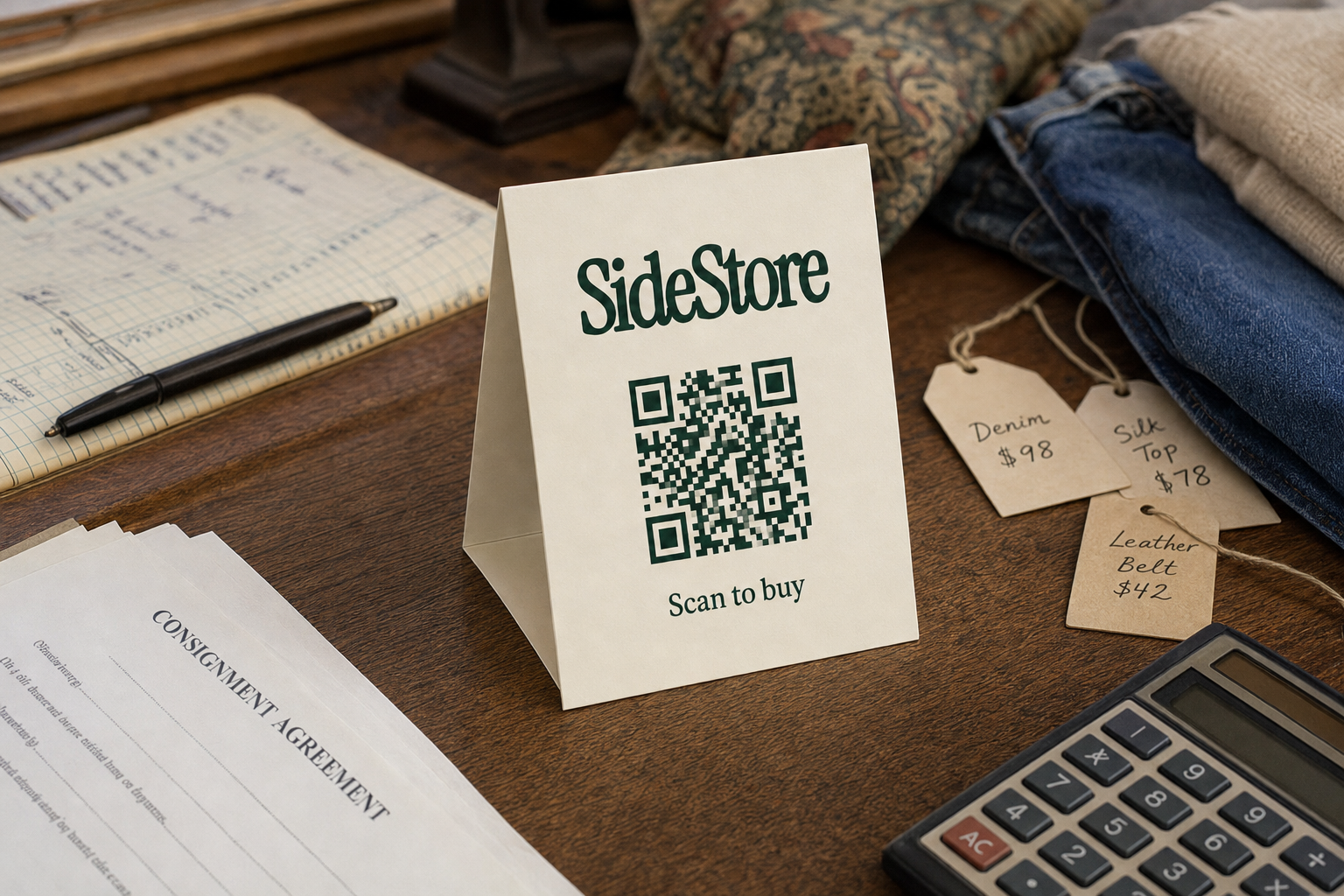
To calculate your consignment split, multiply the retail sale price by your maker percentage. That is your payout per unit. To reverse-engineer an unknown percentage from a payout you've already received, divide the payout by the retail price and multiply by 100.
Here are both formulas written out clearly:
Forward formula (known percentage → payout): Payout = Retail Price × (Maker % ÷ 100)
Reverse formula (known payout → percentage): Maker % = (Payout ÷ Retail Price) × 100
Step-by-Step for Any Proposed Split
- Confirm the retail price. This is the price the buyer pays at the point of sale. Make sure the host agrees on this figure before calculating anything else.
- Identify the agreed maker percentage. If it hasn't been stated as a number, ask for it in writing.
- Multiply retail price by your maker percentage. Divide by 100 if working manually. Example: £40 × 60 ÷ 100 = £24.
- Subtract your cost of goods (COGS). This is where many calculations stop too early. If your product costs £18 to make and your payout is £24, your net margin is £6 per unit, not £24.
- Compare against an alternative split. Run the same calculation at 50% and 70% to understand the actual margin difference.
Worked Comparison
| Scenario | Retail Price | Maker % | Payout | COGS | Net Margin |
|---|---|---|---|---|---|
| A | £40 | 70% | £28 | £18 | £10 |
| B | £40 | 60% | £24 | £18 | £6 |
| C | £40 | 50% | £20 | £18 | £2 |
Scenario A looks obviously better than C. But notice that even a 70% maker split on a £40 item leaves only £10 net if your cost of goods is £18. A higher percentage does not automatically produce a viable margin. The retail price and your COGS drive the outcome just as much as the split itself.
If you're managing multiple placements, consignment inventory software can track per-placement margins automatically. And if you're new to placing products with third-party retailers, selling through someone else's store explains the process from first approach to first payout.
What Is the Typical Consignment Percentage by Category?
Typical consignment percentages range from around 40% to 70% for the maker, depending on product category, sales volume, and how much effort the host merchant puts into merchandising and selling. These figures represent observed industry benchmarks, not guarantees. Individual shops will vary.
| Product Category | Typical Maker % | Typical Host % | Notes |
|---|---|---|---|
| Clothing & apparel | 40, 60% | 40, 60% | Higher-volume hosts often push toward 50/50 or less for makers |
| Handmade jewellery | 50, 60% | 40, 50% | Boutiques may offer better terms for exclusive or limited pieces |
| Art (prints, originals) | 50, 60% | 40, 50% | Galleries sometimes take 40, 50%, higher than typical retail |
| Homewares & ceramics | 50, 65% | 35, 50% | Lower-volume items often justify a higher maker share |
| Furniture | 50, 60% | 40, 50% | Logistics and floor space costs can reduce the maker share |
| Food & specialty goods | 55, 70% | 30, 45% | Short shelf life typically earns makers a higher percentage |
| Books & stationery | 50, 60% | 40, 50% | Low price points require volume to make splits viable |
| Beauty & skincare | 55, 65% | 35, 45% | Regulatory requirements sometimes shift negotiating leverage |
Clothing. The typical range for selling clothing on consignment is 40, 60% to the maker. Fast-fashion or high-turnover hosts tend to negotiate closer to 50/50, while independent boutiques with smaller volumes may offer 55, 60% to attract makers with strong products.
Furniture. Selling furniture on consignment involves real floor space costs and handling logistics, which is why host percentages can run higher than in categories where products sit on a shelf. A 50/50 split is common. 55% to the maker is achievable where the piece is high-value or in demand.
For makers placing handmade pieces in boutiques, the selling handmade jewellery in boutiques guide covers how category norms translate into real negotiation conversations.
These ranges exist as starting points. The shop's footfall, the product's sell-through rate, and your relationship with the host all influence where a split lands in practice.
What Counts as a Fair Consignment Rate?
A fair consignment rate is one where your payout per unit, after subtracting cost of goods, leaves a margin you would willingly repeat. It's also one where the host earns enough to make the placement worth their time and shelf space.
That definition is bilateral. A rate that only works for one party won't hold for long. When assessing any proposed split, apply this three-factor test:
1. Does your payout cover COGS and your time? Run the forward formula. Subtract your cost of goods. Then subtract a rough per-unit allocation of your time spent producing and restocking. If what remains is zero or negative, the split is too low regardless of what the host calls "standard."
2. Is the retail price set to support the split? A 60% maker share on a retail price that's too low produces the same result as a 40% share on a fair price. The split and the retail price must be negotiated together, not independently.
3. Is the split confirmed in writing before product is handed over? Many makers find that verbal agreements shift once a product starts selling. A written consignment agreement that names the exact percentage, the agreed retail price, and the payout schedule protects both parties.
The calculation itself is your negotiation tool. When you walk into a conversation knowing your COGS, your target margin, and the minimum payout per unit you need, you're no longer guessing at whether a proposed split is fair. You can show your working.
Check your proposed split against average consignment percentage benchmarks to understand where you stand relative to the market. If you're preparing for your first conversation with a retailer, how to approach a local shop about stocking your products covers what to bring and how to frame the discussion.
How to Run a Consignment Split Without Manual Calculations
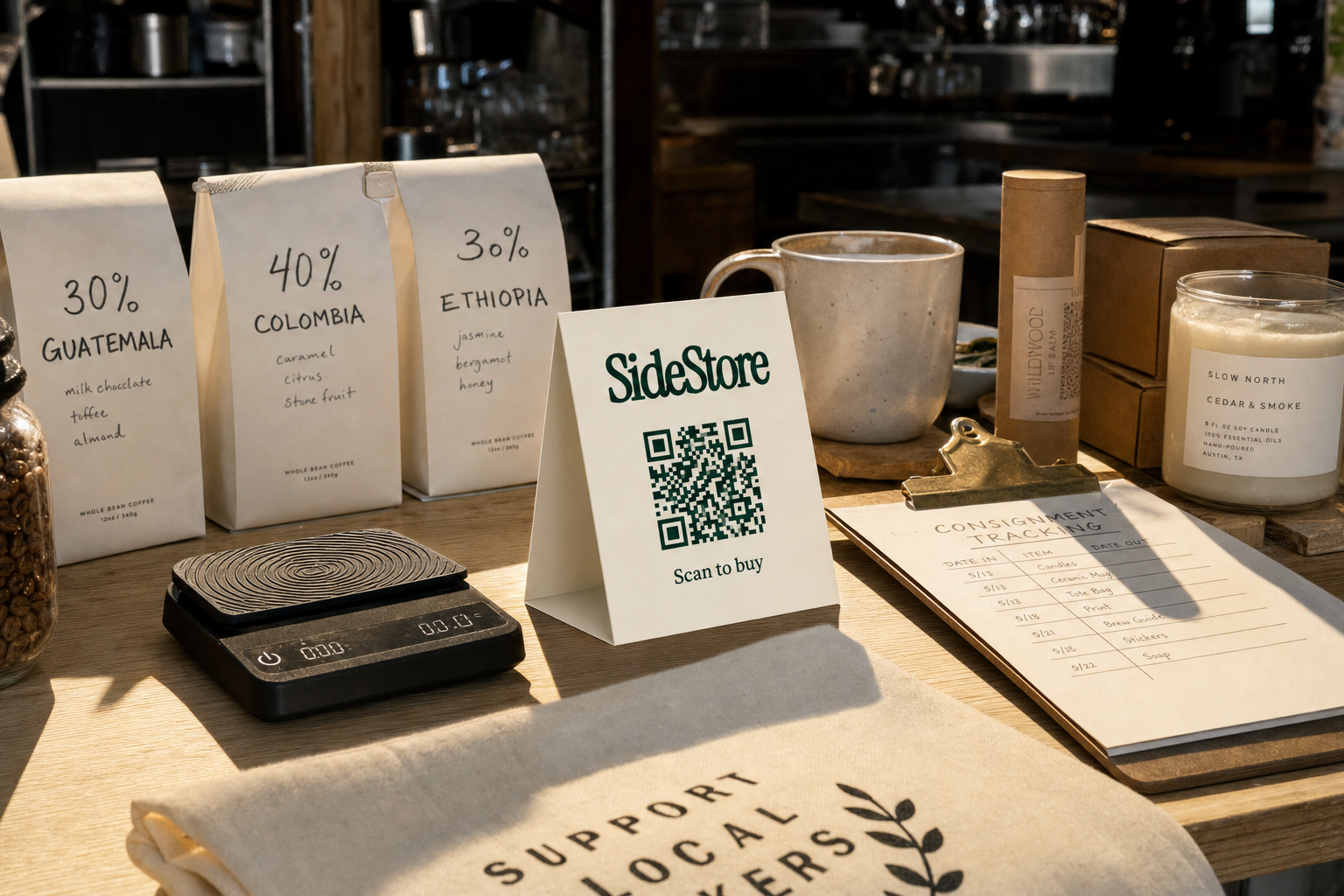
Once you've agreed and verified your split using the formulas above, you don't need to recalculate it by hand every time a product sells. The SideStore Retail Widget handles the split automatically once the agreed percentage is set at the point of placement.
Here's what that means in practice. You negotiate and confirm your maker percentage with the host. You set it in the Retail Widget when you configure the placement. From that point on, every sale triggers an automatic split payout: your share routes to you, the host's share routes to the host, with no manual transfer or end-of-month reconciliation spreadsheet.
The Retail Widget also provides:
- Placement attribution. Each sale is recorded against the specific merchant location where it happened, so you can see which placements are performing.
- Live stock tracking. Stock levels update in real time, so you know when to restock without chasing the host for a count.
- Scan-to-pay QR checkout. A printable QR card that customers can scan to complete a purchase directly. The QR checkout is one function of the Retail Widget. The Widget manages the full lifecycle of a consignment placement from setup through settlement.
The practical sequence is this: calculate your split manually first using the formulas in this article. Confirm it covers your costs. Get it agreed in writing. Then lock it into the Retail Widget. The tool handles execution. The maths is still your responsibility upfront.
For further reading on managing stock across multiple locations, see consignment inventory software. To understand how distributed placements can function as a coherent retail network, how shared retail networks work gives the broader context.
Frequently Asked Questions About Consignment Percentages
These are the questions makers and merchants most commonly ask when working out a consignment split. Each answer below is direct and self-contained, so you can find what you need quickly.
What constitutes a good or fair consignment rate?
A fair rate is one where your payout per unit covers your cost of goods and leaves a margin worth repeating, while the host earns enough from their share to make the placement worthwhile. Run the three-factor test above: does the payout cover COGS, is the retail price right, and is the split confirmed in writing? If all three pass, the rate is workable.
How is the percentage cut calculated from a sale?
Multiply the retail sale price by your maker percentage, then divide by 100. On a £50 item with a 60% maker split: £50 × 60 ÷ 100 = £30 to you, £20 to the host. Nothing is added to the retail price. The agreed price is divided between the two parties according to the split.
What does a consignment shop mean?
A consignment shop is a retail space that sells products on behalf of makers or suppliers without buying the stock upfront. The shop earns a percentage of each sale as payment for the shelf space and selling effort. You earn the remainder. You retain ownership of the product until it sells. See what percentage consignment shops take for how this varies by shop type.
What is the typical or average consignment percentage?
Typical maker shares range from 40% to 70% depending on product category. Clothing often settles near 50/50. Handmade goods and specialty food tend toward 55, 65% for the maker. These are observed benchmarks, not industry rules. Your negotiating position, product demand, and the host's foot traffic will all influence where your split lands.
How do you find a commission rate when the percentage is unknown?
Use the reverse formula: divide your payout by the retail price, then multiply by 100. If you received £22 on a £40 item, your maker percentage is (22 ÷ 40) × 100 = 55%. Always confirm the agreed percentage in your consignment contract before product changes hands. Reverse-engineering it after the fact is a sign the terms weren't documented properly.
What percentage does a furniture consignment business typically take?
Furniture hosts typically retain 40, 50%, leaving the maker with 50, 60%. Floor space, handling, and logistics costs justify a higher host share than you'd see in categories where products sit on a shelf. High-value or in-demand pieces may command better maker terms. See the full breakdown in selling furniture on consignment.
What percentage is standard for clothing consignment?
Clothing consignment typically splits 40, 60% to the maker and 40, 60% to the host, with 50/50 being common among higher-volume retailers. Independent boutiques with lower turnover may offer 55, 60% to makers with strong or exclusive lines. Full context and negotiation advice is in selling clothing on consignment.
Check Your Split Before You Sign
The two formulas to take with you: Payout = Retail Price × (Maker % ÷ 100) for any proposed split, and Maker % = (Payout ÷ Retail Price) × 100 to reverse-engineer a percentage from a payout you've already received.
Before you sign or hand over product, run through this checklist:
- Does the split cover cost of goods? Subtract your COGS from the calculated payout. If the margin is negative or negligible, the retail price or the split needs to change.
- Is the retail price agreed? The split percentage is meaningless without a fixed retail price to apply it to.
- Is everything confirmed in writing? A consignment agreement should name the exact maker percentage, the retail price, and the payout schedule. Use the consignment contract checklist to make sure nothing is missing.
If you're still deciding between consignment and other distribution models, the line sheet for wholesale and pop-up retail alternatives cover adjacent options worth comparing.
Run your numbers. Agree your split. Get it in writing before a single unit leaves your hands.