What Is a Coffee Shop Profit Margin?
A coffee shop profit margin is the percentage of total revenue left after all costs are paid. For most independent operators, that net figure lands somewhere between 2.5% and 6.5%. This range comes up repeatedly in operator communities, and it aligns with what experienced cafe owners describe when they're being candid about the numbers. Some specialty shops with tight cost control and strong ticket averages push closer to 10%. Many first-year operations don't reach positive net margin at all.
If you're searching "coffee shop profit margin reddit" because you want a straight number: expect 3, 6% net as a working assumption for a reasonably well-run independent cafe. Gross margin on espresso drinks sits much higher, often in the 60, 70% range on the beverage itself. But rent, labor, equipment debt, and waste erode that quickly. The gap between how good your latte margin looks in isolation and how little is left at the end of the month is where most new operators get surprised.
For a fuller treatment of what drives the number, see coffee shop profit margin and what to realistically expect before building your projections.
What Reddit Operators Actually Report
Reddit operator communities give a more honest picture of coffee shop margins than most business guides. Operators post when things are hard, not just when things are good. The pattern across those discussions is consistent: most independent cafe owners report net margins in the 2, 6% range, and a significant number describe their first one to two years as break-even at best.
Several patterns show up repeatedly.
Margins are thinner than most people expect going in. Operators frequently report that their beverage cost looks great on paper until rent, payroll taxes, repairs, and shrinkage are factored in. The spread between gross margin on a latte and net margin on the whole business is wide enough to disappoint anyone relying on the gross number.
Labor is the variable that breaks most projections. Scheduling inefficiency, unexpected turnover, and the cost of training replacement staff get cited more than almost any other factor. Operators who run tight, predictable labor schedules consistently report better margins than those who don't.
Volume thresholds matter more than price. You'll see operators note that the jump from 150 to 250 covers per day changes everything, because fixed costs don't scale with those extra 100 covers. This is the leverage point most new operators underestimate.
Weekday vs. weekend imbalance is a margin killer. A cafe that does strong Saturday and Sunday numbers but slow Tuesday through Thursday traffic is carrying full fixed costs across seven days. Operators who've solved this with a loyal weekday base describe noticeably better annual margins.
Discussions about coffee shop profit margins and how much profit a coffee shop makes consistently point to the same conclusion: the business is viable but not forgiving. Understanding your average revenue of a coffee shop before you open is the most important modeling exercise you can do.
The Cost Structure Behind the Numbers
The reason net margin is so much lower than gross margin is simple math: coffee's beverage cost is low, but the overhead required to serve that coffee is substantial. Cost of goods on an espresso drink might run 20, 30% of the sale price, leaving a strong gross margin. Five major cost categories then chip away at what remains.
Here is a realistic cost breakdown as a percentage of revenue for a typical independent cafe:
| Cost Category | Typical % of Revenue |
|---|---|
| Cost of goods (coffee, milk, food) | 28, 35% |
| Labor (wages, taxes, benefits) | 35, 40% |
| Rent and occupancy | 10, 15% |
| Utilities and supplies | 3, 6% |
| Marketing, fees, miscellaneous | 2, 4% |
| Total operating costs | ~78, 100% |
The math explains why net margin compresses so hard. If your costs land at 94, 97% of revenue, your net is 3, 6%. A single bad month of staffing or a rent increase that isn't offset by volume can push that into negative territory.
The behavioral difference between variable and fixed costs matters here. Labor and COGS are variable: you can, in theory, scale them with demand. Rent is fixed: it costs the same whether you serve 80 covers or 280 covers that day. Operators who shift more of their cost base toward variable rather than fixed have more margin protection when volume drops.
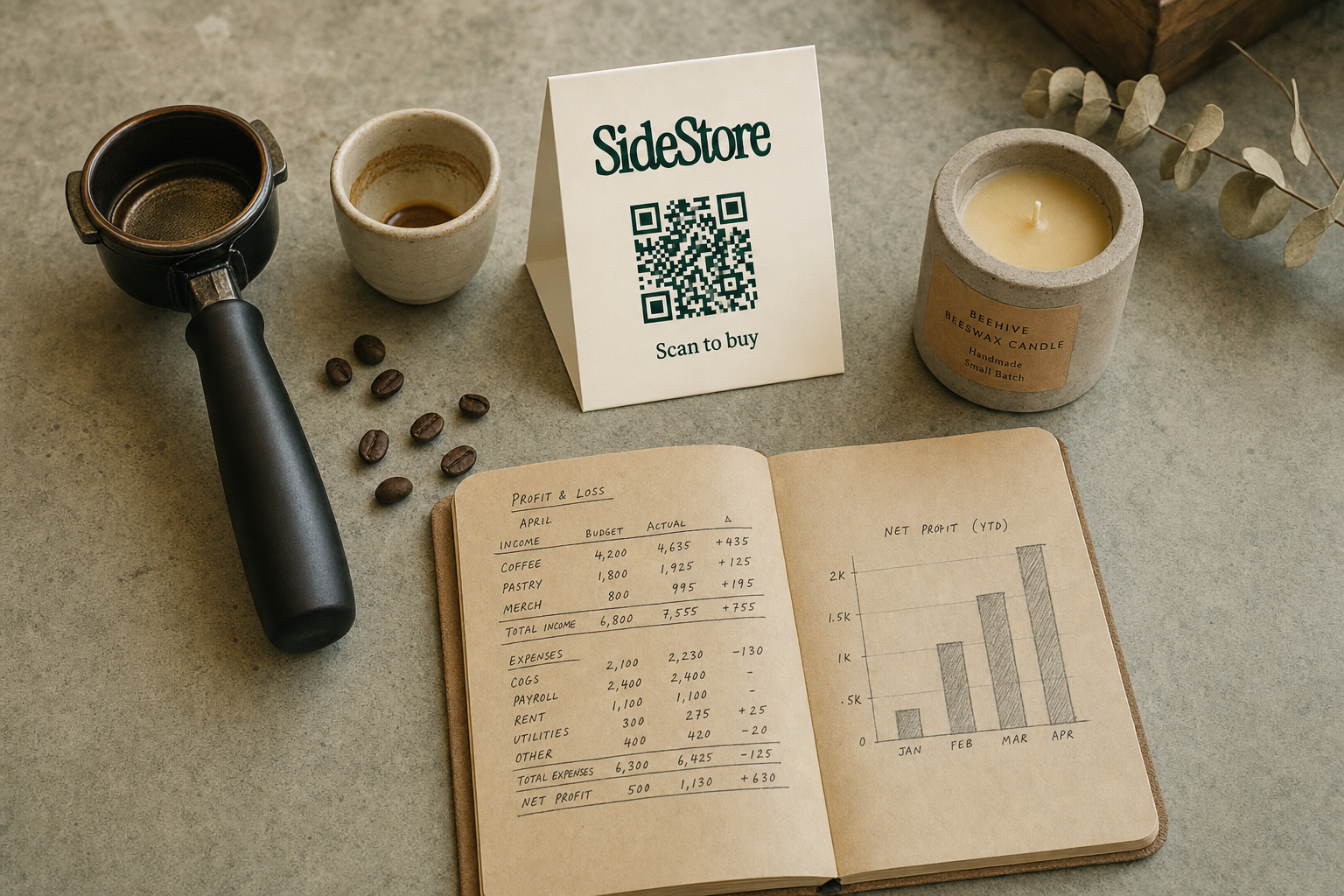
Reviewing your coffee shop profit and loss statement monthly, not quarterly, is the practice that separates operators who catch margin erosion early from those who don't catch it until it's a crisis. For a direct look at what generates profit from a coffee shop, the P&L line items are where to start.
Margin Levers: What Actually Moves the Number
Six levers reliably affect coffee shop margins. They don't all carry equal weight, and knowing which ones to prioritize first matters.
| Lever | Typical Margin Impact | Implementation Difficulty | Time to See Results | Key Risk |
|---|---|---|---|---|
| Labor scheduling optimization | +2, 4 percentage points | Medium | 4, 8 weeks | Under-staffing hurts service quality |
| Average ticket increase (upselling, food pairing) | +1, 3 percentage points | Low, Medium | 2, 6 weeks | Pushback if perceived as pressure |
| Consignment retail (no inventory purchase) | +1, 3 percentage points on retail revenue | Low | 2, 4 weeks | Requires curating the right product fit |
| Rent renegotiation or subletting space | +2, 5 percentage points | High | 3, 12 months | Depends on lease terms and landlord |
| Waste and shrinkage reduction | +0.5, 2 percentage points | Medium | 4, 8 weeks | Requires consistent tracking discipline |
| Catering or wholesale channel | +2, 6 percentage points | High | 3, 6 months | Volume dependency, delivery costs |
Labor scheduling is the highest-impact lever most operators can actually control. Overstaffing slow dayparts is one of the most common margin drains in independent cafes. Cross-training staff to handle multiple roles and building schedules around actual historical traffic data rather than instinct typically produces measurable improvement within two months.
Average ticket size is often underutilized. Operators who build food pairing into their service flow, offer a clear upsell prompt at point of sale, and stock a few higher-margin retail items near checkout report better revenue per cover without needing more foot traffic.
Consignment retail deserves specific attention because it carries no inventory risk. Under a consignment arrangement, a maker places products in your cafe and you earn a split of each sale when it happens. You don't buy the stock, you don't carry unsold inventory risk, and you don't need to manage reorders. For a cafe with free counter or shelf space, it converts idle square footage into margin.
SideStore's Retail Widget manages this mechanically: scan-to-pay checkout via a printable QR card, live stock tracking, and automatic split settlement between the maker and your cafe. You set the split, the system handles the rest.
For more context on how this works in practice, see coffee shop retail, sharing retail space, and selling through consignment.
How Margins Shift From Launch to Maturity
Coffee shop margins are not static. Where you are in the lifecycle of the business determines what margin you should realistically expect. Operators who compare their first-year numbers to the margins of a five-year-old neighborhood institution are comparing the wrong things.
Phase 1: Launch (Months 1, 12)
Expect negative or near-zero net margin in the first year. Most operators report this plainly, and it reflects reality: you're building a customer base, paying down startup costs, and absorbing inefficiencies that only become visible once you're open. Revenue is often 50, 70% of your stabilized run rate. Labor is frequently overstaffed because you haven't yet learned your traffic patterns. Net margin of -5% to +2% is the honest range here.
Phase 2: Stabilization (Months 12, 30)
This is where operators who survive begin to find their floor. Traffic patterns are established, labor scheduling becomes more accurate, and waste reduces. Revenue climbs toward its stable baseline. Net margin typically moves into the 2, 5% range during this phase, though it's uneven. Operators who add a secondary revenue stream, such as coffee retail shop products or catering, often stabilize faster because they're not entirely dependent on daily cover volume.
Phase 3: Maturity (Month 30+)
Operators with a loyal repeat base, controlled fixed costs, and at least one non-beverage revenue stream report net margins in the 6, 10% range. This is not guaranteed, but it is achievable. Some non-profit coffee shop models operate at a deliberately lower margin with community revenue or grants supplementing the difference.
The first-year loss reality is what Reddit operators are most candid about. Planning for it honestly is the single most important thing you can do before you open.
Adding Retail Revenue Without Adding Inventory Risk
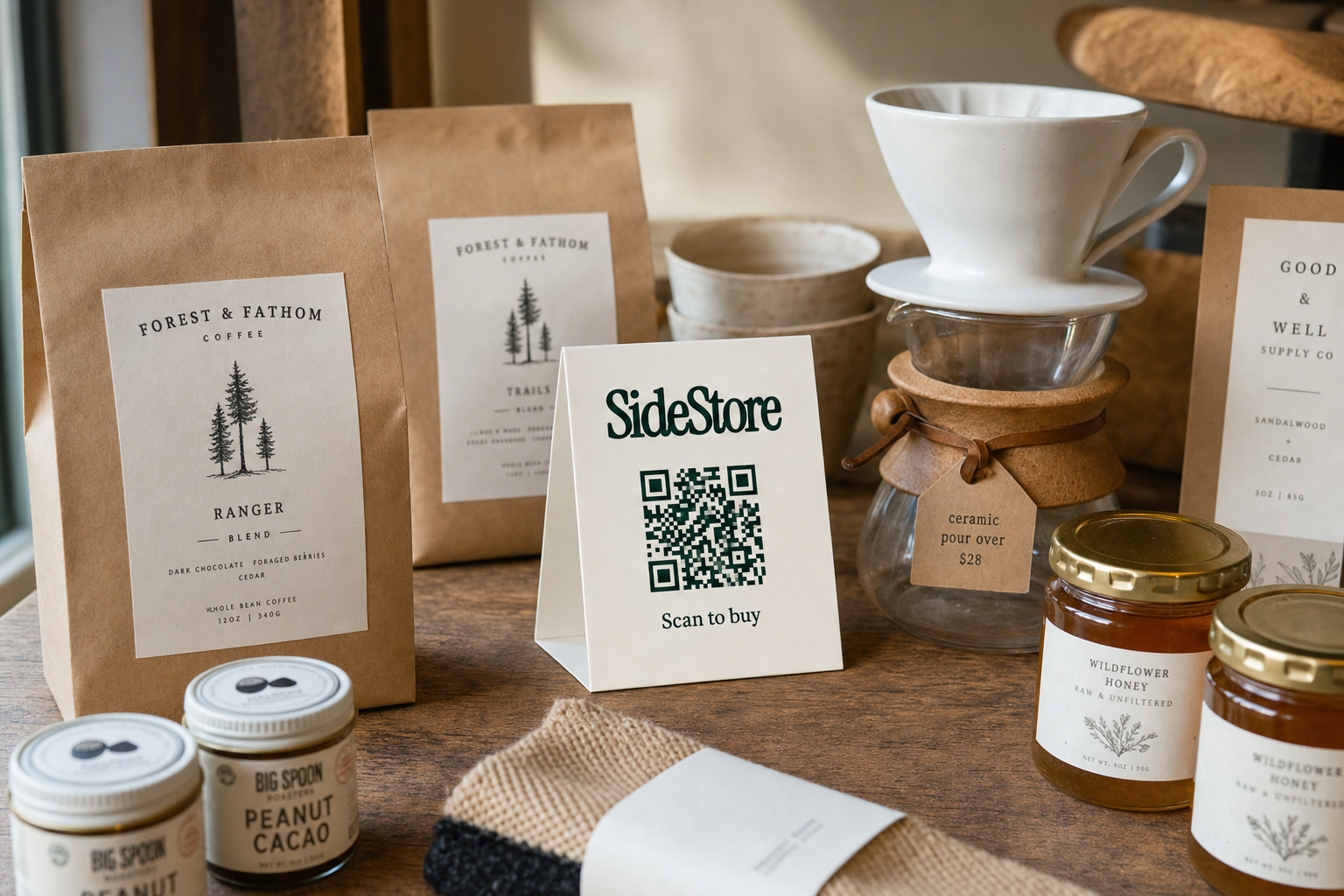
A cafe can earn additional margin from retail without purchasing any inventory. The mechanism is consignment. You host a maker's products in your space, customers buy them, you receive a percentage of each sale, and the unsold stock belongs to the maker, not you.
This is not a new model. Consignment hosting has existed in retail for decades. What's changed is that platforms like SideStore have made the operational side simple enough for a cafe to run without dedicated retail staff.
Here is how the Retail Widget handles it end to end: a maker places their products with you through SideStore and either attaches a scan-to-pay QR card to each product or displays a single SideStore card for all items in the placement. Customers scan to buy. The Retail Widget tracks live stock levels, processes the transaction, and automatically splits the payout between the maker and your cafe. You never touch the settlement math.
Hypothetical illustration:
Assume your cafe hosts five SKUs from a local ceramics maker. Each piece sells for 45 CHF. The consignment split is 70% to the maker, 30% to the cafe. If 20 units sell in a month, that's 900 CHF in revenue your cafe received without buying a single piece of stock, managing any reorder, or carrying unsold inventory risk. At a 5% net margin on 25,000 CHF monthly beverage revenue, that 900 CHF represents the equivalent of more than two-thirds of your total monthly net profit. Earned from shelf space that would otherwise sit empty.
For more on how consignment works from the host side, see selling to consignment, what selling on consignment means, and how consignment selling works.
Frequently Asked Questions
These questions reflect the patterns that come up most often in operator discussions about coffee shop margins.
Is a 10% profit margin good for a coffee shop?
Yes. 10% is genuinely good for an independent coffee shop. Most well-run independent cafes operate in the 3, 6% net range, so reaching 10% typically requires strong volume, tight labor control, and at least one secondary revenue stream. It is achievable, but it is not the average.
Why do so many coffee shops fail?
Operators frequently cite undercapitalization and underestimating fixed costs as the primary reasons. A cafe that opens without 12, 18 months of operating runway may not survive long enough to stabilize its customer base and reach the traffic volume where fixed costs become manageable. Lease terms and location selection also appear consistently in failure post-mortems.
What is a realistic first-year expectation for a coffee shop?
Expect to lose money or break even in year one. Operators who go in planning for a profitable first year are often the ones who run out of capital. A realistic first-year expectation is negative net margin, with stabilization beginning in year two if traffic and retention are tracking well.
Can a coffee shop increase profit margins without raising prices?
Yes. Labor scheduling, waste reduction, and adding zero-inventory-risk retail revenue are the three levers that don't require a price increase. If you're curious about adjacent retail models, the principles in how to start a boutique without inventory and boutique inventory options translate directly to a cafe context.
How does consignment retail affect a cafe's margin?
Consignment retail adds revenue with no inventory cost, which means the margin contribution flows almost directly to the bottom line. Because you don't buy the stock, there is no COGS to offset against the revenue. The main cost is the shelf or counter space you're allocating, which you already own.
The Bottom Line
Coffee shop net margins are thin. Expect 3, 6% for a well-run independent operation, and plan on the first year being loss-making. That is the honest baseline, and planning around it is more useful than planning around an optimistic scenario.
Three levers are worth prioritizing first: labor scheduling, because it has the highest accessible margin impact; average ticket size, because it requires no capital; and consignment retail, because it converts idle space into margin with no inventory risk.
The practical next step is to audit your current cost structure against the percentages in this article. If your labor cost is running above 40% of revenue, that is where to focus. If you have unused counter or shelf space, consignment hosting is worth modeling with concrete numbers before dismissing it.
For a structured look at what retail options fit a cafe context, start with coffee shop retail options and sharing retail space. If you want to understand how retail without inventory works as a model, the mechanics translate directly to a cafe environment.
Build a consignment network without opening a store of your own.