Where to Sell Stuff Online (and Why Adding a Physical Channel Beats Another Listing)
An online selling platform is a digital marketplace or software tool that lets you list, transact, and collect payment for physical or digital goods without owning a storefront. If you're asking where to sell stuff online, the short answer is: Amazon for reach, eBay for variety, Etsy for handmade, Facebook Marketplace for local, and Depop for fashion resale. But the channel you're missing is a physical one.
Each major platform below includes a plain fee comparison, realistic sell-through timelines, and an honest case for why placing your products on consignment in a local venue often moves more units than opening a tenth online listing. Whether you're clearing out surplus stock, testing a new product, or building a real distribution network, the right answer is almost always a mix.
You'll also find a quick-reference table matching product types to channels, a step-by-step guide to scaling a physical placement network, and answers to the twelve questions sellers ask most. For makers specifically, there are also alternatives to Etsy for independent makers worth knowing before you commit to a single channel.
Which Online Marketplaces Are Most Popular, and What Each One Actually Does

Five platforms dominate where people sell things online in 2026: Amazon, eBay, Etsy, Facebook Marketplace, and Depop. Before comparing them, it's worth clearing up a vocabulary confusion that trips up a lot of sellers.
Selling platform vs. online marketplace, they are not the same thing.
An online marketplace is a destination where multiple sellers list products to buyers who arrive organically (think Amazon or eBay). A selling platform is broader: it includes marketplaces, but also standalone tools like Shopify that give you a storefront without a built-in audience. The distinction matters because a marketplace brings traffic; a platform makes you find it yourself.
Amazon is the most widely used site for selling items online by volume. You list inside a product catalogue that already exists, so discovery happens fast. The downside: you compete on price with every other seller on the same listing. Amazon's fulfilment network (FBA) is powerful, but fees and storage costs add up quickly.
eBay suits a wider range of product conditions, including used, vintage, and rare items. Its auction format still works well for collectibles and electronics. It draws a global audience and allows fixed-price listings alongside auctions.
Etsy is built for handmade, vintage, and craft goods. Its audience comes specifically to buy from independent makers, which gives sellers a warmer conversion environment than a general marketplace. If Etsy's fee increases have you reconsidering, there are options for selling through someone else's store that work alongside or instead of it.
Facebook Marketplace sits at the intersection of local and online selling. It's free to list, it's integrated with an existing social graph, and it handles both local pickup and national shipping depending on category. The audience is vast but intent is mixed.
Depop targets younger buyers looking for secondhand fashion and streetwear. Its mobile-first interface and social feed mechanic make it effective for clothing, accessories, and curated vintage, less so for general goods.
Fee Comparison: What Each Platform Actually Costs You
Fees are the most common reason sellers abandon a platform before they've really tested it. The structure below gives you a working comparison. Rates change, so verify current figures on each platform's seller page before you commit.
| Platform | Listing Fee | Final Value / Transaction Fee | Monthly Subscription | Notes |
|---|---|---|---|---|
| Amazon | None (most categories) | ~8, 15% referral fee, varies by category | Optional (Individual plan: per-sale fee; Professional: ~$39.99/mo) | FBA storage and fulfilment fees apply on top |
| eBay | Free up to a monthly allowance, then ~$0.35/listing | ~13.25% on most categories (capped on some) | None required; Store subscriptions from ~$7.95/mo | Promoted listings add an optional ad fee |
| Etsy | $0.20 per listing | ~6.5% transaction fee + payment processing | None required; Etsy Plus ~$10/mo | Offsite Ads fee (12, 15%) applies if opted in |
| Facebook Marketplace | Free | 5% per shipped sale (free for local pickup) | None | Local pickup remains completely free to list and sell |
| Depop | Free | ~10% Depop fee + payment processing | None | Shipping label costs vary by seller location |
| SideStore (consignment) | None | Split settled automatically on sale | None | No upfront cost to host; maker and merchant split defined per placement |
Facebook Marketplace charges nothing on either side for local pickup sales. SideStore consignment charges nothing upfront to either maker or host. Fees are only realised as a split when a sale happens, so you never pay to list something that doesn't sell.
If fees are discouraging you from a particular platform, it usually means the platform's audience doesn't match your product well enough to justify them. The fix is channel fit, not fee avoidance. See consignment terms and conditions for how a consignment split is typically structured.
How to Sell in Person Rather Than Online, and Which Apps Make It Easiest
Selling in person and selling online are distinct activities, though many apps blur the line between them. Local selling means a buyer physically collects the item, usually from your location or a neutral meeting point, with payment exchanged face to face or via peer-to-peer transfer. No shipping, no returns dispute, no waiting for funds to clear.
The most useful apps for local selling:
Facebook Marketplace remains the dominant local selling tool in most English-speaking markets. Free to list, geographically filtered by default, and integrated with Messenger for fast negotiation. The main drawback is meeting stranger risk. Always meet in a public place.
OfferUp (US-focused) is built specifically for local selling with an in-app reputation system. Sellers commonly report it being easier to manage than Facebook for buyer quality. The app supports both local and national shipping.
Nextdoor works best for genuinely neighbourhood-level sales: furniture, tools, garden equipment. The audience is verified by address, so buyer trust is higher, but volume is lower than the larger platforms.
Gumtree dominates local classifieds in the UK and Australia. It's free to list in most categories and handles everything from electronics to job listings, which means the audience is wide but unfocused.
Sellers commonly report searching for region-specific platforms first. A seller in Germany reaches for Kleinanzeigen; one in France looks at Leboncoin. What works depends entirely on where your buyers actually are.
If you want physical presence beyond a one-off local transaction, pop-up store alternatives and permanent consignment placements are worth considering. How to approach a local shop about stocking your products covers the first conversation in practical terms.
How Quickly Can Items Sell? A Realistic Timeline by Channel
Speed to sale varies more than most sellers expect, and it depends on three factors: audience size, algorithm visibility, and purchase intent.
Amazon on day one. Technically, yes. An individual seller account can go live within hours for most categories. But being live is not the same as getting sales. Without reviews, without a sales history, and without advertising spend, new Amazon listings sit at the bottom of search results. Expect to wait weeks before organic traction builds.
eBay can move items within hours for in-demand products, especially via auction. Fixed-price listings take longer without promoted placement.
Etsy listings benefit from search within the platform, but new shops start with minimal search authority. Most sellers report waiting three to six months before consistent organic traffic appears.
Facebook Marketplace and OfferUp are among the fastest channels for the right items. High-demand local goods (furniture, tools, baby equipment) often sell within 24 to 72 hours. The audience is actively browsing with purchase intent.
Depop moves fast for trending fashion but slowly for anything outside its core categories.
Physical consignment placement operates on different logic entirely. Your product is visible every day to foot traffic in a live venue (a cafe, boutique, or hotel lobby) with no algorithm deciding whether to show it. There is no bid, no review threshold, and no ad spend required to stay visible. That structural advantage means consistent daily exposure that an online listing can only replicate with paid promotion. If speed matters, pop-up retail space as a faster physical alternative is another option worth comparing.
Why Adding a Physical Channel Beats Adding Another Listing
Adding your products to another online marketplace puts you in direct competition with every other seller on that platform, inside an algorithm you do not control. Adding a physical placement puts your product in front of a specific audience, in a specific venue, with no competition on the same shelf.
Consignment is the mechanism that makes physical placement accessible without the cost of a store. You place your products in a merchant space (a cafe, boutique, hotel, or any retailer with available shelf space) and get paid when those products sell. The host carries no inventory risk and pays nothing upfront. You carry no lease cost and no floor time.
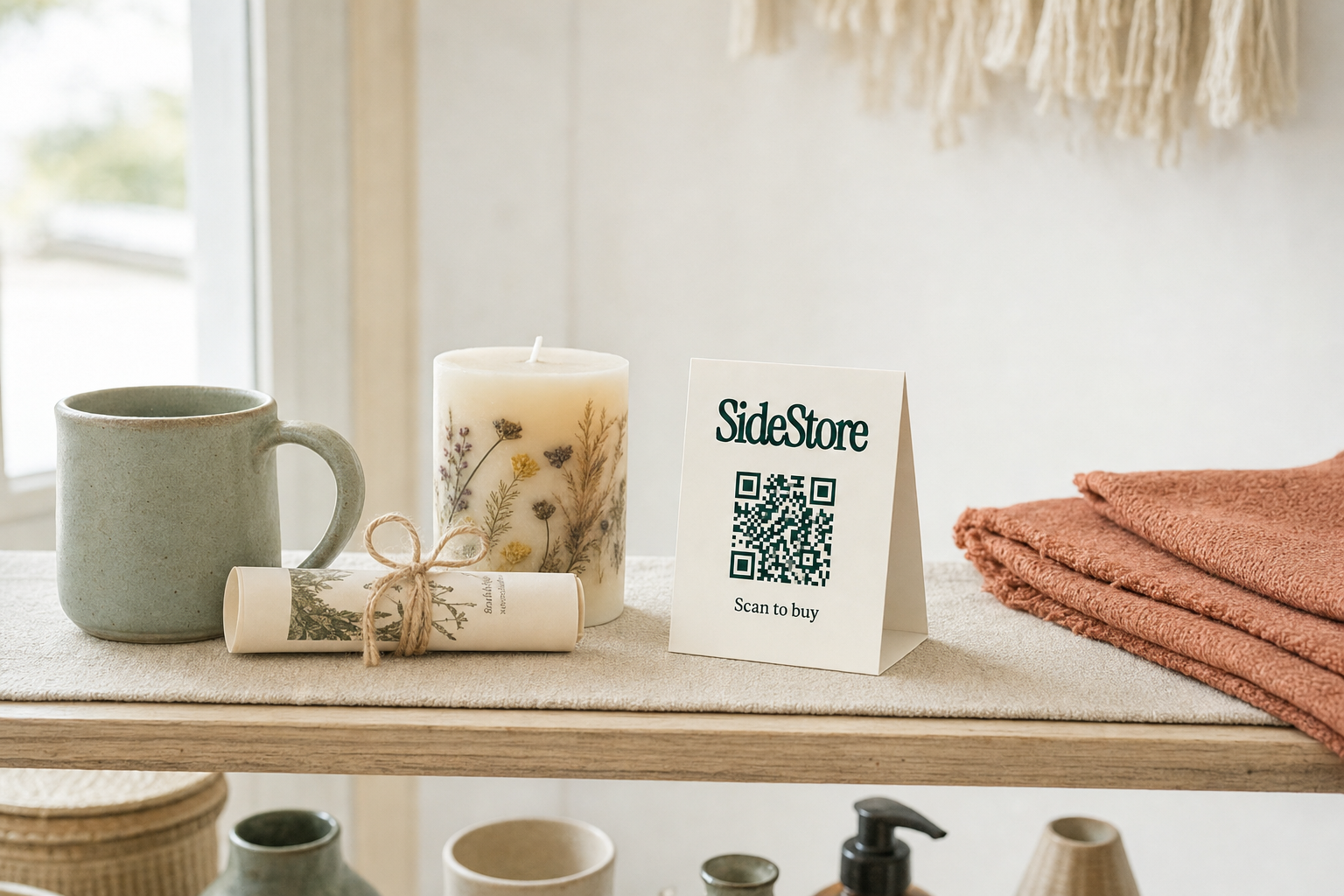
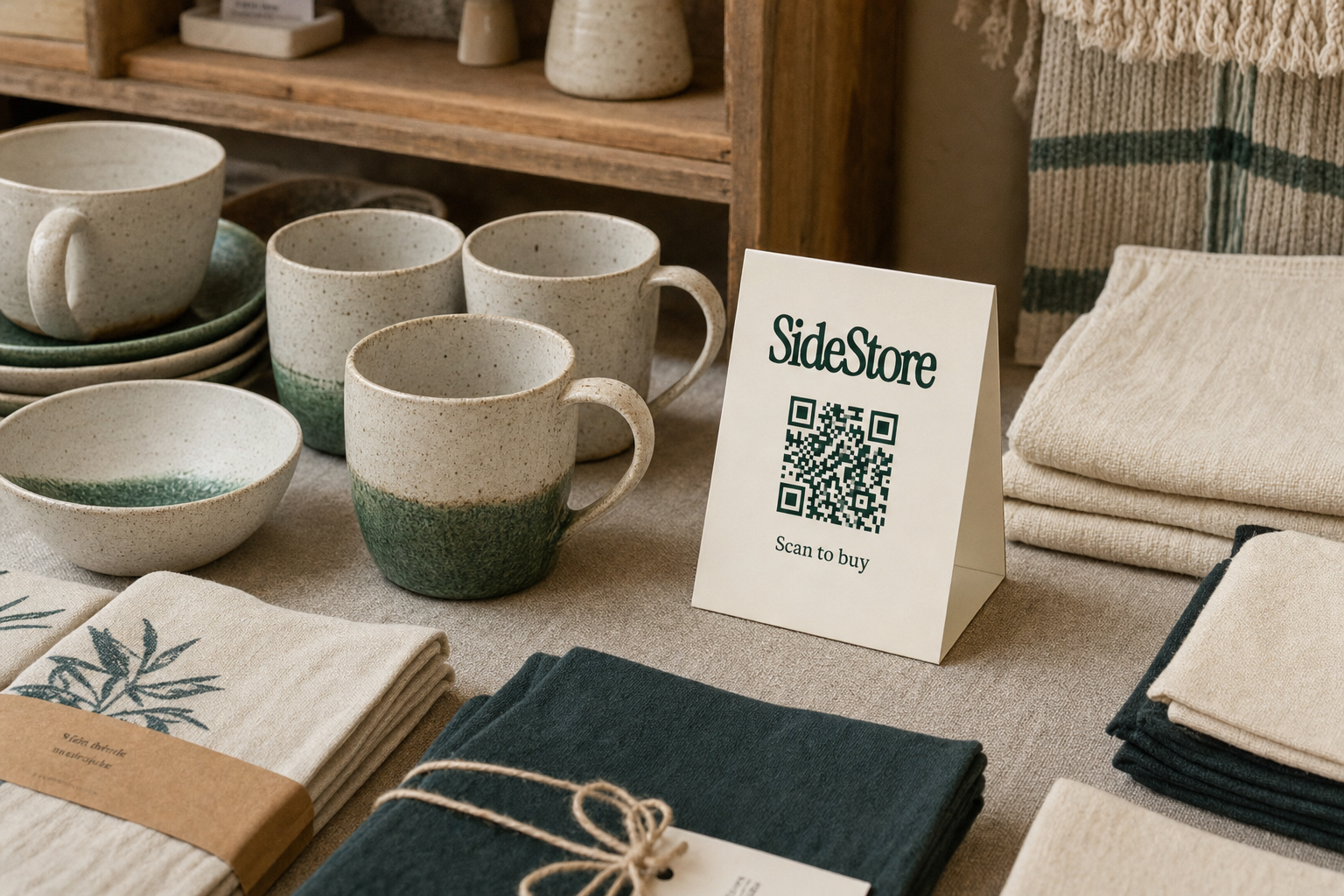
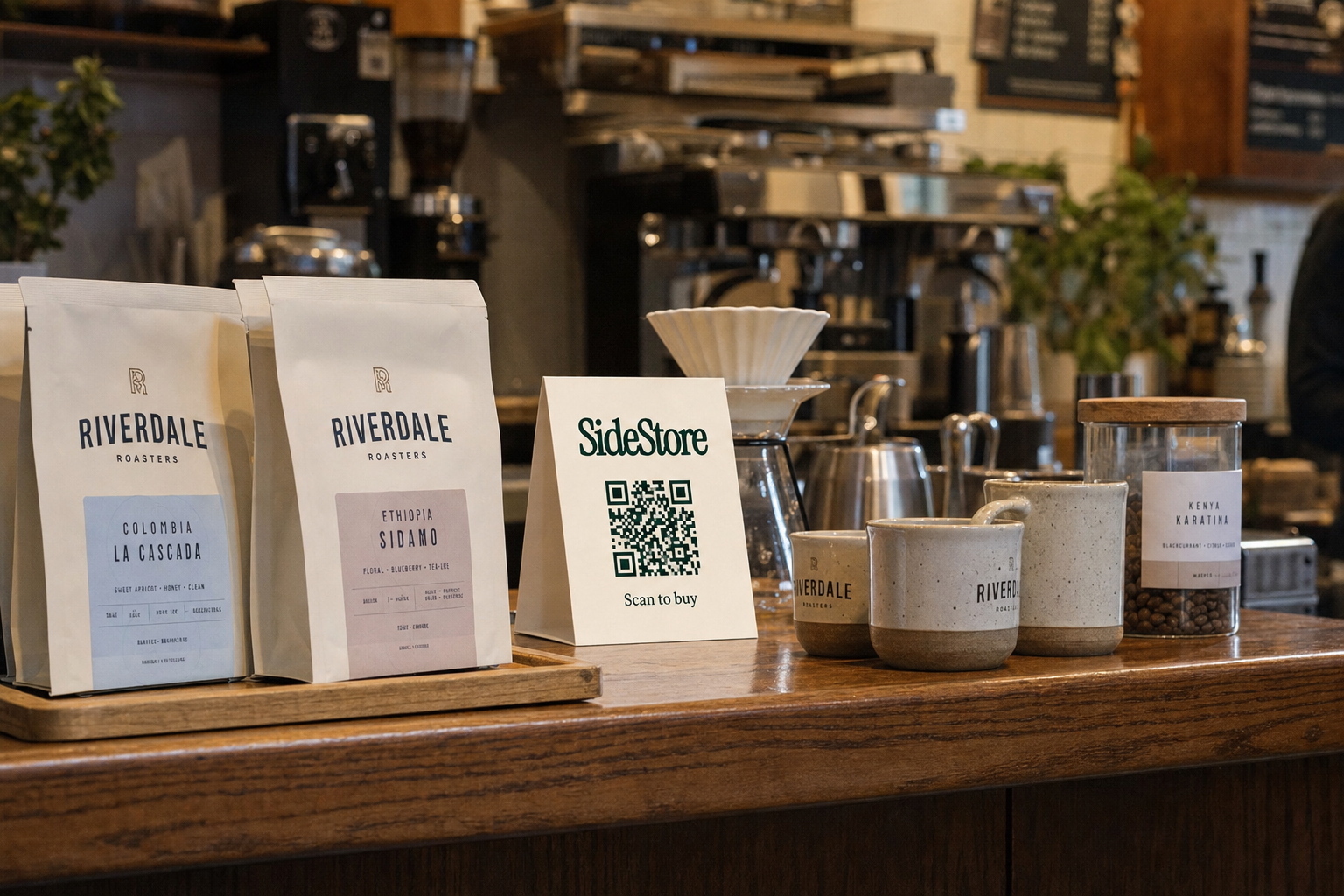
The Retail Widget is SideStore's interface for running that placement end to end. It is not just a QR code. The QR scan-to-pay is one function of a broader system. The Retail Widget handles:
- Scan-to-pay checkout via a printable QR card, which a maker can attach to their product or a merchant can display for all products in a placement
- Live stock tracking, so you know exactly what's on the shelf without visiting the venue
- Placement attribution, so you can see which venue is driving sales
- Automatic split payouts, settling the maker's share and the host's share without manual invoicing
The objection that "more platforms means more competition" applies online. It does not apply to a physical placement. A product sitting in a well-chosen cafe or boutique is not competing with ten thousand identical listings. It is simply there, visible, priced, and buyable.
For makers who sell particular product types, how to sell retail products in a salon on consignment and selling art prints in cafes through consignment show how this works in specific environments. For a broader picture of why distributed placement matters, how shared retail networks support local economies is worth reading.
Which Channel Fits Which Product? A Quick-Reference Guide
Channel fit is the fastest shortcut to better sell-through. The table below matches common product types to their strongest online and physical channels.
| Product Type | Best Online Channel | Best Physical Channel | Why |
|---|---|---|---|
| Handmade / craft goods | Etsy | Boutique or design shop on consignment | Etsy's audience seeks handmade; boutiques curate for the same buyer |
| Secondhand fashion | Depop | Pop-up or vintage market | Fashion resale needs visual discovery; foot traffic converts browsers |
| Electronics (used) | eBay | Local marketplace meetup | eBay reaches specialist buyers; local avoids shipping fragility risk |
| Art prints / original art | Etsy or own site | Cafe or gallery on consignment | Art prints suit browsing environments; daily foot traffic builds awareness |
| Candles / home fragrance | Etsy | Hotel lobby or boutique on consignment | Sensory products convert better in person. Buyers smell before buying |
| Furniture / large items | Facebook Marketplace | Local collection only | Shipping cost kills margin; local pickup is the only practical route |
| Food / packaged goods | Own website or local delivery app | Cafe or deli on consignment | Perishables need proximity; in-venue placement is the natural fit |
| Jewellery / accessories | Etsy or Instagram Shop | Salon or boutique on consignment | Jewellery converts on impulse; in-person display drives that impulse |
For product types that sit at the boundary of retail and hospitality, whether a coffee shop counts as a retail placement answers the question directly.
From One Placement to a Distributed Consignment Network
Starting a physical placement network is simpler than it sounds. Here is how to move from a first placement to a scaled operation, all managed from a single dashboard.
Step 1: Identify one venue. Start with a cafe, boutique, or hotel you already have a relationship with, or one whose customer profile matches your buyer. Use how to approach a local shop about stocking your products to structure that first conversation.
Step 2: Set up your Retail Widget placement. Define the consignment split, upload your product details, and generate the scan-to-pay QR. The merchant displays the QR card (either attached to your product or as a single card for the full placement).
Step 3: Stock the shelf. Drop off your products. From this point, live stock tracking in the Retail Widget tells you exactly what's on the shelf without requiring a visit.
Step 4: Monitor placement attribution. Once sales start, the dashboard shows which venue is converting and at what rate. Use that data to decide where to restock first and where to focus next.
Step 5: Add a second venue. The Retail Widget manages multiple placements simultaneously. Each new venue adds an independent stock count, payout split, and attribution line. No additional admin overhead per placement.
Step 6: Let the merchant handle the floor. In consignment, you don't need to hire someone to handle selling on your behalf. The merchant manages the physical space; you manage the dashboard. Payouts split automatically on each sale.
For operators wondering whether a cafe is worth approaching, how coffee shops earn from hosting consignment products gives the host's side of the calculation.
Frequently Asked Questions
Can someone begin selling on Amazon the same day they sign up? An individual seller account on Amazon can go live within a few hours for most categories. However, new listings without reviews or sales history rank poorly in search results. Expect to invest in advertising or wait weeks before organic sales begin.
Which platform is most widely used for selling items online? Amazon is the largest online marketplace by buyer volume in most Western markets. eBay holds the broadest product range. For handmade goods specifically, Etsy is the leading destination.
What does a selling platform do? A selling platform is any tool or system that lets you list a product, process payment, and fulfil an order. Some platforms are marketplaces with built-in audiences (Amazon, Etsy). Others give you a storefront but expect you to drive your own traffic (Shopify, BigCommerce).
Which online marketplaces are most popular? Amazon, eBay, Etsy, Facebook Marketplace, and Depop are the dominant platforms in English-speaking markets in 2026. Region-specific alternatives include Kleinanzeigen (Germany), Leboncoin (France), and Gumtree (UK and Australia).
What options exist for selling without paying fees? Facebook Marketplace charges no fee for local pickup transactions. OfferUp and Nextdoor are also free for local sales. SideStore consignment charges nothing upfront. The maker only receives a split on completed sales, never a listing fee.
Which apps allow local sales without cost? Facebook Marketplace, OfferUp, Nextdoor, and Gumtree are all free to list on for local sales. Shipping fees apply only if you choose to ship rather than meet locally.
How can items be sold in person rather than online? List on Facebook Marketplace or OfferUp and select local pickup only. Meet buyers in a public place. Alternatively, place products on consignment in a local venue through SideStore. The merchant handles the physical sale; the Retail Widget handles payment and payout automatically.
How quickly can items sell through different platforms? Facebook Marketplace and OfferUp can move high-demand items within 24 to 72 hours. eBay auctions can close in days. Amazon and Etsy listings for new sellers typically take weeks to gain organic traction. Physical consignment placements produce daily exposure from day one.
Is it possible to hire someone to handle online sales? Yes. Virtual assistants and fulfilment services exist for platform management. In a consignment model, the need is different: the merchant handles the physical floor, so you manage only the dashboard. No additional hire required for the in-venue side.
What platforms work best for selling locally? Facebook Marketplace is the most widely used for local sales. OfferUp works well in the US. Nextdoor suits neighbourhood-level items. Sellers commonly report turning to region-specific platforms first. Check what is dominant in your country before defaulting to a global option.
Are there alternatives to Facebook Marketplace? Yes. OfferUp, Nextdoor, Gumtree, and Craigslist all serve local selling. For indie makers, alternatives to Etsy covers non-marketplace options including consignment. Craigslist remains functional for large-item local sales in North America.
Can minors sell items online, and where? Most major platforms (Amazon, eBay, Etsy) require sellers to be 18 or over and have an agreement to their terms of service. Minors can often sell locally on Facebook Marketplace or OfferUp with parental supervision and consent. Policies vary by platform and by country. Check each platform's current terms before proceeding.
The Right Channel Mix: Online Listings Plus One Physical Placement
Pick one or two online platforms that match your product type, then add one physical consignment placement. Online listings give you search discovery and scale. A physical placement gives you daily visibility, no algorithm, and a buyer who can touch the product before buying.
Rank your existing platforms by fee structure and sell-through rate. Drop the weakest one. Put that energy into identifying one local venue (a cafe, boutique, or hotel) and setting up a SideStore placement. The Retail Widget handles checkout, stock tracking, and automatic split payouts from that point forward.
Build a consignment network without opening a store of your own.
For a detailed walkthrough of the mechanics, how to sell through someone else's store covers the full process. If Etsy has been your primary channel and you're ready to diversify, where to sell besides Etsy maps out the best alternatives alongside physical placement options.