Best Products to Sell Online—and Which Ones Actually Sell Better in Physical Shops
The best products to sell online are those with strong margin, proven demand, low fulfilment complexity, and a channel that matches how buyers actually make purchasing decisions. That list changes depending on your product type, your target customer, and where those customers are most ready to buy.
December is peak season for most physical and digital product categories, so November is exactly the right moment to get this right. If you're still building your channel strategy, the decisions you make now will shape your results through the busiest weeks of the year.
One common mistake: treating "best products to sell" as a universal, platform-agnostic list. The reality is that a product selling well on Etsy may underperform on Instagram, and a product that barely converts online may move quickly when it sits on a cafe counter next to a customer's flat white. Channel fit matters as much as product category.
You'll find plenty of guidance on where to sell stuff online, but this article also examines what happens when you add a physical consignment channel alongside your online presence. For many independent makers, understanding consignment selling as a model is the missing piece in a distribution strategy that is otherwise entirely digital.
What Actually Makes a Product Sell, Online or Anywhere
A product sells when four conditions align: the margin is healthy enough to survive platform fees or split payouts, demand is genuine and demonstrable, the product is repeatable enough to restock, and the distribution channel fits the way buyers discover and decide.
Most sellers focus almost entirely on the first two and neglect the last two entirely.
Margin is the starting point. If your product costs CHF 12 to make and retails at CHF 20, platform fees of 15 to 20 percent leave very little room. Many merchants report that products with less than a 60 percent gross margin struggle to survive channel costs. If you're exploring consignment, you need to know how to price inventory before you place a single unit.
Demand is real only when buyers pay for something, not when they say they like it. Validated demand means transactions, not social media saves. This is a common conflation: a product with 10,000 Instagram likes but 30 sales has an audience problem, not a product problem. The audience simply isn't in a buying mindset on that platform.
Repeatability is what separates a product from a project. Can you restock it reliably? Can you produce it consistently at the same quality and cost? One-off craft pieces have their own distribution logic, but a business model built on them is fragile.
Distribution fit is where most independent makers leave money behind. The assumption is that listing everywhere equals selling everywhere. It doesn't. Some products need touch, smell, or context to convert. Others sell on description alone. If you decide to sell through someone else's store, the channel fit question becomes: does this product type benefit from being physically present, or does digital suffice?
The answer to that question shapes everything that follows.
The Best Product Categories to Sell Online (With Real Trade-Offs)
The strongest categories for online selling right now are digital products, handmade physical goods, and niche accessories. Each has real advantages and real limits, and treating them as equivalent is one of the most common planning mistakes.
1. Digital Products
Digital products carry near-zero fulfilment cost, no inventory risk, and infinite scalability. Printable planners, digital templates, photography presets, online courses, and licensing files are strong examples. Once created, a digital product can sell thousands of times with no additional production cost.
Genuine advantages: No shipping, no stock, no spoilage. Revenue is entirely passive after the initial build.
Genuine trade-offs: Discovery is fiercely competitive. Platforms like Etsy and Gumroad are saturated in most categories. Without an existing audience, digital products are hard to surface. You're also entirely dependent on platform algorithm changes. And digital products can't occupy a physical shelf, which means you lose the impulse-purchase environment completely.
Don't conflate the digital model with the physical model. The distribution, pricing logic, customer journey, and margin structure are fundamentally different. Many searchers treat these as interchangeable, but a maker who prints ceramics and a maker who sells Notion templates are running entirely different businesses.
2. Handmade Physical Goods
Jewellery, ceramics, candles, textiles, leather goods, and illustrated prints consistently appear in the top-performing categories on platforms designed for independent makers. Buyers seek the handmade story and the maker connection.
Genuine advantages: High perceived value relative to material cost in many categories. Strong community and gift-purchase demand, particularly in November and December.
Genuine trade-offs: Fulfilment is real work. Shipping costs eat margins. Photography and presentation matter enormously online; poor product images kill conversion. Handmade goods also have a physical presence advantage: buyers often want to touch them before purchasing, which is a strong argument for a physical placement strategy. If you're buying inventory for an online boutique, handmade goods sourced on consignment can solve your stock-risk problem entirely.
3. Niche Accessories and Lifestyle Products
Water bottles with regional artwork, locally scented candles, branded tote bags, and niche wellness products perform well online when targeting a specific community. The specificity is the product's moat.
Genuine advantages: Community-driven word of mouth, lower competition than generic categories, strong gift purchase appeal.
Genuine trade-offs: Demand is narrow and fragile. If you don't organise your online boutique inventory carefully, overstocking in a niche category is a costly mistake. These products also benefit significantly from physical context, which we examine in the next section.
Online vs Physical Retail: Which Channel Fits Which Product?
Not all products should lead with an online listing. The channel that fits a product depends on how buyers discover it, how much context they need to decide, and whether touch or environment drives the purchase. The table below maps common product types to their strongest channel.
| Product Type | Online Channel Fit | Physical Channel Fit | Key Reason |
|---|---|---|---|
| Digital templates / presets | Excellent | None | No physical presence needed; instant download |
| Art prints and illustrations | Good | Excellent | Buyers want to see scale and colour in person |
| Handmade jewellery | Moderate | Excellent | Touch and try-on drive conversion |
| Artisan candles | Moderate | Excellent | Scent is the primary purchase driver |
| Niche accessories (totes, pins) | Good | Good | Works in both; gifting context helps in-person |
| Ceramics and homeware | Moderate | Excellent | Weight, texture, and finish matter to buyers |
| Wellness and beauty products | Moderate | Excellent | Trust built through environment and expert context |
| Printed books and zines | Good | Good | Browsable in person; discoverable online by niche |
| Food and beverage products | Poor online | Excellent | Sampling and immediacy drive purchase |
Consignment is the physical channel most accessible to independent makers. Rather than opening a pop-up or negotiating a wholesale arrangement, you place your products in an existing merchant space on consignment, which means the host carries no inventory risk and you pay nothing upfront. The host earns a split of each sale automatically.
This matters specifically because physical environments capture impulse purchases that online listings miss entirely. A customer browsing a cafe counter while waiting for their order is in a fundamentally different mindset than a customer actively searching a marketplace. The low-friction, ambient purchase moment is one of the most undervalued environments in independent retail.
For makers considering their first physical placement, specific merchant types suit specific product categories. Art prints move in cafe environments. Wellness products suit boutiques. Artisan food products suit coffee shops as retail spaces. The placement is as much a strategy as the product itself, and for makers who want to test physical retail without the costs of a pop-up store alternative, consignment is the most practical entry point.
How Consignment Placements Work, and Why They Suit Popular Physical Products
Consignment is a selling model where a maker places products in a merchant space and gets paid when those products sell, with no upfront cost to the host and no inventory risk on either side. It's not wholesale, it's not dropshipping, and it's not a pop-up: the products live in the merchant's space permanently, and the merchant earns a share of every sale automatically.
If you've been making and selling online and are ready to explore physical distribution, here's how a consignment placement works through SideStore's Retail Widget:
- List your product in the SideStore dashboard, setting your retail price and the host's split percentage.
- Model the placement: choose the merchant space, confirm shelf position, and set your starting stock quantity.
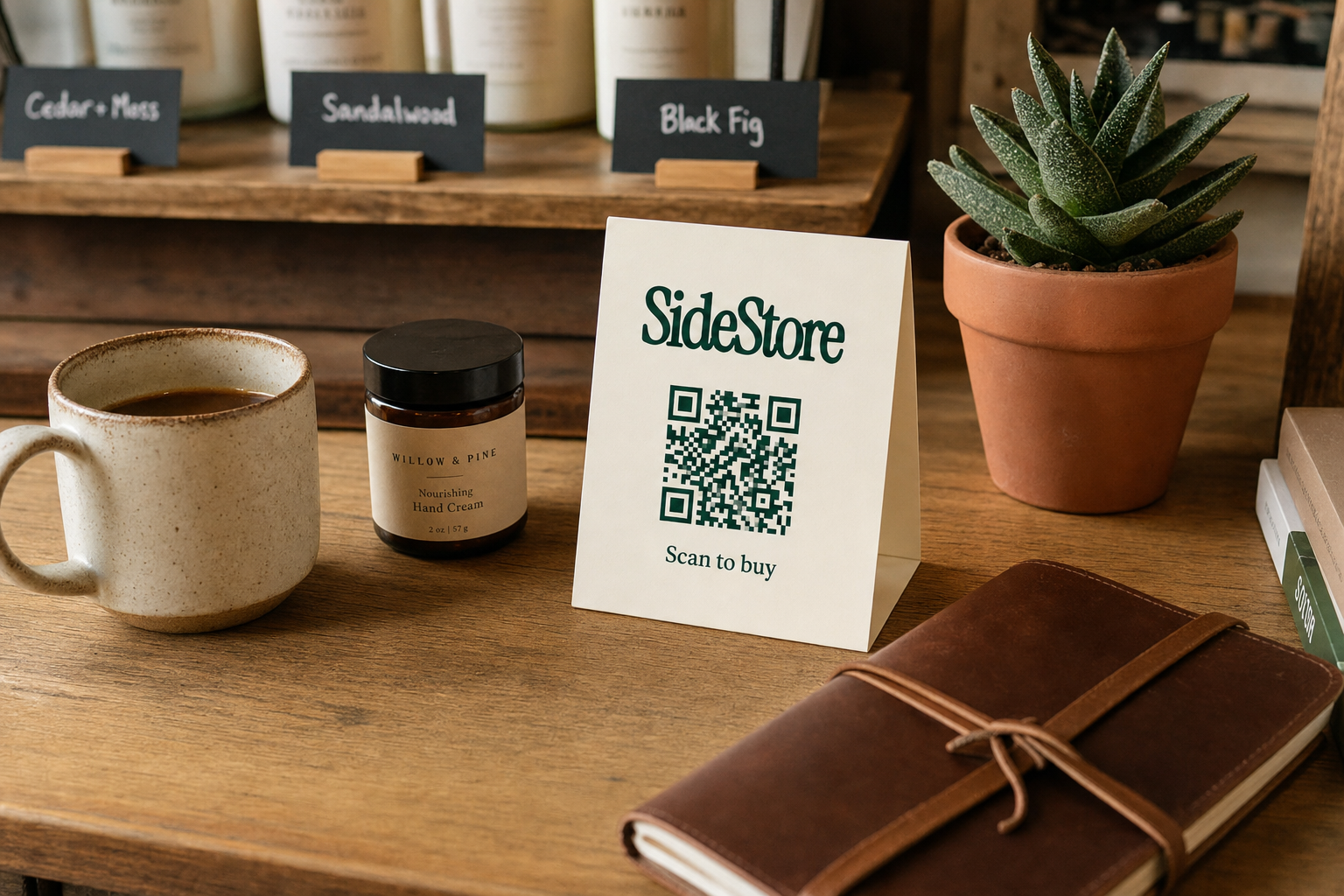
- Go live: the Retail Widget activates the placement with a printable scan-to-pay QR card. A maker can attach the QR card directly to each product, or a merchant can display a single card for all SideStore products in the placement.
- A customer scans and pays: the checkout completes instantly, stock updates automatically, and both the maker and the merchant receive their split payout without manual reconciliation.
- Placement attribution tracks which location generated each sale, so if you have products in five different spaces, you can see exactly which placements are working.
This distributed network model means you can run products in a cafe, a boutique, a hotel lobby, and a salon simultaneously, managed from one dashboard. That's what shared retail networks and local economies look like in practice for independent makers.
Product-to-merchant pairings that work well: illustrated prints in cafes, artisan skincare in boutiques, handmade jewellery in hotels, and wellness accessories in salons. The merchant earns without buying stock. You distribute without opening a store. For a full picture of the terms that govern these arrangements, consignment stock terms and conditions explains what to expect from both sides of the agreement. And if you're new to the model, selling to consignment is the place to start.
Products That Sell Well in Specialist Spaces: Salons, Cafes, and Boutiques
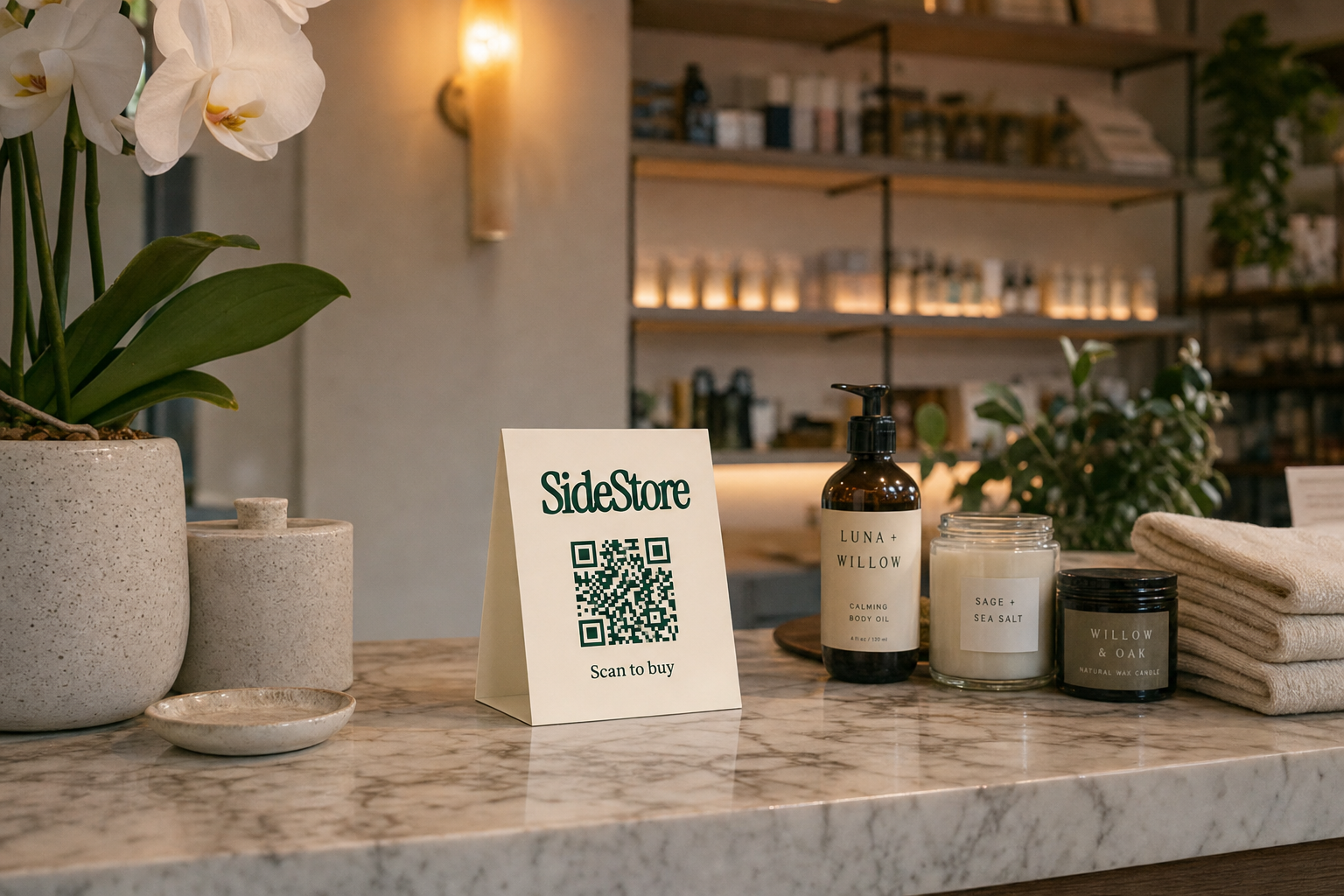
Certain merchant environments are remarkably effective retail channels for makers, and the product categories that convert in each space follow a clear pattern. Hair salons, cafes, and boutiques each create a different buying context, and placing the right product in the right environment makes a material difference.
Hair salons are one of the most underused retail environments in independent maker distribution. Clients spend 45 minutes to two hours in the chair, with limited distractions and genuine dwell time. Makers placing products in salon spaces report strong performance from travel-sized haircare accessories, handmade hair accessories like pins and clips, locally made candles and room mists, and small illustrated prints or cards. The key is that products must feel congruent with the salon's brand and clientele. For a practical guide to how this works, sell retail products in a salon covers the setup clearly.
Cafes convert best on impulse and gift purchases. Products that sit at or below the price of a specialty coffee purchase move quickly. Zines, art prints, handmade greeting cards, small ceramics, and locally produced food products are consistent performers. Understanding coffee shop profit margins helps you pitch the right split to a cafe host: a margin-conscious operator wants to see that hosting your products earns them meaningfully without complicating their workflow.
Boutiques are the most versatile physical environment for a wide range of physical products. Jewellery, textiles, ceramics, skincare, and lifestyle accessories all have a natural home in a well-curated boutique. For hosts managing multiple makers on consignment, boutique inventory management covers the operational side of running a consignment-active space efficiently.
How to Move From Online Listing to Physical Placement: A Starting Framework
Moving from an online listing to a physical placement involves four concrete steps: validating demand online first, identifying the right merchant type for your product, approaching the host with their benefit leading, and activating the placement with the tools that handle the operational detail for you.
Step 1: Validate demand online before placing physically. Your online listing data tells you whether buyers respond to your product at your price point. If a product isn't selling online with traffic, adding a physical placement won't fix a demand problem. Physical placement amplifies a working product; it doesn't rescue a failing one.
Step 2: Match your product to the right merchant type. Use the channel fit table above. Artisan candles belong in a cafe or boutique, not a hardware store. The environment is part of the product's presentation. A mismatched placement underperforms regardless of product quality.
Step 3: Approach the shop by leading with their benefit. When you approach a local shop about stocking your products, the opening conversation should not be about your product's story. Lead with the host's benefit: they earn a split of every sale, carry no stock risk, and need no extra workflow because SideStore's Retail Widget handles checkout, stock tracking, and split payouts automatically. This is a meaningfully different conversation from asking a shop to buy wholesale inventory.
Step 4: Activate the Retail Widget and go live. Once the host agrees, set up the placement in SideStore: price, split, stock quantity, and the scan-to-pay QR. Placement attribution shows you which location generates each sale. Live stock tracking alerts you when restocking is needed. Compared to the costs of pop-up retail space for rent, consignment activation has no premises cost at all. And you can track boutique inventory live across every placement from one dashboard.
Frequently Asked Questions
The most common questions about the best products to sell online reveal a consistent pattern: sellers want fast income, but channel mechanics and product type compatibility shape results more than product category alone.
How much money can be made selling online quickly? There's no honest universal answer to this. Income from online selling depends on margin, platform fees, traffic, and conversion rate, all of which vary by product and category. Many sellers report that sustainable online income takes three to six months to build, even with strong products. Anyone promising fast income without addressing these variables isn't giving you the full picture.
What are the core principles of successful selling? Strong margin, proven demand, product repeatability, and channel fit. These four principles apply whether you sell on a marketplace, through a consignment placement, or both. Getting them right before worrying about marketing or platform choice is the most reliable foundation for building a product business.
Which platforms work best for online sales? It depends on the product type. Etsy suits handmade physical goods and digital downloads. Gumroad and Payhip suit pure digital products. Shopify suits established product businesses wanting their own storefront. Instagram suits high-visual products with an existing audience. No platform works without traffic, and traffic requires either paid advertising or an organic audience.
What types of items have strong customer demand? Handmade goods, personalised products, niche accessories, digital templates, and locally made food and wellness products consistently perform across multiple channels. Gift-purchase products see particular demand in November and December.
Which digital products can be sold online? Printable planners, digital art, photography presets, templates, fonts, e-books, online courses, and licensing files are all viable. The model is entirely different from physical product selling: no inventory, no fulfilment, but high competition and strong dependence on platform discoverability. For more on how to purchase inventory for a boutique if you want to move into physical products, that guide covers the sourcing side.
Where can digital products be sold without upfront costs? Gumroad, Payhip, and Etsy all allow digital product listings with no upfront cost and charge only on completed sales. Ko-fi also allows digital downloads. Each platform takes a transaction fee, so pricing needs to account for that before you list.
What products work well in hair salon retail? Travel-sized haircare accessories, handmade hair clips and pins, locally made candles and room mists, and small illustrated prints perform consistently in salon environments. Products priced between CHF 10 and CHF 40 hit the impulse-purchase range that works in a seated, dwell-time environment.
How can retail products be sold through salon businesses? Consignment is the most practical model. The maker supplies stock, the salon displays it, and the Retail Widget handles checkout and split payouts. The salon earns without buying inventory. The maker earns from foot traffic they'd otherwise never access.
What is consignment selling as a sales model? Consignment is an arrangement where a maker places products in a merchant space and gets paid only when those products sell. The merchant carries no inventory cost and no stock risk. The maker retains ownership of unsold stock. SideStore's Retail Widget handles the checkout, stock tracking, and automatic split payout for every transaction.
Start With Channel Fit, Then Choose Your Product
The best products to sell online are not on a fixed list. They are the products where your margin, demand, and channel fit align. For many physical products, that alignment is stronger in a consignment placement than on a marketplace listing, particularly for goods that need touch, context, or environment to convert.
Start by identifying which channel your product actually suits. If it needs to be touched, smelled, or seen at scale, a physical placement should be part of your strategy from the start, not an afterthought once online sales disappoint. If you're ready to test a physical channel, the first concrete step is to sell through someone else's store using a consignment model that costs neither you nor the host anything until a sale happens.
Build a consignment network without opening a store of your own.