How to Find Retail Store Leads: A Maker's Guide to Identifying the Right Shops for Consignment

A store lead is any shop, cafe, hotel, or venue where your product could plausibly sell and where you haven't yet made contact. Finding the right ones is the first real distribution problem every independent maker faces.
If you've searched for store leads online, you've probably come across StoreLeads, a data platform that tracks Shopify stores and their technology stacks. That tool is built for brand teams doing large-scale e-commerce prospecting. It's not built for a maker building a hand-curated shortlist of local shops to approach on consignment. The two tasks sound similar but are entirely different.
The practical task for most makers is simpler and more personal: identify 20 to 30 real-world venues whose customers would buy your product, qualify each one briefly, and approach the owner with a consignment proposal. Consignment means no upfront cost for the host, no inventory risk, and no purchase order to negotiate. That removes the biggest objection a shop owner normally has. If you're new to selling through someone else's store, consignment is the model that makes the first conversation far easier than wholesale.
What Makes a Venue a Good Store Lead for Consignment?
A good store lead for consignment meets four criteria: its customers match your product category, enough people walk through the door each week, the owner makes their own stocking decisions, and there's visible space on a shelf, counter, or display stand.
Work through each criterion before you invest time in a cold approach.
Category fit. Your product needs to belong in that environment without explanation. Ceramic mugs fit naturally in a specialty coffee shop. Hand-poured candles belong in a lifestyle boutique. Greeting cards make sense in a gift shop. If a customer walking in would be surprised to see your product, that's a signal the fit is weak.
Foot traffic. A quiet neighbourhood store with five customers a day is unlikely to generate meaningful sales on consignment, however friendly the owner. You need steady footfall. Busy cafes, hotels with daily guest turnover, and boutiques in pedestrian zones all clear this bar reliably.
Owner autonomy. The person you're speaking to must be able to say yes without approval from a head office. Franchise locations, chain retailers, and department store concessions almost never offer that. Independent operators do. This is why large retailers are a poor first lead: they require supplier onboarding processes, volume commitments, and procurement contacts that take months to navigate. Many makers spend weeks pursuing a chain store that could never have said yes quickly.
Available display space. A shop with every surface at capacity isn't ready for a new product. Look for open shelving, a spare counter section, or a retail fixture that's only partially used.
Consignment is the entry model that sidesteps the host's main objection. Under wholesale, a shop owner has to spend money before they know whether your product sells. Under consignment, they take no financial risk at all. As you'll see in the consignment terms and conditions that govern a placement, the host earns a share of each sale and pays nothing upfront. That changes the conversation completely.
Which Types of Shops and Venues Should Be on Your List?
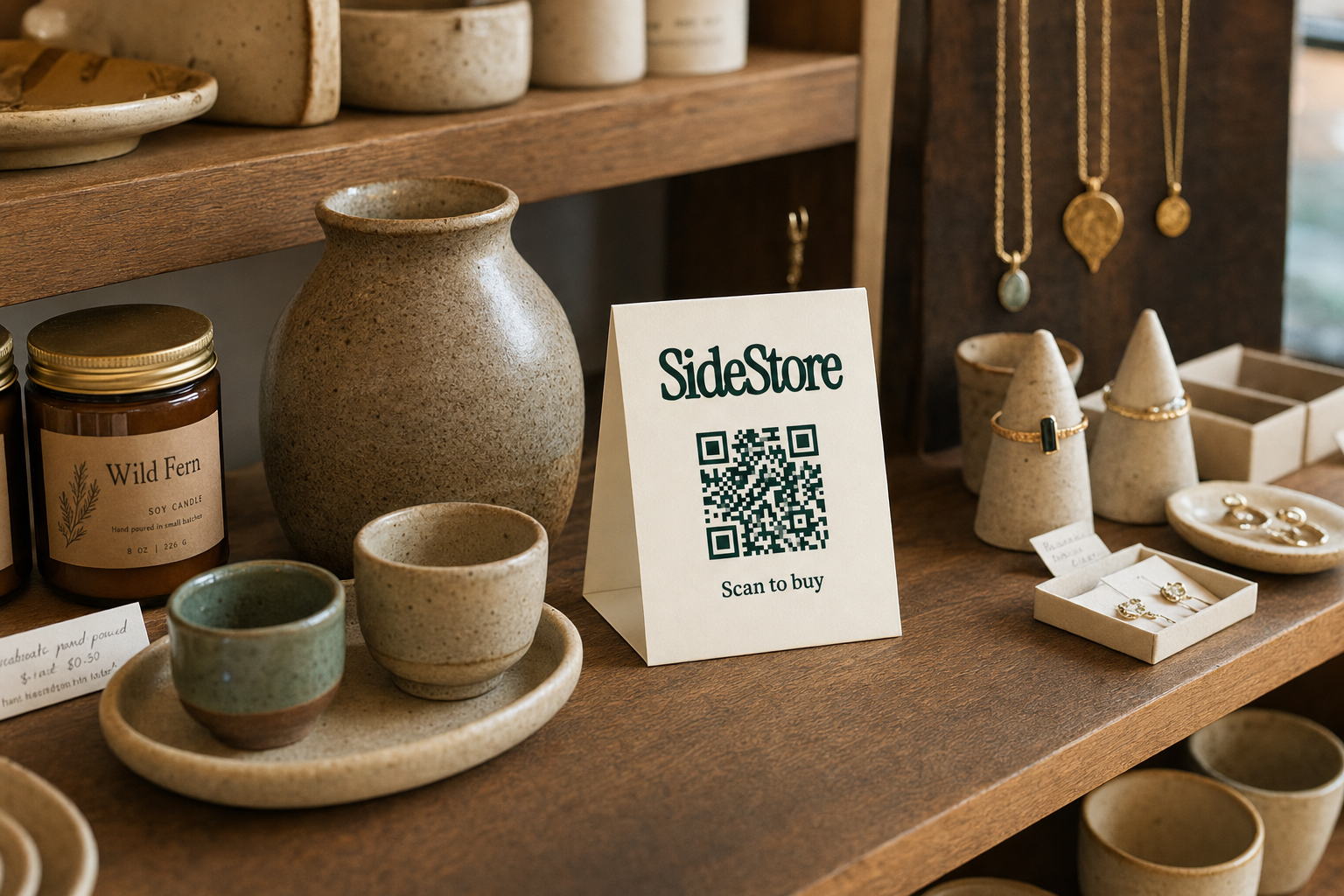
The five most productive venue types for consignment placements are independent boutiques, independent cafes, hotels and B&Bs, hair and beauty salons, and gift shops. Each attracts a paying customer who is already in a browsing or spending mindset.
Independent boutiques. The classic lead. Boutique owners curate their shelves actively, understand product aesthetics, and are accustomed to working with small makers. Category fit matters most here: a fashion boutique and a homeware boutique are entirely different environments.
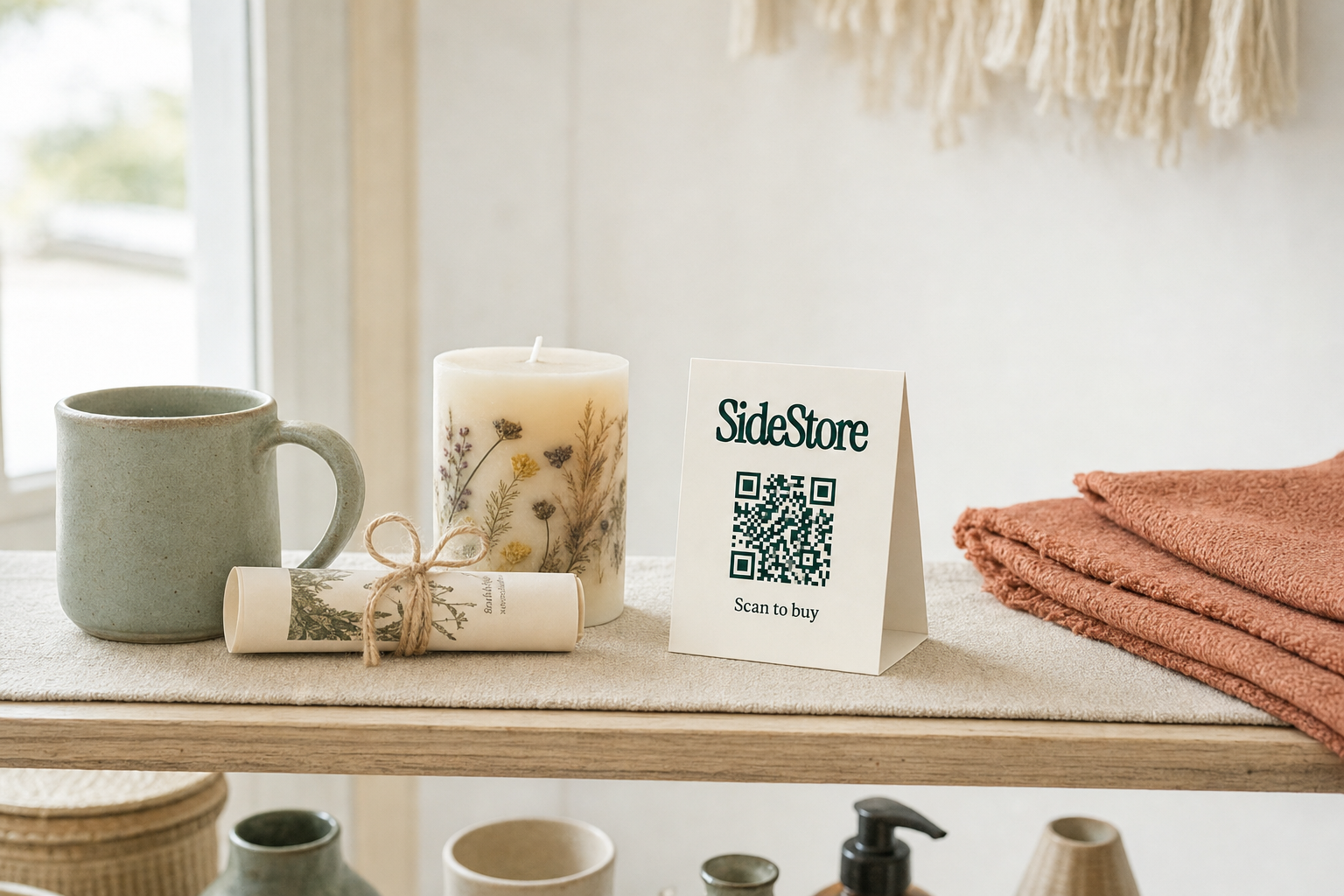
Cafes and coffee shops. This is the venue type most makers overlook, and that's a mistake. Cafes have high weekly footfall, customers who linger, and counter space that often sits underused. A well-made product with a clear scan-to-pay card can sell steadily alongside coffee orders without any effort from the barista. If you're curious about how selling in cafes works in practice, it's a more natural channel than it first appears. If you're unsure whether a coffee shop counts as a retail venue, the short answer is yes: it qualifies as a retail environment for consignment purposes.
Hotels and B&Bs. Guests are away from home, receptive to local products, and often looking for a gift to take back. The owner or manager typically has full autonomy over what appears in reception or in guest rooms. Turnover is daily, which means consistent exposure.
Hair and beauty salons. Appointment-based businesses with clients who sit for 30 to 90 minutes. That dwell time converts into browsing time. Retail products already exist in most salons, so the concept of selling physical goods isn't new to the owner. See the detail on placing products in a salon for the specifics.
Gift shops. Attached to galleries, museums, garden centres, or visitor attractions. Customers arrive expecting to buy something. Gift shops actively seek makers and are often the most receptive owners you'll approach.
How to Research and Build Your Store Lead List
Building a store lead list means finding real venues, noting contact details, and tracking your outreach. Start local, go specific, and keep the list to 20 to 30 shops before you begin approaching anyone.
Here are five methods that work reliably.
1. Walk the neighbourhood. This sounds obvious because it works. Spend two hours in any commercial area and you'll identify a dozen independent venues. Take a photo of the shopfront, note the name and address, and check the owner's name from the door sign or the till receipt. Local knowledge is richer than any database.
2. Google Maps category search. Search "independent boutique [your city]" or "gift shop [your neighbourhood]" in Google Maps. Switch to map view and scan the pins. Read the reviews: they tell you whether the shop sells artisan goods, who the clientele is, and how busy it gets.
3. Instagram location tags. Search the location tag for your town or neighbourhood and filter by shops. Many independent retailers post their interiors and their product ranges, which tells you immediately whether the category fit is there.
4. Local makers' markets and fairs. Talk to other makers who already have placements. They'll name shops that have been easy to work with and shops to avoid. That intelligence has no digital equivalent.
5. Local press and gift guides. Regional lifestyle magazines and newspapers regularly publish "best independent shops" lists. These are pre-qualified leads: someone else has already verified the shop is independent, active, and worth visiting.
On StoreLeads and similar platforms. These tools track Shopify stores by technology stack, revenue band, and product category. They're designed for sales teams prospecting at volume into e-commerce brands. If you're building a hand-curated list of physical venues for consignment placement, those platforms aren't built for your task. Free alternatives to StoreLeads exist for Shopify prospecting, but that's a different job. Don't conflate lead-generation data tools with the practical fieldwork of identifying physical retail leads. They serve different markets entirely.
Your spreadsheet columns. Use these fields: Shop Name, Venue Type, Address, Owner Name, Phone or Email, Category Fit (yes/no), Foot Traffic Estimate (low/medium/high), Display Space (yes/no), Contacted (date), Response, and Status. That's everything you need to run a 25-venue shortlist cleanly.
For more on the broader case for building a local retail network, the economic logic supports keeping your placements geographically clustered at first.
How to Qualify a Store Lead Before You Make Contact
Qualification means checking four things before you pick up the phone or walk through the door. Spending 10 minutes on this per lead saves hours of wasted outreach later.
Work through the checks in this order.
1. Category fit check. Visit the shop in person or review its Instagram and website. Does it already stock products in your category or adjacent to it? A shop that sells artisan food products isn't automatically a good lead for ceramic homeware, even if it feels like a "craft" space. Be honest about the overlap.
2. Ownership check. Search the shop name plus the town name to find the owner. Look for an "About" page, a local press mention, or a Companies House entry if you're in the UK. You need a name and confirmation that this is an independent operator, not a franchise or a managed concession.
3. Space check. Walk past the window. Is there visible display space that isn't already at capacity? A shop that's visually crammed has no practical room for a new placement without removing something else first. That's a harder conversation.
4. Footfall check. Visit at a busy time, typically a Saturday mid-morning, and count how many people enter in 15 minutes. A rough estimate is enough. For context, how much foot traffic a coffee shop typically generates gives useful benchmarks that apply to small retail venues more broadly.
If a lead fails one of the first three checks, move it to a "revisit later" column in your spreadsheet rather than deleting it. Shops change ownership, expand their floor space, and shift their product mix. A weak lead today may be a strong lead in six months.
Store Lead Qualification at a Glance
Use this table to score a venue quickly before you make contact. Each row maps a qualification check to what a strong lead looks like versus a weak one.
| Check | Strong Lead | Weak Lead |
|---|---|---|
| Category Fit | Products adjacent to yours already on the shelves | Unrelated product range; your item would seem out of place |
| Owner Autonomy | Independent operator who makes all stocking decisions | Franchise, chain location, or managed concession |
| Available Display Space | Open shelving, spare counter section, or underused fixture | Every surface at capacity; no obvious room for addition |
| Foot Traffic | Steady daily visitors; busy at weekends | Infrequent visitors; quiet even at peak times |
A lead that scores strong on all four is worth approaching this week. A lead with two or more weak scores is worth deprioritising until something changes.
How to Approach Your Store Leads with a Consignment Proposal

Approach a shop lead with a specific, personal pitch: name the shop, name the product, and name the model (consignment) in the first sentence. Generic outreach gets ignored. Shop owners report that most maker emails read as if they were sent to 50 shops at once, and that's usually true.
The three-part sequence:
1. Show up or email specifically. The most effective first contact for a small independent shop is an in-person visit at a quiet time, typically a weekday morning. If you email first, address the owner by name, mention one product you stock that yours would complement, and keep it to four sentences. No attachments.
2. Name consignment upfront. Many makers bury the financial model at the end of a pitch, after the owner has already started calculating whether they can afford stock. Lead with it: "I work on consignment, so there's no cost to you until a product sells." That shifts the conversation from risk to opportunity immediately.
3. Bring a sample or a photograph. A shop owner can't stock what they can't visualise. A physical sample is best; a high-quality printed photograph is a credible alternative. Leave one or the other behind if the owner is interested but not ready to commit.
For the full detail on structuring a first visit, see how to approach a local shop about stocking your products. For guidance on closing a placement deal and handling follow-up, pitching shops and closing placement deals covers the later stages.
Once a shop says yes, the Retail Widget handles the operational side: placement setup, a printable scan-to-pay QR for the display, live stock tracking, and automatic split payouts to you and the host. The QR is one function of the Retail Widget, not the whole product. The whole product is what lets you manage 10 placements across 10 venues from one dashboard.
How SideStore Turns Store Leads into Active Placements
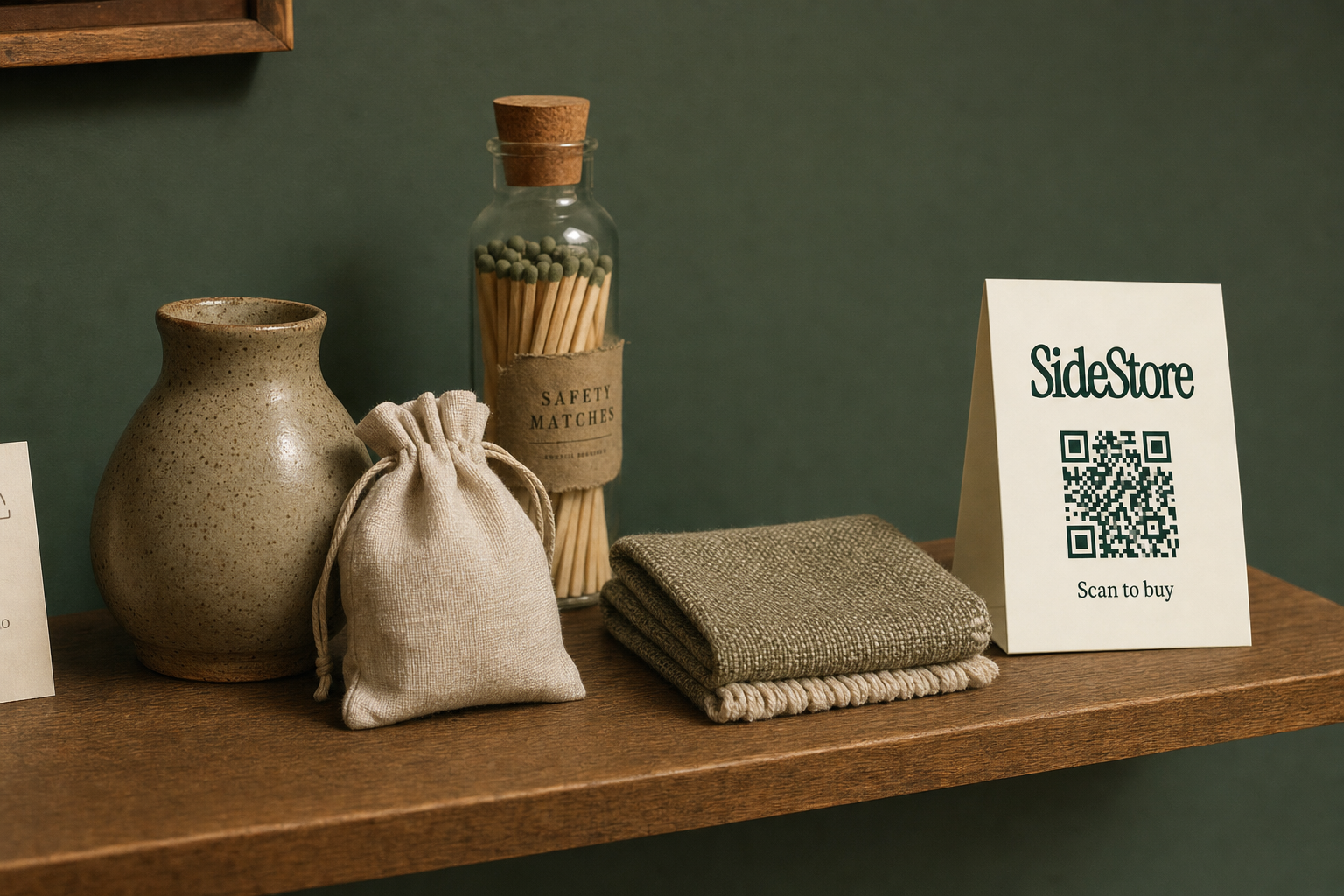
Once a shop agrees to host your product, SideStore takes over the mechanics. The Retail Widget is the interface that handles everything after a shop says yes: you set up the placement, configure the split between you and the host, and generate a printable QR code card for the display.
That QR is one function of the Retail Widget, not a standalone product. When a customer scans it, they pay, the transaction is recorded, your stock count updates live, and both you and the host receive your share automatically. The host doesn't need to log into a system or run a report. That low-effort setup is a genuine selling point in the approach conversation.
The dashboard view matters most once you have multiple placements running. You can see which venues are selling, which locations still have stock, and which placements need a restock visit, all from one place. That's what running a distributed consignment network looks like in practice.
If you're weighing consignment against other formats, why consignment is a smarter alternative to a pop-up covers the trade-offs directly. For makers who sell handmade goods, placing handmade products in boutiques gives the placement context specific to craft categories.
Frequently Asked Questions
The questions below cover both the practical task of finding physical retail store leads and the common confusion around digital tools like StoreLeads. Read them in sequence if you're new to the topic, or jump to the question that fits where you are right now.
What is the StoreLeads app and what does it do? StoreLeads is a B2B data platform that tracks Shopify stores by technology stack, revenue estimates, and product category. It's designed for sales and marketing teams who want to prospect into e-commerce brands at scale. It's not a tool for independent makers looking to place physical products in local shops. The two tasks are entirely different.
What is e-commerce data and how is it used? E-commerce data refers to information about online stores: the platform they run on, their estimated revenue, their product categories, and the third-party apps they use. Sales teams use it to identify and prioritise prospecting targets. For makers building a consignment shortlist, this type of data isn't useful. Your leads are physical venues, not online stores.
Why did Walmart discontinue their store leads program? Walmart ran a supplier lead and pitch programme for a period that allowed small brands to apply for shelf space consideration. The programme was discontinued as part of broader changes to their vendor development approach. The specifics of that decision are Walmart's own. For independent makers, Walmart and large-format retailers aren't productive first leads regardless: the approval process, volume requirements, and pricing expectations are incompatible with small-batch consignment.
How much does StoreLeads cost? StoreLeads publishes its current pricing on its own website. Pricing tiers vary by data volume and team size. Most independent makers building a local consignment shortlist don't need the tool at all. A spreadsheet, Google Maps, and two hours of local fieldwork will produce a better-qualified shortlist than any database for this specific task.
How does the StoreLeads Chrome extension work? The StoreLeads Chrome extension lets users view data about a Shopify store while browsing it: platform details, installed apps, and revenue estimates. It's a prospecting tool for sales teams targeting e-commerce businesses. It doesn't surface data about physical independent shops, which are your actual leads as a maker.
What alternative tools are available to StoreLeads? Alternatives for Shopify store prospecting include BuiltWith, Commerce Inspector, and Similar Web. All serve the same e-commerce sales team use case. For physical retail lead research, your tools are Google Maps, Instagram location search, local press, and your own feet. These don't have a software equivalent that's worth paying for at the scale most makers operate.
How do you access StoreLeads through an API? StoreLeads offers API access on its higher-tier plans, designed for teams that want to pipe store data into their own CRM or prospecting workflow. This is an enterprise-level integration. It has no relevance to a maker building a 25-venue consignment shortlist.
How do you get your brand into retail stores? Start with 20 to 30 hand-picked independent venues whose customers match your product. Qualify each by category fit, owner autonomy, available space, and foot traffic. Approach on consignment: the host takes no financial risk, which removes the main objection. Use SideStore's Retail Widget to manage the placement once a shop agrees. Consider pop-up retail space as an alternative if you want a temporary standalone presence while you build your consignment network.
How do you approach a retail store to sell your product? Visit in person at a quiet time, address the owner by name, and lead with the consignment model. Bring a sample or a photograph. Keep the first conversation short: your goal is to establish whether there's interest, not to close immediately. Follow up within a week if you don't hear back.
Is e-commerce still a viable business model in 2026? Yes, e-commerce remains a large and active channel. But for many independent makers, physical placement generates discovery that an online store can't replicate on its own. A customer who discovers your product in a cafe or boutique and scans the QR to pay is a different kind of buyer than one who finds you through a search ad. Consignment commerce and e-commerce are complementary, not competing.
Start With a Short List and Work It Properly
Twenty to thirty well-qualified leads, approached with a specific consignment proposal, will produce more placements than 200 generic emails. Quality of research and quality of approach are what determine results here, not volume.
Consignment removes the financial objection for the host: no upfront cost, no inventory to buy, and automatic split payouts through the Retail Widget when a product sells. That's a genuinely easy yes for the right venue.
This week, your single concrete action is this: identify five local venues that meet all four qualification criteria and confirm the owner's name for each. Then approach your first shop with a consignment proposal in hand. That's how you build a consignment network through other people's stores without opening a single one of your own.