Consignment Percentage for Jewelry: What's Fair and How to Negotiate It
A consignment percentage for jewelry is the shop's cut of each sale. You place your work on their shelf, a customer buys it, and you split the revenue. For jewelry, that split typically falls between 40% to the shop and 60% to you, or an even 50/50. Most boutique arrangements land somewhere in that window.
If you've landed on clothing consignment articles, you'll notice the rates look different. Clothing consignment shops often take 60% or even 70%, which reflects their high volume, fast turnover, and lower per-item value. Jewelry is different. Your pieces are higher in individual value, they sell more slowly, and they need careful display and handling. Many boutiques recognize this and price their hosting more fairly as a result.
The percentage you agree to shapes your profitability directly. A few points either way, spread across multiple placements, adds up fast. Understanding what's typical, what moves the rate, and how to negotiate from knowledge rather than guesswork is where this guide starts. For context on getting your work into physical stores, see how to sell handmade jewelry in boutiques.
What Percentage Is Typical for Jewelry Consignment Arrangements?
For jewelry, a 50/50 split between maker and shop is the most common starting point. Most consignment arrangements for handmade or independent jewelry sit in a range of 40, 60% to the shop, with 50% representing the midpoint most boutiques will cite as standard.
Here's how the range breaks down in practice:
- 40% to the shop / 60% to you: You land here when you're an established maker with proven sell-through, when you're supplying a venue that benefits from your name, or when the shop's overhead is low.
- 50% to the shop / 50% to you: The standard starting position for most independent boutiques and maker-friendly retailers. Expect this as the first offer.
- 60% to the shop / 40% to you: Typical in high-footfall venues with strong brand cachet, galleries with curatorial reputations, or arrangements where the shop invests significantly in display, marketing, or insurance.
Anything beyond 60% to the shop for jewelry warrants pushback. It's not impossible to justify, but it requires a clear reason: exceptional traffic, national press visibility, or access to an audience you genuinely cannot reach alone.
Before placing any piece, reviewing a consignment agreement for artists helps you understand what the percentage actually covers, because the split alone doesn't tell the full story.
What Factors Push the Consignment Percentage Up or Down?
Several factors determine where your rate lands within the 40, 60% shop range. Foot traffic, display investment, and your track record are the primary levers. Know these, and you negotiate from a position of knowledge.
What earns the shop a higher cut:
- High, demonstrable foot traffic in a curated retail environment
- Dedicated, locked display cases or lit vitrine space for your jewelry
- Active marketing by the shop through social media, newsletters, or in-store events
- Insurance coverage for your stock while on their premises
- A strong existing customer base aligned with your price point
What does not justify a higher cut:
- Vague claims of "lots of customers" without specifics
- A general shelf position with no dedicated display
- No marketing commitment beyond physical presence
The markup-versus-split distinction matters. Many makers confuse these. Markup is what the shop adds to your maker's price to arrive at retail. The consignment split then divides that retail revenue. So if your piece costs you £80 to make and you price it at £80, and the shop marks it up to £100 for retail, the 50/50 split is calculated on £100, giving you £50. Your actual return relative to your cost depends on both numbers. Agree both explicitly before placing stock.
Admin load as a negotiating factor: Shops that use tools like the SideStore Retail Widget handle stock tracking, checkout, and split payouts automatically. That reduced admin is a legitimate reason to negotiate toward a better maker rate. When a shop doesn't need to manually reconcile sales or write you a cheque at month's end, their cost of hosting you drops. Name that plainly in a negotiation.
For a broader view of what consignment involves, see selling through someone else's store and how to approach a local shop about stocking your products.
Is Consignment the Right Channel for Jewelry, or Should You Consider Alternatives?
Consignment suits jewelry well in many cases, but it's not always the right channel. Honest answer: it depends on your cash flow, your margin, and your patience for slow sell-through. Comparing it against other channels helps you decide.
| Channel | Upfront cost to maker | Revenue share | Inventory risk | Speed of payment | Control over pricing |
|---|---|---|---|---|---|
| Consignment | None | 40, 60% to shop | Maker bears unsold stock | Slow (paid when sold) | Shared with host |
| Wholesale | None (stock cost only) | 0% ongoing; you sell at cost | Shop bears it | Fast (paid on delivery) | You lose it at sale |
| Selling direct (market, own site) | Stall fees or platform fees | 100% to you | Maker bears it | Immediate | Full |
| Pawn shop or jeweler buy-out | None | N/A (one-time sale) | None after sale | Immediate | None |
| Pop-up retail | Space rental cost | 100% to you | Maker bears it | During event | Full |
On pawn shops and jewelers as an alternative: Selling outright gives you immediate cash and zero inventory risk. The trade-off is you'll receive well below retail value, often a fraction of what the piece would earn on consignment. If cash flow is the priority and the piece holds mostly material value, that may be your call. If the piece has craft or artistic merit, or a retail price significantly above material cost, consignment will almost always return more over time.
Is consignment worthwhile at all? Yes, for the right maker and the right piece. Consignment lets you place work in front of customers without paying for a shop lease or market stall. But it requires patience: jewelry can sit for weeks or months before selling. You bear the cost of unsold stock, and payment only arrives when a sale happens. That slow payment cycle is the main downside, and it's worth planning around.
For a detailed comparison, selling jewelry on consignment covers the model in depth, and pop-up retail space as an alternative outlines the short-term rental option if you want more control.
How to Negotiate a Fair Consignment Split with a Shop
Negotiating a consignment percentage is easier when you know your floor rate before the conversation starts. Your floor rate is the minimum split that lets you cover costs and make the placement worthwhile. Below that number, you decline, politely and without apology.
Step-by-step negotiation sequence:
Calculate your floor rate. Work backwards from your cost of goods, your time, and your target margin. If your piece costs £30 to make and you need at least £50 to make consignment viable, a 50/50 split requires a retail price of at least £100. Know this number before you walk in.
Research the shop's standard terms. Many boutiques publish or volunteer their standard split. Knowing whether they start at 50/50 or 60/40 tells you how much room exists to negotiate.
Open with your preferred rate, not theirs. Ask for a 50/50 split as a minimum, or 40/60 in your favor if your sell-through record justifies it. Starting at your preferred position leaves room for them to negotiate toward the center rather than pushing you below your floor.
Reduce their admin as leverage. If the shop uses SideStore or another automated consignment tool, their overhead for hosting you is low. If they don't, offer to use one. Less admin is a real benefit you can name.
Agree to a trial period. A 60, 90 day trial with a review clause removes pressure from both sides and gives you a concrete moment to renegotiate based on actual sales data.
A script you can adapt:
"My standard rate is 50/50 on the retail price. I keep detailed stock records and can provide a sell-through report at 30 days. If the placement performs, I'd love to talk about a longer-term arrangement. Does that work as a starting point?"
For more on approaching shops with confidence, see pitching your jewelry to boutiques. For what the agreement should contain, see what a consignment agreement should include.
What to Put in Writing Before You Hand Over Your Jewelry
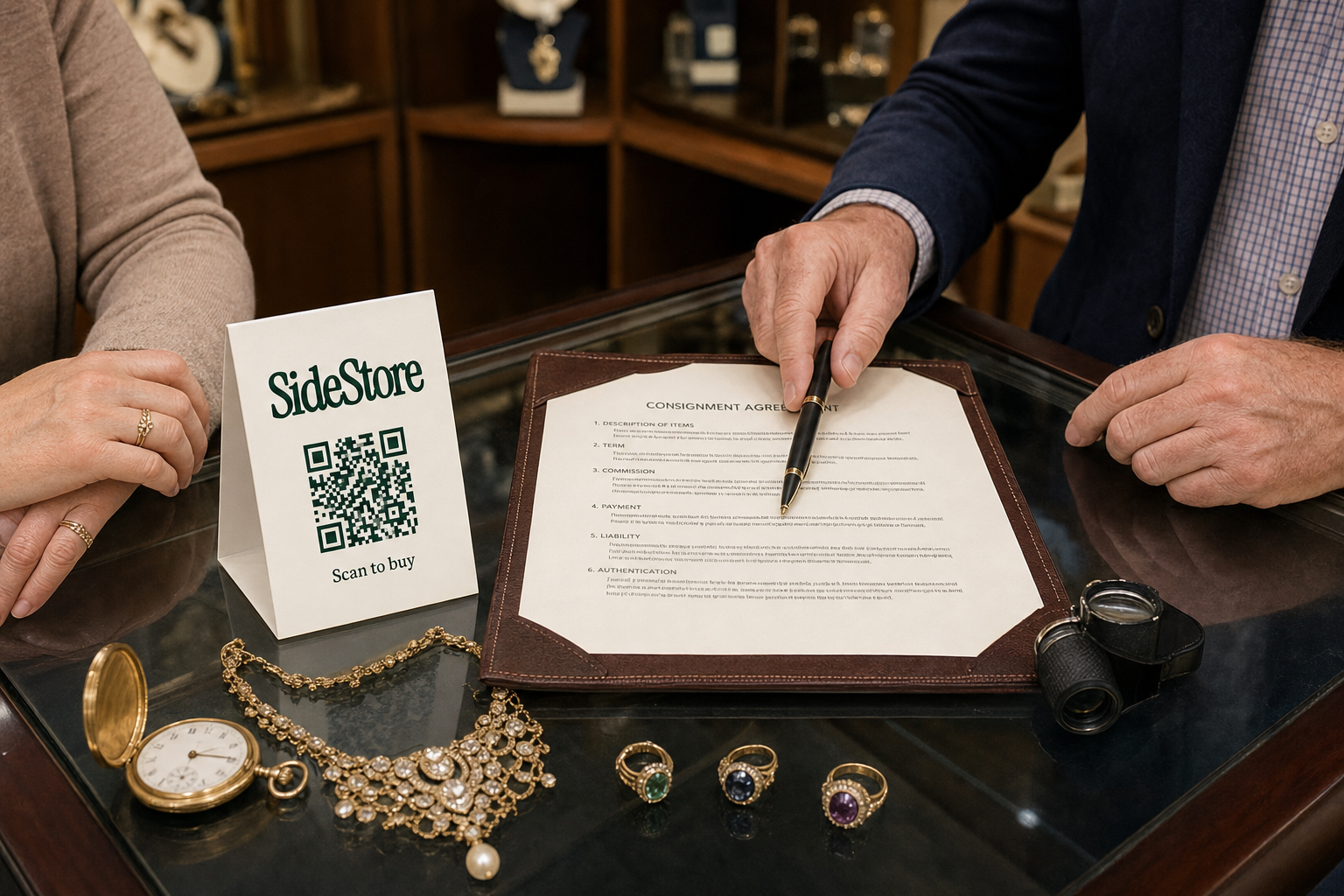
A handshake is not a consignment agreement. Before you leave a single piece with a shop, you need a written document that covers the terms explicitly. This is especially important for jewelry, where individual pieces can be high in value and slow to sell.
Minimum clauses every jewelry consignment agreement should include:
- Exact consignment percentage agreed by both parties, stated numerically
- Retail price for each piece, or the method used to set it, including any markup
- Payment schedule: When are you paid? Monthly is common; quarterly is slow but sometimes offered. For jewelry, monthly payment cycles are worth insisting on.
- Stock list: A signed, itemized record of every piece placed, with description, quantity, and agreed retail price
- Duration and review clause: How long does the agreement run, and when can either party exit?
- Unsold stock return terms: How much notice does the shop give before returning pieces, and in what condition?
- Insurance and liability: Who covers a piece if it's lost, stolen, or damaged while on the premises?
- Exclusivity clause (if any): Does the shop require that you don't place the same pieces elsewhere nearby?
Red flags worth walking away from: No written agreement at all, a payment schedule longer than 60 days, refusal to sign a stock list, or any clause that transfers ownership before a sale. On that last point: consignment means ownership stays with you until a customer buys the piece. Period.
Using a platform like SideStore, which provides automatic split settlement and live stock tracking, creates a transparent record that supplements your written agreement. For a deeper review of the agreement structure, see the consignment agreement for artists guide, and for tools that support ongoing management, see consignment inventory software.
Frequently Asked Questions About Consignment Percentages for Jewelry
What percentage is typical for jewelry consignment arrangements?
The typical consignment percentage for jewelry is 50% to the shop and 50% to the maker. The standard range runs from 40% to the shop at the maker-friendly end, to 60% to the shop in high-footfall or high-service venues. Most boutique arrangements start at 50/50 and adjust based on the shop's traffic, display investment, and your track record.
What counts as a standard consignment fee?
A standard consignment fee is the shop's percentage of the retail sale price, not a flat fee charged upfront. In jewelry, that percentage is typically 50% of the retail price per piece sold. Some shops call it a "commission" rather than a fee. Upfront fees for placement are unusual and should be questioned: standard consignment costs you nothing unless a sale occurs.
Is consignment a worthwhile option for selling jewelry?
Consignment is worthwhile for jewelry when your retail price is healthy enough to absorb the shop's share and still return a meaningful margin to you. The main drawback is slow payment: you're paid when a piece sells, not when you deliver it. Many makers find consignment valuable for reaching new audiences without a fixed retail cost, provided they manage cash flow accordingly.
Should jewelry be sold to a jeweler or pawn shop instead?
Selling outright to a jeweler or pawn shop gives you immediate cash but typically returns well below the piece's retail value. If your jewelry carries significant craft or artistic value above its material cost, consignment will almost always return more over time. Outright sale to a pawn shop makes sense when you need immediate liquidity or when the piece's value is primarily in its material weight.
What is normal markup applied to jewelry?
Markup is separate from the consignment split. Markup is the amount added to your maker's price to arrive at the retail price displayed to customers. For handmade jewelry in boutique settings, many shops apply a markup that results in a retail price roughly double the maker's price, though arrangements vary. Importantly, the consignment split is calculated on the retail price after markup, not on your original cost. Agree both the markup and the split explicitly before placing stock.
What percentage does a consignment arrangement typically take?
A consignment arrangement for jewelry typically takes 40, 60% of the retail sale price for the shop. The most common figure is 50%. The remaining 40, 60% goes to the maker. This is different from clothing consignment, where shops often take 60, 70%, reflecting the higher per-item value and slower turnover of jewelry. For context on how shared retail placements work more broadly, see how shared retail networks support local economies and whether a coffee shop counts as a retail placement.
Setting a Rate You Can Stand Behind
A fair consignment percentage for jewelry starts with knowing your floor rate before any conversation begins. From there, the process is straightforward: negotiate from your preferred position, not the shop's default; get every number in writing; and revisit the terms after the first 60 to 90 days of trading.
Three things always protect you. Know the minimum split that makes the placement financially viable for you. Negotiate from that floor, not below it. And put the agreed rate, the stock list, and the payment schedule into a signed document before a single piece leaves your hands.
Jewelry consignment, managed well, is a low-cost way to reach customers you would not otherwise find. Managed poorly, it ties up stock and pays you slowly. The difference is almost always in the paperwork and the preparation.
For practical next steps, see how to sell handmade jewelry in boutiques for getting your work in front of the right shops, selling jewelry on consignment for a full model overview, and placing products in cafes and other non-traditional retail spaces if you want to explore venues beyond the traditional boutique.