Selling Jewelry on Consignment: How to Place Your Pieces in Shops Without Wholesale Risk
What Is Selling Jewelry on Consignment?
Selling jewelry on consignment means you place your pieces in a shop, the shop displays and sells them on your behalf, and you get paid a percentage of the sale price only after a piece sells. The shop pays nothing upfront. You keep ownership of every unsold piece until someone buys it.
That's the model. It works the same whether you call it "selling on consignment" or "selling through consignment", the distinction is purely grammatical.
For jewelry makers, consignment is the primary route into physical retail without capital risk. Wholesale requires a shop to buy your stock outright, often at a steep discount. Consignment requires only shelf space from the shop. That asymmetry makes it accessible, especially when you're still building your reputation and testing which venues sell your work best.
If you're already thinking about selling handmade jewelry in boutiques or exploring what it means to be selling through someone else's store, consignment is the mechanism that makes those placements work without tying up your cash in unsold stock.
How Does the Jewelry Consignment Process Work?
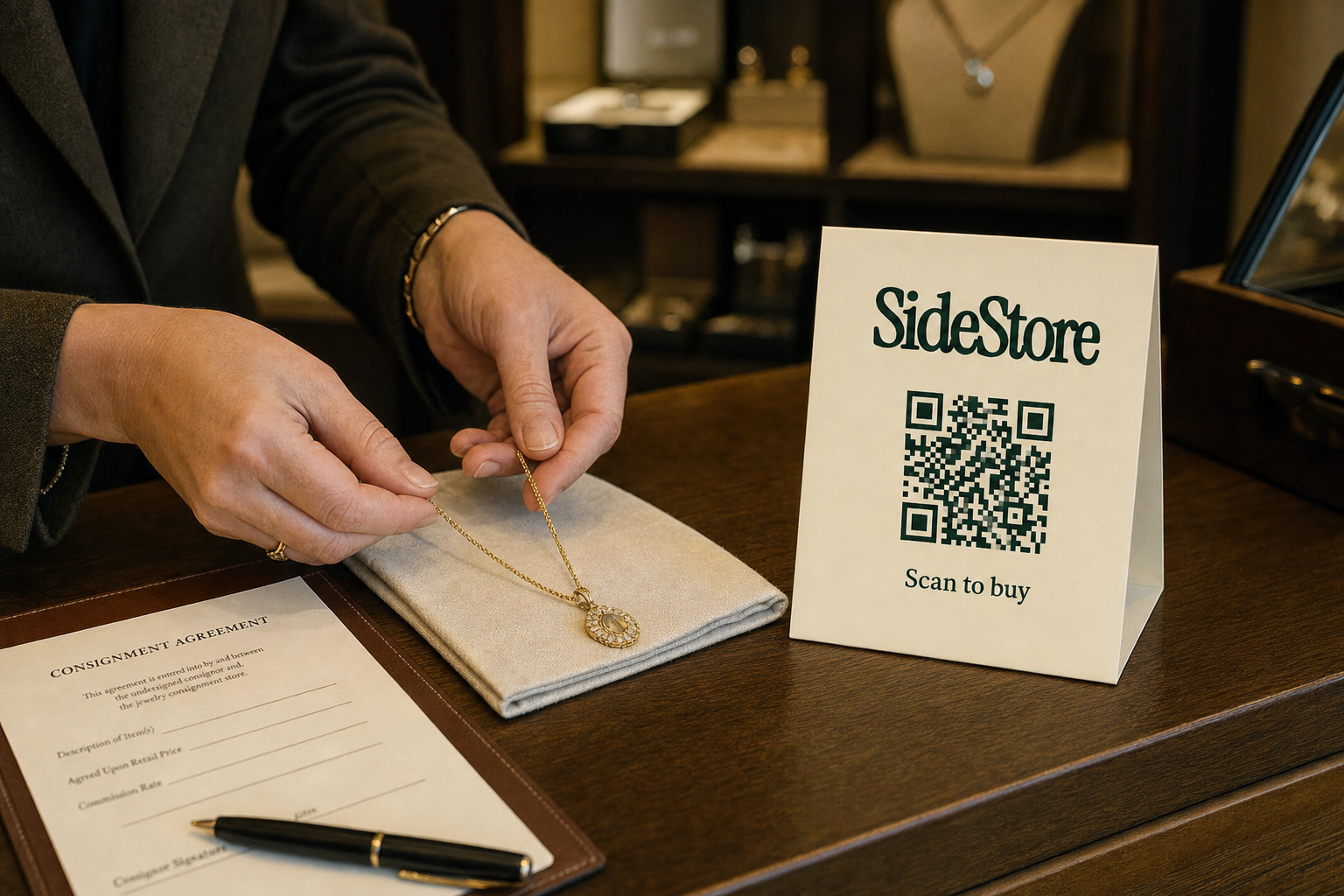
The jewelry consignment process is straightforward: you deliver pieces to a shop, the shop displays them, a customer buys one, the shop pays you your share, and any unsold pieces come back to you at an agreed date. You never lose ownership until a sale happens.
Here's how it plays out in practice:
Agreement. You and the shop owner sign a consignment agreement that covers the split percentage, display period, pricing, and return terms. Nothing moves without this.
Placement. You deliver your jewelry with a signed inventory log. Each piece gets photographed and listed by description, quantity, and retail price. The shop receives no title to the goods.
Display and sale. The shop displays your work. When a customer buys a piece, the shop records the sale at the agreed retail price.
Settlement. The shop forwards your percentage of the sale price. Depending on your agreement, this happens weekly, monthly, or per sale.
Return of unsold stock. At the end of the agreed display period, unsold pieces come back to you in the condition you delivered them. If a piece is lost or damaged while in the shop's care, your agreement should specify who bears the liability.
Ownership is the key concept throughout. You're not selling your stock to the shop. You're placing it. That distinction matters legally and practically.
The manual version of this process works, but it creates friction. Inventory logs go missing. Settlement timelines slip. Disputed stock counts happen regularly. Modern tools close these gaps. The SideStore Retail Widget automates stock tracking, records each sale at the point of checkout, and handles split payouts automatically. That removes the administrative gaps where disputes tend to start. Pairing a written agreement with a tool like consignment inventory software closes most common failure points.
What Percentage Do Shops Take on Jewelry Consignment?
Shops typically take between 30% and 50% of the retail sale price on jewelry consignment, with 40% shop / 60% maker being the most common split in boutiques and independent retailers. Some galleries and hotel gift shops push closer to 50/50, particularly if they carry significant foot traffic or brand cachet.
The split sounds straightforward until you apply it to your actual numbers. Here's a worked example that makes the arithmetic visible:
- Retail price: $120
- Shop takes 40%: $48 to the shop
- Maker receives 60%: $72
- Cost of goods and labour (materials, tools, time): $50
- Maker's net profit: $22
Twenty-two dollars on a $120 ring is an 18% net margin. That's workable if you have consistent volume, but it evaporates quickly if your production costs are higher or the split tilts toward 50/50.
The formula to check any deal:
Net profit = Retail price × (1 - shop percentage) - cost of goods and labour
Run this before you agree to any placement. If the result is negative or uncomfortably thin, you have three options: raise your retail price, reduce your production costs, or negotiate a better split.
The fear of being underpaid in consignment deals is real, but it's addressable. Shops aren't automatically exploitative; many simply set standard terms and expect makers to negotiate. Knowing your cost of goods before you walk in is the single most protective step you can take. If a shop refuses to tell you their standard percentage before you bring stock in, treat that as a warning sign.
For more on pricing your work to survive the split, see pitching and pricing your jewelry for boutique placement.
Consignment, Wholesale, or Pawn Shop: Which Makes More Financial Sense?
Consignment typically offers the highest percentage of retail price to the maker, but payment arrives only after a sale. Wholesale pays immediately but at a steep discount, often 40, 50% of retail. Pawn shops pay the least and buy outright, with no ongoing relationship. The right method depends on your cash position, your pricing power, and how much risk you can absorb.
The table below lays out the core trade-offs:
| Method | Who buys upfront | Maker's risk | Typical payout as % of retail | Speed of payment | Best for |
|---|---|---|---|---|---|
| Consignment | Nobody. Shop pays only on sale | Slow or no payment if stock doesn't sell | Often 50, 70% of retail | Delayed (per sale or monthly) | Makers building distribution with low capital |
| Wholesale | The shop buys stock upfront | Capital tied up; deep discount required | Typically 40, 55% of retail | Immediate on delivery | Makers with proven demand and production scale |
| Pawn shop | The pawn shop buys outright | Permanent loss of piece at low value | Often 20, 40% of estimated value | Immediate | Sellers needing fast cash on existing (not new) pieces |
| Online consignment | Platform pays after sale | Platform fees reduce margin; no physical presence | Typically 50, 70% of retail minus fees | Delayed | Makers without local venue access or selling estate pieces |
A few points worth understanding behind the numbers. Wholesale gives you certainty. The shop owns the stock and the risk, and you get paid on invoice. The trade-off is that you need to price high enough that a 50% wholesale discount still leaves you profitable. Many jewelry makers find that difficult without strong production volume.
Pawn shops are built for liquidation, not for makers selling new work. If you're selling estate jewelry you inherited, a pawn shop may be realistic for quick cash. For anything you made yourself, the maths rarely work in your favour.
Online consignment platforms extend your reach beyond your local area, which matters for niche or high-value pieces. The fees vary significantly by platform, so check them carefully before listing.
For makers building a physical retail presence, shared retail models for independent makers offer a related structure worth understanding alongside consignment.
What Should a Jewelry Consignment Agreement Include?
A consignment agreement for jewelry should cover six core elements: item description and value, the commission split, the display period and return terms, pricing authority, liability for loss or damage, and the payment schedule. Without all six, you're exposed.
Asking a shop for a written agreement isn't adversarial. It's professional, and most established shops expect it. If a shop resists putting terms in writing, that tells you something important before you place a single piece.
Note the terminology: "consignment terms and conditions" and "consignment agreement for artists" refer to the same document. Whatever a shop calls it, the substance should cover:
1. Item description and inventory list. Every piece placed should be itemised with description, material, quantity, and agreed retail price. Attach this as a signed schedule to the agreement. This is your proof of what you delivered.
2. Commission split. State the exact percentage the shop retains and the exact percentage you receive. Write it as a number, not a range.
3. Display period and return terms. Agree on how long the shop will display your work (commonly 60, 90 days) and what happens at the end of that period. You should be entitled to collect unsold pieces promptly.
4. Pricing authority. Specify who can change the retail price and under what circumstances. Discount sales and promotional markdowns should require your written consent unless you've agreed to a floor price below which the shop cannot go.
5. Liability for loss or damage. Your pieces are your property until they sell. Clarify whether the shop's insurance covers your stock or whether you need your own maker's insurance while pieces are on their premises.
6. Payment schedule. State the exact payment frequency, the method (bank transfer, cheque), and what documentation accompanies each payment. Monthly reconciliation with a written sales report is a reasonable minimum.
SideStore's Retail Widget handles several of these administrative elements automatically: it tracks stock in real time, records each sale with placement attribution, and triggers split payouts. That reduces manual reconciliation significantly. It doesn't replace the written agreement, but it does make enforcing it much easier.
Before you approach a shop, read approaching a local shop about stocking your products. Once you're in, tracking consignment inventory covers the operational side in detail.
Where to Place Your Jewelry on Consignment: Shops, Hotels, and Beyond
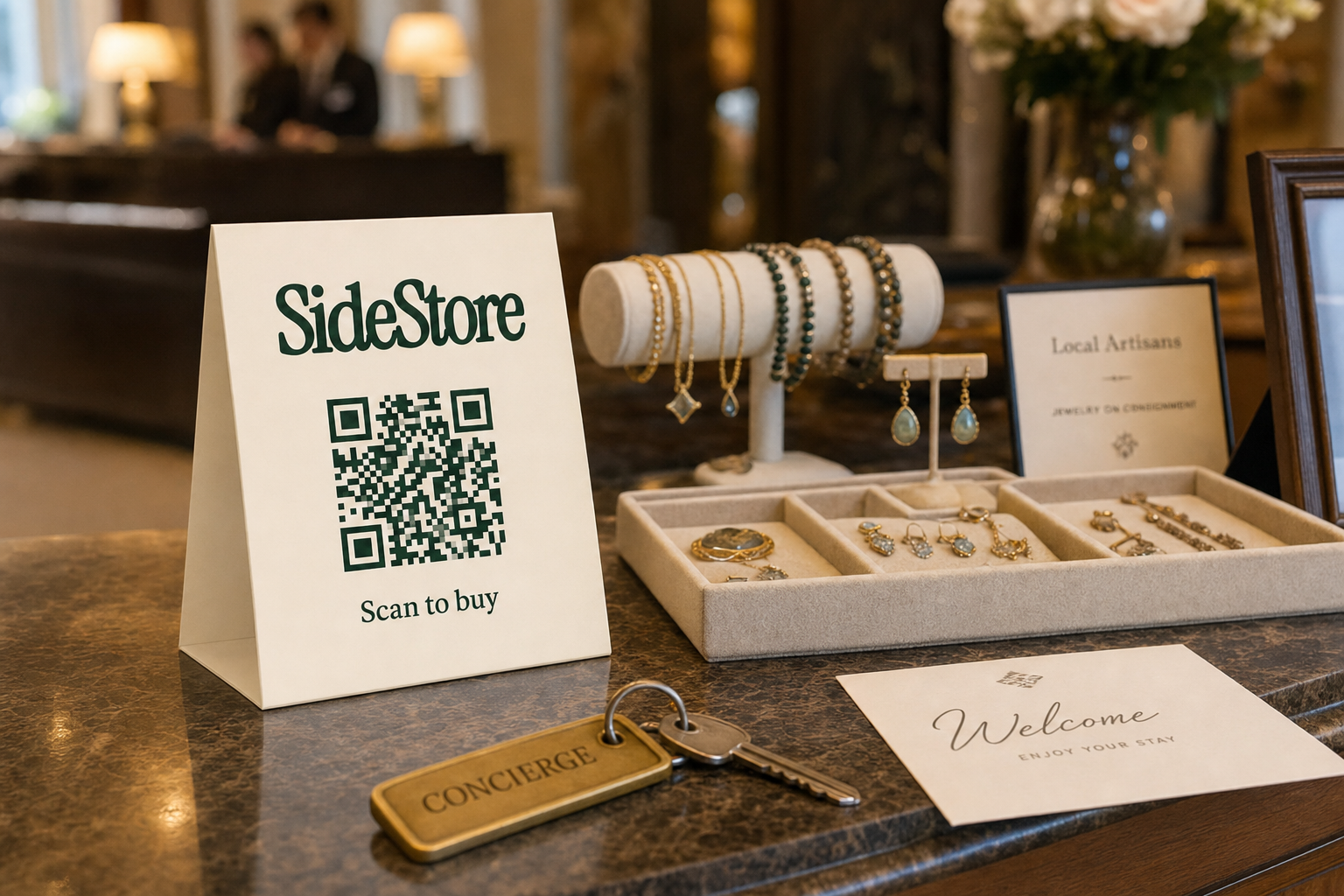
The best venues for jewelry consignment are places where your target buyer already spends time and is in a purchasing mindset. Boutiques, hotel lobbies, design galleries, and high-footfall cafes each offer distinct advantages, and the right choice depends on your price point, aesthetic, and the type of customer you want to reach.
Independent boutiques are the most natural fit. They already attract customers who expect handmade, curated, or locally made goods. A shared aesthetic between your work and the shop's existing offer is the single strongest predictor of sell-through.
Hotel lobbies and gift shops reach a transient, often gift-buying audience. Pieces at accessible price points (under $80, 100) tend to perform well because hotel guests are frequently buying for others. For guidance on this specific channel, see placing products in hotel retail spaces.
Design galleries and maker collectives suit higher-value or more conceptual work. These spaces attract buyers who understand craft and are willing to pay for it, but footfall is often lower.
Cafes and high-footfall hospitality venues are underused placements for jewelry makers. A well-placed display near a counter, with a clear price and a scan-to-pay option, can generate real impulse purchases. See using cafe spaces for retail placement for practical mechanics.
Estate jewelry sits slightly outside the maker context. If you're selling inherited or vintage pieces rather than work you made yourself, online consignment platforms or auction houses are generally more appropriate than boutiques designed for new makers.
Online consignment extends your reach to buyers outside your local area. It suits pieces with strong visual appeal and clear provenance. The trade-off is platform fees and the absence of physical presence.
When you place across multiple venues, the administrative load multiplies. SideStore lets you manage all placements from a single dashboard, with live stock tracking and automatic split settlement across each location. That's also part of how shared retail networks support local makers.
How to Track Your Stock and Make Sure You Get Paid
The foundation of getting paid reliably on consignment is a clear record of exactly what you placed, where, and at what price. Without that record, disputes about missing pieces or incorrect payouts are almost impossible to resolve in your favour.
The manual baseline is simple and should be in place regardless of any software you use:
- Photograph every piece before delivery, with a visible label or identifier.
- Use a signed delivery log. The shop owner or manager signs to acknowledge receipt of each item by description and retail price.
- Reconcile monthly. Request a written sales report each month. Cross-reference it against your delivery log and any pieces returned.
- Follow up in writing. If a piece is missing from a report or a payment is short, raise it by email so there's a paper trail.
The automated alternative removes manual reconciliation almost entirely. SideStore's Retail Widget tracks live stock across all your placements. Each sale is recorded at the point of checkout, with placement attribution showing exactly which venue sold which piece. Split payouts are calculated and distributed automatically. You can see, in real time, what has sold, what's still on display, and what payment is due.
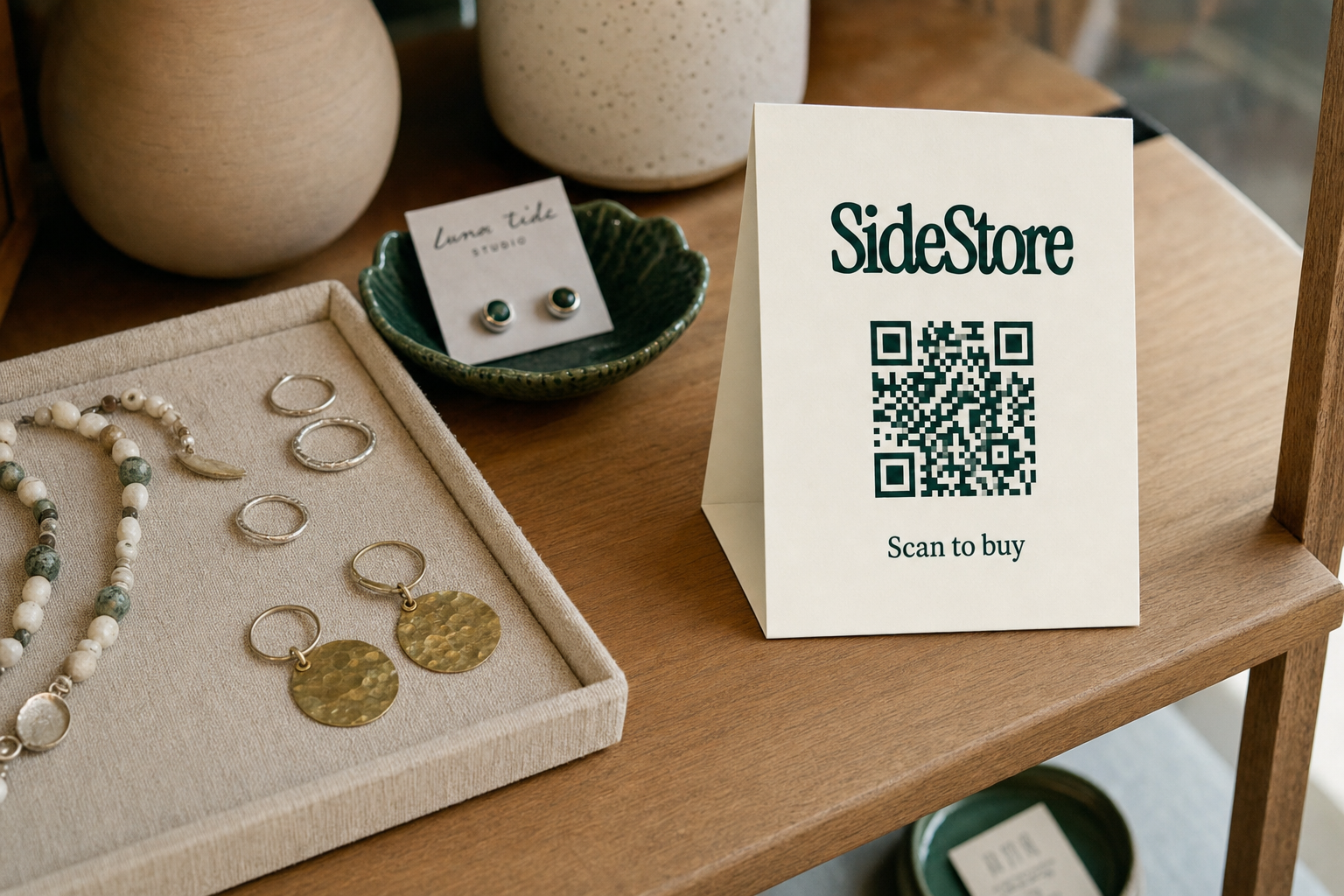
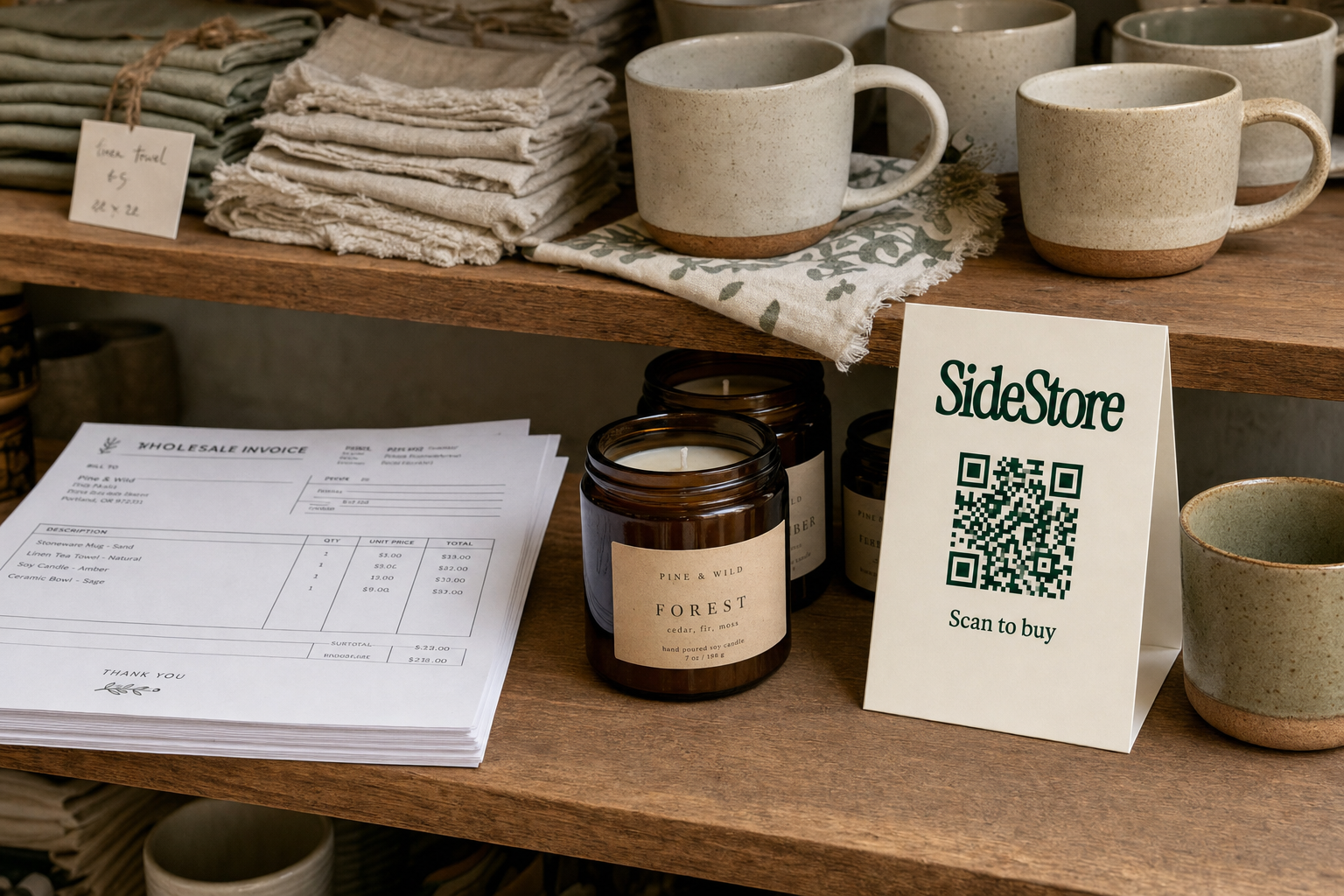
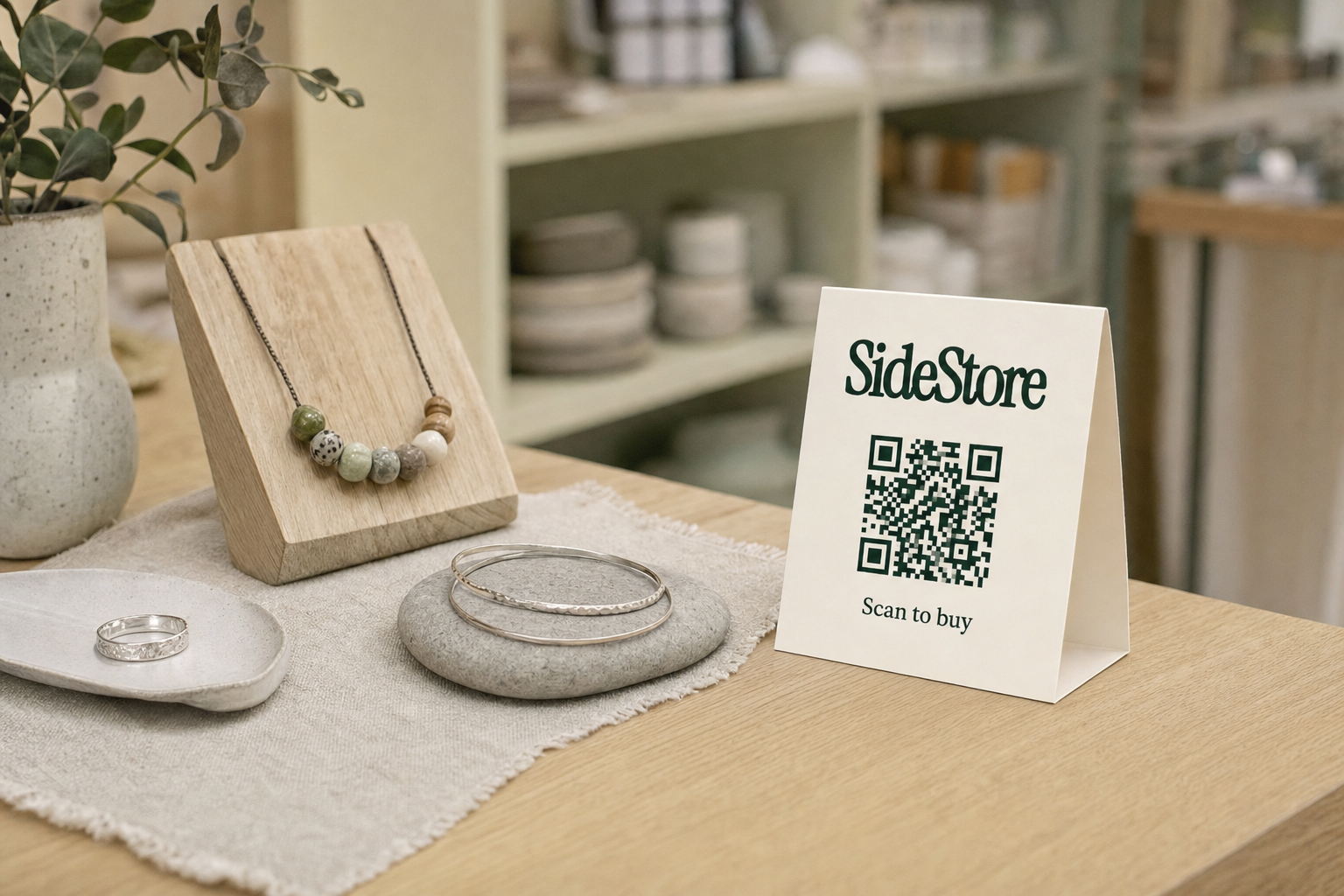
The scan-to-pay QR card is one function of the Retail Widget, not the whole product. A merchant can display a single card for all products in a SideStore placement, or you can attach a QR card to individual pieces. Either way, every scan-to-pay transaction feeds directly into the stock and settlement records.
For deeper coverage of the software side, see consignment inventory software and managing consignment placements in local shops.
Frequently Asked Questions About Selling Jewelry on Consignment
These questions come up repeatedly from makers at every stage, from placing their first pieces to managing multiple venues.
What fees do jewelers charge for consignment arrangements?
Most shops and galleries take 30, 50% of the retail sale price as their commission, with 40% being a common starting point. Some venues add handling or display fees, but this is less typical in straightforward consignment. Always ask for the full fee structure in writing before placing stock, including any deductions applied before your percentage is calculated.
Which sales method generates the most profit when selling jewelry?
Consignment returns the highest percentage of retail price to the maker, typically 50, 70% of the sale price, but only when items actually sell. Wholesale pays less per piece (often 40, 55% of retail) but pays immediately. The most profitable method depends on your sell-through rate, production costs, and how quickly you need cash.
Should jewelry be sold to a jeweler or pawn shop instead?
For makers selling work you created, consignment in a suitable boutique or gallery almost always generates more per piece than a pawn shop. Pawn shops are designed for quick liquidation, not ongoing maker distribution, and they typically pay 20, 40% of assessed value. For estate pieces or inherited jewelry, a pawn shop or auction house may be more practical.
How can sellers avoid being undervalued when selling jewelry?
Know your cost of goods and labour before any negotiation. Apply the formula: retail price multiplied by your percentage, minus production costs. If the result isn't a viable margin, the placement doesn't work at that price. Request a written agreement that locks in the split, the retail price, and your consent rights over any discounting.
How does the jewelry consignment process work?
You place pieces with a shop under a written agreement, the shop displays and sells them, and you receive your share of the sale price after each transaction. You retain ownership of every unsold piece and collect them at the end of the agreed display period.
What should sellers anticipate when selling jewelry through consignment?
Expect slower cash flow than wholesale, since payment arrives only after a sale. Expect some pieces to take weeks or months to sell, and others not to sell at all. Budget time for monthly reconciliation, and build your retail price to remain profitable after the shop's percentage is deducted.
What does selling on consignment mean?
Selling on consignment means placing your products in a shop or venue without any upfront payment from the shop. The shop sells your pieces on your behalf and pays you a percentage of each sale price. You retain ownership until a sale occurs.
Are there consignment options available for estate jewelry?
Yes. Estate jewelry (inherited or vintage pieces you didn't make yourself) can be placed through specialist consignment dealers, auction houses, or online consignment platforms. The terms and percentages differ from maker-focused boutique consignment, so compare options carefully before committing.
Can jewelry be sold on consignment online?
Yes. Several online consignment platforms accept jewelry and handle photography, listing, and payment. They suit makers without local venue access or those selling estate pieces. Platform fees vary, so calculate your net return before listing. If you want physical presence without the complexity, pop-up retail as an alternative to consignment is worth considering alongside online options.
Start Placing Your Jewelry on Consignment
The path from maker to placed, active consignment seller is a sequence, not a leap. Find a venue whose customers already align with your work. Draft a written agreement that covers all six clauses. Activate your placement with the Retail Widget so stock tracking and split payouts run automatically from day one. Reconcile monthly and follow up on any discrepancies in writing.
None of these steps requires you to open a store, carry overhead, or buy into wholesale minimums. Consignment places your pieces in front of real buyers, in real spaces, on your terms.
Start with one placement. Prove the fit. Then expand to more venues, using SideStore's dashboard to manage stock and settlements across all of them from one place.
Build a consignment network without opening a store of your own.
When you're ready to act, selling handmade jewelry in boutiques covers venue selection in detail, and how to approach a local shop about stocking your products walks you through the first conversation.