How to Get Your Candles into Gift Shops (without Upfront Wholesale Risk)
Consignment placement is straightforward: you place products in a shop, they sell, you get paid. No upfront cost to the host. No inventory risk on either side.
To get candles into gift shops, your fastest, lowest-risk route is consignment. Walk in with a clear pitch, a signed agreement, and a system that handles checkout and splits automatically. You avoid the capital burden of wholesale minimums. The shop takes on zero financial exposure. Most gift shops are open to the conversation, particularly with handmade candles that match their aesthetic. Your job is to make the arrangement feel effortless for them.
For a full picture on working with retail partners of all types, a maker's guide to retail partnerships covers the broader landscape.
Wholesale vs Consignment: What Each Model Actually Costs You
The core difference is who carries the financial risk before the sale. Wholesale transfers that risk to you immediately. Consignment keeps it distributed until a product actually sells.
| Model | Who pays upfront | Who holds stock risk | Maker's margin per unit | Speed of payment | Typical split or discount |
|---|---|---|---|---|---|
| Wholesale | The shop (buys stock) | The shop | Lower, typically 40, 60% below retail | On invoice (30, 60 day terms are common) | Shop buys at 40, 55% of RRP |
| Consignment | Nobody pays upfront | You retain ownership until sale | Higher, you set the retail price | After each sale, per agreed schedule | Maker typically keeps 60, 70% of sale price |
If you have strong sell-through data and cash flow to fund a wholesale order, wholesale gives you faster volume and cleaner logistics. The shop owns the stock, manages the display, and you move forward.
If you are earlier in your distribution journey, consignment is the rational choice. You keep ownership of unsold stock, your margin per unit is generally higher, and you are not gambling on a shop's ability to sell your candles before your invoice is due. The trade-off is operational: you track and reconcile stock across placements. That overhead is manageable with the right tools, and it is worth understanding before you scale. See retail partnership structures for makers for a deeper look at how each model scales.
What Consignment Percentage to Expect (and How to Negotiate It)
For handmade candles in gift shops, a typical consignment split gives you 60, 70% of the retail sale price, with the host shop keeping the remaining 30, 40%. These are common ranges, not fixed rules. Your actual split depends on several factors.
The realistic split range
Most independent gift shops land somewhere between a 60/40 and 70/30 maker-to-shop split. Some boutique-style venues with high foot traffic may push toward 50/50, particularly if they are providing a premium display position. Charity shops and community retailers may accept less margin.
What moves the split toward you
You have more negotiating leverage when your candles have a clear brand identity, consistent packaging, and proven sell-through history from other placements. Offering to supply display materials, point-of-sale signage, or handling your own restocking reduces the shop's effort and strengthens your position.
What moves it toward the shop
High-traffic venues, shops with a loyal and specific customer base, or those offering premium shelf placement will reasonably expect a larger share. If the shop is doing significant curation work or actively promoting your candles, a more generous split acknowledges that contribution.
How to frame the negotiation
Avoid framing it as a negotiation at all. Open with the split you want and explain the logic clearly: your production costs, your retail price, and why the margin works for both sides. If you need concrete numbers on what each placement actually returns, consignment inventory software can make those figures solid before you walk into the meeting.
How to Find the Right Gift Shops for Your Candles
The right gift shop is one whose existing product mix, customer profile, and price point already align with your candles. Pitching cold to mismatched venues wastes time on both sides.
Venue types worth targeting:
- Independent gift boutiques selling handmade or locally sourced goods, where your candles sit naturally alongside ceramics, textiles, and stationery
- Hotel lobbies and bed-and-breakfast reception areas where guests actively look for locally made products to take home
- Museum and gallery shops that stock artisan goods with a strong aesthetic or regional story
- Florists and home décor shops where fragrance is already part of the buying experience
- Wellness studios and spas where candles align with the environment and the customer's mindset
- Farm shops and deli-style retailers that stock artisan and locally produced goods alongside food
What to look for:
Check for shops that already stock handmade or small-batch products at a similar price point to yours. Look at whether the shop has a clear visual identity your candles would complement. A shop selling mass-produced gifts at low price points is unlikely to convert your candles well, regardless of how good your pitch is.
What to avoid:
Steer clear of chains, franchises, or any retailer with centralised buying that requires going through a head office. For alternative approaches when gift shops are not the right fit, pop-up retail and alternative distribution options is worth reading alongside this.
How to Pitch a Gift Shop: The Consignment Conversation
A good pitch for candle consignment is short, direct, and framed around the shop owner's benefit, not your product's features. You are offering them revenue from shelf space they already have, with zero stock risk.
The pitch sequence:
Open with the outcome, not the origin story. State plainly what you are proposing: "I make handmade candles and I'd like to place a small selection here on consignment."
Explain the model in one sentence. "You get a percentage of every sale, and you carry no stock risk. If a candle doesn't sell, it comes back to me."
Show the product. Bring two or three candles in your best-performing scents. Let the quality speak. Do not overwhelm with a full range on a first visit.
Name your proposed split. Be direct: "I work on a 65/35 split in my favour. Does that work for your margins?" Having a number ready signals professionalism and saves negotiation time.
Address the logistics. Explain how checkout works, how you track stock, and how they receive their share. This is where the SideStore Retail Widget becomes a genuine differentiator: you can show that the shop needs no special POS system, that sales are tracked automatically, and that their split is paid out without them chasing an invoice.
Leave something behind. A printed card, a product sheet, or a sample they can keep. Follow up within five to seven days if you do not hear back.
Rejection is part of the process. Not every shop's customer base suits your candles, and a polite no is useful information. For a view of how boutiques manage their inventory and what constraints shape their decisions, that context helps you pitch with genuine empathy.
What to Put in a Candle Consignment Agreement
A consignment agreement is a short written document that protects both parties and removes ambiguity about ownership, payment, and liability. Even a simple one-page agreement is far better than a handshake.
The five clauses every candle consignment agreement needs:
- Stock ownership clause, specifying that products remain your property until sold
- Payment schedule, when and how the shop pays your share (weekly, monthly, or per sale)
- Consignment split, the agreed percentage for you and the shop, stated clearly
- Damaged or lost stock policy, who bears the cost if a candle is damaged in-store or goes missing
- Term and termination, how long the arrangement runs, and how either party ends it
The clauses that cause the most disputes:
Stock ownership is the clause most often misunderstood. Because the shop has physical possession of your candles, it must be unambiguously clear in writing that ownership does not transfer until a sale is completed. In most cases this is straightforward to draft, but it matters enormously if the shop closes, is sold, or faces financial difficulty.
Payment schedule disputes usually arise not from dishonesty but from vagueness. "Monthly" is not enough. Specify the date (for example, the last working day of each month), the payment method, and what sales data the shop provides with each payment. SideStore's automatic split payouts remove the invoice-chasing problem entirely, because settlement happens per sale rather than on a manual schedule.
Damaged stock is worth addressing explicitly. Agree upfront whether the shop compensates you at cost price or retail price for damaged stock, and whether normal retail wear is your risk or the shop's. Keep this practical and fair. Accurate tracking of your boutique inventory is the foundation for any damage dispute resolution.
Consult a local legal adviser for jurisdiction-specific requirements before finalising any agreement.
How to Manage Multiple Gift Shop Placements Without a Spreadsheet
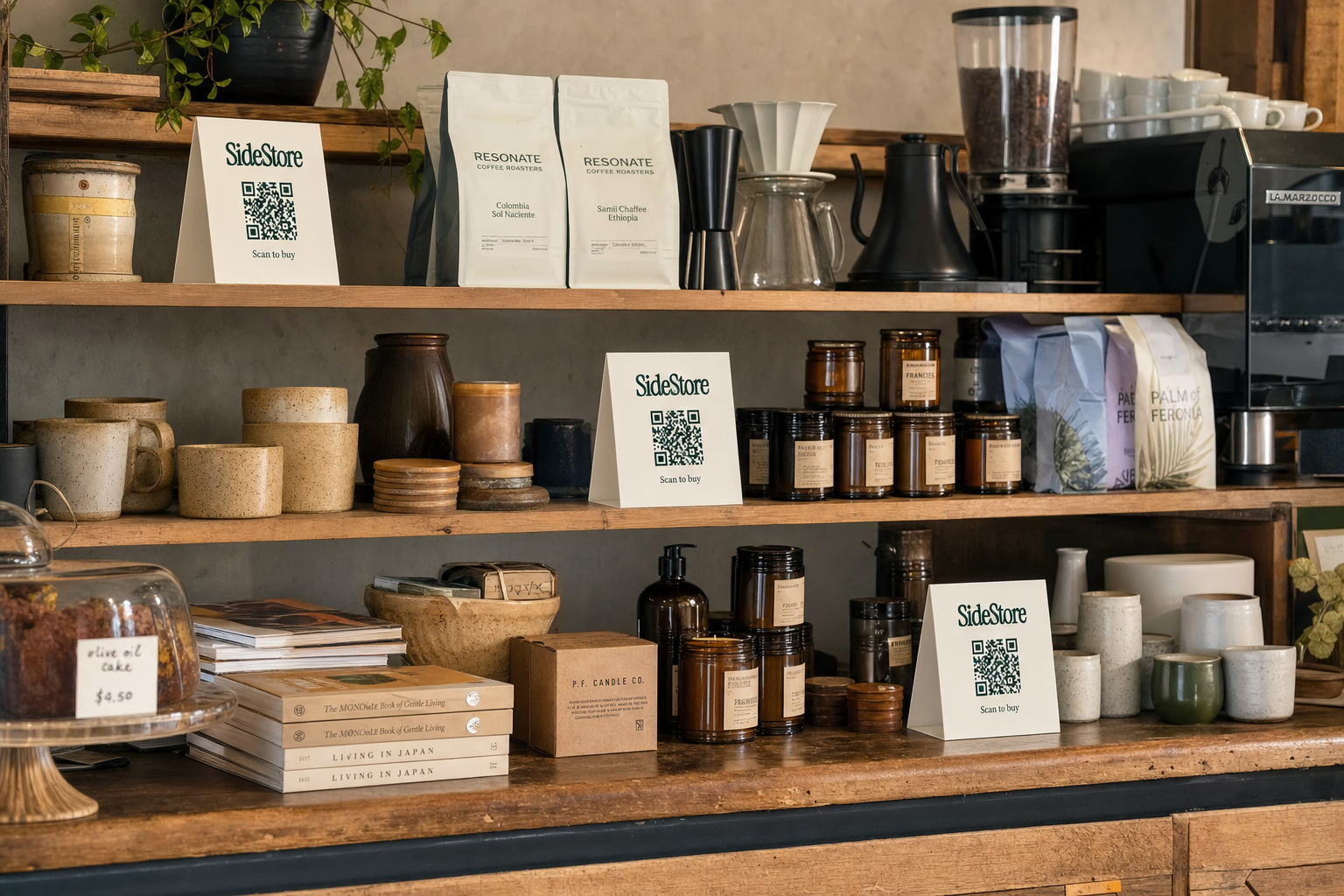
Once you move beyond one placement, the operational complexity multiplies fast. Stock levels in each shop, sales by location, split calculations per venue, and restocking schedules become a real management job if you handle them manually.
SideStore's consignment inventory software and the Retail Widget are designed for exactly this situation. Here is what each function does in practice:
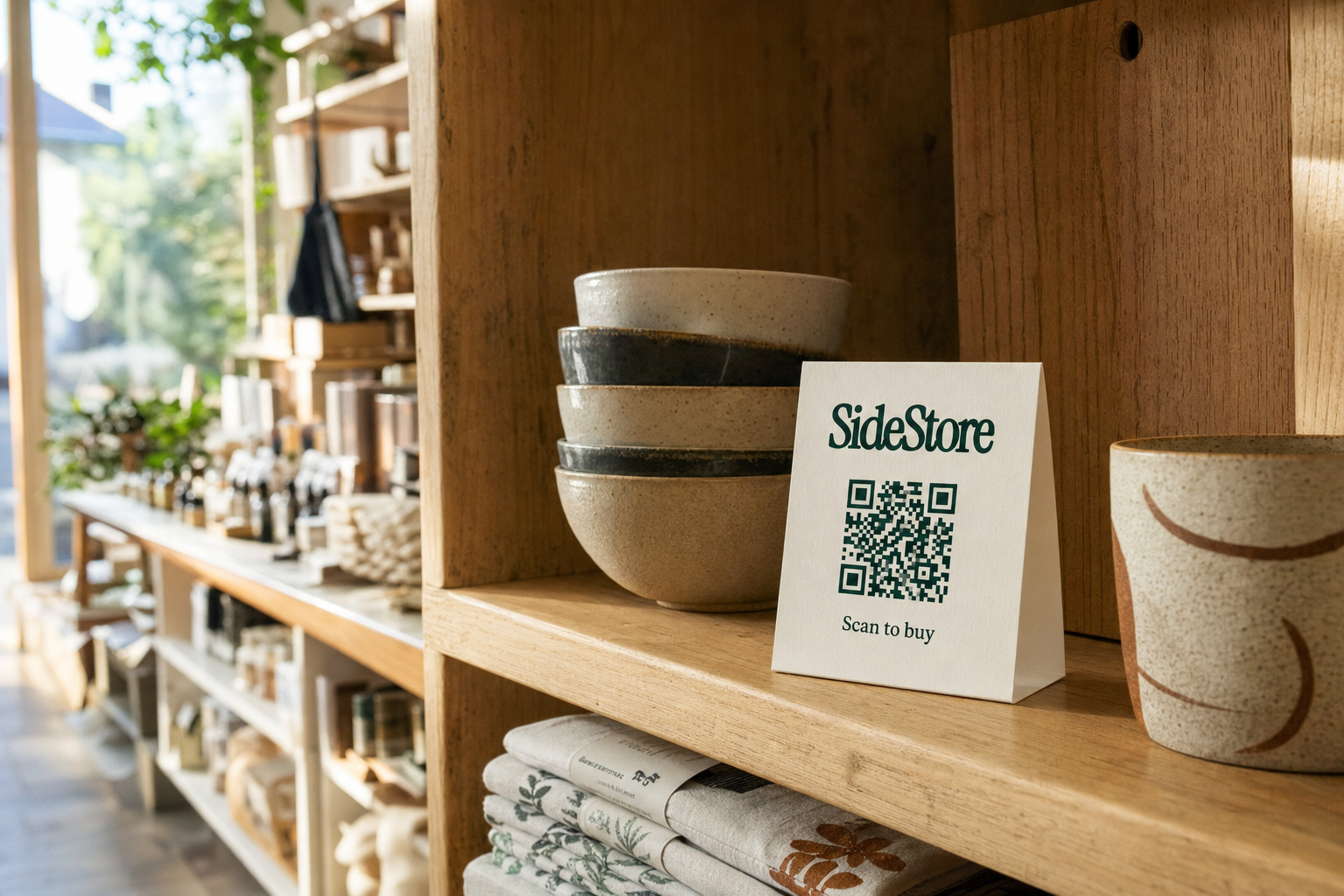
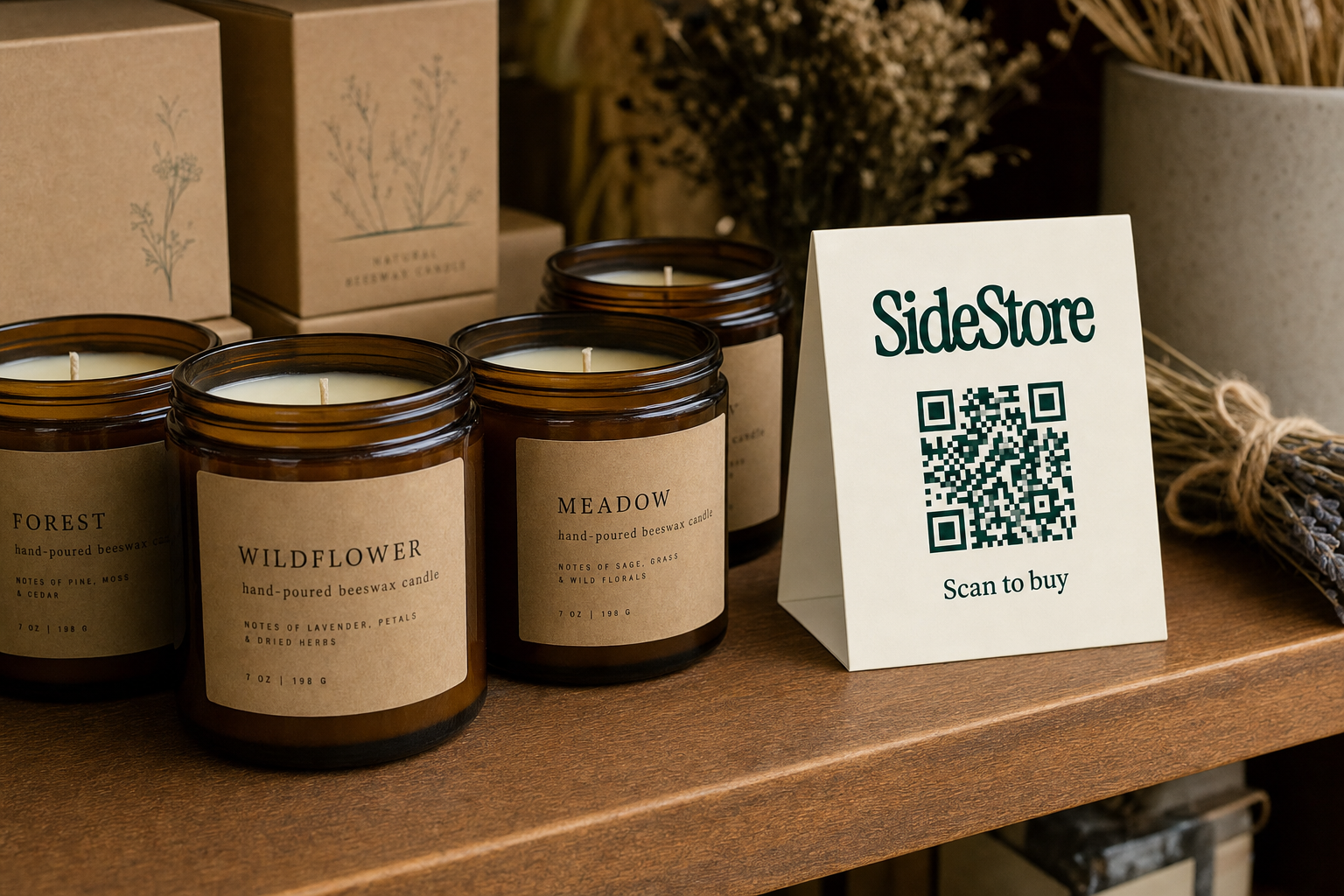
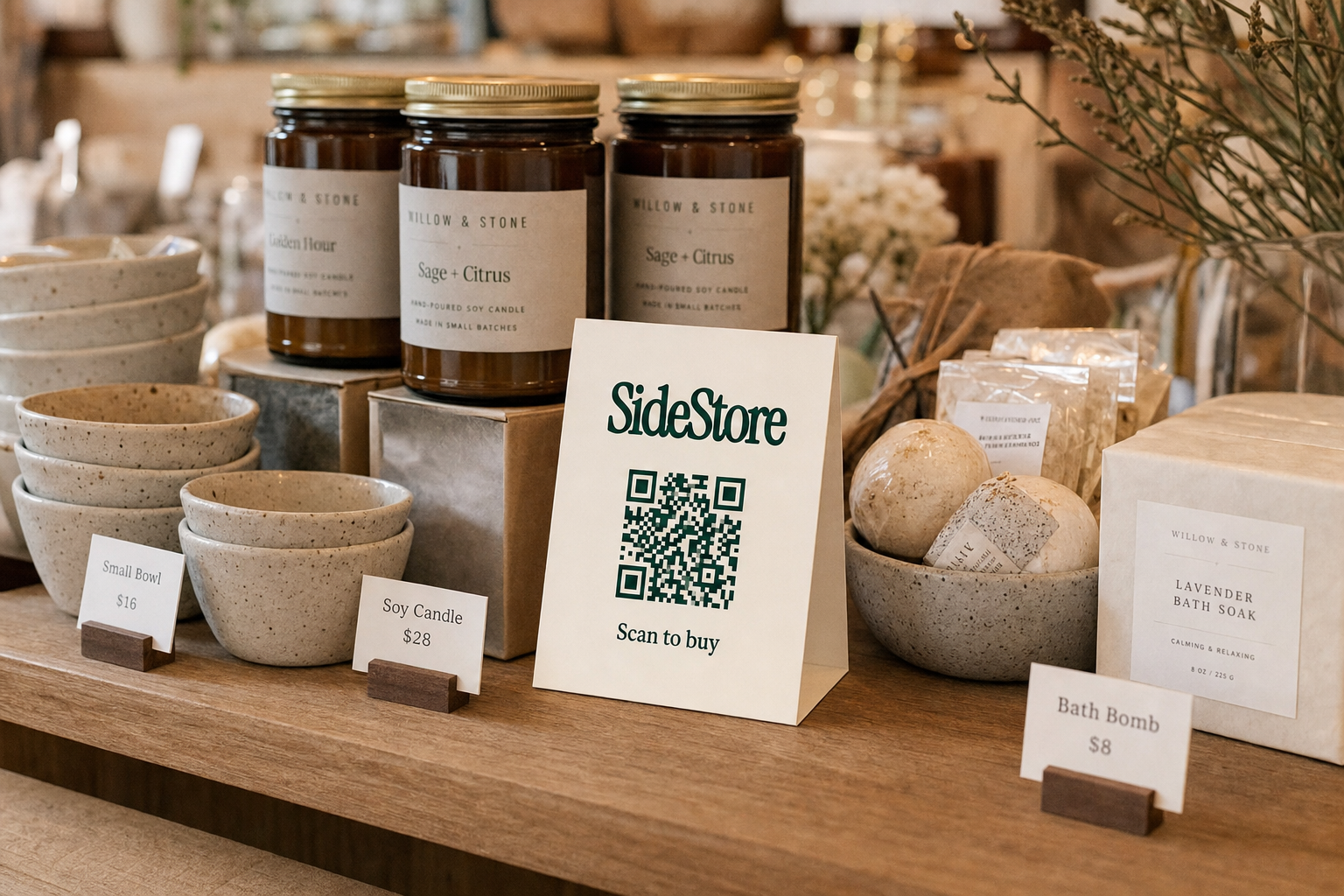
Scan-to-pay QR checkout: You print a SideStore QR code card and attach it to each product, or a shop can display a single SideStore card covering all the products in the placement. A customer scans, pays, and the sale is recorded. No POS terminal required. No manual logging. This is one function of the Retail Widget, not the whole product.
Live stock tracking per placement: The Retail Widget shows you current stock levels at each location in real time. You know when a placement is running low before the shop has to call.
Placement attribution: Every sale is recorded against the specific placement where it happened. When you have candles in five shops, you see which locations convert and which sit idle. That information shapes your restocking decisions and your future pitching.
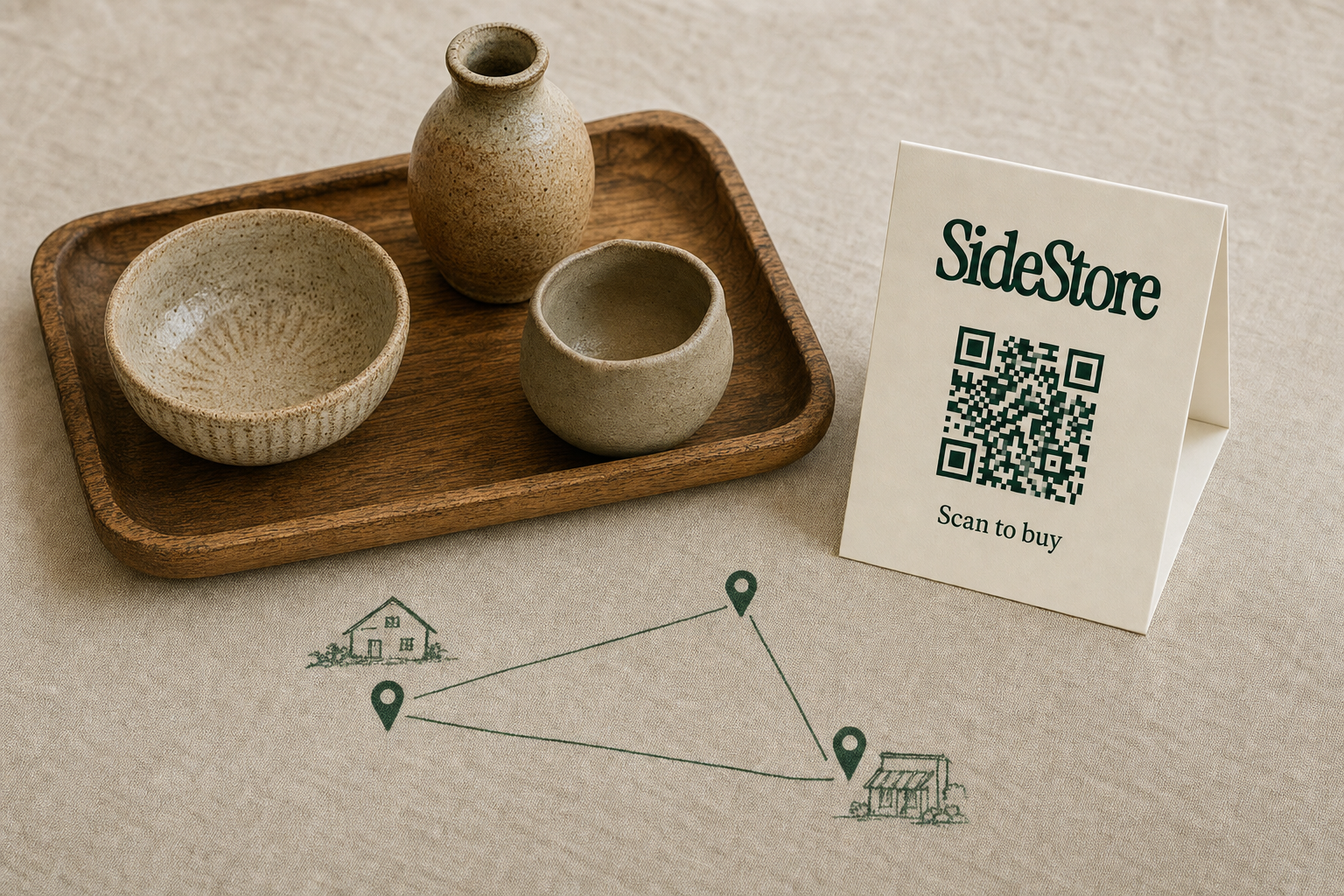
Automatic split payouts: Your share and the shop's share are calculated and settled automatically per sale. No month-end invoice. No chasing. No awkward conversation about outstanding balances.
The difference between managing one placement and managing ten is mostly systems. With a spreadsheet, ten placements is a part-time administrative job. With the Retail Widget, it is a dashboard check. For a broader view on managing inventory across multiple boutique locations, that article covers the operational patterns in more detail.
How to Price Your Candles So Consignment Still Makes Sense
Price your candles at a retail point that leaves your maker's share, after the consignment split, above your total cost of production, with enough margin remaining to make the effort worthwhile.
The arithmetic needs to work before you pitch, not after. Here is an illustrative example (figures are illustrative only):
- Cost to make one candle: £8 (materials, fragrance, vessel, label, packaging)
- Retail price: £22
- Consignment split: 65% maker, 35% shop
- Your return per sale: £22 × 0.65 = £14.30
- Gross margin per unit: £14.30 − £8.00 = £6.30
At that margin, you need volume to make placement worthwhile. If restocking a location costs you time and travel, factor that in. If you are driving forty minutes each way to replenish a shop selling three candles a month, the economics may not work, regardless of how good the split is.
The practical implication: price for consignment from the start, not as an afterthought. If your production costs mean you need £12 per unit after the split, work backward to your retail price. A retail price that feels high to you may be perfectly reasonable to a gift shop customer who is buying a handmade product with a clear story.
Frequently Asked Questions
What is a typical consignment percentage for candles in a gift shop?
For handmade candles, a typical consignment split gives you 60, 70% of the retail sale price, with the shop keeping 30, 40%. These are common ranges rather than fixed rates. High-traffic venues or those offering premium display positions may negotiate toward a 50/50 split.
Do gift shops prefer wholesale or consignment for new makers?
Many independent gift shops prefer consignment for new makers because it requires no upfront purchasing commitment. It reduces their risk and lets them test whether your candles sell before committing to a wholesale order. Once you have proven sell-through in a location, some shops will transition you to wholesale on their own initiative.
How do I get my handmade products into stores for the first time?
Start with consignment rather than wholesale. Identify shops whose existing product mix matches your candles, approach them in person with samples, and propose a small trial placement with a clear agreement. How to sell through someone else's store covers the full process for first-time placements.
How does SideStore handle the split between maker and shop?
SideStore's Retail Widget calculates and settles the agreed consignment split automatically per sale. When a customer pays via the scan-to-pay QR checkout, your share and the shop's share are recorded and paid out without either party having to generate an invoice or chase a payment. Consignment inventory software explains how the tracking and payout functions work together.
How many gift shop placements can one maker manage?
With manual methods, most makers find three to five placements is the practical limit before stock reconciliation and payment chasing becomes unmanageable. With the SideStore Retail Widget's live stock tracking, placement attribution, and automatic split payouts, the operational ceiling is significantly higher. The dashboard gives you visibility across all placements at once.
Place Your First Candle. Scale From There.
Getting candles into gift shops without upfront wholesale risk is a practical, repeatable process. Find shops that match your aesthetic, pitch the consignment model clearly, agree a fair split in writing, and use tools that handle checkout and settlement automatically.
Your first placement is a proof of concept. It tells you whether your retail price holds in a real environment, which scents convert, and how much restocking effort each location actually requires. With that data, every subsequent pitch is more confident and every placement more deliberate.
If you are still weighing up your options, weighing up your distribution options as an independent maker is a useful next step.
Build a consignment network without opening a store of your own.