How to Sell Stationery in Independent Bookstores: Consignment Placement for Paper Goods Makers
Selling stationery in independent bookstores means placing your paper goods, notebooks, greeting cards, notepads, gift wrap, on consignment. The store pays you only when your products sell. They carry no inventory risk. You keep ownership of your stock until someone buys it.
To make it work, you need three things: a product range that fits the store's aesthetic and customer base, a clear written agreement, and a system to manage stock and payouts across multiple venues without chasing each store manually.
Consignment is the realistic entry point for most stationery makers. No minimum orders. No upfront invoices. The store takes a percentage of each sale, you collect the rest. The model is straightforward, but the operational details matter: the split, the agreement terms, and how you handle restocking when things move.
For a fuller picture of how this model works across different retailer types, see retail partnerships for makers.
Why Independent Bookstores Are a Strong Channel for Stationery Makers

Independent bookstores are one of the most natural homes for stationery. The customer who buys literary fiction or a poetry collection already values paper, craft, and considered objects. That alignment is real, not forced.
It matters practically. You are not convincing a buyer that stationery belongs in their space. It already does. Notebooks sit logically beside the books people carry home. Greeting cards go near the till. Wrapping paper and gift tags make sense in a shop where customers regularly buy gifts for others. The visual language of quality paper goods and curated bookselling overlaps naturally. Your product does not need explaining.
Independent bookstores also give you accessible decision-makers. A large chain routes every new supplier through a central buying department. An independent bookstore's buyer is usually the owner or the manager on the floor. You can reach them with a well-written email or by walking in on a quiet Tuesday afternoon. That access shortens the pitch cycle considerably.
The caveat is real: independent bookstores have limited floor space, and most of it goes to books. Stationery occupies a secondary section. You are competing with other makers for a finite number of display slots, and turnover matters to the store. A product that sits for three months without selling will likely come off the shelf. Choose placements where your product genuinely fits, and monitor stock actively.
For related guidance on placing paper goods in other retail contexts, see getting art prints into local shops and consignment vs wholesale.
Consignment vs Wholesale: Which Model Works for Stationery in Bookstores?
For most stationery makers who are new to a bookstore or unknown to a buyer, consignment is the realistic starting model. Wholesale requires the store to pay upfront, take on inventory risk, and commit to a minimum order. Most independents are reluctant to accept those conditions for an untested product.
| Model | Upfront cost to store | Inventory risk | Payment timing | Minimum order | Ease of entry |
|---|---|---|---|---|---|
| Consignment | None | Maker bears it | After sale | None | High, low barrier for new makers |
| Wholesale | Full invoice at order | Store bears it | Net 30, 60 days after delivery | Often required | Low, store must commit before selling |
The trade-off is plain. Consignment removes almost every objection a bookstore buyer has to trying a new stationery range. The store pays nothing until your products sell. If they do not sell, the products go back to you. For the store, it is close to a no-risk trial.
The trade-off for you is margin and cash flow timing. On consignment, you wait for a sale to get paid. On wholesale, you invoice once and get paid in full, but only if the buyer places the order in the first place. For a new maker without an established track record, the choice is often not consignment versus wholesale. It is consignment or nothing.
Once your products have a proven sell-through rate in one or two bookstores, wholesale conversations become easier. Buyers respond to data. "These sold out in six weeks at this store" is a stronger argument for a wholesale order than any product description you could write.
See the full comparison of consignment and wholesale models for a deeper breakdown.
How to Pitch Your Stationery to an Independent Bookstore Buyer
The right way to pitch stationery to a bookstore buyer is to send a physical sample pack paired with a short, specific email. Lead with the consignment offer: no upfront cost to the store, no minimum order, stock returned if it does not perform. That sentence gets the pitch opened.
Here is the process, step by step.
1. Research the store before you write a word.
Walk in or browse their online presence. What stationery do they already stock? What aesthetic runs through their curation? A store selling literary fiction and independent small-press titles is a different buyer from one that leans toward children's books and gift wrapping. Tailor your selection to what already sells in that room.
2. Send a physical sample pack, not a PDF.
Post three to five products that represent your range. Include a one-page sheet with retail prices, your proposed split, and a restock process overview. Buyers want to touch the product. A PDF of photography is not enough.
3. Write a pitch email under 150 words.
Name the store specifically. State what you make, why it fits their space, and what the consignment offer is. "No upfront cost, 40% split on sales, I handle restocking" covers the essentials. Attach one image. Do not attach a full catalogue.
4. Follow up once, after seven to ten days.
A single follow-up is appropriate. Two or three become noise. Keep the follow-up shorter than the original email. One sentence asking whether they received the samples and whether they have questions is enough.
5. Go in prepared to negotiate the split.
The percentage you propose in the email is an opening position. Most bookstore buyers will have a view of what split works for them. Know your minimum acceptable margin before you walk in. Be ready to counter clearly rather than agree on the spot to terms that make the placement unviable.
For related guidance on approaching boutique buyers, see pitching handmade products to boutique buyers. If you are also considering cafes and high-footfall venues, placing products in high-foot-traffic venues covers the same pitch principles in a different context.
Consignment Percentage and Pricing: What to Expect and How to Calculate Your Margin
Stationery makers placing products in independent bookstores can generally expect the store to take between 30% and 50% of the retail selling price. Forty percent is commonly cited in independent retail. These are estimates, not guarantees. Individual stores set their own terms, and the actual split you agree is a negotiation.
Here is a worked example to test your numbers before you commit.
You make a lined notebook that retails for £18.00. The store takes 40%, meaning £7.20 goes to them and £10.80 comes to you per unit sold. Your cost of goods, materials, printing, packaging, is £4.50. That leaves you £6.30 contribution per unit before any fees, shipping, or admin time.
Run the same numbers at a 50% split. The store takes £9.00, you receive £9.00, and after your £4.50 cost of goods your contribution drops to £4.50. That is still viable, but the margin for error is narrower. If your COGS is higher because you use premium paper or letterpress printing, a 50% split can make the placement unworkable at that retail price.
Set your retail price to make the math work at the higher end of the split range before you pitch, not after. If £18 only works at 40%, price the notebook at £22 or revise your cost structure. Agreeing to a 50% split on a price that only works at 40% is a slow way to lose money placement by placement.
Track your cost of goods accurately. Include packaging, consumables, and any per-unit labelling you apply for the store. Vague COGS estimates produce real losses at scale.
See how consignment splits compare to wholesale margins for a side-by-side view.
What Your Consignment Agreement Must Include (Before You Leave Any Stock)
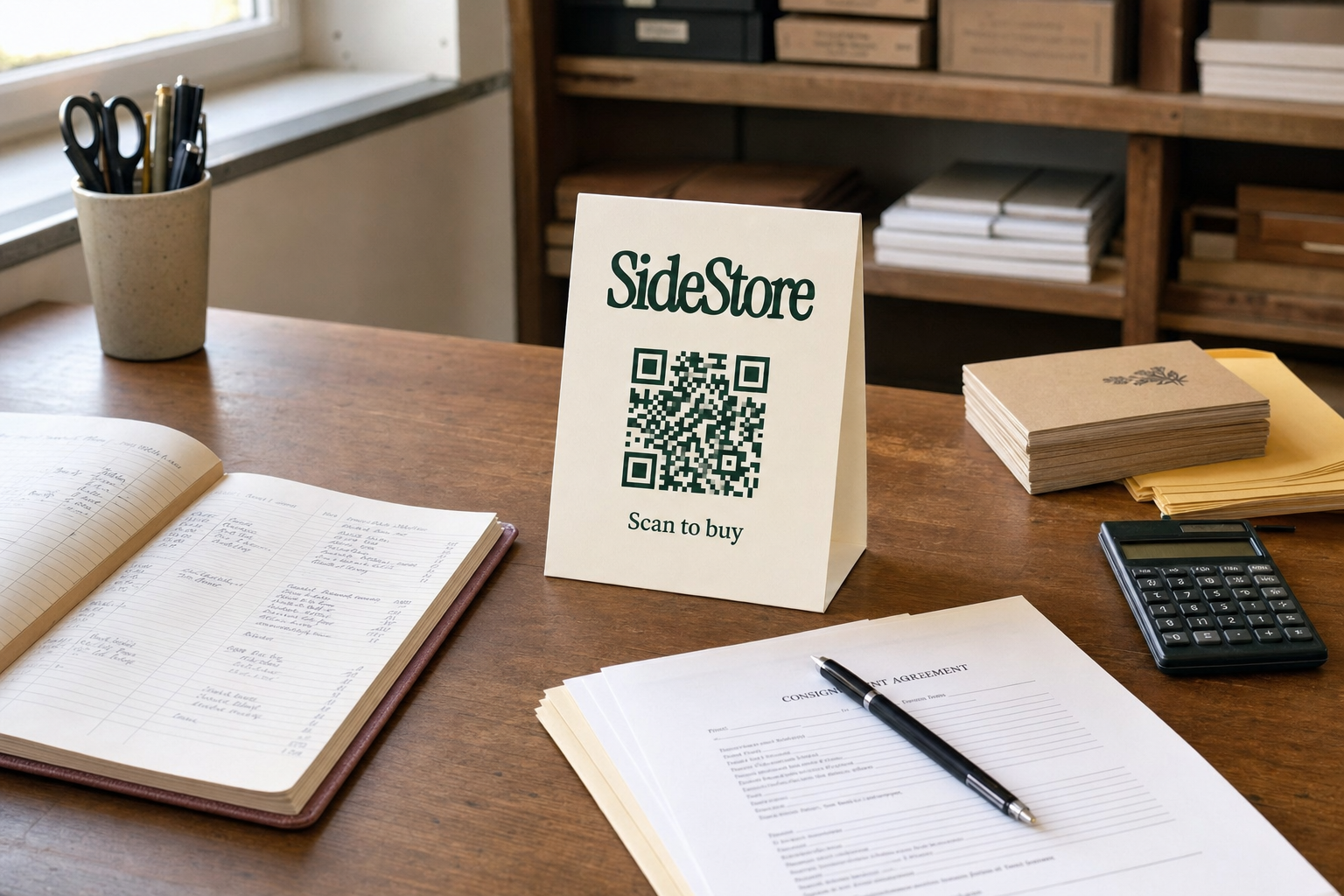
A consignment agreement for stationery makers must contain eight specific clauses, and it must be signed before a single unit of stock leaves your hands. A handshake arrangement is not an agreement. If stock goes missing or payment is delayed and nothing is in writing, your options are limited.
Here are the eight clauses to require:
Parties and effective date. Full legal names of the maker and the store, and the date the agreement begins.
Product description and quantities. A specific list of products placed, with SKUs, quantities, and retail selling prices. Vague product descriptions create disputes.
Consignment split and payment schedule. The agreed percentage, the retail price it applies to, and when and how the store pays you, monthly, bi-weekly, or on a rolling settlement. Without a payment schedule, "when convenient" becomes the default, and late payment has no agreed trigger.
Stock ownership. Explicit statement that products remain your property until sold. This matters if the store closes, changes hands, or enters insolvency proceedings.
Restock process and minimum stock levels. Who initiates a restock request, how much notice you receive, and what happens if stock drops below a minimum threshold. Without this, you find out stock has run out when a buyer calls to say nothing is left, weeks after it sold.
Unsold stock and returns. How long the placement runs, how unsold products are returned, and who covers return shipping.
Loss, damage, and theft liability. Which party covers lost or damaged stock, and whether the store carries insurance on consignment goods. This is one of the most commonly skipped clauses, and the most costly when something goes wrong.
Termination terms. How either party ends the agreement, how much notice is required, and what happens to stock and outstanding payments on termination.
Review the agreement against the requirements of your local jurisdiction before signing. Laws governing consignment arrangements differ by country and region. If the placement is significant, legal advice is worth the cost.
For more on structuring retail relationships, see retail partnership agreements for makers and consignment inventory software.
How to Manage Stock and Get Paid Across Multiple Bookstore Placements
Managing stock and payment across several bookstore placements without it becoming unmanageable requires a live dashboard with scan-to-pay checkout and automatic split payouts. Not a spreadsheet and a string of WhatsApp messages to each store.
Manual tracking fails at scale. When you have one placement, a monthly check-in works. When you have five, you are chasing five stores for payment confirmations and stock counts on different schedules. When you have ten, the admin alone becomes a part-time job.
The Retail Widget is built for this problem. It is a consignment management interface that handles checkout, live stock tracking, placement attribution, and automatic split settlement across every placement in your network. Each time a product sells, the Widget logs the transaction, updates stock, and triggers the agreed split payout without you manually reconciling anything.
The QR checkout is one function within the Retail Widget, not the whole product. In a bookstore context, you can attach a printed SideStore QR card directly to each product, or the bookstore can display a single card covering all your products in their placement. A customer scans, completes the purchase, and stock is decremented automatically. No staff intervention required for the transaction itself.
Restock triggers are where this gets operationally meaningful. Rather than discovering a product has sold out when a buyer mentions it, you see stock levels in real time from your dashboard. You set a threshold and respond before the shelf goes empty.
For a broader look at software options, see consignment inventory software options. If you are weighing fixed retail against pop-up or consignment formats, alternatives to fixed retail for independent makers covers that trade-off.
From One Bookstore to a Distributed Consignment Network: How to Scale Placements
Growing from one bookstore placement to several starts with the sales data from your first placement. That data is your pitch to the next store. "These three products sold in six weeks at [Bookstore Name]" is a concrete, checkable claim. It is far more persuasive to a new buyer than any marketing copy you could write.
Run your first placement long enough to gather meaningful data before approaching a second venue. Six to eight weeks is usually enough to see which products sell, which sit, and what the restock cadence looks like. Take that information into your next pitch with the numbers visible: units sold, sell-through rate, average restock frequency.
Beyond bookstores, independent stationery fits naturally in other venue types. Hotel gift shops serve customers who buy small gifts and travel keepsakes. Cafes with a curated shelf attract the same customer who buys your notebooks. Design-led boutiques stock paper goods alongside ceramics and prints. Each additional venue type is a new set of placements to manage, which is where centralised dashboard management stops being a convenience and becomes a necessity.
Many makers find the operational jump from one placement to five is harder than the jump from five to twenty. The systems they put in place early either hold or break. The time to build those systems, using a tool like the Retail Widget to centralise stock, checkout, and payouts, is before the complexity arrives, not after.
See placing products in local shops at scale and consignment placements in cafes for related venue guidance.
Frequently Asked Questions
How do I get my stationery into stores?
The most accessible route is a consignment offer paired with a physical sample pack sent directly to the store's buyer or owner. Lead with the no-upfront-cost terms. Consignment means the store pays only when your products sell. Follow up once after seven to ten days. If the fit is right and your products suit the store's customer, a trial placement is a low-risk yes for most independent retailers.
What percentage do consignment stores take?
Independent stores typically take between 30% and 50% of the retail selling price, with 40% a commonly cited midpoint for paper goods and stationery. The exact split depends on the store, the product category, and your relationship with the buyer. Treat published ranges as estimates and negotiate based on your own cost of goods. See consignment vs wholesale explained for context.
What should a consignment agreement for artists include?
A consignment agreement should include: the parties and start date, a specific product list with quantities and prices, the agreed split and payment schedule, a statement of stock ownership, restock terms, a returns and unsold stock clause, liability for loss or damage, and termination terms. Missing the payment schedule and the loss/damage clause are the two most common and costly omissions. Have the agreement signed before any stock changes hands.
Do independent bookstores buy stationery wholesale from unknown makers?
Rarely, as a first engagement. Most independent bookstores are cautious about placing wholesale orders from makers without a track record. It requires committing cash upfront and absorbing the inventory risk if products do not sell. Consignment is the far more common entry point for new makers. Once you have proven sell-through data from a placement, a wholesale conversation becomes considerably easier. See getting handmade products into boutiques for parallel guidance on buyer behaviour in independent retail.
Start Your First Bookstore Placement
The next step is concrete: research one bookstore that fits your product, send a sample pack with a concise consignment pitch, get an agreement signed before stock is placed, and use the Retail Widget to manage checkout, stock, and split payouts from day one.
That sequence applies whether you are placing with one store or building toward ten. Selling through someone else's store covers the broader model, and consignment inventory software will help you choose the right tools before your placements grow beyond what a spreadsheet can handle.
Place the product. Manage the placement. Get paid automatically.