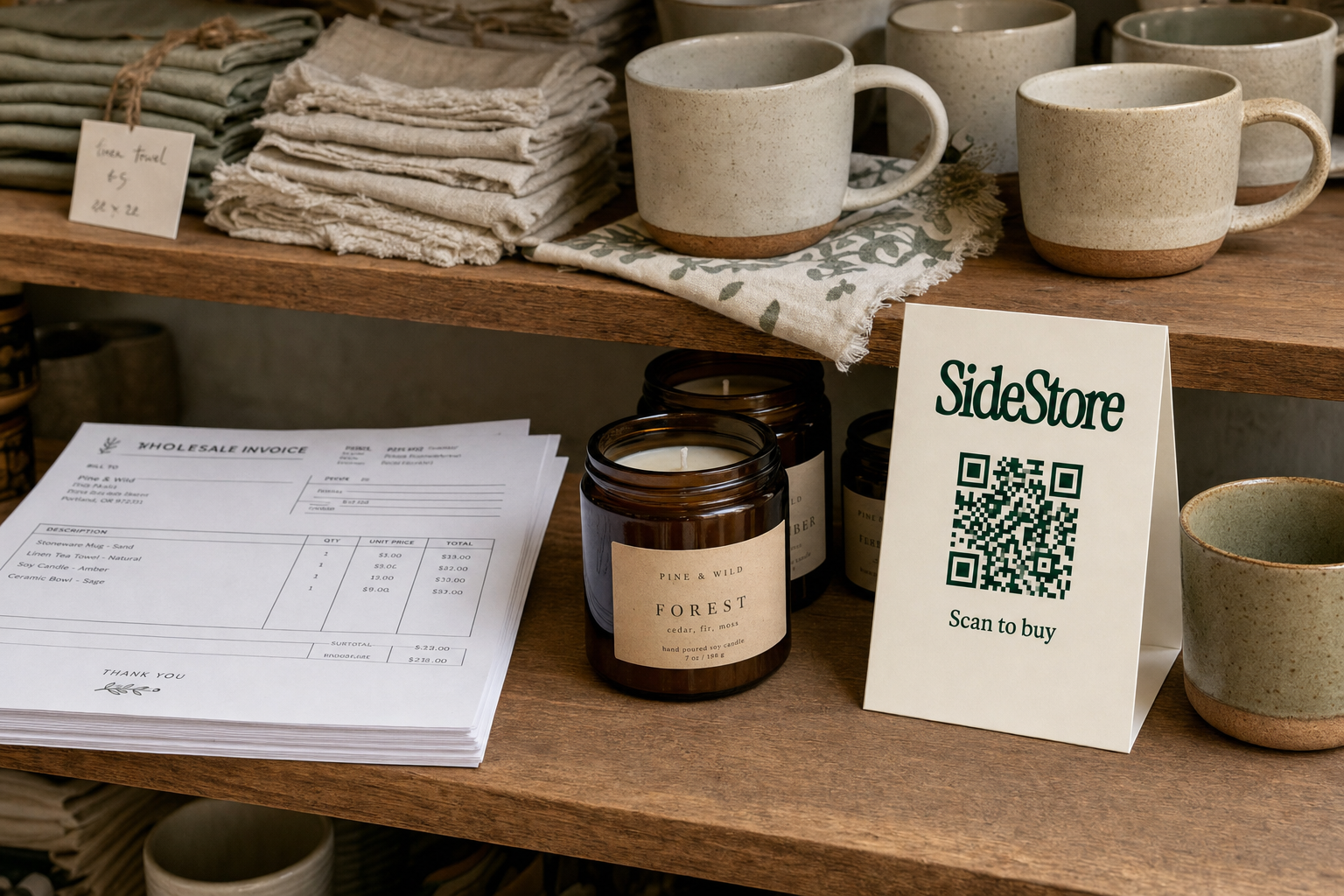
I've Made a Product—Now What? Your First 90 Days of Getting It in Front of Buyers
You've Made Something. Here's How to Sell It.
You've finished your product. The hard part is done. Now comes the part that stops most makers: figuring out where to actually sell it.
The practical answer isn't what you'd expect. It's not a Shopify store. It's not Amazon. It's a physical space where your target customer already spends money, reached through consignment, where you only pay when something sells.
Here's the concrete order of operations. Days 1, 30: place your product somewhere people can see and touch it, and validate that demand is real. Days 31, 60: add a second placement and build a minimal online presence. By day 90, you'll know your unit economics, have actual sales data, and understand which channel converts best for your product.
This guide walks you through a channel comparison, a worked pricing example, and a plain explanation of how consignment works mechanically. You'll also find practical guidance on getting your products into merchant spaces without the overhead of running your own store.
No inventory warehouse. No store lease. Just product, placement, and a plan.
Which Channel Should You Sell Through First?
The right first channel hinges on three things: how much money you can spend before your first sale, how quickly you need proof that buyers want what you've made, and whether your product benefits from being held and examined in person.
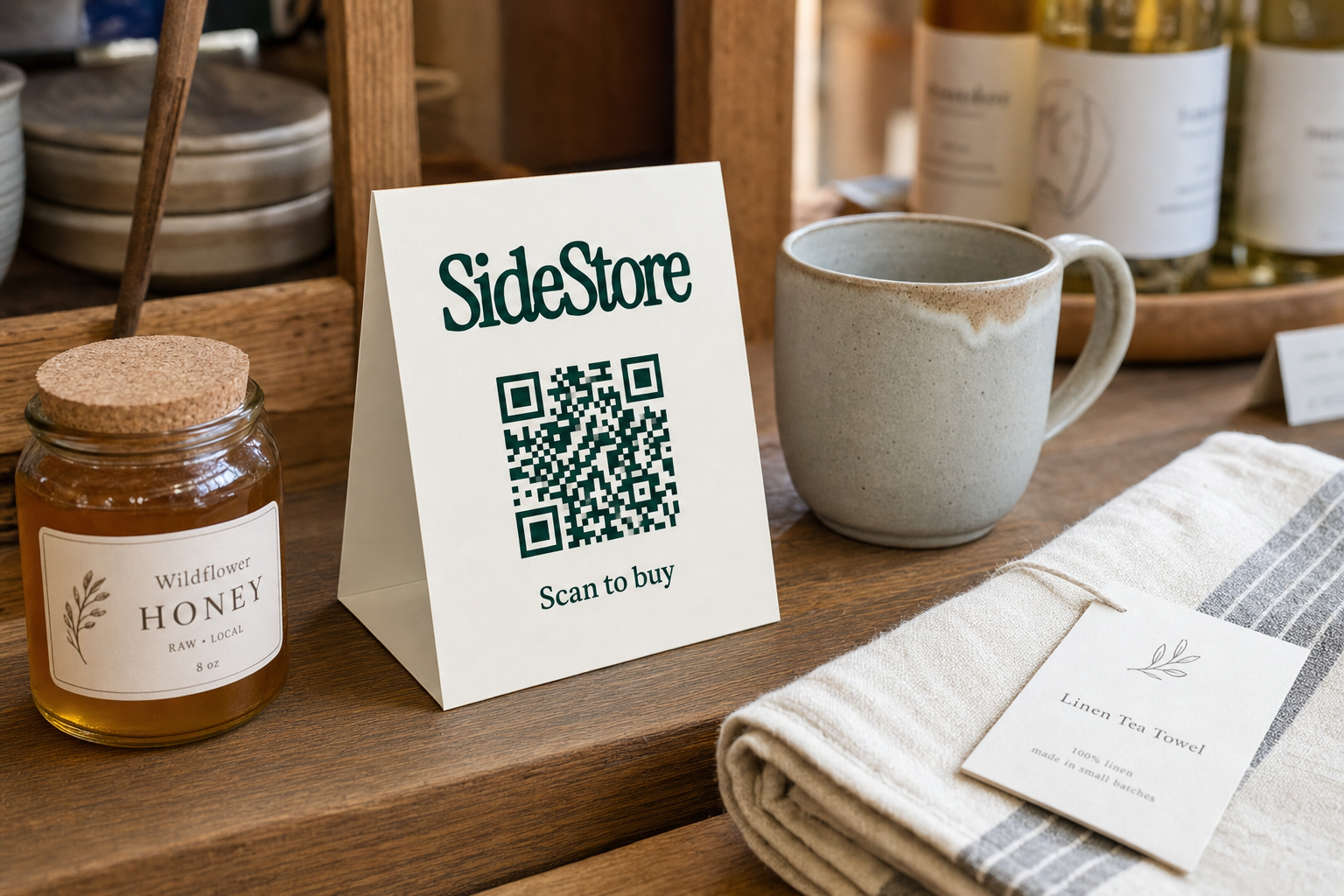
For most physical products made by independent makers, the fastest path to a real sale is a physical venue where your buyer already exists. Online channels take time to build traffic. A café or boutique with steady foot traffic can sell your product the day you place it.
That said, each channel has a role. Here's an honest comparison.
| Channel | Upfront cost | Time to first sale | Inventory risk | Ongoing effort | Best for |
|---|---|---|---|---|---|
| Consignment (SideStore) | None | Same day as placement | None (host holds stock, maker replenishes on sale) | Low once set up | Physical products needing in-person discovery |
| Etsy | Low listing fees | Days to weeks (SEO dependent) | You hold stock | Moderate (photography, listings, fulfilment) | Handmade and craft products with search demand |
| Shopify | Monthly subscription | Weeks to months (traffic required) | You hold stock | High (marketing, tech, fulfilment) | Makers ready to build a brand and drive their own traffic |
| Amazon | Variable (FBA fees add up) | Days if listing is optimised | You hold or send to FBA | High (competitive, listing management) | Products in established categories with search volume |
| Instagram / TikTok Shop | Free to start | Variable | You hold stock | High (content creation is constant) | Makers with an audience or strong visual product |
| Pop-up retail | Stall fee per event | Day of event | You hold stock | Moderate per event | Testing demand in person without a long-term commitment |
| Walmart Marketplace | Application required | Weeks after approval | You hold stock | Moderate to high | Established sellers with volume capacity |
On Etsy versus Shopify: Etsy gives you a built-in audience and handles discovery, at the cost of transaction fees and limited brand control. Shopify gives you full ownership and no marketplace competition, but you're entirely responsible for driving traffic. Many makers start on Etsy to validate demand, then migrate to Shopify once they have proof. Neither is wrong; the question is whether you want to rent an audience or build one.
On selling without inventory: Consignment is the most practical model. You supply the product; the merchant hosts it. Nothing sells, nothing costs you. You can also explore short-term physical presence through pop-up retail, or approach high-foot-traffic venues like coffee shops that already attract your buyer profile.
On Walmart: Walmart Marketplace involves an application process and works best for makers who already have volume, consistent fulfilment capacity, and products in categories where Walmart shoppers actively search. It's not a practical first channel for most independent makers.
How Does Selling on Consignment Work?
Consignment is straightforward: you place your products in a merchant's space and get paid only when they sell. The merchant takes no inventory risk. You take no venue cost. The payment splits between you and the host automatically on each sale.
Here's how it works in practice. Say you make a ceramic mug priced at £40. You agree on a 70/30 consignment split with a café: you receive £28 per sale, the café receives £12. No sale, no payment either way. When a customer buys, the split settles automatically.
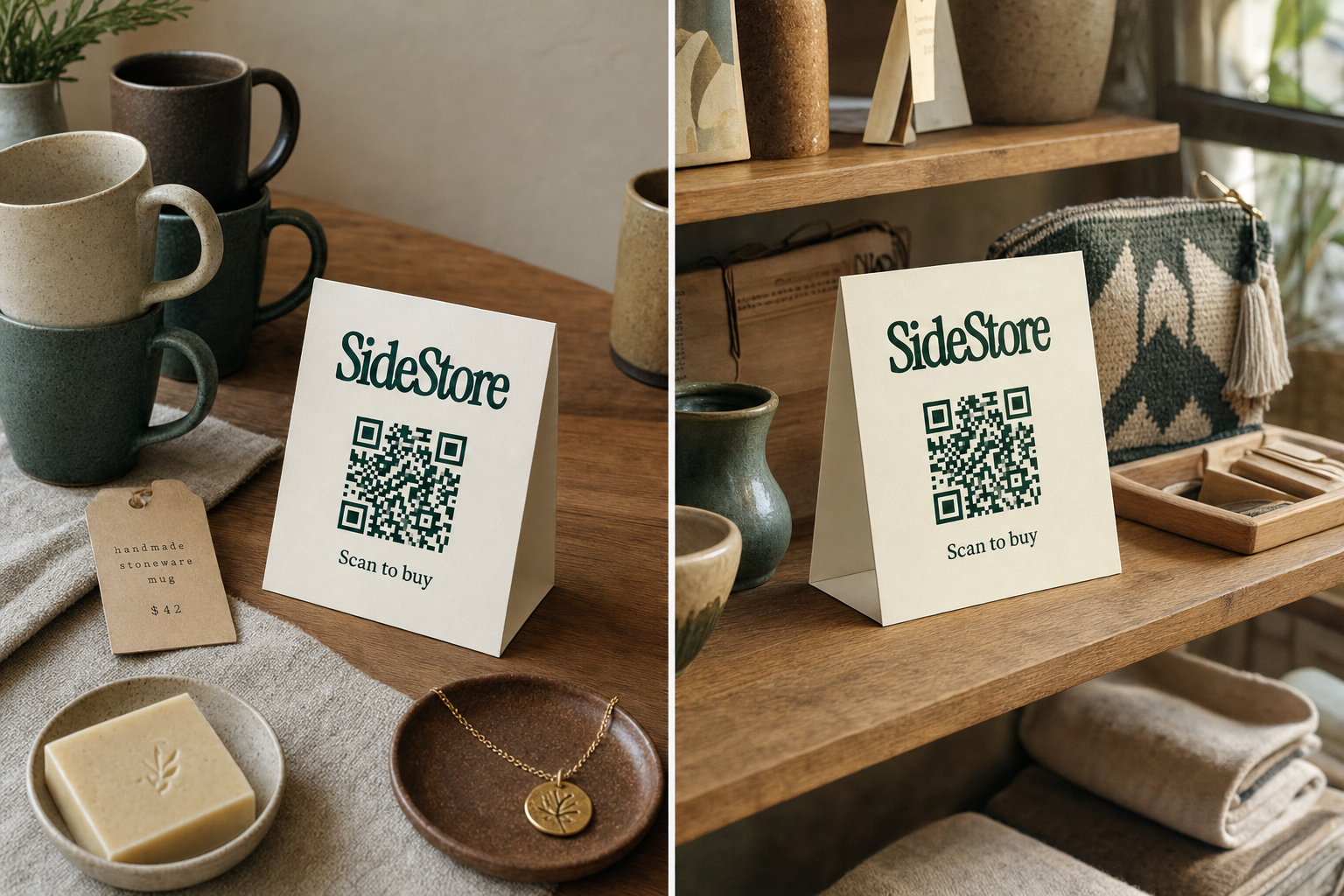
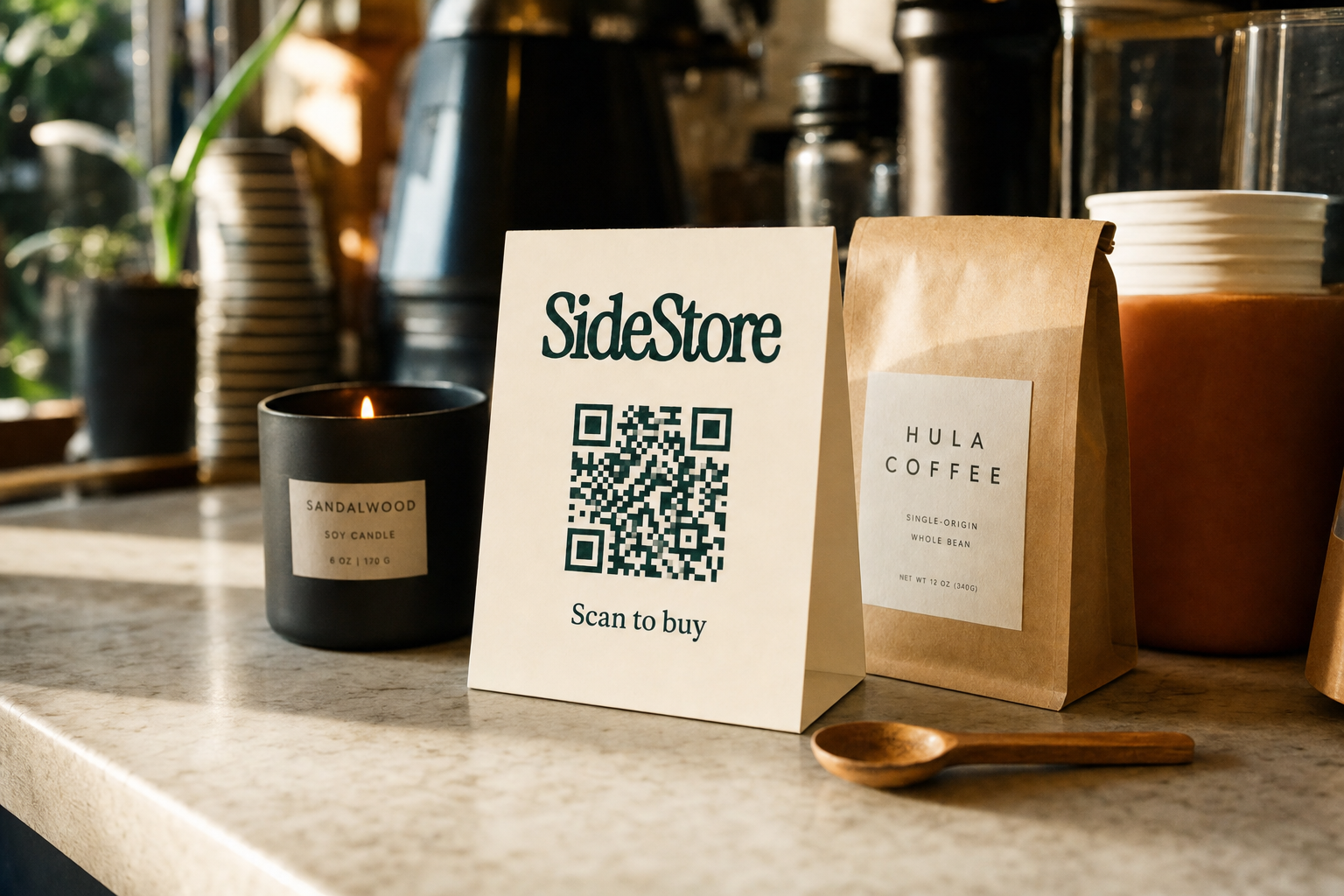
The SideStore Retail Widget is the interface that manages this end to end. It's not just a QR code. The Retail Widget handles the full consignment workflow: modelling the placement and split before you commit, going live with a scan-to-pay QR that customers use to buy in the café, tracking live stock levels so you know when to replenish, attributing each sale to the correct placement, and settling the split payout to you and the host automatically. The QR checkout is one function of the Retail Widget, not the whole product.
For a maker, this means you can place products in five different venues, see stock and sales data for each in one dashboard, and receive your share of every sale without chasing anyone for payment.
For a merchant, it means incremental revenue from shelf space they already have, with no buying, no stock risk, and no manual reconciliation.
Many makers report that this model removes the single biggest barrier to offline distribution: the upfront cost of being stocked. You don't need to sell a case of 50 units to a wholesaler who may return half. You place, you track, you replenish when stock moves.
Before any placement, draft a written consignment agreement covering split percentages, replenishment terms, and how unsold stock is handled. And if you're managing multiple placements, consignment inventory software makes the tracking practical at scale.
How to Get Your Products into Stores (Without Getting Ignored)
Getting your products into physical stores is mostly a reframe problem. You're not asking a merchant to do you a favour. You're offering them revenue from shelf space they already own and aren't currently monetising. Walk in with that posture and most conversations go better.
The most common mistake is the cold DM or email pitch with no context. Foot-traffic venues, boutiques, and cafes respond far better to a brief in-person conversation, a sample in hand, and a clear answer to the question every merchant is actually thinking: "What does this cost me, and what do I earn?"
Here's the approach sequence that tends to work:
Identify venues where your buyer already shops. Not just "local cafes" broadly. Look for places where your product category is already represented, or where the customer demographic matches. A ceramics maker belongs in a design-forward café or homeware boutique, not a fast-food chain.
Walk in at a quiet time with a physical sample. Tuesday morning usually beats Friday afternoon. Ask for the owner or manager. Keep your opening short: "I make [product] locally and wondered if you'd have five minutes to look at a possible consignment arrangement."
Lead with the merchant's upside, not your product's features. Merchants need to hear: zero inventory cost, zero stock risk, automatic split payouts, and easy stock tracking. Your product's beauty is secondary. Their margin is primary.
Show the numbers on the spot. If your product is priced at £35 and you're offering a 70/30 split, say clearly: "You earn £10.50 on every unit sold, with no buying-in required." Concrete numbers close more conversations than enthusiasm does.
Offer a trial placement of a small quantity. Five to ten units removes almost all perceived risk. A merchant who'd hesitate to commit to 50 units will almost always agree to a small trial.
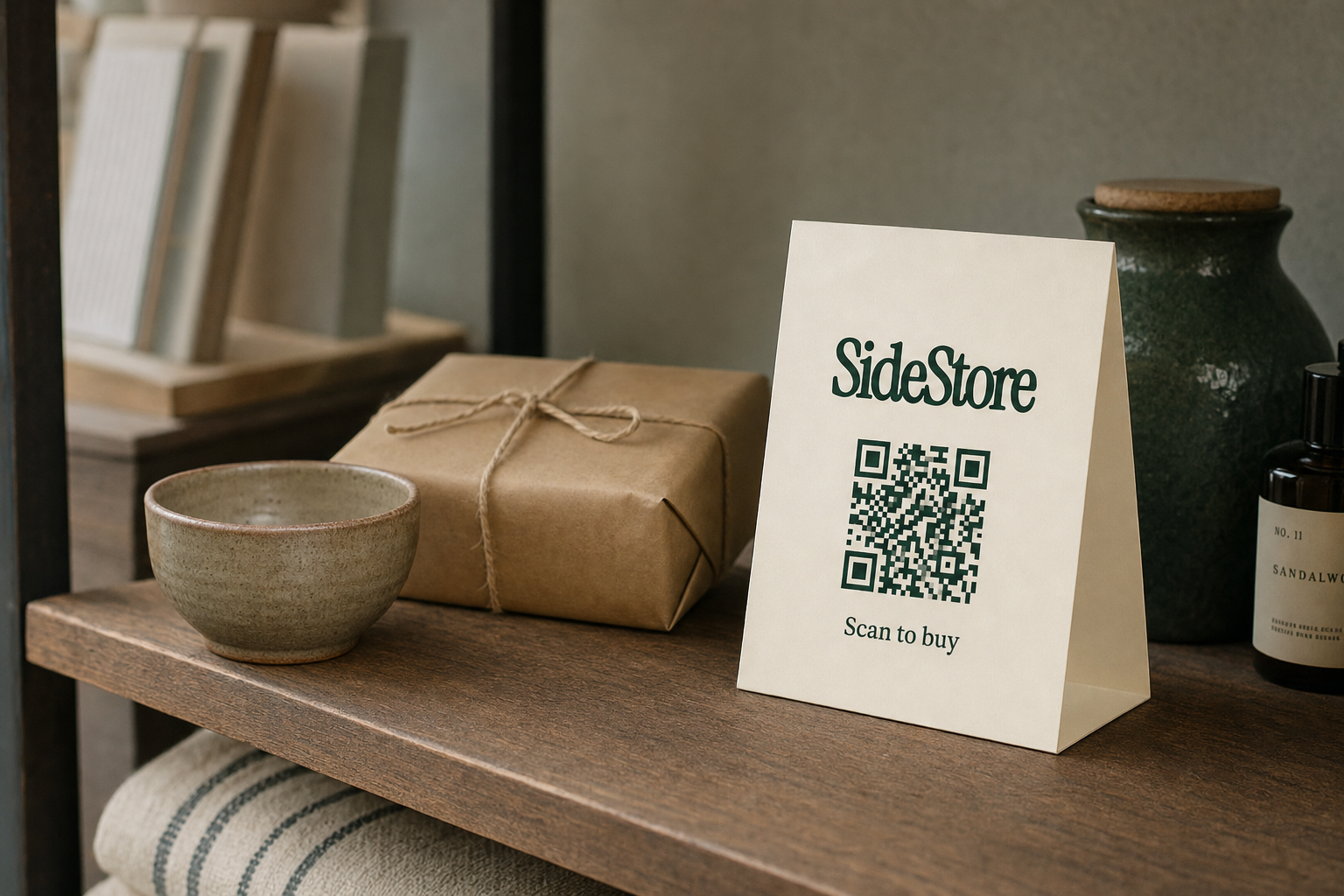
Set up the Retail Widget before you leave. If the merchant agrees, you can configure the placement, set the split, and go live with the scan-to-pay QR card in the same visit. Speed signals that the arrangement will be low-effort for them to manage.
Follow up with the agreement in writing. Send a simple consignment agreement that both parties sign. This protects you and makes the arrangement feel professional, which matters to merchants who've had casual arrangements go wrong before.
For category-specific guidance, see how to approach a local shop about stocking your products, and category-focused guides on selling handmade jewellery in boutiques and selling art prints in cafes.
The pitch anxiety most makers feel is real, but it shrinks quickly once you reframe the conversation. You're not asking permission to exist. You're offering a merchant revenue from stock they don't have to buy.
Your First 90-Day Plan: Phase by Phase
The first 90 days should do one thing above all else: generate real data from real buyers. Everything else is setup. Here's the plan in concrete phases.
| Phase | Timeframe | Key actions | Owner | Success metric |
|---|---|---|---|---|
| 1: Prepare | Days 1, 14 | Price your product (see Section 6). Sign up for SideStore. Draft your consignment agreement. Photograph your product clearly. Identify 3, 5 candidate venues. | Maker | Ready to pitch, pricing confirmed, agreement drafted |
| 2: Place | Days 15, 30 | Approach your top two venues in person with a sample. Set up the Retail Widget for each agreed placement. Print and attach the QR card. Confirm placement attribution is live. Replenish opening stock (5, 10 units per venue). | Maker + Merchant | At least one live placement, Retail Widget active, scan-to-pay QR in place |
| 3: Validate | Days 31, 60 | Monitor stock and sales data in the dashboard. Note which venue sells faster. Add a third placement. Set up a minimal online listing (Etsy or Instagram) to capture search-driven buyers. | Maker | At least one completed sale, stock-turn data for two venues |
| 4: Optimise | Days 61, 90 | Review split economics across placements. Remove or renegotiate any placement not moving stock. Increase quantity at the venue converting best. Begin building a small email list from buyers. Review pricing against real unit costs. | Maker | Positive unit economics confirmed, at least two active placements with repeat sales |
Aim to have your first live placement by the end of day 30. Expect the first sale to take a few days to a week after going live, depending on foot traffic. Don't treat a slow first week as failure; use it as data on venue selection.
By day 90, you should know your best-performing placement type, your actual cost-per-unit-sold, and whether your split model leaves you with a viable margin. That's the foundation for scaling into shared retail networks or expanding to new cities and venue types.
The 90-day frame isn't a guarantee of any specific outcome. It's a structure for learning fast without spending money you don't have.
Pricing Your Product for a Consignment Split That Works
The most common pricing mistake is setting a price by feel and then negotiating the split afterwards. That sequence leaves you guessing at your own margin. Reverse it: start from your costs, then build the split in from the start.
The formula is straightforward:
Retail price = (Cost of goods + your target margin) ÷ your share of the split
Here's a worked example. Suppose your product costs £12 to make (materials plus your time, conservatively valued). You want to clear at least £16 on every unit. You're offering a 70/30 split to the merchant.
Your required net is £16. Your share of retail is 70%. So your minimum retail price is £16 ÷ 0.70 = £22.86. Round up to £24 or £25 for a clean price point. At £25 retail, you receive £17.50 and the merchant receives £7.50. Your margin above cost is £5.50 per unit.
Now test that price against reality. Is £25 credible for your product in the venue where you plan to place it? Would a customer in that café or boutique pay it without hesitation? If not, either your cost needs to come down, your split needs to move, or both.
What types of products are profitable to sell? Products with high perceived value relative to their cost of goods work best in consignment: handmade goods, limited-edition prints, speciality food and drink products, scented or personal-care items, and locally made objects where provenance is part of the value. Products that compete primarily on price are harder to make work in a consignment split, because the margin at retail has to absorb both your target return and the merchant's share.
A common range for consignment splits in independent retail is 60/40 to 80/20 in the maker's favour, though this varies by product category and venue type. Use directional benchmarks rather than treating any single split as standard. What matters is that your numbers work before you commit to a placement, not after.
How to Sell Products Without a Store or a Warehouse
You don't need a store or a warehouse to sell products. You need placements: merchant spaces that host your products on consignment and convert the venue's existing foot traffic into buyers.
This is the distributed consignment network model. Instead of one store you own, you have five, ten, or twenty placements across different venues. Each placement holds a small quantity of your stock. Each generates its own sales data. Each settles its own split payout. You manage all of them from one dashboard.
The practical implication: your "store" is the network of spaces where your products live. Your warehouse is whatever spare corner of your home or studio you use to store replenishment stock before it's needed. Most makers starting out need less physical space than they expect, because consignment keeps stock moving through venues rather than sitting in a single location.
On social media selling: Instagram and TikTok can absolutely be part of your channel mix. Instagram Shopping and TikTok Shop both allow direct product links from content, which is genuinely useful for makers with a visual product and a growing audience. The honest caveat is that social selling requires consistent content output. Many makers report that social channels drive awareness but convert fewer buyers directly than a well-placed product in a venue where the customer can pick it up and examine it. Use social media to build an audience and drive people toward your placements, rather than relying on it as your primary sales channel from day one.
Selling through someone else's store handles the practicalities in detail. And if you're assessing venue profitability, understanding how cafes think about margin and space gives useful context for why some hosts are more motivated than others to take a consignment arrangement.
Frequently Asked Questions
These questions come up repeatedly from makers in their first months of selling. Here are direct answers.
Which website platform is best for selling products?
It depends on where your traffic will come from. Etsy provides a built-in audience for handmade and craft products. Shopify gives you full control over branding and customer data but requires you to drive your own traffic. For makers just starting out, Etsy is typically faster to first sale. Shopify becomes more valuable once you've proven demand and are ready to invest in marketing.
Should I use Etsy or Shopify for selling?
Start on Etsy if you make handmade, vintage, or craft products and don't yet have an audience. Start on Shopify if you have a strong brand concept, are willing to run paid ads, and want full ownership of the customer relationship. Many makers use both: Etsy for discovery, Shopify for repeat buyers who come back directly.
Is an LLC required to sell products online?
In most jurisdictions, you're not legally required to form an LLC before selling products. Sole trader or sole proprietor status is sufficient to start. That said, an LLC or limited company does provide liability separation, which many makers choose once sales volumes grow. Check the rules in your specific country or region, as requirements and thresholds vary. A tax professional is worth consulting before your first full trading year.
What types of products are profitable to sell?
Products with high perceived value relative to production cost tend to be most profitable: handmade goods, limited-run prints and artwork, speciality consumables (candles, preserves, soap), and locally made objects where provenance adds value. Products that compete primarily on low price are harder to make work in a consignment or independent retail context, where margin needs to cover both your return and the merchant's share.
How do I start selling on Amazon?
You register as a seller on Amazon Seller Central, then choose between Fulfilled by Merchant (you ship each order) or Fulfilled by Amazon (you send stock to an Amazon warehouse). Amazon is best suited to products in established categories with clear search demand. It's competitive and involves fees at multiple points. It's generally not the right first channel for handmade or limited-run products, where Etsy or physical consignment placements are a better fit.
How can I sell products without holding inventory?
Consignment is the most practical model. You supply a small quantity of stock to a merchant; they hold it in their venue; you're paid when it sells. You replenish only when stock moves. This keeps your capital tied up in goods at any one time to a minimum. A solid consignment agreement template sets out the terms clearly before you begin.
Can I sell products on social media platforms like TikTok or Instagram?
Yes. Both TikTok Shop and Instagram Shopping allow you to link products directly from posts and videos, enabling checkout without leaving the app. These channels work best for visually compelling products and makers who can produce consistent content. Many makers use them to build awareness and drive buyers toward their physical placements or website, rather than relying on social as their primary sales channel.
How do I create a free website for selling?
Platforms including Big Cartel, Squarespace (on a free trial), and Etsy all allow you to list products at low or no initial cost. "Free" typically means limited features, transaction fees, or both. For a maker just starting out, a free Etsy shop or a Big Cartel free plan (up to a small number of products) is a practical starting point. Expect to pay more as your volume grows.
How can I sell products for companies and earn money?
This typically describes affiliate selling, brand ambassador arrangements, or reseller agreements, where you market or sell another company's products in exchange for a commission or margin. Consignment operates on similar logic in reverse: you're the maker and the merchant earns a share of your sales by hosting your products in their space.
Is it possible to sell on Walmart as a seller?
Yes. Walmart Marketplace accepts third-party seller applications. The process involves meeting Walmart's seller requirements, which include fulfilment capability and product quality standards. It's best suited to makers with consistent production volume and products in categories where Walmart's customer base actively searches. It's not typically a practical first channel for independent makers with small-batch production.
The Move That Matters Most in Your First 90 Days
The highest-leverage decision in your first 90 days isn't which platform to join. It's whether to spend those 90 days building traffic to a digital storefront you own, or getting your product into a physical venue where your buyer already is. For most makers with a physical product and limited marketing budget, the second path generates real sales data faster and at lower cost.
The channel comparison table gives you the full picture. The short version: consignment placements in high-foot-traffic venues carry no upfront cost, no inventory risk, and can go live the same day you agree on the arrangement. Online channels are valuable, but they take time to build. Use physical placements to validate demand while your online presence develops.
Pricing is the other variable that trips makers up in the early months. Set your retail price before you negotiate a split, not after. Know your cost, know your target margin, and build the merchant's share in from the start. If the numbers don't work at a 70/30 split, they won't work at 60/40 either without raising the price.
Here are your three concrete next actions:
- Identify two venues this week where your target buyer already spends money, and book time to visit in person with a sample product.
- Model your pricing using the formula in Section 6 before you walk into any merchant conversation.
- Read the guide on how to approach a local shop and set up managing consignment inventory before your first placement goes live.
Build a consignment network without opening a store of your own.