Auto Boutique Columbus Ohio Inventory
Discover how Columbus auto boutiques source, manage, and profit from inventory, including how consignment via SideStore eliminates upfront stock risk for operators and makers alike.
Auto boutique inventory is the curated selection of automotive lifestyle products, accessories, and goods that a specialty retail space stocks for sale, whether purchased outright, sourced from local makers, or held on consignment.
If you run or are researching an auto boutique in Columbus, Ohio, your inventory decisions are the single biggest lever on both your cash flow and your risk. Columbus has a strong local maker scene and a steady stream of car-culture customers, which means two realistic options exist: buy wholesale and own the stock yourself, or place products on consignment and earn a split when each item sells. Both approaches can work. The right answer depends on your capital, your risk tolerance, and how much admin you want to carry.
This guide covers what auto boutique boutique inventory for sale actually consists of, where Columbus operators source it, and how a consignment model through SideStore can let your shelves generate revenue without you buying a single unit. If you want to understand what consignment means before going further, that primer is worth reading first.
What Goes Into Auto Boutique Inventory
Auto boutique inventory typically falls into four categories: automotive accessories, lifestyle and apparel, artisan and handcrafted goods, and branded merchandise.
Automotive accessories are the core. Think interior trim pieces, steering wheel covers, gear shift knobs, seat organizers, air fresheners, and detail supplies. These are high-turnover, low-price items that drive repeat visits.
Lifestyle and apparel extends the brand. Caps, tote bags, enamel pins, and graphic tees with automotive themes are common. Margins vary widely depending on whether you buy wholesale or hold items on consignment.
Artisan and handcrafted goods are where Columbus shines. Local makers produce everything from hand-poured automotive-scented candles to custom leather key fobs, hand-screenprinted prints, and ceramic accessories. These items differentiate a boutique from a generic auto parts shelf. When you carry them on consignment, the maker retains ownership until the item sells, you never buy the stock, you earn a percentage of each sale.
Branded merchandise rounds out the mix. House-branded items like stickers, cups, and apparel build loyalty and are typically purchased wholesale with controlled margins.
The critical distinction between wholesale and consignment shapes everything else about how you run the space. With wholesale, you buy the stock, you own the risk, and you keep the full margin on each unit. With consignment, the maker places the product, you display it, and you both earn when it sells. There is no upfront outlay for the host, and no leftover stock you've paid for but cannot move. Sharing retail space with makers is the practical version of this model. For guidance on how much stock makes sense when starting out, the how much inventory to start with resource gives a useful baseline to calibrate against.
How Columbus Boutiques Source Inventory
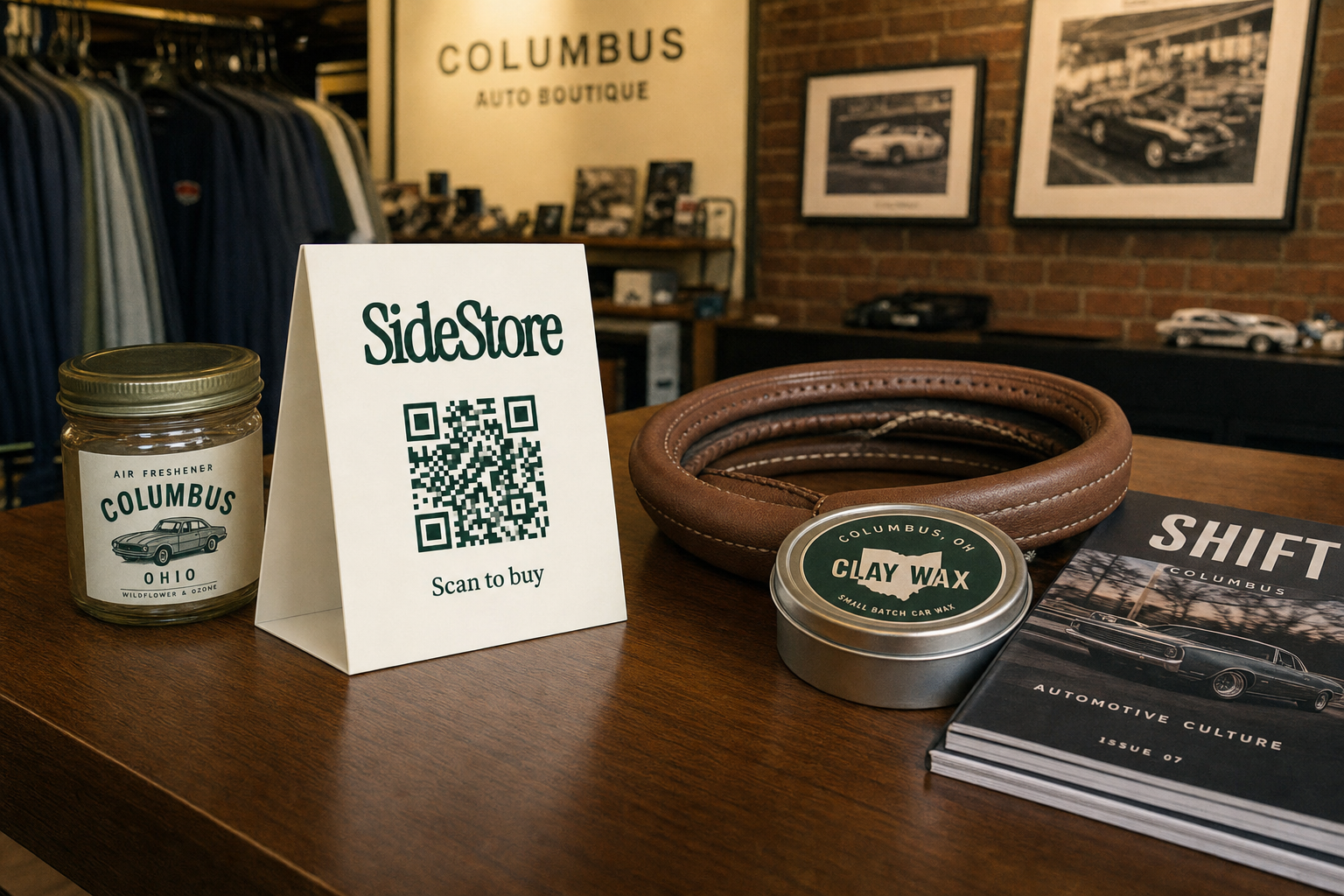
Columbus boutiques source auto boutique inventory through three main routes: wholesale purchasing, local vendor relationships, and consignment placements, each with meaningful trade-offs.
Wholesale is the most familiar path. You contact a distributor or brand, place a minimum order, pay upfront, and receive stock to sell. The advantage is full margin control and predictable supply. The disadvantage is that you carry all inventory risk. If a product does not move, you have paid for it regardless. Minimum order quantities can also tie up cash that a smaller operator would rather keep liquid.
Local vendor relationships are a Columbus-specific advantage. The city's maker and design community is active, and many independent creators want retail placement. You can negotiate direct purchase arrangements with local vendors, buy at wholesale from them, sell at retail. This keeps selection local and distinctive, but you still own the stock once purchased.
Consignment flips the risk structure. A maker places products in your space through a platform like SideStore. You display the items, they sell through the Retail Widget (which handles checkout, stock tracking, and automatic split payouts), and neither party has paid for inventory upfront. Your margin on each sale is lower than a full wholesale-to-retail markup, because the maker retains a share. That is the honest trade-off: less risk, but also less margin per unit sold.
For makers, how consignment works for makers explains the process from the other side. If you are evaluating selling through consignment as an operator, the key question is whether the passive margin on consignment items justifies the lower per-unit return compared with wholesale, for many Columbus boutique operators, the answer is yes, because the shelf space was otherwise empty.
Wholesale vs Consignment: A Side-by-Side Comparison
The core difference between wholesale and consignment comes down to who carries the risk and who controls the margin. Both models can coexist in the same boutique, many operators run a wholesale core and fill specialty shelves with consignment placements.
| Dimension | Wholesale | Consignment via SideStore |
|---|---|---|
| Upfront cost | Paid at order, before any sale | None, maker places stock at their cost |
| Inventory risk | Fully on the operator | Fully on the maker |
| Margin per unit | Higher (full retail minus wholesale cost) | Lower (split with the maker on each sale) |
| Admin effort | Manual reordering, stock reconciliation | Automatic via Retail Widget dashboard |
| Speed to shelf | Dependent on supplier lead times | Live as soon as placement is configured |
| Scalability | Limited by capital and storage | Add placements without additional capital outlay |
The table above makes consignment look straightforwardly better, so the trade-off deserves plain acknowledgement: your per-unit margin is lower on consignment items. If a wholesale product returns, say, a strong retail markup and a consignment item returns a negotiated host split, you are earning less per unit on the consignment side. What consignment gives you in return is risk-free shelf coverage, no dead stock, and automatic settlement without chasing invoices. For operators with limited capital or empty display space that is not earning anything, boutique inventory options on consignment can generate revenue that a blank shelf never could. If you accumulate slow-moving wholesale stock, the challenge of how to clear slow-moving boutique inventory becomes real and costly.
How the SideStore Retail Widget Works for a Columbus Boutique
The SideStore Retail Widget is the interface that lets a maker place products in your space and lets you manage, track, and settle those placements, the QR scan-to-pay checkout is one function of the Widget, not the whole product.
Here is how the setup sequence works for a Columbus auto boutique:
A maker configures the placement. The maker sets up their product in SideStore, defines pricing, selects your boutique as the host venue, and sets the consignment split. This negotiation happens between maker and operator before the placement goes live, SideStore records and enforces whatever terms are agreed.
You accept the placement. As the host, you confirm the terms in your Retail Widget dashboard. No purchase order, no payment at this stage.
Products arrive on your shelf. The maker delivers physical stock to you. You display it. The Retail Widget assigns live stock tracking to those units from the moment the placement is active.
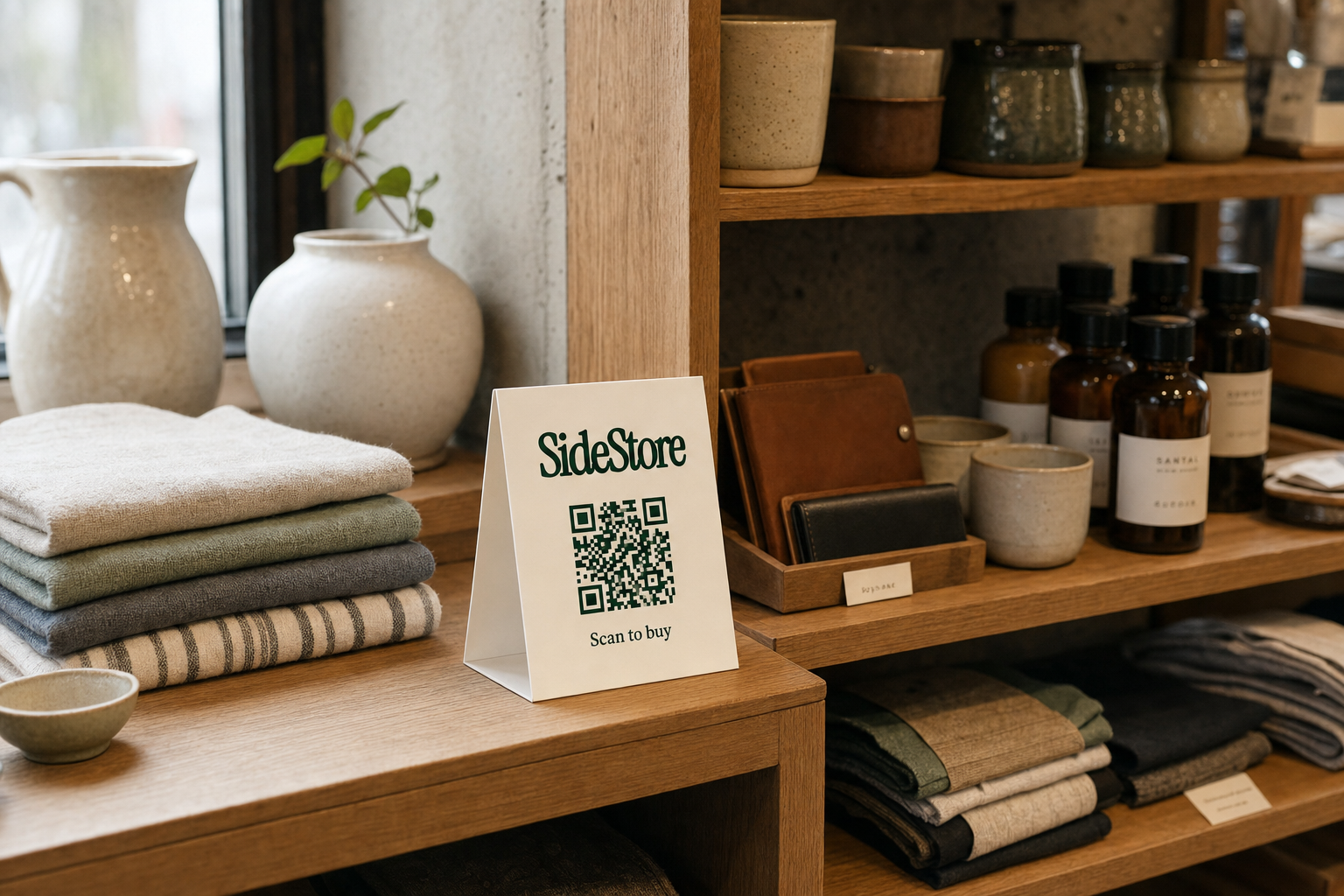
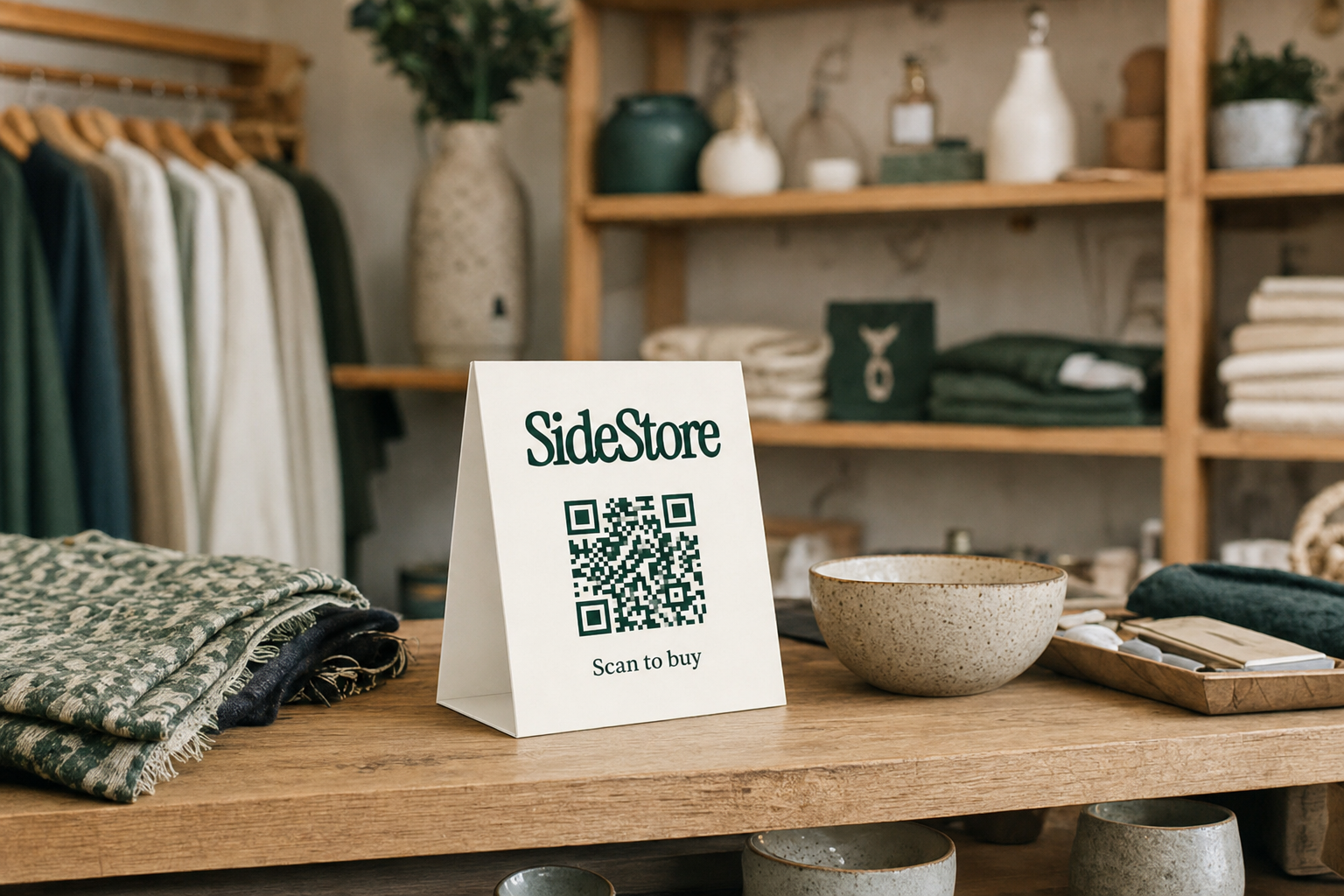
A customer scans to purchase. The maker prints a SideStore QR code card and attaches it to their product, or you display a single SideStore card covering all products in the placement. The customer scans, selects the item, and pays. Checkout is handled by the Widget.
Stock updates automatically. Each scan-to-pay transaction decrements the live stock count. You can see current stock levels in your dashboard without counting shelves manually.
Settlement runs automatically. When a sale completes, the Retail Widget splits the revenue according to the agreed terms and routes each party's share automatically. You do not chase the maker for your cut, and the maker does not wait on a manual payment from you.
Low stock triggers a restock conversation. When inventory drops to a threshold, you can see it in the dashboard and prompt the maker to replenish.
This model works in any high-foot-traffic retail space. How coffee shops use consignment retail follows an identical sequence. If you want a broader view of selling on consignment and how the terms typically work, that resource covers the fundamentals.
Managing Auto Boutique Inventory on Consignment
Managing consignment inventory in a Columbus auto boutique is primarily a dashboard task, not a floor task. Your operational role is minimal by design.
Your SideStore dashboard shows you, at a glance: which placements are active, how many units remain in each, how many sales each placement has generated, and what your accumulated host-split balance is. You do not need to integrate a new point-of-sale system. The Retail Widget sits alongside your existing operations.
The risks you do not carry are worth naming plainly. You have not purchased the stock, so unsold units are not a financial loss to you. The maker carries that exposure. If a product stops selling, your downside is the shelf space it occupies, not a sunk inventory cost. That changes the calculus on clearing slow-moving boutique inventory significantly: with consignment, you simply end the placement and the maker retrieves their stock.
What you do manage is placement quality. Not every product will suit your auto boutique's customer. Evaluate placements on fit with your audience before agreeing to them. A well-curated consignment shelf earns steadily; a poorly curated one sits idle and earns nothing for either party.
For operators curious about a model where you carry almost no inventory yourself, running a boutique without buying inventory explores that structure in more depth.
For Makers: Placing Your Products in Columbus Auto Boutiques
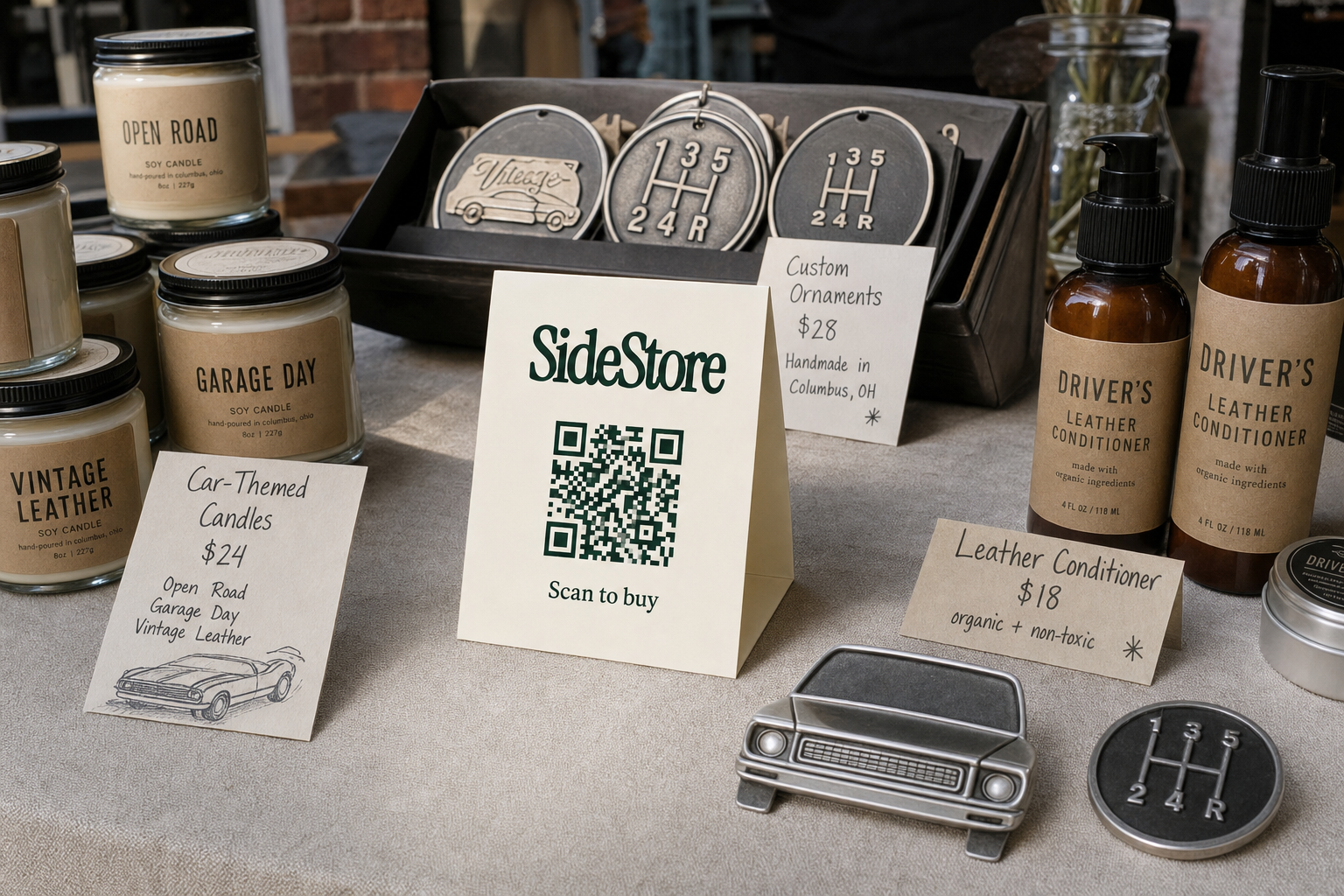
If you are an independent maker trying to get your products into physical retail in Columbus, you already know how hard that door is to open. Boutiques want proven sellers. You need a shelf to prove them. It is a genuine access problem, and consignment is one of the few practical ways around it.
Consignment placement through SideStore lets you put your products in a Columbus auto boutique without waiting for a buyer, without producing on speculation for a wholesale order, and without opening a store of your own. You retain ownership of your stock until it sells. When it does, your share of the sale settles automatically.
The split between maker and host is negotiated between the two parties. Commonly, host splits range somewhere in the lower portion of the sale price and maker shares cover the majority, but these terms vary by venue, product type, and relationship. SideStore records and enforces whatever is agreed, there is no ambiguity at payout time.
Getting started means finding a Columbus auto boutique with available shelf space and a willingness to take placements. Approach operators with a clear product pitch: what the item is, what it retails for, what split you are proposing, and how you will handle restocking. Operators are more likely to say yes when you make the process frictionless for them.
If you are still in the early stages of understanding your distribution options, starting a boutique with no inventory gives useful context on the broader model. For a clear view of what you are agreeing to, understanding consignment terms is worth reading before you approach your first venue.
What a Columbus Boutique Actually Earns from Consignment Placements
A Columbus auto boutique earns its host split on every consignment sale, automatically, with no manual reconciliation.
To make the revenue model concrete: consider an illustrative example. Suppose a maker places ten artisan automotive candles at a retail price of $28 each. The agreed host split is 30 percent. If all ten sell, the boutique earns $84 without purchasing a single unit of stock. The maker earns $196. If only five sell, the boutique earns $42 and the maker retrieves the five remaining candles.
These figures are illustrative only, not a guaranteed return. Actual earnings depend on the retail price, the agreed split, and how well the product suits your customer base.
The key insight is that consignment earnings are additive to whatever your boutique already generates from wholesale stock. Shelf space that was empty is now earning a margin. Operators thinking about how retail hosts think about profit margins will recognise this as incrementally improving per-square-foot yield. For a broader look at how incremental revenue for retail venues compounds over multiple placements, the revenue model becomes compelling quickly when several active makers are placing simultaneously.
Running Consignment Inventory in a Columbus Auto Boutique
Consignment is a practical, low-risk way to fill a Columbus auto boutique's shelves with distinctive products and earn revenue without upfront stock purchases.
For operators: the Retail Widget handles checkout, stock tracking, and split settlement automatically. Your role is curation and shelf management, not capital outlay. For makers: consignment placement gives you physical retail access without a storefront. Both sides benefit when the fit is right.
Ready to run a consignment placement? Get started with consignment and configure your first placement today.