Starting boutique inventory is the stock you purchase upfront to launch your online shop and fulfill initial customer orders. For most new online boutiques, the right starting range is 30 to 100 total units, spread across 10 to 20 SKUs, at roughly 3 to 5 units per style.
That range is not arbitrary. It is tight enough to protect your cash, wide enough to give customers a real sense of what your boutique stands for. Go below 30 units and you risk selling out before you have any data. Go above 100 and you tie up capital in stock that may not move.
The core tension here is cash versus stockout risk. Buy too little and you cannot test what sells. Buy too much and you cannot survive a slow first month. Every decision in this guide comes back to resolving that tension with numbers, not guesswork.
If you want to sidestep the upfront buy entirely, the guide also covers consignment placements and how to start an online boutique with no inventory. For makers already looking at sourcing options, see our boutique inventory for sale overview.
How Many SKUs Should a New Online Boutique Carry?
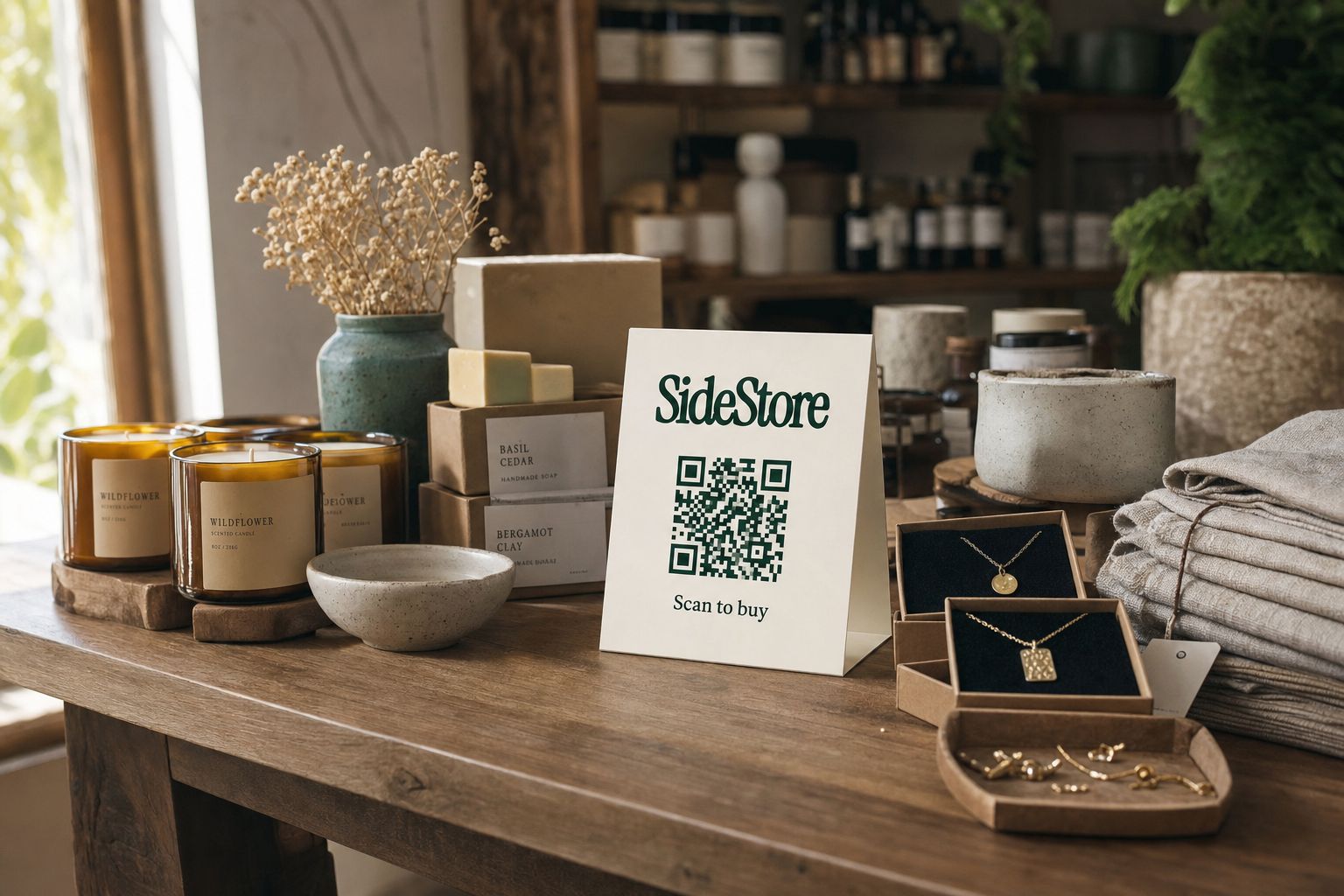
A new online boutique should carry 10 to 20 SKUs at launch. Fewer than 10 and the shop feels sparse; more than 20 and you fragment your budget, muddy your brand positioning, and create a reordering headache before you have any sales data to guide you.
One clarification that matters more than most new boutique owners expect: a SKU is a specific sellable combination. One blouse in three colours and two sizes is six SKUs, not one product. That distinction changes your inventory planning entirely, because depth in a single style costs real money.
The 10 to 20 range works because it forces curation. Curation should be driven by demand signals, not personal taste. Look at what is already selling in your category on platforms where search and purchase data are visible. Check return rates and review sentiment on comparable products. Use your own social content performance as a proxy signal: the styles your audience engages with are likelier to convert than the ones you love personally.
Tight-category boutiques, those that sell one clear type of product to one clear customer, almost always outperform scatter-shot assortments at launch. A boutique that opens with 12 SKUs all built around linen resort wear has a more defensible position than one with 20 SKUs spanning three unrelated aesthetics.
The honest trade-off: depth versus breadth is a genuine tension, not a solved problem. More SKUs give customers more reasons to buy in a single session. Fewer SKUs let you go deeper per style, which protects against stockouts on your best performers. There is no universally correct answer. The 10 to 20 range is a starting constraint, not a permanent ceiling.
If you want to add local products without buying inventory, consignment placements are one way to extend your apparent range without extending your capital commitment.
How Many Units Per Style Should You Order?
Order 3 to 5 units per style for your first buy. That quantity is the minimum viable test: enough stock to get real sales data, small enough that an underperforming style does not sink your budget.
One or two units per style sounds conservative but creates a different problem. A single sale leaves you with one unit left and no data on whether the sellout was luck or signal. Two units sells out in a weekend and you spend the following week out of stock on something that might have been your best performer. You lose both revenue and data.
Ten or more units per unproven style is the opposite error. You are betting significant capital on something your customers have never seen. If it does not move, you are stuck with stock that costs you storage space and cash flow.
For apparel specifically, size distribution matters. A common starting point for a women's clothing boutique is to weight toward the middle of your size range, roughly 20 to 30 percent in your most common size, with smaller quantities on the extremes. Your own customer data will override any general heuristic quickly, but you need a starting point.
The escalation rule is straightforward. If you have pre-launch data, use it. A sold-out pre-order, a waitlist with real email captures, or strong engagement on a specific style in a content test all justify a larger first run on that style. Doubling your unit count on two or three proven styles while keeping the rest at 3 to 5 is a disciplined way to scale selectively.
Typical boutique conversion rates run somewhere between 1 and 4 percent on new online stores, though your own site data will vary significantly by traffic source and category. That range is useful for projecting how many visitors you need to move through your opening stock, not as a guarantee. See also how to start an online boutique without inventory if you want to delay the buy decision entirely.
Sizing Your First Inventory Budget: The Numbers That Matter
Allocate 50 to 60 percent of your available startup capital to inventory, and no more. The rest covers your platform, marketing, packaging, and a cash reserve for reorders. Spending everything on stock is one of the most common and most avoidable errors new boutiques make.
Here is how the arithmetic works at a practical scale. Take 15 SKUs at 4 units each: that is 60 units. Wholesale costs vary widely by category and supplier, so these figures are illustrative rather than benchmarks. But if your average wholesale cost per unit sits between $15 and $35, your opening inventory buy runs somewhere between $900 and $2,100. At a standard 2x to 2.5x keystone markup, the retail value of that stock sits between $1,800 and $5,250.
Your sell-through rate tells you whether your buy was correctly sized. The formula is simple:
Sell-through rate = Units sold / Units received x 100
A sell-through rate above 80 percent in the first 60 days is a strong signal to reorder. Below 50 percent, you have a demand or pricing problem to diagnose before you buy more.
The cash-flow trap is spending your entire budget on opening stock and having nothing left to respond to what the data tells you. Your first order is not your only order. It is a test.
Open-to-buy (OTB) is the formal budget framework that established buyers use to plan inventory investment by period. You do not need to run a full OTB model at launch, but understanding the concept matters: it is the practice of committing only what your projected sales can support, rather than buying what you can theoretically afford.
Consignment is one way to reduce initial capital exposure. For more on the model, see selling consignment and selling through consignment.
How to Test Demand Before You Commit to a Large Order
Test demand before your first large order using three concrete signals: social content performance, pre-orders or waitlists, and consignment placements in physical spaces.
Signal 1: Social content performance. Post product content before you buy. Track saves, shares, and direct questions. Saves and shares consistently outperform likes as purchase-intent indicators. If a specific style generates strong saves across multiple posts, that is a genuine demand signal. If it generates only likes, it is probably aesthetically pleasing but not yet purchase-worthy in your audience's mind.
Signal 2: Pre-orders and waitlists. A pre-order requires a real commitment from the customer. Even a small pre-order run of 10 to 15 units tells you something a thousand Instagram likes cannot: people are willing to pay. A waitlist with email capture costs almost nothing to set up and gives you an audience to sell to on day one.
Signal 3: Consignment placements. Placing products in a merchant space on consignment is one of the most underused demand tests available to new boutiques. The model is straightforward: you place your product in a physical location, the host merchant displays it at no upfront cost to them, and you both earn when it sells. No inventory write-off risk. Real purchase data from real buyers. Platforms like SideStore are built specifically for this kind of placement. See selling on consignment for a full explanation of the model, and sell products without opening a retail store for practical placement ideas. If you are looking beyond traditional retail, alternatives to weekend markets for small brands covers other low-cost distribution channels worth testing.
The MOQ trap. Many suppliers set minimum order quantities somewhere between 6 and 24 units per style, though ranges vary widely by category. If a supplier's MOQ forces you into quantities larger than your test budget allows, look for suppliers who offer samples, work with smaller run minimums, or consider a consignment placement first to generate revenue before you commit.
Your first order is not just stock. It is data you are paying for.
Inventory Sizing by Stage: A Quick-Reference Guide
The right inventory size depends on where you are in your boutique's lifecycle. Pre-launch, you are testing. At launch, you are proving. In growth, you are scaling what works.
| Stage | SKU Count | Units per SKU | Total Units | Key Priority |
|---|---|---|---|---|
| Pre-launch | 3, 5 | 2, 3 | 6, 15 | Demand validation |
| Launch | 10, 20 | 3, 5 | 30, 100 | Cash efficiency |
| Growth | 20, 40 | 5, 10 | 100, 400 | Reorder discipline |
| Mature boutique | 40+ | 10, 20+ | 400+ | OTB planning |
Your sell-through rate is the trigger for moving between stages. If you hit 80 percent or above in 60 days at launch, you have the signal to expand SKU count and unit depth in order two. If sell-through stalls below 50 percent, diagnose before you scale; more inventory will not fix a positioning or pricing problem. For what to do when stock does not move, see how to get rid of boutique inventory.
Five Inventory Mistakes New Boutiques Make (and How to Avoid Them)
New boutiques make predictable inventory mistakes. Most of them come down to buying from optimism rather than data. Here are the five most damaging, and how to avoid each one.
1. Overbying on styles you personally love. Buying what you like rather than what signals say will sell is the most common first-order mistake. Fix: Validate each style with at least one external demand signal before it makes your buy list. Social saves, search volume, and pre-orders all count. Your personal taste does not.
2. Going too shallow across too many SKUs. Twenty SKUs at 1 unit each gives you no margin for error and no reorder data worth acting on. Fix: Narrow your launch assortment to 10 to 15 SKUs and put 3 to 5 units behind each one. Depth beats breadth in a first buy.
3. Spending the entire budget on opening stock. No cash reserve means no ability to reorder what sells or respond to a slow period. Fix: Keep at least 40 percent of your startup capital outside the initial inventory buy. That money is your operational buffer and your reorder fund.
4. No clearance plan for slow movers. Stock that sits past 90 days becomes a cash-flow problem. Many first-time buyers have no plan for it. Fix: Set a clearance trigger before you launch. If a style hits 90 days with less than 40 percent sell-through, mark it down, bundle it, or move it through a consignment channel. See what to do with slow-moving boutique inventory for practical options.
5. Reordering before you have sell-through data. Reordering based on gut feeling rather than actual sell-through rate compounds your first-order mistakes. Fix: Wait until you have at least 30 days of clean sales data. Then reorder only the SKUs with a sell-through rate above 70 percent. For sourcing the reorder, boutique inventory for sale covers accessible wholesale options.
The Inventory-Light Alternative: Consignment Placements in Physical Spaces
Consignment placements let you place your products in real-world merchant spaces, earn on each sale, and generate genuine purchase data without committing to a full wholesale buy. For a new boutique trying to validate demand before a large inventory investment, this is one of the most practical tools available.
The model is straightforward. You place your product with a host merchant, such as a cafe, boutique, hotel, or any retailer with available shelf space. The merchant displays it at no upfront cost to them and no inventory risk on their side. When a sale happens, both you and the merchant earn. No one absorbs the cost of unsold stock.
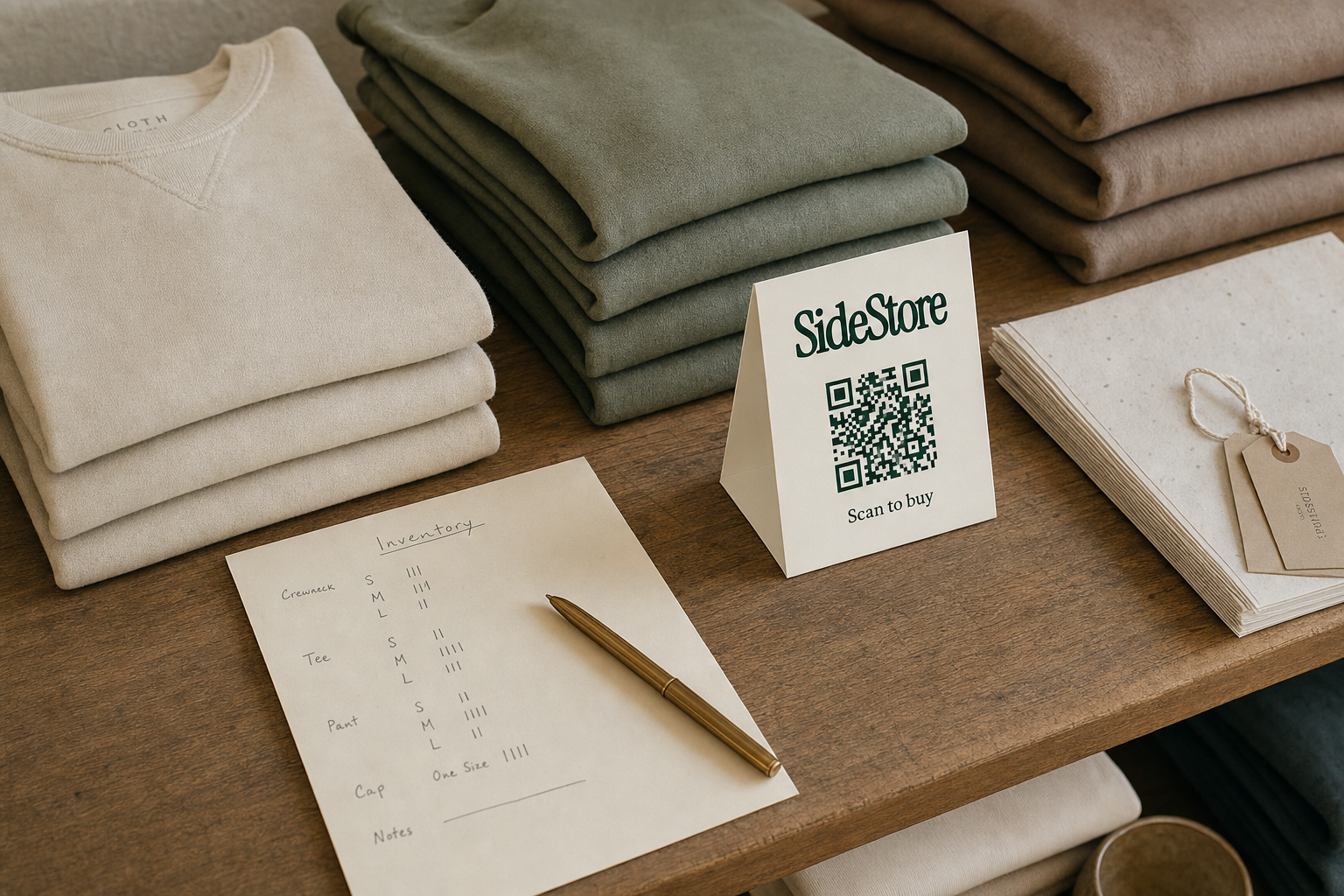
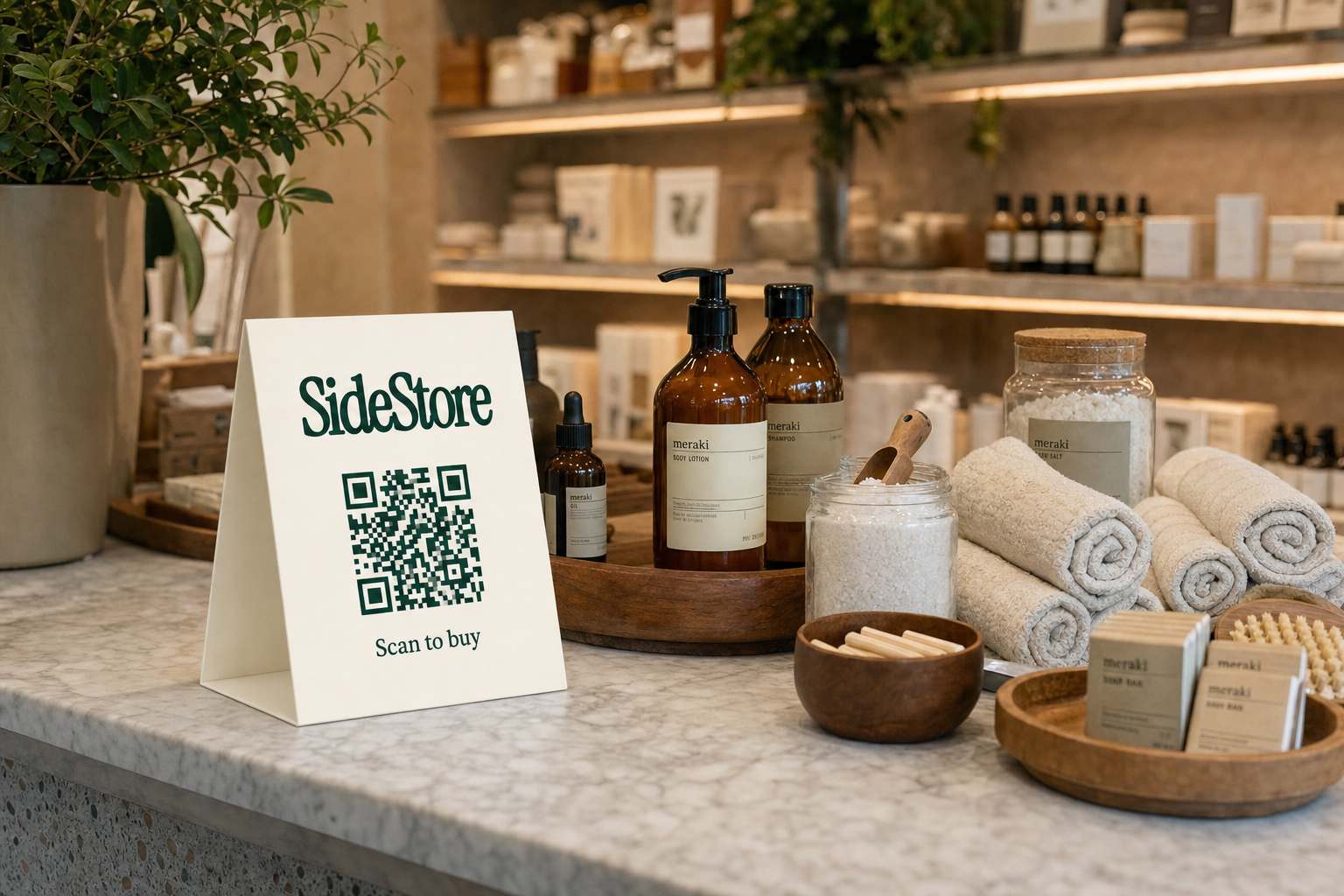
SideStore's Retail Widget is built specifically for this kind of placement. It handles checkout (including a scan-to-pay QR on a printable card), live stock tracking, placement attribution, and automatic split payouts to you and your host. The QR checkout is one function of the Retail Widget, not the whole product. The Widget manages the consignment placement end to end.
For boutique owners, the practical value is data. Three to four weeks of consignment sales across two or three merchant locations tells you which styles actually sell to strangers, not just to your existing social audience. That data makes your next inventory buy sharply more defensible.
Explore how this works from the merchant side: boutique shops adding local products without buying inventory, cafes making money from unused shelf space, and hotels turning lobby space into retail revenue.
Frequently Asked Questions
These are the questions most new boutique owners ask when planning their first inventory buy. The answers are direct; where ranges are given, they are illustrative starting points, not guarantees.
How much should I spend on inventory for a new boutique?
Allocate 50 to 60 percent of your available startup capital to inventory, and reserve the rest for operations, marketing, and reorders. On a $3,000 startup budget, that puts roughly $1,500 to $1,800 into stock. At a wholesale cost of $15 to $35 per unit, that buys you 45 to 120 units depending on your category. Wholesale costs vary widely, so treat those figures as illustrative rather than fixed benchmarks.
Is it better to have more styles or more units per style?
At launch, more units per style typically outperforms more styles. Depth protects you from stocking out on your best performer before you can reorder, and it gives you enough data per style to make a confident reorder decision. Start with 10 to 20 SKUs and put 3 to 5 units behind each one. Breadth is a growth-stage priority, not a launch priority.
What if my first inventory order doesn't sell?
First, diagnose before you act. Is it a pricing issue, a traffic issue, or a product-market fit issue? A sell-through rate below 50 percent after 60 days warrants a markdown or a channel change, not a reorder. Consider consignment placements as a secondary channel to move slow stock. What to do with boutique inventory that doesn't sell covers your clearance options in detail.
Can I start a boutique with no inventory?
Yes. Consignment, drop-shipping, and pre-order models all let you operate without holding stock upfront. Consignment in particular gives you real purchase data from physical locations before you commit to a wholesale buy. See start an online boutique with no inventory for a full breakdown of the inventory-light launch options available to new boutique owners.
Starting Right: Inventory Discipline as a Competitive Advantage
The three numbers to keep in mind for how much inventory to start with for an online boutique are clear: 10 to 20 SKUs, 3 to 5 units per style, and no more than 50 to 60 percent of your capital in opening stock. That discipline is not a constraint. It is a competitive advantage over boutiques that overbuy and run out of runway before they run out of ideas. Use your first order to buy data. Use the data to make order two deliberate. For makers ready to test before they buy, selling consignment is the logical next step.