How to Sell Jewelry Through Beauty Salons: A Consignment Guide for Makers
Selling jewelry through beauty salons works on consignment: you place your pieces in a salon's retail space, the salon earns a percentage only when a piece sells, and neither of you carries stock risk or upfront cost. It is straightforward once you understand what salon owners actually need.
The mechanics are simple. Approach a salon whose clientele matches your price point, offer them a 25 to 35 percent split on each sale, document the terms in writing, set up a small self-contained display, and use a system to track stock and settle payouts automatically. Done well, a network of three or four salon placements becomes a meaningful distribution channel that costs you no premises and no wholesale discounting.
Why salons? Clients sit for 45 minutes to two hours. They are already spending money on themselves. They are looking in the mirror, thinking about how they look. That mindset carries naturally to small accessories. A pair of earrings on display beside the reception desk is not an interruption; it is a continuation of the same conversation. Few retail environments offer that combination of dwell time and buying psychology.
For a fuller picture of how this compares to boutique placements and pop-ups, see the guide to selling handmade jewelry in boutiques. The principles overlap, but salon buyer psychology is distinct enough to warrant its own approach.
Why Beauty Salons Work for Jewelry
A client who has just had a blowout, a manicure, or a colour treatment is primed. She is looking in the mirror. She is thinking about how she looks. That self-investment mindset does not stop when the treatment ends. It carries to the waiting area, to the till, to your display.
Beyond the psychology, salons offer something most retail environments cannot: genuine dwell time. A client waiting for colour to process has nothing to do but look around. She will notice your display. She will pick something up. If your piece is priced correctly and displayed well, the sale often completes itself.
There is a structural advantage too. Most salon owners do not stock retail products outside professional haircare or nail ranges. Your jewelry faces little direct competition in the room. The owner has an unused surface, a captive audience, and no supplier relationship to protect. That makes them far more open to a consignment proposal than a boutique owner with a queue of suppliers at the door.
The model that makes this work without risk to either party is consignment: you own your pieces until they sell, the salon hosts them, and payouts split automatically. No upfront cost to the salon, no dead stock risk, no wholesale discount eating into your margin. For the full picture of selling through someone else's store, including how consignment compares to wholesale and other arrangements, that guide covers the complete framework.
Two honest notes: salons with back-to-back appointments and no browsing time sell less than salons with a relaxed, lounge-style atmosphere. And a salon whose clients are budget-conscious will not convert well on pieces above £30 to £40. Read the room before you pitch.
Choosing the Right Salon for Your First Placement
The clearest signal that a salon fits your work is whether its existing retail products, if any, are priced near yours. A salon selling £18 professional shampoos to a budget clientele is not the right home for £65 handmade silver earrings. Price alignment is your first filter, and you can usually assess it from the window or website before you walk in.
Once you have passed that filter, look for these signals:
Dwell time. Do treatments keep clients seated for 30 minutes or more? Colouring, extensions, nail work, and blowdries all create browsing windows. Express cut-and-go salons give clients almost no time to notice a display.
Physical space near a natural pause point. Is there a reception desk, waiting area, or product shelf near the till? You need roughly 30 to 60 centimetres of clean surface where a small display can sit without blocking foot traffic.
Foot traffic quality over volume. Fifteen loyal clients per day, each spending £80, outperform 40 walk-ins spending £20. You are looking for spending mindset, not headcount.
Owner attention to the room. A well-styled salon, where product shelves are tidy and displays are intentional, signals an owner who will care for your display rather than let it gather dust.
Client relationship with the space. Regulars who return fortnightly build familiarity with your pieces over time. A first visit may not convert. A second or third look often does.
For more on reading a retail environment before you commit, the guide to placing products in local independent shops covers the qualifying checklist in detail.
Pitching the Salon Owner: What to Say and What to Send
The most effective pitch is short, outcome-first, and removes risk from the owner's mind. Lead with the fact that they earn money from space they already have, at no cost and no inventory commitment. That is the pitch. Everything else is detail.
In person (which works better than email for a first contact), say something like:
"I'm a local jewelry maker looking to place a small collection on consignment in a few salons. You'd earn around 30 percent of every sale, you'd never buy any stock upfront, and I handle the display and restocking. Would that be something you'd want to hear more about?"
That opener answers the owner's two instinctive questions: what do I earn, and what do I have to do? If they are interested, follow with a one-page consignment sheet covering your pieces, retail prices, your split offer, and agreement terms. Keep it to one page. Salon owners are busy.
If they prefer email first, send:
- Three to five product photos at high quality, on a clean background
- One sentence about your maker background
- Your retail price range
- The split you are offering and a plain-language description of how consignment works
- A note that there is no cost or stock commitment for them
Do not send a 40-SKU catalogue, a complex price list, or anything that requires a complicated decision. Your goal for first contact is a meeting or a trial, not full-range selection.
One distinction worth understanding before you walk in: consignment is categorically different from wholesale. In wholesale, the salon buys your stock upfront at a reduced price and takes all the risk. In consignment, they never buy anything. For a full breakdown of consignment versus wholesale, that guide covers when each model makes sense for maker and host.
Consignment Percentage for Jewelry in Salons: What to Offer and Why
For jewelry on consignment in a beauty salon, the standard range is 25 to 40 percent to the host, with 30 percent as the most common opening. That reflects what the salon contributes: space, foot traffic, and client relationship, with no stock risk or purchasing commitment.
The exact percentage should track the placement quality. A high-footfall central salon with a lounge atmosphere warrants a higher split than a quiet suburban salon with one display shelf. Thirty percent is defensible for most placements. Thirty-five percent is reasonable if the salon has strong footfall or prominent display space. Forty percent is worth considering only if the owner is actively promoting pieces to clients or the location is genuinely exceptional.
Worked example: a £40 pair of earrings at a 30 percent split
- Retail price: £40.00
- Salon's 30% share: £12.00
- Your 70% share: £28.00
- From that £28, subtract materials cost (say £8): you net £20 per pair sold
That margin only works if your retail price already accounts for the consignment cut. Price for the channel, not for wholesale. Many makers calculate their price for direct sales and then try to offer consignment on top, which compresses margins to the point where the placement is not worth running. Build the consignment percentage into your pricing from the start.
At a 35 percent split on the same pair:
- Salon's 35% share: £14.00
- Your 65% share: £26.00
- Net after £8 materials: £18.00
Two pounds less per sale. Across ten sales a month, that is £20. Across three salons, it is £60. The arithmetic compounds, so model it carefully before you agree.
For context on how these rates compare to boutique placements, the guide to consignment rates when selling in boutiques includes useful parallel benchmarks.
The Consignment Agreement: What to Put in Writing Before You Leave Pieces
Never leave pieces in a salon without a signed agreement. A verbal understanding is not enforceable, and memory of what was agreed tends to drift when money is involved.
Your agreement does not need to be a legal document, but it must cover six things:
A description and count of the pieces placed, including a reference price or photo for each item so there is no ambiguity about what was left.
The retail price for each piece, agreed and fixed, so the salon cannot discount without your consent.
The consignment split, stated as a percentage, with a plain-language description of how it is calculated. For example: "30% of the retail sale price to the salon, 70% to the maker, settled monthly."
The settlement schedule, meaning when and how you will be paid. Monthly is standard. Specify whether payment is by bank transfer, cash, or another method.
A process for damaged, lost, or stolen pieces, including who bears the cost and how you will be notified. This is the clause most makers skip and most regret.
A notice period for ending the arrangement, typically two to four weeks, with a process for collecting unsold stock.
Keep the agreement to one page. Both parties sign and hold a copy.
For makers managing more than one or two placements, tracking agreement terms manually across salons becomes error-prone. Consignment inventory software can store agreement details alongside live stock data, which simplifies oversight and dispute resolution.
Setting Up Your Jewelry Display in a Salon: Space, Fixtures, and First Impressions
A good salon display occupies roughly 30 by 40 centimetres and sits at the reception desk or point of payment, where clients are naturally stationary and looking around. Those two locations convert better than a shelf tucked beside a product rack, because client attention is already paused.
Keep your display self-contained and free-standing. Bust forms, ring rolls, and small tiered stands work well in tight spaces. Choose display fixtures in neutral or natural materials that do not compete with the pieces: raw linen, natural wood, and white acrylic all work well. Avoid branded units from other companies; they read as clutter.
Limit pieces on display at any one time. Eight to twelve pieces offer choice without overwhelming the eye. More than that and your display starts to look like a market stall. Each piece should be visible and reachable without moving other pieces.
Label pricing clearly. A small card or tag with the price is not a barrier; it removes the awkwardness of having to ask. Clients who cannot quickly find the price often set the piece down and walk away.
For principles on structuring a small retail display that catches attention in non-traditional retail space, the guide to pop-up retail display principles covers fixture choice and visual hierarchy in detail.
Managing Stock, Restocking, and Getting Paid Across Multiple Placements
Manual stock tracking works for one salon placement. It starts to fail at two, and by three it becomes unreliable. The core problem: you are not present when pieces sell, so you depend on the salon to record each transaction accurately and in real time. That works fine when you have one relationship you can check weekly. It becomes a problem at five salons with 60 pieces in the field.
The cleaner solution is a consignment management system that gives you and the host visibility into live stock levels and records each sale at the point of transaction.
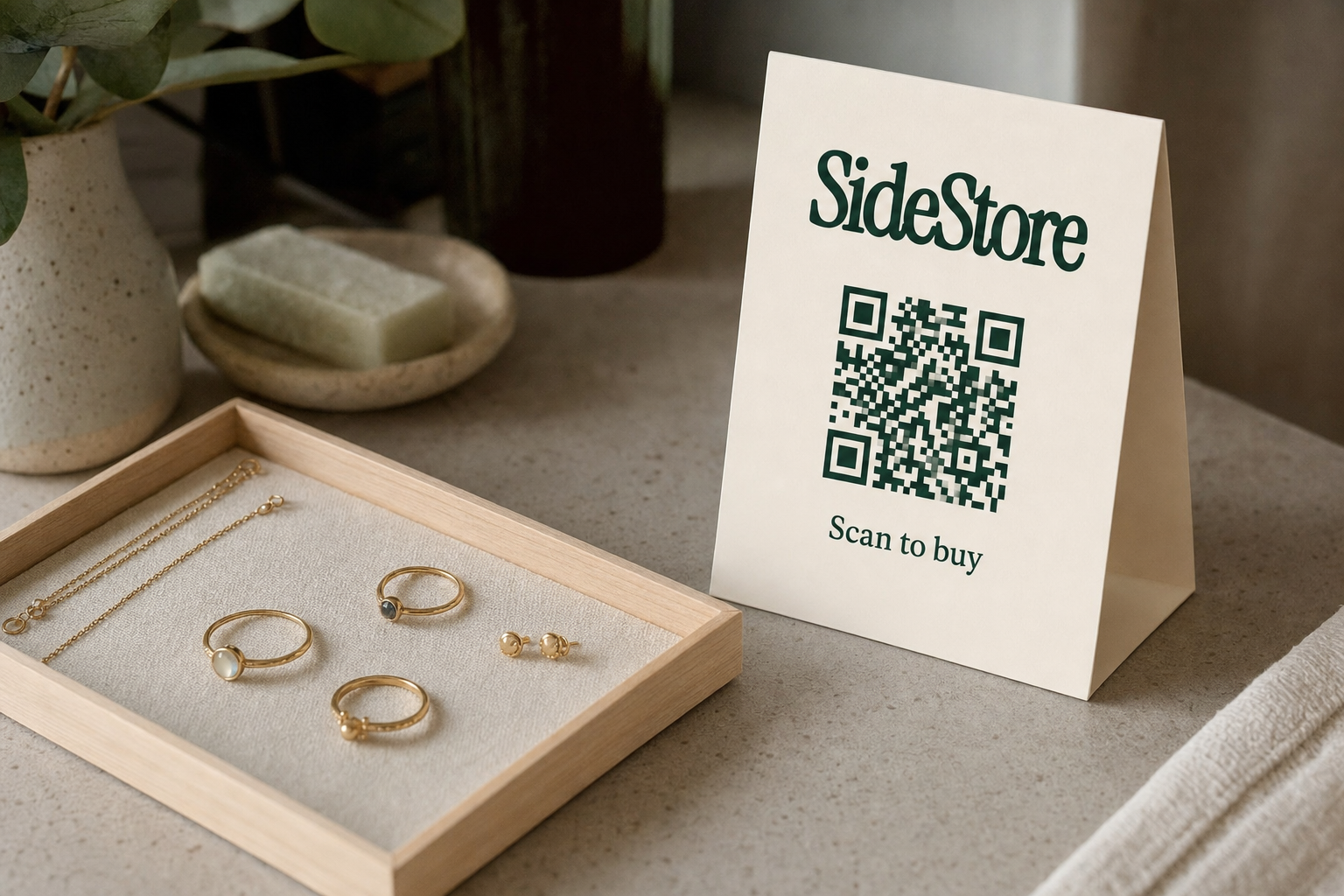
SideStore's Retail Widget is built for this. It is the interface that lets you place and manage a product on consignment end to end: it handles placement setup, live stock tracking, placement attribution, and automatic split payouts to maker and host. One function within the Retail Widget is a scan-to-pay QR that a salon can display so clients can complete a purchase by scanning, without salon staff needing to process anything manually. But the QR checkout is one part of the system, not the whole product.
For a maker running three or four salon placements, having split payouts calculated and settled automatically removes the most friction-prone part of the relationship. There is no end-of-month manual calculation, no chasing invoices, and no disagreement about what sold. The dashboard shows every placement, live.
For further reading on the operational side, inventory systems for small retail placements and consignment inventory software both cover tooling options in detail.
Salon Consignment vs Other Placement Channels: A Quick Comparison
How does a salon placement compare to your other options? It sits between a boutique and a pop-up in terms of effort and buyer intent, and it offers dwell time that most channels cannot match.
| Channel | Typical host split to maker | Dwell time and buyer mindset | Setup effort | Ongoing management | Best for |
|---|---|---|---|---|---|
| Beauty salon | 60 to 75% to maker | High dwell, self-investment mindset, captive audience | Low (small display, one surface) | Low to medium (monthly restock and settlement) | Accessible jewelry under £60 to £80 |
| Independent boutique | 55 to 70% to maker | Medium dwell, active browsing intent | Medium (styled shelf or rail) | Medium (regular restock, relationship management) | Wider price range, higher volume |
| Pop-up or market | 100% to maker (no split) | Low dwell, impulse buying | High (full setup and breakdown each time) | High (present the whole time) | New audience testing, launch pieces |
| Hotel or B&B lobby | 60 to 75% to maker | Variable dwell, gift mindset | Low to medium | Low (infrequent restock) | Gift-oriented pieces, higher price points |
Two observations: salons offer the best ratio of effort to dwell time for most jewelry makers. Pop-ups give you full margin but cost you a full day. For a deeper look at consignment versus wholesale across channels, see consignment vs wholesale and the guide to pop-up retail for independent makers.
Frequently Asked Questions
These are the questions that come up when makers are setting up their first salon placement.
What is a fair consignment percentage for jewelry in a salon?
A fair average consignment percentage is 25 to 35 percent to the salon, with 30 percent being the most widely accepted starting point. The exact percentage should reflect placement quality: footfall, dwell time, and how prominently your pieces are displayed.
Do I need a contract for salon consignment?
Yes, always. Even a one-page signed agreement that covers the pieces placed, retail prices, the split, settlement schedule, and a process for lost or damaged items is enough to protect both parties. A verbal arrangement is difficult to enforce and prone to misremembering.
How do I price jewelry for consignment?
Price for the channel from the start. Take your materials cost, add your time, then work backwards from the retail price to confirm your margin after the consignment percentage is taken. If the margin does not work at a 30 percent split, the piece is either underpriced or too costly to produce for this channel.
What happens if a piece is stolen or lost in a salon?
This is exactly why your agreement needs a clause on it. Common practice is for the salon to bear some or all of the cost if a piece goes missing from their premises, but the terms must be agreed in writing before placement. Without a clause, you have no clear recourse.
Can I sell in multiple salons at once?
Yes, and for most makers, two to four placements is a sensible working network. Managing multiple placements manually is feasible at low volume. Beyond three locations, a tool like SideStore's Retail Widget that handles live stock tracking and automatic split payouts across all placements makes the operation significantly more reliable. See the guide to running consignment placements across multiple locations for the full operational picture.
Starting Your First Salon Placement: The Short Version
Start here, in this order:
- Qualify two or three salons whose clientele and price point match your jewelry.
- Pitch in person, leading with the host benefit: they earn from space they already have, at no cost and no stock risk.
- Agree a consignment percentage (30 percent to the salon is a solid opening offer) and put it in a signed one-page agreement.
- Set up a small, self-contained display at the reception desk or point of payment, with clear pricing on each piece.
- Track sales and stock digitally from day one, even if you start with a spreadsheet and upgrade to a consignment management system as you scale.
A network of three or four well-chosen salons, managed through a single dashboard with automatic split payouts, is a meaningful distribution channel that costs you no premises and no wholesale discounting. That is what consignment commerce, done properly, actually looks like in practice.
For the full operational framework, a maker's guide to retail partnerships covers the model end to end. And if you want to run salons alongside boutique placements, selling handmade jewelry in boutiques is the natural companion read.