The Future of Cooperative Commerce: How Independent Makers Are Reshaping Retail
Cooperative commerce is a model where revenue, governance, and infrastructure are shared equitably among the people who produce and distribute goods. In physical retail, it's already happening: independent makers placing products on consignment in merchant spaces, with automatic split payouts at every sale and zero upfront cost to either party.
If you're an independent maker trying to reach physical retail without signing a lease or absorbing stock risk, cooperative commerce is the operating model that makes it work. This isn't philosophy reserved for food co-ops or credit unions. It's a practical distribution approach, and it applies directly to the shelf space sitting idle in cafes, boutiques, and hotels near you.
The distribution barrier facing independent makers is real. Most retail channels demand margin, minimums, or both. Consignment flips that equation: you earn when you sell, the merchant earns a share for hosting, and the infrastructure handles the rest. That's what selling through someone else's store looks like at its most efficient, and it's part of a broader shift in how shared retail networks support local economies.
What Is Cooperative Commerce and How Does It Generate Revenue?
Cooperative commerce generates revenue through sales. Revenue flows to the people doing the work: producers, hosts, and the platform infrastructure they share. Unlike a traditional marketplace that charges listing fees, takes growing commissions, and owns the customer relationship, a cooperative model keeps the commercial relationship between seller and buyer transparent and equitable.
The mechanics rest on seven principles established by the International Co-operative Alliance:
- Voluntary and open membership, participation is open to anyone able to use the cooperative's services
- Democratic member control, members govern the cooperative on a one-member, one-vote basis
- Member economic participation, members contribute equitably to, and democratically control, the capital of their cooperative
- Autonomy and independence, cooperatives are autonomous organisations controlled by their members
- Education, training, and information, cooperatives provide education and training for members and the public
- Cooperation among cooperatives, cooperatives serve their members most effectively by working together
- Concern for community, cooperatives work for the sustainable development of their communities
These principles are not decorative. They describe how revenue circulates. A cooperative generates surplus through trading and returns that surplus to members in proportion to their participation, rather than paying it to external shareholders.
A common misconception: cooperatives avoid profit. They don't. They generate revenue through legitimate commercial trade; they distribute it differently. In a consignment placement context, this looks like a maker earning a set percentage of every sale, a merchant host earning a split for providing the space, and the platform taking a transparent operational fee. No hidden margin. No position-buying. Every party knows the terms in advance, which is exactly what a sound consignment agreement for artists formalises.
Platform Cooperative vs Traditional Marketplace: What Makers Actually Experience
The difference between a platform cooperative and a traditional marketplace isn't ideological; it's mechanical. A traditional marketplace extracts increasing fees as it scales, owns the customer data, and can change terms unilaterally. A cooperative-aligned model keeps terms transparent, returns surplus to participants, and gives sellers a voice in how the system operates.
Here's how the three models compare across the dimensions that matter most to a maker:
| Dimension | Traditional Marketplace | Platform Cooperative | Consignment Commerce (SideStore) |
|---|---|---|---|
| Revenue model | Platform takes commission; seller earns remainder | Surplus returned to member-sellers based on participation | Split payout set in advance; maker and merchant each earn a transparent share at point of sale |
| Upfront cost to seller | Listing fees, subscription fees, or paid advertising required | Member contribution, often modest | No upfront cost; maker pays nothing until a product sells |
| Customer relationship | Platform owns customer data | Members collectively govern data policy | Placement is between maker, merchant, and buyer |
| Stock risk | Seller ships inventory speculatively | Varies by model | Merchant hosts on consignment; no purchase required |
| Term transparency | Terms set and changed by platform | Democratically set by members | Consignment terms agreed in writing before placement goes live |
| Governance | Shareholders and executives decide | Members vote | Maker and merchant agree placement by placement |
| Scalability | Platform scales; seller margin often compresses | Can be slow to scale; governance overhead | Dashboard-managed; one maker can run multiple placements simultaneously |
The governance distinction matters. In a true platform cooperative, sellers vote on how the platform runs. Durable but slow. In consignment commerce like SideStore, governance operates at the placement level: you and the merchant agree terms before anything goes live, and those terms are documented through consignment stock terms and conditions. You don't need a committee vote to change a placement; you negotiate directly.
The scalability objection comes up often. Here's the answer: consignment inventory software collapses much of the overhead. When stock tracking, checkout, and split settlement are handled by a single interface, running ten placements isn't ten times the administration of running one.
Open Infrastructure for Independent Commerce: What It Looks Like in Practice
Open infrastructure for independent commerce means the tools to place, sell, and settle are accessible to makers without requiring them to build their own distribution network from scratch. In physical consignment, that infrastructure has three functional layers.
Layer 1: Placement tools. Before a product sells anywhere, it needs to be placed. Placement tools help you model the consignment terms, identify a suitable merchant space, and get a product live on a physical shelf. This includes the ability to set split percentages, define the product catalogue, and assign placements to specific locations. If you're unsure how to start that conversation with a merchant, the practical guide to approaching a local shop about stocking your products covers the mechanics of that first meeting.
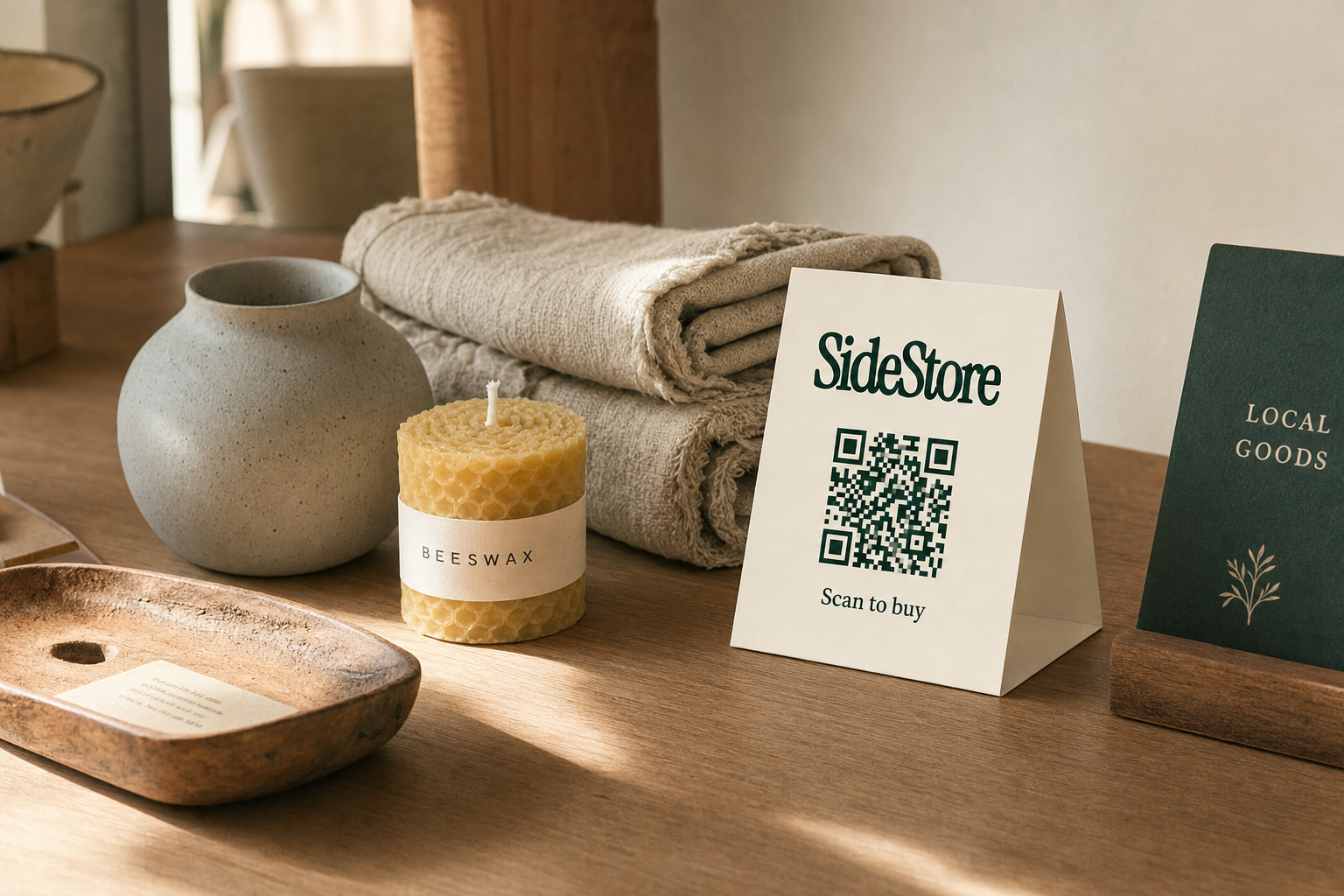
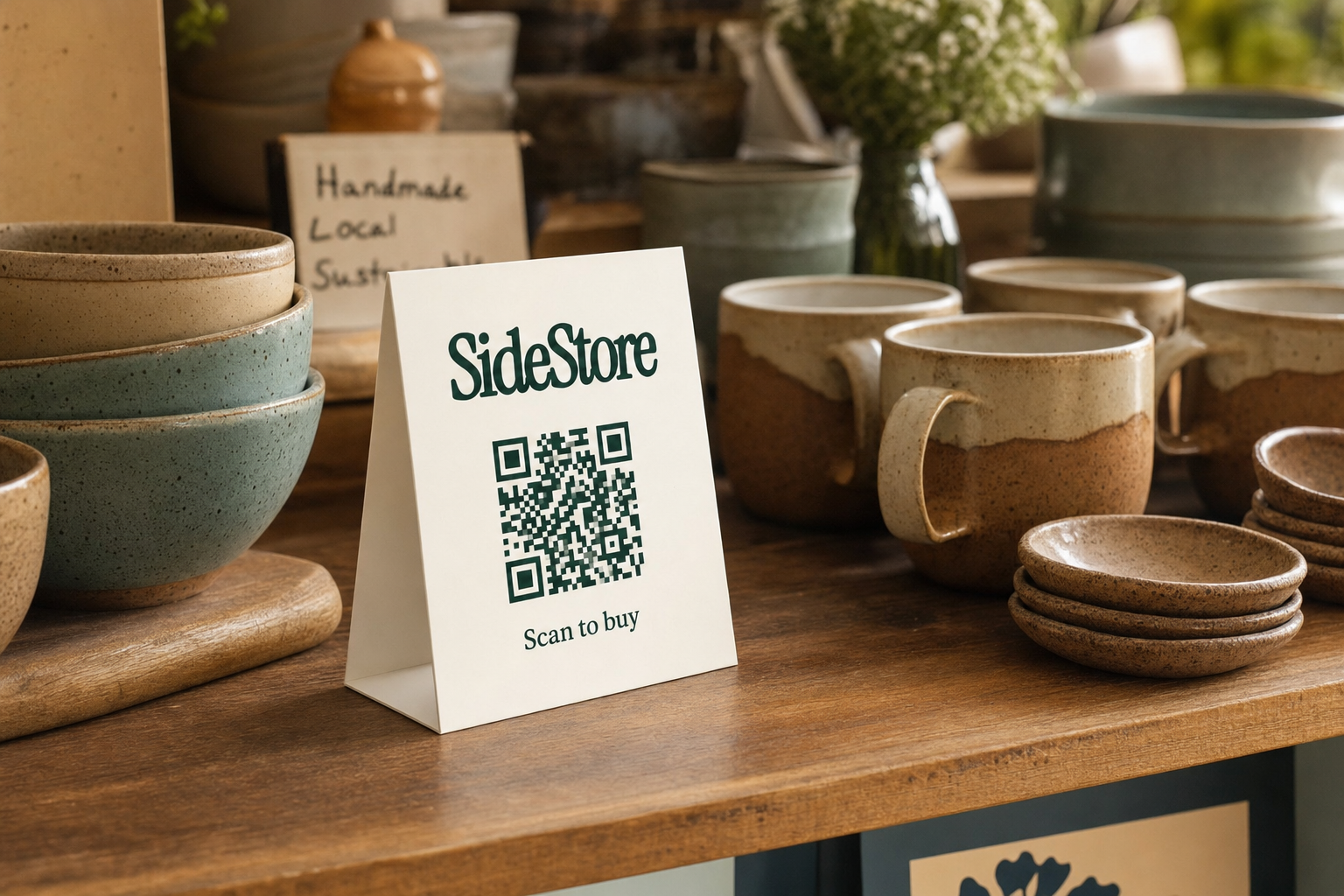
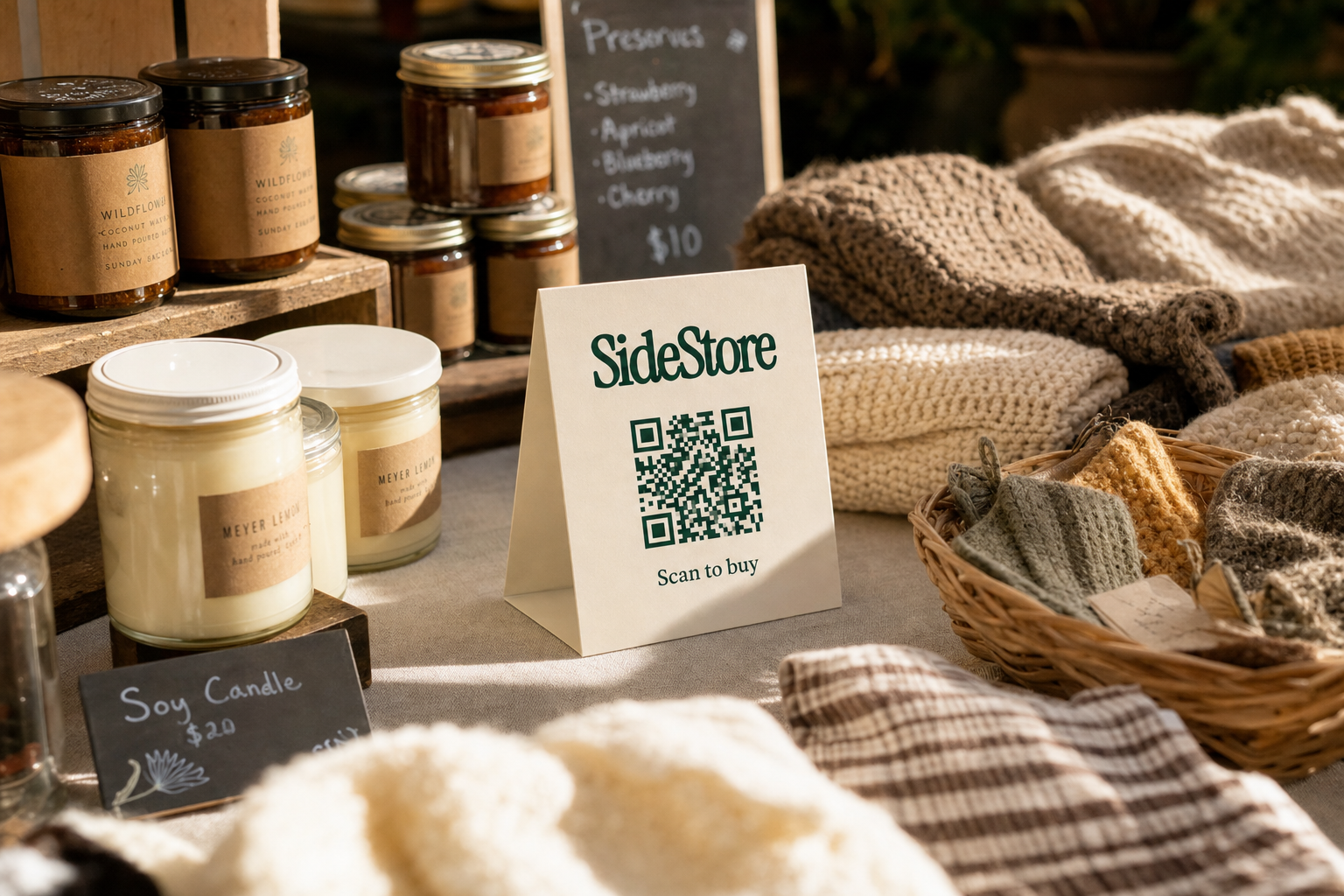
Layer 2: Checkout infrastructure. A product on a shelf without a purchase mechanism is just a display. The Retail Widget handles checkout at the point of placement. You can print a SideStore QR code card and attach it directly to your product, or a merchant can display a single SideStore card covering all the products in their placement. The scan-to-pay QR is one function of the Retail Widget, not the whole product. The Widget also handles live stock tracking and placement attribution, so you always know what sold, where, and when.
Layer 3: Settlement infrastructure. Every sale triggers an automatic split payout, distributing your maker's share and the merchant's host share without manual reconciliation. This is where the cooperative principle of equitable economic participation becomes mechanical rather than aspirational.
Whether a coffee shop counts as a retail placement or a boutique does, the infrastructure works the same way. The Retail Widget handles the operational complexity so neither you nor the merchant needs to.
How Independent Makers Are Reshaping Retail Through Cooperative Placement
Independent makers are reshaping retail not by opening stores, but by building distributed consignment networks across merchant spaces that already have foot traffic. One maker, one dashboard, many placements: that's the structural shift.
The distribution barrier most independent makers face isn't product quality. It's access. Traditional wholesale demands a retailer buy your stock outright, which means a buyer commits capital before a single unit sells. Consignment inverts that entirely. The merchant takes no inventory risk. You supply the product, they supply the space, the Retail Widget supplies the infrastructure. Everyone earns at the point of sale.
The merchant benefit is straightforward. Idle shelf space generates no revenue. A consignment placement from an independent maker turns that space into a margin stream with no purchasing decision required. If you want to understand how café hosts think about additional revenue, the logic is the same: earned income from space already paid for.
The cooperative sector has always understood this kind of mutual benefit. REI, the outdoor gear retailer, operates as a consumer cooperative with millions of members. Credit unions return surplus to depositors rather than shareholders. The Mondragon Corporation in the Basque Country is one of the largest worker-owned cooperative networks in the world. These aren't small experiments; they're durable, scaled businesses. The 2026 International Day of Cooperatives will highlight themes relevant to the global cooperative movement, though the specific 2026 theme has not yet been officially confirmed at the time of publication.
For a maker selling ceramics, textile goods, or art prints, the cooperative logic works at a much smaller scale but with the same structural logic: equitable terms, shared benefit, no extraction. Products that sell well on a café counter and selling art prints in cafes are practical entry points into exactly this kind of distributed placement.
How to Enter Cooperative Commerce as a Maker or Merchant Today
Entering cooperative commerce doesn't require joining a formal cooperative organisation. For makers and merchants alike, it starts with a single placement on agreed terms. The mistake most people make is treating cooperative commerce as a philosophy to study rather than an operation to run.
For makers, the path has three steps:
- Model your consignment terms. Decide your maker's share, your recommended retail price, and your minimum viable placement quantity. Use the Retail Widget to set these parameters before you approach any merchant. Know your numbers before the conversation.
- Identify and approach a merchant. Look for spaces with relevant foot traffic and idle shelf space. Cafes, boutiques, and hotel lobbies are common starting points. Review consignment agreement terms every maker should know so you arrive prepared.
- Go live and manage from your dashboard. Once terms are agreed and documented through clear consignment stock terms and conditions, activate the placement. The Retail Widget handles checkout, stock tracking, and automatic split payouts. You monitor from one place.
For merchants, the parallel path is:
- Identify your available space. One shelf, one counter section, one display area. You don't need a dedicated room.
- Agree consignment terms with a maker. No stock purchase, no minimum commitment. The terms define what you earn per sale.
- Activate the placement. Display the SideStore QR card, let the Retail Widget handle checkout and settlement, and earn your host share automatically.
The full mechanics of how to sell through someone else's store cover the nuances of both sides of this relationship in more detail.
Frequently Asked Questions About Cooperative Commerce
How do cooperatives generate revenue?
Cooperatives generate revenue through commercial trading, exactly as any other business does. What differs is how that revenue is distributed. Surplus is returned to members in proportion to their use or participation, rather than paid to external shareholders. In a consignment commerce context, every sale generates revenue that splits automatically between the maker, the merchant host, and the platform, with each party's share agreed in advance.
What theme will the International Day of Cooperatives feature in 2026?
The specific theme for the 2026 International Day of Cooperatives has not been officially confirmed at the time of publication. Historically, the International Day of Cooperatives, observed on the first Saturday of July, has centred on themes including sustainability, equitable economic participation, and the cooperative movement's role in community resilience. Check the International Co-operative Alliance's official communications for the confirmed 2026 theme.
Which cooperative businesses are largest in the United States?
Among the most recognised cooperative businesses in the United States are REI (Recreational Equipment Inc.), a consumer cooperative with millions of active members; credit unions, which collectively serve tens of millions of depositor-members nationwide; and agricultural cooperatives such as Land O'Lakes. Internationally, the Mondragon Corporation in Spain is one of the largest worker-owned cooperative networks globally. These are established, scaled commercial organisations.
What are the seven core principles that define cooperatives?
The seven cooperative principles, as defined by the International Co-operative Alliance, are: (1) voluntary and open membership, (2) democratic member control, (3) member economic participation, (4) autonomy and independence, (5) education, training, and information, (6) cooperation among cooperatives, and (7) concern for community. These principles govern how cooperative revenue is generated, distributed, and governed. For how these principles apply in a physical retail context, see how shared retail networks support local economies and consignment inventory software for the operational tools that enact them.
The Infrastructure Is Already Here
The future of cooperative commerce doesn't require a new institution. The infrastructure exists: the Retail Widget places products on consignment, handles scan-to-pay checkout, tracks live stock, attributes each sale to its placement, and triggers automatic split payouts to makers and merchant hosts alike. That's cooperative commerce operating as a system, not a slogan.
You don't need to open a store. You need a placement. Build a distributed consignment network across the merchant spaces already near you, with terms agreed in writing and settlement handled automatically at every sale. Start with one shelf, one merchant, one product. Then scale across more placements from the same dashboard.
The practical first step is straightforward: begin by approaching a local shop about stocking your products and putting the Retail Widget to work.