Why Makers Need Portable Commercial Relationships (and How to Build Them)
Why Makers Need Portable Commercial Relationships
A portable commercial relationship is one you own the terms of, can replicate across multiple venues, and can move without losing your inventory data, your income history, or your negotiating position.
Here's the risk: if you sell through one shop, one platform, or one market and that channel goes quiet, so does your income. When a single stockist changes owner, loses interest, or closes, your distribution disappears with it. Portable commercial relationships solve that by turning each placement into a repeatable, self-contained unit rather than a fragile handshake.
You don't need to open a store of your own to build this kind of distribution. You need a clear agreement, a process you can repeat, and infrastructure that tracks what happens at each location. Selling through someone else's store is the starting point. Scaling it across five, ten, or twenty venues is the goal.
This article covers what portable commercial relationships actually mean for a maker, why single-channel dependency is a structural risk, and how to build a multi-venue placement portfolio using consignment as the operational model.
What 'Commercial Partner' Actually Means for an Independent Maker
A commercial partner, for a maker, is any business that helps you place your products in front of buyers in exchange for an agreed share of the outcome. Not a customer. Not a distributor. Something more collaborative and more specific than either.
The distinction matters. A customer buys from you and the transaction ends. A distributor takes your stock, marks it up, and sells independently, often with little transparency on sell-through. A commercial partner is different: you share both the risk and the reward. The relationship is ongoing, not transactional.
For you as a maker, this means the café displaying your ceramics, the boutique carrying your prints, or the hotel stocking your candles can each function as a genuine commercial partner rather than simply a host. The operational difference is clear. A host relationship is informal. A commercial partner relationship has defined terms: what product, what split, who tracks stock, how payment settles, and what happens when either party wants to exit.
Approaching a local shop about stocking your products is where most makers start, and it's the right place. But arriving with a clear consignment agreement is what converts a host into a genuine commercial partner. Without agreed terms, you have a favour. With them, you have a relationship you can replicate and, if necessary, move.
The goal isn't to treat every café owner as a contract negotiation. It's to have a standard framework that you apply consistently, so each new partner relationship costs you less effort and delivers more certainty.
Why Single-Channel Dependency Leaves Makers Exposed
Relying on a single channel to sell your products is one of the more serious structural risks a maker can carry, and it's often invisible until it materialises. If one stockist accounts for all or most of your revenue, a change in their circumstances becomes a change in yours.
The failure modes are specific and real. A market stall depends on weather, footfall, and your own physical presence. If you can't attend, you don't sell. An online marketplace platform can suspend listings with little notice, change its algorithm, or raise fees. Your ranking isn't an asset you own. A single retail stockist can close, change category focus, or simply decide your product no longer fits their floor plan. Many makers report losing a significant share of monthly income when a single stockist relationship ends without warning.
The risk isn't just financial. It's informational. When one relationship carries all your sales data, losing that relationship means losing visibility into what was selling, at what rate, and to what kind of buyer. You start from zero.
Shared retail networks exist partly to buffer this exact risk. When your products are placed across multiple venues, no single closure wipes out your income. The network absorbs the disruption.
This is also why the tooling you use matters. Handshake agreements can't generate the placement data you need to manage risk across venues. Consignment inventory software gives you a live view across all placements, so you can see which venues are performing, which are stagnant, and where to redirect stock. That operational visibility isn't possible when each placement runs on informal terms and a mental model built on trust alone.
Single-channel dependency isn't a sign of laziness. It's often the result of early success with one partner. The transition from one relationship to many is the moment most makers avoid because it feels like added complexity. It's actually the opposite: it's how you reduce complexity over time.
Portable Commercial Relationships vs Fixed Retail Agreements: What Changes
What changes when a commercial relationship is portable rather than fixed is your exposure. Portable consignment keeps inventory risk, exit terms, and data with you, the maker. Fixed retail agreements typically transfer all three to the retailer.
| Dimension | Portable consignment | Fixed retail agreement |
|---|---|---|
| Upfront cost | None to the host; you supply stock at no charge until sale | Often requires a minimum order or purchase commitment |
| Inventory risk | You retain ownership until point of sale | Retailer takes ownership on purchase; you're paid upfront but lose unsold visibility |
| Portability | You can retrieve unsold stock and redeploy to another venue | Stock is sold to retailer; retrieval isn't a standard option |
| Data ownership | You retain sales data, scan events, and placement attribution | Sales data sits with the retailer; you receive only the invoice |
| Exit terms | Defined in the consignment agreement; typically notice period plus stock retrieval | Governed by purchase order terms; you have no claim on how or whether products are sold |
This is a genuine structural difference, not a marginal one. Under a fixed retail agreement, once your product is on a buyer's shelf, you have limited recourse if it doesn't sell. Under a portable consignment model, unsold stock comes back to you and can be placed elsewhere.
Two practical implications follow. First, the consignment stock terms and conditions you agree at the start of a placement determine your exit options. Vague terms produce disputes. Specific terms produce clean transitions. Second, the portability of a relationship depends on how it's recorded. If the terms live only in an email thread, they're difficult to enforce and impossible to replicate at scale. If they live in a standard framework applied consistently, each new placement takes minutes to set up and the exit process is already defined before you start.
Portable doesn't mean casual. It means structured for flexibility rather than structured for permanence.
How to Build a Portfolio of Portable Commercial Relationships
Building a portfolio of portable commercial relationships means treating each new venue placement as a repeatable unit: same framework, same terms, same tooling, different location. The goal is to make your fifth placement as straightforward as your first should have been.
Here's a practical sequence.
1. Define your standard placement offer. Before approaching any venue, clarify what you're offering: product category, suggested retail price, your split, minimum stock quantity, and restock terms. Ambiguity at this stage costs you time at every subsequent step.
2. Identify venue types that match your product. Not every venue suits every product. Products that sell well on a café counter are different from what moves in a boutique. If you make art prints, selling art prints in cafés is a tested category. Start where your product has natural contextual fit.
3. Approach venues with a clear, low-friction pitch. Hosts want to know three things: what you're asking of them, what they earn, and how easy it is to manage. Answer all three before they ask. How to approach a local shop about stocking your products covers the conversation in detail.
4. Formalise every placement with a written agreement. A handshake isn't portable. A standard consignment agreement is. Use the same document each time, adjusted only for venue-specific details. What your consignment agreement should include gives you the clause-level detail.
5. Use software to manage placements centrally. Each new venue adds complexity that informal tracking can't handle. Consignment inventory software lets you see stock levels, sales events, and settlement balances across all placements from one place.
6. Measure and rotate. After sixty to ninety days in each venue, assess sell-through rate. Strong venues get restock priority. Weak venues get a conversation about display position or product mix, or the stock moves elsewhere. This is portfolio management, not product abandonment.
7. Compound across venues deliberately. A widely referenced rule in branding holds that buyers need roughly three exposures to notice a brand, seven to consider it, and twenty-seven to act with confidence. Whether those exact numbers apply to every situation, the underlying principle holds: presence in multiple venues compounds brand familiarity over time in a way a single placement can't. Each additional venue you add isn't just another sales point; it's another source of repeated exposure for buyers who move through multiple spaces in your city or region.
Building a portfolio takes time. The mechanics, once set, are repeatable. Start with two or three venues, stabilise the process, then extend.
Open Infrastructure and the Future of Cooperative Commerce
Open infrastructure for commerce means the tools you use to manage placements aren't locked to a single venue, platform, or proprietary system. You own the relationship data, the sales history, and the stock movement records regardless of which host you're working with.
This matters because it's the operational definition of portability. A commercial relationship is only truly portable if the information it generates travels with you when the relationship ends or when you add a new partner.
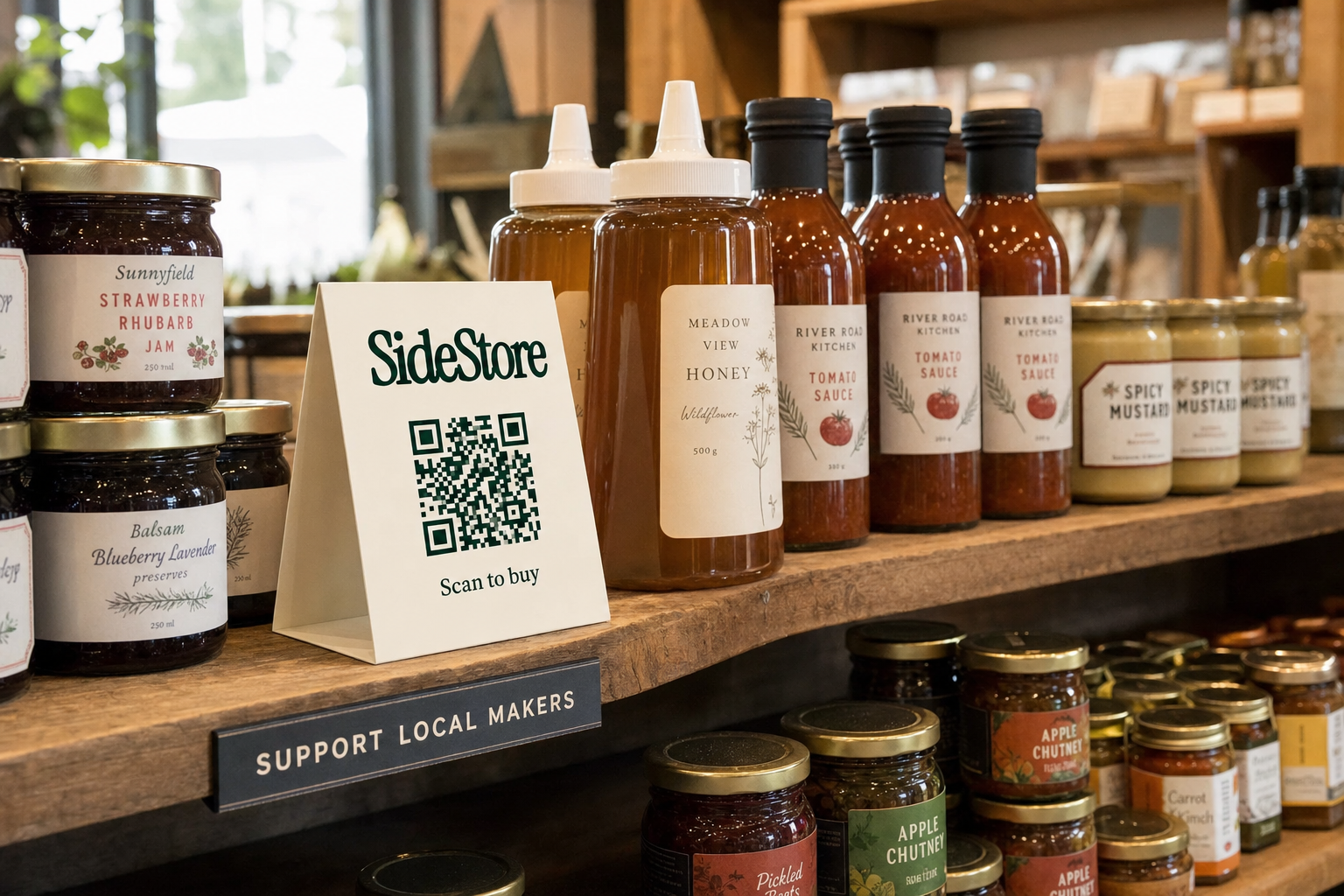
SideStore's Retail Widget is built around this principle. It handles the specific mechanics that handshake-based consignment can't: scan-to-pay checkout via a printable QR code, live stock tracking across placements, placement attribution so you know which venue generated which sale, and automatic split settlement so you and the host each receive your share without manual calculation or chasing invoices.
These aren't decorative features. Scan-to-pay removes the need for a venue to have a separate point-of-sale system. Split settlement removes the awkward end-of-month reconciliation. Stock tracking gives you the visibility to manage a portfolio rather than just hope each venue is performing.
How shared retail networks support local economies describes the broader context. Makers placing products in cafés, boutiques, and hotels creates a distributed retail layer that benefits all parties. Whether a coffee shop counts as retail is a question many venue owners ask, and the answer is increasingly yes, particularly when a proper consignment framework is in place. What a café can realistically earn from retail gives hosts the numbers they need to evaluate the arrangement.
The future of cooperative commerce isn't one large platform intermediating every transaction. It's makers and merchants transacting directly, with shared infrastructure managing the operational detail.
Frequently Asked Questions
The most common misunderstandings makers carry about commercial relationships cluster around terminology: confusing a commercial partner with a distributor, treating branding rules as rigid formulas, or assuming relationship marketing is a marketing department concern rather than a maker's daily practice. The answers below address the questions that surface most often.
What does the term 'Commercial Partner' mean in business context?
A commercial partner is any entity with whom you share both the risk and the reward of a commercial transaction under agreed terms. For a maker, this typically means a venue or retailer that hosts your products on consignment, earns a share of each sale, and operates within a defined framework covering stock ownership, split, and exit terms. It's distinct from a customer, who completes a single transaction, and from a distributor, who takes ownership of your stock.
How does the 3-7-27 rule apply to branding strategy?
The 3-7-27 rule is a widely referenced guideline holding that a buyer needs approximately three exposures to notice a brand, seven to begin considering it, and twenty-seven before they act with real confidence. For you as a maker, this means presence in multiple venues accelerates the familiarity curve. A buyer who encounters your ceramics in a café and then again in a boutique is further along the path to purchase than one who has seen them in one location only.
What is Kotler's approach to relationship marketing theory?
Philip Kotler's relationship marketing framework, well established in marketing literature, argues that the goal of marketing isn't a single transaction but a long-term relationship with buyers, partners, and channels. For a maker, this means treating each venue partner as an ongoing relationship to nurture rather than a one-off distribution deal. It's the conceptual underpinning for why a portfolio of sustained placements outperforms a sequence of one-off transactions.
What is the business practice of building ongoing relationships with customers called?
It's called relationship marketing. Applied to your distribution network, it extends to the venues and hosts you work with, not only to the end buyers of your products. Consignment inventory software supports this by giving you the data to stay in active dialogue with each host about performance, restock, and product mix.
Why would a business want to control media channels?
Controlling a channel means the rules of that channel can't be changed by someone else to your disadvantage. A maker who sells through someone else's store on consignment retains ownership of the stock and the relationship data, which is a form of channel control. A maker who sells through a third-party marketplace owns neither: the platform sets the terms, the fees, and the visibility rules.
Build the Network, Not Just the Next Deal
The practical action from everything above is to stop treating each new stockist as a standalone relationship and start treating it as one node in a network you're building deliberately. Map the venues in your area, identify the two or three most plausible starting points, formalise the terms with a proper consignment agreement, and use software to manage what happens after you go live.
The network doesn't require you to open a store of your own. It requires you to build agreements that are clear, repeatable, and portable, so that each new venue you add strengthens the whole rather than adding a new source of fragility. Selling through someone else's store is the mechanism. Building a consignment network without opening a store of your own is the outcome SideStore is designed to support: one dashboard, every placement, live data, and automatic settlement at each location.
The network is the asset. Start building it.