Art Consignment Percentage: What Galleries and Shops Take (and How to Negotiate)
Art consignment percentages split each sale between you and the venue hosting your work. Standard splits run from 40/60 (you keep 60%) to 50/50, depending on the type of venue and what services they provide. Galleries tend to take 50%, while independent shops and cafes commonly take 25, 35%. Two things move rates most: the venue's overhead and what they actually do for you, and your track record and negotiating position.
This guide covers what consignment splits mean in practice, how rates vary by venue type, what pushes your percentage up or down, and how to negotiate from a position that's grounded in actual numbers. If you're ready to sell art prints in local shops or need a template for your first consignment agreement for artists, the sections below give you a clear framework.
What Is an Art Consignment Percentage?
An art consignment percentage is the proportion of each sale the venue keeps as commission. You supply the work at no upfront cost to the host; they display and sell it, then send you your share after the sale.
Here's how it works. A print sells for £100 on a 50/50 split: the gallery keeps £50, you get £50. On a 35/65 split at an independent shop, the shop keeps £35 and you take £65. The price displayed is always the full retail price; the split is invisible to the buyer.
Don't compare consignment percentages across different industries as if they're interchangeable. Clothing consignment stores in the UK often offer sellers only 40, 50% of the sale price. Vehicle consignment typically charges flat dealer fees. Jewelry resellers may take 40, 60%. These differ fundamentally from art because the economics are different: original art has no standard wholesale price, galleries actively cultivate buyers, and insurance and framing costs are real expenses. Comparing a gallery's 50% take to a clothing reseller's 45% misses the point entirely.
Many artists are surprised that 50/50 is considered normal in gallery contexts. It is. The reasoning is straightforward: galleries provide curatorial credibility, marketing, opening events, and often insurance. Selling through someone else's store means the host absorbs the selling costs so you don't have to.
Standard Art Consignment Rates by Venue Type
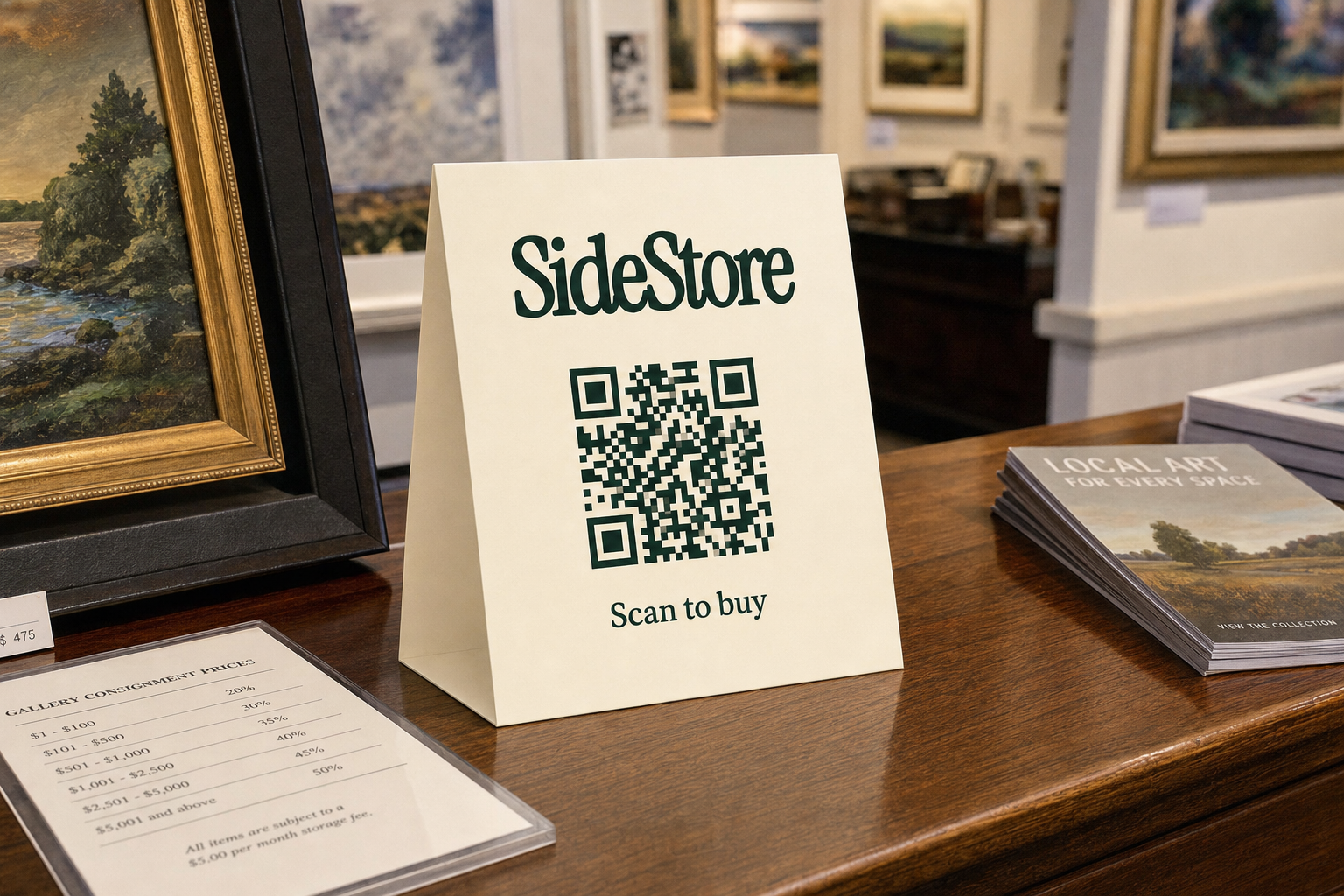
Consignment rates vary significantly by venue, and knowing the convention for each type stops you from accepting a gallery's 50% at a pop-up stall or underselling yourself at a boutique. Industry convention, not fixed law, governs these numbers.
| Venue Type | Typical Maker Share | Typical Venue Share | Key Driver |
|---|---|---|---|
| Commercial art gallery | 50% | 50% | Curation, marketing, opening events, insurance |
| Cooperative gallery | 60, 70% | 30, 40% | Artists share costs directly; lower overheads |
| Independent boutique | 60, 70% | 30, 40% | Lower service overhead, volume-driven |
| Cafe or coffee shop | 65, 75% | 25, 35% | Minimal sales effort; passive placement |
| Hotel or B&B | 60, 70% | 30, 40% | Captive audience; light curation |
| Online/platform reseller | 55, 70% | 30, 45% | Platform fees and payment processing |
The 50% gallery commission surprises most artists encountering consignment for the first time. But the justification is real: a well-run commercial gallery invests heavily in marketing individual artists, maintains a collector database, staffs sales conversations, pays for professional lighting and exhibition design, and often handles shipping, framing, and insurance. That overhead has to come from somewhere.
A cafe, by contrast, leans a framed print against a wall, hangs it with a card, and rings it through the till when someone buys it. The selling effort is minimal. A cafe taking 35% for that service is on the generous end; many artists report successfully placing work in selling art prints in cafes contexts at 25, 30% to the venue.
Independent shops occupy the middle ground. They talk up your work to customers, create displays, and include your pieces in their social media. A 30, 40% venue share reflects that variable level of involvement. Retail products that sell well in cafes follow the same logic: the venue's margin should match their actual contribution to the sale.
Match your expectations to the venue's service level. Pushing back on a 50% gallery split because a boutique took 30% is comparing completely different services.
What Pushes Your Consignment Percentage Up or Down?
Three variables move your consignment rate. Understanding them gives you something concrete to negotiate with, rather than just hoping for a better number.
Artist track record and proof of sales. A gallery taking on an unknown artist carries more risk than one showing a maker with a demonstrated sales history and an existing audience. If you can show that your work actually moves (prior sales data, social following, press coverage), you have grounds to ask for a better split. Many venues start new consignment relationships at 50/50 and renegotiate at 60/40 after a successful first placement. Come to the conversation with evidence, not just enthusiasm. Consider approaching a local shop about stocking your work with a one-page sales sheet that shows pricing, prior placement results, and restocking frequency.
Venue services and overhead. The more the venue does, the more defensible their share. If a gallery frames the work, insures it, and runs a private view to launch the collection, 50% is reasonable. If a cafe simply leans a print against a wall near the counter with no insurance and no active selling, 25, 30% to the venue is fair. Ask explicitly what services are included before you accept any rate. Get specific: is the work insured? Who handles framing? Who sets the retail price?
Non-percentage agreement terms. When a percentage is stuck, the rest of the agreement becomes negotiable. A venue that insists on 50% might agree to a shorter exclusivity window, a lower minimum display period, faster payment terms (30 days instead of 90), or a higher retail price (which raises your absolute return even at the same percentage). These levers matter. A 50% cut of a £200 print pays you the same as 40% of a £250 print, with no additional effort on your part.
How to Negotiate Your Art Consignment Percentage
Negotiating your consignment percentage is easier when you've done the maths before the conversation. Most artists accept the first rate offered because they haven't calculated where their floor actually sits.
Step 1: Calculate your cost floor. Before any conversation, know your minimum viable percentage. Add up materials, production time at an hourly rate, packaging, and delivery. Say a framed print costs you £40 to produce and you price it at £120. To break even, you need at least £40 from the sale, which means you need a minimum 33% maker share. Below that, you're paying the venue to display your work. With that number in hand, you can say with confidence: "I need a minimum 65% maker share to make this viable at this price point."
Step 2: Frame the ask around the venue's gain. Hosts accept consignment because it earns them margin from space they already have. When you present your work, lead with what they gain: zero inventory risk, zero upfront cost, a product that fits their existing customer's taste, and passive income from a shelf or wall that currently earns nothing. A venue that understands its own benefit is more willing to offer reasonable terms.
Step 3: Use surrounding terms as levers. If the venue won't move on percentage, negotiate the rest. Shorter exclusivity, faster payout cycles, a higher price point, or better placement (eye-level versus a back corner) can all improve your actual return without changing the headline split. Track these terms carefully in your consignment agreement for artists.
Step 4: Get it in writing and reduce the admin friction. Venues that have never run consignment before often stall because the admin feels complicated. Tools like SideStore's Retail Widget eliminate that friction: it handles scan-to-pay checkout, live stock tracking, and automatic split payouts, so the venue doesn't need to manage a spreadsheet or chase you for restocking updates. When a venue can see that accepting your work requires almost no admin on their side, the conversation about terms gets much simpler. For managing multiple placements, consignment inventory software is worth exploring early.
Why Independent Shops and Cafes Are Often a Better Starting Point
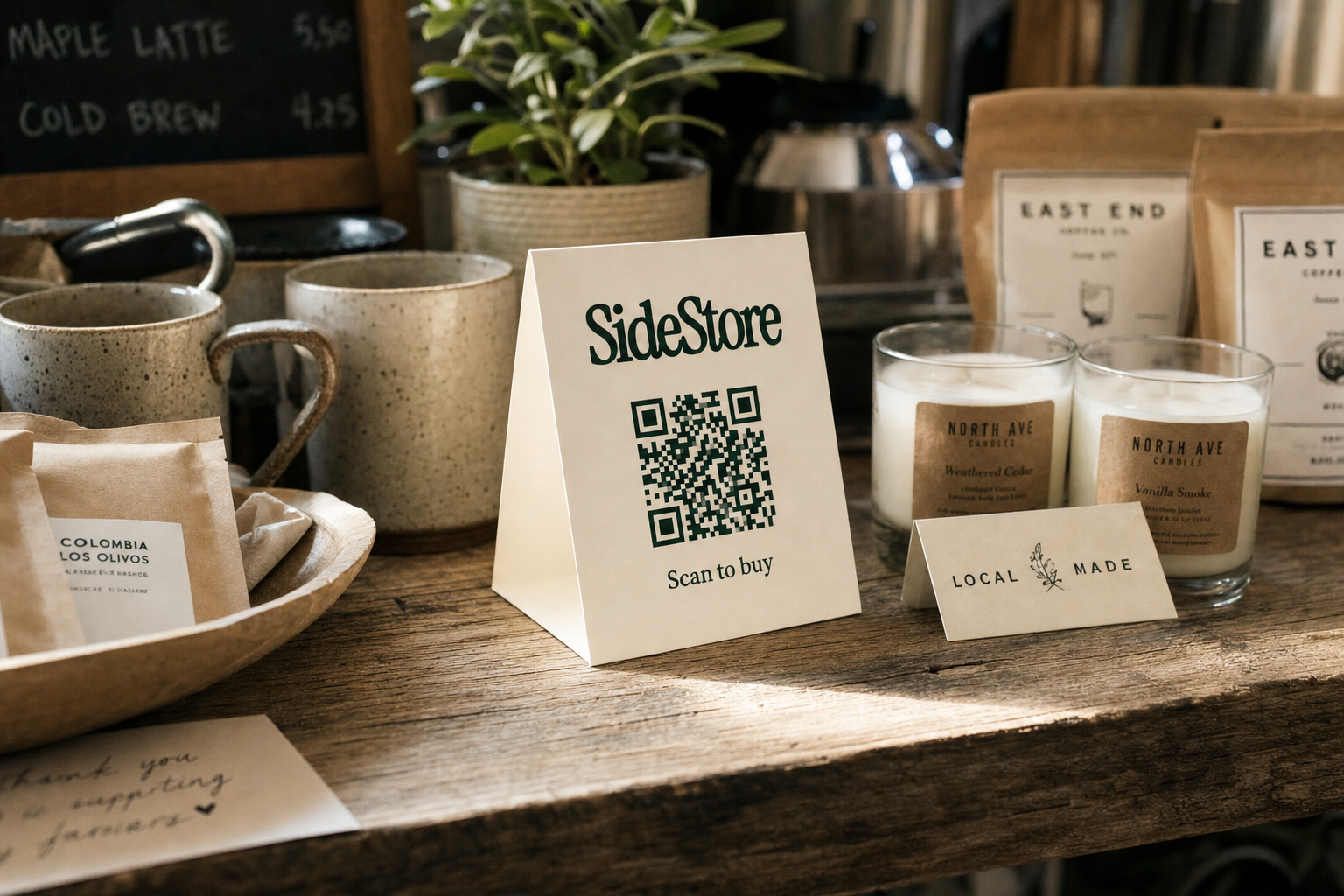
For most artists early in their consignment journey, independent shops and cafes offer better rates, lower barriers, and faster feedback than commercial galleries. A cafe or boutique typically takes 25, 35% versus a gallery's 50%, which means you keep significantly more of each sale while building the proof-of-concept your portfolio needs.
The barrier to entry is also lower. Gallery representation often requires a portfolio review, an existing reputation, or a personal introduction. A well-presented approach to a local cafe with a sample print and a clear price list can result in a placement the same week. That speed matters: you learn what sells, at what price, and in which locations faster than you would waiting for a gallery decision.
The case for multiple independent venues is even stronger. Five placements at 30% venue share across five local cafes and boutiques gives you a distributed consignment network: multiple income streams, geographic reach, and real sales data. SideStore's Retail Widget is built for exactly this model. It lets you place work across multiple venues, track stock at each location, and receive automatic split payouts without chasing individual hosts. You manage everything from one dashboard.
How shared retail networks support local economies explores the broader context. Whether a coffee shop counts as a retail venue for your purposes is also worth understanding before you approach one.
Frequently Asked Questions About Art Consignment Percentages
What percentage split is considered reasonable for art consignment?
A 60/40 or 65/35 split in the artist's favour is considered reasonable for most independent venue placements. Galleries typically operate at 50/50, which is also considered standard in that context given the services they provide. Anything below 50% to the artist at a low-service venue (a cafe or pop-up stall) deserves pushback. The key question is always: what is the venue actually contributing to the sale?
What does the 70/30 rule mean in painting?
The 70/30 rule in painting refers to a consignment split where the artist retains 70% of the sale price and the venue takes 30%. It's common in lower-overhead settings such as cafes, craft markets, and independent boutiques. It's not a universal standard but reflects the norm for venues where the selling effort is minimal and the host's contribution is mainly space and foot traffic.
Do art galleries typically take a 50% commission?
Yes. A 50/50 split is industry convention for commercial galleries, and many artists report it as the default opening offer from established venues. The justification is the cost of curation, marketing, openings, insurance, and active collector relations that galleries provide. Cooperative galleries, where artists share costs directly, often offer 60, 70% to artists.
What is the 80/20 rule in art?
The 80/20 rule in art is not a consignment split. It refers to the Pareto principle applied to sales patterns: broadly, that a small proportion of works or buyers tends to account for the majority of revenue. You may hear artists say "80% of my sales come from 20% of my prints," meaning a few popular pieces drive most income. It has nothing to do with commission percentages.
What are standard consignment rates for art?
Standard consignment rates for art range from 25, 35% to the venue at low-service locations (cafes, independent shops) to 50% at commercial galleries. For pop-up and pop-up retail contexts, 30, 40% to the organiser is typical. These are industry conventions, not fixed rules, and they are negotiable based on track record, services, and agreement terms.
Place Your Work on Terms That Work for You
The standard art consignment percentage runs from 40/60 to 50/50, with galleries taking up to 50% for full-service representation and independent shops and cafes taking 25, 35% for lower-effort placement. Knowing those ranges, and knowing your own cost floor, is the starting point for every consignment conversation.
Two concrete next actions: review the full guide to how to sell art prints in local shops to understand the practical placement process, and use how to sell through someone else's store to build your outreach approach.
SideStore's Retail Widget makes the multi-venue model manageable: one dashboard handles checkout, stock tracking, and split payouts across every placement. Build a consignment network without opening a store of your own.