Community-Owned Marketplace vs Traditional Marketplace: What Makers Need to Know
A community-owned marketplace is governed and co-owned by its participants, typically sellers, buyers, or both, where surplus and decision-making authority flow back to members rather than to external shareholders.
The real distinction between a community-owned marketplace and a traditional marketplace comes down to power: in a traditional marketplace, a private company sets the rules, adjusts the fees, and captures the surplus. In a community-owned model, the participants themselves govern those terms. For independent makers navigating offline distribution, that structural difference determines how stable your access to a sales channel actually is, how much of your margin you keep long-term, and what happens when the platform changes its terms.
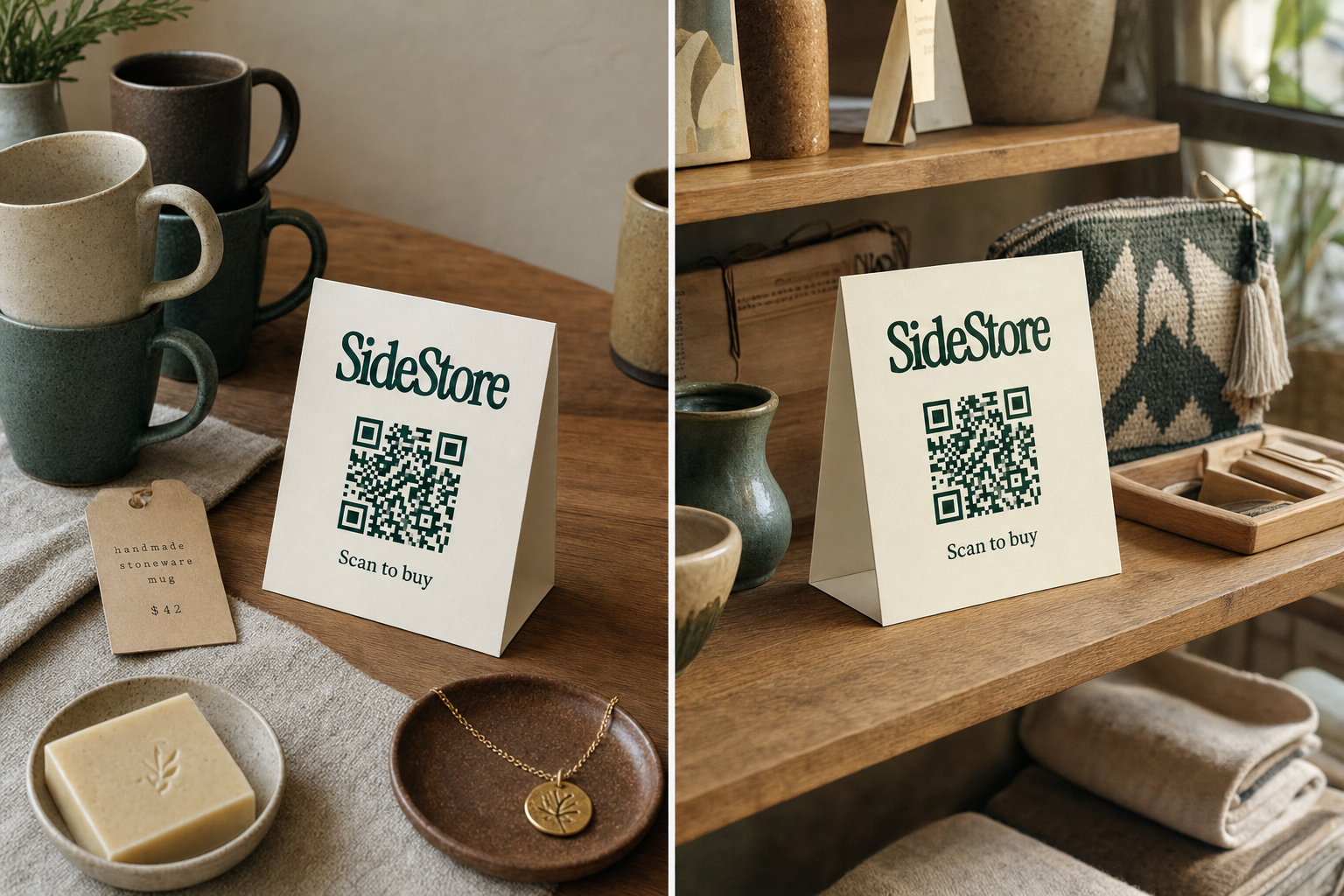
The sections below map those differences precisely, cover fee mechanics, and show where physical consignment commerce, including distributed models like SideStore, fits within this broader landscape. For context on how distributed retail access connects to local economic participation, see how shared retail networks support local economies.
What Are the Main Differences Between a Market and a Marketplace?
A market is a place, physical or conceptual, where exchange happens directly between a buyer and a seller. A marketplace is a platform or intermediary that structures, enables, and typically monetises that exchange at scale. The distinction matters strategically.
When you attend a weekend craft market, you are in a direct-exchange environment. You set up, you sell, you collect payment, and no intermediary takes a commission on each transaction. The venue may charge a stall fee, but the mechanic is straightforward. Many makers transition to online or hybrid selling and carry this frame with them, only to discover that a marketplace operates on fundamentally different logic.
A marketplace introduces a third party between maker and buyer. That third party provides infrastructure: discovery, payment processing, dispute resolution, trust signals. In return, it extracts value, usually as a percentage of each transaction, a listing fee, or both. The marketplace sets the rules of participation, and those rules can change at the platform's discretion.
This confusion leads makers to underestimate platform dependency. A stall at a market gives you direct customer relationships and no commission exposure. A listing on a traditional marketplace gives you reach but subordinates your terms to the platform's. Understanding that distinction is foundational before choosing any distribution channel, including the option of selling through someone else's store on consignment, which operates on a third set of mechanics entirely.
The practical test: ask yourself whether a third party sets the rules of exchange, processes payment, and takes a cut. If yes, you are on a marketplace, not at a market. That framing clarifies the trade-offs before you commit.
Do Sellers Pay Fees to List on a Traditional Marketplace? How the Cost Structure Works
Yes. Sellers on traditional marketplaces almost always pay fees, though the structure varies widely by platform. Understanding the fee layers before listing protects your margin.
Traditional marketplace fees typically stack. Listing fees are charged per item, either as a flat amount or recurring. Transaction fees are charged as a percentage of each sale. Payment processing fees layer on top of the transaction fee, covering the cost of card networks and payment infrastructure. Some platforms also charge subscription fees for seller accounts above a basic tier, and promotional fees if you want visibility beyond the default algorithm.
The percentages vary by platform, product category, and seller tier, and platforms adjust them without notice. Rather than quoting figures that may be outdated, it's more useful to know the structure: you are paying for discovery, trust signals, and payment rails, and those costs compound. A maker pricing a physical product for a traditional marketplace needs to model all four fee layers, not just the headline commission rate.
The consignment split model works differently. In a consignment arrangement, you place products in a merchant space, and when a product sells, the revenue is split between you and the host at a pre-agreed rate. There is no listing fee, no payment processing surcharge layered separately, and no algorithmic promotion cost. The trade-off is reach: a consignment placement in one host location has smaller discovery surface than a marketplace with millions of visitors. For detail on how those splits work in practice, see what percentage consignment shops take.
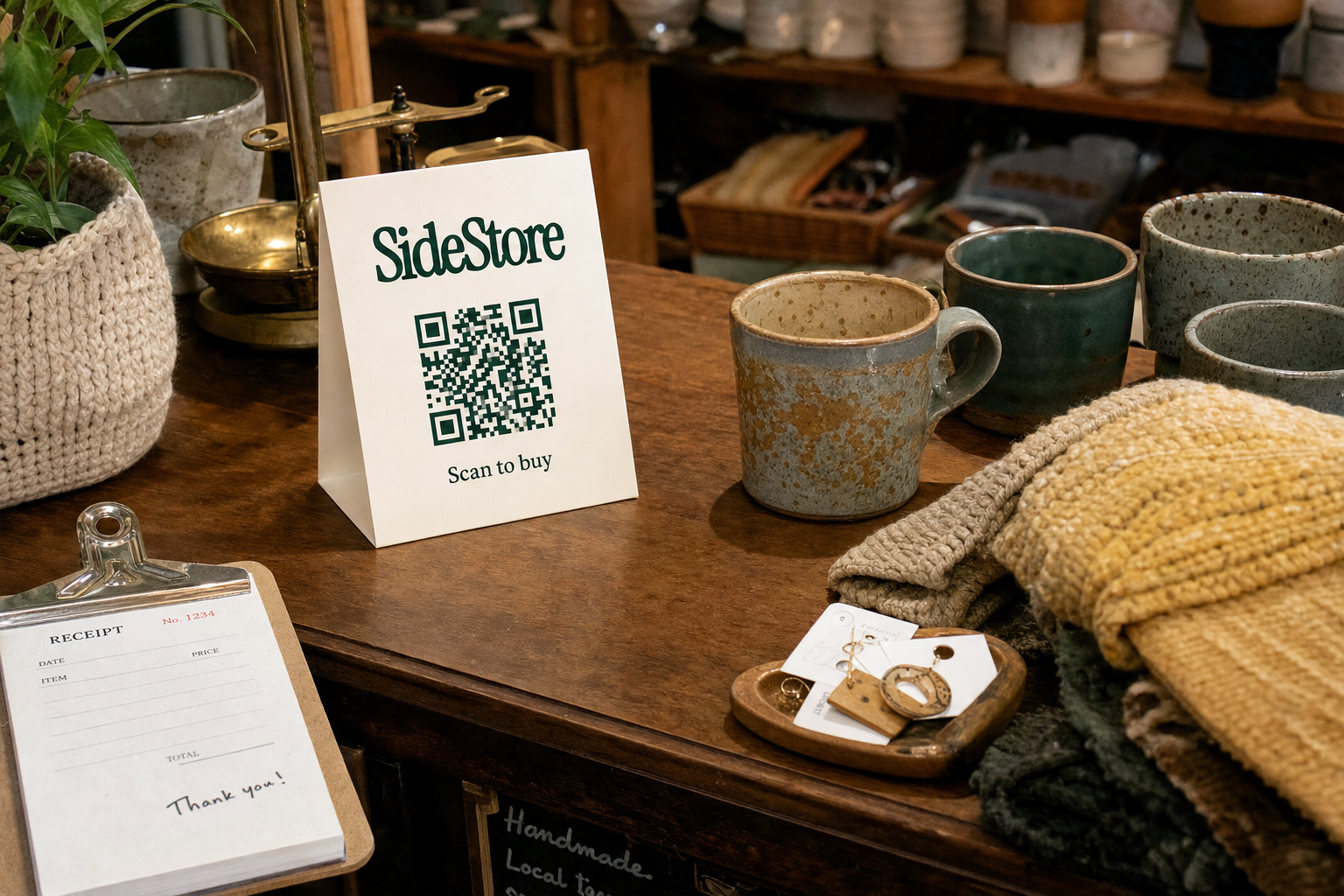
SideStore's Retail Widget handles the split settlement automatically at checkout, so the mechanics that would otherwise require manual invoicing between you and the host are managed by platform infrastructure. For tools that manage inventory across multiple placements, consignment inventory software covers the practical options.
How Do Community-Owned Models Differ from Traditional Marketplace Structures?
A community-owned marketplace, often structured as a platform cooperative, differs from a traditional marketplace in one foundational way: the people who use it also govern and own it. That difference changes fee logic, data access, and what happens when the platform's interests and your interests diverge.
A platform cooperative is a business entity, typically a cooperative, that owns and governs a digital platform. Members, who may be sellers, buyers, or both, hold ownership stakes and vote on platform rules, fee changes, and strategic direction. Surplus generated by the platform is distributed back to members rather than extracted by external investors.
The governance mechanic matters practically. On a traditional marketplace, a fee change is a unilateral decision made by the company and announced to sellers, often with limited notice. On a cooperative platform, a fee change requires member deliberation and a vote. That slower process is both the cooperative model's strength and its honest trade-off: you have recourse and voice, but decisions take longer and require active participation from members to function well.
Open infrastructure refers to a related but distinct concept. Where a traditional marketplace is closed, meaning your product data, customer relationships, and transaction history sit inside the platform's systems and are not portable, open infrastructure gives you access to your own data and, in some cases, allows you to build on top of shared systems. For makers who want to build distribution that is not dependent on any single platform's continued goodwill, that portability matters considerably.
The real risk of traditional marketplaces is not the current fee level; it is the structural asymmetry. You can be de-listed, have your terms changed, or find your product category de-prioritised, and you have no formal mechanism to contest it. Cooperative governance does not eliminate this risk entirely, but it changes the accountability structure.
For makers thinking about how distributed consignment networks relate to local economic resilience, shared retail networks that support local economies provides useful context.
Community-Owned vs Traditional Marketplace: Core Concepts at a Glance
The structural differences between a community-owned marketplace and a traditional marketplace are clearest when placed side by side. The table below maps the key dimensions.
| Dimension | Traditional Marketplace | Community-Owned Marketplace |
|---|---|---|
| Ownership | Private company or investors | Members (sellers, buyers, or both) |
| Fee structure | Set unilaterally by the platform; can change without notice | Set by member vote; changes require governance process |
| Who sets the rules | Platform management | Member governance body |
| Data access | Platform retains data; limited portability for sellers | Members typically have access to their own data |
| Maker recourse when terms change | Accept or leave | Participate in governance process; vote on proposed changes |
| Surplus distribution | To shareholders or reinvested by the company | Distributed to members as patronage or reinvested collectively |
| Speed of governance | Fast, unilateral decisions | Slower, deliberative, requires member participation |
Two observations worth holding together. First, traditional marketplaces offer speed and reach that cooperative models often cannot match in the early stages. Second, the governance asymmetry in traditional marketplaces is a real long-term risk for any maker whose primary distribution depends on a single platform.
If you are considering distributed physical retail as an alternative or complement to platform selling, the mechanics of approaching a local shop about stocking your products give you a practical starting point.
What Categories Exist Within Commerce Platforms, and Where Does Physical Consignment Fit?
Commerce platforms for makers fall into four broad categories, and knowing where physical consignment sits within that map helps you evaluate your options without conflating different mechanics.
The four categories are:
Digital marketplaces. Platforms where you list products for sale online. The platform handles discovery, payment, and usually fulfilment infrastructure. Fees layer as described above. Examples span handmade goods, digital products, and mass retail.
Direct-to-consumer (DTC) platforms. Tools that let you own your own online storefront, typically through a subscription. Reach is lower than a marketplace because you build your own audience, but you retain customer data and relationships.
Social commerce. Selling via social media platforms, where product listings appear within content feeds. Discovery can be high but the platform controls the algorithm and the audience relationship entirely.
Physical consignment infrastructure. A distinct category covering tools and networks that facilitate placing physical products in real-world merchant spaces on consignment. You do not open a store; a merchant hosts the product and takes a split of each sale. SideStore operates in this category. It is not a marketplace; it is infrastructure that lets you run a distributed consignment network across multiple host locations, each managed through the Retail Widget.
The honest trade-off for physical consignment is scale: a well-run consignment network across a dozen host locations will never have the discovery surface of a digital marketplace with millions of visitors. The advantage is margin predictability, direct placement in high-foot-traffic spaces, and a fee structure that does not stack invisibly. Whether a coffee shop counts as a retail host and how to approach selling art prints in cafes on consignment are practical questions that sit squarely in this category.
The Future of Cooperative Commerce: What Open Infrastructure Means for Independent Makers
Open infrastructure for independent commerce means the rails that enable selling, including payment processing, inventory management, placement attribution, and settlement, are accessible to you without locking you into a single platform's closed ecosystem.
The significance is practical. When your sales infrastructure is closed, meaning your transaction history, customer data, and product performance data live inside one platform's systems, your business continuity depends on that platform's continued operation and goodwill. When infrastructure is open or portable, you can move, combine tools, or build on top of shared systems without starting from zero.
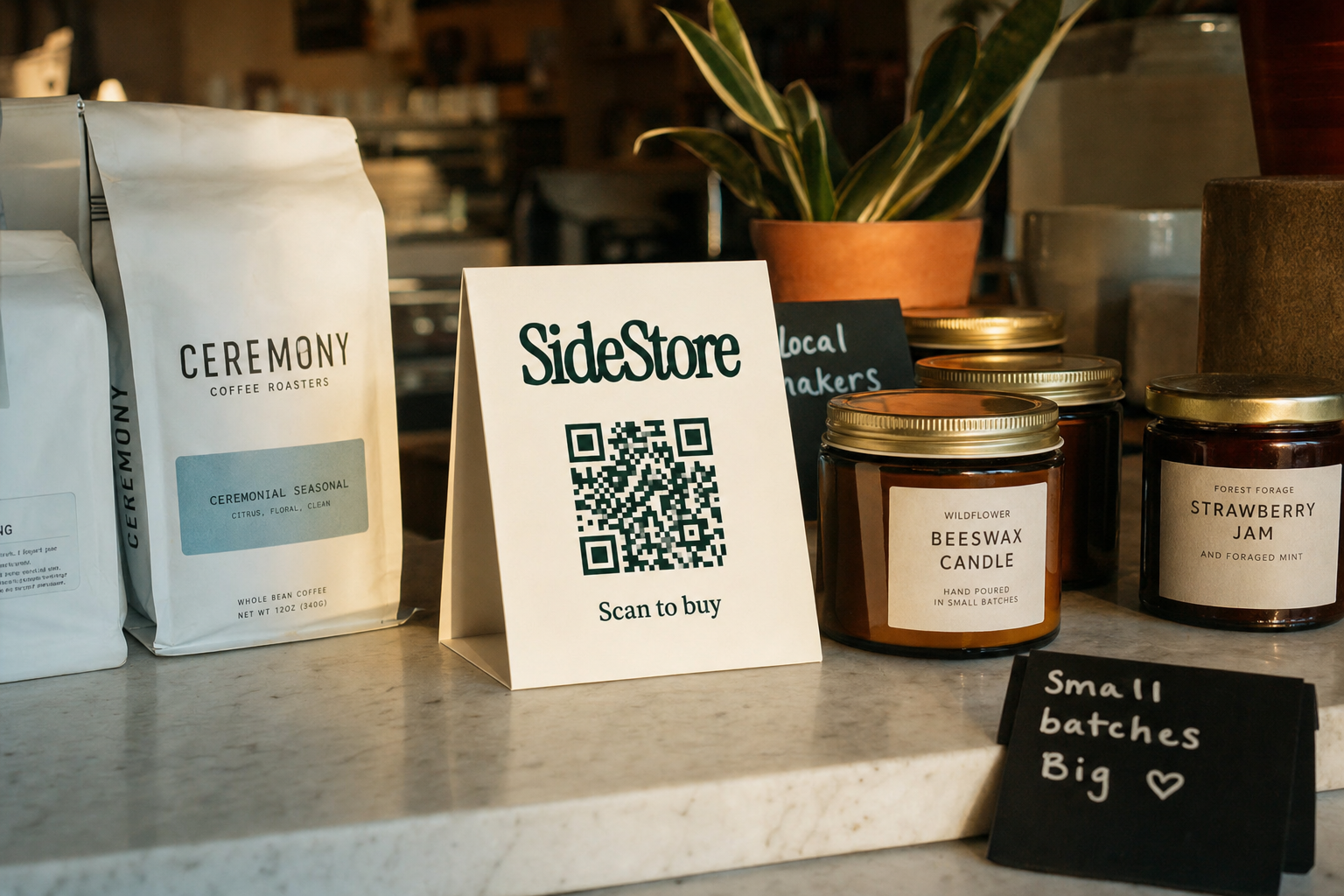
The distributed consignment model is a present-day expression of this principle applied to physical retail. Rather than placing all distribution dependency on a single platform or a single store, you build a network of placements across multiple merchant spaces, each operating on shared infrastructure, such as the SideStore Retail Widget, that handles checkout, stock tracking, and split settlement consistently. No single merchant host controls your access to the whole network.
What remains unresolved is scale. Open and cooperative infrastructure models currently reach fewer participants than established closed platforms, and the network effects that make large marketplaces powerful are genuinely hard to replicate. The honest position is that open infrastructure gives you more structural security but typically less immediate reach. For makers weighing these options against the costs of physical retail formats, the trade-offs involved in pop-up retail space for rent offer a useful comparison point. For makers in specific categories, placing handmade jewelry in boutiques on consignment shows how the model applies in practice.
Which Model Actually Serves Makers Better, and When?
Neither model is universally superior. The right structure depends on your stage, your product category, and the kind of dependency risk you can absorb. Frame this as a three-stage decision.
Early stage: You are building your first distribution footprint. At this point, a traditional marketplace offers reach you cannot generate yourself. The fee burden is real but the discovery value is genuine. Many makers report that the early phase of marketplace selling builds the sales history and product validation that later makes physical placement conversations easier.
Growth stage: You have product-market fit and are looking to diversify distribution. This is where dependency risk on a single platform starts to matter. A fee change or algorithm shift that cuts your marketplace visibility becomes an existential problem if that channel carries most of your revenue. Adding physical consignment placements through a distributed network reduces that single-point dependency, even if the aggregate reach is smaller.
Established stage: You have direct customer relationships and enough distribution diversity that no single platform controls your business. Here, cooperative and open-infrastructure models become more strategically attractive, because you have the volume to participate meaningfully in governance and the margin stability to accept slower decision-making.
The objection that cooperative platforms are too hard to access is fair at the early stage. The response is that consignment commerce through infrastructure like SideStore does not require you to wait for a cooperative platform to mature. It gives you a distributed physical network now, with predictable split economics. For context on the margin realities your merchant hosts face, margin realities for physical retail hosts is worth reading. When you are ready to open new placement conversations, how to approach a local shop about stocking your products gives you a practical framework.
Frequently Asked Questions
These questions reflect what makers most often need to resolve when comparing the community-owned marketplace versus traditional marketplace decision.
What are the main differences between a market and a marketplace?
A market is a direct-exchange environment where buyers and sellers transact without a structuring intermediary. A marketplace is a platform that organises, enables, and typically monetises those transactions, setting the rules and extracting a fee. The structural difference determines your commission exposure, your customer data ownership, and how much control you have over your own terms of sale.
Do sellers need to pay fees to list on a marketplace?
On most traditional marketplaces, yes. Fee structures typically include some combination of listing fees, transaction fees, and payment processing fees, and may include subscription or promotional fees. The total cost compounds across fee layers, so model all of them before pricing. For an alternative mechanic, see what percentage consignment shops typically take.
What are the core concepts that define how marketplaces function?
The core mechanics are: discovery (the platform surfaces your product to buyers), trust infrastructure (reviews, dispute resolution, payment security), fee extraction (the platform takes a share of each transaction or charges for access), and rule-setting authority (the platform determines participation terms unilaterally). Consignment inventory software options handle similar mechanics for physical placement networks.
How do community-owned models differ from traditional marketplace structures?
In a community-owned or platform cooperative model, the participants, typically sellers, govern the platform and share in its surplus. Fee changes require member votes rather than unilateral decisions. The trade-off is slower governance and, at present, smaller scale than established traditional marketplaces.
What categories exist within e-commerce platforms?
The main categories are digital marketplaces, direct-to-consumer storefronts, social commerce, and physical consignment infrastructure. Each operates on different fee mechanics, reach dynamics, and dependency structures. Physical consignment infrastructure, the category SideStore occupies, is distinct from all three digital categories and is often overlooked by makers mapping their distribution options.
The Structural Choice Is Yours to Make
Choosing between a community-owned marketplace versus traditional marketplace is, at its core, a decision about dependency and margin stability. Traditional marketplaces offer reach you cannot easily replicate independently; the cost is structural asymmetry, where the platform sets the terms and you accept or leave. Community-owned models restore governance rights and surplus participation; the cost is slower decision-making and, currently, smaller scale.
Physical consignment commerce sits outside both categories. It gives you distributed presence in real-world merchant spaces, predictable split economics, and no single platform controlling your access to the whole network. SideStore's Retail Widget handles checkout, stock tracking, placement attribution, and split settlement at each location, so the operational overhead of managing multiple placements is contained.
If you are ready to explore what a distributed consignment network looks like in practice, how to sell through someone else's store covers the mechanics directly. For category-specific guidance, selling art prints in cafes through consignment shows the model applied to a common maker product.
Build a consignment network without opening a store of your own.