How to Get Your Products into Museum Shops: Pitching Curators on Consignment
Learn how to pitch museum shop buyers, set consignment terms, and manage live placements, a practical guide for independent makers ready to sell in cultural retail spaces.

How to Get Your Products into Museum Shops
Getting your products into museum shops requires three things: a product that connects to a museum's cultural mission, a pitch that frames you as a reliable supplier, and a consignment offer that removes financial risk for the buyer. Museum shop consignment is an arrangement where an independent maker places products in a museum retail space and receives payment only when those products sell, with no upfront cost to the shop.
Start by researching museums whose collections align with your work, then approach the retail buyer (not the curatorial team) with a short email, a one-page PDF, and a consignment proposal. Most museums are open to consignment for new makers precisely because it carries no inventory risk on their side.
This guide covers everything from identifying the right institutions and writing a pitch that gets read, to understanding consignment vs wholesale terms and managing a live placement over the long term. If you are new to retail partnerships for makers, museum shops are one of the most credible entry points available.
Why Museum Shops Are Worth the Effort
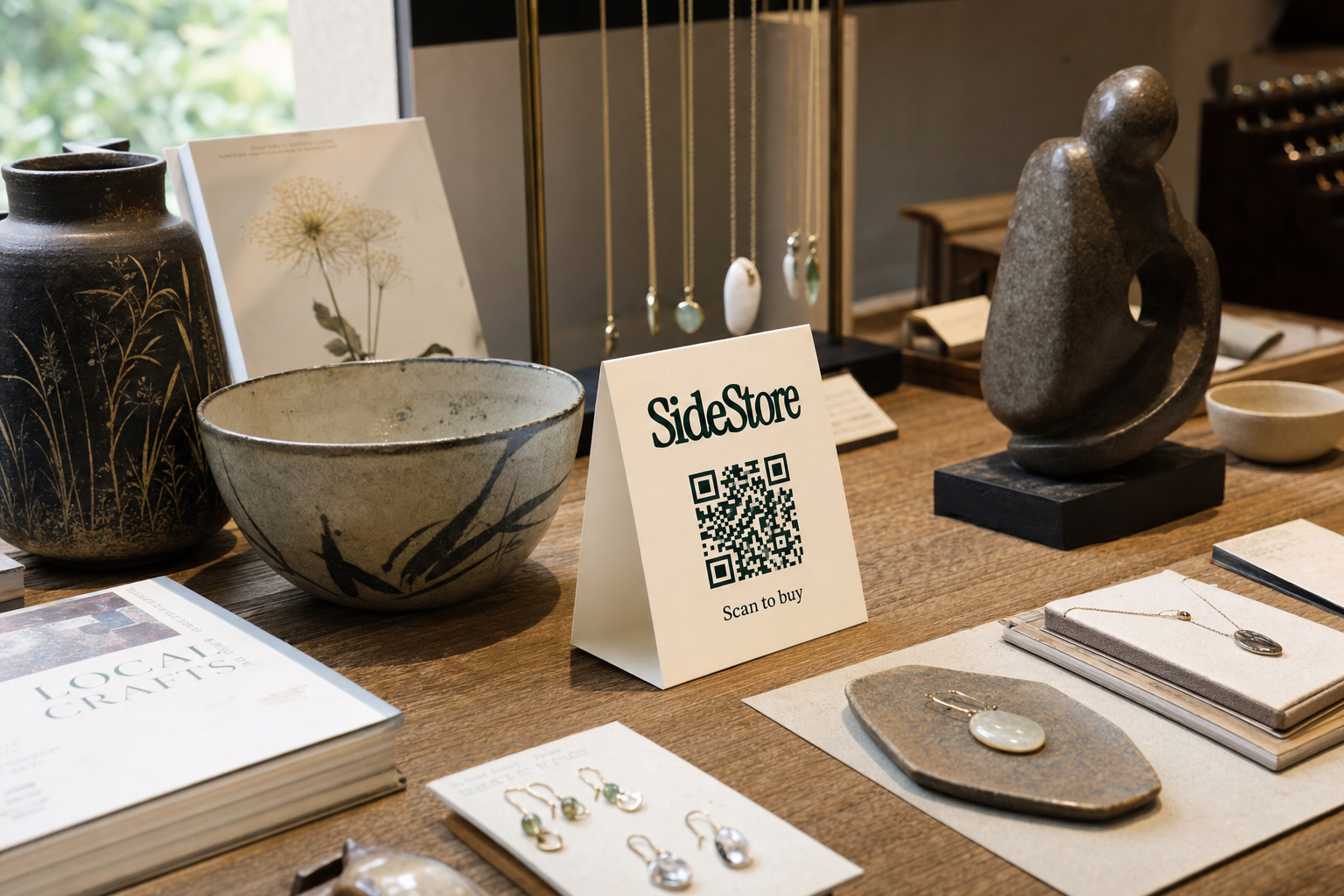
Museum shops are worth targeting because they attract a self-selecting audience: visitors who have already paid to engage with culture, history, or craft. That makes them more likely to value handmade and design-led work than the average high-street browser.
The advantages are real. A placement in a museum shop signals to every future buyer and stockist that your work has passed a curatorial filter. The perceived value of products sold in that context tends to be higher, which can support a price point you might struggle to defend elsewhere. Visitors are often in a gift-buying mindset, and they are browsing with time and intention rather than rushing past a market stall.
The trade-offs are equally real, and you should go in with your eyes open. Museum shops often carry institutional commission rates that sit at the higher end of the consignment range, sometimes reaching 50% of the retail price. Stock turnover can be slow, particularly in smaller regional museums with lower footfall. Payment cycles at larger institutions can run to 60 or even 90 days. And the buying process tends to move slowly: decisions go through committees, seasonal buying windows, and institutional sign-off.
For makers building a portfolio of physical distribution alternatives, a museum placement is a credibility asset as much as a revenue channel. Treat it as both, and the patience required starts to make sense.
How to Identify the Right Museum Shops to Approach
The right museum to approach is one whose mission connects directly to your work. A ceramicist fits naturally in a decorative arts museum. A textile maker belongs in a folk museum or a fashion archive. Mission alignment is not a soft preference; it is the single strongest predictor of whether a buyer will read past your subject line.
Start with that filter. List the themes, materials, and cultural references in your work, then search for museums whose permanent collections overlap. Regional and specialist institutions are better starting points than large national museums. Their buying teams are smaller, more accessible, and more willing to experiment with new makers on a consignment basis.
Once you have a shortlist, visit the shop in person if you can. Observe the price range, the product types, and the overall aesthetic. Note whether the shop sells predominantly reproductions and postcards or whether it stocks independent maker work. This visit will also tell you how your own product would sit on the shelf.
If you cannot visit in person, most museum shops maintain an online store that reflects their buying preferences. Browse it carefully.
Finding the right contact matters. You are looking for the retail manager or shop buyer, not the curator, the director, or the education team. Check the museum's website staff page, LinkedIn, or call the main reception and ask directly for the name of the person responsible for shop buying. Pitching to the wrong person wastes both of your time.
For more on approaching specialist retail environments, see pitching boutiques and specialist retailers.
What Museum Shop Buyers Look for in a Maker's Product
Museum shop buyers are looking for four things: mission relevance, an appropriate price point, restock reliability, and professional presentation. Get all four right and you are a serious candidate. Miss one and the conversation stalls.
Mission relevance comes first. Your product does not need to be a literal replica of an artefact in the collection, but there must be a legible connection. A buyer needs to be able to explain to their manager why this product belongs in their shop. Give them that explanation in your pitch; do not make them construct it themselves.
Price point matters because museum shop visitors span a wide range. Shops typically stock items at several tiers, from small impulse purchases through to considered gifts. Know where your product sits, and check that it fits within the range the shop already carries. Pricing yourself 40% above everything else on the shelf is a problem regardless of the quality.
Restock reliability is something many new makers underestimate. A buyer who loves your work and places an initial consignment order will not reorder if you took eight weeks to deliver the first batch and went silent for a month after that. Be honest with yourself about your production capacity before you pitch, and be honest with the buyer about lead times.
Presentation means retail-ready packaging, clear pricing, and a product that can be displayed without assembly or explanation. If your product requires a label, make it legible at arm's length.
Frame everything through the visitor experience. A buyer is not just buying a product; they are curating a moment in the visitor's journey. Show them how your work fits that moment.
For makers working with prints and paper goods, the principles translate directly: see consignment placement for art prints.
How to Write and Send a Pitch That Gets Read
A good pitch is short, specific, and does the buyer's thinking for them. Your email should be under 200 words. Attach a one-page PDF. Lead with the mission connection, not your biography.
Here is the five-part structure that works:
The connection (one sentence). Name the link between your work and the museum's collection or mission. Be specific: "My hand-thrown stoneware references the slip-glazing traditions in your British ceramics collection" is more useful than "I make pottery and love your museum."
The product (two to three sentences). Describe what you make, the materials, and the retail price range. Include one or two product images in the PDF, not embedded in the email body.
The consignment offer (one sentence). Offer consignment explicitly. This removes the financial risk for the buyer and makes the decision easier: "I propose placing six pieces on consignment at a 50/50 split, with a 90-day initial trial period."
The logistics (one sentence). State your restock lead time and your minimum quantity. Keep it brief and credible.
The close (one sentence). Ask for a specific next step, not a vague expression of interest. "Would a 15-minute call next week work?" is better than "Please let me know if you're interested."
Send the email to the named buyer, not a generic inbox. Tuesday to Thursday mornings tend to get better open rates than Mondays or Fridays, though buyer schedules vary.
Follow up once, no earlier than two weeks after the initial send. Keep the follow-up to three sentences. More than one follow-up risks damaging the relationship before it starts.
For broader guidance on how to approach retail partnerships and alternative ways to reach retail audiences, both are worth reading alongside this section.
Consignment Terms in Museum Retail: What to Expect and What to Negotiate
Expect museum consignment terms to lean in the institution's favour. Most museum shops operate with commission structures and payment cycles that reflect their administrative overhead, not their enthusiasm for your work. Knowing the realistic ranges before you enter the conversation means you can negotiate from a position of knowledge rather than surprise.
| Term | Typical museum range | What to negotiate |
|---|---|---|
| Commission split | 40, 50% to the shop | Push toward 40% if your price point is below £50; above that, 45% is often achievable |
| Payment cycle | 30, 90 days after sale | Request 30-day cycles in writing; 60 days is a common compromise |
| Consignment period | 3, 6 months initial term | Negotiate a 90-day review with a right to withdraw unsold stock |
| Liability for loss or damage | Often maker's risk by default | Request the shop insures stock at replacement value while on their premises |
| Exclusivity | Rarely required, occasionally requested | Resist any geographic exclusivity clause; product-category exclusivity is more acceptable |
The commission split is where profitability lives or dies. At a 50% commission, your wholesale-equivalent margin must cover production, packaging, delivery, and any restocking effort. Run the numbers before you agree. If the margin does not work at 50%, say so plainly and propose a retail price adjustment or a lower split rather than accepting terms that make the placement unviable.
Payment cycle length has a direct cash-flow impact, particularly if you are restocking a placement before receiving payment for the previous cycle. Build this lag into your production planning.
Red flags to watch for: any clause that grants the museum ownership of unsold stock after the consignment period; vague language around what constitutes a "sale" for payout purposes; and any agreement with no fixed end date and no right of withdrawal.
For a full comparison of structures, see consignment vs wholesale terms for makers.
What a Consignment Agreement for Artists Must Include
Every museum shop placement should be governed by a written consignment agreement. This is not about mistrust; it is about professional practice. A clear agreement protects both parties and gives you a paper trail if stock goes missing, payment is delayed, or the placement ends unexpectedly.
A consignment agreement for artists must include seven non-negotiable clauses:
Product description and quantity. List every item placed by title, SKU or description, unit retail price, and quantity. Vague references to "a selection of ceramics" create disputes.
Commission split. State the exact percentage the shop retains and the percentage you receive, unambiguously. Define whether commission is calculated on the retail price inclusive or exclusive of any applicable tax.
Payment terms. Specify the payment cycle (30, 60, or 90 days), the trigger event (date of sale or end of reporting period), and the payment method.
Consignment period and renewal. State the start date, the initial term, and the conditions under which the agreement renews or expires.
Unsold stock and withdrawal rights. Define who bears the cost of returning unsold stock and within what timeframe the maker can request its return.
Liability and insurance. State explicitly who is responsible for loss, theft, or damage while stock is on the shop's premises. Do not leave this to assumption.
Exclusivity (or the absence of it). If no exclusivity applies, say so. Silence on this point can later be interpreted either way.
For high-value placements, seek legal review before signing. Digital agreements are accepted practice and are easier to store and retrieve than paper documents. Consignment management tools such as those referenced in consignment inventory software can also hold placement records digitally, which is useful when you are managing more than one venue.
Managing a Live Museum Shop Placement: Stock, Reporting, and the Long Game
Once your placement is live, the real work is consistency. Managing a museum shop placement involves three recurring responsibilities: monitoring stock levels, staying across sales reporting, and maintaining the relationship with your buyer contact.
Stock monitoring means knowing when units are running low before the shop emails you in a mild panic. Agree a reorder trigger point at the outset, for example, when fewer than three units remain, and hold that stock ready. Gaps on the shelf mean lost sales and a buyer who starts to question your reliability.
Sales reporting varies by institution. Some shops provide monthly sales statements; others require you to follow up. Establish the reporting rhythm in writing at the start. If you are managing multiple placements, tracking sales venue by venue in a spreadsheet quickly becomes unmanageable.
This is where a consignment management tool earns its place. SideStore's Retail Widget handles stock tracking, placement attribution, and automatic split settlement across all your active placements. Rather than chasing payment and manually reconciling sales data from each venue, you manage everything from one dashboard. The QR scan-to-pay function is one feature within that system, not the whole thing.
The long game in museum retail is the consignment-to-wholesale progression. A placement that sells consistently over two or three buying cycles is a strong signal. Many museum buyers will raise the possibility of a wholesale order once trust is established. That shift changes your cash-flow entirely: you receive payment upfront rather than waiting for individual sales to clear.
For managing placements across venues, see consignment inventory software and managing consignment placements across multiple venues.
Scaling Beyond One Museum: Building a Distributed Consignment Network
One museum placement proves your model. Two or three start to build a pattern. Beyond that, the pitch assets you have already built, your one-page PDF, your product photography, your consignment terms, are reusable with minimal adaptation.
Each new placement you can name in a pitch makes the next pitch easier. Museum buyers respond to evidence that other institutions have already trusted your work. A line that reads "currently stocked at [regional museum] and [specialist gallery shop] on consignment" carries more weight than a portfolio of press clippings.
The administrative challenge scales with the number of placements. Tracking stock levels, sales, and payouts across multiple venues manually, through spreadsheets, email threads, and bank reconciliations, is time-consuming and error-prone. The gaps in that process cost you money and reputation.
SideStore is built for exactly this stage. The Retail Widget gives you a single interface to manage every placement: live stock tracking across venues, placement attribution so you know which location is selling and which is slow, and automatic split settlement so payment flows without you chasing it. You build a distributed consignment network and run it like software, without opening a store of your own.
For makers weighing up how this fits alongside other formats, comparing retail distribution options for makers and building a multi-channel physical distribution strategy are both worth reading at this stage.
Frequently Asked Questions
The most common misunderstanding about museum shop consignment is that the buyer relationship works like a standard retail pitch. It does not. Museum buyers operate within institutional constraints, committee sign-offs, seasonal budgets, mission mandates, that mean even a strong pitch can move slowly. Knowing that going in prevents you from misreading a delayed response as rejection.
What consignment percentage do museum shops typically take?
Museum shops typically retain between 40% and 50% of the retail price as their commission, leaving the maker with 50% to 60%. The exact split depends on the institution's size, the product category, and your negotiating position. Smaller regional museums are often more flexible than large national institutions. Before agreeing to any split, run the margin calculation from your production cost upward to confirm the placement is viable. For a structural comparison, see consignment vs wholesale: which model suits makers.
Do museum shops prefer consignment or wholesale?
It depends on the institution and the maker. Established suppliers with a track record tend to move to wholesale because it simplifies the shop's buying process and gives the maker upfront payment. For new makers, consignment is the more accessible entry point because it removes inventory risk for the shop. Many museum buyers use consignment as a trial period, with wholesale becoming an option once consistent sales are demonstrated.
How long does it take to hear back from a museum shop buyer?
Response times vary considerably. Some buyers reply within two weeks; others operate on seasonal buying cycles and may not review new submissions outside those windows. In practice, many makers report waiting four to eight weeks before receiving a substantive response, if they receive one at all. Send one follow-up after two weeks, keep it brief, and if you hear nothing after six weeks, move on to the next institution on your list.
Can I pitch multiple museum shops at the same time?
Yes, and you should. Pitching one museum at a time is an inefficient use of your effort. Consignment proposals carry no exclusivity obligation unless the agreement explicitly creates one, and most museum consignment arrangements do not. Adapt your pitch template to each institution's mission, send in parallel, and track your outreach so you can follow up systematically. Landing two or three placements simultaneously also gives you negotiating context for future approaches.
Start Small, Document Everything, and Let the Track Record Do the Pitching
Start with one museum whose mission fits your work, send a short pitch with a consignment offer, and get your first placement live. That is the first step and the only one that matters right now. From there, document every sale, every restock, and every conversation.
Your action sequence: identify the right institutions using the mission-fit filter, send a structured five-part pitch to the named buyer, and govern every placement with a written consignment agreement from day one. As placements accumulate, use a consignment management tool to handle the stock tracking and split settlement so the administration does not cap your growth.
The track record you build across pitching other specialist retailers and consignment placement for art and print makers becomes your most persuasive pitch asset over time. Build a consignment network without opening a store of your own.