Live Selling Platforms vs Consignment Placement: Which Earns More for Independent Makers?
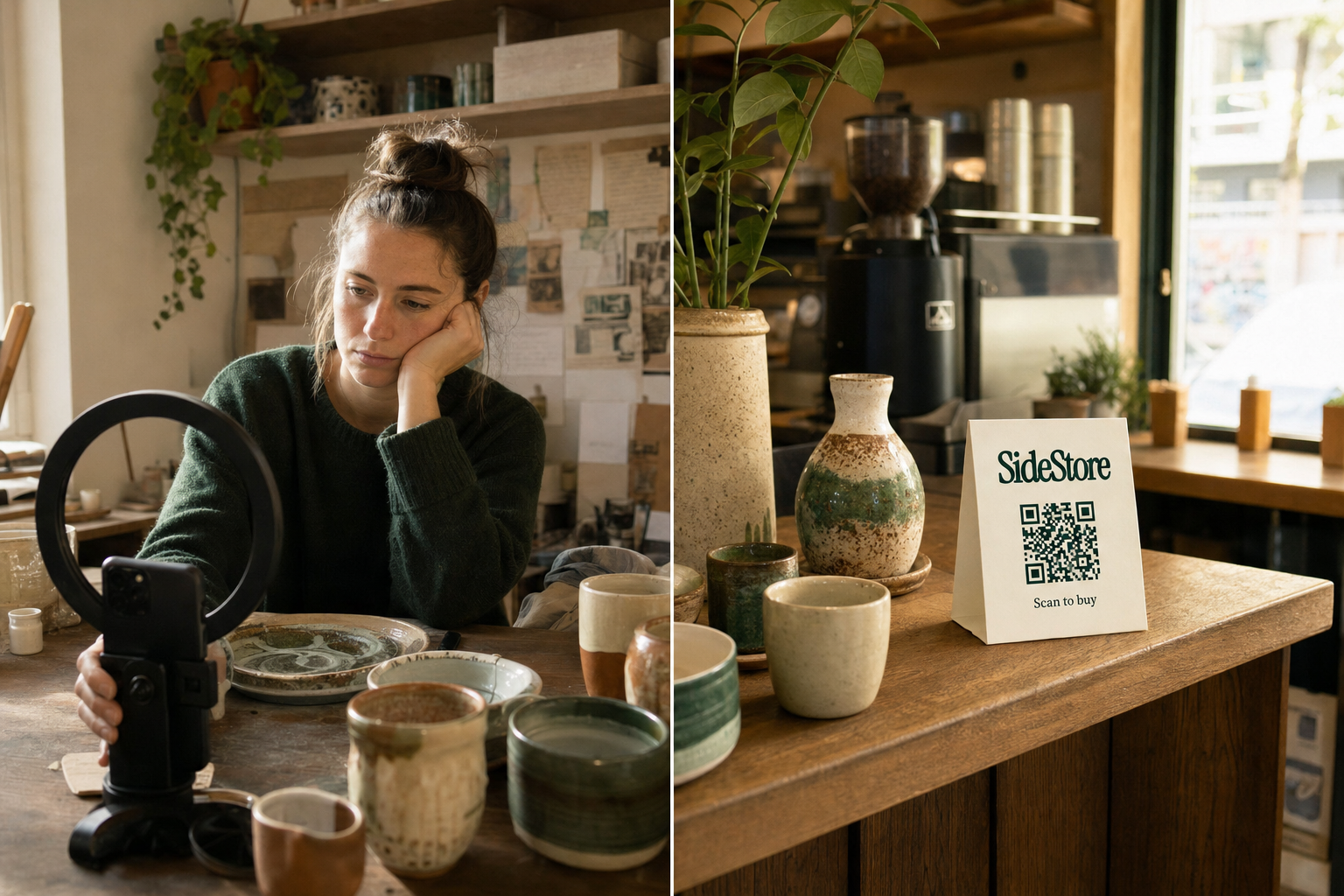
Live selling platforms are digital channels where you broadcast video in real time, showcase products, and accept purchases from viewers during the stream. If you're weighing live selling against consignment placement, here's the core distinction: live selling pays when you perform, consignment placement pays while you're doing something else entirely.
Both models suit different kinds of makers, and neither is universally better.
The peak season for live commerce is December, which makes November the right moment to decide your channel mix before the rush hits. This article compares the major live selling platforms, TikTok Shop, Whatnot, Instagram Live, and Amazon Live, against consignment placement through SideStore. It will help you choose based on what you actually have: an audience, a product, available time, and a tolerance for platform risk.
If you're already thinking about selling without a social media following, this comparison will answer the question directly.
What Are Live Selling Platforms and How Do They Work?

Live selling platforms are interactive broadcast environments. You present physical products on video, viewers ask questions in real time, and purchases are completed without leaving the stream. That's the core mechanic. Two clarifications matter before going further.
Live selling vs live auction: these are not the same thing, though many people use the terms interchangeably. In live selling, a product is listed at a fixed or discounted price and bought directly. In live auction, the price rises as viewers bid, and the highest bid wins. Whatnot operates on an auction model; TikTok Shop operates on a fixed-price model. Knowing the difference changes how you price and how you manage unsold stock.
Live commerce platforms vs general marketplaces with live features: Instagram and Facebook offer live video with product tagging, but they're social platforms that added commerce, not platforms built for selling first. TikTok Shop and Whatnot were designed around the transaction. The experience, algorithm, and seller support differ substantially between the two types.
Major platforms and their regions:
- TikTok Shop operates in the US, UK, Southeast Asia (including Philippines and Singapore), and parts of Europe. Mobile app: yes.
- Whatnot operates in the US and UK, with a mobile app. Focused on collectibles, trading cards, and niche goods.
- Instagram Live Shopping is available in several markets but has rolled back purchase features in some regions. Mobile app: yes.
- Amazon Live is US-only. Desktop and app access.
All of these platforms have mobile apps, so you can broadcast from your phone. That lowers the barrier to entry, though not the skill requirement.
For makers exploring offline alternatives, retail partnerships for makers offer a different path to physical distribution without the camera.
Which Live Selling Platforms Operate in the UK, India, Philippines and Singapore?
Platform availability varies significantly by country, and the landscape changes fast. Treat the information below as a starting point and verify directly with each platform before committing.
United Kingdom: TikTok Shop is live in the UK with full shopping features. Whatnot operates in the UK, particularly for collectibles and cards. Instagram Live has commerce features in the UK, though the checkout integration has been inconsistent. Amazon Live is not available to UK sellers.
Philippines: TikTok Shop is active in the Philippines and is one of the dominant live commerce channels in Southeast Asia. Shopee Live, Lazada Live, and Facebook Live Shopping are also widely used by Filipino sellers.
Singapore: TikTok Shop, Shopee Live, and Lazada Live all operate in Singapore. These platforms have strong adoption across Southeast Asian markets.
India: TikTok is banned in India as of the date of this article, so TikTok Shop is not an option for Indian makers. Meesho Live, YouTube Shopping, and Instagram Live with product links are the more common routes. The live commerce space in India is developing, with local platforms entering regularly.
Are there free live selling platforms? Streaming on Instagram Live or Facebook Live costs nothing to start. However, platforms that process transactions take a commission on each sale, which varies by platform. No platform is genuinely free end-to-end if it's handling your payments.
For makers in regions where platform options are limited, how shared retail networks support local makers explores physical distribution alternatives.
Live Selling vs Consignment Placement: Earnings Comparison
A live seller with a large, engaged audience can earn more per session than most consignment placements will earn per week. But that comparison changes sharply when you account for time, risk, and what happens when the platform changes its rules.
| Dimension | Live Selling Platforms | Consignment Placement (SideStore) |
|---|---|---|
| Upfront cost | Low to none (equipment, time) | None for the host; maker supplies stock |
| Platform or host fee | Commission per sale (varies by platform) | Split payout agreed between maker and merchant |
| Inventory risk | Maker holds and ships stock | No risk for the host; maker restocks as needed |
| Time required per week | High: preparation, broadcast, fulfilment | Low: restock visits, no performance required |
| Audience needed to earn | Yes: meaningful reach drives meaningful sales | No: foot traffic comes from the merchant's location |
| Geographic reach | Wherever the platform operates | Wherever you can place stock in a merchant space |
| Earnings model | Event-driven: peaks during streams | Continuous: sells while you're away |
| Payment timing | Platform payout cycles (days to weeks) | Automatic split settlement via the Retail Widget |
| Stock tracking | Manual or platform-integrated | Live via the Retail Widget per placement |
| Scalability | Scales with audience size | Scales with number of merchant placements |
Time cost is the most underestimated row. A single live selling session typically involves product preparation, a broadcast of one to two hours, and post-sale fulfilment. Doing that consistently, week after week, is closer to a part-time job than passive income. Consignment placement requires periodic restocking visits but no performance.
Platform risk is real. The proposed US ban on TikTok in early 2025 was a live demonstration of what concentration risk looks like: sellers who had built their entire distribution on a single platform faced losing it overnight. Diversification isn't optional advice.
Earnings structure differs in kind, not just degree. Live selling is transaction-intensive on specific days; consignment is lower-intensity but continuous. For makers with inconsistent schedules, continuous is often more reliable.
Before placing stock on consignment, reading a consignment agreement for artists will give you a clear picture of what terms to expect, and reviewing consignment stock terms and conditions will prepare you for the host side of the arrangement.
TikTok Shop for Makers: What It Actually Takes
TikTok Shop works for independent makers, but not passively and not immediately. The platform connects your product listings to your TikTok content. When a viewer taps a product pinned to your video or live stream, they can purchase without leaving the app. That frictionless path to purchase is the genuine advantage.
What it actually requires is less often discussed honestly. You need an account with enough followers for TikTok to show your content to non-followers, which means posting consistently and understanding what performs on the platform. You need to maintain fulfilment standards: TikTok monitors dispatch times and penalises sellers who ship late or accumulate cancellations. And you need to either go live regularly or produce short-form video that features your products naturally. That's a creative and technical skill on its own.
The commission TikTok Shop takes varies by category and market, but it's generally reported to be in the range of a few percent, making it lower than many marketplaces. The real cost is time and content production.
Platform concentration risk isn't abstract. TikTok faced real and documented legislative pressure toward a ban in the United States in 2025. Sellers who had built their primary sales channel there faced genuine uncertainty. That's not a reason to avoid TikTok Shop entirely, but it is a reason not to make it your only channel.
TikTok Shop genuinely suits makers who enjoy creating content, who have or are building an audience, and whose product photographs and demonstrates well on video. If that isn't you, you're not failing: you're simply better suited to a different model. Consignment placement through SideStore gives you offline distribution without requiring you to be on camera or at the mercy of an algorithm.
For makers who want to think through the full picture, how to sell products without social media covers the options directly.
Consignment Placement: How Physical Retail Earns Without Performance
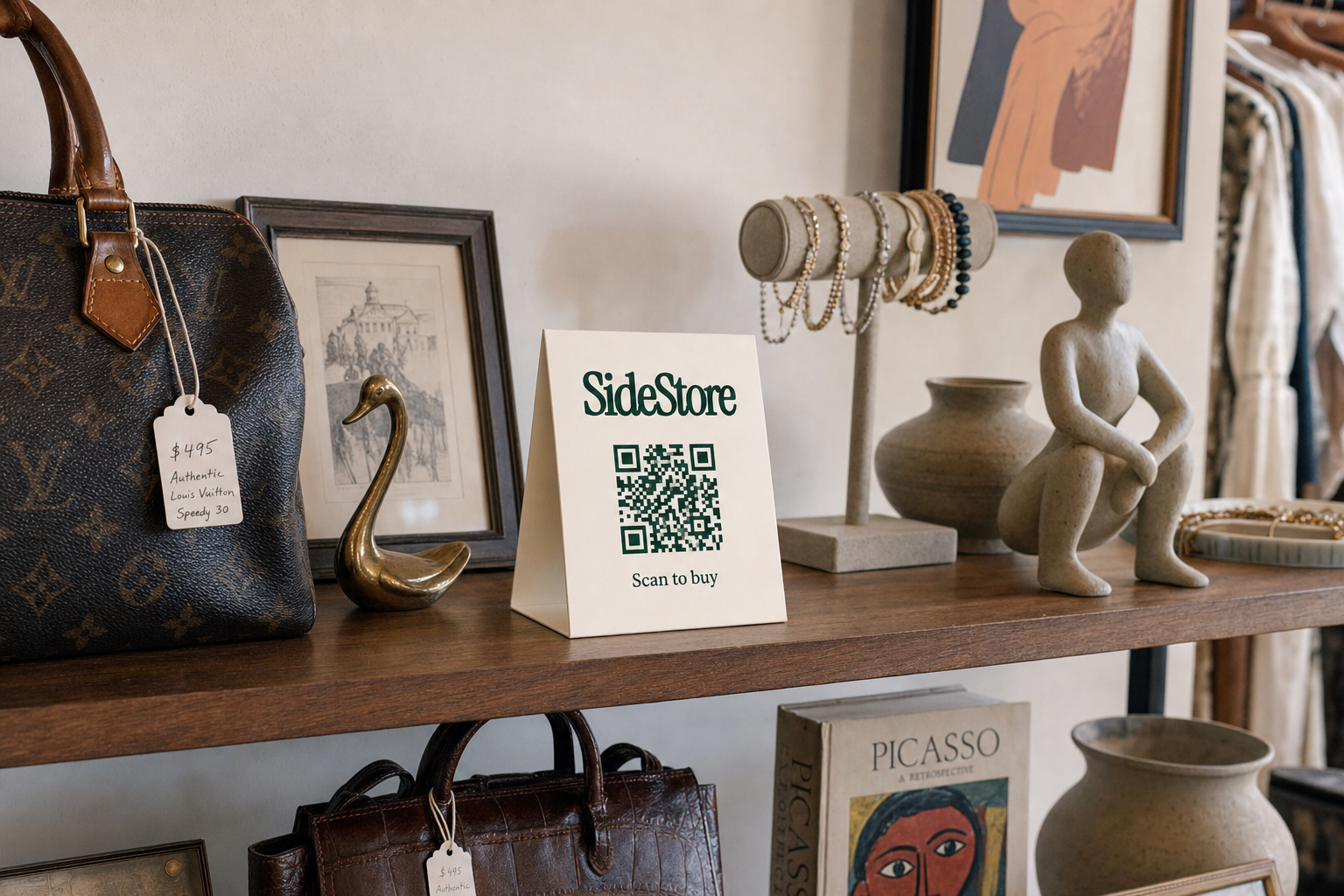
Consignment placement is a distribution model where you place your products in a merchant's space. The merchant hosts and displays the stock. When a product sells, the revenue is split between you and the merchant automatically. No purchase is required from the host, and no inventory risk falls on the merchant.
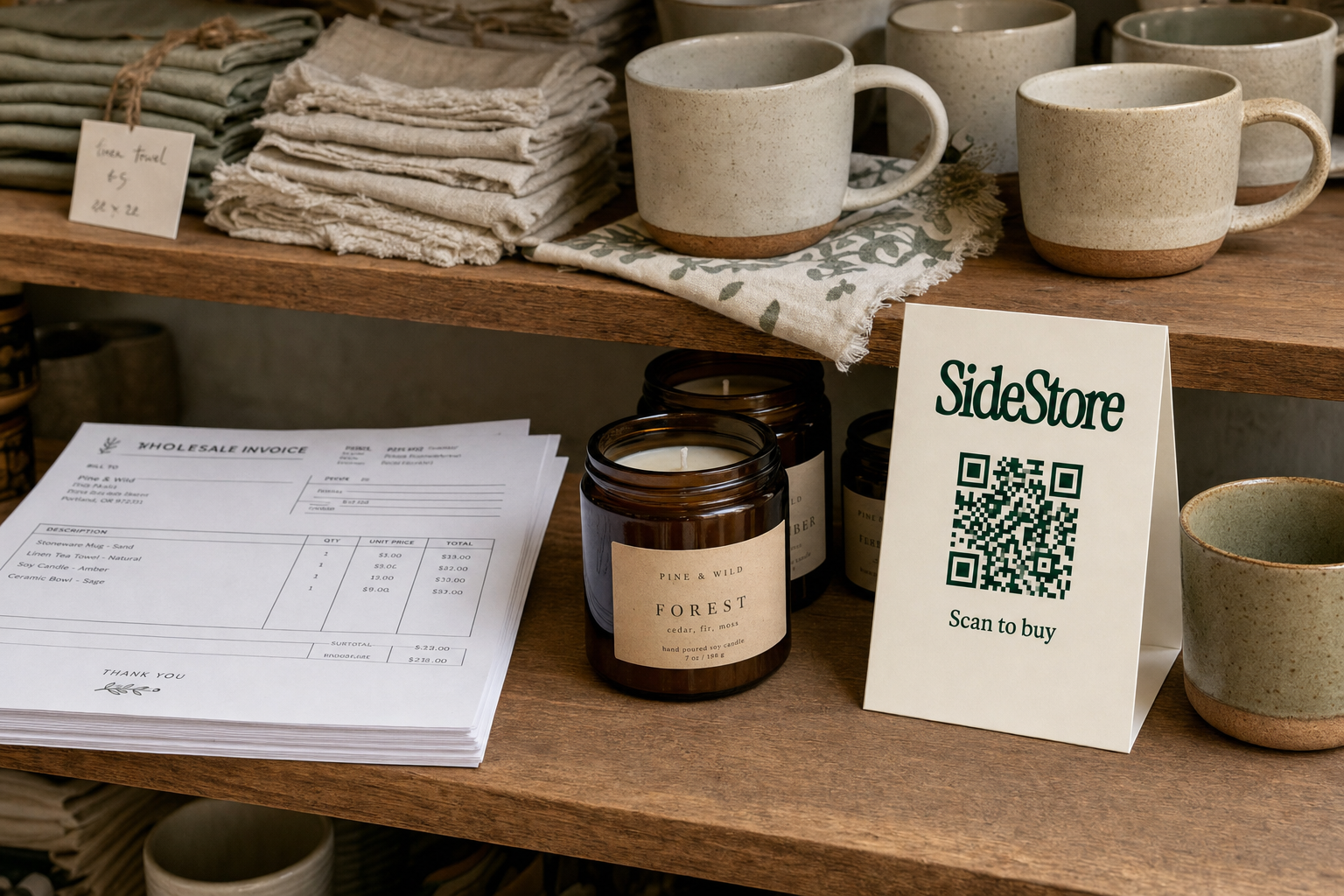
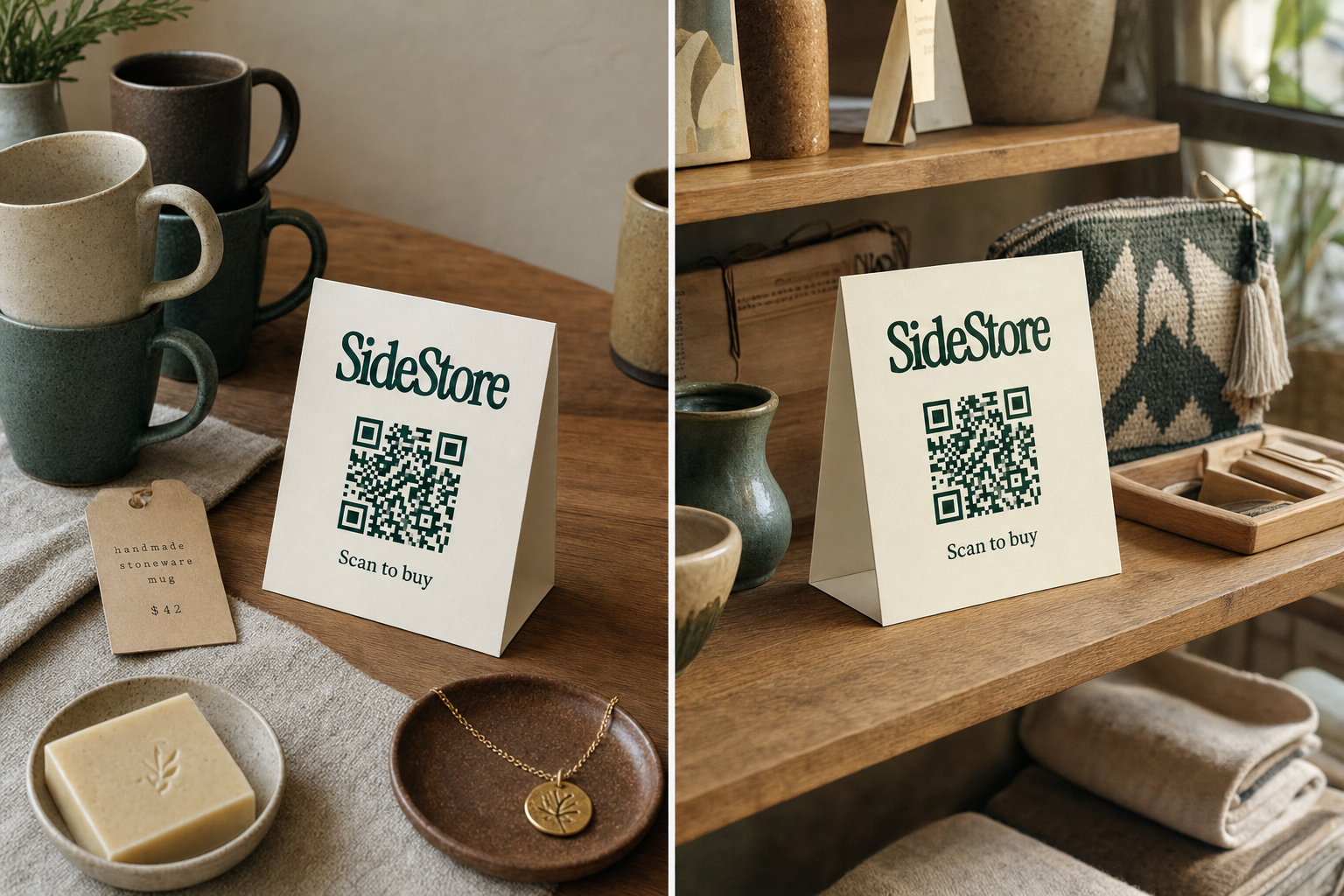
SideStore manages this through the Retail Widget, which handles the entire placement end to end. Each placement gets live stock tracking so you know what has sold and what needs restocking across every location. When a customer purchases, the payment can go through a scan-to-pay QR, which is a printable code you can attach to your product or a merchant can display for all products in their SideStore section. That QR checkout is one function of the Retail Widget, not the whole product: the Widget also handles placement attribution, split settlement, and stock visibility across your full network of locations.
Merchant spaces that work well for consignment include cafes, boutiques, hotels, salons, and any high-foot-traffic retail environment where the host already has browsing customers and underused shelf or counter space. The host earns from space they already have, with no extra staffing or stock management required.
What consignment placement doesn't do: it doesn't build you a social following, and it requires you to physically restock locations when stock runs low. These are genuine constraints, not minor footnotes.
The earnings model is passive between restock visits. Your products sell during the merchant's trading hours, including when you're working on other things. Scale comes from adding more placements, not from performing more often.
Makers placing in food and beverage settings may find it useful to read about products that sell well on a cafe counter. Those in beauty and wellness spaces can explore how to sell products in a salon. For artists specifically, selling art prints in cafes covers the placement mechanics in more detail.
Which Model Suits Which Maker?
The right channel depends on what you have and what you want to build. If you enjoy performing on camera and already have an audience, live selling can earn well per session. If you want distribution that runs without you, consignment placement is the more sustainable structure for most independent makers.
| Maker Profile | Recommended Channel |
|---|---|
| Has 10,000+ engaged social followers and enjoys live video | TikTok Shop or Whatnot |
| Creates niche collectibles or limited-edition goods | Whatnot (auction model suits scarcity) |
| Makes physical goods with no social audience | Consignment placement via SideStore |
| Has inconsistent time and wants passive income | Consignment placement via SideStore |
| Has both an audience and local stockists | Live selling + consignment placement combined |
Running both channels simultaneously is a legitimate strategy. Live sessions build awareness and drive interest. Consignment placements convert that interest in physical locations where browsing customers encounter your products without a screen. The two models complement rather than compete.
The platform-diversification lesson from the TikTok risk episode applies here: no single channel is stable forever. Building stock into physical locations gives you a distribution layer that no algorithm change or legislative decision can remove.
When you're ready to approach physical merchants, how to approach a local shop about stocking your products covers the conversation practically. And if you're wondering whether a coffee shop counts as a retail host, it does, and it's often one of the most accessible starting points.
Frequently Asked Questions
What are the different live selling platforms available? The main live selling platforms are TikTok Shop, Whatnot, Instagram Live Shopping, Amazon Live, Facebook Live Shopping, Shopee Live, and Lazada Live. Each operates in different regions and suits different product categories. TikTok Shop and Shopee Live are strongest in Southeast Asia; Whatnot is dominant in the US and UK for collectibles; Amazon Live is US-only.
Which live selling platforms operate in the UK? TikTok Shop and Whatnot both operate fully in the UK. Instagram Live with product links is available, though its checkout integration has varied over time. Amazon Live is not available to UK sellers. Verify current feature availability directly with each platform before building a strategy around them.
Which live selling platforms operate in India? TikTok is banned in India, so TikTok Shop is not an option. Indian sellers most commonly use Instagram Live with product links, YouTube Shopping, and Meesho Live. The space is active and evolving, with local platforms entering the market regularly.
Which live selling platforms operate in the Philippines? TikTok Shop is widely used in the Philippines and is one of the most active live commerce channels in the country. Shopee Live and Lazada Live are also strongly adopted. Facebook Live Shopping remains popular for smaller sellers.
Which live selling platforms operate in Singapore? TikTok Shop, Shopee Live, and Lazada Live all operate in Singapore. All three have mobile apps and support live selling with in-app purchase.
Are there free live selling platforms available? Broadcasting on Instagram Live or Facebook Live costs nothing. Platforms that process transactions, such as TikTok Shop or Whatnot, take a commission on each sale. No end-to-end transaction platform is fully free: if they handle your payment, they take a share.
What live selling platforms are similar to Whatnot? Platforms with a similar auction-and-live-bidding mechanic include Popshop Live and Loupe, both focused on collectibles. For fixed-price live selling in a similar niche, TikTok Shop and Instagram Live Shopping are the closest alternatives with broader category reach.
Do live selling platforms have mobile apps? Yes. TikTok Shop, Whatnot, Shopee Live, Lazada Live, and Instagram all have mobile apps that allow you to broadcast and sell from your phone. Amazon Live also has a mobile broadcast option via its app.
How does live commerce differ from traditional e-commerce? Traditional e-commerce is asynchronous: a customer browses a static listing and buys in their own time. Live commerce is synchronous: you're present, can answer questions, demonstrate products, and create urgency in real time. Conversion rates in live sessions tend to be higher per viewer, but the audience must be there at the right moment.
How can someone invest in live shopping platforms? This article covers how to earn from live selling as a maker, not how to invest in platforms as a financial instrument. If you're exploring equity investment in live commerce companies, that falls outside this article's scope: consult a financial adviser and research publicly listed companies or venture-backed platforms independently. For a consignment agreement for artists or consignment stock terms and conditions, the linked articles will be more relevant to your situation as a maker.
The Practical Choice: Platform or Placement?
If you have an audience and enjoy creating content, live selling platforms are worth testing this December, when live commerce peaks. If you have neither a following nor the appetite to perform consistently, consignment placement is the more reliable path to passive income from your physical products.
The structural lesson from 2025's platform volatility is clear: concentration in any single channel is a risk. Building your products into physical merchant spaces through consignment creates a distribution layer that no algorithm update or regulatory decision can switch off overnight.
The two models aren't mutually exclusive. Many makers find that live sessions build awareness while consignment placements convert that awareness in the physical world, without any additional performance required.
SideStore's premise is straightforward: build a consignment network without opening a store of your own. Place your products into merchant spaces that already have foot traffic, let the Retail Widget handle stock tracking and split payouts, and earn while you're not in the room.
Explore how shared retail networks support independent makers and how to sell through someone else's store to start building your placement network.