Online Selling Platforms vs Physical Placement: Which Channel Actually Grows a Maker's Business?

Online selling platforms are digital marketplaces where you list products and buyers discover them through search, algorithms, or curated feeds. The major categories include general marketplaces (eBay, Amazon), maker-specific platforms (Etsy, Folksy), fashion resale platforms (Depop, Vinted), local buyer platforms (Facebook Marketplace, Gumtree), and digital product platforms (Gumroad, Payhip). Each has a different fee structure, and the most common mistake makers make is conflating "free to list" with "fee-free", many platforms charge zero upfront but take a percentage on every sale.
A second, subtler mistake: treating online platforms as your only distribution channel. They are powerful, but they create algorithmic dependency. If the platform changes its ranking logic, your visibility changes overnight. Physical consignment placement exists as a parallel channel, not a competitor to it.
This guide covers the main platform types and their cost mechanics, how platforms differ by region, and how selling through someone else's store through consignment placement fits into your broader distribution strategy.
What Are the Major Online Selling Platforms Available?
Online selling platforms fall into five distinct categories, each built for a different product type, audience, and fee structure. Knowing which category fits your product before you list saves you from paying the wrong fees or reaching the wrong buyers.
General marketplaces eBay and Amazon are the largest. eBay charges insertion fees plus a final value fee (typically 12, 13% for most categories). Amazon charges referral fees starting at around 8%, plus fulfilment costs if you use FBA. Both platforms offer enormous reach but equally enormous competition.
Maker-specific platforms Etsy charges a $0.20 USD listing fee per item plus a 6.5% transaction fee and a payment processing fee. Folksy, the UK equivalent, charges a similar listing and transaction fee structure. These platforms attract buyers who want handmade and independent products, which suits most makers well.
Fashion resale Depop charges sellers a transaction fee on each sale. Vinted takes no seller fees but charges buyers a protection fee instead. This distinction matters: "free to sell" on Vinted means the buyer absorbs the platform cost, not you.
Local buyer platforms Facebook Marketplace and Gumtree are free to list in most categories and charge no transaction fee for in-person cash sales. Costs appear if you use shipping or promoted listings.
Digital product platforms Gumroad and Payhip let creators sell downloadable files directly. Gumroad takes a flat percentage per sale; Payhip charges a transaction fee that reduces if you subscribe to a paid plan.
The "free to list" versus "fee-free" confusion runs deep. A platform that costs nothing to list still earns from your sales, sometimes significantly. Read the full fee schedule, not just the headline.
There is also an algorithmic dependency risk worth naming plainly: your discovery on any of these platforms depends on rules you do not control. An algorithm change can cut your visibility without warning. That dependency is a structural reason to build distribution across more than one channel.
Which Platform Works Best for Your Product Type?
Platform fit depends on three variables: what you are selling, whether you need a local or national buyer, and how much you are willing to pay in fees per transaction. Start there, not with the platform's brand name.
Selling used or secondhand items: eBay remains the most established platform for secondhand goods across most price points. Facebook Marketplace works well for bulky items where local pickup makes more sense than shipping.
Selling clothing: Depop and Vinted both specialise in fashion resale, but their fee models differ meaningfully. Depop charges the seller; Vinted charges the buyer. If your margin is tight, Vinted's seller-side zero fees preserve more of your revenue per sale. For new, handmade clothing, Etsy typically reaches a more purchase-ready buyer than either resale platform.
Selling handmade or original goods: Etsy is the default starting point, but its 6.5% transaction fee on top of payment processing adds up at volume. Folksy suits UK-based makers who want a smaller, more curated audience.
Fee-free selling: No major platform is entirely fee-free once you process a payment online. The closest options are Facebook Marketplace and Gumtree for local cash sales, where no platform fee applies to an in-person transaction. Any platform that processes payment digitally will charge something, either to you or to your buyer.
Selling digital products: Gumroad and Payhip are purpose-built for downloads and memberships. Neither is suited to physical goods at scale.
For makers considering products that sell well in physical retail spaces, online platforms are well-suited to one-off or batch sales. They do not provide the persistent, passive retail presence that a well-placed physical consignment gives you.
Do Platforms Differ by Region, UK, Australia, and Canada?
Yes. Platform availability and dominance vary by country. The globally recognised platforms (eBay, Etsy, Amazon, Facebook Marketplace) operate across all major English-speaking markets, but regional alternatives often serve local buyers more effectively for certain product types.
United Kingdom: Vinted, Gumtree, and Folksy are widely used alongside eBay. Folksy is maker-specific and UK-only. Vinted has strong UK adoption for secondhand fashion. Gumtree dominates local classifieds.
Australia: Gumtree is again the leading local classifieds platform. Facebook Marketplace has significant traction for secondhand goods. eBay Australia operates as a separate site and is well-established for general resale.
Canada: Kijiji (owned by eBay) is the dominant local classifieds platform. Facebook Marketplace is heavily used. Etsy and Amazon both operate fully in Canada for makers selling nationally.
The practical limitation of regional platforms is that they concentrate your reach within a geography. Useful for local sales, but it caps your addressable market. Physical consignment placement inverts this logic: you can place products in merchant spaces across different cities or regions without being tied to any single platform's regional footprint. The placement travels with how shared retail networks support local economies, building presence wherever the right merchants exist.
Online Platforms vs Physical Consignment: A Side-by-Side Comparison
The core question is not which channel is better in the abstract, but what each channel does structurally and what it costs you in different scenarios.
| Channel | Setup cost | Fee model | Discovery mechanic | Customer relationship | Stock risk | Payout timing |
|---|---|---|---|---|---|---|
| General marketplace (eBay, Amazon) | Free to list | 8, 13% per sale | Algorithm and search | Buyer-platform, not buyer-maker | You hold unsold stock | Days after sale |
| Maker marketplace (Etsy) | $0.20/listing + 6.5% per sale | Per-listing + per-sale | Algorithm and search | Moderate; shop identity visible | You hold unsold stock | Rolling batched payouts |
| Local classifieds (Facebook Marketplace) | Free | Zero for cash sales | Proximity search | Direct but transient | You hold unsold stock | Instant (cash) |
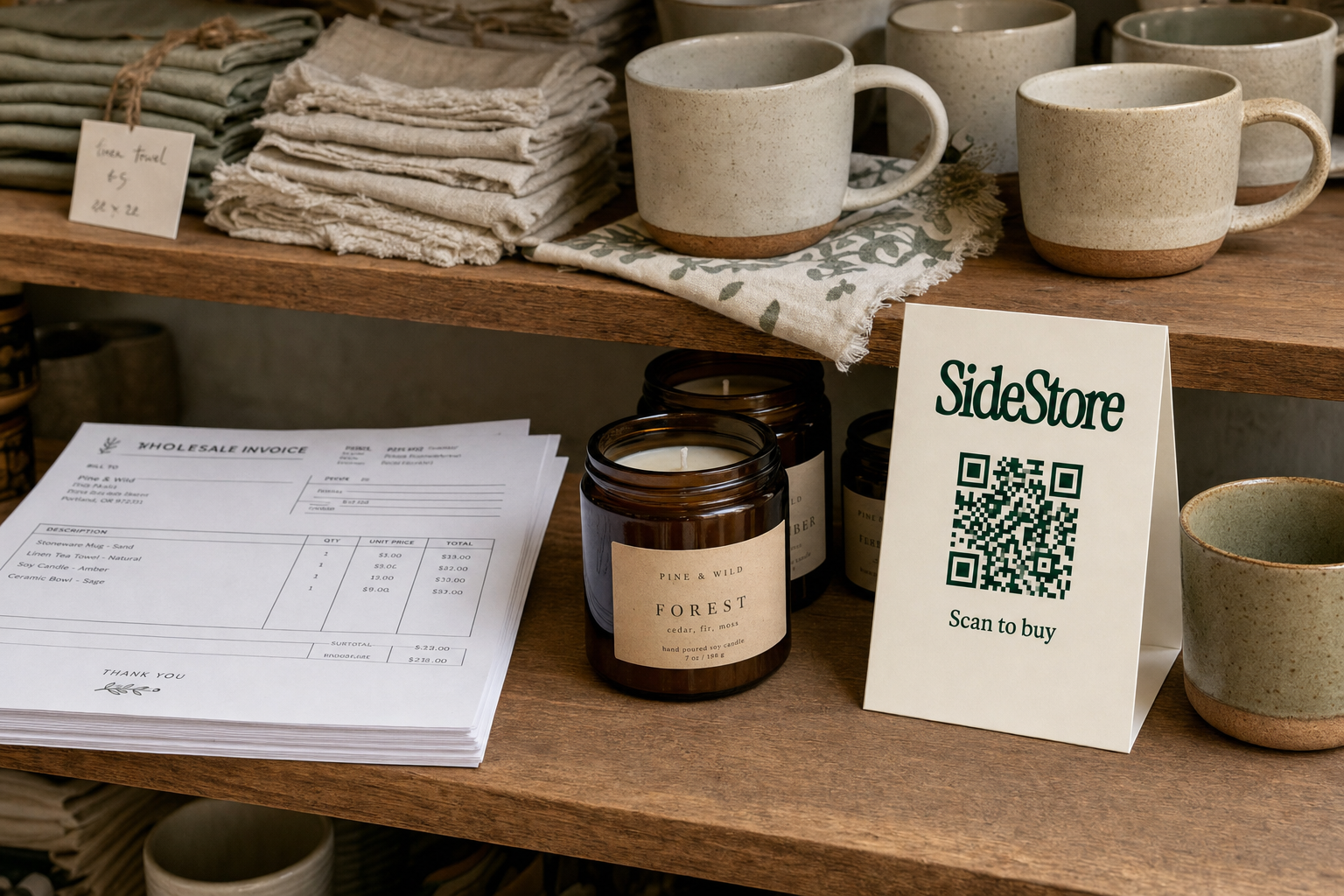
| Physical consignment (SideStore) | Zero upfront | Split payout agreed with merchant | Foot traffic and in-store browsing | In-person, tactile, durable | Host merchant holds no financial risk; you reclaim unsold goods | Automatic split settlement per sale |
The table reveals three trade-offs. First, online platforms offer scale of audience but gate your visibility behind an algorithm; foot traffic is slower to accumulate but delivers a physically present buyer who can hold and examine your product. Second, every online platform charges a fee on the sale; a consignment split payout is also a fee structure, but it is agreed directly with the merchant and reflects the value of the space. Third, payout timing on online platforms depends on platform schedules; the Retail Widget settles the split automatically at the point of sale, with no manual reconciliation.
The key insight: these channels compound. You can list on Etsy and simultaneously place stock in two local merchant spaces without splitting effort, you are reaching two structurally different buyer types. Review the mechanics of a consignment agreement for artists and understand consignment stock terms and conditions before setting up either channel, so your agreements are clear on both sides.
How Physical Consignment Placement Actually Works
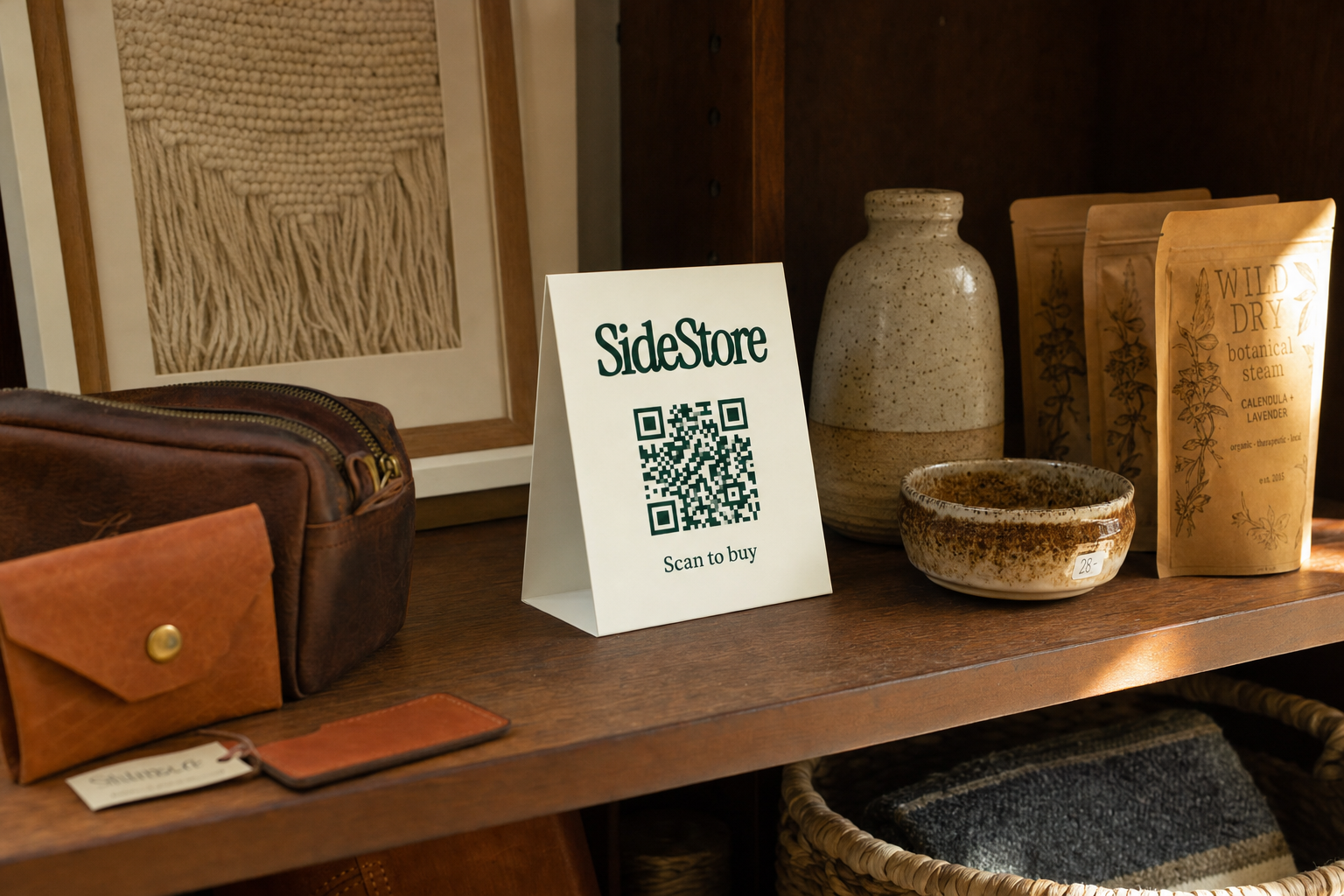
Physical consignment placement means you place products in a merchant space, and the merchant earns a share of each sale without buying any stock upfront. The mechanics are straightforward: no inventory risk for the host, no fixed cost for you, and payment happens only when something sells.
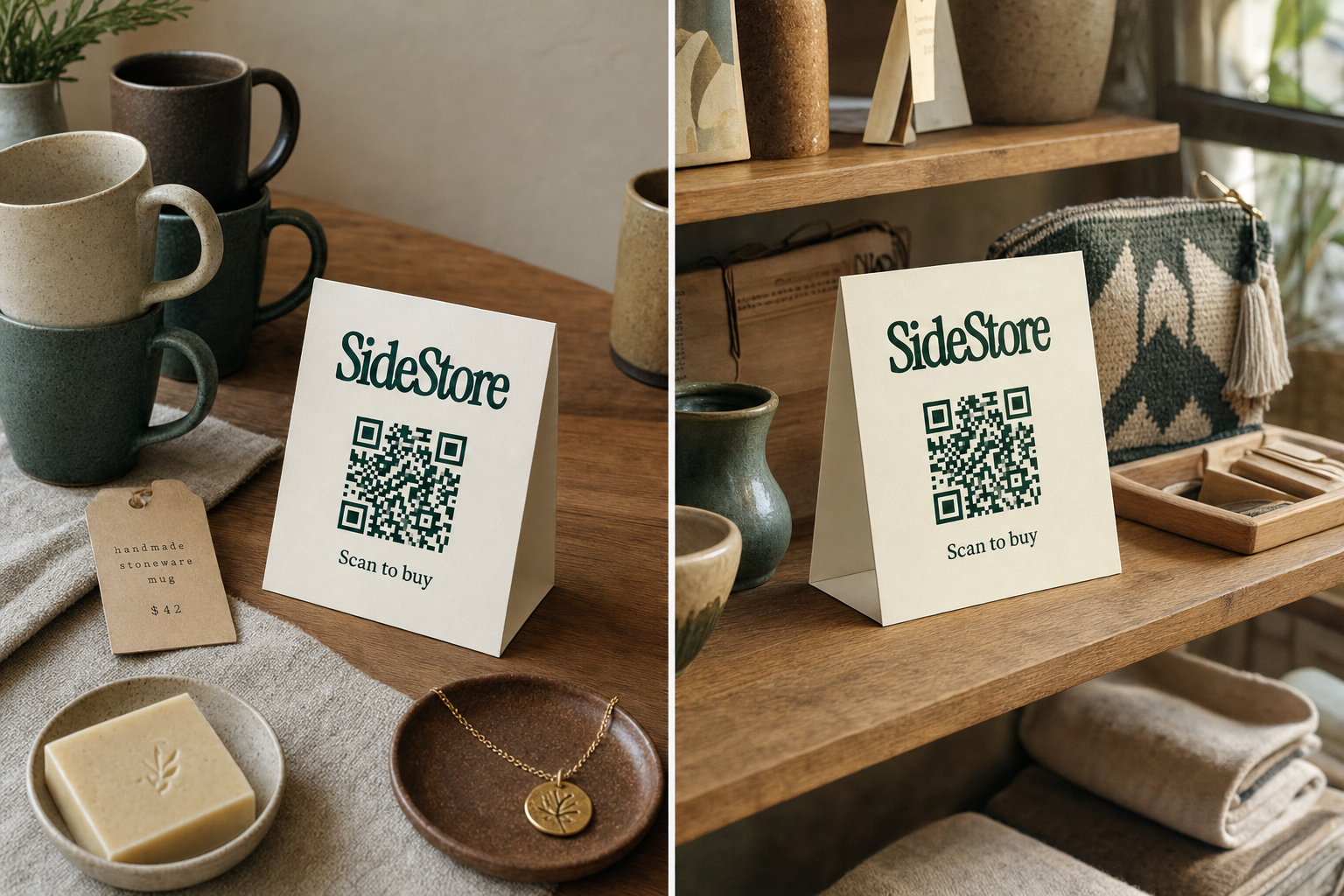
SideStore's Retail Widget is the interface that runs this. It is not simply a QR code, it is a full consignment-management interface that handles checkout, live stock tracking, placement attribution, and automatic split payouts. Understanding each function matters:
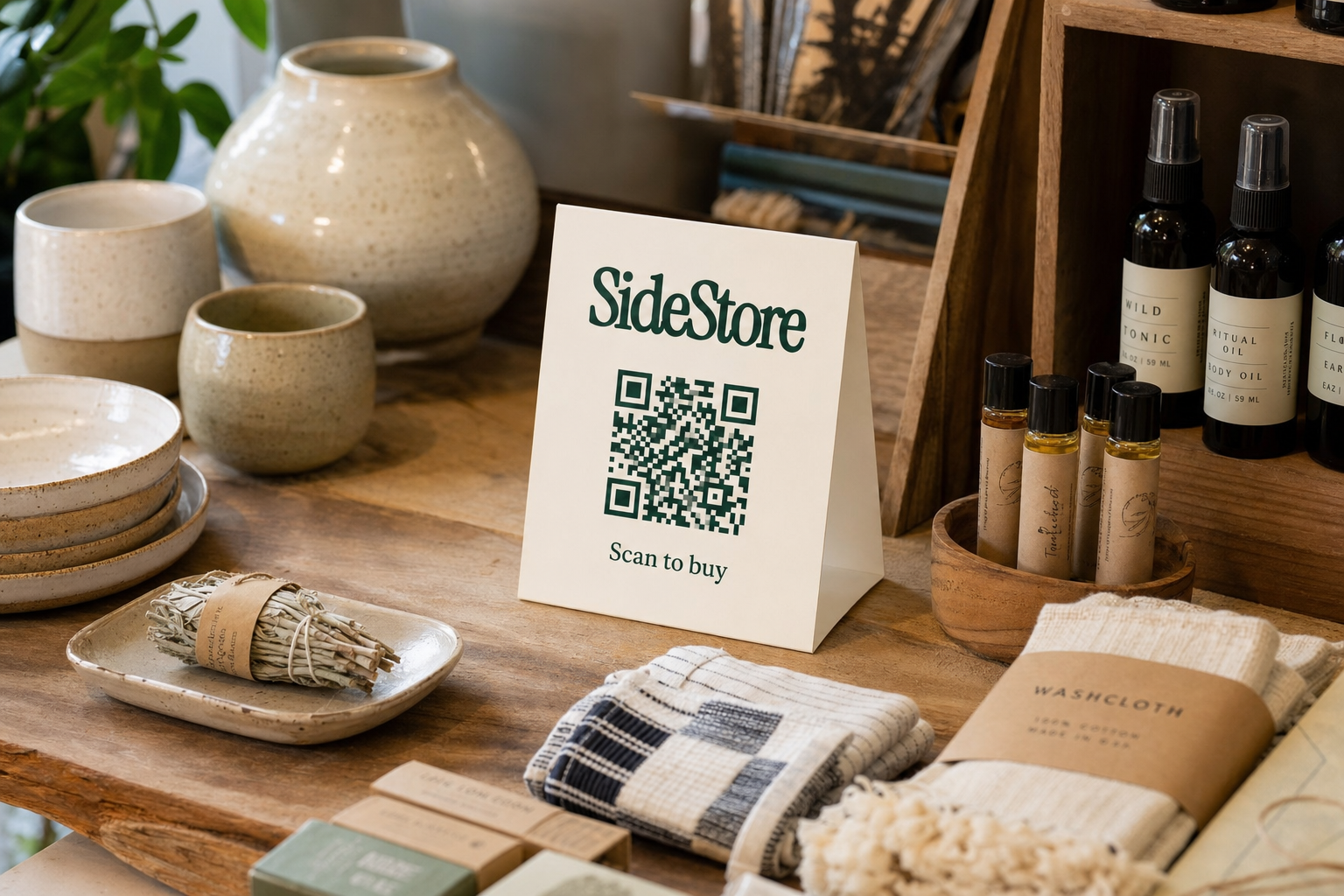
Checkout: You print a SideStore QR card and attach it to your product, or a merchant displays a single card covering all the products in their SideStore placement. A customer scans the code to purchase without needing the merchant to process the transaction manually.
Live stock tracking: Your dashboard shows real-time inventory levels across every placement. When stock runs low at a specific location, you see it.
Placement attribution: Each placement is tagged separately, so you can compare performance across merchant locations. A placement in a busy hotel lobby will show different numbers from one in a quiet boutique. You use that data to decide where to add stock and where to pull it.
Automatic split payouts: When a sale completes, the agreed split settles automatically between you and the merchant. No invoices, no manual transfers.
From the dashboard, you control pricing, stock allocation, and placement details. What you cannot control is foot traffic at a given location, that is the merchant's asset, not yours. Scale in physical consignment comes from adding more placements across more merchant spaces, not from a single listing going viral. That is a slower build, but a more stable one.
Useful starting points: how to approach a local shop about stocking your products and specific guidance on selling art prints in cafés if that format fits your work.
When to Lead with Online, When to Lead with Physical, and When to Use Both
The right channel to lead with depends on where you are in your business and what problem you are actually trying to solve. Most makers searching "best place to sell online" are asking a bigger question than they realise: they want distribution, not just a listing.
Lead with online when: your product ships easily, you have good product photography, and you are comfortable managing listings, reviews, and algorithm changes. Online platforms give you access to national or international buyers from day one, which is valuable for products with broad appeal and a clear category fit on an existing platform.
Lead with physical placement, or add it alongside online, when: your product benefits from being seen, touched, or explained in person. Ceramics, textiles, art prints, food products, and skincare all sell better when a customer can hold them. Physical placement also suits makers who want a persistent retail presence that does not require you to actively manage listings or respond to algorithm changes. A product sitting in a well-trafficked café or boutique sells quietly, without you refreshing a dashboard.
Consider selling retail products in a salon or exploring whether a coffee shop counts as a retail space for the kind of venues where physical placement works naturally.
Why this is not an either/or choice: A maker who only sells online has built distribution on someone else's infrastructure, entirely. If that platform changes its fees, alters its algorithm, or restricts your category, your revenue changes. Physical consignment placements are relationships with real merchants, not subject to a platform's terms of service. Building both channels means no single rule change can eliminate your distribution overnight. Yes, building a consignment network requires outreach and relationship-building with merchants. That takes time. It also produces a channel you actually own.
Frequently Asked Questions
What are the major online selling platforms available? The five main categories are general marketplaces (eBay, Amazon), maker-specific platforms (Etsy, Folksy), fashion resale platforms (Depop, Vinted), local buyer platforms (Facebook Marketplace, Gumtree), and digital product platforms (Gumroad, Payhip). Each charges fees differently: some charge the seller per transaction, some charge the buyer, and some charge both a listing fee and a sale fee.
Which platforms work best for selling used items? eBay is the most established platform for used goods across most price points and ships nationally. Facebook Marketplace and Gumtree are stronger for bulky secondhand items where a local buyer who can collect in person makes shipping unnecessary. Depop and Vinted are the dominant options for used clothing specifically.
Are there free options for selling online? "Free" means different things on different platforms. Facebook Marketplace and Gumtree charge no listing fee and no transaction fee for cash-in-person sales. But any platform that processes digital payment will charge something, either a transaction fee to the seller, a protection fee to the buyer, or both. There is no major platform that is entirely cost-free end-to-end for digital transactions.
What platforms specialise in digital product sales? Gumroad and Payhip are purpose-built for digital products: downloads, PDFs, music files, and memberships. Both charge a percentage per sale. Neither is suited to physical goods. Etsy technically allows digital downloads alongside physical products, but its audience primarily expects handmade physical goods.
Which platforms are best for selling clothing? For secondhand clothing, Vinted (no seller fee, buyer pays a protection fee) and Depop (seller pays a transaction fee) are the category leaders. For new, handmade clothing, Etsy reaches buyers who are actively looking for independent makers. For high-volume or branded fashion, Amazon and eBay have broader reach but less category fit for handmade work.
What selling platforms operate without transaction fees? Facebook Marketplace and Gumtree charge no transaction fee for in-person cash sales. No major platform eliminates fees entirely for online payment processing. Some platforms, like Vinted, shift the fee to the buyer rather than the seller, which may feel fee-free to you but still adds cost to the transaction.
Which platforms focus on local buyer connections? Facebook Marketplace, Gumtree, and Kijiji (Canada) are built for local buyer-seller connections. For a more structured local presence, selling through someone else's store through physical consignment placement gives you a permanent retail presence in a specific location, a structured alternative to one-off classified ads. Merchants who host consignment stock can also meaningfully benefit, as explored in what a coffee shop realistically earns from retail.
What are the top platforms in specific regions like the UK, Australia, or Canada? UK: Vinted, Gumtree, and Folksy alongside eBay and Etsy. Australia: Gumtree and Facebook Marketplace for local; eBay Australia for general resale. Canada: Kijiji dominates local classifieds; Etsy and Amazon operate nationally. All regions have access to the global platforms (eBay, Etsy, Amazon), with regional alternatives strongest for local and secondhand categories.
The Channel Question Is Actually a Distribution Strategy Question
Choosing between online selling platforms and physical consignment placement is not a binary decision, it is a distribution strategy question. Online platforms give you reach and speed; physical placement gives you presence, tactility, and a channel that does not depend on an algorithm's goodwill. Both have real costs and real constraints. The maker who understands both makes better decisions about where to invest time and which gap to fill first.
If you have never sold in a physical space, the practical next step is simple: identify one local merchant whose customers match your buyers. A café, a boutique, a salon, a hotel lobby. Approach them about a consignment placement. The Retail Widget handles the mechanics from there, checkout, stock tracking, and automatic split settlement, so the conversation with the merchant is about the product and the space, not the logistics.
Build a consignment network without opening a store of your own. Start with approaching a local shop about stocking your products and make sure what a consignment agreement should include is clear before you place your first unit.