Open Infrastructure for Independent Commerce: What It Means and Why Makers Should Care

What Is Open Infrastructure for Independent Commerce?
Open infrastructure for independent commerce is a set of shared commercial rails, portable terms, and distributed selling channels that any maker can join, use, and leave without losing their relationships, data, or selling history. It is the opposite of a closed platform that owns your customers, sets your terms, and charges a toll for every transaction.
If you sell through a large marketplace today, you are building on rented land. The platform controls visibility, commission rates, and the customer relationship. If the terms change or your account is suspended, you leave with nothing that transfers. Open infrastructure asks a different question: what if the commercial rails were shared, the terms were documented between the parties directly, and the placement could move without starting over?
For makers, this matters because distribution is the hard part. Making the product is tractable. Getting it in front of buyers consistently, without a fixed-cost shop, without platform dependency, and without surrendering the relationship is where most independent makers run out of road. Open infrastructure is the structural answer to that problem, and consignment commerce is its clearest physical-world expression.
What Open Infrastructure Actually Means for Makers
Open infrastructure for makers means three concrete things: shared rails you do not have to build yourself, commercial relationships that travel with you, and distribution that does not require a single permanent location or platform to function.
Shared rails. In digital infrastructure, shared rails might mean a payment protocol or an open API. In physical retail, shared rails are the agreed terms, the checkout mechanics, and the inventory systems that allow a maker's products to live in multiple venues without each venue requiring a bespoke arrangement negotiated from scratch. When those rails exist, a ceramicist can place work in a café in one town, a boutique hotel in another, and an independent bookshop in a third, all operating on the same documented terms.
Portability. Your commercial history, stock records, and settlement data belong to you, not to the platform hosting the transaction. If you leave a venue, you take the record of what sold, at what price, and what was owed. That record becomes the basis for the next placement.
Distribution without dependency. Closed marketplace infrastructure creates a single point of failure. One algorithm change, one policy shift, one fee increase removes your distribution. Open infrastructure spreads that risk across multiple venues, each of which is a relationship you own.
The contrast with a closed marketplace is structural, not cosmetic. A closed marketplace centralises discovery, customer data, and settlement. It offers reach in exchange for dependency. Open infrastructure trades some of that reach for resilience: you own more, control more, and are not evicted when the platform changes its mind.
For makers exploring this in the physical world, selling through someone else's store is the entry point, and how shared retail networks support local economies shows what those networks look like at scale.
Why Portable Commercial Relationships Matter More Than Followers
A portable commercial relationship is one where the documented terms, selling history, and settlement records travel with you when a placement ends, so the next placement starts from a position of demonstrated track record rather than zero.
The risk of non-portable relationships is concrete. Many makers build what looks like distribution: a strong presence in one venue, a good relationship with one manager, solid sales over two seasons. Then the manager leaves, the venue closes, or the terms are renegotiated upward. Because nothing was documented at the relationship level, the maker cannot easily prove to the next venue what they sold, at what margin, and how the arrangement worked. They start over. The pattern is common enough that it quietly kills momentum for makers who are otherwise producing good work.
Portability requires documentation. A consignment agreement that names the split, the restock schedule, the unsold goods policy, and the settlement frequency gives both parties something that survives personnel changes and ownership transitions. That document is the portable element. The selling history attached to it, showing units moved and revenue generated at a specific venue, becomes the maker's proof of concept for the next conversation.
The practical limitation is honest: setup is required. Writing a consignment agreement, tracking stock at each venue, and reconciling payouts across multiple placements takes more administrative effort than listing a product on a marketplace. The trade-off is that what you build is yours. There is no platform intermediating the relationship.
If you are ready to start building portable placements, a consignment agreement that protects both sides covers the terms that matter most, and approaching a local shop about stocking your products gives you the practical first step.
Community-Owned Marketplace vs Traditional Marketplace: What Changes
The core difference between a community-owned or open-infrastructure model and a traditional marketplace is who controls the rails and who owns the relationship with the buyer when the transaction is done.
| Dimension | Traditional Marketplace | Community-Owned or Open Infrastructure |
|---|---|---|
| Who owns the rails | The platform | Shared between participants or held by the maker directly |
| Who owns the customer relationship | The platform | The maker and the host venue |
| Commission structure | Set unilaterally by the platform, subject to change | Agreed directly between maker and host |
| Portability of commercial history | Stays on the platform; leaves with nothing | Documented between parties; travels with the maker |
| Data access | Platform controls what you see | Full access to your own stock, sales, and settlement records |
| Who sets the terms | The platform, with updates at will | Both parties, in a written agreement |
| Example model | Large e-commerce marketplace | Consignment network across independent venues |
The most important practical difference is not the commission rate. It is the ownership of what you build. On a traditional marketplace, every five-star review, every returning customer, and every sales record is an asset belonging to the platform. You are building on someone else's land, and the value of that land compounds for them, not for you.
In an open-infrastructure model, the consignment placement is the unit. Each placement is a direct commercial relationship between maker and host, with agreed terms and documented performance. When that placement ends, the record goes with the maker. Across ten placements, that record becomes a distribution network, and the maker owns every piece of it.
The honest trade-off is reach. Traditional marketplaces offer discovery at scale that no individual consignment network can match today. Open infrastructure wins on resilience and ownership, not on initial visibility.
How shared retail networks support local economies gives context on why those networks compound over time, and consignment inventory software covers the tools that make managing multiple placements practical.
Consignment Commerce as Open Infrastructure in the Physical World
Consignment commerce is structurally open infrastructure because it separates the rails from the venue: a maker's commercial relationship, terms, and settlement mechanics do not belong to any single shop or platform, and each placement is a documented, replicable unit that can be deployed in any suitable merchant space.
The specific mechanics that make it work are four: the split agreement, live stock tracking, placement attribution, and scan-to-pay checkout.
The split agreement is the portable document. It defines what percentage of each sale goes to the maker and what percentage stays with the host, agreed directly between the two parties before any product moves. No third party sets that rate.
Live stock tracking means both the maker and the host can see what is on the shelf at any moment. That visibility removes the friction that historically made multi-venue consignment difficult to manage. A maker with six placements needs to know where stock is running low without calling each venue individually.
Placement attribution connects each sale to the venue where it happened. That record builds the maker's proof of performance across locations. It is what makes the commercial history portable: you can show a prospective host what sold where, precisely.
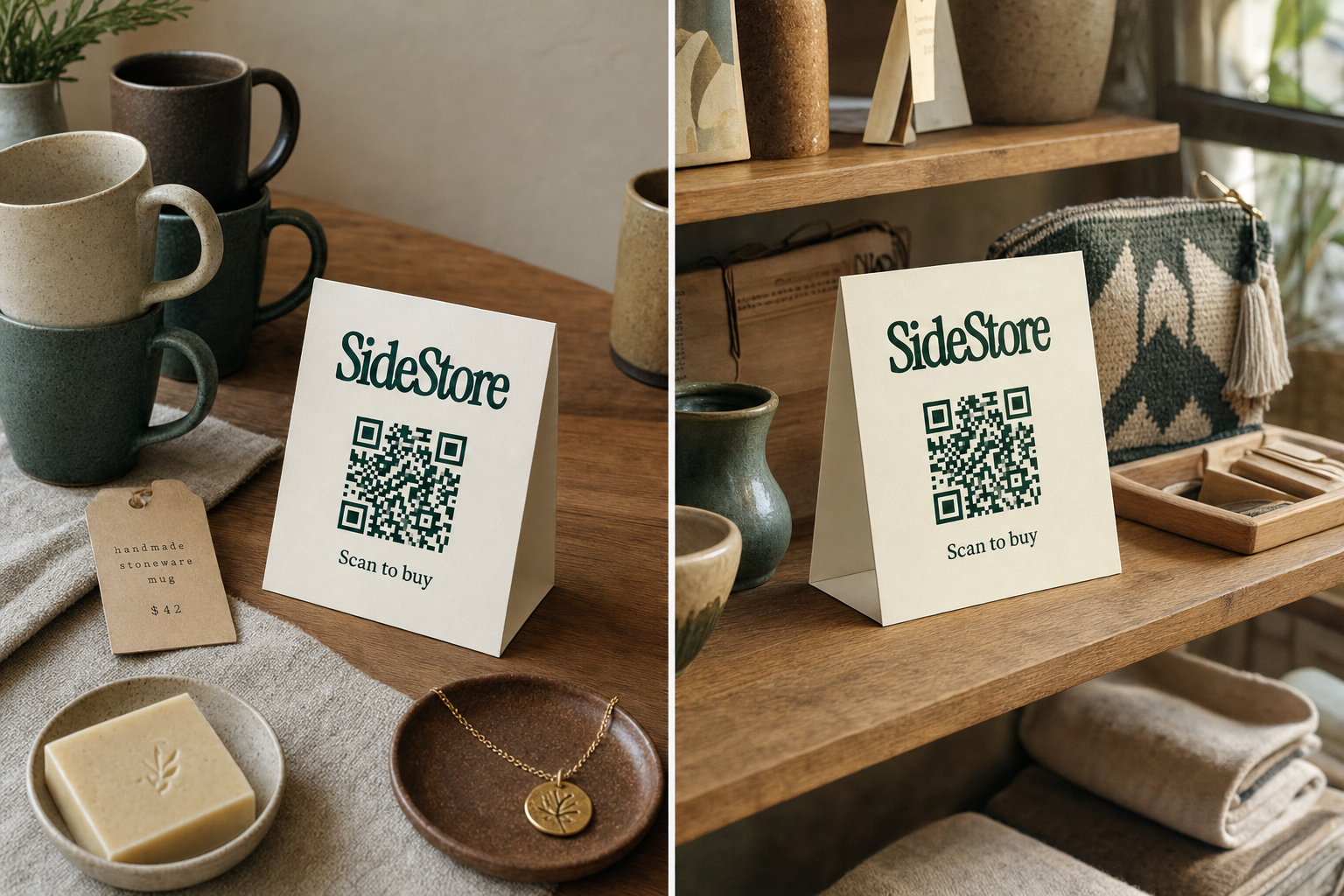
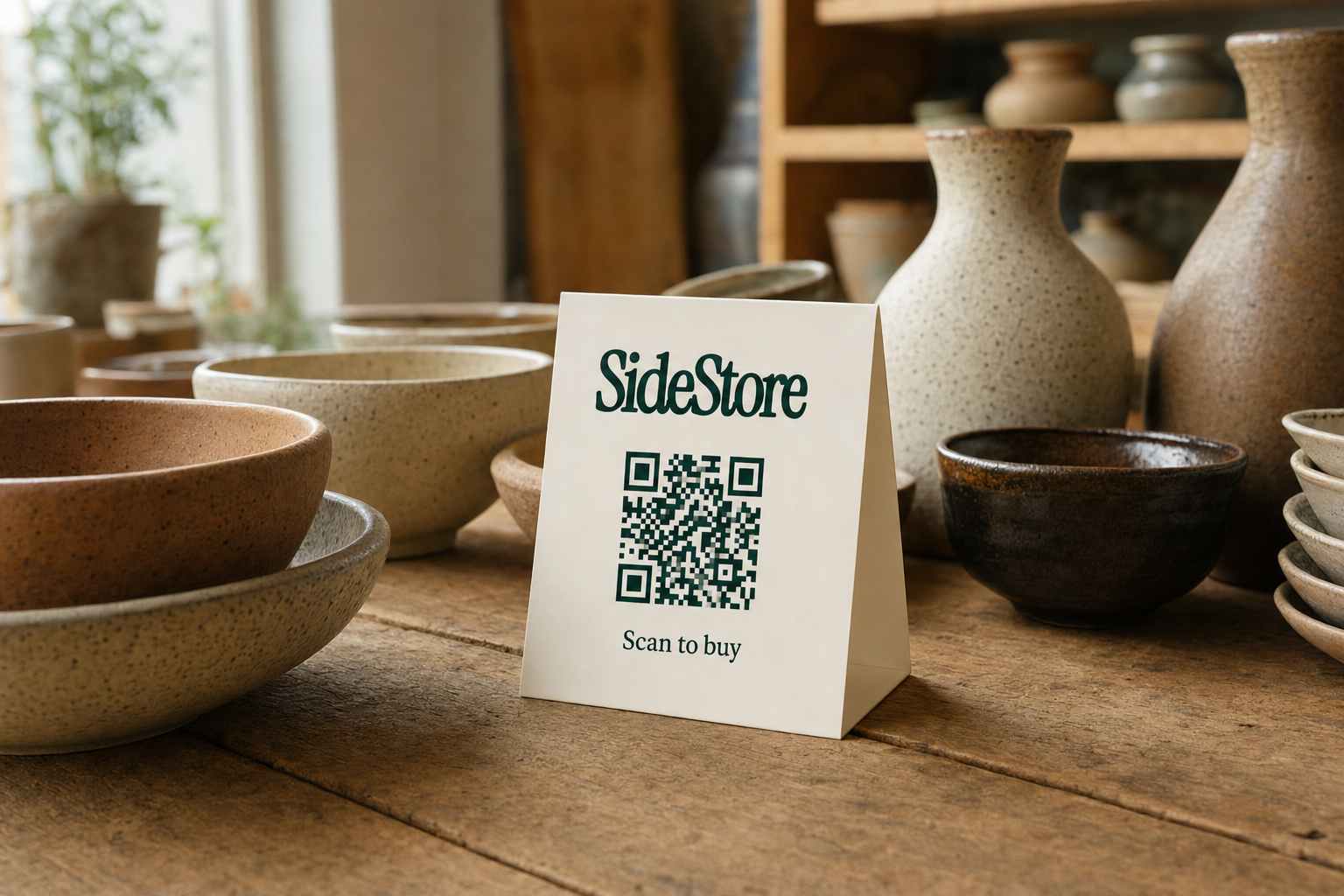
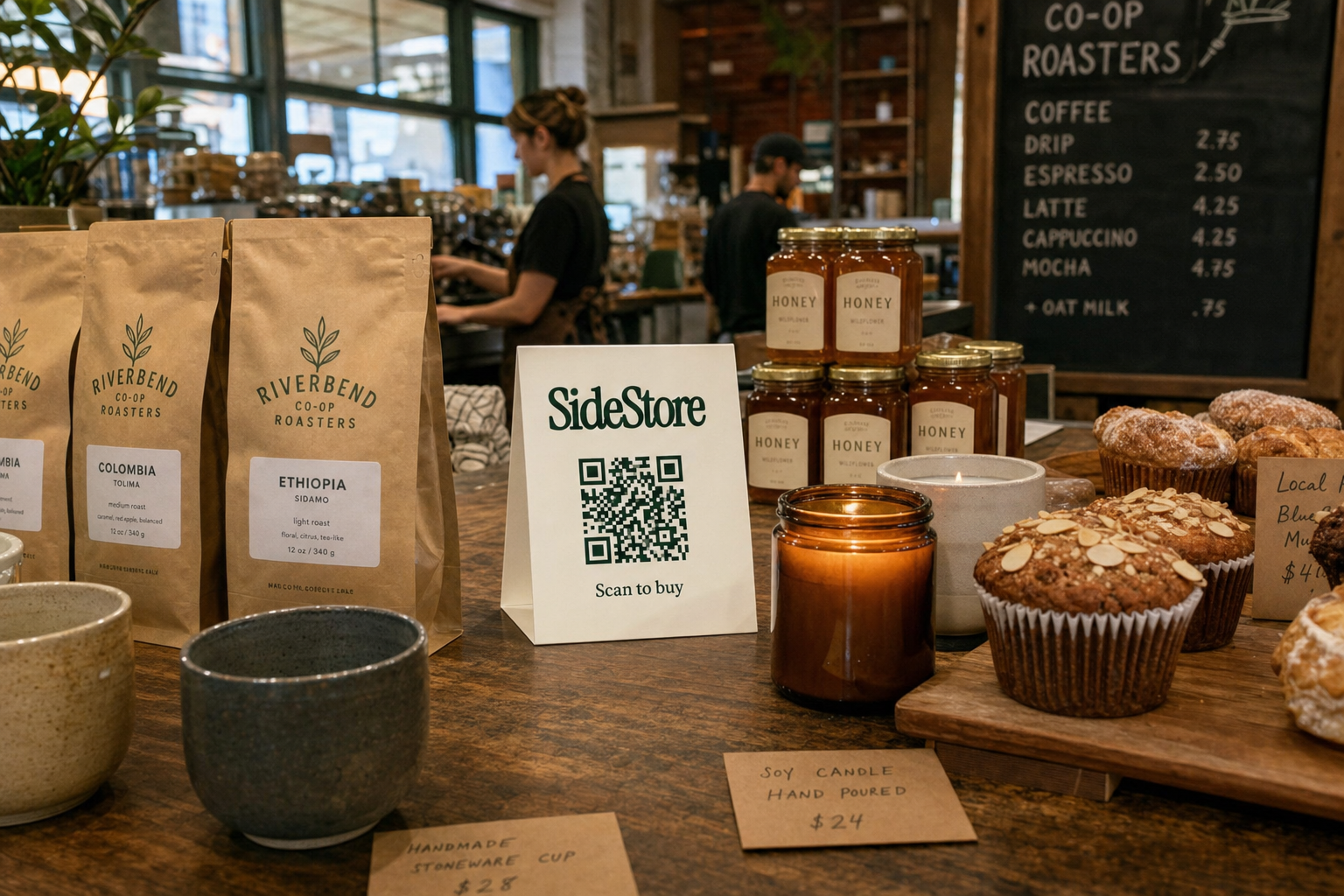
Scan-to-pay is the checkout mechanism: a QR code card, either attached to the product by the maker or displayed by the host for all items in the placement, that completes the purchase and routes settlement automatically. This is one function of the SideStore Retail Widget, not the whole product. The Retail Widget is the interface that manages the placement end to end, from the initial agreement through stock tracking, placement attribution, and split payout settlement.
Deploy that across multiple venues and you have a distributed consignment network, the physical-world equivalent of what cooperative commerce describes in principle. Venues like café counters and boutique shelves are natural starting points. What sells well at a café counter, how art prints move in café settings, and whether a coffee shop counts as a retail placement are all practical questions with concrete answers once the infrastructure is in place.
The Future of Cooperative Commerce: What the Shift Looks Like in Practice
Cooperative commerce is a model where the makers and hosts participating in a commercial network share the rails, own their relationships directly, and retain the commercial history they generate, rather than surrendering it to a centralising platform.
Three patterns are visible in independent retail today. First, makers are actively seeking multi-venue placements rather than single-platform listings, treating each café, boutique, or hotel as a node in a network they control. Second, hosts are recognising that idle shelf space has margin potential with no inventory risk when the terms are documented and the checkout is handled. Third, the administrative friction that made multi-venue consignment unscalable is being reduced by tools that handle stock tracking and split settlement automatically, making what was once a two-person job manageable solo.
What the model still lacks is honest acknowledgment. Network effects favour closed platforms. A large marketplace surfaces your product to buyers who were not looking for you specifically. A consignment network of ten venues does not replicate that discovery at scale, at least not yet. Reach remains the gap.
The direction of travel for makers who act early is accumulation. Each documented placement adds to a commercial record you own. Each host relationship is a node you retain when you scale to the next venue. The makers building that infrastructure now are not waiting for cooperative commerce to become mainstream. They are building the network before the network is obvious.
For makers weighing their options, alternatives to renting pop-up retail space covers the cost comparison, and how café margins work for hosts shows what participating venues are actually weighing when they agree to a placement.
Frequently Asked Questions
These four questions come up consistently when makers start researching open infrastructure and consignment commerce. Each answer is self-contained.
What is open infrastructure for independent commerce?
Open infrastructure for independent commerce is a set of shared commercial rails, portable terms, and multi-venue distribution channels that makers can use without surrendering their customer relationships or selling history to a single controlling platform. It contrasts directly with closed marketplaces where the platform owns the data and sets the terms unilaterally.
How is a consignment network an example of open infrastructure?
A consignment network is open infrastructure because each placement is a direct agreement between maker and host, with terms the two parties set, settlement records both parties own, and stock data that travels with the maker. No central platform intermediates the relationship or retains the commercial history when the placement ends.
What is the difference between a community-owned marketplace and a traditional marketplace?
A traditional marketplace owns the customer relationship, sets commission rates unilaterally, and retains your selling history when you leave. A community-owned or open-infrastructure model documents terms directly between maker and host, gives both parties full access to their own data, and makes the commercial record portable. The trade-off is that traditional marketplaces offer greater initial discovery reach.
Why do portable commercial relationships matter for makers?
Portable commercial relationships mean your selling history belongs to you, not to the platform or venue where the sales happened. When a placement ends, you take proof of performance to the next host rather than starting over. Review consignment agreement terms every maker should know to understand what to document before placing your first product.
What to Do with This
If you are a maker, the practical starting point is one documented placement, not a platform migration or a philosophical commitment to cooperative commerce. Pick one venue, write the terms, track the stock, and own the record when it closes.
That record is the foundation. Each placement you add extends the network you control. Open infrastructure is not built by waiting for the rails to appear; it is built placement by placement.
Sell through someone else's store and build a consignment network without opening a store of your own.