How to Sell Products in a Salon: A Maker's Guide to Beauty-Space Consignment
Selling products in a salon means placing physical goods on consignment in a beauty space. The salon hosts your products, earns a share of each sale, and takes on no upfront cost or inventory risk.
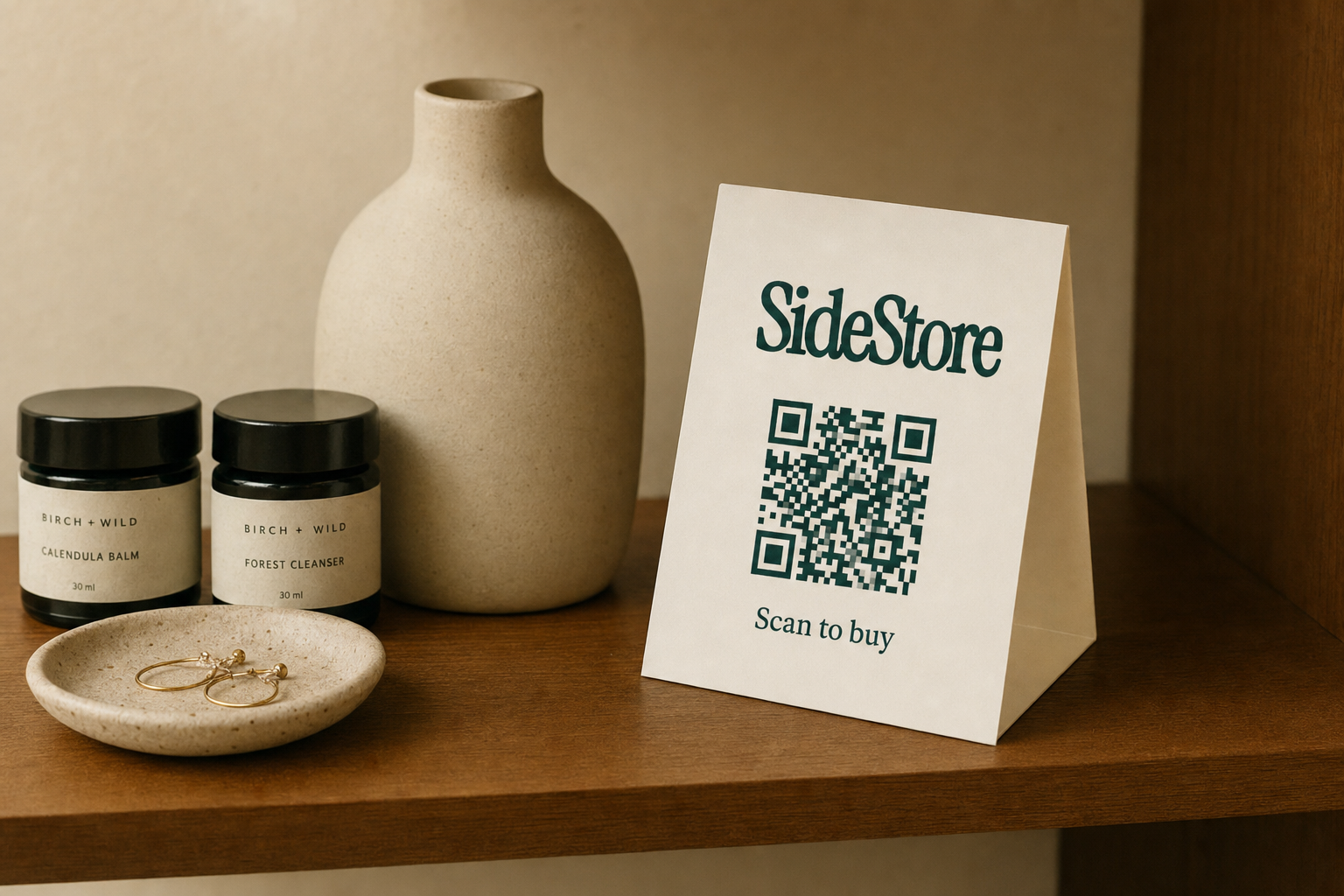
Here is the direct path: approach the salon owner with a consignment proposal, bring a small curated selection of display-ready products, agree on a margin split and restocking schedule, and use SideStore's Retail Widget to handle checkout, stock tracking, and automatic split payouts. The Retail Widget is the interface that places and manages a product on consignment: it includes scan-to-pay QR checkout, live stock tracking, placement attribution, and automatic split settlement to both you and the host.
Salons are massively underused retail venues for independent makers. Clients sit in a chair for thirty minutes to two hours. They trust the stylist's recommendations. They have already decided to spend money on themselves that day. Most retailers would pay handsomely to manufacture that kind of buying context.
This guide covers which products work, how to structure your pitch, what consignment terms to set, and how to manage placements without operational overhead. For jewellery and accessories detail, the consignment guide for makers in beauty salons goes deeper. If you are new to consignment altogether, start with the primer on selling through someone else's store.
Why Salons Work as Retail Spaces (and Why Most Makers Overlook Them)
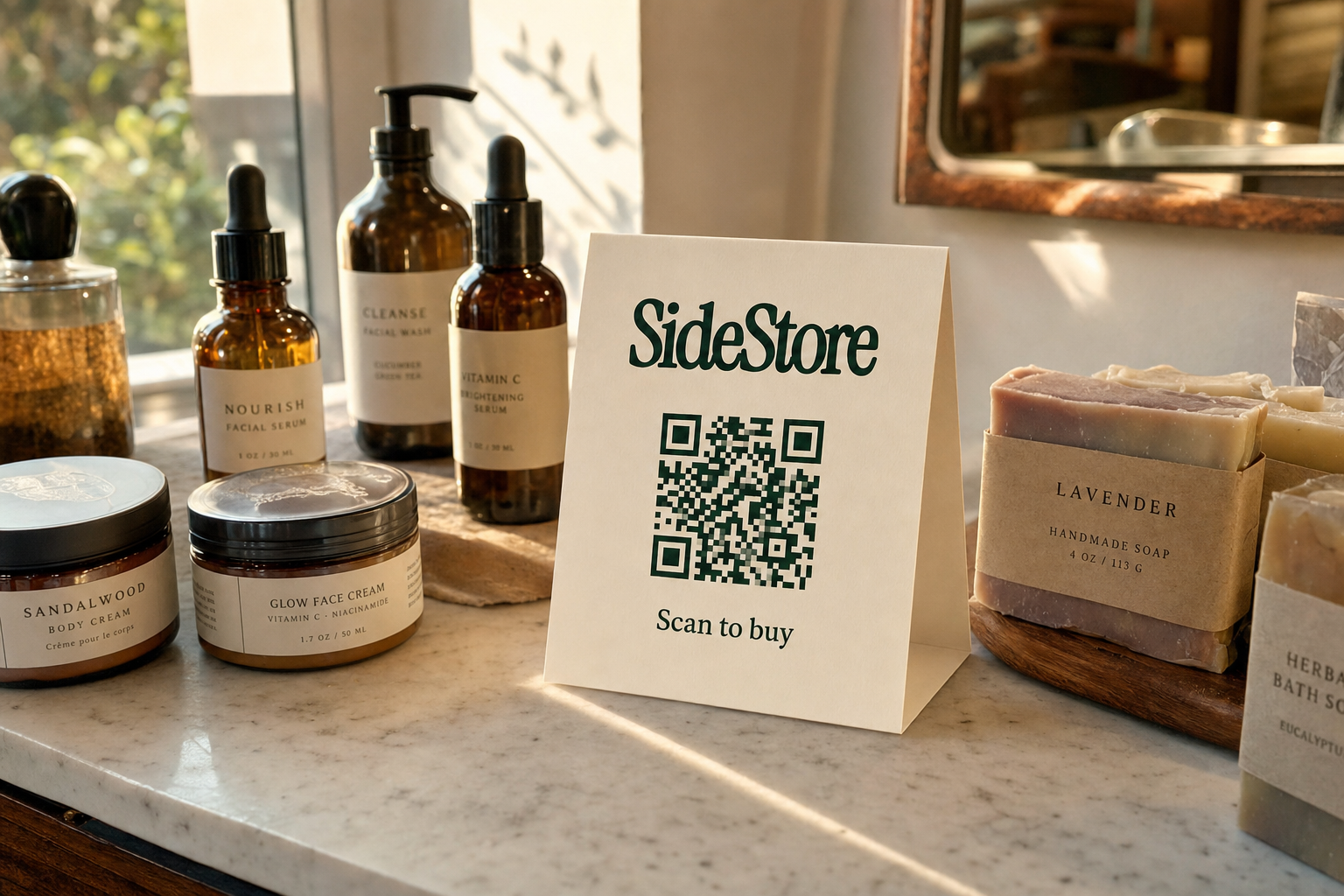
Salons combine long dwell time, established stylist trust, and a client who has already committed to spending on themselves. That combination is rare. Most makers assume only professional beauty brands, shampoo manufacturers, or salon-supply wholesalers belong on the shelves.
That assumption costs you placements.
Walk into most independent salons and the retail shelf is thin: a few branded conditioners, some colour-care products, and empty space. Salon owners commonly report that clients ask about the candles on the counter, the prints on the wall, or the decorative objects before they ask about hair products. The space signals taste. Clients respond to that signal.
Three structural reasons make salons strong retail hosts.
Dwell time. A salon appointment runs thirty minutes to two hours. Clients have time to notice your product, pick it up, read the label, and ask the stylist about it. A typical shop visit is ten minutes.
Stylist trust. The relationship between a client and their regular stylist is personal. A soft endorsement from the stylist, "this candle is from a local maker, it sells well here", carries weight that a cold shelf cannot.
Self-care mindset. Clients arrive having already decided to invest in themselves. The psychological barrier to an additional small purchase, a hand balm, a ceramic dish, a botanical mist, is lower than in almost any other retail environment.
Many makers find that how shared retail networks support independent makers applies directly here: the salon becomes one node in a distributed consignment network rather than a one-off placement. And if you are exploring your options before committing to a permanent space, alternatives to renting your own retail space puts the salon's low-risk entry point in useful context.
Which Products Work Best in a Salon Setting
The products that work best in a salon are small, giftable, sensory, and priced between roughly CHF 15 and CHF 80. They need to look intentional on a shelf, require no explanation to a passing client, and hold their display quality without daily attention from the stylist.
Here is how product categories break down in practice:
Strong performers
- Candles and room mists. Scent is native to salon environments. Clients already associate the space with fragrance. A well-packaged candle at CHF 28 to CHF 45 is easy to sell without a pitch.
- Hand balms and skin salves. Tactile, usable in the chair, and often sampled by the stylist. Keep formulations free of anything that could interfere with colour services.
- Jewellery and accessories. Earrings, hair clips, and simple necklaces sit naturally in a salon context. Many salon owners find these among their fastest-moving consignment lines. See the detailed notes in selling art prints in local shops on consignment for display principles that transfer across categories.
- Ceramics and small homeware. Bud vases, ring dishes, and textured cups perform well when priced accessibly and displayed with care. Clients pick them up.
- Botanical or herbal products. Loose-leaf teas, plant-based wellness items, and dried botanical bunches appeal to the self-care values the salon environment activates.
- Art prints and zines. Smaller A5 or A4 prints work if the salon has a distinct visual identity. Larger framed pieces can work as display-and-order rather than immediate purchase.
What does not work
Bulky or heavy items that disrupt the counter. Products requiring refrigeration. Anything priced above CHF 150 without a relationship already built between the stylist and the client. Fragile packaging that degrades under salon humidity. Food items where hygiene compliance is ambiguous.
On margin: many salon owners find that mid-price artisan goods in the CHF 20 to CHF 60 range sit at a sweet spot where the client does not need to deliberate and the maker can offer a meaningful host split without underpricing their work. Higher price points can work but require active stylist endorsement. The shared retail models for independent makers framework is useful if you are deciding whether a single salon placement makes sense or whether a collective arrangement delivers better reach.
Display-readiness matters. If your product needs explanation to make sense, it will not sell from a shelf. If it needs a specific fixture you cannot install, negotiate before you go live.
Consignment vs. Wholesale: Which Arrangement to Propose to a Salon
For a first approach to a salon, propose consignment. Consignment works because the salon takes on no financial risk: you place your products, the salon earns a percentage when items sell, and unsold stock returns to you. A wholesale arrangement asks the salon to buy inventory upfront, which is a much harder yes from an owner who does not yet know your product.
| Arrangement | Upfront cost to salon | Inventory risk | Maker cash flow | Ease of getting a 'yes' | Best for |
|---|---|---|---|---|---|
| Consignment | None | None | Paid on sale | High | First placements, new maker-salon relationships |
| Wholesale buy-in | Full stock purchase | Salon bears it | Immediate | Low | Established brands with proven sell-through data |
| Sale or return | None | Shared (salon returns unsold) | Paid on sale | Medium | Mid-stage relationships with some trust built |
Typical consignment splits in salon settings run from 60/40 to 70/30 in the maker's favour, though this varies by location, product margin, and how much display space or active endorsement the salon provides. Negotiate from your own cost base, not from a benchmark you read online.
The maker's common fear with consignment is losing visibility over stock. You place ten units and have no clear sense of what has sold, what is sitting, or when you need to restock. That is where SideStore's Retail Widget becomes essential. The Retail Widget is the interface that places and manages a product on consignment: it handles live stock tracking, a scan-to-pay QR checkout function, placement attribution, and automatic split payouts to both maker and host. It is not simply a QR code; it is the operational layer that makes a multi-salon consignment network manageable from one dashboard.
For deeper reading on the tools side, consignment inventory software for tracking placements covers what to look for. If you are also considering hospitality venues alongside salons, consignment placement in hospitality venues applies many of the same principles.
How to Approach a Salon Owner About Stocking Your Products
Approach a salon owner by leading with their benefit, not your product. Before you describe what you make, show the owner that hosting your products costs them nothing upfront, requires minimal effort, and adds to their client experience. Once that frame is clear, your product becomes easy to consider.
Many makers find the initial approach the hardest part. It feels transactional when it should feel collaborative. The instinct is to send a product catalogue or a wholesale price list. That instinct will cost you most of the yeses before you even get to the conversation.
Here is a practical sequence:
1. Research before you contact. Visit the salon in person or study its social presence. Understand its aesthetic, its clientele, and what is already on the shelf. You are looking for a fit, not a gap to fill.
2. Make contact at a quiet moment. Mid-morning on a weekday, after the opening rush, is generally better than a Friday afternoon or peak hours. Many makers find a brief email or DM the day before works well, asking for five minutes rather than arriving unannounced.
3. Open with the host benefit. "I make [product]. I'd like to place a small selection here on consignment, no cost to you, no stock to buy, and you earn a percentage of every sale." Lead with what is in it for their business, not for you.
4. Bring a physical sample. Not a catalogue. Not a lookbook. Bring the actual product, display-ready. Let them handle it. Salons are tactile environments; your pitch should be too.
5. Come with a specific proposal, not a vague offer. Suggest a number of units, a split percentage, a restocking rhythm, and a trial period. Vague offers create work for the owner. A clean proposal creates a decision.
6. Avoid these common mistakes:
- Pitching wholesale to a salon that has never stocked your product. Too high a commitment for a first conversation.
- Leading with your retail price before the host split is agreed. It sounds like you are protecting your margin before you have earned their trust.
- Approaching at the wrong moment. A stylist mid-service, an owner who is visibly stressed, a busy Saturday morning. Timing signals whether you respect how they work.
For more on the mechanics, how to approach a local shop about stocking your products covers the script logic in detail. And if your product range is jewellery or accessories, placing jewellery on consignment in beauty spaces handles category-specific pitch nuances.
Setting Up Consignment Terms That Protect Both Parties
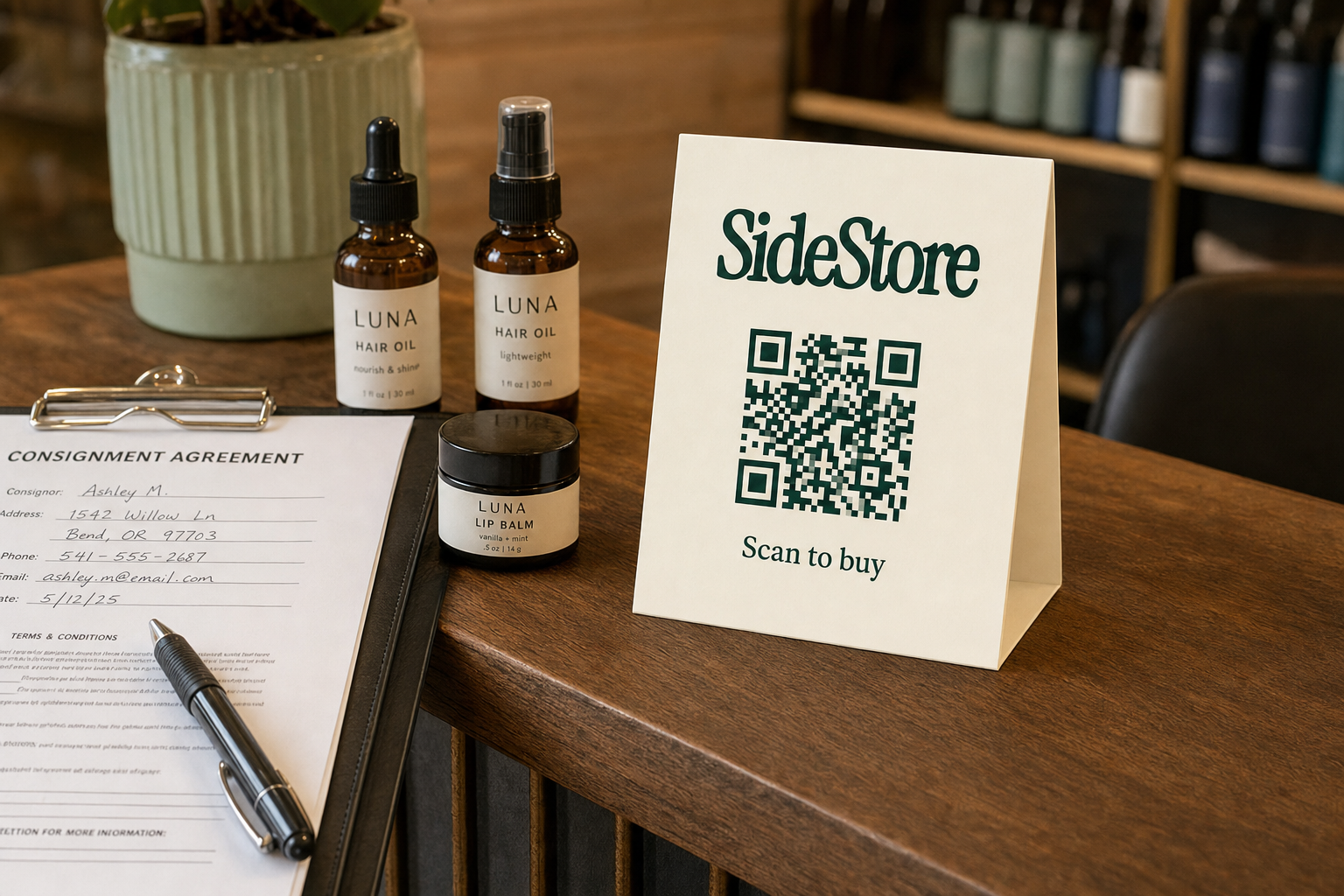
Every consignment arrangement needs five written terms before you place a single unit. A handshake agreement feels easier in the moment and creates problems at the first stocktake.
Here are the five terms every agreement should include:
1. Commission split. State the percentage the salon retains from each sale and the percentage returned to the maker. Write it as a fixed split, not a sliding scale, unless you have agreed a specific volume-based model.
2. Minimum display period. Agree how long the salon commits to displaying the product before either party can end the arrangement. Four to eight weeks is common for a first trial.
3. Restocking responsibilities. Specify who initiates restocking, how much lead time the maker needs, and what happens if a line sells out faster than expected.
4. Stock reconciliation process. Define how often stock is counted, who counts it, and how discrepancies are handled. Without this clause, shrinkage, breakage, and counting errors become sources of friction.
5. Payout timing. State when the maker is paid and in what form. Monthly settlement is standard. If you are using SideStore's Retail Widget, the automatic split payout function handles this operationally: the Retail Widget is the interface that places and manages a product on consignment, including live stock tracking, placement attribution, and automatic split payouts. Settlement timing is built into the platform rather than manually chased.
A written agreement does not need to be a legal document. A short email confirmation of these five terms, replied to and acknowledged, creates a shared record. That said, this is general guidance, not legal advice. If your product values are significant or you are entering a multi-season arrangement, consult a professional.
For the software layer behind these terms, tracking consignment stock and payouts automatically covers the operational tools. For how the same term structures apply in cafe and venue settings, consignment agreements in cafe and venue settings is directly relevant.
Managing Your Salon Placement Without Adding Operational Burden
Managing a salon consignment placement well means establishing a light, predictable routine rather than reacting to problems. A weekly stock check, a monthly in-person or message-based check-in with the salon, and a restocking visit timed to your production cycle are typically enough to keep a single placement running smoothly.
Weekly stock checks. If you are using SideStore's Retail Widget, live stock tracking gives you a real-time read on what has sold without requiring a site visit. The scan-to-pay QR function, one part of the Retail Widget rather than the whole product, handles each transaction at the shelf and updates stock automatically. You see the number; you plan the restock.
Monthly check-ins. A brief message to the salon owner asking how the display is looking, whether clients are engaging, and whether any products need swapping out maintains the relationship without demanding their time. Many makers find this rhythm also surfaces useful signals: which products get picked up most, which collect dust, and what the stylist is personally enthusiastic about.
Seasonal and product refresh tactics. The single most effective strategy for increasing sales to existing salon clients is changing what is on the shelf. A static display becomes invisible after a few visits. Rotating in new colourways, seasonal scents, or a small new product line every six to eight weeks reactivates client attention. This also signals to the salon owner that you are an active, engaged placement, not a passive one.
As you add placements, the multi-salon dashboard in SideStore becomes the scale tool. Building a distributed consignment network and managing placements across multiple venues both cover what the operational step-up looks like once you move beyond a single salon.
Frequently Asked Questions
The questions below cover the most common things makers and salon owners ask about retail product sales in beauty spaces.
Can consignment arrangements work for salon product sales?
Yes. Consignment is often the best arrangement for salon product sales precisely because it removes the upfront cost barrier for the salon. The owner takes on no stock risk and earns a percentage of each sale. For a maker, it means shelf presence without a wholesale minimum. Many makers find it easier to secure a first yes from a salon through consignment than through any other arrangement.
Which products work best for retail sales in a hair salon?
Candles, hand balms, jewellery, small ceramics, botanical products, and art prints in accessible price ranges (roughly CHF 15 to CHF 80) tend to perform well. Products need to be self-explanatory on a shelf, display-ready, and sized to sit comfortably on a salon counter without dominating the space. Products requiring explanation, refrigeration, or complex setup rarely sell through without active stylist endorsement.
How do you approach selling to salon owners as a supplier?
Lead with the host benefit: no upfront cost, no inventory to buy, a percentage of every sale. Come with a physical sample, a specific consignment proposal, and a suggested trial period. Avoid pitching wholesale to an owner who has never stocked your product, and time your approach to a quiet moment rather than a peak-service window. See a full guide to selling through someone else's store for the broader framework.
What strategies increase product sales to existing clients?
Regular product refresh is the most consistent lever. Rotating new items every six to eight weeks reactivates client attention on a display they have stopped noticing. Stylist endorsement, even informal, moves product faster than any shelf position. Seasonal lines, limited editions, and small product sets priced as gifts also convert well in salon environments where clients are already in a self-care purchasing mindset.
How do you sell salon products online?
Online sales are a separate channel with different mechanics: ecommerce platforms, fulfilment, and digital marketing. This guide focuses on offline consignment placement as the physical complement to any online presence you already have. Many makers find that salon placements build local recognition that strengthens online conversion, but the two channels require distinct setups.
Where should salon owners source their retail products?
Directly from independent makers through consignment arrangements is a practical and low-risk route. It requires no purchase order, no minimum buy, and no inventory sitting on a shelf unsold. Local maker markets, craft platforms, and consignment networks like SideStore connect salon owners with makers whose products fit their aesthetic and client base. Exploring what a collective store model looks like for makers gives salon owners a sense of the range of product types available through these channels.
What salon supplies generate the highest profit margins?
Among consignment products, smaller accessories and consumables typically yield the highest effective margin for the salon because they turn over quickly and take up minimal space. Candles, hand products, and jewellery commonly generate useful returns relative to the shelf space they occupy. The maker sets the retail price; the salon earns a percentage split without the cost of buying in.
How can salons attract more customers?
Offering a curated selection of local maker products is one way to differentiate a salon's in-person experience in a way that online booking and loyalty schemes cannot replicate. Clients who come in for a service and discover something they want to buy tell other people about it. Hosting consignment products from makers whose work aligns with the salon's aesthetic adds a retail dimension to the visit without adding operational complexity to the salon's core business.
Start with One Salon, One Placement
The practical way to begin selling products in a salon is to identify one salon with the right aesthetic, make a consignment proposal, and place a small curated selection. That first placement is how you learn what sells, what display works, and what the operational rhythm looks like.
Consignment means no upfront cost to the salon and no inventory risk. You place your products, the Retail Widget handles checkout via scan-to-pay QR, live stock tracking, and automatic split payouts to you and the host, and you manage the placement from a single dashboard. If it works, you add another salon. If it does not, you pull stock and learn.
For category-specific guidance, selling jewellery through beauty salons on consignment covers how to position accessories in a beauty space. For the pitch itself, how to approach a local shop about stocking your products gives you the practical script.
One salon. One placement. That is where the consignment network starts.