Boutique inventory management is the practice of tracking, ordering, and controlling the physical products in your retail space so that the right items are available at the right time without tying up more capital than necessary.
Done well, it keeps your shelves full without bloating your storage room or your overdraft. Done poorly, it leaves you with a rack of unsold stock that cost real money to buy and costs more every week it sits there. Whether you run a single-room gift shop, a fashion boutique, or a café with a small product corner, the principles are the same: know what you have, know what sells, and know when to act. If you are also looking at how to source products without committing to full wholesale orders, boutique inventory for sale covers those sourcing options in more detail.
Why Inventory Management Makes or Breaks a Small Boutique
Poor inventory control is one of the most direct ways a small boutique loses money, and one of the easiest to underestimate until it is already a problem. The issue cuts both ways: too little stock means missed sales and disappointed customers; too much means cash locked in product that is not moving.
Think about it concretely. A boutique carries 200 SKUs. Just 20 of them account for the bulk of your revenue. The other 180 are doing one of two things: turning slowly but steadily, or sitting idle and draining working capital. A boutique holding three months of slow-moving stock in a category that turns only twice a year is effectively financing its own slowdown. That is not a hypothetical. That is a pattern that repeats whenever buying decisions are made on intuition rather than data.
The flip side is equally damaging. Running out of your best-sellers during peak traffic, whether that is a Saturday afternoon or the lead-up to a local event, means lost revenue that does not come back. A customer who cannot find what they want rarely waits for a restock.
When overstock does build up, you need a clear plan rather than a permanent discount rack. The practical options for how to get rid of boutique inventory range from targeted promotions to consignment redistribution, but none of them are as cheap as buying right in the first place. Inventory discipline is not an administrative chore. It is a direct driver of margin.
Core Inventory Methods for Boutique Retailers
Three established methods cover the majority of boutique inventory needs. Used together, they give you a clear, actionable picture of what to stock, when to reorder, and what to deprioritise.
FIFO (First In, First Out) means selling the oldest stock first. For fashion or seasonal goods this matters because product sits for months. Placing new deliveries at the back of the rail and selling from the front is basic discipline, but it prevents markdowns on goods that age out of trend.
Par levels are minimum stock thresholds. You set a par of, say, four units for a candle line. When stock drops to four, you reorder. The par accounts for your supplier lead time. If restocking takes two weeks, your par must cover two weeks of typical sales, with a small buffer. Par levels work best when you have consistent sales history and a reliable supplier relationship.
ABC analysis categorises every SKU by revenue contribution. A-items are your top performers: a small proportion of SKUs generating a large proportion of revenue. B-items are mid-range. C-items are slow or marginal. The discipline here is to focus reorder energy on A and B items and review C-items regularly rather than automatically restocking them.
A fourth approach sits outside traditional buying models: consignment. With consignment, you stock products from a maker without purchasing them outright. You only pay when a product sells, eliminating upfront stock cost and capital risk for the items on your shelves. If you want to understand how this works from both sides of the arrangement, selling on consignment and selling through consignment explain the mechanics in full.
Inventory Approaches Compared: Owned Stock vs Consignment
The choice between buying stock outright and hosting it on consignment is not purely a preference. It is a structural business decision with real implications for cash flow, margin, and risk.
Owned inventory gives you complete control over pricing and supplier selection, but it transfers all risk to you. Consignment inverts that: you earn a host share on each sale without buying a single unit, but you accept that the maker sets the price and your margin is a split rather than a markup. Neither model is universally better. The right answer depends on your space, your cash position, and your appetite for stock risk.
The table below lets you compare the two approaches directly:
| Dimension | Owned Inventory | Consignment |
|---|---|---|
| Upfront cost | You purchase stock at wholesale before selling | No upfront purchase; the maker retains ownership until sale |
| Stock risk | Full risk sits with you; unsold stock is a sunk cost | No capital risk to the host; unsold stock stays the maker's |
| Reorder admin | You manage purchase orders, lead times, and supplier relationships | Maker manages restocking; host requests replenishment as needed |
| Margin structure | You buy at wholesale and sell at retail, keeping the full markup | You receive a pre-agreed host share of each sale price |
| Best-fit scenario | Proven best-sellers with reliable sell-through and clear demand history | New or unproven products, seasonal lines, or hosts with limited capital |
For boutiques that have idle shelf space and want to earn from it without buying stock, consignment is the more efficient model. How this plays out in practice is visible in adjacent venue types: how cafes make money from unused shelf space is a direct example. For a plain-language explanation of what consignment means contractually, selling on consignment: meaning covers the core terms.
Tracking Stock Without a Full POS System
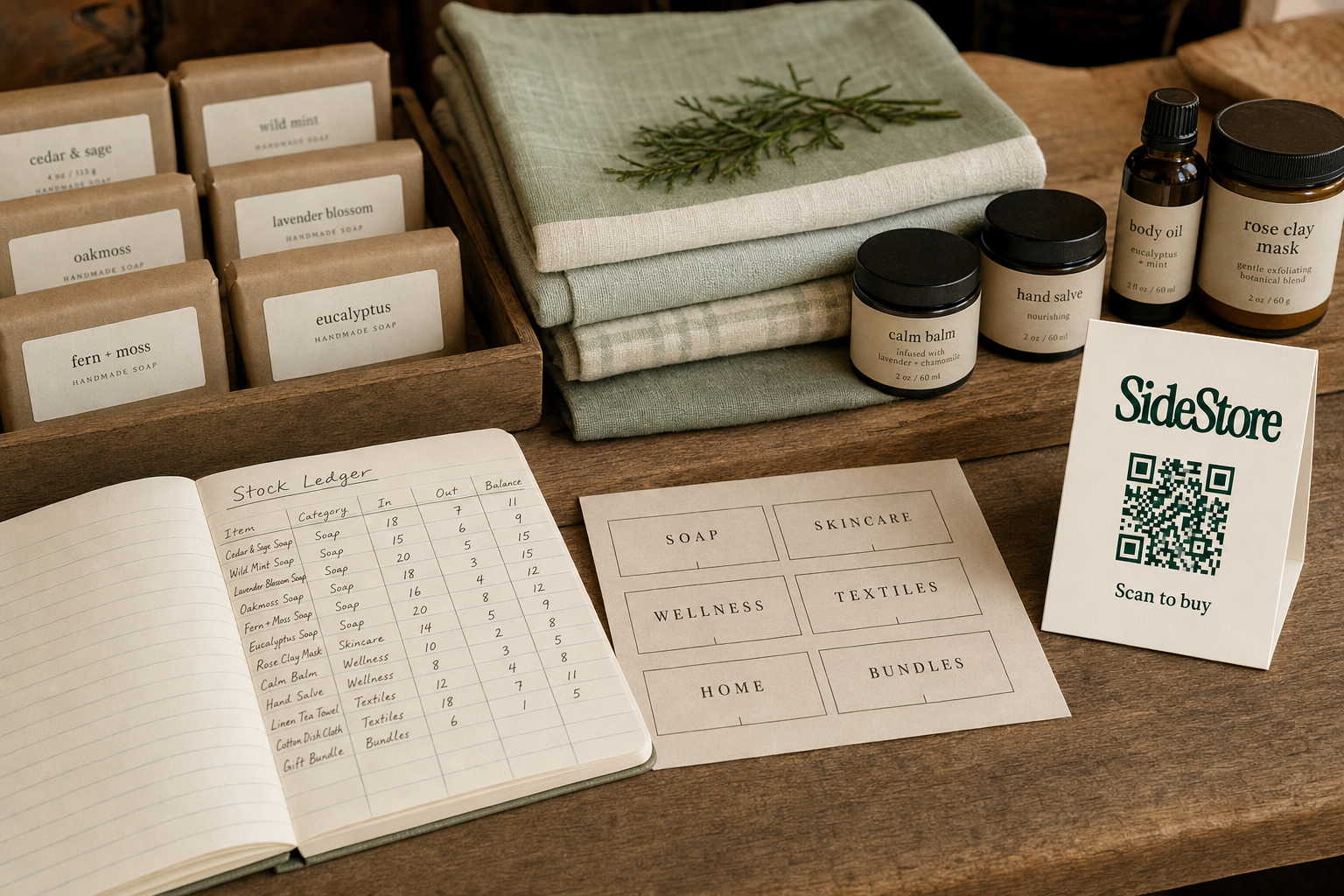
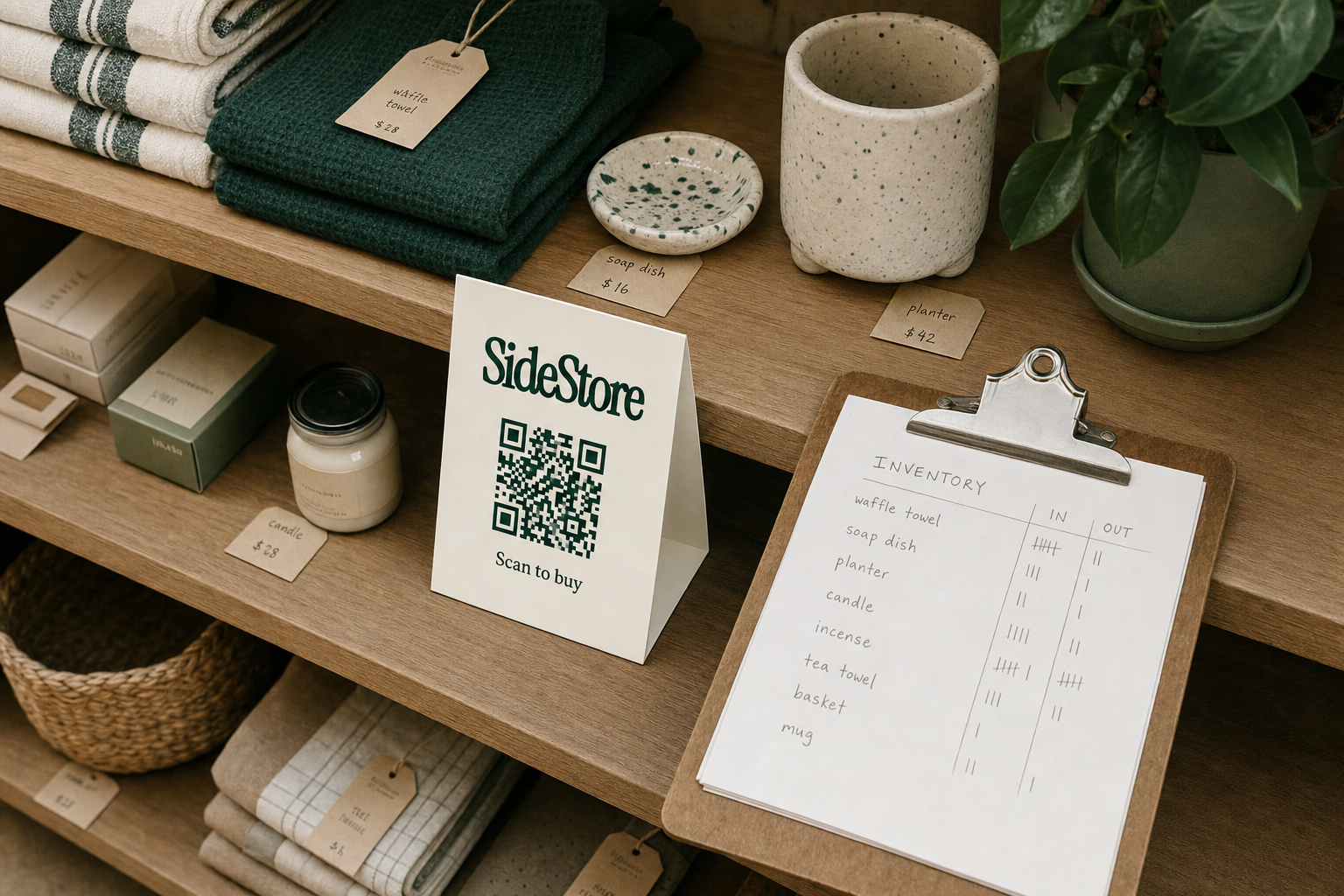
You do not need a full point-of-sale system to maintain accurate stock visibility, but you do need a method that captures every transaction and adjusts your count in real time. Manual tallies on a spreadsheet work at very low volume. They break down the moment a team member forgets to log a sale.
The practical options sit on a spectrum:
- Paper tally sheets, zero cost, high error rate, suitable only for single-person operations with very few SKUs.
- Spreadsheet tracking, workable for boutiques with under 50 SKUs if updated consistently after every transaction. The discipline requirement is the constraint.
- Lightweight inventory apps, purpose-built tools that log sales and update counts without requiring a full POS terminal or monthly software licence.
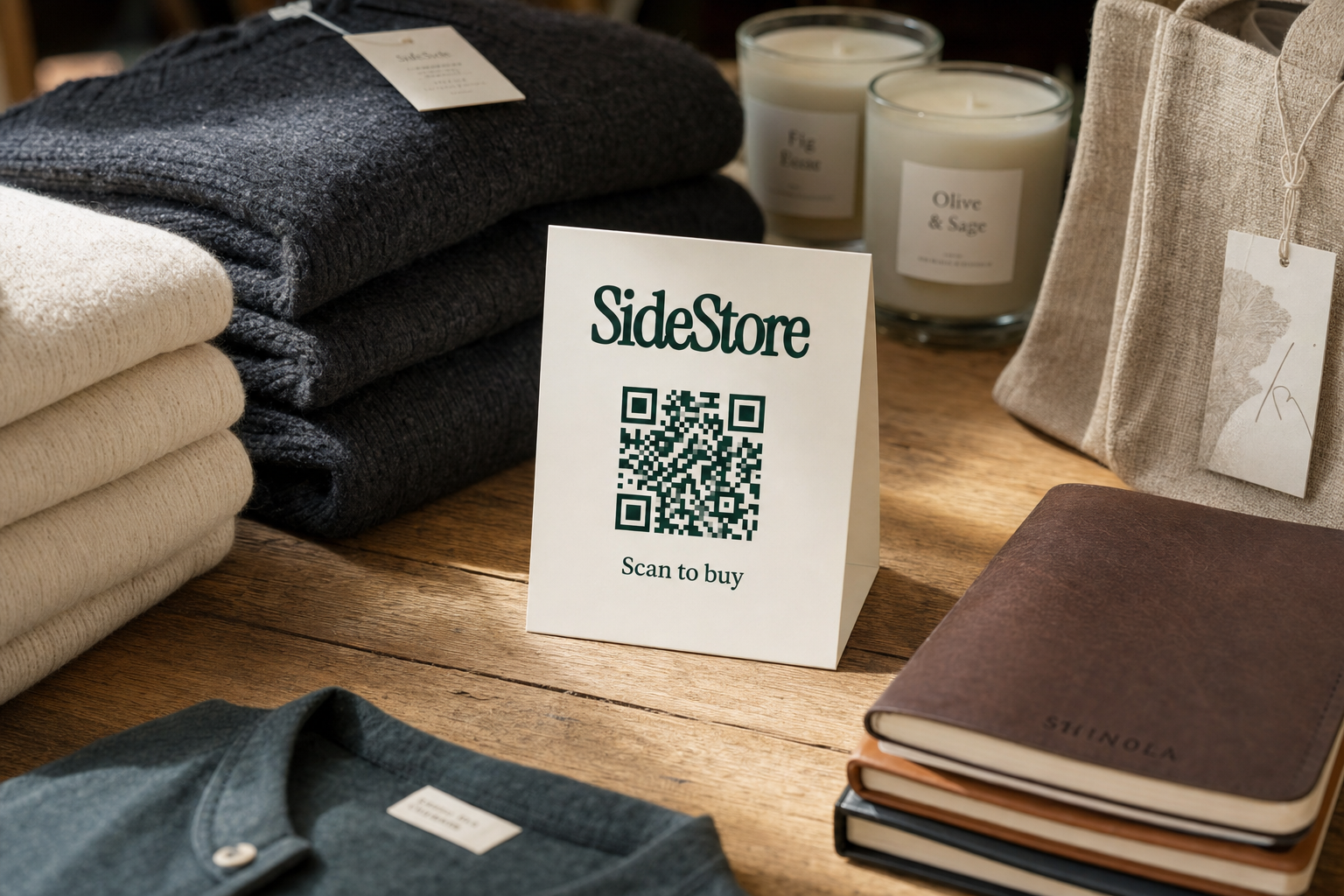
- Consignment platforms with built-in stock tracking, for products placed on consignment, a platform like SideStore handles this automatically. The Retail Widget decrements live inventory on every scan-to-pay transaction. You do not need to log the sale manually. The system updates the count the moment a customer pays. For a precise explanation of how that works at the point of purchase, how the SideStore QR card works covers the checkout flow.
The key discipline, regardless of method, is that the stock count must update at the moment of sale, not at the end of the day or week. Lag in your count means decisions made on wrong data. If you are considering how this model scales across larger venues, how hotels turn lobby space into retail revenue shows the same live-tracking principle applied to a higher-traffic environment.
Managing Overstock and Slow-Movers
Overstock is a symptom of a buying decision that did not match actual demand. Every boutique encounters it at some point. The question is how quickly you recognise it and what you do next.
Slow-movers are easier to spot than most boutique owners admit. If a product has not sold in eight weeks and there is no seasonal explanation, it is occupying space that a faster line could use. Your first options, in order of preference, are: reduce the price to clear at reduced margin, bundle it with a faster-selling item to move both, or move it to a sale area with clear signage.
The structural fix is to review your C-items on a set schedule, monthly or quarterly, rather than waiting until the problem is obvious. A consignment arrangement changes this equation for the host. Because the host does not own the stock, a slow-moving consignment product carries no capital loss. Your cost is opportunity cost: the shelf space that a faster product could use. That is a meaningful distinction when you are weighing whether to clear a line or simply renegotiate the placement.
For detailed clearance tactics, clearing boutique overstock covers the practical options. If you are a maker looking at where else your product might move faster, alternatives to weekend markets for makers is a useful parallel read.
Consignment as an Inventory Strategy for Boutiques

Consignment is one of the most practical inventory strategies available to a boutique host. It separates shelf presence from capital outlay. You stock your space without buying, and you earn a split of each sale when it happens.
The mechanics work like this. A maker places their products in your space through SideStore. The Retail Widget is the interface that manages the placement end to end: it handles checkout, including a printable scan-to-pay QR card, live stock tracking, placement attribution, and automatic split payouts to both you and the maker. The QR checkout is one function of the Retail Widget, not the whole product. When a customer scans and pays, the Widget records the transaction, decrements the stock count, and logs the payout split. You do not need to reconcile manually at month end.
The trade-off is honest and worth naming plainly. You earn a host share rather than a full retail markup, so your margin per unit is lower than it would be on owned stock you bought at wholesale. The offset is that you carry zero capital risk on the product. If it sells, you earn. If it does not, you have lost nothing except the shelf space it occupied.
This makes consignment especially well suited to product categories where demand is less predictable, seasonal items, artisan goods, local-maker lines, or new ranges you want to trial without committing. Makers benefit from physical placement without opening a store of their own, which is described in detail at how local makers can sell without opening a store. For boutique-adjacent hosts running smaller spaces, how bed and breakfasts earn from a small retail corner shows the same model at a smaller scale.
Seasonal and Event-Driven Inventory Planning
Seasonal boutique inventory management requires a different rhythm from year-round stock planning. Demand concentrates in predictable windows, and the cost of being wrong compounds quickly.
The core principle is to plan backwards from your peak dates. If your highest-traffic period is the six weeks before a local festival, your stock needs to be in place before that window opens, not during it. Supplier lead times, customs delays if you source internationally, and your own receiving capacity all sit between the order and the shelf.
A typical scenario: a boutique stocking ceramics from a local maker might place a larger consignment run in the four weeks before a holiday season, knowing that foot traffic and gift-purchasing intent will rise together. Because the ceramics are on consignment, the boutique takes none of the buying risk on the expanded range. If the season underperforms, the unsold pieces go back to the maker.
For boutiques that want to reduce owned seasonal stock further, running a boutique with no inventory explores how consignment and similar models enable a leaner buying position. Coffee shop retail as a venue model is a practical illustration of how seasonal product rotations work in a high-frequency consignment setting.
Build a Smarter Boutique Inventory Strategy
Good boutique inventory management comes down to three repeatable disciplines: know what you have, know what sells, and keep the cost of being wrong as low as possible. Par levels, ABC analysis, and regular slow-mover reviews handle the first two. Consignment handles the third.
If you are running a boutique with idle shelf space and want to earn from it without purchasing stock, the consignment model through SideStore removes the main barrier. The Retail Widget handles checkout, live stock tracking, and automatic split payouts in each placement. No manual reconciliation. No capital tied up in product you are not sure will move.
For boutiques that want to go further and explore a model built on consignment commerce from the ground up, how to start a boutique without inventory covers the approach in full detail.
Start with SideStore and the Retail Widget. Place products on consignment, track stock live, and get paid automatically when they sell.