How to Get Your Products into Retail Stores: The Maker's Step-by-Step Playbook
Learn how to get your products into retail stores with this step-by-step playbook covering preparation, pitching, consignment, wholesale, and managing placements.
Getting your products into retail stores is the process of placing your goods on shelves in existing shops, boutiques, or hospitality venues so that those stores sell on your behalf. It is not the same as buying wholesale stock to fill a store you own. That distinction matters, and it trips up many makers at the start.
If you are an independent maker, artisan, or designer, you are looking for distribution, not sourcing. You want a host merchant to carry your product and take a cut when it sells. The two main models for doing that are consignment and wholesale. Consignment is the lower-risk entry point: you supply the stock, the store displays it, and you split the revenue on each sale. No upfront payment to you, no inventory purchase by the host. Wholesale flips the dynamic: the retailer buys your stock outright at a reduced price, carries the risk, and sets the retail price.
This playbook walks you through five steps: prepare your product, find the right stores, pitch buyers, go live, and manage your placements at scale. It also covers food-specific requirements, a pitch email template you can use today, and a comparison of placement models so you can choose the one that fits your situation. If you want the broader context first, the step-by-step guide for independent makers covers the full landscape before you get into channel mechanics.
Step 1: Prepare Your Product Before You Approach a Single Store
Retail readiness means a buyer can say yes without asking follow-up questions. Before you contact a single store, you need packaging that communicates your product without you in the room, a line sheet that makes ordering or placing easy, and a pricing structure that works for both you and the host.
Packaging and presentation
Your packaging must do two jobs: attract a customer browsing a shelf and survive the handling involved in getting there. Labels need to be legible, professional, and honest about what is inside. For any product a store might sell without staff explanation, include a short product description, your brand name, and contact or website details. Buyers judge the product by what surrounds it.
The line sheet
A line sheet is a one or two-page document that tells a buyer everything they need to place an order or agree a consignment placement. It should include: product name and SKU, a clean photograph, retail price, your wholesale or consignment terms, minimum quantities (if any), lead time, and your contact details. Keep it plain and scannable. A buyer receiving twenty pitches a week does not read dense paragraphs.
Pricing structure: wholesale versus consignment
For wholesale, the standard approach is to set your retail price at roughly twice your cost of goods, then offer the buyer a price at half of retail. That is the keystone model. Your margin depends entirely on how efficiently you produce. For consignment, the typical split runs somewhere between 60/40 and 70/30 in the maker's favour, though terms vary by store type and product category. Neither model is universal: negotiate based on your cost structure and the store's foot traffic. For help on approaching a local shop about stocking your products, including how to frame your terms, that guide goes deeper on the conversation.
Food product considerations
Food products require additional preparation. Labels must include a full ingredient list, allergen declarations, net weight, and a best-before or use-by date. If you produce from a home kitchen, research your region's cottage food laws carefully: many jurisdictions restrict which products can be sold commercially from unlicensed premises, and stores carrying unlicensed food products face liability. Shelf-stable products with longer best-before dates are considerably easier to place than refrigerated or short-life items. Sort compliance before you approach any buyer, not after.
Step 2: Find Stores That Are Actually a Good Fit
The right retail partner for an independent maker is usually an independent retailer, not a major chain. Targeting stores whose existing customer base already buys products like yours is the single most reliable way to get a yes.
Where to look
Independent boutiques, gift shops, homeware stores, and design retailers are the most accessible entry points for most product categories. Cafes and specialty food shops suit food, beverage, and lifestyle products particularly well. Hotels and bed-and-breakfasts are strong placement venues for locally made goods, travel accessories, and artisan food. Florists, bookshops, and wellness studios often carry a small range of complementary non-core products and are open to consignment because they take on no inventory risk.
Collective and shared retail models, sometimes called maker markets or retail collectives, are worth considering early. They are structured for exactly this kind of placement. For background on how shared retail models work for independent makers and on how shared retail networks support local economies, those articles explain the mechanics and the broader context.
Which product types place most easily
Products that are self-explanatory at a glance, attractively packaged, and priced at an accessible impulse-buy level tend to place most easily. Handmade candles, specialty food items, greeting cards, small prints, soaps, and locally made accessories consistently find homes in independent retail. Products that require demonstration, refrigeration, or lengthy explanation are harder to place without a dedicated sales conversation.
Big-box retailers: a different path entirely
If your question is how to get into Walmart, Target, or a national grocery chain, the process is structurally different. These retailers have formal vendor onboarding portals, category buyers working to annual plans, compliance requirements around barcoding, insurance, and supply capacity, and timelines that routinely run to twelve months or longer. Most independent makers are not ready for that process at the start, and attempting it too early wastes time better spent building a local consignment network. Treat big-box placement as a separate, longer-term goal with its own preparation.
Step 3: How to Pitch Retail Buyers, Email, In Person, and Follow-Up
Pitching a retail buyer means giving them a clear, low-effort reason to say yes. The pitch itself is short: who you are, what the product is, why it fits their store, and what the terms are. Everything else is noise.
How to approach retail stores to sell your product by email
Cold email is often the first contact. Keep it under 200 words. Buyers receive many pitches and respond to specificity and brevity. Here is a worked template you can adapt:
Subject: [Product name] for [Store name], consignment placement
Hi [Buyer's name],
I make [product name], a [one-line description: what it is, what makes it distinct]. I think it would be a good fit for [store name] because [one specific reason: matches your existing aesthetic / complements your food range / appeals to the customers who buy X from you].
I work on consignment, so there is no upfront cost and no inventory risk for you. I handle restocking, and you keep [X]% of each sale.
I have attached a one-page line sheet with pricing, photos, and product details. Happy to drop by with samples at a time that suits you.
[Your name] [Brand name] [Contact / website]
Attach your line sheet as a PDF. Do not paste a wall of product descriptions into the body of the email. For more detail on how to approach a local shop about stocking your products, that guide covers the full conversation from first contact to signed agreement.
Warm introductions
A referral from someone the buyer already trusts shortens the path significantly. If another maker already stocks in your target store, ask whether they would introduce you. Local maker networks, craft associations, and market stalls are all places to build those connections. A warm introduction does not guarantee a yes, but it usually guarantees the email gets opened.
In-person pitching
Walking in with samples works best at quieter times: mid-morning on a weekday, not Saturday afternoon. Bring a concise leave-behind: your line sheet, one or two product samples, and a business card. Be direct about what you are proposing. Many store owners appreciate a maker who is clear about terms rather than vague about "partnership possibilities."
Follow-up cadence
If you hear nothing after your first email, follow up once, seven to ten days later. Keep it brief: a one-line note referencing your previous email and offering to answer questions. After a second non-response, move on rather than persisting. Buyers who are interested tend to respond. Those who do not respond twice are not currently a fit, and returning repeatedly damages the relationship before it starts. For context on selling through someone else's store, including how ongoing relationships develop after the initial yes, that guide covers the relationship beyond the pitch.
Consignment vs Wholesale vs Pop-Up: Choosing Your Placement Model
Your placement model determines who carries the financial risk, how much margin you retain, and how quickly you can go live. The table below lays out the three main options so you can compare them directly.
| Model | Who pays upfront | Maker margin | Retailer risk | Speed to place | Best for |
|---|---|---|---|---|---|
| Consignment | Nobody, maker supplies stock, retailer pays on sale | Higher (typically 60, 70% of retail) | Low, no stock purchase required | Fast, agreement and drop-off, often days | Makers starting out, testing new venues, lower-volume products |
| Wholesale | Retailer buys stock upfront at maker's wholesale price | Lower (often 40, 50% of retail, before production costs) | High, retailer owns unsold stock | Slower, buyer must commit budget | Makers with proven demand and production capacity to fulfil orders |
| Pop-up | Maker rents or shares space for a fixed period | Highest, maker keeps full retail margin minus space cost | None, maker sells directly | Variable, depends on space availability | Makers testing a new market or launching a product, seasonal goods |
Consignment suits most independent makers looking to enter retail without upfront commitment from either side. Wholesale becomes relevant once you have demonstrated sell-through and can fulfil larger orders reliably. Pop-up placement gives you full margin but requires your time and presence. For details on pop-up retail space for rent and for the broader framework on a maker's guide to retail partnerships, those resources go further on each model.
One conflation worth naming directly: some people searching for how to get products into retail stores are actually asking how to source wholesale inventory for a store they themselves are opening. That is the opposite process. If you are a maker seeking distribution, you are the supplier, not the buyer. The table above assumes you are the maker looking for shelf space, not the retailer looking for stock.
Step 4: Place Your Products and Go Live in the Store
Once a store agrees to carry your product, the placement itself requires a written agreement, a clear record of what stock you are delivering, and a system for tracking what sells. Getting this right from day one prevents disputes and makes restocking straightforward.
The consignment agreement
Even for a small independent placement, a written agreement protects both sides. It should cover: the consignment split (your percentage and the store's percentage), the payment schedule (weekly, fortnightly, or monthly settlement), who is responsible for damaged or stolen stock, the minimum display period, and the terms for ending the arrangement. A one-page document is enough for most independent placements. Both parties sign it before stock goes on the shelf.
Day-one documentation
On the day you deliver stock, record exactly what you are leaving: product names, SKUs, quantities, and agreed retail prices. Give the store a copy and keep one yourself. This is your baseline. Any discrepancy between this record and future stock counts is what triggers a conversation about sales versus loss.
Stock tracking
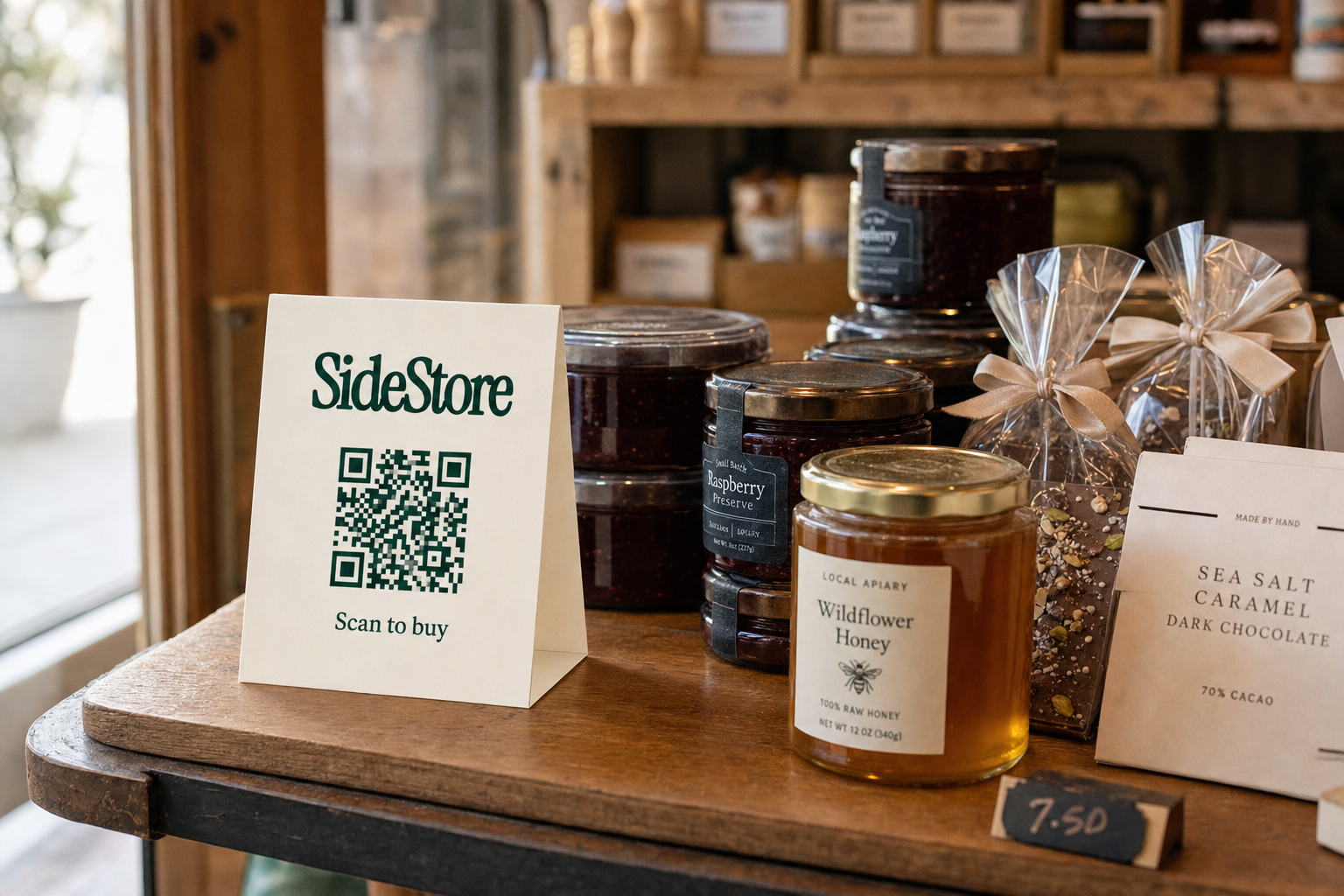
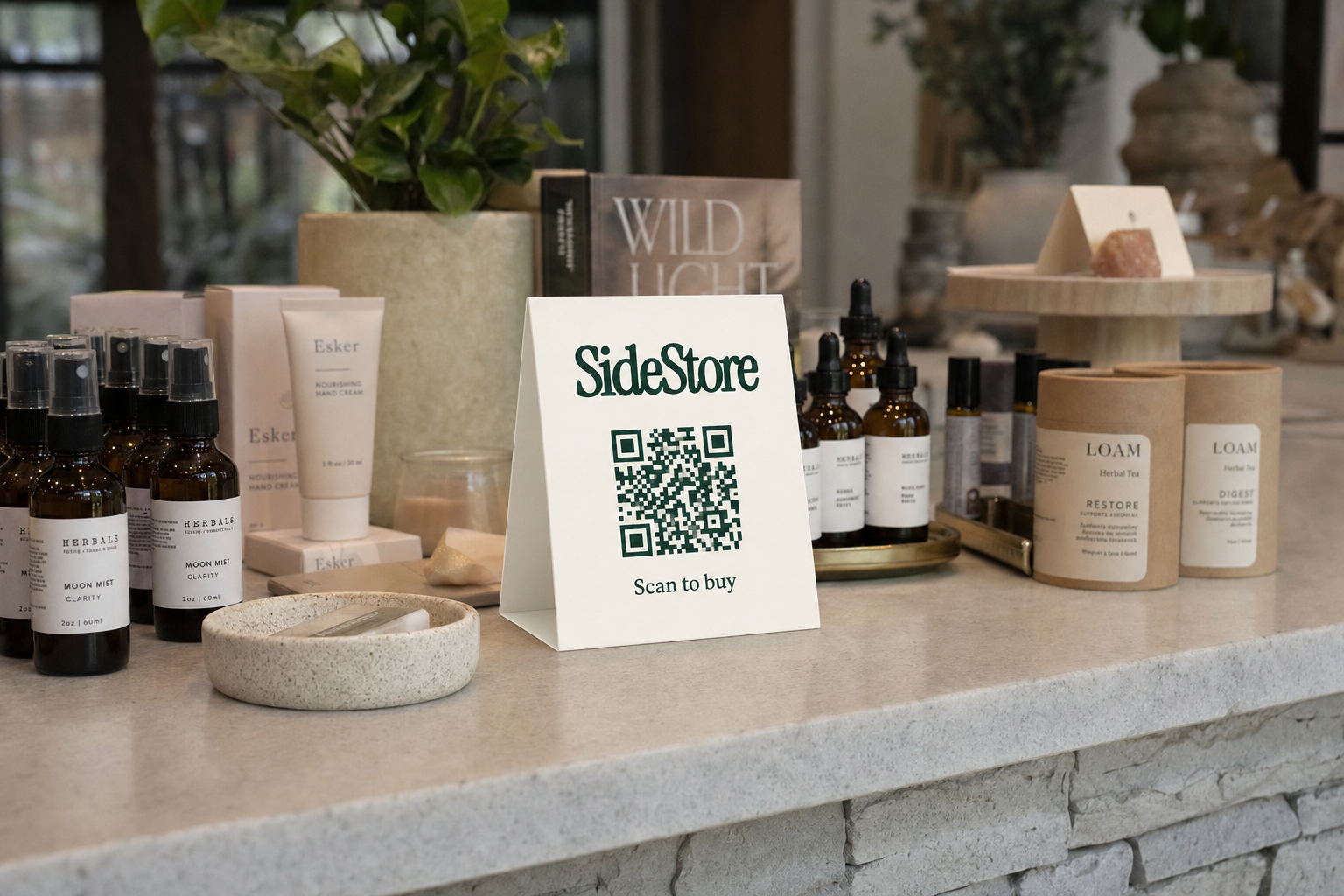
Manual stock tracking, spreadsheets updated on each visit, is workable for one or two placements. It becomes unreliable fast when you are managing multiple locations. This is where purpose-built tools make a material difference. The SideStore Retail Widget handles live stock tracking, placement attribution, and automatic split payouts across all your placements from one dashboard. The scan-to-pay QR code is one function of the Retail Widget: customers scan it to purchase, the sale records automatically, and the payout splits between you and the host without manual reconciliation. For a deeper look at consignment inventory software and at the specifics of consignment placement for art prints in local shops as a practical example, both guides cover the operational detail.
The point of getting this infrastructure right at placement one is that it scales. What you set up for your first store becomes the system you replicate for your fifth and your fifteenth.
Step 5: Manage Placements and Build a Distributed Consignment Network
Placing your product in a store is the beginning, not the end. Ongoing management is what determines whether a placement stays live, grows, and becomes a genuine revenue stream.
Recurring management tasks
Restocking is the most immediate task. Track stock levels so you can replenish before a shelf goes empty, not after. An empty space on a shelf earns nothing, and a store that runs out repeatedly will eventually reclaim the space for a more reliable supplier. Check in with your host contact regularly, not to push sales, but to ask whether the product is generating questions, whether the display needs adjusting, and whether there is anything the store needs from you.
Payout reconciliation means confirming that what you receive matches what sold. With manual arrangements, this involves comparing your delivery records against the store's sales reports and calculating your share. With SideStore, placement attribution and automatic split payouts handle this continuously: every sale logs to the correct placement, and your balance updates in real time.
Scaling to multiple locations
The logic of a distributed consignment network is simple: the same product, placed in multiple stores across a region, generates revenue from each location without you needing a physical presence in any of them. SideStore's dashboard gives you a single view of live stock levels, sales, and payouts across every placement. Venues worth considering as you expand include cafes and hospitality venues, where maker products often sell well alongside a resident audience, and hotels, which suit locally made goods at a slightly higher price point. The guides on selling local products to hotels and selling art prints in cafes cover the specifics of each venue type. For the operational side at scale, managing consignment inventory at scale goes further.
On big-box retail
If your longer-term goal includes national chains or big-box retailers, build your consignment network first. Demonstrated sell-through across multiple independent locations is the evidence a category buyer at a large retailer wants to see. It also gives you the production capacity and operational discipline those retailers require. Big-box onboarding is a separate, longer process, and it starts with proof that your product sells.
Frequently Asked Questions
These questions come up consistently from makers navigating retail placement for the first time. The answers below address the most common points of confusion directly.
How do retail stores source and acquire their products?
Independent stores typically source products through trade shows, direct approaches from makers and brands, wholesale directories, and buyer relationships built over time. Larger chains use formal category management processes and vendor portals. For independent makers, a direct approach to an independent store, with a clear line sheet and consignment terms, is the most direct path to placement. The step-by-step guide to getting products into stores covers the full sourcing picture from the maker's side.
How should you pitch a product to retail buyers?
Keep the pitch short and specific. Lead with what the product is, why it fits that particular store, and what the terms are. Attach a line sheet. Offer samples. Do not open with your brand story or a lengthy explanation of your process. Buyers make decisions based on fit, margin, and whether the product will sell to their customers.
What pricing arrangement should apply when retailers sell your product?
On consignment, the maker typically receives 60 to 70 percent of the retail price, with the host keeping the remainder as a commission. On wholesale, the retailer buys at roughly 50 percent of the intended retail price and keeps all the margin above that. Consignment is lower risk for both sides on a first placement. For context on how cafes think about product margins, that guide explains the host's perspective on what makes a placement worth the shelf space.
How can homemade products get stocked in retail locations?
Homemade products can be placed through consignment with independent retailers, collective stores, and hospitality venues. The key requirements are professional packaging, compliance with any applicable food or safety regulations, and a clear consignment agreement. Many successful placements start with a single local shop and grow from there.
How do you contact retail buyers about carrying a product?
Email is the standard first contact. Use the buyer's name if you can find it, reference the specific store, keep the message under 200 words, and attach a line sheet. Follow up once if you hear nothing. In-person approaches work well in smaller independent stores where the owner is often present during quieter hours.
Is getting my product into stores the same as buying wholesale inventory for a store I own?
No. These are opposite processes. A maker seeking retail distribution is the supplier: they want stores to carry and sell their products. A retailer buying wholesale inventory is the buyer: they are sourcing stock to fill their own shelves. The playbook above is for makers seeking distribution, not for retailers sourcing stock.
What is the process for getting products into major big-box retailers?
Major retailers like Walmart or national grocery chains have formal vendor onboarding portals, compliance requirements around barcoding, insurance, and supply capacity, and procurement timelines that typically run to twelve months or more. Most independent makers are not positioned for that process at the outset. The practical path is to build a track record of sell-through in independent retail first, then approach larger retailers with evidence of demand and production capacity behind you.
Start With One Placement, Then Build From There
Getting your products into retail stores comes down to five steps: prepare a retail-ready product with clear pricing, find stores whose customers match your buyer, pitch with a concise email and a solid line sheet, go live with a documented consignment agreement, and manage stock and payouts consistently. Each step is repeatable.
The most useful thing you can do today is identify one store that fits, write the pitch email, and send it. For a full account of what comes next, selling through someone else's store covers the ongoing relationship in detail.