Boutique inventory is the curated selection of physical products a retail shop purchases or acquires on consignment to sell to its customers. If you need to know where to buy boutique inventory right now, there are four main sourcing channels: wholesale marketplaces, trade shows, direct purchases from independent makers, and consignment placements. Wholesale and trade shows require upfront capital and carry stock risk; consignment lets you carry products without buying them at all. This guide covers how each channel works, what it actually costs, and how to compare them so you can match the sourcing model to your boutique's cash position and growth stage. You'll also find a step-by-step section on accepting consignment products and a sourcing comparison table you can use to make a quick decision. For a curated list of products already available to boutiques, see boutique inventory for sale. If you want to carry local products without any upfront buy, start with add local products without buying inventory.
Wholesale Marketplaces: The Traditional Starting Point
Wholesale marketplaces are platforms where brands and manufacturers sell to retailers in bulk at discounted prices, typically 40, 60% below MSRP. That translates to a 2x, 2.5x markup when you sell at full price. Most boutique owners start here because the product selection is broad and the ordering process is straightforward.
Here's how it works: you browse a platform, place an order above a supplier's minimum order quantity (MOQ), and pay upfront or on agreed net terms. MOQs vary widely. Some suppliers set them as low as six units per style; others require a $300, $500 minimum per order. Net-30 terms are common with established suppliers, though new buyers often pay upfront until they build a trading history. Return windows, when offered at all, typically cover damaged goods only. Unsold stock is your responsibility.
That last point matters. When you buy wholesale, you own every unit until it sells. A slow season, a trend reversal, or a miscalculation about what your customers actually want can leave you with shelves of product that won't move. Clearing that stock usually means markdowns, bundling, or off-price channels, all of which erode the margin you planned on. For a practical look at what to do when you've over-bought, see getting rid of boutique inventory.
Wholesale marketplaces reward boutiques that have consistent sell-through history and reliable cash flow. If you're early-stage or testing a new product category, the capital commitment is real and the risk is real. Factor that honestly into your sourcing plan before placing your first order.
Trade Shows: Discovering New Suppliers in Person
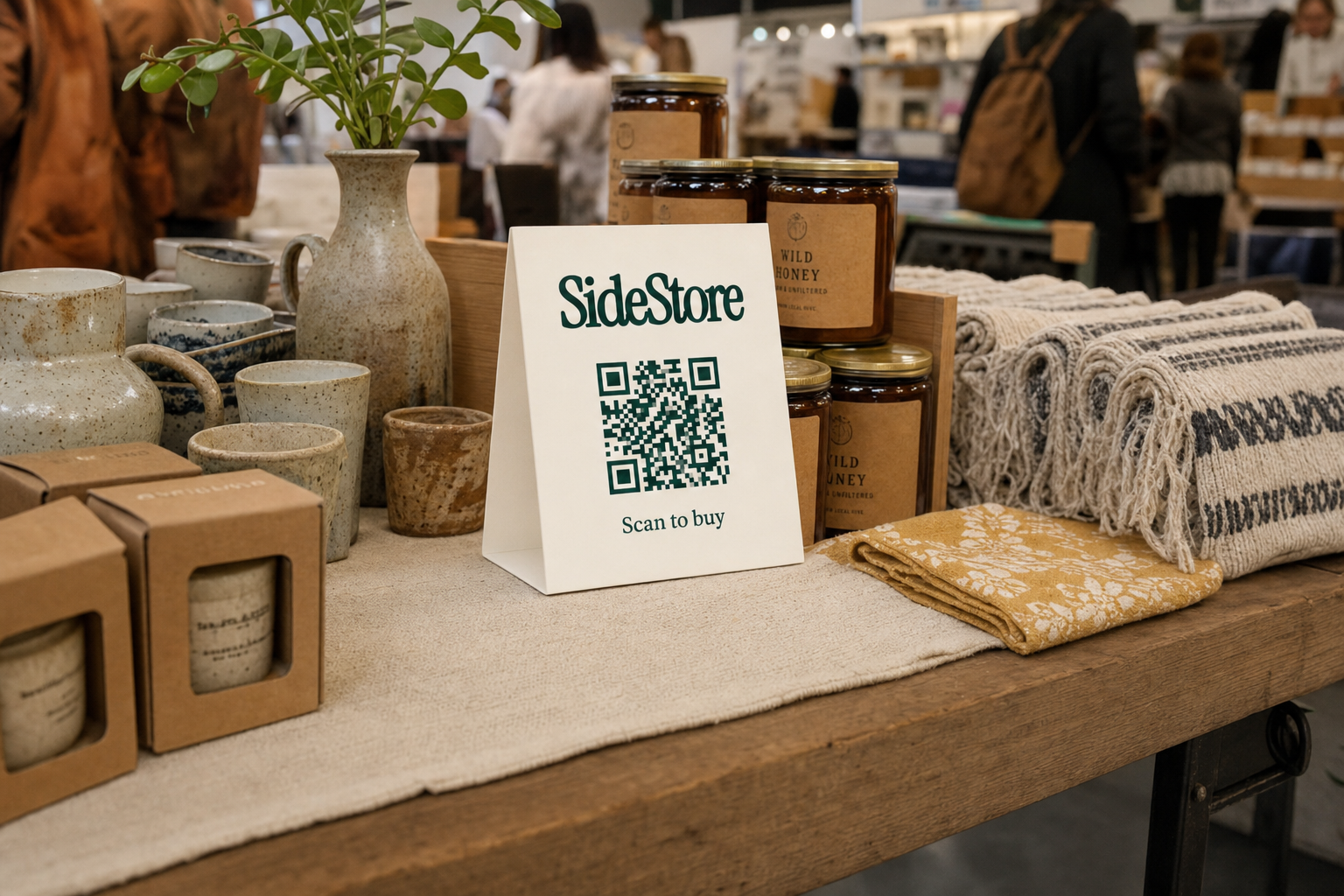
Trade shows let you meet suppliers face to face, assess product quality before you order, and negotiate terms directly. That in-person quality assessment is the single strongest reason to attend, and for boutiques stocking tactile or craft-forward categories, it's often decisive.
The buying calendar clusters shows twice a year, in January and July. You attend, walk the floor, handle samples, and write orders. Lead times from a signed order to delivered goods typically run 30, 90 days depending on the supplier's production cycle and shipping origin, so you need to plan your open-to-buy budget well in advance.
The cost reality is plain: trade show sourcing is not cheap. Registration fees, travel, accommodation, and then upfront orders at the show add up quickly. Some shows require a business license or tax ID to register, which filters out casual buyers but also adds administrative friction for newer boutiques.
That said, the value of holding the product before committing is hard to overstate. Photos on a wholesale platform can obscure weight, texture, construction quality, and finish, all things that matter to boutique customers who are paying a premium. If your brand positioning depends on curation and quality, a trade show buy gives you defensible confidence in what you're putting on your shelves.
Local and Independent Makers: Differentiated Product, Flexible Terms
Local and independent makers give boutiques something wholesale cannot: product that no other shop in your area carries. That differentiation drives repeat visits, word-of-mouth, and the kind of story-driven selling that justifies boutique pricing. Make the business case for maker sourcing before you worry about logistics, because the commercial upside is real.
Where to find them: craft fairs and local markets are the most direct route, since you can see the work and meet the maker in one visit. Instagram is highly effective for discovering makers whose aesthetic already has an audience. SideStore connects boutiques directly with independent makers who are actively looking for consignment placements in merchant spaces.
Once you find a maker you want to work with, you have two sourcing options: a direct wholesale buy (you purchase units upfront at an agreed price) or a consignment arrangement (the maker places product in your boutique, you pay them when it sells, and you keep an agreed percentage). Makers who are still building their distribution are often willing to offer consignment terms precisely because it costs them nothing to be in your space. That flexibility is valuable. You can test a new maker's product with your customers before committing capital to a full buy.
For a detailed breakdown of how to structure these arrangements, see add local maker products without buying inventory and how local makers sell without opening a store.
Consignment Sourcing: Carry Products Without Buying Them
Consignment is the sourcing model with the lowest capital risk. A maker places their product in your boutique, you sell it, and you split the revenue on each sale. You pay nothing upfront, you hold no inventory at cost, and unsold stock that doesn't move simply goes back to the maker.
The precise mechanics matter. The maker retains ownership of the product until it sells. On each sale, you keep your host percentage and the maker receives the rest. Host percentages in consignment retail typically run 20, 40%, negotiated between you and the maker before the placement goes live. The trade-off versus wholesale is straightforward: your per-item margin is lower than on a wholesale buy (where you might mark up 2x, 2.5x), but you have zero capital at risk and no clearance exposure.
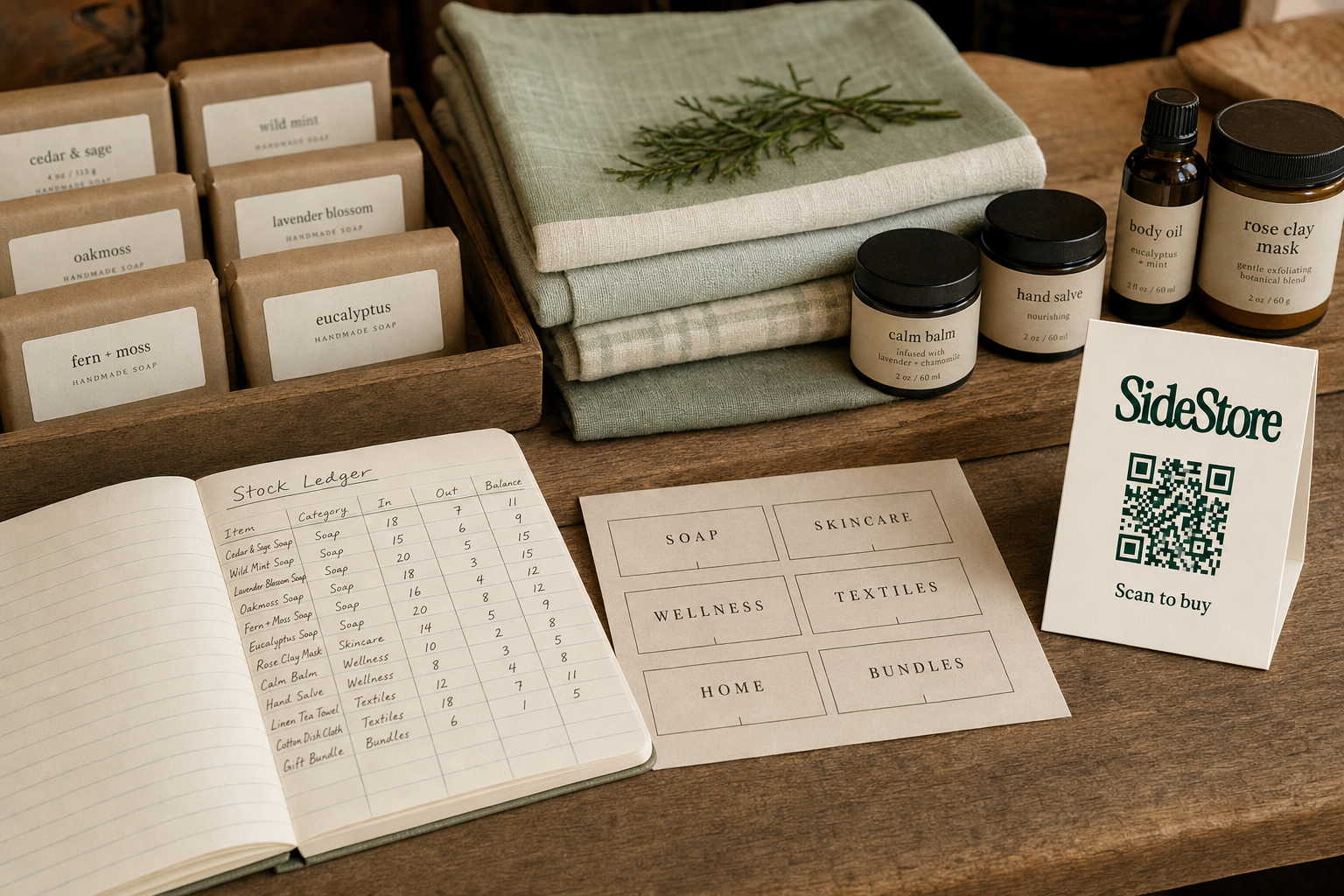
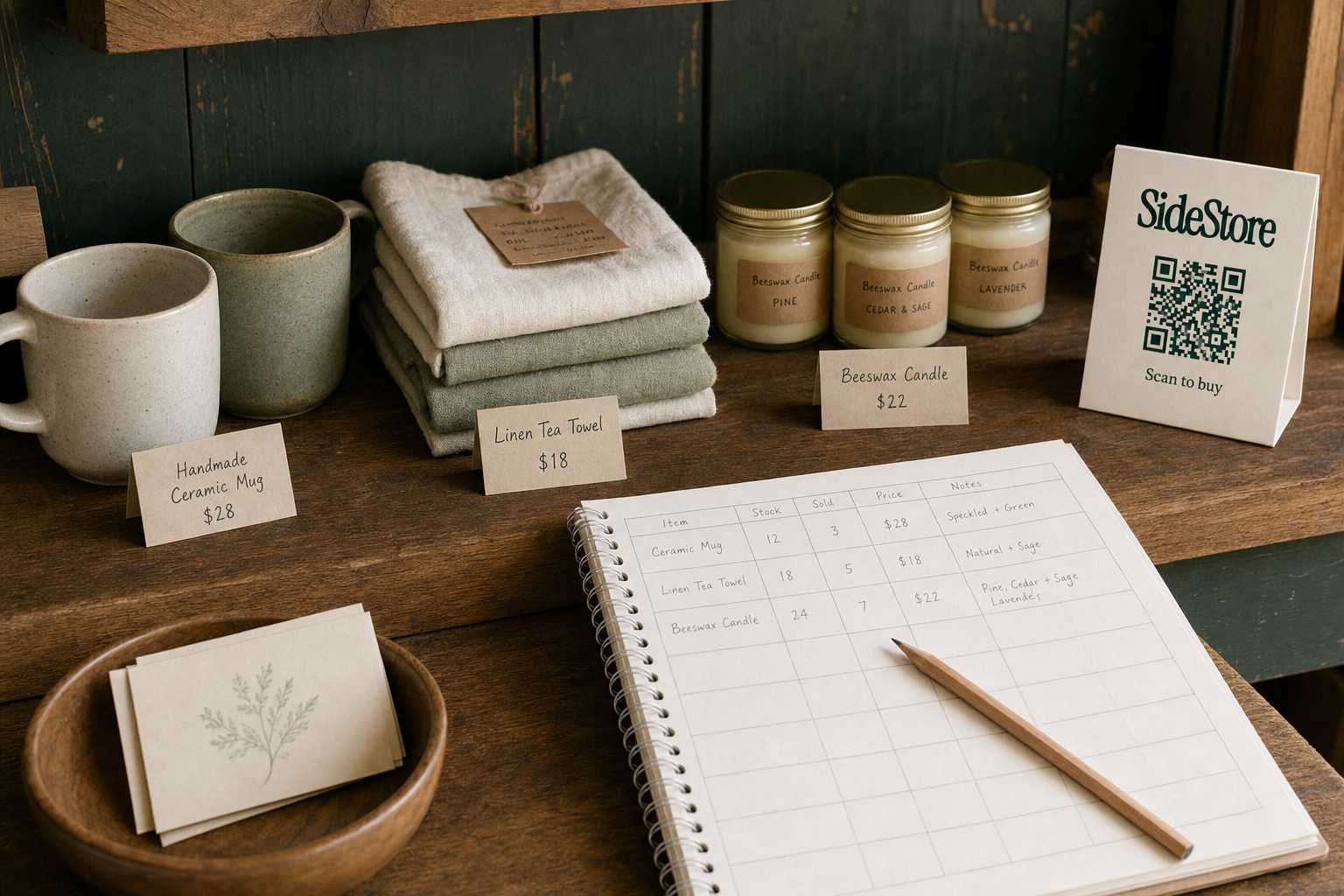
The operational challenge with traditional consignment, tracking stock, calculating splits, chasing payments, is exactly what the Retail Widget solves. The Retail Widget is the interface that places and manages a consignment arrangement end to end. It handles scan-to-pay checkout via a printable QR card that makers or merchants can display in-store, live stock tracking so you always know what's on your shelf, placement attribution so every sale is tied to its placement, and automatic split payouts so neither you nor the maker has to calculate or chase a payment manually.
For evidence that this model works across different venue types, see how cafes earn from unused shelf space and how hotels turn lobby space into retail revenue. For the underlying mechanics, selling on consignment: what it means gives a clean definition, and how the SideStore QR card works covers the checkout side precisely.
Sourcing Channels Compared: Costs, Risk, and Fit
Choosing where to buy boutique inventory comes down to one practical question: how much capital can you put at risk, and how confident are you in your sell-through? The table below maps each channel against the variables that matter for a boutique buyer.
| Channel | Upfront Cost | Stock Risk | Typical Margin | Best Fit |
|---|---|---|---|---|
| Wholesale Marketplace | Medium, High (MOQ-based order) | Full, you own unsold stock | 2x, 2.5x MSRP markup | Boutiques with proven sell-through and open-to-buy budget |
| Trade Show | High (travel + registration + upfront orders) | Full, you own unsold stock | 2x, 2.5x MSRP markup | Boutiques sourcing tactile or quality-sensitive categories |
| Direct Maker (wholesale buy) | Low, Medium (negotiated MOQ) | Full, you own unsold stock | Varies; typically 1.8x, 2.5x depending on maker pricing | Boutiques wanting unique product with direct maker relationships |
| Consignment (maker placement) | None | None, unsold stock returns to maker | 20, 40% host split per sale | Boutiques testing new categories or carrying local/maker product |
The pattern is clear: upfront-buy channels give you better per-item margin but load all the inventory risk onto you. Consignment inverts that. Lower margin per item, no capital at risk, no clearance problem. A practical approach for many boutiques is to run both: carry proven wholesale lines at full margin while using consignment slots to test new makers, new categories, or seasonal additions without committing cash.
For more on the consignment model from the seller's side, see selling to consignment. If you're considering a broader low-inventory retail structure, starting a boutique without inventory covers the operating model in detail.
How to Evaluate a Supplier or Maker Before You Commit
Before you source from any channel, apply the same five-point evaluation to every supplier or maker. The weight of each criterion shifts depending on whether you're doing an upfront buy or a consignment arrangement.
1. Product quality and consistency. Handle samples before committing. For consignment, this matters slightly less upfront because your capital isn't at risk, but it still affects your customer experience and reputation.
2. Pricing and margin structure. Confirm the wholesale price, MSRP, and your expected margin or host split before any agreement. For upfront buys, thin margins with high MOQs compound your risk. For consignment, confirm the host percentage explicitly.
3. Reliability and lead times. Ask for references or check trading history. For wholesale, late deliveries disrupt your floor plan and sell-through window. For consignment, reliability matters for restocking. A maker who doesn't refill promptly leaves empty shelf space.
4. Brand fit and story. Your customers buy the product and the story behind it. A maker whose aesthetic and values align with your boutique's positioning is worth more than a generic supplier with a slightly better price.
5. Ongoing performance. Once a product is on your shelf, you need data. The Retail Widget's live stock tracking and placement attribution give you a clear view of how each maker's product performs over time, what sells, how fast, and from which placement. That data makes restocking and range decisions straightforward rather than guesswork.
For the maker's perspective on what makes a strong in-store consignment arrangement, how to sell handmade products in physical stores on consignment is useful background. If you want to understand the shelf-space opportunity more broadly, make money from unused shelf space covers the host-side economics clearly.
Getting Started: How to Accept Maker Products on Consignment
Accepting your first consignment placement is operationally straightforward. The four steps below cover everything from agreement to automatic payout.
Step 1: Agree terms with the maker. Settle on the host percentage (typically 20, 40%), what happens to unsold stock, and how long the initial placement runs. Put this in writing, even if it's just a signed email.
Step 2: Set up the placement in the Retail Widget. The Retail Widget is the SideStore interface that manages the consignment arrangement end to end. Product listing, stock quantities, pricing, split ratios, and placement details all live here. Both you and the maker can see live stock levels and sales data.
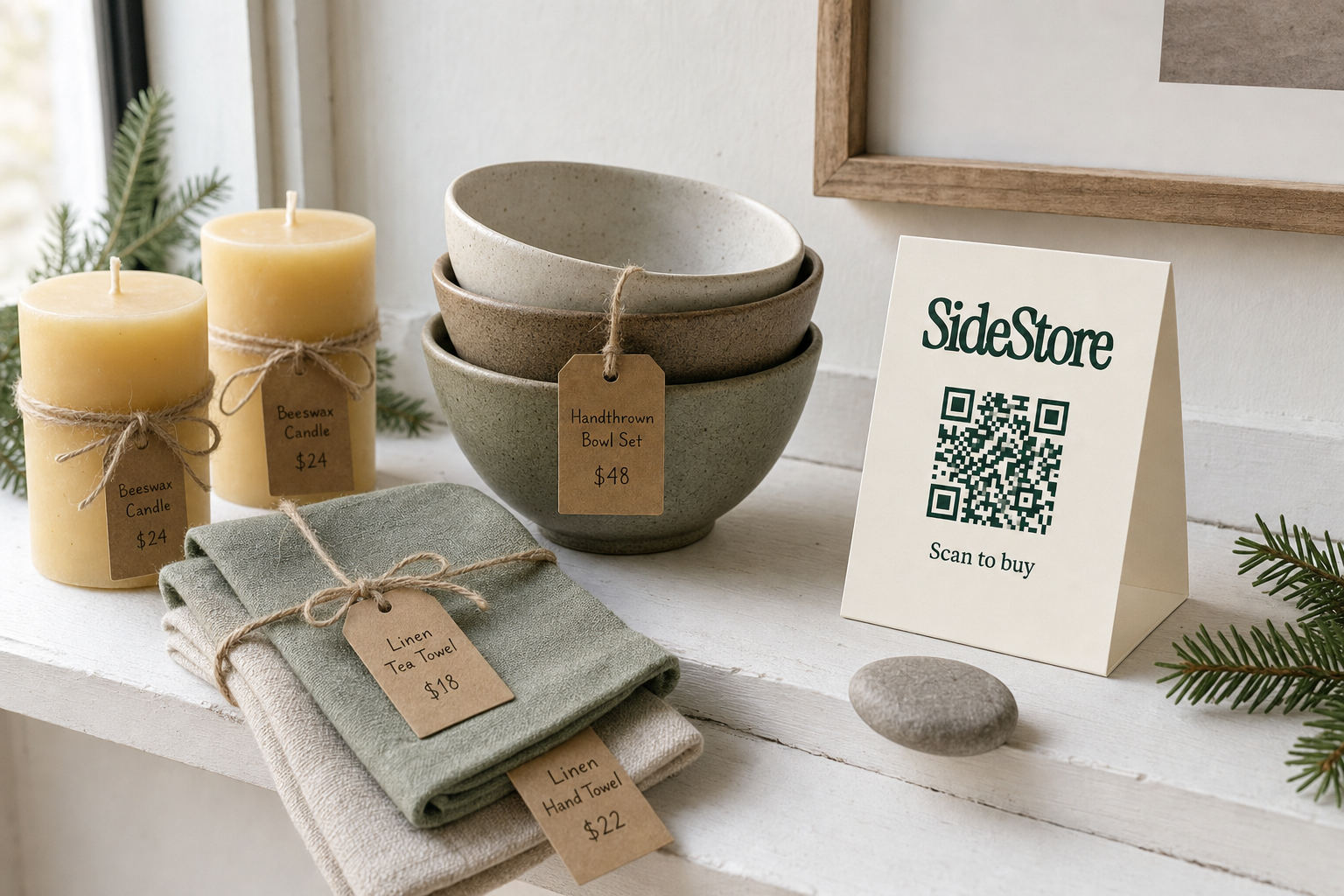
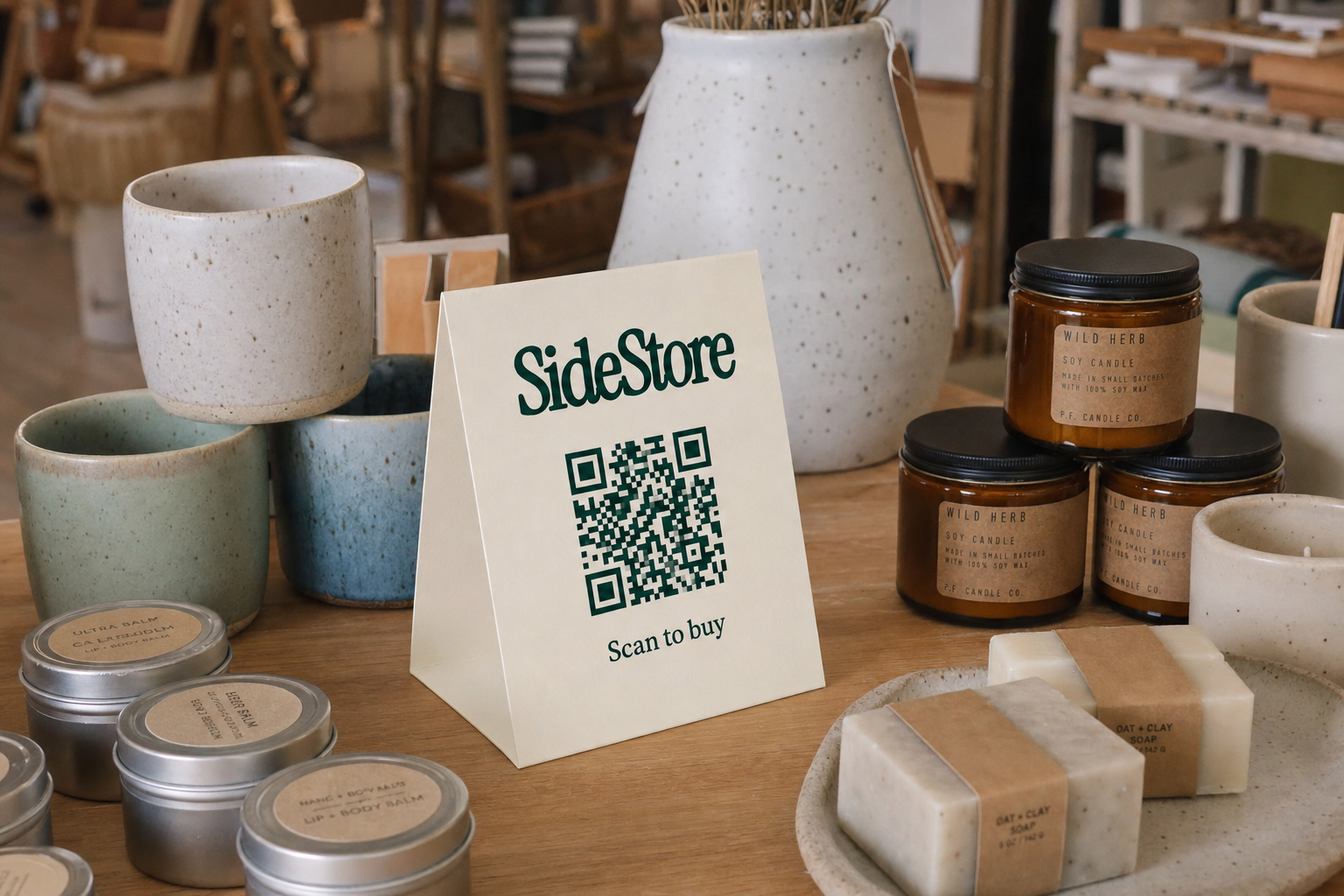
Step 3: Display the QR card in-store. The SideStore QR card is the scan-to-pay checkout mechanism within the Retail Widget. A maker can attach the QR card to their individual products, or you can display a single card for all products in the placement. Customers scan, pay, and the transaction is recorded automatically. The QR card handles checkout; the Retail Widget handles everything else.
Step 4: Collect your automatic split payouts. When a sale completes, the Retail Widget splits and settles the revenue automatically. Your host percentage is paid to you; the maker receives the rest. No manual calculation, no payment chasing.
The merchant-side outcome: you earn from shelf space you already have, with no stock to buy, no inventory to count, and no payments to chase. See how the SideStore QR card works for the checkout mechanics in detail. For the maker's perspective on why consignment placement beats weekend markets, alternatives to weekend markets for independent makers is worth a read.
Frequently Asked Questions
The questions boutique owners most often ask about sourcing come down to minimums, risk, returns, and how the money works.
What is the minimum order quantity for wholesale boutique sourcing?
MOQs vary by supplier, but common ranges for boutique-scale wholesale are six to twelve units per style, or a minimum dollar value per order of $150, $500. Some platforms let you mix styles to hit a dollar minimum; others enforce per-style quantities strictly. Always confirm before you submit an order.
Can a boutique carry consignment and wholesale products at the same time?
Yes, and many boutiques do. Wholesale lines provide consistent margin on proven sellers; consignment slots let you carry local or new maker product without capital commitment. Running both models in parallel is a practical way to manage cash flow while still offering a differentiated range. See how boutique shops add local products without buying inventory for more on the mixed-model approach.
How does a boutique handle returns on consignment products?
This is negotiated in the consignment agreement. Common practice: if a customer returns a product, the sale is reversed and no split is paid. The product returns to your shelf or back to the maker depending on the agreement. Establish your return policy clearly with makers before the placement goes live, so there's no ambiguity when a return happens.
What percentage do consignment hosts typically earn?
Host percentages in consignment retail typically run 20, 40% of the sale price, negotiated between the boutique and the maker. The split reflects factors like foot traffic, display quality, and how much operational work the host takes on. For a full explanation of how consignment splits work, see what consignment means.
How does SideStore handle split payouts for consignment sales?
When a sale completes through the Retail Widget, the platform automatically calculates and settles the agreed split. The host percentage goes to the boutique; the remainder goes to the maker. No manual reconciliation, no invoicing back and forth. The Retail Widget handles the split settlement on every transaction, so both parties always know what they're owed and when it's been paid.
The Right Sourcing Channel Depends on Your Risk Appetite
The sourcing decision for any boutique comes down to one variable: how much capital can you put at risk against how confident you are in what will sell. Wholesale and trade show buying give you better per-item margin but require upfront cash and leave you holding unsold stock. Consignment removes that risk entirely, at the cost of a lower host split per item.
The practical decision rule: use wholesale for proven categories you know will sell, and use consignment to test new makers, new categories, and seasonal additions without committing inventory budget. If you're ready to add local maker products without buying a single unit, add local maker products without buying inventory is the next step. Or browse boutique inventory for sale, list your space on SideStore, accept a maker placement, and let the Retail Widget handle checkout, live stock tracking, and automatic split payouts from day one.
Build a consignment network without opening a store of your own.