How to Sell Ceramics in Local Shops: Consignment Placement for Potters and Studio Makers
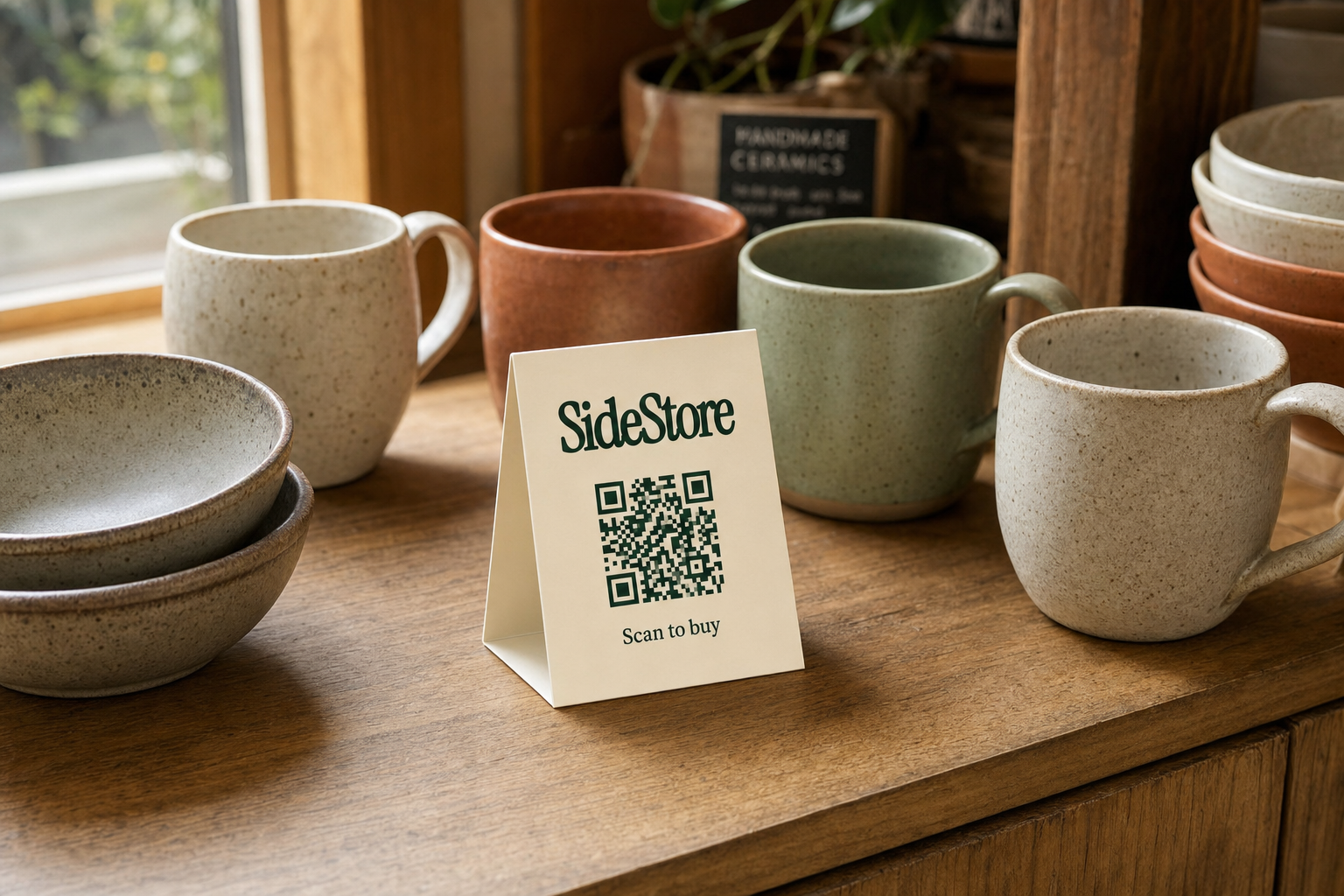
Selling ceramics through coffee shops is consignment: you place your handmade pieces on a café counter or shelf, the host earns a percentage only when a piece sells, and you get paid automatically. No upfront cost to either party. No inventory risk.
If you want to get your ceramics into stores without paying wholesale minimums or renting market stalls every weekend, consignment placement is the practical starting point. You identify a suitable venue, agree a split (typically 25% to 40% to the host), leave your pieces in place, and collect your share of each sale. The host takes on nothing. You take on no fixed overhead. The Retail Widget handles checkout, live stock tracking, and automatic split payouts so neither of you needs to manage the admin manually.
The sections below cover everything you need to move from studio to shelf: which venues to target, how to pitch them, how to price so the split math works in your favour, what to put in writing, and how to manage five or ten placements without losing track of your stock.
Why Consignment Is the Right Model for Handmade Ceramics
Consignment suits handmade ceramics because it removes the two barriers that kill most independent distribution attempts: the capital requirement of wholesale, and the time cost of running your own retail space.
With wholesale, a shop wants to buy your pieces outright at 50% of retail or less. You need the cash to produce a run. You carry the margin compression. You bear the risk if the buyer's store has a slow month. None of that compounds.
With a market stall, you trade your Saturday for a few hundred pounds of sales, and repeat that every week indefinitely. The time investment is real. The output does not scale.
Consignment sidesteps both. You retain ownership of every piece until it sells. The host earns from space they already have, which is why independent café owners are genuinely interested in low-effort revenue from placements. You earn a larger share of the retail price than any wholesale arrangement would give you.
The honest trade-off is cash flow. You will not be paid until a piece sells. If a slow venue holds three mugs for two months, that stock is tied up and you are not seeing a return on those pieces. This is real. The mitigation is choosing venues with genuine foot traffic and browsers who linger, then restocking quickly when something does sell. Maintain visibility on the shelf.
Consignment also compares well to pop-up retail once you account for setup time, travel, and the inconsistency of market attendance. A permanent placement in a café that trades six days a week works harder than a monthly market slot, even if the per-sale margin looks similar on paper.
Finding the Right Local Venues for Your Ceramics
The right venue for a ceramic consignment placement is one where customers already pause, browse, and feel comfortable spending on something they did not plan to buy before walking in.
Not every shop with a counter qualifies. Here is a practical tiered approach.
Coffee shops and cafés (start here). Independently owned cafés are the most accessible entry point. Customers sit with a coffee, look around, and have time to notice and handle a piece. In independently owned cafés, browsers dwell for twenty minutes or more, which creates natural consideration time for a mug or small bowl sitting near the till. Prioritise cafés with a clear aesthetic identity: minimalist fit-out, exposed brick, handmade furniture. Your ceramics will look at home, and the owner's taste is likely aligned with yours. Avoid large chain cafés. They have centralised buying decisions you cannot reach with a walk-in pitch.
Independent boutiques (second tier). Gift shops, homeware boutiques, and lifestyle stores are a natural fit for functional ceramics. Buyers here are already in a purchasing mindset. The challenge is that boutique owners often have existing supplier relationships and may move slowly to take on a new maker without a referral or track record at another local venue.
Hotels and bed and breakfasts (third tier). Smaller independent hotels and B&Bs sometimes display and sell locally made objects as part of their guest experience. The sales volume is lower, but the dwell time and average spend per visitor can be higher.
Wherever you look, walk the space before you pitch it. If your glazed stoneware pieces look out of place in the window, they will look out of place on the shelf.
How to Pitch a Coffee Shop or Boutique on Consignment
Pitching a venue on consignment is straightforward when you lead with the host's benefit: they earn revenue from space they already have, with no stock to buy and no risk if a piece does not sell.
Follow this sequence on the day.
1. Visit first as a customer. Order something. Sit down. Look at the space. Confirm the aesthetic fit. Check where your pieces could sit. Get a sense of whether the owner is present or if a manager runs the floor.
2. Return with two or three pieces, not a catalogue. Bring your best-performing items physically. A tangible object on the counter does more persuasive work than a photograph.
3. Open with the host benefit, not your story. The owner's first question is always: "what does this cost me?" Your answer should be: nothing upfront.
Use language close to this:
"I make ceramic mugs and small pieces in my studio and I'm placing them in a few local independent shops on consignment. You'd display them here, I'd manage restocking, and you'd take a percentage of each sale. Nothing to buy, nothing to lose if a piece doesn't move. I handle checkout through a QR card that tracks sales automatically, so there's no manual reconciliation for you."
4. Agree a trial, not a permanent arrangement. Propose a four-to-six-week trial with three to five pieces. This reduces the commitment the owner feels and removes their biggest psychological barrier: being locked in.
5. Follow up within 48 hours with the written terms.
The three objections you will hear, and honest answers to each.
"I don't want the admin." The Retail Widget handles checkout, stock tracking, and automatic split payouts. The host's job is to display the pieces.
"What if something breaks?" Agree in writing who bears breakage liability. Many makers absorb this risk for the first placement to get the relationship started.
"I'm not sure it will sell." Propose the trial. Low commitment, real data after four weeks.
Pricing Your Ceramics for Consignment: The Split Math
Getting the pricing right before you place a single piece is the difference between a placement that builds your income and one that quietly erodes your margin.
Work backwards from what you need to net, not forwards from your material cost.
Here is a worked example with real numbers.
Suppose your total cost to make a stoneware mug, clay, glaze, kiln time, your labour at a rate you have decided is acceptable, comes to £18. You want to net at least £22 per piece sold, to cover your time, cover the cost of maintaining the placement, and leave a margin.
The café you are placing with takes 30% of the retail price.
The calculation:
- Required net to maker: £22
- Host split: 30% (meaning you keep 70%)
- Retail price: £22 ÷ 0.70 = £31.43, round up to £32
- Host earns per sale: £32 × 0.30 = £9.60
- You earn per sale: £32 × 0.70 = £22.40
Run this calculation for every piece and every venue, because the split will vary. Host splits typically range from 25% to 40% depending on the venue, the category of object, and what you negotiate. A 40% split on a £32 mug means you need to price to £37 or £38 to preserve the same £22 net. At that price point, check whether the venue's customer base will actually pay it. A busy city-centre café can often support a higher price point than a small-town gift shop.
The mistake most potters make is pricing for a 0% split, essentially pricing as if they sold direct, and then accepting a host split on top. That compresses your margin to a point where the placement is not worth maintaining. Build the split into the retail price from the start. Present it to the host as the shelf price. They do not need to know your cost structure.
One more variable: if you are using the Retail Widget, the platform fee comes out of your share, not the host's. Factor that into your net target before you run the division.
What to Agree Before You Place a Single Piece
The terms of a consignment placement should be in writing before you leave any piece in a venue. Even for a trial run. Even with someone you trust.
Here are the key terms to cover, presented as a reference you can quote or adapt:
| Term | What It Covers | Typical Range or Standard |
|---|---|---|
| Host split percentage | The percentage of each retail sale that goes to the venue host | Typically 25%, 40%; agree per-venue in writing |
| Payment frequency | How often the host (or the platform) pays out your share of sales | Typically weekly or monthly; the Retail Widget automates this |
| Restock lead time | How much notice the maker needs to replenish sold pieces | Typically 3, 7 days; agree a minimum stock threshold that triggers a restock request |
| Minimum display commitment | The number of pieces and the display position the host agrees to maintain | Typically 3, 6 pieces in a visible position; specify shelf or counter |
| Breakage or loss liability | Who bears the cost if a piece is broken, stolen, or lost in the venue | No fixed industry standard; many makers absorb this for small placements; negotiate per agreement |
| Agreement length and exit terms | How long the placement runs and how either party ends it | Typically a 4, 8 week trial, rolling monthly thereafter; 2 weeks' notice to exit is common |
Once you have more than two or three active placements, written terms stop being just good practice and become operationally necessary. Without them, a host who changes staff or ownership has no record of your arrangement. You have no recourse if stock goes missing.
The Retail Widget removes the manual steps of tracking sales, calculating splits, and chasing payment. But it does not substitute for a written agreement on the terms above. Think of the platform as automating what happens after the sale. The agreement governs the relationship before and around it.
How the Retail Widget Activates Each Placement
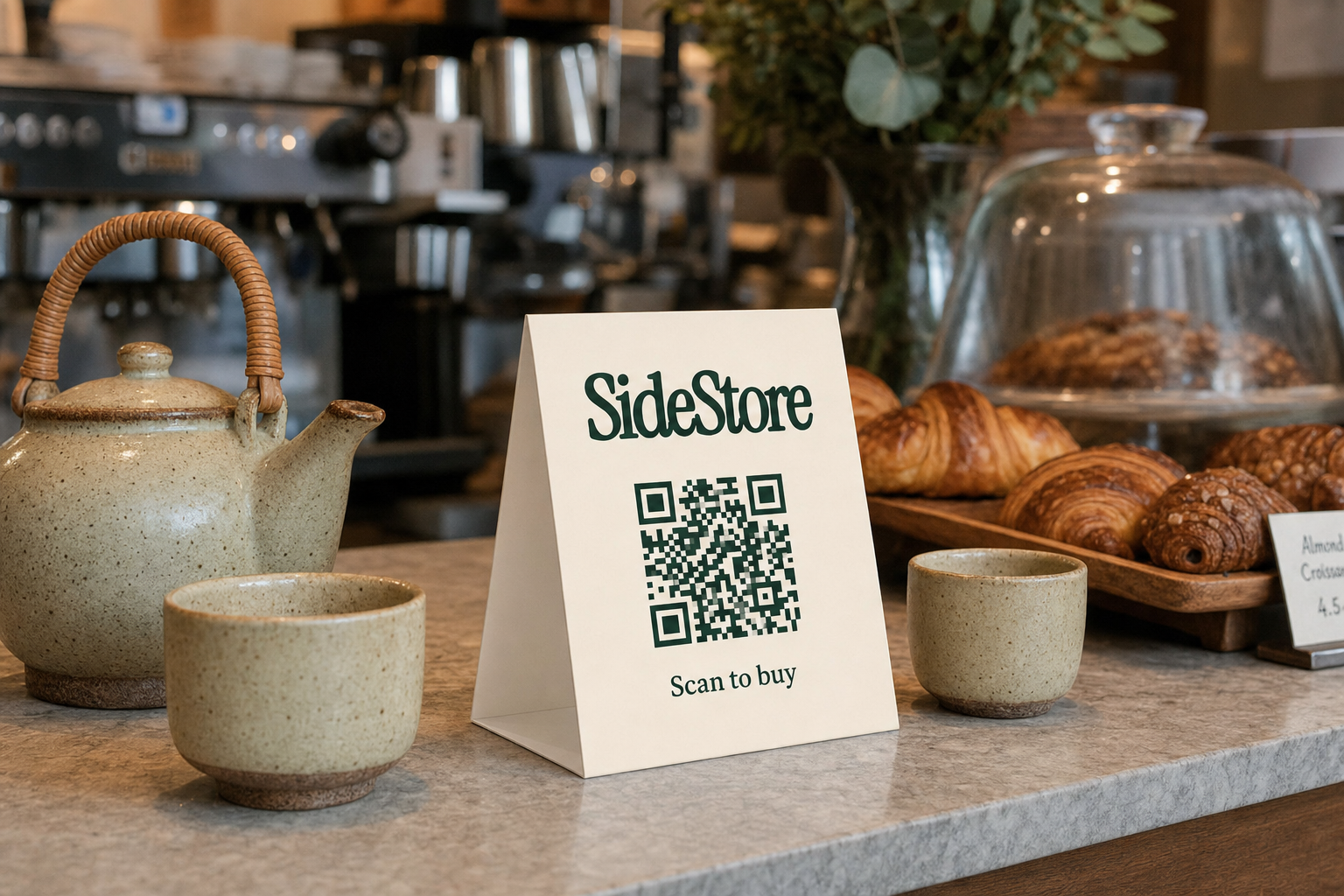
The Retail Widget is the interface that places and manages a ceramic product on consignment from the moment it goes on a shelf to the moment the payout reaches your account.
It is not simply a QR code. The QR scan-to-pay is one function of the Widget: the checkout mechanism that lets a customer pay for a mug by scanning a card next to it, without the host needing to process the transaction manually. But the Widget also handles live stock tracking (so you can see in real time how many pieces remain at each venue), placement attribution (so you know which specific venue generated which sale), and automatic split payouts (so the host's share is settled without either of you doing manual reconciliation).
What you see in the dashboard: each placement appears as a named location with a current stock count, a running sales total, and a payout balance. When a piece sells at a café on Elm Street, that sale appears attributed to that placement, not pooled with sales at your other venues. You can see at a glance which locations are moving stock and which are stagnant.
Compare that to the manual approach. Without the Widget, you are texting the café owner to ask how many mugs are left, cross-referencing a spreadsheet, chasing a bank transfer at the end of the month, and hoping your records and theirs agree. For one venue, manageable. For five venues with different systems, it becomes a part-time administrative job.
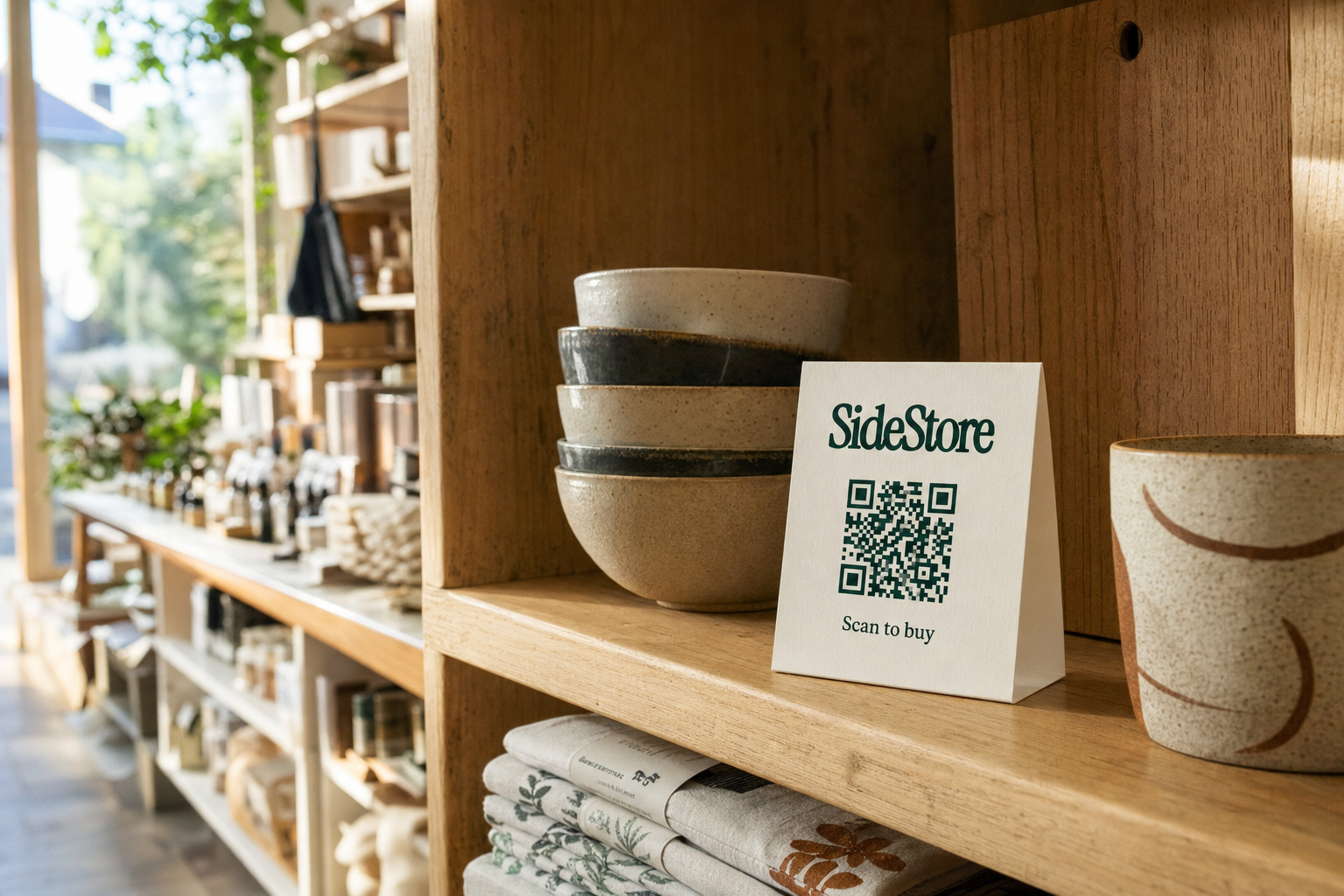
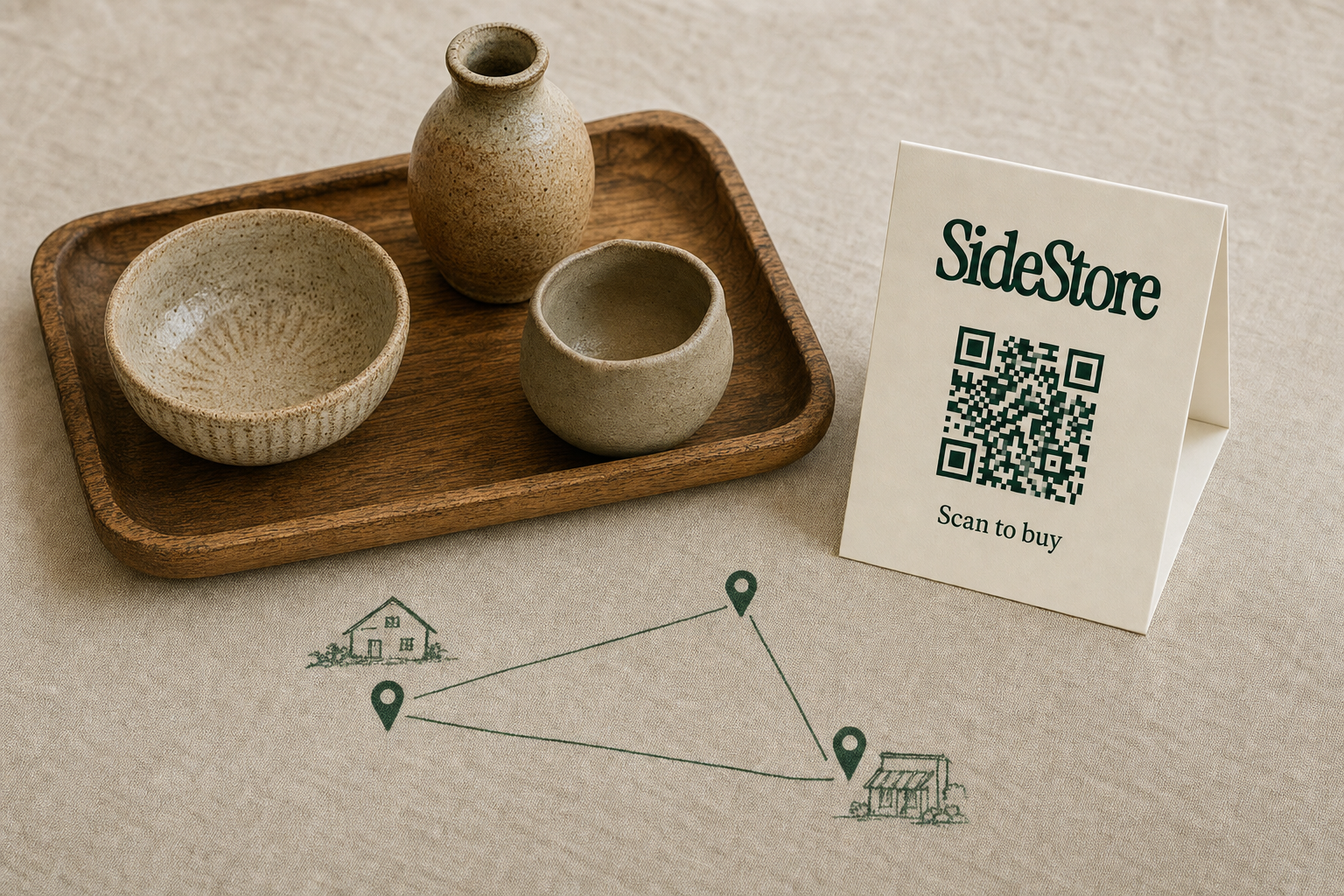
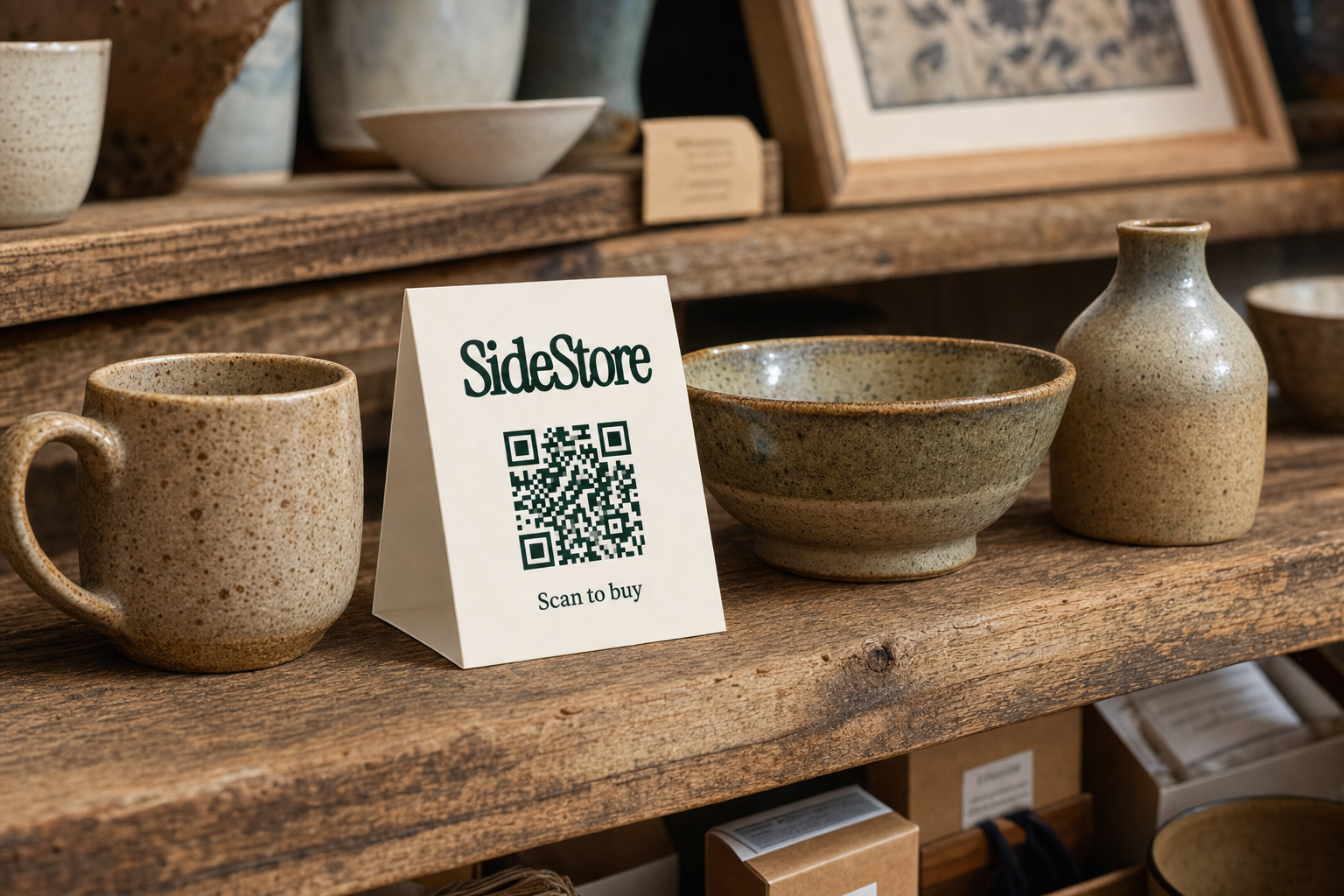
The Retail Widget turns that administration into a dashboard view. You print a QR card per product, or the host displays a single SideStore card for the whole placement. Each scan at checkout flows through to the central record automatically.
Scaling from One Venue to Ten: Managing Multiple Placements
Going from one active placement to ten introduces three operational problems that did not exist at single-venue scale: stock drift, restock timing, and reconciliation overhead.
Stock drift happens when your live count and the venue's actual shelf count diverge. A piece was moved, not scanned, or sold without the checkout being triggered. At one venue you notice this quickly. At ten, it compounds silently until you visit and find empty shelves you thought were stocked.
Restock timing becomes a coordination problem. Ten venues selling at different rates means ten different restock schedules. Without placement attribution, you cannot tell which venues need attention until you visit all of them. With the Retail Widget's live inventory view, you can see each location's stock count in the dashboard and plan your restock route before you leave the studio.
Reconciliation overhead grows linearly with placements if you are doing it manually. Tallying what sold, what was returned, what each host is owed becomes a spreadsheet job. With automatic split payouts, the Retail Widget settles each sale as it happens. Your end-of-month reconciliation is a summary, not a reconstruction.
One honest caveat: the Retail Widget handles the data and the payouts. It does not physically move your stock. Building a distributed consignment network still requires your time and your vehicle to get pieces to venues and replenish them when they sell. The software reduces the administrative load. The physical logistics remain yours to manage.
Five Mistakes Potters Make When Starting Consignment (and How to Avoid Them)
Most early consignment placements fail for the same handful of reasons. Knowing them in advance is the practical advantage you have over makers who are figuring this out by trial and error.
1. Pricing without the split baked in. Potters often set a retail price based on their direct-sale rate and then discover that after the host takes 30%, the margin is too thin to be worth the effort. Fix: always calculate your retail price by dividing your required net by one minus the host percentage, before you agree anything.
2. Starting with too many pieces at too many venues. Spreading twenty pieces across five venues before you understand which locations actually sell feels like momentum. It is actually inventory dilution. Fix: start with one or two venues, three to five pieces each, and scale only when you have sales data to guide you.
3. No written agreement. A handshake arrangement works until the café changes managers, sells, or has a stock dispute. Fix: put the split, the payment frequency, the restock terms, and the breakage policy in writing before you leave a single piece.
4. Not restocking promptly. An empty shelf is invisible. If a piece sells and you take two weeks to replenish it, the momentum of that first sale is lost and the host loses confidence in the placement. Fix: set a restock trigger. When stock falls below two pieces, you restock within four days. Treat it as a business commitment.
5. Choosing venues for the wrong reasons. Placing ceramics in a café because the owner is a friend, or because it is convenient to visit, rather than because the customer profile fits, leads to stagnant stock. Fix: walk the space as a customer first and assess whether the existing clientele would genuinely stop and buy a handmade mug.
Frequently Asked Questions
These are the questions potters and studio makers ask most often before placing their first consignment piece in a local venue.
How much commission does a coffee shop take on consignment?
Coffee shops typically take between 25% and 40% of the retail price per piece sold. The exact split depends on the venue, the category of object, and what you negotiate. There is no fixed industry standard, so treat any split you are offered as a starting point rather than a fixed rate.
Do I need a formal contract for ceramic consignment?
Yes. Even for a short trial placement, you need written terms covering the split percentage, payment timing, restock responsibilities, and who carries breakage liability. A brief written agreement protects both parties if the venue changes hands or a dispute arises over missing stock.
What if a ceramic piece breaks in the shop?
Breakage liability is a negotiated term with no universal standard. Many makers absorb the cost of broken pieces for early placements to reduce friction and build trust with a new host. As placements grow, it is worth formalising this in your written agreement so both parties know where they stand before anything breaks.
How do I track which venue is selling my ceramics?
The Retail Widget provides placement attribution. Each sale is recorded against the specific venue where it happened, not pooled across your locations. You can see live stock counts, sales totals, and payout balances per placement from a single dashboard.
Start with One Venue, One Placement, One Piece
The path to selling ceramics through coffee shops and local shops does not require a full stocklist, a polished pitch deck, or ten venues lined up. It requires one suitable venue, two or three of your strongest pieces, and a willingness to walk in and have a direct conversation about a mutually beneficial arrangement.
This week: identify one independent café or boutique within walking distance whose aesthetic matches your work. Visit it as a customer. Then go back with two pieces and the opening line from the section above. If the owner is interested, send the written terms the same day.
A single placement gives you real data: how fast pieces sell, which items get picked up most, whether the host is a reliable partner. That data is what allows you to extend to a second venue with confidence rather than guesswork.
When you are ready to grow, the same model works for handmade jewelry in boutiques and independent goods in any retail space. The Retail Widget handles the splits and stock tracking at scale so the administration does not grow faster than your placements.
Build a consignment network without opening a store of your own. Start with one shelf, in one room, in one place that already has the customers you want to reach.